
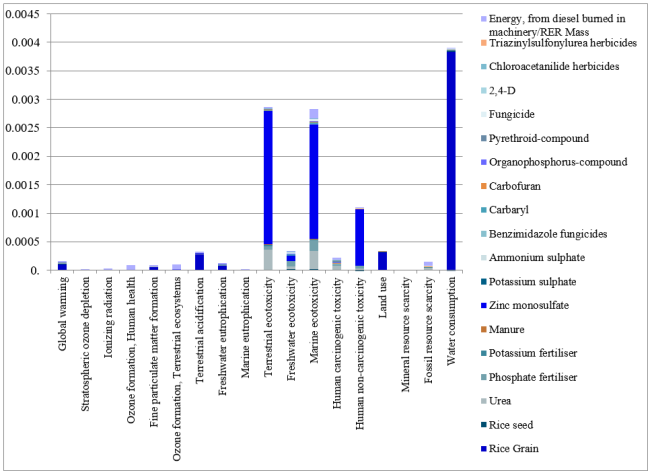
Rice, a principal cereal crop often regarded as a staple food, plays a vital role in the agricultural economy of western Odisha. Cultivation of rice needs various forms of material and energy inputs, making it a resource-intensive process, and hence, its environmental consequences are becoming increasingly significant. Consequently, finding the right strategies and solutions to improve sustainability has become essential. The right scientific tools and credible data are required for assessing the sustainability by evaluating the environmental burden associated with rice cultivation. Environmental impact assessment can be performed by various methods, and Life Cycle Assessment (LCA) is one such approach which is widely used. LCA provides intricate details in the cultivation process, which are generally overlooked during most studies. This study evaluates the environmental impacts associated with the rice cultivation process using LCA with a focus on hotspots due to inputs, outputs and emissions. The ReCiPe midpoint methodology has been used to calculate 18 impact indicators. The results were characterized and normalized subsequently for comparison. Results show a Global warming potential (GWP) of 1.34 kg CO2eq per functional unit. The highest normalized impact was found to be water consumption (3.89E-03), indicating that intensive rice farming has led to high water consumption, while high normalized values of terrestrial (2.86E-03) and marine ecotoxicity (2.83E-03) indicate contamination of water bodies due to excessive fertilizer and chemical use. These impacts pose challenges to environmental sustainability and highlight the need for sustainable rice cultivation practices, including improved water management, balanced nutrient use, and eco-friendly farming techniques, to reduce environmental degradation while maintaining crop productivity.
| Published in |
American Journal of Science, Engineering and Technology (Volume 11, Issue 4)
This article belongs to the Special Issue Advances in Translational Research, Biotechnology, and Sustainable Bio-Innovations |
| DOI | 10.11648/j.ajset.20261104.32 |
| Page(s) | 426-436 |
| Creative Commons |
This is an Open Access article, distributed under the terms of the Creative Commons Attribution 4.0 International License (http://creativecommons.org/licenses/by/4.0/), which permits unrestricted use, distribution and reproduction in any medium or format, provided the original work is properly cited. |
| Copyright |
Copyright © The Author(s), 2026. Published by Science Publishing Group |
Life Cycle Assessment, Rice Cultivation, Sustainability, Methane Emissions, Global Warming Potential
Input | Quantity | Unit | Description | Source |
|---|---|---|---|---|
Inputs from nature | ||||
Land | 11,000 | m2 | Land for nursery and main field | Field area |
Irrigation water | 11,500 | m3 | Total water requirement | [11] |
Material Inputs | ||||
Seed | 62.5 | kg | Input from Ecoinvent 3 database | Field Survey |
Urea | 180 | kg | N (Nitrogen supplement) | Field Survey |
Phosphate fertiliser | 60 | kg | P2O5 (Phosphate supplement) | Field Survey |
Potassium fertiliser | 60 | kg | K2O (Potassium supplement) | Field Survey |
Manure | 2471 | kg | Organic nutrient source (NPK) | Field Survey |
Zinc monosulfate | 19.77 | kg | ZnSO4.H2O (micronutrient fertilizer (containing 33% Zinc and 15% Sulphur) | Field Survey |
Potassium sulphate | 120 | kg | K2SO4 (K and S source) | Field Survey |
Ammonium sulphate | 3.216 | kg | (NH4)2SO4 (NPK 21-0-0) | Field Survey |
Benzimidazole fungicides | 4.94 | kg | Fungicide, (for fungal diseases like blast, sheat blight etc.) | Field Survey |
Carbaryl | 6.6188 | kg | Insecticide (for stem borer, leaf hoppers) | Field Survey |
Carbofuran | 4.13 | kg | Insecticide (for broad spectrum insects) | Field Survey, IPM Rice cultivation |
Organophosphorus-compound | 5.35 | kg | Insecticide (for brown plant hoppers) | Field Survey, [11] |
Pyrethroid-compound | 3.74 | kg | Insecticide (for leaf folders, root grubs etc.) | Field Survey, [11] |
Fungicide | 10.127 | kg | Carbendazim 12% + Mancozeb 63% WP (for blast, sheath blight, and leaf spot) | Field Survey |
2,4-D | 2.685 | kg | Herbicide (for broadleaf weed) | Field Survey |
Chloroacetanilide herbicides | 3.0875 | kg | Herbicide (for grassy weeds) | Field Survey |
Triazinylsulfonylurea herbicides | 0.1976 | kg | Herbicide (for grassy weeds and broad weed leafs) | Field Survey |
Compartment | Emission | Quantity | Source |
|---|---|---|---|
Air | Carbon dioxide | 258 kg | Calculated value |
Methane | 133.28 kg | [11, 26] | |
Nitrogen dioxide | 5.38 kg | [11, 27] | |
Ammonia | 31.49 kg | [11, 27] |
Compartment | Emission | Quantity | Source |
|---|---|---|---|
Water | Water (evapotranspiration) | 5175 kg | [11, 28] |
Water, groundwater | 1163.6 m3 | [11, 28] | |
Water, river | 4654.4 m3 | [11, 28] | |
Phosphorus, groundwater | 0.21573 kg | [11, 28] | |
Phosphorus, river | 0.061069 kg | [11, 28] |
Impact Category | Impact result | Unit |
|---|---|---|
Global warming potential | 1.32E+00 | kg CO2 eq |
Stratospheric ozone depletion | 2.38E-07 | kg CFC11 eq |
Ionizing radiation | 8.45E-03 | kBq Co-60 eq |
Ozone formation, Human health | 1.91E-03 | kg NOx eq |
Fine particulate matter formation | 2.19E-03 | kg PM2.5 eq |
Ozone formation, Terrestrial ecosystems | 1.94E-03 | kg NOx eq |
Terrestrial acidification | 1.34E-02 | kg SO2 eq |
Freshwater eutrophication | 7.79E-05 | kg P eq |
Marine eutrophication | 4.09E-05 | kg N eq |
Terrestrial ecotoxicity | 2.97E+00 | kg 1,4-DCB |
Freshwater ecotoxicity | 4.11E-04 | kg 1,4-DCB |
Marine ecotoxicity | 2.92E-03 | kg 1,4-DCB |
Human carcinogenic toxicity | 6.08E-04 | kg 1,4-DCB |
Human non-carcinogenic toxicity | 1.61E-01 | kg 1,4-DCB |
Land use | 2.01E+00 | m2a crop eq |
Mineral resource scarcity | 1.07E-03 | kg Cu eq |
Fossil resource scarcity | 1.43E-01 | kg oil eq |
Water consumption | 1.04E+00 | m3 |
LCA | Life Cycle Assessment |
LCI | Life Cycle Inventory |
GWP | Global Warming Potential |
GHGs | Green House Gases |
SRI | System of Rice Intensification |
| [1] | CEICdata.com. (2024c, December 23). India Agricultural area: Foodgrains: Rice: Odisha. |
| [2] | Directorate of Economics and Statistics. (2024). Odisha Economic Survey 2023-24. Planning and Convergence Department, Government of Odisha. pc.odisha.gov.in |
| [3] | R. Chen and Q. Zhang, “Pesticide usage in rice cultivation: Consequences for soil and water health,” Molecular Soil Biology, Jan. 2024, |
| [4] | Bhoi, R., Mahananda, M. R., & Pradhan, A. (2023). High consumption of pesticides in agricultural fields leads to prevalence of cancer cases in rural pockets of eastern India: A case study. Environmental Quality Management, 33(1), 359–376. |
| [5] | Behera SS, Ojha CSP, Prasad KSH, Dash SS. Yield, water, and carbon footprint of rainfed rice production under the lens of mid-century climate change: a case study in the eastern coastal agro-climatic zone, Odisha, India. Environ Monit Assess. 2023 Apr 5; 195(5): 544. |
| [6] | Kumar, N., Chhokar, R. S., Meena, R. P., Kharub, A. S., Gill, S. C., Tripathi, S. C., Gupta, O. P., Mangrauthia, S. K., Sundaram, R. M., Sawant, C. P., Gupta, A., Naorem, A., Kumar, M., & Singh, G. P. (2022). Challenges and opportunities in productivity and sustainability of rice cultivation system: a critical review in Indian perspective. Cereal research communications, 50(4), 573–601. |
| [7] | Nirmal K Mandal, Prasanta Parida, Kuntal Sarkar, Jyotirmoyee Pati. (2025). Sustainable Farming for the Future: A Comparative Analysis of Economic and Environmental Viability in Rice Cultivation Models. European Economic Letters (EEL), 15(1), 1277–1291. |
| [8] | Zhou, W., Arcot, Y., Medina, R. F., Bernal, J., Cisneros-Zevallos, L., & Akbulut, M. E. S. (2024). Integrated Pest Management: An Update on the Sustainability Approach to Crop Protection. ACS omega, 9(40), 41130–41147. |
| [9] | Kumar R, Bhardwaj A, Singh LP, Singh G, Kumar A, Pattnayak KC. Comparative life cycle assessment of environmental impacts and economic feasibility of tomato cultivation systems in northern plains of India. Scientific Reports. 2024. 14(1). 7084. |
| [10] | K. Beer et al., “Energy budgeting and global warming potential of traditional rice production system in Eastern Ghats region of Odisha,” Journal of environmental biology. 2024. 45(2). 200–209. |
| [11] | Jimmy, A. N., Khan, N. A., Hossain, M. N., & Sujauddin, M. (2017). Evaluation of the environmental impacts of rice paddy production using life cycle assessment: case study in Bangladesh. Modeling Earth Systems and Environment, 3(4), 1691–1705. |
| [12] | Xueqing He, Yuhui Qiao, Long Liang, Marie Trydeman Knudsen, Friederike Martin, Environmental life cycle assessment of long-term organic rice production in subtropical China, Journal of Cleaner Production. 2018. 176. 880-888. |
| [13] | Khangar NS, Thangavel M. Assessment of environmental impacts: a life cycle analysis of wheat and rice production in Madhya Pradesh. Agronomy Research. 2024. 3(22). |
| [14] | N. Hatcho, Y. Matsuno, K. Kochi, K. Nishishita Assessment of environment-friendly Rice farming through life cycle assessment (LCA). CMU. J. Nat Sci. Special Issues on Agricultural & Natural Resources. 2012 11. 403-408. |
| [15] | Sevigné-Itoiz, E., Mwabonje, O., Panoutsou, C., & Woods, J. (2021). Life cycle assessment (LCA): informing the development of a sustainable circular bioeconomy? Philosophical Transactions of the Royal Society a Mathematical Physical and Engineering Sciences, 379(2206), 20200352. |
| [16] | ISO 14040: International Organization for Standardization. (2006). Environmental management—Life cycle assessment—Principles and framework (ISO Standard No. 14040: 2006). |
| [17] | ISO 14044: International Organization for Standardization. (2006). Environmental management—Life cycle assessment—Requirements and guidelines (ISO Standard No. 14044: 2006). |
| [18] | Ahmad, A., Zoli, M., Latella, C., & Bacenetti, J. (2023). Rice cultivation and processing: Highlights from a life cycle thinking perspective. Science of The Total Environment, 871, 162079. |
| [19] | Shoaib-ul-Hasan, S., Roci, M., Asif, F. M. A., Salehi, N., & Rashid, A. (2021). Analyzing Temporal Variability in Inventory Data for Life Cycle Assessment: Implications in the Context of Circular Economy. Sustainability, 13(1), 344. |
| [20] | Moutik, B., Summerscales, J., Graham-Jones, J., & Pemberton, R. (2023). Life Cycle Assessment Research Trends and Implications: A Bibliometric Analysis. Sustainability, 15(18), 13408. |
| [21] | Alhashim R, Deepa R, Anandhi A. Environmental Impact Assessment of Agricultural Production Using LCA: A Review. Climate. 2021; 9(11): 164. |
| [22] | Gathorne-Hardy, A., Barbara Harriss-White, & Rebecca White. (2013). Greenhouse gas emissions from rice. In RGTW Working Paper Number 5. |
| [23] | Islam, S. M. M., Gaihre, Y. K., Biswas, J. C., Singh, U., Ahmed, M. N., Sanabria, J., & Saleque, M. A. (2018). Nitrous oxide and nitric oxide emissions from lowland rice cultivation with urea deep placement and alternate wetting and drying irrigation. Scientific reports, 8(1), 17623. |
| [24] | G. W. Kim, S. T. Jeong, G. Y. Kim, P. J. Kim, and S. Y. Kim, “Evaluation of carbon dioxide emission factor from urea during rice cropping season: A case study in Korean paddy soil,” Atmospheric Environment, vol. 139, pp. 139–146, May 2016, |
| [25] | H. S. Eggleston, L. V. Buendia, K. Miwa, T. Ngara, and K. Tanabe, “2006 IPCC Guidelines for National Greenhouse Gas Inventories,” OSTI OAI (U.S. Department of Energy Office of Scientific and Technical Information), Jul. 2006, [Online]. Available: |
| [26] | IPCC. (2006). 2006 IPCC Guidelines for National Greenhouse Gas Inventories. Prepared by the National Greenhouse Gas Inventories Programme, Eggleston H. S., Buendia L., Miwa K., Ngara T. and Tanabe K. (eds). IGES, Hayama |
| [27] | Nemecek, Thomas, Xavier Bengoa, Jens Lansche, Andreas Roesch, Mireille Faist-Emmenegger, Vincent Rossi, Sébastien Humbert, Patrik Mouron, and Eliane Riedener. "World food LCA database." Methodological Guidelines for the Life Cycle Inventory of Agricultural Products 3 (2019). |
| [28] | Wernet, G., Bauer, C., Steubing, B., Reinhard, J., Moreno-Ruiz, E., and Weidema, B. (2016). The ecoinvent database version 3 (part I): overview and methodology. The International Journal of Life Cycle Assessment, 21(9), 1218–1230. |
| [29] | Giuliana, V., Lucia, M., Marco, R., & Simone, V. (2022). Environmental life cycle assessment of rice production in northern Italy: a case study from Vercelli. The international journal of life cycle assessment, 1–18. Advance online publication. |
| [30] | H. Qian et al., “Greenhouse gas emissions and mitigation in rice agriculture,” Nature Reviews Earth & Environment, vol. 4, no. 10, pp. 716–732, Sep. 2023, |
| [31] | Singh, P., Singh, G., Sodhi, G. P. S. et al. Accounting Carbon Footprints and Applying Data Envelopment Analysis to Optimize Input-Induced Greenhouse Gas Emissions Under Rice–Wheat Cropping System in North-Western India. J Soil Sci Plant Nutr 21, 3030–3050 (2021). |
| [32] | Kasmaprapruet, S., Paengjuntuek, W., Saikhwan, P., & Phungrassami, H. (2009). Life cycle assessment of milled rice production: case study in Thailand. European Journal of Scientific Research, 30(2), 195-203 |
| [33] | G. A. Blengini and M. Busto, “The life cycle of rice: LCA of alternative agri-food chain management systems in Vercelli (Italy),” Journal of Environmental Management, vol. 90, no. 3, pp. 1512–1522, Dec. 2008, |
| [34] | Harun, S. N., Hanafiah, M. M. & Aziz, N. I. H. A. An LCA-Based Environmental Performance of Rice Production for Developing a Sustainable Agri-Food System in Malaysia. Environmental Management 67, 146–161 (2021). |
| [35] | Amirahmadi E, Moudrý J, Konvalina P, Hörtenhuber SJ, Ghorbani M, Neugschwandtner RW, Jiang Z, Krexner T, Kopecký M. Environmental Life Cycle Assessment in Organic and Conventional Rice Farming Systems: Using a Cradle to Farm Gate Approach. Sustainability. 2022; 14(23): 15870. |
| [36] | Abdo et al., “Carbon footprint of global rice production and consumption,” Journal of Cleaner Production, vol. 474, p. 143560, Sep. 2024, |
APA Style
Samal, S. K., Sahoo, S. S., Majhi, P., Mohanty, M. K. (2026). Environmental Sustainability of Rice Cultivation in Western Regions of Odisha: A Life Cycle Perspective. American Journal of Science, Engineering and Technology, 11(4), 426-436. https://doi.org/10.11648/j.ajset.20261104.32
ACS Style
Samal, S. K.; Sahoo, S. S.; Majhi, P.; Mohanty, M. K. Environmental Sustainability of Rice Cultivation in Western Regions of Odisha: A Life Cycle Perspective. Am. J. Sci. Eng. Technol. 2026, 11(4), 426-436. doi: 10.11648/j.ajset.20261104.32
@article{10.11648/j.ajset.20261104.32,
  author = {Suraj Kumar Samal and Sudhansu Sekhar Sahoo and Pritikrishna Majhi and Mahendra Kumar Mohanty},
  title = {Environmental Sustainability of Rice Cultivation in Western Regions of Odisha: A Life Cycle Perspective},
  journal = {American Journal of Science, Engineering and Technology},
  volume = {11},
  number = {4},
  pages = {426-436},
  doi = {10.11648/j.ajset.20261104.32},
  url = {https://doi.org/10.11648/j.ajset.20261104.32},
  eprint = {https://article.sciencepublishinggroup.com/pdf/10.11648.j.ajset.20261104.32},
  abstract = {Rice, a principal cereal crop often regarded as a staple food, plays a vital role in the agricultural economy of western Odisha. Cultivation of rice needs various forms of material and energy inputs, making it a resource-intensive process, and hence, its environmental consequences are becoming increasingly significant. Consequently, finding the right strategies and solutions to improve sustainability has become essential. The right scientific tools and credible data are required for assessing the sustainability by evaluating the environmental burden associated with rice cultivation. Environmental impact assessment can be performed by various methods, and Life Cycle Assessment (LCA) is one such approach which is widely used. LCA provides intricate details in the cultivation process, which are generally overlooked during most studies. This study evaluates the environmental impacts associated with the rice cultivation process using LCA with a focus on hotspots due to inputs, outputs and emissions. The ReCiPe midpoint methodology has been used to calculate 18 impact indicators. The results were characterized and normalized subsequently for comparison. Results show a Global warming potential (GWP) of 1.34 kg CO2eq per functional unit. The highest normalized impact was found to be water consumption (3.89E-03), indicating that intensive rice farming has led to high water consumption, while high normalized values of terrestrial (2.86E-03) and marine ecotoxicity (2.83E-03) indicate contamination of water bodies due to excessive fertilizer and chemical use. These impacts pose challenges to environmental sustainability and highlight the need for sustainable rice cultivation practices, including improved water management, balanced nutrient use, and eco-friendly farming techniques, to reduce environmental degradation while maintaining crop productivity.},
 year = {2026}
}
TY  - JOUR
T1  - Environmental Sustainability of Rice Cultivation in Western Regions of Odisha: A Life Cycle Perspective
AU  - Suraj Kumar Samal
AU  - Sudhansu Sekhar Sahoo
AU  - Pritikrishna Majhi
AU  - Mahendra Kumar Mohanty
Y1  - 2026/10/17
PY  - 2026
N1  - https://doi.org/10.11648/j.ajset.20261104.32
DO  - 10.11648/j.ajset.20261104.32
T2  - American Journal of Science, Engineering and Technology
JF  - American Journal of Science, Engineering and Technology
JO  - American Journal of Science, Engineering and Technology
SP  - 426
EP  - 436
PB  - Science Publishing Group
SN  - 2578-8353
UR  - https://doi.org/10.11648/j.ajset.20261104.32
AB  - Rice, a principal cereal crop often regarded as a staple food, plays a vital role in the agricultural economy of western Odisha. Cultivation of rice needs various forms of material and energy inputs, making it a resource-intensive process, and hence, its environmental consequences are becoming increasingly significant. Consequently, finding the right strategies and solutions to improve sustainability has become essential. The right scientific tools and credible data are required for assessing the sustainability by evaluating the environmental burden associated with rice cultivation. Environmental impact assessment can be performed by various methods, and Life Cycle Assessment (LCA) is one such approach which is widely used. LCA provides intricate details in the cultivation process, which are generally overlooked during most studies. This study evaluates the environmental impacts associated with the rice cultivation process using LCA with a focus on hotspots due to inputs, outputs and emissions. The ReCiPe midpoint methodology has been used to calculate 18 impact indicators. The results were characterized and normalized subsequently for comparison. Results show a Global warming potential (GWP) of 1.34 kg CO2eq per functional unit. The highest normalized impact was found to be water consumption (3.89E-03), indicating that intensive rice farming has led to high water consumption, while high normalized values of terrestrial (2.86E-03) and marine ecotoxicity (2.83E-03) indicate contamination of water bodies due to excessive fertilizer and chemical use. These impacts pose challenges to environmental sustainability and highlight the need for sustainable rice cultivation practices, including improved water management, balanced nutrient use, and eco-friendly farming techniques, to reduce environmental degradation while maintaining crop productivity.
VL  - 11
IS  - 4
ER  -
School of Mechanical Sciences, Odisha University of Technology and Research, Bhubaneswar, India
Biography: Suraj Kumar Samal is a Ph.D. scholar at Odisha University of Technology and Research (OUTR), School of Mechanical Sciences. He completed his Master of Technology in Farm Machinery and Power Engineering from Odisha University of Agriculture and Technology (OUAT) in 2019, and his Bachelor of Technology from the same institution in 2016. He had worked as a SRF in the BPCL-OUAT Biofuel research collaboration projects from 2020-22 as an LCA practitioner. He is currently working as a Guest Lecturer in the Department of Renewable Energy Engineering, OUAT.
Research Fields: Farm machinery, Ergonomics, Renewable energy, Life cycle analysis, Biofuel from lignocellulosic biomass

School of Mechanical Sciences, Odisha University of Technology and Research, Bhubaneswar, India
Biography: Sudhansu Sekhar Sahoo is presently working as an Associate Professor in the School of Mechanical Sciences at Odisha University of Technology and Research (OUTR), Bhubaneswar. He completed his M.Tech in Thermal Engineering from IIT Delhi and PhD in Renewable Energy from IIT Bombay. He has been honored with various prestigious awards and fellowships including Bhaskara Advanced Solar Energy (BASE) Fellowship Program (2017). He has published more than 90 papers in International Journals and more than 15 books/book chapters to date. The Indian Patent Office has granted him over 35 Patents/Designs to date. He is lifetime member of various organizations like Solar Energy Society of India, Fluid Mechanics and Fluid Power, Institute of Engineers, Indian Society of Technical Education, Society of Automotive Engineers.
Research Fields: Fluid and Thermal Engineering, Energy Systems, Renewable Energy, Solar Thermal, Energy Management, Waste Management

Department of Biotechnology, Chandigarh University, Unnao, India
Biography: Pritikrishna Majhi is currently working as an Assistant Professor in the Department of Biotechnology at the School of Applied Sciences, Chandigarh University, Lucknow Campus, Uttar Pradesh. Dr. Majhi completed her M.Sc. in Microbiology with specialization in Algal Technology in 2016 and was awarded Ph.D. degree in 2021 from Odisha University of Agriculture and Technology, Bhubaneswar, Odisha. She has worked as a Senior Research Fellow in the project funded by Bharat Petroleum Corporation Limited (BPCL), India. She has also worked as Project Fellow at Coir Board Regional Office, Bhubaneswar. She has completed her Post Doctorate Degree under the 1st National Call of E-YUVA Scheme supported by DBT-BIRAC, Government of India. Her extensive research experiences include sectors like nutraceuticals, bioremediation, and synthesis of value-added products from microalgae and seaweed. She combines rigorous scientific inquiry with innovative experimental techniques, consistently producing high-impact publications and patent.
Research Fields: Microbiology, Bioremediation, Microalgae, Biofuel, Conservation Biology

Department of Farm Machinery and Power Engineering, Odisha University of Agriculture and Technology, Bhubaneswar, India
Biography: Mahendra Kumar Mohanty is an Emeritus professor in the Renewable Energy Division at the College of Agricultural Engineering and Technology, OUAT, Bhubaneswar. With 29 years of professional experience, his career spans roles from Junior Scientist to Professor. An alumnus of IIT Kharagpur (M.Tech) and IIT Delhi (Ph.D.), he has been recognized as the Best Research Scientist (2009-10) at OUAT and is a Fellow of the Institute of Engineers, India. Dr. Mohanty has led multiple DST-funded projects involving biodiesel plant installation and solar hybrid systems. He has supervised numerous Ph.D. and M.Tech scholars. His extensive publication record includes impactful studies on energy and exergy analysis and sustainable fuel alternative.
Research Fields: Renewable energy, Farm machinery and power, Biofuel production, Waste management, Solar photovoltaic


Information



 Share This Article
 Twitter
 Linked In
 Facebook
 Copy
Copy Download