Abstract
Koraput district household economy primarily depends on agriculture, in which cereal cultivation plays a vital role. The district topography is very peculiar, with a peculiar distribution of the land mass. During the kharif season, most of the Koraput district becomes covered in greenery through the cultivation of various crops, especially finger millet in the uplands. However, erratic rainfall remains the main constraint, hampering millet production. Despite many difficulties in the cultivation of millets in Koraput, the district contributes a major portion, around 65160 hectares, with a production of 8.44 qtls/ha (Data source: Department of Agriculture, 2013) of the area under millet cultivation. Nowadays, the global food system faces unparalleled challenges of hunger, undernutrition, malnutrition, and inadequate availability and affordability of healthy, nutritious diets. In this backdrop, a neglected underutilized crop like millet has received renewed policy primacy by governments in many states as well as by the central government in India for achieving nutritional and income security of the millet farming community of the country, who are the custodians of our diet; and for the high resilience of the crop against climate vulnerability of the farming sector. The Government of Odisha has placed special emphasis on millet cultivation and introduced the “Odisha Millets Mission (OMM),” now renamed “Odisha Shree Anna Abhiyan (OSAA),” as a rejuvenation effort in this direction. This supportive government policy provided a clear roadmap for expanding millet cultivation and increased millet farmers' household income. The present study aims to assess household income and millet consumption among millet farmers in Koraput block, Koraput district, as it ranks among the district's blocks in terms of area under millet cultivation and the number of households engaged in crop production. The block's high land suitability is reported to be the major factor behind extensive millet production. The block was selected using purposive sampling.
Keywords
Koraput, Economic Development, Nutritional Security, Millet
1. Introduction
India is the world's largest millet producer, accounting for 41% of global production, followed by Niger (12%) and China (8%) as of 2021. In India, Pearl Millet (Bajra) and Sorghum (Jowar) together contributed approximately 19% of world production in 2020
| [8] | Satyarathi, T et al. 2021. Pearl Millet: A climate-resilient multicereal for mitigating Hidden Hunger and providing nutritional security—Indian Council of Agricultural Research. |
[8]
. In millet production, India ranks 12
th in millet yields. Multiple varieties of millets are produced in India, like pearl millet, Sorghum, Finger millet, Foxtail millet, Kodo, Barnyard, Proso, little millet, and pseudo-millets like buckwheat and Amaranthus. Millets are cereals similar to rice and wheat but are nutritious in protein, minerals, and vitamins. Millets are a natural source of iron, zinc, and calcium, and contain higher levels of folic acid, calcium, iron, potassium, magnesium, and zinc than wheat and rice
| [9] | Singh, E. & Sarita 2016. Potential of Millets: Nutrient Composition and Health Benefits. Journal of Scientific and Innovative Research, 5(2), 46-50. |
[9]
.
The Ministry of Agriculture and Farmers Welfare, Government of India, rebranded the millets as coarse cereals, such as sorghum, major millets, and other tiny millets, as nutri-cereals. Finger millet, a rich source of calcium (300 –370 mg/100g), is a prime example. Based on the nutritional values, the Indian government is promoting millets as part of its National Food Security Mission. The United Nations, at the behest of the Government of India, declared 2023 as the International Year of Millets to create public awareness and increase production and consumption of millets
| [10] | Thakur, A. et al 2023 Millet Production and Consumption in India and Their Nutritional Aspects. Journal of Just Agriculture, 3(5). |
[10]
.
The Government of India is also sponsoring millet cultivation and processing, product development, and marketing-related research and development programs like “Integrated Cereals Development Programs in Coarse.
2. Materials and Methods
This study presented a literature review, followed by samples collected from various stakeholders through questionnaires and data compilation.
2.1. Research Questions/Hypotheses
From 2017-18 to 2021-22, Odisha recorded a 14-fold increase in millet production and an average yield improvement of 28%. However, this production achievement is uneven across districts. No study shows the relative economic advantage that enabling policies provide to millet producers. Similarly, on the consumption side, there is no evidence of widespread dietary behavior change in favor of millets. Institutional inadequacies continue to constrain the development of a robust millet market in the State. This study aims to improve understanding of the situation to help develop effective strategies for production, marketing support, and consumption.
The primary objective of the proposed study is to generate an evidence-based understanding of the impact of multiple government interventions aimed at building household resilience through increased millet production and consumption in the localized contexts of Koraput districts of Odisha, which vary in tribal population. The study will evaluate the policy goal of household resilience building in terms of (a) enhanced income security and (b) greater nutritional security. A related objective is to identify key lessons from government action on millets promotion that can be adopted for replication and scaling up the activities.
2.2. The Key Hypotheses for This Study Are the Following
Policy incentives aimed at increasing millet production are effective in local contexts only when complementary institutional (market-based) arrangements exist to provide cost-efficient solutions to procurement and distribution challenges.
More millet production, paired with consumer awareness, will increase millets' share in local diets and contribute to greater nutritional security.
Consumers’ preference for more millets in their diets will increase only when targeted awareness campaigns on the nutritional needs of specific population groups are paired with customized millet products and appropriate delivery mechanisms.
Tribal communities have a traditional relationship with millet-based farm and food systems.
2.3. Study Area
Koraput district is in southern Odisha, India, with its district headquarters in Koraput. Before 1992, Koraput was one of Odisha's largest districts. The district lies in the Eastern Ghats and is known for its hilly terrain, rich and diverse mineral deposits, and tribal culture. Koraput district is located between 18 degrees 13’ and 19 degrees 10’ North latitude and 82 degrees 5’ and 83 degrees 23’ East longitude. It shares borders with Rayagada District, Nabarangpur District, and Kalanhandi District to the north; Bastar District of Chhattisgarh to the west; Malkangiri District to the south; and Alluri Sitharama Raju and Parvathipuram Manyam Districts of Andhra Pradesh to the east. Its area is 8,807 km2, making it Odisha's third-largest district after Mayurbhanj and Sundargarh. About twenty-one villages in the Kotia Gram Panchayat are the subject of a long-pending territorial dispute with the State of Andhra Pradesh.
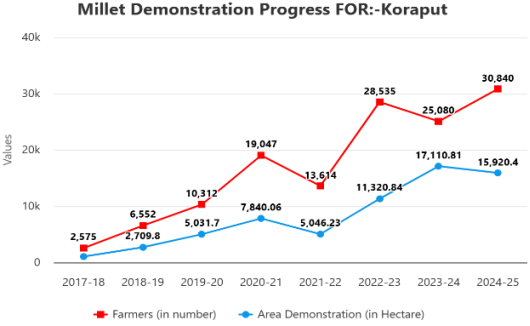
The district has about 1,455 villages and 191 gram panchayats across 12 blocks, involving 30,840 farmers and 15,920.4 hectares of millet-cultivated area; Figure 1 shows year-wise progress. A total of 100 farm households were covered under this survey. In 2024-25, 30840 farmers benefited as per the district data. In addition to the survey, the study covered focus group discussions (FGDs) with women Self Help Groups (Mission Shakti Groups) / entrepreneurs engaged in millet processing and value-addition. This is expected to bring out the gender dimension of the schemes being evaluated with the following steps.
Step 1 – Stakeholder consultation: The study began with stakeholder consultations to develop a comprehensive farm-to-plate Value Chain (VC) of millets in the Odisha context. The VC identified activities carried out under production, processing, marketing, and consumption of ragi – the dominant millet cultivated in the study districts – and analyzed each activity based on select parameters like improved packages of practices, availability and source of seeds, cost of inputs, and the returns farmers get. Under processing, focus on procurement, stakeholders involved, financing, skill development, quality control, and certification. Marketing parameters would include product diversity, product pricing, and distribution channels.
Step 2 – Policy review and mapping: Government enabling actions mapped onto the identified value chain activities.
Step 3 – Conducted field surveys at the individual level and through FGDs.
Step 4 –The collected data were subjected to statistical and econometric analysis to correlate benefits received from various schemes with stated choices made by respondents on production and consumption of millets, and further to evaluate how such choices have translated to resilience building in terms of higher income and nutritional security at household level.
Figure 1. Total millet farmers in Koraput and area covered under various millets in Koraput trend from 2017-18 to 2024 – 25.
2.4. Sampling
The study covers a sample size of 100 rural households for survey purposes. The sampling covered one block of Koarput, Kundra, Boipariguda block of Koraput district of Odisha, identifying farm households for the survey. The sample was collected from 20 representative villages of 5 gram panchayats.
3. Results
The study found that more than 50% of millet growers increased farm income in this block by selling millet in the government mandi; however, very few millet-based entrepreneurship opportunities were generated in the area (such as value-added products and processing). In 2023-24 and 2024-25, the Govt. of Odisha distributed pulverizers, dehusker, etc. to farmers for processing and value addition. Still, the equipment was not properly utilized due to limited machinery capacity and single-phase electrification in rural areas. More than half of farmers pointed out that millet cultivation is a good option in the present situation as majority of the cereals affected by pest and insect, In mandi system not available for maize, in case of paddy farmers suffer a lot to get the full price from mandi but in the same time millet is the best crop to overcome such situation to mitigate climate change and achieve full productive utilization of the land area and value to the work. Although millet consumption patterns have improved in recent years, leading to better nutritional security, awareness remains low among villagers and urban residents. Across all social categories, millet farmers, especially those with more than 1 hectare of land area under millet cultivation, are benefiting from government policies and schemes.
It intends to assess household resilience-building in terms of enhanced income security and greater nutritional security due to millet production and consumption.
Through various training and awareness programs to build skills and capacity among millet farmers, the study places special focus on women, covering post-harvest technologies for value addition and market linkages at the village level to strengthen household income security.
A total of 100 households (HHs) were surveyed in the 3 blocks of Koarput district of Odisha. The study found that 78.82% of respondents were positive about receiving improved seeds through the government scheme, but 66.9% sold the millet cultivars. Belonging to scheduled tribe category, 19.32% OBC, 9.2% SC, 3.47% General, and 1.11% SEBC. Of all respondents, 92.16% are ration card holders. Only 32.85% of respondents have FPO/farmer’s cooperative/FIG membership, and among them, 48% benefited from FPO membership through increased production.
The household survey analysis clearly shows that land under millet cultivation (in acres) increases as average household size decreases, along with a decline in the average number of dependent members in the household and the average number of migrant members. Since these three indicators are generally associated with relatively better-off rural households, the results suggest that richer households in the study areas tend to have more land under millet cultivation. On the other hand, more female members in the household tend to encourage more land under millet cultivation.
The drought-resistant nature of millets makes them an excellent choice for withstanding the effects of climate change. Millets not only conserve water but also support the most vulnerable people in society, such as tribal communities, women, and small and marginal farmers. More than 67% of millet growers reported having gained from millet cultivation in terms of higher farm income. But even this income increase is not enough to prevent distress migration from the household, improve savings or investment in productive assets, or reduce indebtedness.
Moreover, that very little entrepreneurship opportunities generated based on millet in that area like making value added products out of millet, millet flour selling etc. 23.3% of the respondent’s response to this and 44.7% answer may be possible but not sure and 32.5% response not in our locality value addition product better for livelihoods. Based on the statement, more focus and diversification are needed, and perishable items in millet value addition should be strengthened. Therefore, more technological advancements are needed to meet the standards.
4. Discussion
Economically superior households prefer millet cultivation. Female family members have a positive relationship with the land under millet cultivation
| [7] | Rizwana M., Singh P., Ahalya N. and Mohanasundaram T., 2022, “Assessing the awareness of nutritional benefits of millets amongst women in Bangalore”, British Food Journal, 125 (6): 2002-2018. |
[7]
. Their study also found that most women influenced millet consumption to preserve overall health. An earlier study supported this finding and explained that reduced drudgery for women due to less care work for millet crops during peak agricultural seasons will make more time available for child care and leisure
| [6] | Rao, D. et al 2017 Nutritional and Health Benefits of Millets. Indian Institute of Millets Research. |
[6]
.
Around one third of farmers in the study area reported benefiting from millet cultivation because it increases their farm income. A recent study similarly found a benefit-cost ratio of 1.05 for finger millets in Chhattisgarh
| [2] | Kaushal, R Singh I, Thapliyal, S. D., Gupta, A. K., Mandal, D., Tomar, J. M. S., and Durai, J. (2020). Rooting behavior and soil properties in different bamboo species of Western Himalayan Foothills, India. Scientific reports, 10(1), 4966. |
[2]
. A field trial in Koraput district, Odisha also showed that improved varieties and agronomic practices can deliver significantly higher yields in a context where the area under finger millet cultivation has been declining
| [4] | Pradhan A., Panda A. K., Bhavani R. V., 2019, “Finger millet in Tribal Farming Systems contributes to Increased Availability of Nutritious Food at Household Level. Insights from India”, Agric Res, 8(4): 540-547. |
[4]
. However, millet-based entrepreneurship development is inadequate. Skill and capacity building among farmers, especially farm women, in post-harvest processing technologies for value addition and in establishing forward and backward linkages with millet production is necessary to generate income and improve the nutritional well-being of poor households in arid and semiarid regions of India
| [1] | Jeeva C. J, Joshi K., Singh A. and Behera B. C., 2019, " Engendering finger millet-based value chains for livelihood and nutritional security of women in agriculture,” Current Science, 116(11): 1893-1896. |
[1]
. Hence, technological improvements are essential to enhance millet crop and post-harvest production. More than half of our respondents in the study area belong to the scheduled tribe category. A small number of farmers have FPO/farmer’s cooperative/FIG membership and benefit from it. India has tremendous scope for income generation for women in SHGs and FPOs through marketing processed millet products like ready-to-cook and ready-to-eat products.
In the past few years, farmers have witnessed the consequences of climate change, such as increased temperatures, reduced rainfall and water availability, unexpected changes in seasons and crop behavior, and more pest infestations. In this context, millet cultivation is a good option for climate adaptation, as millets are drought-resistant and require fewer inputs to survive. It is evident from many studies that millet’s climate-resilient property and outstanding capacity to withstand low water availability and stressful climatic conditions serve as a better option than staple cereal crops
| [3] | Kumar, P & Singh, I. P 2022. An economic Analysis of pearl millet crop in Rain-fed Micro Farming Situation of Rajasthan, India—International Journal of Environment and Climate Change. |
[3]
.
Ragi is predominantly cultivated in the study area: finger millet (3064 hectares), Little millet 350 hectares), and local bajra 03 hectares). Secondary data for the entire state of Odisha also show that millet crop diversification has been slow. Although millet consumption has increased slowly in recent years, people still need more awareness. Millet nutrition education is imperative through various media channels, knowledge development on the significance of millets, and interventions to change people’s mindset towards millet consumption
| [5] | Prashanthi A., Reddy R. G., Neela R. R., Devi T. S. and A. Meera, 2022, “Awareness and Consumption of Millets among school Children in Rural and Urban Areas of Telangana State, India.Biological Forum, 14(3): 64-70 (2022). |
[5]
. There is also inadequate accessibility of secondary processed or ready-to-eat products. Improved and efficient post-harvest and value-addition technologies have created opportunities to prepare and process enhanced products accepted by both urban and rural consumers (Rathore S. et al., 2016).
Procurement facilities and MSP-related policies mostly help large farmers. Several policy-related challenges in the study area need to be addressed, including low yields, limited crop diversification, limited adoption of modern technology, insufficient procurement, processing, and marketing facilities, and low consumer awareness, which can promote distress selling and create opportunities for intermediaries.
The study area is tribal dominated. Most tribal farmers are marginal or landless and lease land for millet cultivation. In contrast, non-tribal farmers are, on average, small farmers and allocate less area to millet cultivation.
The consumption rate per month per HH is higher in the tribal community, as millets sometimes hold cultural significance in their traditional cuisine, and they prepare different millet dishes and celebrate Bandapana Parab, Chaitra Parab, Pusha Parab, etc.
For both communities, almost half of the people consume millets, mostly ragi. Those who rarely or never consume millets usually sell them in local markets. They mentioned that market linkages are very weak, and processing and storage facilities are also limited.
5. Conclusion
The present study showed that millet cultivation is a good choice to mitigate climate change according to almost half of the farmers. Female family members have a positive relationship with the land under millet cultivation. The allocated area under millets and the monthly consumption rate per HH are higher among tribal than non-tribal respondents. Awareness remains low in the study area, although millet consumption has increased in the past few years, improving nutritional security. Millet farmers, especially those with higher land area under millet cultivation, benefited from government policies and schemes across all social categories. Farm income from millet farming increased for about 47.8% of respondents overall, but for millet farmers, it increased by 2 to 3 times. Entrepreneurship remains very low, although the study area has strong scope for opportunities such as making value-added products from millets. Millets-based Value Chain Development (VCD) is essential to sustain higher millets production and procurement, but few are willing to take it further in processing and marketing. For this to happen, the State needs significant institutional capacity building, especially in quality testing and certification, branding, packaging, and scale-appropriate technology development. FPOs and WSHGs would need capabilities in post-harvest processing for value addition, development, business management, and, most importantly, creating both forward and backward market linkages.
Abbreviations
HH | House Hold |
FPOs | Farmer Producer Company |
WSHG | Women Self-Help Group |
MSP | Minimum Support Price |
FGD | Focus Group Discussion |
VCD | Value Chain Development |
OMM | Odisha Millet Mission |
OSAA | Odisha Shree Anna Abhiyan |
Acknowledgments
Farming community of Koarput Block of Koraput District, Odisha, and Pratap Chandra Jena (Coordinator, Odisha Millet Mission, M S Swaminathan Research Foundation, Jeypore, Koraput, Odisha.
Author Contributions
Suravee Dash: Conceptualization, Writing-original draft
Manoja Das: Formal analysis
Kartik Charan Lenka: Conceptualization, Data curation, Writing-review & editing
Funding
We declare that the authors self-financed the study, and no other funding source was involved. If publication fees are required, the authors will cover them.
Conflicts of Interest
The authors declare no conflicts of interest.
References
| [1] |
Jeeva C. J, Joshi K., Singh A. and Behera B. C., 2019, " Engendering finger millet-based value chains for livelihood and nutritional security of women in agriculture,” Current Science, 116(11): 1893-1896.
|
| [2] |
Kaushal, R Singh I, Thapliyal, S. D., Gupta, A. K., Mandal, D., Tomar, J. M. S., and Durai, J. (2020). Rooting behavior and soil properties in different bamboo species of Western Himalayan Foothills, India. Scientific reports, 10(1), 4966.
|
| [3] |
Kumar, P & Singh, I. P 2022. An economic Analysis of pearl millet crop in Rain-fed Micro Farming Situation of Rajasthan, India—International Journal of Environment and Climate Change.
|
| [4] |
Pradhan A., Panda A. K., Bhavani R. V., 2019, “Finger millet in Tribal Farming Systems contributes to Increased Availability of Nutritious Food at Household Level. Insights from India”, Agric Res, 8(4): 540-547.
|
| [5] |
Prashanthi A., Reddy R. G., Neela R. R., Devi T. S. and A. Meera, 2022, “Awareness and Consumption of Millets among school Children in Rural and Urban Areas of Telangana State, India.Biological Forum, 14(3): 64-70 (2022).
|
| [6] |
Rao, D. et al 2017 Nutritional and Health Benefits of Millets. Indian Institute of Millets Research.
|
| [7] |
Rizwana M., Singh P., Ahalya N. and Mohanasundaram T., 2022, “Assessing the awareness of nutritional benefits of millets amongst women in Bangalore”, British Food Journal, 125 (6): 2002-2018.
|
| [8] |
Satyarathi, T et al. 2021. Pearl Millet: A climate-resilient multicereal for mitigating Hidden Hunger and providing nutritional security—Indian Council of Agricultural Research.
|
| [9] |
Singh, E. & Sarita 2016. Potential of Millets: Nutrient Composition and Health Benefits. Journal of Scientific and Innovative Research, 5(2), 46-50.
|
| [10] |
Thakur, A. et al 2023 Millet Production and Consumption in India and Their Nutritional Aspects. Journal of Just Agriculture, 3(5).
|
Cite This Article
-
APA Style
Dash, S., Das, M., Lenka, K. C. (2026). Millet Growers Safeguarding the Household Economy and Nutritional Security Through Cultivation of Millets: A Case Study of Koraput, Odisha. American Journal of Science, Engineering and Technology, 11(4), 437-442. https://doi.org/10.11648/j.ajset.20261104.33
 Copy
|
Copy
|
 Download
ACS Style
Dash, S.; Das, M.; Lenka, K. C. Millet Growers Safeguarding the Household Economy and Nutritional Security Through Cultivation of Millets: A Case Study of Koraput, Odisha. Am. J. Sci. Eng. Technol. 2026, 11(4), 437-442. doi: 10.11648/j.ajset.20261104.33
Copy
|
Download
AMA Style
Dash S, Das M, Lenka KC. Millet Growers Safeguarding the Household Economy and Nutritional Security Through Cultivation of Millets: A Case Study of Koraput, Odisha. Am J Sci Eng Technol. 2026;11(4):437-442. doi: 10.11648/j.ajset.20261104.33
Copy
|
Download
-
@article{10.11648/j.ajset.20261104.33,
  author = {Suravee Dash and Manoja Das and Kartik Charan Lenka},
  title = {Millet Growers Safeguarding the Household Economy and Nutritional Security Through Cultivation of Millets: A Case Study of Koraput, Odisha},
  journal = {American Journal of Science, Engineering and Technology},
  volume = {11},
  number = {4},
  pages = {437-442},
  doi = {10.11648/j.ajset.20261104.33},
  url = {https://doi.org/10.11648/j.ajset.20261104.33},
  eprint = {https://article.sciencepublishinggroup.com/pdf/10.11648.j.ajset.20261104.33},
  abstract = {Koraput district household economy primarily depends on agriculture, in which cereal cultivation plays a vital role. The district topography is very peculiar, with a peculiar distribution of the land mass. During the kharif season, most of the Koraput district becomes covered in greenery through the cultivation of various crops, especially finger millet in the uplands. However, erratic rainfall remains the main constraint, hampering millet production. Despite many difficulties in the cultivation of millets in Koraput, the district contributes a major portion, around 65160 hectares, with a production of 8.44 qtls/ha (Data source: Department of Agriculture, 2013) of the area under millet cultivation. Nowadays, the global food system faces unparalleled challenges of hunger, undernutrition, malnutrition, and inadequate availability and affordability of healthy, nutritious diets. In this backdrop, a neglected underutilized crop like millet has received renewed policy primacy by governments in many states as well as by the central government in India for achieving nutritional and income security of the millet farming community of the country, who are the custodians of our diet; and for the high resilience of the crop against climate vulnerability of the farming sector. The Government of Odisha has placed special emphasis on millet cultivation and introduced the “Odisha Millets Mission (OMM),” now renamed “Odisha Shree Anna Abhiyan (OSAA),” as a rejuvenation effort in this direction. This supportive government policy provided a clear roadmap for expanding millet cultivation and increased millet farmers' household income. The present study aims to assess household income and millet consumption among millet farmers in Koraput block, Koraput district, as it ranks among the district's blocks in terms of area under millet cultivation and the number of households engaged in crop production. The block's high land suitability is reported to be the major factor behind extensive millet production. The block was selected using purposive sampling.},
 year = {2026}
}
Copy
|
Download
-
TY  - JOUR
T1  - Millet Growers Safeguarding the Household Economy and Nutritional Security Through Cultivation of Millets: A Case Study of Koraput, Odisha
AU  - Suravee Dash
AU  - Manoja Das
AU  - Kartik Charan Lenka
Y1  - 2026/10/17
PY  - 2026
N1  - https://doi.org/10.11648/j.ajset.20261104.33
DO  - 10.11648/j.ajset.20261104.33
T2  - American Journal of Science, Engineering and Technology
JF  - American Journal of Science, Engineering and Technology
JO  - American Journal of Science, Engineering and Technology
SP  - 437
EP  - 442
PB  - Science Publishing Group
SN  - 2578-8353
UR  - https://doi.org/10.11648/j.ajset.20261104.33
AB  - Koraput district household economy primarily depends on agriculture, in which cereal cultivation plays a vital role. The district topography is very peculiar, with a peculiar distribution of the land mass. During the kharif season, most of the Koraput district becomes covered in greenery through the cultivation of various crops, especially finger millet in the uplands. However, erratic rainfall remains the main constraint, hampering millet production. Despite many difficulties in the cultivation of millets in Koraput, the district contributes a major portion, around 65160 hectares, with a production of 8.44 qtls/ha (Data source: Department of Agriculture, 2013) of the area under millet cultivation. Nowadays, the global food system faces unparalleled challenges of hunger, undernutrition, malnutrition, and inadequate availability and affordability of healthy, nutritious diets. In this backdrop, a neglected underutilized crop like millet has received renewed policy primacy by governments in many states as well as by the central government in India for achieving nutritional and income security of the millet farming community of the country, who are the custodians of our diet; and for the high resilience of the crop against climate vulnerability of the farming sector. The Government of Odisha has placed special emphasis on millet cultivation and introduced the “Odisha Millets Mission (OMM),” now renamed “Odisha Shree Anna Abhiyan (OSAA),” as a rejuvenation effort in this direction. This supportive government policy provided a clear roadmap for expanding millet cultivation and increased millet farmers' household income. The present study aims to assess household income and millet consumption among millet farmers in Koraput block, Koraput district, as it ranks among the district's blocks in terms of area under millet cultivation and the number of households engaged in crop production. The block's high land suitability is reported to be the major factor behind extensive millet production. The block was selected using purposive sampling.
VL  - 11
IS  - 4
ER  -
Copy
|
Download







 Share This Article
 Twitter
 Linked In
 Facebook