
The dairy industry is one of the most important sectors among the food process industries. But it generates a significant amount of wastewater due to more quantity of water usage in various processing units, i.e., pasteurization, homogenization, equipment cleaning, and sanitation. On an average, about 2.5 to 10 liters of wastewater are generated for each liter of milk processed. This wastewater contains a large concentration of pollutants like carbohydrates, proteins, oil, greases, suspended solids and other nutrients. Because of these, the concentration of BOD and COD in the waste water was pretty high. If it is dumped directly to the water resources without appropriate treatment, it may serious problems like, polluted water, bad smells, even damaged aquatic life. In this study, an environmental-friendly approach was adopted by transforming agricultural waste materials like dried guava leaves and coconut shells into granular activated carbon for the wastewater treatment. To simulate actual industrial conditions, synthetic dairy wastewater was generated in laboratory scale. Then it was treated using these low-cost adsorbents. Their performance was evaluated by measuring the reduction in COD, BOD, and TDS concentrations. Activated carbon derived from guava leaves achieved the removal efficiencies of 76% for COD, 78% for BOD, and 65% for TDS. In comparison, the coconut shell derived activated carbon performed somewhat better, achieving 84% removal of COD, 80% of BOD, and 68% of TDS. The study demonstrates that converting waste into valuable resources through biotechnological processes provides a sustainable and eco-friendly solution for the efficient treatment of dairy wastewater.
| Published in |
American Journal of Science, Engineering and Technology (Volume 11, Issue 4)
This article belongs to the Special Issue Advances in Translational Research, Biotechnology, and Sustainable Bio-Innovations |
| DOI | 10.11648/j.ajset.20261104.31 |
| Page(s) | 420-425 |
| Creative Commons |
This is an Open Access article, distributed under the terms of the Creative Commons Attribution 4.0 International License (http://creativecommons.org/licenses/by/4.0/), which permits unrestricted use, distribution and reproduction in any medium or format, provided the original work is properly cited. |
| Copyright |
Copyright © The Author(s), 2026. Published by Science Publishing Group |
Dairy Waste Water, BOD, COD, TDS, Activated Carbon
Parameter | World Bank Report CPCB, India | Maximum Value (mg/l) |
|---|---|---|
TSS | 150 | 50 |
COD | - | 250 |
BOD5 | 100 (based on BOD5) | 50 |
Oil & Grease | 10 | 10 |
pH | 6.5-8.5 | 6-9 |
Temperature Rise | - | < = 30°C |
Coliform Bacteria | - | 400 MPN/ 100 ml |
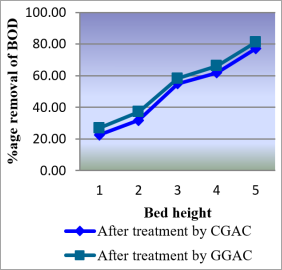
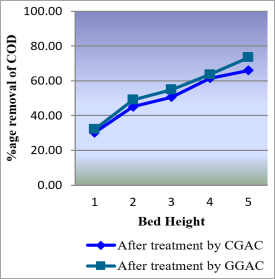
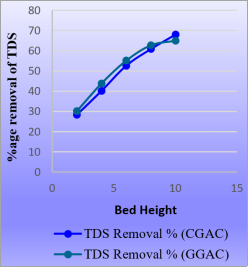
Bed Ht (cm) | COD Removal % (CGAC) | COD Removal % (GGAC) | BOD Removal % (CGAC) | BOD Removal % (GGAC) | TDS Removal % (CGAC) | TDS Removal % (GGAC) |
|---|---|---|---|---|---|---|
2 | 30.28 | 32.17 | 22.54 | 26.95 | 28.40 | 30.15 |
4 | 45.15 | 49.11 | 31.76 | 37.16 | 40.22 | 43.87 |
6 | 50.61 | 54.92 | 54.99 | 58.24 | 52.63 | 55.14 |
8 | 61.49 | 63.66 | 61.83 | 66.14 | 60.85 | 62.73 |
10 | 66.03 | 73.46 | 77.12 | 81.18 | 68.00 | 65.00 |
COD | Chemical Oxygen Demand |
BOD | Biochemical Oxygen Demand |
TDS | Total Dissolved Solid |
TSS | Total Suspended Solid |
| [1] | Kushwaha, J. P., Srivastava, V. C., & Mall, I. D. (2011). An overview of various technologies for the treatment of dairy wastewaters. Critical Reviews in Food Science and Nutrition, 51(5), 442–452. |
| [2] | Food and Agriculture Organization of the United Nations (FAO). (2025). Agricultural production statistics 2010–2024. FAOSTAT. |
| [3] | Agrahari, S., & Kumar, S. (2024). Phytoremediation: A shift towards sustainability for dairy wastewater treatment. Chem Bio Eng. Reviews, 1(1), 115–135. |
| [4] | Ramsuroop, J., Gutu, L., Ayinde, W. B., Basitere, M., & Manono, M. S. (2024). A review of biological processes for dairy wastewater treatment and the effect of physical parameters which affect their efficiency. Water, 16(4), 537. |
| [5] | Kushwaha, J. P., Srivastava, V. C., & Mall, I. D. (2010). Treatment of dairy wastewater by commercial activated carbon and bagasse fly ash: Parametric, kinetic and equilibrium modelling, disposal studies. Bioresource Technology, 101(10), 3474–3483. |
| [6] | Kushwaha, J. P., Srivastava, V. C., & Mall, I. D. (2013). Sequential batch reactor for dairy wastewater treatment: Parametric optimization, kinetics and waste sludge disposal. Journal of Environmental Chemical Engineering, 1(4), 1036–1043. |
| [7] | Mishra, S., Bindhani, S. K., & Jena, H. (2023). Statistical analysis of COD and BOD removal from dairy wastewater. International Journal of Membrane Science and Technology, 10(2). |
| [8] | Ekka, B., Mierina, I., Juhna, T., Kokina, K., Turks, M. (2022). Synergistic effect of activated charcoal and chitosan on treatment of dairy wastewaters. Materials Today Communications, 31, 103477. |
| [9] | Awogbemi, O., & Von Kallon, D. V. (2023). Progress in agricultural waste derived biochar as adsorbents for wastewater treatment. Applied Surface Science Advances, 18, 100518. |
| [10] | Rathi, B. S., M., T., S., K. S., R., G., & V., R. (2024). Recent research progress on modified activated carbon from biomass for the treatment of wastewater: A critical review. Environmental Quality Management, 33(4), 907–928. |
| [11] | Jagadeesh, N. and Sundaram, B. (2023). Adsorption of pollutants from wastewater by biochar: A review. Journal of Hazardous Materials Advances, 9, 100226. |
| [12] | Ullah, S., Shah, S.S.A., Altaf, M., Hussain, I., Sayed, M., Kallel, M., Elbahy, Z., Rehman, A., Najam, T., Nazir, M., (2024). Activated carbon derived from biomass for wastewater treatment: Synthesis, application and future challenges. Journal of Analytical and Applied Pyrolysis, 179, 106480. |
| [13] | Anitha, A., Dawn, S., Muthukumaravel, K. K., & Praveen Rajendran. (2024). Studies on kinetics, isothermal modelling and optimization of cow dung adsorbent for synthetic dairy wastewater treatment. Global NEST Journal, 26(10), 1–10. |
| [14] | Rachiq, T., Nora, S., Jamal, M., Khadija, E. M., Rehmani, M., Naif, A. J., Souad, E. H., Rahal, S., (2022). Study and modeling of dairy effluents treatment using design of experiments methodology. Desalination and Water Treatment, 261, 131–140. |
| [15] | Da Silva, L. R., Araujo, T., Da Fonseca, M., Santos, N., Gomes, G., Gomes, J., Araujo, J., Rocha, A., (2024). Application of Photo-Fenton oxidative process followed by adsorption in dairy effluents treatment. Journal of Water Process Engineering, 68, 106365. |
| [16] | Talafha, A., Abu-Dalo, M., Albiss, B. A., & Al-Nabulsi, A. (2024). Design and fabrication of nanocomposite adsorbents for dairy industry wastewater treatment. Discover Sustainability, 5, 530. |
| [17] | Zycki M., Barszcz, W., & Lozynska, M., (2025). Treatment of dairy wastewater retentate after microfiltration: Evaluation of the performance of the system based on activated sludge and activated carbon. Membranes, 15(8), 237. |
APA Style
Mishra, S., Bindhani, S. K., Jena, H. M. (2026). Biotechnological Valorization of Solid Waste–Derived Adsorbents for Sustainable Removal of COD, BOD, and TDS from Dairy Wastewater. American Journal of Science, Engineering and Technology, 11(4), 420-425. https://doi.org/10.11648/j.ajset.20261104.31
ACS Style
Mishra, S.; Bindhani, S. K.; Jena, H. M. Biotechnological Valorization of Solid Waste–Derived Adsorbents for Sustainable Removal of COD, BOD, and TDS from Dairy Wastewater. Am. J. Sci. Eng. Technol. 2026, 11(4), 420-425. doi: 10.11648/j.ajset.20261104.31
@article{10.11648/j.ajset.20261104.31,
  author = {Suman Mishra and Santosh Kumar Bindhani and Hora Mohan Jena},
  title = {Biotechnological Valorization of Solid Waste–Derived Adsorbents for Sustainable Removal of COD, BOD, and TDS from Dairy Wastewater},
  journal = {American Journal of Science, Engineering and Technology},
  volume = {11},
  number = {4},
  pages = {420-425},
  doi = {10.11648/j.ajset.20261104.31},
  url = {https://doi.org/10.11648/j.ajset.20261104.31},
  eprint = {https://article.sciencepublishinggroup.com/pdf/10.11648.j.ajset.20261104.31},
  abstract = {The dairy industry is one of the most important sectors among the food process industries. But it generates a significant amount of wastewater due to more quantity of water usage in various processing units, i.e., pasteurization, homogenization, equipment cleaning, and sanitation. On an average, about 2.5 to 10 liters of wastewater are generated for each liter of milk processed. This wastewater contains a large concentration of pollutants like carbohydrates, proteins, oil, greases, suspended solids and other nutrients. Because of these, the concentration of BOD and COD in the waste water was pretty high. If it is dumped directly to the water resources without appropriate treatment, it may serious problems like, polluted water, bad smells, even damaged aquatic life. In this study, an environmental-friendly approach was adopted by transforming agricultural waste materials like dried guava leaves and coconut shells into granular activated carbon for the wastewater treatment. To simulate actual industrial conditions, synthetic dairy wastewater was generated in laboratory scale. Then it was treated using these low-cost adsorbents. Their performance was evaluated by measuring the reduction in COD, BOD, and TDS concentrations. Activated carbon derived from guava leaves achieved the removal efficiencies of 76% for COD, 78% for BOD, and 65% for TDS. In comparison, the coconut shell derived activated carbon performed somewhat better, achieving 84% removal of COD, 80% of BOD, and 68% of TDS. The study demonstrates that converting waste into valuable resources through biotechnological processes provides a sustainable and eco-friendly solution for the efficient treatment of dairy wastewater.},
 year = {2026}
}
TY  - JOUR
T1  - Biotechnological Valorization of Solid Waste–Derived Adsorbents for Sustainable Removal of COD, BOD, and TDS from Dairy Wastewater
AU  - Suman Mishra
AU  - Santosh Kumar Bindhani
AU  - Hora Mohan Jena
Y1  - 2026/10/17
PY  - 2026
N1  - https://doi.org/10.11648/j.ajset.20261104.31
DO  - 10.11648/j.ajset.20261104.31
T2  - American Journal of Science, Engineering and Technology
JF  - American Journal of Science, Engineering and Technology
JO  - American Journal of Science, Engineering and Technology
SP  - 420
EP  - 425
PB  - Science Publishing Group
SN  - 2578-8353
UR  - https://doi.org/10.11648/j.ajset.20261104.31
AB  - The dairy industry is one of the most important sectors among the food process industries. But it generates a significant amount of wastewater due to more quantity of water usage in various processing units, i.e., pasteurization, homogenization, equipment cleaning, and sanitation. On an average, about 2.5 to 10 liters of wastewater are generated for each liter of milk processed. This wastewater contains a large concentration of pollutants like carbohydrates, proteins, oil, greases, suspended solids and other nutrients. Because of these, the concentration of BOD and COD in the waste water was pretty high. If it is dumped directly to the water resources without appropriate treatment, it may serious problems like, polluted water, bad smells, even damaged aquatic life. In this study, an environmental-friendly approach was adopted by transforming agricultural waste materials like dried guava leaves and coconut shells into granular activated carbon for the wastewater treatment. To simulate actual industrial conditions, synthetic dairy wastewater was generated in laboratory scale. Then it was treated using these low-cost adsorbents. Their performance was evaluated by measuring the reduction in COD, BOD, and TDS concentrations. Activated carbon derived from guava leaves achieved the removal efficiencies of 76% for COD, 78% for BOD, and 65% for TDS. In comparison, the coconut shell derived activated carbon performed somewhat better, achieving 84% removal of COD, 80% of BOD, and 68% of TDS. The study demonstrates that converting waste into valuable resources through biotechnological processes provides a sustainable and eco-friendly solution for the efficient treatment of dairy wastewater.
VL  - 11
IS  - 4
ER  -
Department of Chemical Engineering, Gandhi Institute of Engineering and Technology University, Gunupur, India
Biography: Suman Mishra is working in the field of Chemical Engineering as a teacher and researcher. She completed her M. Tech from Biju Patnaik University of Technology and is currently pursuing her Ph.D. in wastewater treatment. Her areas of interest include mass transfer, environmental engineering, wastewater treatment, and sustainable process development. She has been actively involved in teaching, student guidance, and curriculum-related activities. Her research mainly focuses on adsorption studies, process optimization, and the use of eco-friendly materials for industrial wastewater treatment. Along with academics and research, she also contributes to project guidance, technical writing, and other educational activities in Chemical Engineering. She has more than 15 publications with in reputed Scopus Journals.
Research Fields: mass transfer, environmental engineering, wastewater treatment, and sustainable process development
Department of Chemical Engineering, Gandhi Institute of Engineering and Technology University, Gunupur, India
Biography: Santosh Kumar Bindhani is an Associate Professor in Chemical Engineering at GIET University, Gunupur. He completed his M. Tech from Anna University, Chennai and PhD from BPUT, Rourkela. He is an experienced teacher and researcher. With more than 18 years of academic and research experience, he has been involved in teaching, guiding students, and contributing to various research and development activities. His areas of interest include thermo-dynamics properties, process design, separation processes, environmental engineering, and sustainable technologies. He has also worked on several sponsored projects supported by organizations like DST, SERB, etc. Along with research and academics, he actively participates in student development and institutional activities at the university. He has more than 15 publications with H-index 4 in reputed Scopus Journals.
Research Fields: thermo-dynamics properties, process design, separation processes, environmental engineering, and sustainable technologies

Department of Chemical Engineering, National Institute of Technology, Rourkela, India
Biography: Hora Mohan Jena is an Associate Professor in the Department of Chemical Engineering at NIT, Rourkela. He completed his PhD from NIT, Rourkela. He is a respected teacher and researcher. He has extensive experience in teaching and research, with specialization in fluidization engineering, multiphase flow, computational fluid dynamics (CFD), reactor engineering, and wastewater treatment. Over the years, he has guided many students and research scholars and has published several research papers in reputed journals. He is also actively involved in academic and research activities related to Chemical Engineering. He has more than 70 publications with an H-index of 14 in reputed Scopus Journals.
Research Fields: in fluidization engineering, multiphase flow, computational fluid dynamics (CFD), reactor engineering, and wastewater treatment

Information



 Share This Article
 Twitter
 Linked In
 Facebook
 Copy
Copy Download