
 ,
Bodroth Rabi Prasad,
Suman Polaki,
Tapas Ranjan Guru,
Abhipsa Pradhan,
Sushree Yugma Senapati,
Snehalata Pradhan
,
Bodroth Rabi Prasad,
Suman Polaki,
Tapas Ranjan Guru,
Abhipsa Pradhan,
Sushree Yugma Senapati,
Snehalata Pradhan
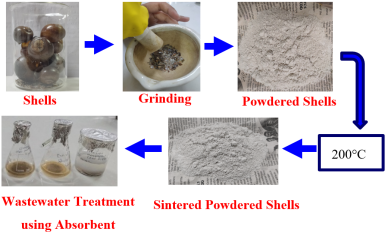
Water pollution caused due to industrial wastewater discharge has emerged as a crucial environmental concern worldwide. With heavy metals being most hazardous contaminants. Lead (Pb) particularly remains a significant environmental and public health concern. It is a serious treat due to its non-biodegradable nature, environmental persistence and significantly high tendency to bioaccumulate in living organisms. Exposure to lead, even at low concentrations, can cause severe renal, neurological, developmental, and physiological disorders. Thereby making its removal from contaminated water system is an important priority. Conventional methods for lead removal, such as chemical precipitation, ion exchange, and membrane filtration, are often costly, energy-intensive, and may generate secondary pollutants. Therefore, low-cost, sustainable, and environmentally benign alternatives are highly desirable. In this present study the snail shell waste was investigated as an eco-friendly biosorbent for the removal of PB2+ ions from contaminated aqueous systems. Snail shells primarily composed of calcium carbonate (CaCO3) plays a crucial role in their effectiveness as a biosorbent. The CaCO3 can interact with heavy metal ions through adsorption, ion exchange, surface complexation, and precipitation. In this study, collected snail shells were washed, dried, pulverized, and used in normal as well as sintered forms to evaluate their biosorbent potential against contaminated water. The level of contamination was evaluated before and after biosorbent treatment was estimated using a UV-Visible spectrophotometer after colour development and calibration with standard solutions. The experimental groups included lead normal snail shell, sintered snail shell. The results indicated a reduction in impure concentration after treatment with snail shell biosorbent, with sintered snail shell showing comparatively higher removal efficiency than normal snail shell. The improved performance of sintered snail shell may be attributed to increased surface reactivity and enhanced availability of calcium-based active sites. Overall, the findings suggest that snail shell waste can act as an efficient, low-cost, and sustainable biosorbent for reducing lead toxicity in contaminated water systems. The utilization of snail shell waste not only supports heavy metal remediation but also contributes to waste valorisation, circular economy, and environmental sustainability.
| Published in |
American Journal of Science, Engineering and Technology (Volume 11, Issue 4)
This article belongs to the Special Issue Advances in Translational Research, Biotechnology, and Sustainable Bio-Innovations |
| DOI | 10.11648/j.ajset.20261104.18 |
| Page(s) | 310-315 |
| Creative Commons |
This is an Open Access article, distributed under the terms of the Creative Commons Attribution 4.0 International License (http://creativecommons.org/licenses/by/4.0/), which permits unrestricted use, distribution and reproduction in any medium or format, provided the original work is properly cited. |
| Copyright |
Copyright © The Author(s), 2026. Published by Science Publishing Group |
Lead Toxicity, Snail Shell Waste, Biosorption, Waste Water Treatment, Calcium Carbonate
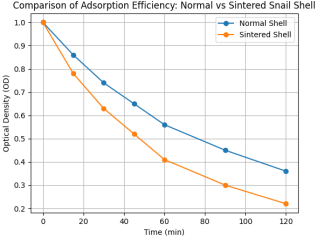
Time (min) | OD Value (Normal) | % Removal | OD (Sintered) | % Removal |
|---|---|---|---|---|
0 | 1.00 | 0 | 1.00 | 0 |
15 | 0.86 | 14 | 0.78 | 22 |
30 | 0.74 | 26 | 0.63 | 37 |
45 | 0.65 | 35 | 0.52 | 48 |
60 | 0.56 | 44 | 0.41 | 59 |
90 | 0.45 | 55 | 0.30 | 70 |
120 | 0.36 | 64 | 0.22 | 78 |
Pb2+ | Lead Ion |
OD | Optical Density |
UV–Vis | Ultraviolet Visible |
| [1] | Mishra S, De A. Various sources of heavy metals contamination, including industrial activities, mining, agriculture, and urbanization. InHeavy metal contamination in the environment 2024 Dec 30 (pp. 71-94). |
| [2] | Ishchenko VA. Environment contamination with heavy metals contained in waste. Environmental Problems. Vol. 3, No. 1: 21-24. 2018. |
| [3] | Derrick A, Yohana MA, Yudong Z, Gongyu L, Tan B, Zhang S. Understanding the detrimental effects of heavy metal pollution in shrimp farming and treatment methods–a review. Annals of Animal Science. 2025 Jan 22; 25(1): 35-56. |
| [4] | Generalova A, Davidova S, Satchanska G. The mechanisms of lead toxicity in living organisms. Journal of xenobiotics. 2025 Sep 11; 15(5): 146. |
| [5] | Peters RW, Walker TJ, Ku Y, Berdanier B, Chang TK, Freund D. Physical and chemical methods. Journal (Water Pollution Control Federation). 1983 Jun 1; 55(6): 599-612. |
| [6] | Dodbiba G, Ponou J, Fujita T. Biosorption of heavy metals. Microbiology for minerals, metals, materials and the environment. 2015 Feb 25; 7(4): 409-26. |
| [7] | Wang P, Shen T, Li X, Tang Y, Li Y. Magnetic mesoporous calcium carbonate-based nanocomposites for the removal of toxic Pb (II) and Cd (II) ions from water. ACS Applied Nano Materials. 2020 Jan 3; 3(2): 1272-81. |
| [8] | Vishnu Priyan V, Sathasivam J, Kumar A. Valorisation of agricultural waste into a low-cost adsorbent: perspective. Agricultural Waste to Value-Added Products: Bioproducts and Its Applications. 2024 Jul 25: 125. |
| [9] | Dhillon GS. Protein byproducts: transformation from environmental burden into value-added products. Academic Press; 2016 Aug 13. |
| [10] | Xyla AG, Giannimaras EK, Koutsoukos PG. The precipitation of calcium carbonate in aqueous solutions. Colloids and Surfaces. 1991 Jan 1; 53(2): 241-55. |
| [11] | Ternero F, Rosa LG, Urban P, Montes JM, Cuevas FG. Influence of the total porosity on the properties of sintered materials—a review. Metals. 2021 Apr 28; 11(5): 730. |
| [12] | Mazaheri H, Ong HC, Amini Z, Masjuki HH, Mofijur M, Su CH, Anjum Badruddin I, Khan TY. An overview of biodiesel production via calcium oxide based catalysts: Current state and perspective. Energies. 2021 Jul 1; 14(13): 3950. |
| [13] | Allen T. Powder sampling and particle size determination. Elsevier; 2003 Dec 9. |
| [14] | Rashed MN. Adsorption technique for the removal of organic pollutants from water and wastewater. InOrganic pollutants-monitoring, risk and treatment 2013 Jan 30. IntechOpen. |
| [15] | Nhung NT, Long VD, Fujita T. A critical review of snail shell material modification for applications in wastewater treatment. Materials. 2023 Jan 27; 16(3): 1095. |
| [16] | Bi J, Wang J, Ferguson S, Huang X, Tao Q, Li G, Wang T, Hao H. Modeling of mixed mechanism adsorption processes driven by surface adsorption and internal ion exchange. Industrial & Engineering Chemistry Research. 2020 Jul 15; 59(32): 14467-75. |
| [17] | Potortì AG, Messina L, Licata P, Gugliandolo E, Santini A, Di Bella G. Snail shell waste threat to sustainability and circular economy: novel application in food industries. Sustainability. 2024 Jan 13; 16(2): 706. |
| [18] | Adepitan OL, Alabi OO, Gbadeyan OJ, Deenadayalu N, Jayeola AT. Investigation into the development and utilization of snail shell biomaterials: A systematic review. Discover Materials. 2025 Feb 22; 5(1): 47. |
APA Style
Prusty, G., Prasad, B. R., Polaki, S., Guru, T. R., Pradhan, A., et al. (2026). Sustainable Use of Waste Snail Shell Powder for Water Treatment: A Preliminary Adsorption Study. American Journal of Science, Engineering and Technology, 11(4), 310-315. https://doi.org/10.11648/j.ajset.20261104.18
ACS Style
Prusty, G.; Prasad, B. R.; Polaki, S.; Guru, T. R.; Pradhan, A., et al. Sustainable Use of Waste Snail Shell Powder for Water Treatment: A Preliminary Adsorption Study. Am. J. Sci. Eng. Technol. 2026, 11(4), 310-315. doi: 10.11648/j.ajset.20261104.18
@article{10.11648/j.ajset.20261104.18,
  author = {Ghanishtha Prusty and Bodroth Rabi Prasad and Suman Polaki and Tapas Ranjan Guru and Abhipsa Pradhan and Sushree Yugma Senapati and Snehalata Pradhan},
  title = {Sustainable Use of Waste Snail Shell Powder for Water Treatment: A Preliminary Adsorption Study},
  journal = {American Journal of Science, Engineering and Technology},
  volume = {11},
  number = {4},
  pages = {310-315},
  doi = {10.11648/j.ajset.20261104.18},
  url = {https://doi.org/10.11648/j.ajset.20261104.18},
  eprint = {https://article.sciencepublishinggroup.com/pdf/10.11648.j.ajset.20261104.18},
  abstract = {Water pollution caused due to industrial wastewater discharge has emerged as a crucial environmental concern worldwide. With heavy metals being most hazardous contaminants. Lead (Pb) particularly remains a significant environmental and public health concern. It is a serious treat due to its non-biodegradable nature, environmental persistence and significantly high tendency to bioaccumulate in living organisms. Exposure to lead, even at low concentrations, can cause severe renal, neurological, developmental, and physiological disorders. Thereby making its removal from contaminated water system is an important priority. Conventional methods for lead removal, such as chemical precipitation, ion exchange, and membrane filtration, are often costly, energy-intensive, and may generate secondary pollutants. Therefore, low-cost, sustainable, and environmentally benign alternatives are highly desirable. In this present study the snail shell waste was investigated as an eco-friendly biosorbent for the removal of PB2+ ions from contaminated aqueous systems. Snail shells primarily composed of calcium carbonate (CaCO3) plays a crucial role in their effectiveness as a biosorbent. The CaCO3 can interact with heavy metal ions through adsorption, ion exchange, surface complexation, and precipitation. In this study, collected snail shells were washed, dried, pulverized, and used in normal as well as sintered forms to evaluate their biosorbent potential against contaminated water. The level of contamination was evaluated before and after biosorbent treatment was estimated using a UV-Visible spectrophotometer after colour development and calibration with standard solutions. The experimental groups included lead normal snail shell, sintered snail shell. The results indicated a reduction in impure concentration after treatment with snail shell biosorbent, with sintered snail shell showing comparatively higher removal efficiency than normal snail shell. The improved performance of sintered snail shell may be attributed to increased surface reactivity and enhanced availability of calcium-based active sites. Overall, the findings suggest that snail shell waste can act as an efficient, low-cost, and sustainable biosorbent for reducing lead toxicity in contaminated water systems. The utilization of snail shell waste not only supports heavy metal remediation but also contributes to waste valorisation, circular economy, and environmental sustainability.},
 year = {2026}
}
TY  - JOUR
T1  - Sustainable Use of Waste Snail Shell Powder for Water Treatment: A Preliminary Adsorption Study
AU  - Ghanishtha Prusty
AU  - Bodroth Rabi Prasad
AU  - Suman Polaki
AU  - Tapas Ranjan Guru
AU  - Abhipsa Pradhan
AU  - Sushree Yugma Senapati
AU  - Snehalata Pradhan
Y1  - 2026/10/17
PY  - 2026
N1  - https://doi.org/10.11648/j.ajset.20261104.18
DO  - 10.11648/j.ajset.20261104.18
T2  - American Journal of Science, Engineering and Technology
JF  - American Journal of Science, Engineering and Technology
JO  - American Journal of Science, Engineering and Technology
SP  - 310
EP  - 315
PB  - Science Publishing Group
SN  - 2578-8353
UR  - https://doi.org/10.11648/j.ajset.20261104.18
AB  - Water pollution caused due to industrial wastewater discharge has emerged as a crucial environmental concern worldwide. With heavy metals being most hazardous contaminants. Lead (Pb) particularly remains a significant environmental and public health concern. It is a serious treat due to its non-biodegradable nature, environmental persistence and significantly high tendency to bioaccumulate in living organisms. Exposure to lead, even at low concentrations, can cause severe renal, neurological, developmental, and physiological disorders. Thereby making its removal from contaminated water system is an important priority. Conventional methods for lead removal, such as chemical precipitation, ion exchange, and membrane filtration, are often costly, energy-intensive, and may generate secondary pollutants. Therefore, low-cost, sustainable, and environmentally benign alternatives are highly desirable. In this present study the snail shell waste was investigated as an eco-friendly biosorbent for the removal of PB2+ ions from contaminated aqueous systems. Snail shells primarily composed of calcium carbonate (CaCO3) plays a crucial role in their effectiveness as a biosorbent. The CaCO3 can interact with heavy metal ions through adsorption, ion exchange, surface complexation, and precipitation. In this study, collected snail shells were washed, dried, pulverized, and used in normal as well as sintered forms to evaluate their biosorbent potential against contaminated water. The level of contamination was evaluated before and after biosorbent treatment was estimated using a UV-Visible spectrophotometer after colour development and calibration with standard solutions. The experimental groups included lead normal snail shell, sintered snail shell. The results indicated a reduction in impure concentration after treatment with snail shell biosorbent, with sintered snail shell showing comparatively higher removal efficiency than normal snail shell. The improved performance of sintered snail shell may be attributed to increased surface reactivity and enhanced availability of calcium-based active sites. Overall, the findings suggest that snail shell waste can act as an efficient, low-cost, and sustainable biosorbent for reducing lead toxicity in contaminated water systems. The utilization of snail shell waste not only supports heavy metal remediation but also contributes to waste valorisation, circular economy, and environmental sustainability.
VL  - 11
IS  - 4
ER  -
Department of Life Sciences, Gandhi Institute of Engineering and Technology University, Gunupur, India
Biography: Ghanishtha Prusty is a PhD scholar in Toxicology at GIET University, Odisha, Gunupur, India. She holds a Master’s degree in Life Sciences and has research expertise in environmental toxicology, heavy metal stress, and microbial analysis. Her work focuses on the impact of pollutants such as lead on aquatic organisms and the application of sustainable remediation strategies. She has experience in metagenomics, spectroscopic techniques, and biosensor-based approaches. She has published research on lead toxicity and enzymatic responses and is actively engaged in interdisciplinary research integrating environmental science with biotechnology.
Research Fields: Environmental Toxicology, Heavy Metal Toxicity, Microbial Ecology and Metagenomics.

Department of Biotechnology, Gandhi Institute of Engineering and Technology University, Gunupur, India
Biography: Bodroth Rabi Prasad is an Assistant Professor in the Department of Biotechnology at GIET University, Odisha, India. He holds a Ph.D. in Biotechnology and has extensive experience in environmental biotechnology and wastewater treatment. His research focuses on microbial applications, biosorption, and sustainable approaches for pollution control. He has contributed to several research publications and academic projects related to environmental remediation and biological treatment technologies. He is actively involved in teaching, mentoring students, and guiding research in applied biological sciences.
Research Fields: Environmental Biotechnology, Bio-based Adsorbents for Wastewater Treatment, Lignocellulosic Biomass Processing and Valorization, Microbial Applications in Pollution Control.

Department of Biotechnology, Centurion University of Technology and Management, Parlakhemundi, India
Biography: Suman Polaki is an academic and researcher associated with Centurion University, Odisha, India. He holds a Ph.D. in Biotechnology and specializes in environmental microbiology and bioprocess technology. His research interests include wastewater treatment, microbial biotechnology, and sustainable environmental solutions. He has been involved in interdisciplinary research projects and has contributed to academic development through teaching and student mentorship. His work focuses on applying biological systems for environmental and industrial applications.
Research Fields: Proteomics and Functional Biology, Molecular Analysis of Stress Responses, Environmental Microbiology, Wastewater Treatment and Environmental Applications.

Department of Life Sciences, Gandhi Institute of Engineering and Technology University, Gunupur, India
Biography: Tapas Ranjan Guru is a postgraduate student pursuing an M.Sc. in Life Sciences (Batch 2023–2025) at GIET University, Odisha, India. His academic interests include environmental science, biotechnology, and wastewater treatment. He is actively involved in research on low-cost biosorbents and their application in pollutant removal from industrial wastewater. His work focuses on developing sustainable and eco-friendly approaches for environmental remediation. He is gaining hands-on laboratory experience and contributing to applied research projects under academic supervision.
Research Fields: Lifescience, Animal Science, Biosorption Techniques, Microbiology, Environmental Science.

Department of Life Sciences, Gandhi Institute of Engineering and Technology University, Gunupur, India
Biography: Abhipsa Pradhan is an M.Sc. Life Sciences student (Batch 2023–2025) at GIET University, Odisha, India. Her academic focus related to wastewater treatment using natural biosorbents. Her work emphasizes developing cost-effective and eco-friendly solutions for pollution control. She is actively building laboratory skills and participating in research activities under faculty guidance.includes environmental biotechnology, microbiology, and sustainable waste management. She is engaged in research
Research Fields: Environmental Science, Animal Science, Waste Management, Lifescience, Microbiology.

Department of Life Sciences, Gandhi Institute of Engineering and Technology University, Gunupur, India
Biography: Sushree Yugma Senapati is a postgraduate student pursuing an M.Sc. in Life Sciences (Batch: 2023–2025) at GIET University, Odisha, India. Her academic interests lie in environmental science and applied biotechnology. She is involved in experimental research on wastewater treatment and biosorption techniques using natural materials. Her work focuses on sustainable environmental solutions and practical laboratory-based applications. She is developing strong research and analytical skills through active participation in academic projects
Research Fields: Water treatment, Lifescience, Animal Science, Microbiology, Environmental Biotechnology

Department of Life Sciences, Gandhi Institute of Engineering and Technology University, Gunupur, India
Biography: Snehlata Pradhan is an M.Sc. Life Sciences student (Batch 2023–2025) at GIET University, Odisha, India. Her academic interests include environmental science, microbiology, and biotechnological applications in pollution control. She is currently engaged in research on wastewater treatment using low-cost biosorbents. Her work contributes to sustainable environmental management and waste utilization strategies. She is gaining practical experience in laboratory techniques and research methodologies.
Research Fields: Microbiology, Environmental Science, Animal Science, Waste Management, Bio absorption.


Information


 Share This Article
 Twitter
 Linked In
 Facebook
 Copy
Copy Download