
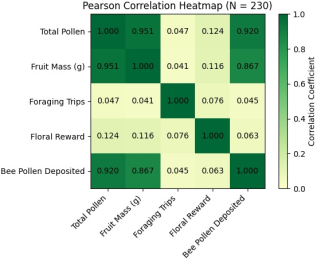
Pollination is a fundamental ecological process that supports plant reproduction and contributes to ecosystem stability. While social bees have been extensively studied, solitary buzz-pollinating species remain comparatively under-researched. Amegilla cingulata, commonly known as the blue-banded bee, is an effective sonicator of poricidal anthers and plays a significant role in the pollination of economically important crops. However, there is limited in-depth, field-based research examining the relationship between its behavioural ecology and quantitative pollination outcomes. This study aimed to evaluate the nesting ecology, foraging behaviour and pollination efficiency of Amegilla cingulata, though in this specific case, to identify which of the factors was the most significant determinant of reproductive success as indicated by fruit mass. A field-based observational design was employed (N = 230). Ecological variables were categorized into nesting structure, foraging activity, and pollination performance indicators. Behavioural patterns were summarized using descriptive statistics. Pearson correlation analysis was conducted to assess the relationships between pollen transfer variables and reproductive output. Multiple linear regression analysis was used to identify predictors of fruit mass. Additionally, independent samples t-tests were performed to examine differences in pollen deposition across nest orientations. Nesting architecture was structurally homogenous with the major types of nests being branched and vertical ones. Total pollen deposition and mass of the fruit were found to have good positive relations (r =.951, p <. 001). The regression analysis also supported that total pollen was the most significant parameter (= .950, p < .001), which was adopted to predict the fruit mass because it explained over 90 percent of the variability in fruit reproductive output. There were insignificant predictive effects of behavioural variables such as foraging time and frequency of visitation. The angularity of the nest did not have much effect on the deposition of pollen. The findings indicate that, within this ecological system, pollen transfer efficiency is the primary determinant of reproductive success, rather than the intensity of foraging behaviour. In particular, effective pollen deposition was the strongest predictor of fruit mass, underscoring its central role in fruit development. These results highlight the ecological importance of solitary buzz-pollinators such as Amegilla cingulata in regulating plant productivity. Overall, the study emphasizes that the quality of pollinationmeasured through efficient pollen delivery, matters more than behavioural intensity in determining reproductive outcomes.
| Published in |
American Journal of Science, Engineering and Technology (Volume 11, Issue 4)
This article belongs to the Special Issue Advances in Translational Research, Biotechnology, and Sustainable Bio-Innovations |
| DOI | 10.11648/j.ajset.20261104.17 |
| Page(s) | 299-309 |
| Creative Commons |
This is an Open Access article, distributed under the terms of the Creative Commons Attribution 4.0 International License (http://creativecommons.org/licenses/by/4.0/), which permits unrestricted use, distribution and reproduction in any medium or format, provided the original work is properly cited. |
| Copyright |
Copyright © The Author(s), 2026. Published by Science Publishing Group |
Behavioural Ecology, Pollination Efficiency, Amegilla cingulata, Buzz Pollination, Pollen Deposition, Fruit Mass, Solitary Bees, Plant-Pollinator Interactions
Variable | Min | Max | Mean | SD | Skewness | Kurtosis |
|---|---|---|---|---|---|---|
Tunnel Width (mm) | 4 | 8 | 5.90 | 1.43 | 0.06 | −1.32 |
Mean Cell Width (mm) | 2 | 4 | 3.03 | 0.78 | −0.05 | −1.37 |
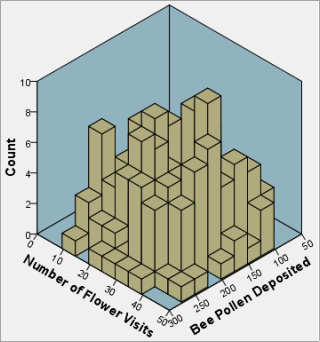
Number of Flower Visits | 12 | 45 | 27.90 | 10.59 | 0.11 | −1.34 |
Floral Reward (1=P, 2=N, 3=Both) | 1 | 3 | 1.97 | 0.61 | 0.01 | −0.31 |
Bee Pollen Deposited | 90 | 279 | 180.96 | 54.07 | 0.07 | −1.15 |
Mean Foraging Duration (min) | 8 | 18 | 13.13 | 2.92 | −0.02 | −1.18 |
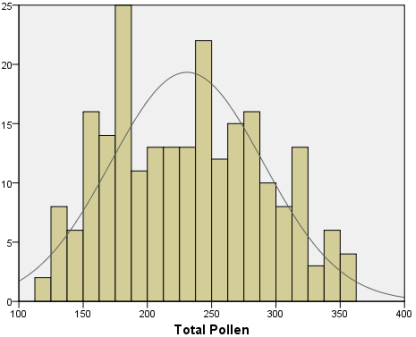
Total Pollen | 117 | 354 | 230.80 | 59.32 | 0.15 | −0.94 |
Fruit Mass (g) | 29.90 | 70.40 | 49.83 | 9.48 | 0.10 | −0.82 |
Tunnel Length (mm) | 18 | 45 | 31.57 | 8.12 | 0.01 | −1.17 |
Nest Angle (°) | 25 | 90 | 69.80 | 17.22 | −1.18 | 0.51 |
Variable | Mean | SD | Skewness | Kurtosis |
|---|---|---|---|---|
Nest Type (1=Branched) | 0.76 | 0.43 | −1.20 | −0.56 |
Nest Position (1=Vertical) | 1.34 | 0.47 | 0.68 | −1.55 |
Nest Distribution (1=Aggregated) | 0.57 | 0.50 | −0.27 | −1.95 |
Floral Reward Type | 1.97 | 0.61 | 0.01 | −0.31 |
Variables | 1 | 2 | 3 | 4 | 5 |
|---|---|---|---|---|---|
Total Pollen | — | ||||
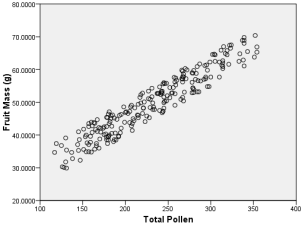
Fruit Mass (g) | .951** | — | |||
Number of Foraging Trips | .047 | .041 | — | ||
Floral Reward | .124 | .116 | .076 | — | |
Bee Pollen Deposited | .920** | .867** | .045 | .063 | — |
R | R2 | Adjusted R2 | SE | Durbin–Watson |
|---|---|---|---|---|
.951 | .905 | .904 | 2.94 | 2.048 |
Predictor | B | SE | Beta | t | P |
|---|---|---|---|---|---|
Constant | 14.75 | 1.27 | — | 11.64 | <.001 |
Total Pollen | 0.152 | 0.003 | .950 | 46.35 | <.001 |
Mean Foraging Duration | −0.061 | 0.067 | −.019 | −0.918 | .360 |
Number of Flower Visits | 0.031 | 0.018 | .034 | 1.662 | .098 |
Nest Position | N | Mean | SD |
|---|---|---|---|
Vertical | 152 | 230.06 | 57.56 |
Horizontal | 78 | 232.23 | 62.96 |
t | df | p | Mean Difference | 95% CI |
|---|---|---|---|---|
−0.262 | 228 | .793 | −2.17 | [−18.48, 14.14] |
Statistic | Minimum | Maximum | Mean | SD |
|---|---|---|---|---|
Predicted Value | 33.06 | 68.76 | 49.83 | 9.02 |
Residual | −5.27 | 5.26 | 0.00 | 2.92 |
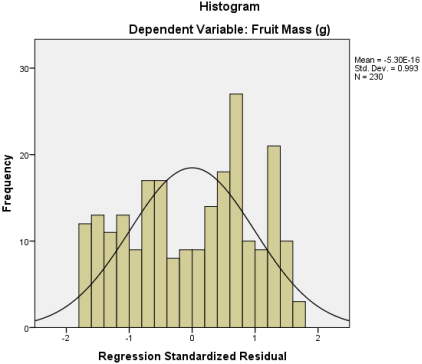
Standardized Residual | −1.79 | 1.79 | 0.00 | 0.99 |
ANOVA | Analysis of Variance |
df | Degrees of Freedom |
IEP | Isoelectric Point |
SPSS | Statistical Package for the Social Sciences |
PD | Pollen Depositio |
| [1] | Athira KS, Pradeepkumar T. Pollination Strategies for Advancing Protected Cultivation of Vegetable Crops. JOURNAL OF ADVANCES IN BIOLOGY & BIOTECHNOLOGY Учредители: Sciencedomain International. 2025 Feb 13; 28(2): 235-52. |
| [2] | Carion F, Gérard M, Ghisbain G, Wood TJ. Unravelling Amegilla (Glossamegilla) diversity across the Wallace Line: new species, wing morphometrics, and biogeographic boundaries (Hymenoptera, Apidae). ZooKeys. 2025 Oct 16; 1256: 1. |
| [3] | Delgado T, Leal LC, El Ottra JH, Brito VL, Nogueira A. Flower size affects bee species visitation pattern on flowers with poricidal anthers across pollination studies. Flora. 2023 Feb 1; 299: 152198. |
| [4] | Eeraerts M, Siopa C, Osterman W, Osterman J, Chabert S, Verheyen K. The global contribution of wild insect and honeybee visitation to crop pollination success is asymptotic. Global Ecology and Biogeography. 2025 Jul; 34(7): e70088. |
| [5] |
Hiraiwa MK, Ushimaru A. Loss of functional diversity rather than species diversity of pollinators decreases community‐wide trait matching and pollination function. Functional Ecology. 2024 May; 38(5): 1296-308.
https://besjournals.onlinelibrary.wiley.com/doi/full/10.1111/1365-2435.14527 |
| [6] | Kumar A, Singh S, Pandey A, Singh BK, Pandey R, Mishra MK, Kumar S, Gautam Y, Singh AK. Foraging Attributes of Insect Pollinators on Tulsi (Ocimum basilicum). Uttar Pradesh Journal of Zoology. 2024 May 18; 45(12): 75-81. |
| [7] |
Lopresti LC, Lach L, Montesinos D. The specialised buzz pollination syndrome poses a partial barrier to plant invasions. Journal of Ecology. 2024 Aug; 112(8): 1686-700.
https://besjournals.onlinelibrary.wiley.com/doi/full/10.1111/1365-2745.14338 |
| [8] | Mesquita‐Neto JN, Schlindwein C. Bee body size and foraging behavior predict the pollination role of bees in a buzz‐pollinated plant community. Ecology and Evolution. 2025 Sep; 15(9): e72150. |
| [9] | Mukhopadhyay S, Samajpati I, Chakraborty A, Basu P. Dominance Hierarchy and Floral Trait Preference: Behavioural Strategies of Bee Community Foraging on Brinjal (Solanum melongena). Ethology. 2026. |
| [10] | Nandhakumar G, Deborah Mercy D. Buzzing in the City: The Rise of Urban Beekeeping and Its Ecological Impact. |
| [11] | Paudel BR, Fairnie AL, McCarren S, Anderson B, Illing N, Barrett SC. Loss of buzz pollination results in chronic pollen limitation in an enantiostylous plant. South African Journal of Botany. 2024 Aug 1; 171: 592-601. |
| [12] | Prendergast K. An Evaluation of the Popularity of Australian Native Bee Taxa and State of Knowledge of Native Bee Taxonomy Among the Bee-Interested Public. Insects. 2025 Nov 10; 16(11): 1149. |
| [13] | Putra IL, Setiawan H, Rahmadini SR. Diversity and abundance of bees (Hymenoptera: Apidae) in Campus 4 of Ahmad Dahlan University. Journal Pijar Mipa. 2022 Nov 30; 17(6): 826-33. |
| [14] | Roguz K, Chiliński M, Roguz A, Zych M. Pollination of urban meadows–Plant reproductive success and urban-related factors influencing frequency of pollinators visits. Urban Forestry & Urban Greening. 2023 Jun 1; 84: 127944. |
| [15] | Sarma AK, Deka MK, Neog B. Species richness of Hymenopteran flower visitors in Brassica campestris var. toria in Assam, India: A comparison of five sampling methods. Animal Taxonomy and Ecology. 2024 Oct 8; 70(3): 314-28. |
| [16] | Sengupta U, Krishna S. More is not always better: impact of nutrient-addition on floral traits important for buzz pollination. Acta Oecologica. 2023 Nov 1; 121: 103957. |
| [17] | Sharon A, Anupama K, Guetat-Bernard H, Prasad S, Lazar J, Indhu A, Varadharajan A, Landy F, Narpavi S, Andrieu J, Gallai N. Native bees and pollination in the Puducherry Bioregion. Institut Français de Pondichéry; 2022. |
| [18] | Udayakumar A, Chaubey BK, Shivalingaswamy TM. Amegilla violacea (Lepeletier, 1841) (Anthophorini: Apidae)–A native bee, an effective pollinator of eggplant (Solanum melongena). Journal of Apicultural Research. 2023 Mar 15; 62(2): 411-7. |
| [19] | Valadão‐Mendes LB, Santana PC, Rech AR, Brito VL, Maruyama PK. Fine‐tuning the buzz: comparing visitation frequency and pollination effectiveness in plant–pollinator networks. New Phytologist. 2025 Nov 21. |
| [20] | Vallejo-Marin M, Russell AL. Harvesting pollen with vibrations: towards an integrative understanding of the proximate and ultimate reasons for buzz pollination. Annals of Botany. 2024 Mar 1; 133(3): 379-98. |
| [21] | Vallejo-Marín M. How and why do bees buzz? Implications for buzz pollination. Journal of Experimental Botany. 2022 Feb 24; 73(4): 1080-92. |
| [22] |
White J. “The Bees Seem Alive and Make a Great Buzzing”: Unsettling Homes in South-West Western Australia. InBees, Science, and Sex in the Literature of the Long Nineteenth Century 2023 Nov 8 (pp. 91-110). Cham: Springer International Publishing.
https://link.springer.com/chapter/10.1007/978-3-031-39570-3_6 |
| [23] |
Woodrow C, Jafferis N, Kang Y, Vallejo-Marín M. Buzz-pollinating bees deliver thoracic vibrations to flowers through periodic biting. Current Biology. 2024 Sep 23; 34(18): 4104-13.
https://www.cell.com/current-biology/fulltext/S0960-9822(24)00947-3 |
| [24] | Wooster EI, Fleck R, Torpy F, Ramp D, Irga PJ. Urban green roofs promote metropolitan biodiversity: A comparative case study. Building and Environment. 2022 Jan 1; 207: 108458. |
APA Style
Sahoo, D., Yerra, A., Mishra, P. (2026). Behavioral Ecology and Pollination Efficiency of the Solitary Buzz Pollinator (Amegilla Cingulata). American Journal of Science, Engineering and Technology, 11(4), 299-309. https://doi.org/10.11648/j.ajset.20261104.17
ACS Style
Sahoo, D.; Yerra, A.; Mishra, P. Behavioral Ecology and Pollination Efficiency of the Solitary Buzz Pollinator (Amegilla Cingulata). Am. J. Sci. Eng. Technol. 2026, 11(4), 299-309. doi: 10.11648/j.ajset.20261104.17
@article{10.11648/j.ajset.20261104.17,
  author = {Debakanta Sahoo and Aparna Yerra and Pallavi Mishra},
  title = {Behavioral Ecology and Pollination Efficiency of the Solitary Buzz Pollinator (Amegilla Cingulata)},
  journal = {American Journal of Science, Engineering and Technology},
  volume = {11},
  number = {4},
  pages = {299-309},
  doi = {10.11648/j.ajset.20261104.17},
  url = {https://doi.org/10.11648/j.ajset.20261104.17},
  eprint = {https://article.sciencepublishinggroup.com/pdf/10.11648.j.ajset.20261104.17},
  abstract = {Pollination is a fundamental ecological process that supports plant reproduction and contributes to ecosystem stability. While social bees have been extensively studied, solitary buzz-pollinating species remain comparatively under-researched. Amegilla cingulata, commonly known as the blue-banded bee, is an effective sonicator of poricidal anthers and plays a significant role in the pollination of economically important crops. However, there is limited in-depth, field-based research examining the relationship between its behavioural ecology and quantitative pollination outcomes. This study aimed to evaluate the nesting ecology, foraging behaviour and pollination efficiency of Amegilla cingulata, though in this specific case, to identify which of the factors was the most significant determinant of reproductive success as indicated by fruit mass. A field-based observational design was employed (N = 230). Ecological variables were categorized into nesting structure, foraging activity, and pollination performance indicators. Behavioural patterns were summarized using descriptive statistics. Pearson correlation analysis was conducted to assess the relationships between pollen transfer variables and reproductive output. Multiple linear regression analysis was used to identify predictors of fruit mass. Additionally, independent samples t-tests were performed to examine differences in pollen deposition across nest orientations. Nesting architecture was structurally homogenous with the major types of nests being branched and vertical ones. Total pollen deposition and mass of the fruit were found to have good positive relations (r =.951, p Amegilla cingulata in regulating plant productivity. Overall, the study emphasizes that the quality of pollinationmeasured through efficient pollen delivery, matters more than behavioural intensity in determining reproductive outcomes.},
 year = {2026}
}
TY  - JOUR
T1  - Behavioral Ecology and Pollination Efficiency of the Solitary Buzz Pollinator (Amegilla Cingulata)
AU  - Debakanta Sahoo
AU  - Aparna Yerra
AU  - Pallavi Mishra
Y1  - 2026/10/17
PY  - 2026
N1  - https://doi.org/10.11648/j.ajset.20261104.17
DO  - 10.11648/j.ajset.20261104.17
T2  - American Journal of Science, Engineering and Technology
JF  - American Journal of Science, Engineering and Technology
JO  - American Journal of Science, Engineering and Technology
SP  - 299
EP  - 309
PB  - Science Publishing Group
SN  - 2578-8353
UR  - https://doi.org/10.11648/j.ajset.20261104.17
AB  - Pollination is a fundamental ecological process that supports plant reproduction and contributes to ecosystem stability. While social bees have been extensively studied, solitary buzz-pollinating species remain comparatively under-researched. Amegilla cingulata, commonly known as the blue-banded bee, is an effective sonicator of poricidal anthers and plays a significant role in the pollination of economically important crops. However, there is limited in-depth, field-based research examining the relationship between its behavioural ecology and quantitative pollination outcomes. This study aimed to evaluate the nesting ecology, foraging behaviour and pollination efficiency of Amegilla cingulata, though in this specific case, to identify which of the factors was the most significant determinant of reproductive success as indicated by fruit mass. A field-based observational design was employed (N = 230). Ecological variables were categorized into nesting structure, foraging activity, and pollination performance indicators. Behavioural patterns were summarized using descriptive statistics. Pearson correlation analysis was conducted to assess the relationships between pollen transfer variables and reproductive output. Multiple linear regression analysis was used to identify predictors of fruit mass. Additionally, independent samples t-tests were performed to examine differences in pollen deposition across nest orientations. Nesting architecture was structurally homogenous with the major types of nests being branched and vertical ones. Total pollen deposition and mass of the fruit were found to have good positive relations (r =.951, p Amegilla cingulata in regulating plant productivity. Overall, the study emphasizes that the quality of pollinationmeasured through efficient pollen delivery, matters more than behavioural intensity in determining reproductive outcomes.
VL  - 11
IS  - 4
ER  -
Department of Life Sciences, Gandhi Institute of Engineering and Technology University, Gunupur, India
Biography: Debakanta Sahoo is a Zoology academician and researcher from Odisha, India, with more than five years of teaching experience as a Lecturer in Zoology and over three years of experience as a Laboratory Assistant-cum-Store Keeper in Zoology. He is currently pursuing his Ph.D. in the Department of Life Sciences at GIET University. He completed his M.Sc. in Zoology from S.C.S. (Autonomous) College under Utkal University. His areas of research include Animal Behaviour, Ecology, and Toxicology, with special emphasis on buzz pollinators and the ecological impacts of pesticides. Mr. Sahoo has presented his research work at several national and international conferences and has published research papers in the field of zoological sciences. He is also actively involved in awareness campaigns related to pollinator conservation and wildlife protection.
Research Fields: Animal Behaviour, Ecology, and Toxicology

Department of Biotechnology, Gandhi Institute of Engineering and Technology University, Gunupur, India
Biography: Aparna Yerra is currently working as an Assistant Professor at GIET University. She completed her M.Sc. and Ph.D. in Biotechnology from GITAM University. Her research contributions primarily focus on polyamines and sericulture, and she has published several research articles in these areas. She has presented her research work at numerous national and international conferences and received the Young Scientist Conclave Award in recognition of her contributions. She was subsequently selected for the DST-SERB National Post-Doctoral Fellowship, during which she worked on silk-based biomaterials. Aparna also served as a Research Scientist at MNR Medical College and worked as a faculty member at the Central University of Andhra Pradesh. Her current research interests are centred on sericin protein and silk-based biomaterials, with a focus on their biomedical applications.
Research Fields: sericin protein and silk-based biomaterials

Department of Zoology, Samanta Chandra Sekhar Autonomous College, Puri, India
Biography: Pallavi Mishra working as Assistant Professor of Zoology at SCS Autonomous College, Puri, Odisha with more than 15 years of teaching and research experience in the field of biological sciences. She obtained her Ph.D. in Zoology from Utkal University, where her doctoral research focused on the role of oxidative stress in the cardiac system under hypo- and hyperthyroid conditions. Her Research interest includes oxidative stress biology, molecular biology, environmental toxicology, microbiology, and biomedical sciences. Dr. Mishra has served as Principal Investigator for research projects funded by the Government of Odisha, including studies on antibiotic-resistant genes in earthworm casts and the development of chitosan biochar composites for water purification and oil adsorption. She has published several research papers in reputed Scopus-indexed journals and is currently guiding Ph.D. scholars in the field of zoological sciences.
Research Fields: oxidative stress biology, molecular biology, environmental toxicology, microbiology, and biomedical sciences


Information



 Share This Article
 Twitter
 Linked In
 Facebook
 Copy
Copy Download