
Rapid urbanization, industrialization and increasing freshwater deficiency require decentralized wastewater treatment solutions that establish both regulatory compliance and real-world applicability. The present study demonstrates the translational performance assessment of a decentralized sewage treatment plant (STP) specially made in 2015 at JK Township, Rayagada, India, with a capacity of 3000 m3/day with the operational load of approximately 1700 m3/day. The STP treats domestic sewage generated from residential colonies, canteens, and administrative facilities using an integrated treatment system which includes biological processes, flocculation, sedimentation, filtration, and disinfection. Performance evaluation was performed by using analytical data, which includes physio-chemical and biological parameters such as pH, biochemical oxygen demand (BOD), chemical oxygen demand (COD), total suspended solids (TSS), total dissolved solids (TDS), and fecal coliform. The results reveal high removal efficiencies of 91.3% for BOD, 93.1% for TSS, and 97.1% for fecal coliform, with treated effluent consistently meeting Consent to Operate (CTO) discharge standards. In addition to the conventional compliance review, this research also suggests the translation routes to the treated wastewater reuse to non-drinkable uses like cooling tower make-up, landscape garden, and plantation activities, which would support a zero liquid discharge strategy. Additionally, Sludge management and internal water recirculation enhance operational sustainability. The result further confirms that decentralized STPs can serve as dependable, scalable, and circular bioeconomy-aligned solutions for sustainable wastewater management in urban and semi-urban regions.
| Published in |
American Journal of Science, Engineering and Technology (Volume 11, Issue 4)
This article belongs to the Special Issue Advances in Translational Research, Biotechnology, and Sustainable Bio-Innovations |
| DOI | 10.11648/j.ajset.20261104.26 |
| Page(s) | 375-380 |
| Creative Commons |
This is an Open Access article, distributed under the terms of the Creative Commons Attribution 4.0 International License (http://creativecommons.org/licenses/by/4.0/), which permits unrestricted use, distribution and reproduction in any medium or format, provided the original work is properly cited. |
| Copyright |
Copyright © The Author(s), 2026. Published by Science Publishing Group |
Decentralized Sewage Treatment, Performance Evaluation, Sustainable Water Reuse, Circular Bioeconomy, Zero Liquid Discharge
Parameter | Unit | Influent (Mean ± SD) | Effluent (Mean ± SD) | CTO Limit |
|---|---|---|---|---|
BOD | mg/L | 72 ± 2.1 | 6.2 ± 2.3 | 30 |
COD | mg/L | 320 ± 4.0 | 60 ± 2.9 | — |
TSS | mg/L | 112 ± 4.5 | 7.7 ± 3.3 | 100 |
TDS | mg/L | 1752 ± 2.9 | 1351 ± 1.9 | — |
Fecal Coliform | MPN/100 mL | 1800 ± 12 | 160 ± 6.2 | 1000 |
Parameter | Reduction Efficiency (%) |
|---|---|
BOD | 91.3 |
COD | 81.0 |
TSS | 93.1 |
Fecal Coliform | 97.1 |
STP | Sewage Treatment Plant |
BOD | Biochemical Oxygen Demand |
COD | Chemical Oxygen Demand |
TSS | Total Suspended Solids |
TDS | Total Dissolved Solids |
CTO | Consent to Operate |
ZLD | Zero Liquid Discharge |
| [1] | Massoud, M. A.; Tarhini, A.; Nasr, J. A. Decentralized wastewater management in developing regions. Journal of Environmental Management. 2009, 90(1), 652–659. |
| [2] | Libralato, G.; Ghirardini, A. V.; Avezzu, F. Centralized vs decentralized wastewater treatment systems. Journal of Environmental Management. 2012, 94(1), 61–68. |
| [3] | Singh, A.; Sawant, M.; Kamble, S. J.; Herlekar, M.; Starkl, M.; Aymerich, E.; Kazmi, A. Performance evaluation of a decentralized wastewater treatment system in India. Environmental Science and Pollution Research. 2019, 26(21), 21172–21188. |
| [4] | Varma, V. G.; Jha, S.; Raju, L. H. K.; Kishore, R. L.; Ranjith, V. A review on decentralized wastewater treatment systems in India. Chemosphere. 2022, 300, 134462. |
| [5] | Nagarajan, D.; Lee, D.-J.; Chen, C.-Y.; Chang, J.-S. Resource recovery from wastewaters using microalgae-based approaches: a circular bioeconomy perspective. Bioresource Technology. 2020, 302, 122817. |
| [6] | Verstraete, W.; Van de Caveye, P.; Diamantis, V. Resource recovery from domestic wastewater: Current trends and future prospects. Bioresource Technology. 2009, 100(23), 5537–5545. |
| [7] | APHA. Standard Methods for the Examination of Water and Wastewater, 23rd ed.; American Public Health Association, Washington DC, USA, 2017. |
| [8] | Central Pollution Control Board (CPCB). General Standards for Discharge of Environmental Pollutants; Government of India, New Delhi, 2019. |
| [9] | UNESCO WWAP. Wastewater: The Untapped Resource; United Nations World Water Development Report, Paris, 2017. |
| [10] | Angelakis, A. N.; Snyder, S. A. Wastewater treatment and reuse: Past, present, and future. Water. 2015, 7(9), 4887–4895. |
APA Style
Sahu, R. K., Padhi, R. K., Das, M. (2026). Translational Assessment of a Decentralized Sewage Treatment Plant for Sustainable Water Reuse and Circular Bioeconomy Applications. American Journal of Science, Engineering and Technology, 11(4), 375-380. https://doi.org/10.11648/j.ajset.20261104.26
ACS Style
Sahu, R. K.; Padhi, R. K.; Das, M. Translational Assessment of a Decentralized Sewage Treatment Plant for Sustainable Water Reuse and Circular Bioeconomy Applications. Am. J. Sci. Eng. Technol. 2026, 11(4), 375-380. doi: 10.11648/j.ajset.20261104.26
@article{10.11648/j.ajset.20261104.26,
  author = {Ripu Kumar Sahu and Radha Krushna Padhi and Manoja Das},
  title = {Translational Assessment of a Decentralized Sewage Treatment Plant for Sustainable Water Reuse and Circular Bioeconomy Applications},
  journal = {American Journal of Science, Engineering and Technology},
  volume = {11},
  number = {4},
  pages = {375-380},
  doi = {10.11648/j.ajset.20261104.26},
  url = {https://doi.org/10.11648/j.ajset.20261104.26},
  eprint = {https://article.sciencepublishinggroup.com/pdf/10.11648.j.ajset.20261104.26},
  abstract = {Rapid urbanization, industrialization and increasing freshwater deficiency require decentralized wastewater treatment solutions that establish both regulatory compliance and real-world applicability. The present study demonstrates the translational performance assessment of a decentralized sewage treatment plant (STP) specially made in 2015 at JK Township, Rayagada, India, with a capacity of 3000 m3/day with the operational load of approximately 1700 m3/day. The STP treats domestic sewage generated from residential colonies, canteens, and administrative facilities using an integrated treatment system which includes biological processes, flocculation, sedimentation, filtration, and disinfection. Performance evaluation was performed by using analytical data, which includes physio-chemical and biological parameters such as pH, biochemical oxygen demand (BOD), chemical oxygen demand (COD), total suspended solids (TSS), total dissolved solids (TDS), and fecal coliform. The results reveal high removal efficiencies of 91.3% for BOD, 93.1% for TSS, and 97.1% for fecal coliform, with treated effluent consistently meeting Consent to Operate (CTO) discharge standards. In addition to the conventional compliance review, this research also suggests the translation routes to the treated wastewater reuse to non-drinkable uses like cooling tower make-up, landscape garden, and plantation activities, which would support a zero liquid discharge strategy. Additionally, Sludge management and internal water recirculation enhance operational sustainability. The result further confirms that decentralized STPs can serve as dependable, scalable, and circular bioeconomy-aligned solutions for sustainable wastewater management in urban and semi-urban regions.},
 year = {2026}
}
TY  - JOUR
T1  - Translational Assessment of a Decentralized Sewage Treatment Plant for Sustainable Water Reuse and Circular Bioeconomy Applications
AU  - Ripu Kumar Sahu
AU  - Radha Krushna Padhi
AU  - Manoja Das
Y1  - 2026/10/17
PY  - 2026
N1  - https://doi.org/10.11648/j.ajset.20261104.26
DO  - 10.11648/j.ajset.20261104.26
T2  - American Journal of Science, Engineering and Technology
JF  - American Journal of Science, Engineering and Technology
JO  - American Journal of Science, Engineering and Technology
SP  - 375
EP  - 380
PB  - Science Publishing Group
SN  - 2578-8353
UR  - https://doi.org/10.11648/j.ajset.20261104.26
AB  - Rapid urbanization, industrialization and increasing freshwater deficiency require decentralized wastewater treatment solutions that establish both regulatory compliance and real-world applicability. The present study demonstrates the translational performance assessment of a decentralized sewage treatment plant (STP) specially made in 2015 at JK Township, Rayagada, India, with a capacity of 3000 m3/day with the operational load of approximately 1700 m3/day. The STP treats domestic sewage generated from residential colonies, canteens, and administrative facilities using an integrated treatment system which includes biological processes, flocculation, sedimentation, filtration, and disinfection. Performance evaluation was performed by using analytical data, which includes physio-chemical and biological parameters such as pH, biochemical oxygen demand (BOD), chemical oxygen demand (COD), total suspended solids (TSS), total dissolved solids (TDS), and fecal coliform. The results reveal high removal efficiencies of 91.3% for BOD, 93.1% for TSS, and 97.1% for fecal coliform, with treated effluent consistently meeting Consent to Operate (CTO) discharge standards. In addition to the conventional compliance review, this research also suggests the translation routes to the treated wastewater reuse to non-drinkable uses like cooling tower make-up, landscape garden, and plantation activities, which would support a zero liquid discharge strategy. Additionally, Sludge management and internal water recirculation enhance operational sustainability. The result further confirms that decentralized STPs can serve as dependable, scalable, and circular bioeconomy-aligned solutions for sustainable wastewater management in urban and semi-urban regions.
VL  - 11
IS  - 4
ER  -
Department of Chemical Engineering, Gandhi Institute of Engineering and Technology University (GIET University), Odisha, India
Biography: Ripu Kumar Sahu is a Ph.D. Scholar in the field of Engineering and Applied Sciences, actively engaged in academic research and interdisciplinary studies. His research interests include environmental pollution and its control, process engineering, emerging technologies, and sustainable scientific developments. He has contributed to research publications in reputed journals and conference proceedings.
Research Fields: Applied Sciences, Environmental Sciences
Department of Chemical Engineering, Gandhi Institute of Engineering and Technology University (GIET University), Odisha, India
Biography: Radha Krushna Padhi is presently serving as an Associate Professor in the field of Chemical Engineering at GIET University, with more than 21 years of teaching experience. He is an academician and researcher with expertise in process engineering, heat transfer, fluidization, and environmental engineering. He is actively involved in teaching, research, and academic administration. His research interests include process safety, sustainable energy systems, and multiphase flow studies. He has published several research papers in reputed national and international journals and conference proceedings.
Research Fields: Chemical engineering
Department of Biotechnology, Gandhi Institute of Engineering and Technology University, Odisha, India
Biography: Manoja Das is a prominent academic and researcher, currently leading the Department of Biotechnology at Gandhi Institute of Engineering and Technology University, Odisha, Gunupur. With extensive experience in biotech research, teaching, and administration, he has made significant contributions to nanobiotechnology, microbial biotechnology, natural products, and plant biotechnology. His research primarily focuses on green nanoparticle synthesis, probiotics, phytochemical analysis, and the development of bio-functional materials for healthcare and agriculture. Dr. Das has published extensively in reputable national and international journals and mentor students at all levels. He has led numerous projects funded by DBT, BIRAC, MSME, and AICTE.
Research Fields: Plant biotechnology, Botany
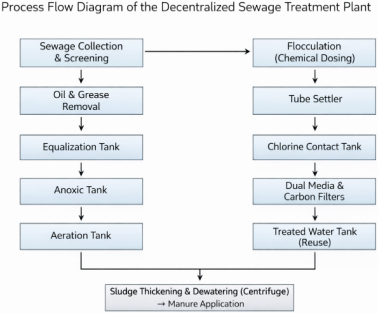
Figure 1. Process flow diagram of the decentralized sewage treatment plant showing major treatment units, sludge handling, and treated water reuse pathways.
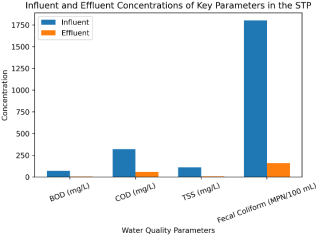
Figure 2. Influent and effluent concentrations of key water quality parameters in the decentralized sewage treatment plant.
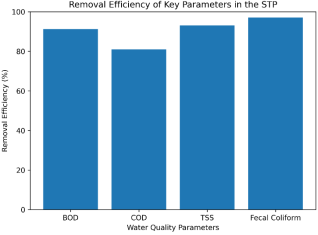
Figure 3. Removal efficiency of key water quality parameters in the decentralized sewage treatment plant.

Information



 Share This Article
 Twitter
 Linked In
 Facebook
 Copy
Copy Download