
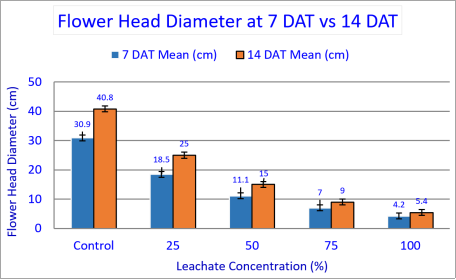
The highly invasive weed Chromolaena odorata (L.) R. M. King & H. Rob. is well known for its strong allelopathic and competitive effects in agricultural ecosystems. The current study investigated the negative impact on the growth of three economically important crops—rice (Oryza sativa L.), moong dal (Vigna radiata L.), and sunflower (Helianthus annuus L.)—when grown in proximity to weeds. Laboratory experiments compared crop growth with and without C. odorata. The results revealed significant suppression of crop growth due to the weed's antagonistic effects. Among the crops, moong dal was most sensitive, with a 80% decrease in growth, followed by rice, which experienced a 72% reduction. In sunflowers, reproductive development was especially affected, with an 60% decrease in head size compared to control plants. These inhibitory effects are likely caused by allelopathic compounds released by C. odorata through root exudates and decomposing residues. These chemicals may interfere with normal physiological and developmental processes in neighboring crops. Overall, the findings highlight the ecological dominance of C. odorata and its potential to reduce crop yields in agricultural systems. Understanding these crop–weed interactions is crucial for developing effective weed management strategies to minimize yield losses and promote sustainable farming practices.
| Published in |
American Journal of Science, Engineering and Technology (Volume 11, Issue 4)
This article belongs to the Special Issue Advances in Translational Research, Biotechnology, and Sustainable Bio-Innovations |
| DOI | 10.11648/j.ajset.20261104.11 |
| Page(s) | 246-251 |
| Creative Commons |
This is an Open Access article, distributed under the terms of the Creative Commons Attribution 4.0 International License (http://creativecommons.org/licenses/by/4.0/), which permits unrestricted use, distribution and reproduction in any medium or format, provided the original work is properly cited. |
| Copyright |
Copyright © The Author(s), 2026. Published by Science Publishing Group |
Chromolaena Odorata, Allelopathy, Crop-weed Interaction, Growth Inhibition
Leachate Concentration | Length of the stem (in cm) | Length of the Root (in cm) | Area of leaf (in cm2) | |||
|---|---|---|---|---|---|---|
7DAT | 14DAT | 7 DAT | 14DAT | 7 DAT | 14DAT | |
Control | 8.4±1.2 | 21.2±1.2 | 5.2 ±1.2 | 11.9 ±1.2 | 60.2±1.2 | 82.5±1.2 |
25 | 6.7±1 | 17±1 | 4.2 ±1 | 9.5 ±1 | 48.2±1 | 66.0±1 |
50 | 5.4±0.8 | 13.6±0.8 | 3.4 ±0.8 | 7.6 ±0.8 | 39.0±0.8 | 52.8±0.8 |
75 | 4.32±0.6 | 10.9±0.6 | 2.7 ±0.6 | 6.1 ±0.6 | 31.2±0.6 | 42.2±0.6 |
100 | 3.4±0.5 | 8.7±0.5 | 2.1 ±0.5 | 4.9 ±0.5 | 25±0.5 | 34.0±0.5 |
Leachate Concentration | Length of the stem (in cm) | Length of the Root (in cm) | Area of leaf (in cm2) | |||
|---|---|---|---|---|---|---|
7DAT | 14DAT | 7 DAT | 14DAT | 7 DAT | 14DAT | |
Control | 8.4±1.2 | 21.2±1.2 | 5.2 ±1.2 | 11.9 ±1.2 | 30.2±1.2 | 45.6±1.2 |
25 | 6±1 | 15.2±1 | 3.7±1 | 8.6 ±1 | 21.7±1 | 32.9±1 |
50 | 4.3±0.9 | 11±0.9 | 2.7 ±0.9 | 6.2 ±0.9 | 15.6±0.9 | 15.6±0.9 |
75 | 3.1±0.8 | 7.9±0.8 | 1.9 ±0.8 | 4.5±0.8 | 11.2±0.8 | 11.2±0.8 |
100 | 2.2±0.6 | 5.7±0.6 | 1.4 ±0.6 | 3.2 ±0.6 | 8.1±0.6 | 12.3±0.6 |
Leachate Concentration | Length of the stem (in cm) | Length of the Root (in cm) | Area of leaf (in cm2) | |||
|---|---|---|---|---|---|---|
7 DAT | 14 DAT | 7 DAT | 14 DAT | 7 DAT | 14 DAT | |
Control | 8.4±1.2 | 21.2±1.2 | 5.2 ±1.2 | 11.9 ±1.2 | 30.2±1.2 | 45.6±1.2 |
25 | 6±1 | 15.2±1 | 3.7±1 | 8.6 ±1 | 21.7±1 | 32.9±1 |
50 | 4.3±0.9 | 11±0.9 | 2.7 ±0.9 | 6.2 ±0.9 | 15.6±0.9 | 15.6±0.9 |
75 | 3.1±0.8 | 7.9±0.8 | 1.9 ±0.8 | 4.5±0.8 | 11.2±0.8 | 11.2±0.8 |
100 | 2.2±0.6 | 5.7±0.6 | 1.4 ±0.6 | 3.2 ±0.6 | 8.1±0.6 | 12.3±0.6 |
DAT | Days After Treatment |
CRD | Completely Randomized Design |
SEM | Standard Error of Mean |
| [1] | Kong, C., Li, Z., Li, F., Xia, X., & Wang, P. (2024). Chemically mediated Plant–Plant interactions: allelopathy and allelobiosis. Plants, 13(5), 626. |
| [2] | Cheng, F., & Cheng, Z. (2015). Research Progress on the Use of Plant Allelopathy in Agriculture and the Physiological and Ecological Mechanisms of Allelopathy. Frontiers in Plant Science, 6, 1020. |
| [3] | Sengupta, R., & Dash, S. S. (2024). Allelopathic impact of Chromolaena odorata on the local crops in Mizoram, India. Research in Ecology, 12–21. |
| [4] | Indrianingsih, A. W., Ahla, M. F. F., Windarsih, A., Suratno, Wiyono, T., Noviana, E., Fadzhillah, N. A., & Alfiani, R. N. (2025). Phytochemical Constituent of Devil Weed (Chromolaena odorata), Concurrent with Its Antioxidant, α-Glucosidase Inhibitory, and Antibacterial Activity. Molecules, 30(21), 4314. |
| [5] | Otabor, J. I., Egbon, I., Toews, M. D., & Uyi, O. (2025). The Double-Edged Sword: Local Perspectives on the Spread, Impact, Management, and Uses of the Invasive Chromolaena odorata in Southern Nigeria. Sustainability, 17(8), 3514. |
| [6] | Rai, P. K., & Singh, J. S. (2024). Ecological insights and environmental threats of invasive alien plant Chromolaena odorata: Prospects for sustainable management. Weed Biology and Management, 24(1), 15–37. |
| [7] | Kanase, V., & Shaikh, S. (2018). A Pharmacognostic And Pharmacological Review On Chromolaena odorata (Siam Weed). Asian Journal of Pharmaceutical and Clinical Research, 11(10), 34. |
| [8] | Omokhua, A. G., McGaw, L. J., Finnie, J. F., & Van Staden, J. (2015). Chromolaena odorata (L.) R. M. King & H. Rob. (Asteraceae) in sub-Saharan Africa: A synthesis and review of its medicinal potential. Journal of Ethnopharmacology, 183, 112–122. |
| [9] | Zahara, M. (2019). Description of Chromolaena odorata L. R. M King and H. Robinson as a medicinal plant: A Review. IOP Conference Series Materials Science and Engineering, 506, 012022. |
| [10] | Rao, K. S., Chaudhury, P. K., & Pradhan, A. (2009). Evaluation of anti-oxidant activities and total phenolic content of Chromolaena odorata. Food and Chemical Toxicology, 48(2), 729–732. |
| [11] | Magar, A. B., Shrestha, D., Pakka, S., & Sharma, K. R. (2023). Phytochemistry, Biological, and Toxicity Study on Aqueous and Methanol Extracts of Chromolaena odorata. The Scientific World JOURNAL, 2023, 1–11. |
| [12] | Putri, D. A., & Fatmawati, S. (2019). A New Flavanone as a Potent Antioxidant Isolated from Chromolaena odorata L. Leaves. Evidence-based Complementary and Alternative Medicine, 2019, 1–12. |
| [13] | Hardianti, B., Amin, A., Lallo, S., & Hertati, A. (2024). Phytochemical composition by GC–MS, In vitro Antioxidant, In silico chemically active compound of Chromolaena odorata L. weed extract targeting EGFR as Anti-Lung Cancer. Research Journal of Pharmacy and Technology, 6020–6031. |
| [14] | Giang, P. M., Huong, D. T. V., Thao, V. M., Thuy, T. T. T., & Trang, V. M. (2024). Flavonoids from the Leaves of Chromolaena odorata and their α-Glucosidase Inhibitory Activity. Pharmaceutical Chemistry Journal, 57(10), 1621–1626. |
| [15] | Vijayaraghavan, K., Rajkumar, J., & Seyed, M. A. (2018). Phytochemical screening, free radical scavenging, and antimicrobial potential of Chromolaena odorata leaf extracts against pathogenic bacterium in wound infections– a multispectrum perspective. Biocatalysis and Agricultural Biotechnology, 15, 103–112. |
| [16] | Phetburom, N., Chopjitt, P., Dulyasucharit, R., Nontunha, N., Daenprakhom, K., Ongarj, P., Hatachote, S., Srichaijaroonpong, S., Hatrongjit, R., Kerdsin, A., & Boueroy, P. (2025). Antimicrobial activity of Chromolaena odorata crude extracts against Streptococcus suis. Microbial Pathogenesis, 206, 107799. |
APA Style
Mohanty, A., Das, M., Gantayat, P. K. (2026). Allelopathic Effect of Chromolaena odorata (L.) R. M. King & H. Rob. on Neighboring Crop P lants. American Journal of Science, Engineering and Technology, 11(4), 246-251. https://doi.org/10.11648/j.ajset.20261104.11
ACS Style
Mohanty, A.; Das, M.; Gantayat, P. K. Allelopathic Effect of Chromolaena odorata (L.) R. M. King & H. Rob. on Neighboring Crop P lants. Am. J. Sci. Eng. Technol. 2026, 11(4), 246-251. doi: 10.11648/j.ajset.20261104.11
@article{10.11648/j.ajset.20261104.11,
  author = {Aishwarya Mohanty and Manoja Das and Prasanna Kumar Gantayat},
  title = {Allelopathic Effect of Chromolaena odorata (L.) R. M. King & H. Rob. on Neighboring Crop P lants},
  journal = {American Journal of Science, Engineering and Technology},
  volume = {11},
  number = {4},
  pages = {246-251},
  doi = {10.11648/j.ajset.20261104.11},
  url = {https://doi.org/10.11648/j.ajset.20261104.11},
  eprint = {https://article.sciencepublishinggroup.com/pdf/10.11648.j.ajset.20261104.11},
  abstract = {The highly invasive weed Chromolaena odorata (L.) R. M. King & H. Rob. is well known for its strong allelopathic and competitive effects in agricultural ecosystems. The current study investigated the negative impact on the growth of three economically important crops—rice (Oryza sativa L.), moong dal (Vigna radiata L.), and sunflower (Helianthus annuus L.)—when grown in proximity to weeds. Laboratory experiments compared crop growth with and without C. odorata. The results revealed significant suppression of crop growth due to the weed's antagonistic effects. Among the crops, moong dal was most sensitive, with a 80% decrease in growth, followed by rice, which experienced a 72% reduction. In sunflowers, reproductive development was especially affected, with an 60% decrease in head size compared to control plants. These inhibitory effects are likely caused by allelopathic compounds released by C. odorata through root exudates and decomposing residues. These chemicals may interfere with normal physiological and developmental processes in neighboring crops. Overall, the findings highlight the ecological dominance of C. odorata and its potential to reduce crop yields in agricultural systems. Understanding these crop–weed interactions is crucial for developing effective weed management strategies to minimize yield losses and promote sustainable farming practices.},
 year = {2026}
}
TY  - JOUR
T1  - Allelopathic Effect of Chromolaena odorata (L.) R. M. King & H. Rob. on Neighboring Crop P lants
AU  - Aishwarya Mohanty
AU  - Manoja Das
AU  - Prasanna Kumar Gantayat
Y1  - 2026/10/17
PY  - 2026
N1  - https://doi.org/10.11648/j.ajset.20261104.11
DO  - 10.11648/j.ajset.20261104.11
T2  - American Journal of Science, Engineering and Technology
JF  - American Journal of Science, Engineering and Technology
JO  - American Journal of Science, Engineering and Technology
SP  - 246
EP  - 251
PB  - Science Publishing Group
SN  - 2578-8353
UR  - https://doi.org/10.11648/j.ajset.20261104.11
AB  - The highly invasive weed Chromolaena odorata (L.) R. M. King & H. Rob. is well known for its strong allelopathic and competitive effects in agricultural ecosystems. The current study investigated the negative impact on the growth of three economically important crops—rice (Oryza sativa L.), moong dal (Vigna radiata L.), and sunflower (Helianthus annuus L.)—when grown in proximity to weeds. Laboratory experiments compared crop growth with and without C. odorata. The results revealed significant suppression of crop growth due to the weed's antagonistic effects. Among the crops, moong dal was most sensitive, with a 80% decrease in growth, followed by rice, which experienced a 72% reduction. In sunflowers, reproductive development was especially affected, with an 60% decrease in head size compared to control plants. These inhibitory effects are likely caused by allelopathic compounds released by C. odorata through root exudates and decomposing residues. These chemicals may interfere with normal physiological and developmental processes in neighboring crops. Overall, the findings highlight the ecological dominance of C. odorata and its potential to reduce crop yields in agricultural systems. Understanding these crop–weed interactions is crucial for developing effective weed management strategies to minimize yield losses and promote sustainable farming practices.
VL  - 11
IS  - 4
ER  -
Department of Biotechnology, Gandhi Institute of Engineering and Technology University, Gunupur, India
Biography: Aishwarya Mohanty is a dedicated Ph.D. researcher scholar in Botany at GIET University. Her work explores the allelopathic effects of Chromolaena odorata and its impact on plant growth and ecological interactions. During her doctoral research, she studies the plant's bioactive compounds and phytochemicals to evaluate their potential for use in agriculture and environmental management. Her research aims to contribute to sustainable weed control and to natural, plant based methods of growth regulation. Mrs. Mohanty is actively involved in both laboratory and field research, dedicated to advancing botanical science through innovative and impactful studies. Her academic focus and scientific approach highlight her strong interest in plant physiology, ecology, and applied biotechnology.
Research Fields: Microbiology, Plant physiology

Department of Biotechnology, Gandhi Institute of Engineering and Technology University, Gunupur, India
Biography: Manoja Das is a prominent academic and researcher, currently leading the Department of Biotechnology at Gandhi Institute of Engineering and Technology University, Odisha, Gunupur. With extensive experience in biotech research, teaching, and administration, he has made significant contributions to nanobiotechnology, microbial biotechnology, natural products, and plant biotechnology. His research primarily focuses on green nanoparticle synthesis, probiotics, phytochemical analysis, and the development of bio-functional materials for healthcare and agriculture. Dr. Das has published extensively in reputable national and international journals and mentors' students at all levels. He has led numerous projects funded by DBT, BIRAC, MSME, and AICTE.
Research Fields: Plant Biotechnology, Microbiology, Plant physiology

Department of Biotechnology, Rayagada Autonomous College, Rayagada, India
Biography: Prasanna Kumar Gantayat, PhD, D.Sc, is a distinguished academician and educationist celebrated for his dedicated service to higher education in Odisha. He served as the Principal of Rayagada Autonomous College, where he contributed significantly to academic growth, institutional management, and student support. With decades of experience in teaching and educational leadership, Dr. Gantayat has been instrumental in enhancing the academic environment and fostering quality education in the region. Under his leadership, the college advanced in academics, infrastructure, and extracurricular activities. He is highly regarded by colleagues, students, and the academic community for his disciplined nature, visionary guidance, and unwavering commitment to education. Dr. Gantayat continues to motivate young scholars and educators through his scholarly work and social engagement. He has authored numerous research articles in various journals and magazines. His lifelong dedication to education has earned him widespread recognition and respect within Odisha's academic circles.
Research Fields: Microbiology, Biotechnology, Plant physiology


Information



 Share This Article
 Twitter
 Linked In
 Facebook
 Copy
Copy Download