
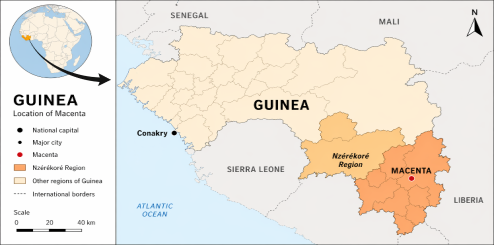
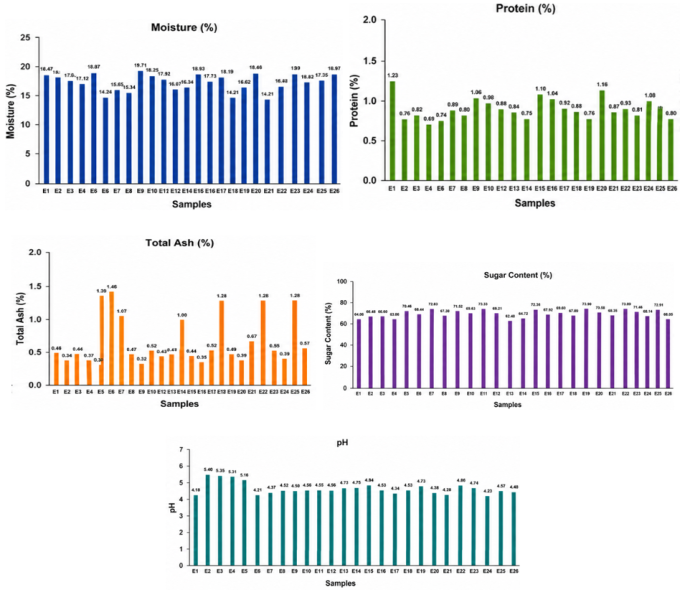
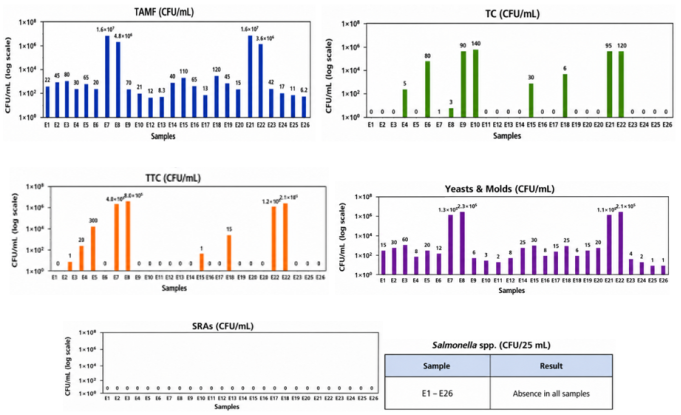
This study aimed to evaluate the physicochemical and microbiological quality of honey marketed in the urban commune of Macenta (Guinea). A total of twenty-six (26) honey samples were collected and analyzed using standardized methods. Physicochemical results showed that moisture content ranged from 14.09% to 17.95%, generally complying with the recommended limit (<18%), indicating good storage stability. The pH values, ranging from 3.63 to 5.04, reflect the acidic nature of honey, which is favorable for preservation. Sugar content (62.50%-76.25%) indicates a good energy value, although lower values in some samples may suggest incomplete ripening. Total ash content (0.24%-1.21%) reflects variability related to botanical origin or possible external contamination. From a microbiological perspective, most samples exhibited low to moderate total aerobic mesophilic flora counts (101-102 CFU/mL), indicating overall acceptable quality. However, some samples showed high microbial loads (≈104 CFU/mL), associated with the presence of total and thermotolerant coliforms, suggesting environmental contamination and inadequate hygienic practices. High levels of yeasts and molds were also observed in these samples, indicating a potential risk of spoilage. In contrast, sulfite-reducing anaerobes and Salmonella were absent in all samples. In conclusion, honey marketed in Macenta shows generally satisfactory physicochemical quality but heterogeneous microbiological quality. Strengthening good hygienic practices and improving storage conditions are necessary to ensure product safety and quality.
| Published in | World Journal of Food Science and Technology (Volume 10, Issue 3) |
| DOI | 10.11648/j.wjfst.20261003.12 |
| Page(s) | 77-87 |
| Creative Commons |
This is an Open Access article, distributed under the terms of the Creative Commons Attribution 4.0 International License (http://creativecommons.org/licenses/by/4.0/), which permits unrestricted use, distribution and reproduction in any medium or format, provided the original work is properly cited. |
| Copyright |
Copyright © The Author(s), 2026. Published by Science Publishing Group |
Honey, Physicochemical Properties, Microbiological Quality, Food Safety, Guinea
TAMF (CFU/mL) | Total Aerobic Mesophilic Flora, Expressed in Colony-forming Units Per Millilitre |
TC (CFU/mL) | Total Coliforms, Expressed in Colony-forming Units Per Millilitre |
TTC (CFU/mL) | Thermotolerant Coliforms, Expressed in Colony-forming Units Per Millilitre |
YM (CFU/mL) | Yeasts and Molds, Expressed in Colony-forming Units Per Millilitre |
SRA (CFU/mL) | Sulfite-reducing Anaerobes, Expressed in Colony-forming Units Per Millilitre |
SAL (CFU/25 mL) | Salmonella Spp., Expressed in Colony-forming Units Per 25 Ml of Sample |
| [1] | Albu A, Bora FD, Cucu-Man S-M, et al (2025) Assessing Honey Quality: A Focus on Some Physicochemical Parameters of Honey from Iasi County (Romania). Agriculture 15: 333. |
| [2] | Rysha A, Kastrati G, Biber L, et al (2022) Evaluating the Physicochemical Properties of Some Kosovo’s and Imported Honey Samples. Applied Sciences 12: 629. |
| [3] | Vázquez-Quiñones CR, Moreno-Terrazas R, Natividad-Bonifacio I, et al. (2018) Microbiological assessment of honey in Mexico. Revista Argentina de Microbiología. 50: 75-80. |
| [4] | Al-Waili N, Salom K, Al-Ghamdi A, Ansari MJ (2012) Antibiotic, Pesticide, and Microbial Contaminants of Honey: Human Health Hazards. The Scientific World Journal 2012: 1-9. |
| [5] | Luca L, Pauliuc D, Oroian M (2024) Honey microbiota, methods for determining the microbiological composition and the antimicrobial effect of honey - A review. Food Chemistry: X 23: 101524. |
| [6] | Guerzou M, Aouissi HA, Guerzou A, et al (2021) From the Beehives: Identification and Comparison of Physicochemical Properties of Algerian Honey. Resources 10: 94. |
| [7] | Mohamad Ghazali NS, Yusof YA, Mohd Ghazali H, et al (2021) Effect of surface area of clay pots on physicochemical and microbiological properties of stingless bee (Geniotrigona thoracica) honey. Food Bioscience 40: 100839. |
| [8] | Gajek M, Moj K, Wysocki P, et al (2026) Analysis of Changes in Selected Physicochemical Parameters and Elemental Composition of Honey as a Result of Adulteration with Sugar Additives. Foods 15: 562. |
| [9] | Ogwu MC, Izah SC (2025) Honey as a Natural Antimicrobial. Antibiotics 14: 255. |
| [10] | Bruxel F, Geller AM, Felice AG, et al (2025) Microbial Contamination in Commercial Honey: Insights for Food Safety and Quality Control. Microbiology Research 16: 128. |
| [11] | Snowdon JA, Cliver DO (1996) Microorganisms in honey. International Journal of Food Microbiology 31: 1-26. |
| [12] | Bakary C, Masse D, Ibrahim K, Guichard BL (2019) Microbiological quality, physicochemical properties, and sensory profile of honeys from the Worodougou region, Côte d’Ivoire. ESJ 15: |
| [13] | Babarinde GO, Babarinde SA, Adegbola DO, Ajayeoba SI (2011) Effects of harvesting methods on physicochemical and microbial qualities of honey. J Food Sci Technol 48: 628-634. |
| [14] | Nzeh J, Quansah L, Dufailu OA (2022) Physicochemical properties of imported and locally produced honey did not translate into its microbial quality and antibacterial activity. Discov Food 2: 24. |
| [15] | Nabeneza S, Porphyre V, Davrieux F (2015) Characterization of honeys from the Indian Ocean region by near-infrared spectroscopy: feasibility study. Rev Elev Med Vet Pays Trop 67: 130-132. |
| [16] | Ucuncu O, Kul MK, Baltaci C, Aykoc AM (2025) Physicochemical properties of fifteen flower honey samples from five districts in Türkiye. Sci Rep 16: 1233. |
| [17] | Polatidou K, Nouska C, Tananaki C, et al (2025) Physicochemical and Rheological Characteristics of Monofloral Honeys—Kinetics of Creaming-Crystallization. Foods 14: 1835. |
| [18] | Oroian M, Paduret S, Amariei S, Gutt G (2016) Chemical composition and temperature influence on honey texture properties. J Food Sci Technol 53: 431-440. |
| [19] | White JW, Rudyj ON (1978) The Protein Content of Honey. Journal of Apicultural Research 17: 234-238. |
| [20] | Cucu A-A, Baci G-M, Moise AR, et al (2021) Towards a Better Understanding of Nutritional and Therapeutic Effects of Honey and Their Applications in Apitherapy. Applied Sciences 11: 4190. |
| [21] | Khan SU, Anjum SI, Rahman K, et al (2018) Honey: Single food stuff comprises many drugs. Saudi Journal of Biological Sciences 25: 320-325. |
| [22] | Zammit Young G-W, Blundell R (2023) A review on the phytochemical composition and health applications of honey. Heliyon 9: e12507. |
| [23] | Lewoyehu M, Amare M (2019) Comparative Assessment on Selected Physicochemical Parameters and Antioxidant and Antimicrobial Activities of Honey Samples from Selected Districts of the Amhara and Tigray Regions, Ethiopia. International Journal of Food Science 2019: 1-10. |
| [24] | Rababah T, Al-U’datt M, Naqresh A, et al (2024) Effect of Temperature and Time on the Physicochemical and Sensory Properties of Crystallized Honey. ACS Omega 9: 20243-20252. |
| [25] | Bonte F, Desmouliere A (2013) Honey: Origin and Composition. Pharmaceutical News. 52: 18-21. |
| [26] | Waworuntu J (2024) Sugar Content Composition of Various Types of Honey Produced by Apis Mellifera L.: A Review. jppipa, pendidikan ipa, fisika, biologi, kimia 10: 98-106. |
| [27] | Raweh HSA, Badjah-Hadj-Ahmed AY, Iqbal J, Alqarni AS (2023) Physicochemical Composition of Local and Imported Honeys Associated with Quality Standards. Foods 12: 2181. |
| [28] | Werner A, Laccourreye O (2011) Le miel en oto-rhino-laryngologie : When, why, and how? French Annals of Otorhinolaryngology and Head and Neck Pathology 128: 153-157. |
| [29] | Iurlina MO, Fritz R (2005) Characterization of microorganisms in Argentinean honeys from different sources. International Journal of Food Microbiology 105: 297-304. |
| [30] | Luca L, Pauliuc D, Ursachi F, Oroian M (2025) Physicochemical parameters, microbiological quality, and antibacterial activity of honey from the Bucovina region of Romania. Sci Rep 15: 4358. |
| [31] | Damto T, Kebebe D, Gemeda M (2023) Physicochemical properties and microbial qualities of honey produced by a stingless bee (Meliponula beccarii L.) in the Oromia region, Ethiopia. Cogent Food & Agriculture 9: 2258784. |
| [32] | Fernández LA, Ghilardi C, Hoffmann B, et al (2017) Microbiological quality of honey from the Pampas Region (Argentina) throughout the extraction process. Revista Argentina de Microbiología 49: 55-61. |
| [33] | Kędzierska-Matysek M, Teter A, Daszkiewicz T, Florek M (2023) Microbiological Quality of Polish Artisanal Varietal Honeys. Foods 12: 3349. |
APA Style
Kouyate, S., Ndiaye, N. A., Niang, L., Dieng, M., Traore, A. (2026). Evaluation of the Physicochemical and Microbiological Quality of Honey Marketed in the Urban Commune of Macenta, Guinea. World Journal of Food Science and Technology, 10(3), 77-87. https://doi.org/10.11648/j.wjfst.20261003.12
ACS Style
Kouyate, S.; Ndiaye, N. A.; Niang, L.; Dieng, M.; Traore, A. Evaluation of the Physicochemical and Microbiological Quality of Honey Marketed in the Urban Commune of Macenta, Guinea. World J. Food Sci. Technol. 2026, 10(3), 77-87. doi: 10.11648/j.wjfst.20261003.12
@article{10.11648/j.wjfst.20261003.12,
  author = {Sekou Kouyate and Ndeye Adiara Ndiaye and Lahat Niang and Modou Dieng and Aly Traore},
  title = {Evaluation of the Physicochemical and Microbiological Quality of Honey Marketed in the Urban Commune of Macenta, Guinea},
  journal = {World Journal of Food Science and Technology},
  volume = {10},
  number = {3},
  pages = {77-87},
  doi = {10.11648/j.wjfst.20261003.12},
  url = {https://doi.org/10.11648/j.wjfst.20261003.12},
  eprint = {https://article.sciencepublishinggroup.com/pdf/10.11648.j.wjfst.20261003.12},
  abstract = {This study aimed to evaluate the physicochemical and microbiological quality of honey marketed in the urban commune of Macenta (Guinea). A total of twenty-six (26) honey samples were collected and analyzed using standardized methods. Physicochemical results showed that moisture content ranged from 14.09% to 17.95%, generally complying with the recommended limit (1-102 CFU/mL), indicating overall acceptable quality. However, some samples showed high microbial loads (≈104 CFU/mL), associated with the presence of total and thermotolerant coliforms, suggesting environmental contamination and inadequate hygienic practices. High levels of yeasts and molds were also observed in these samples, indicating a potential risk of spoilage. In contrast, sulfite-reducing anaerobes and Salmonella were absent in all samples. In conclusion, honey marketed in Macenta shows generally satisfactory physicochemical quality but heterogeneous microbiological quality. Strengthening good hygienic practices and improving storage conditions are necessary to ensure product safety and quality.},
 year = {2026}
}
TY  - JOUR
T1  - Evaluation of the Physicochemical and Microbiological Quality of Honey Marketed in the Urban Commune of Macenta, Guinea
AU  - Sekou Kouyate
AU  - Ndeye Adiara Ndiaye
AU  - Lahat Niang
AU  - Modou Dieng
AU  - Aly Traore
Y1  - 2026/11/13
PY  - 2026
N1  - https://doi.org/10.11648/j.wjfst.20261003.12
DO  - 10.11648/j.wjfst.20261003.12
T2  - World Journal of Food Science and Technology
JF  - World Journal of Food Science and Technology
JO  - World Journal of Food Science and Technology
SP  - 77
EP  - 87
PB  - Science Publishing Group
SN  - 2637-6024
UR  - https://doi.org/10.11648/j.wjfst.20261003.12
AB  - This study aimed to evaluate the physicochemical and microbiological quality of honey marketed in the urban commune of Macenta (Guinea). A total of twenty-six (26) honey samples were collected and analyzed using standardized methods. Physicochemical results showed that moisture content ranged from 14.09% to 17.95%, generally complying with the recommended limit (1-102 CFU/mL), indicating overall acceptable quality. However, some samples showed high microbial loads (≈104 CFU/mL), associated with the presence of total and thermotolerant coliforms, suggesting environmental contamination and inadequate hygienic practices. High levels of yeasts and molds were also observed in these samples, indicating a potential risk of spoilage. In contrast, sulfite-reducing anaerobes and Salmonella were absent in all samples. In conclusion, honey marketed in Macenta shows generally satisfactory physicochemical quality but heterogeneous microbiological quality. Strengthening good hygienic practices and improving storage conditions are necessary to ensure product safety and quality.
VL  - 10
IS  - 3
ER  -
Department of Food Technology and Quality Control, Higher Institute of Science and Veterinary Medicine (ISSMV), Dalaba, Republic of Guinea
Biography: Sekou Kouyate is an Assistant Researcher in the Department of Food Technology and Product Control (TCPA) at the Higher Institute of Veterinary Science and Medicine. He obtained his Master’s degree in Quality Management in Bio-Industries from the Higher Polytechnic School (ESP), Cheikh Anta Diop University, in 2024. Recognized for his commitment, rigor, and dedication, Eng. Kouyate, currently a PhD candidate, has been appointed Head of the Physicochemical and Microbiological Laboratory of the institute. He has actively contributed to the microbiological and physicochemical analysis of food products for numerous undergraduate and graduate theses at ISSMV Dalaba, playing a key role in the practical training and scientific development of future professionals in the agri-food sector.
Research Fields: Food quality control, physico-chemical analysis of food, microbiological analysis of food, laboratory management and research, food preservation technology, bio-industrial process management, food product development.

Department of Chemical Engineering and Applied Biology, Higher Polytechnic School / Cheikh Anta Diop University, Dakar, Senegal
Biography: Mme Ndeye Adiara Ndiaye is a Lecturer-Researcher at the Higher Polytechnic School, Cheikh Anta Diop University of Dakar (Senegal). She holds a PhD in Plant and Microbial Biotechnology, specializing in plant breeding. Her multidisciplinary background includes microbiology, biotechnology, quality management, and biological engineering. Her research focuses on applied microbiology, particularly microbiota characterization, food quality, and safety. She uses molecular and analytical techniques to study microbial dynamics in food systems. Her work aims to improve food safety, address public health issues, and promote sustainable agri-food systems. She is actively involved in teaching, research, and supervision of future engineers and researchers
Research Fields: Microbiology and food safety.

Department of Chemical Engineering and Applied Biology, Higher Polytechnic School / Cheikh Anta Diop University, Dakar, Senegal
Biography: Lahat Niang, originally from Ndeme (Diourbel region, Senegal), is an assistant in the Department of Chemical Engineering and Applied Biology at the École Supérieure Polytechnique (ESP) of Cheikh Anta Diop University (UCAD) in Dakar. He holds a bachelor’s degree in Physics and Chemistry from the Faculty of Science and Technology at UCAD. He was admitted through a competitive examination to ESP, where he trained as a food industry engineer. He subsequently worked in the industrial sector as a process engineer and later as a manager of industrial laboratories. He obtained his Ph.D. in Process and Environmental Engineering with highest honors. He is a specialist in industrial and environmental processes. His research focuses mainly on agri-food issues, particularly food safety and processing technologies, and he has authored several scientific publications in this field.
Research Fields: Enhancement and valorization of local agro-food products, Valorization of underutilized plant resources, Agro-food processing and product development, Food science and technology

Department of Chemical Engineering and Applied Biology, Higher Polytechnic School / Cheikh Anta Diop University, Dakar, Senegal
Biography: Modou Dieng was born in Pékesse, Thiès region (Senegal). He completed his secondary education at the Military Prytanée of Saint-Louis, obtaining a bac-calaureate in natural and physical sciences with hon-ors. He pursued higher education at ENSUT (now ESP), earning a DUT in Biological Analyses and a Tech-nologist Engineering diploma in Sanitary Engineering. He later obtained an AEA and a DEA with honors from the Institute of Environmental Sciences. In 2009, he completed a PhD in Animal Production and Biotech-nology at the Inter-State School of Veterinary Sciences and Medicine, graduating with highest honors. He is currently a Lecturer-Researcher at Cheikh Anta Diop University. His teaching includes food microbiology, general microbiology, and waste management. He also serves in key laboratory management roles and has authored around forty scientific publications.

Department of Food Technology and Quality Control, Higher Institute of Science and Veterinary Medicine (ISSMV), Dalaba, Republic of Guinea
Biography: Aly Traore graduated from the Department of Food Technology and Quality Control. He has a solid background in food microbiology, quality control, and food safety. His research interests focus on assessing the microbiological quality of food products, preventing foodborne health risks, and improving agro-food processing methods. He is particularly interested in the safety of locally marketed food products and in developing strategies to reduce contamination. Through his work, he contributes to enhancing food safety and protecting public health within communities.
Research Fields: Microbiological analysis of foods, techniques for counting microorganisms.


Information



 Share This Article
 Twitter
 Linked In
 Facebook

 Copy
 Download