1. Introduction
Vegetable oils play a central role in many sectors, ranging from human nutrition to the cosmetics, pharmaceutical, and energy industries. Despite this diversity of uses, global production remains heavily concentrated around a few widely cultivated species, notably soybeans, oil palm, rapeseed, and sunflower, which reduces the diversification of vegetable oil sources on the international market
. In sub-Saharan Africa, and particularly in Guinea, several local or naturalized oilseed species have largely untapped potential
| [3] | Tchiégang C, Oum MN, Dandjouma AA, Kapseu C (2004) Qualité et stabilité de l’huile extraite par pressage des amandes de Ricinodendron heudelotii (Bail.) Pierre ex Pax pendant la conservation a temp e rature ambiante Clerg. J Food Eng 62 62: 9-77. https://doi.org/10.1016/S0260-8774(03)00172-9 |
[3]
. Their development could contribute to strengthening food security while stimulating the emergence of high-value-added local supply chains
| [4] | Coulibaly M, N’dri, Y D, Kouassi, K N, et al (2018) Impact of traditional extraction processes of Ricinodendron heudelotii seeds kernels on physico-chemical characteristics of extracted oil. J Rech Sci Univ 20: 79-192. |
[4]
.
In some African countries, such as Côte d’Ivoire,
Ricinodendron heudelotii, a forest species whose seeds are traditionally used as a condiment under the name akpi
| [5] | Frederique K, Soro D, Boukachabine K, et al (2025) International Journal of Sustainable Agricultural Research Exploring the potential of Ricinodendron heudelotii and anarcadium occidentale (Cashew nut) oil quality and purity from Ivory Coast Keyword s. Int J Sustain Agric Researc 12: 64-274.
https://doi.org/10.18488/ijsar.v12i4.4640 |
[5]
, is reported to be a promising source of lipids, particularly in rural areas where harvesting and processing still rely on artisanal practices
| [4] | Coulibaly M, N’dri, Y D, Kouassi, K N, et al (2018) Impact of traditional extraction processes of Ricinodendron heudelotii seeds kernels on physico-chemical characteristics of extracted oil. J Rech Sci Univ 20: 79-192. |
| [5] | Frederique K, Soro D, Boukachabine K, et al (2025) International Journal of Sustainable Agricultural Research Exploring the potential of Ricinodendron heudelotii and anarcadium occidentale (Cashew nut) oil quality and purity from Ivory Coast Keyword s. Int J Sustain Agric Researc 12: 64-274.
https://doi.org/10.18488/ijsar.v12i4.4640 |
| [6] | Issaka D, Ferdinan D, Peforo S, et al (2019) Comparative study of fatty acid composition and nervonic acid contents of four tropical s plants: Ricinodendron heudelotii, Cyperus esculentus, Citrullus colocynthis and Irvingia gabonensis from Côte d ’ Ivoir e. African J Biotechnol Full 18: 54-765.
https://doi.org/10.5897/AJB2019.16805 |
[4-6]
. The study of oils extracted from these seeds is of particular interest for local development. From a technological standpoint, determining lipid yields, fatty acid profiles, oxidative stability, and bioactive compound content is an essential step in identifying the potential uses of these oils, whether for food, cosmetic, or artisanal applications
| [5] | Frederique K, Soro D, Boukachabine K, et al (2025) International Journal of Sustainable Agricultural Research Exploring the potential of Ricinodendron heudelotii and anarcadium occidentale (Cashew nut) oil quality and purity from Ivory Coast Keyword s. Int J Sustain Agric Researc 12: 64-274.
https://doi.org/10.18488/ijsar.v12i4.4640 |
[5]
. From a socio-economic perspective, these oilseed resources could represent a significant source of income for rural communities, particularly for women, who are often at the heart of collection, processing and marketing activities
| [5] | Frederique K, Soro D, Boukachabine K, et al (2025) International Journal of Sustainable Agricultural Research Exploring the potential of Ricinodendron heudelotii and anarcadium occidentale (Cashew nut) oil quality and purity from Ivory Coast Keyword s. Int J Sustain Agric Researc 12: 64-274.
https://doi.org/10.18488/ijsar.v12i4.4640 |
[5]
.
The production of reliable data on the physicochemical characteristics of these oils is therefore essential to inform valorization strategies and support local development initiatives based on the principles of sustainability, food sovereignty, public health, and recognition of endogenous African resources. This knowledge will contribute to a better understanding of the potential of these species and can serve as a basis for structuring competitive and resilient local oilseed value chains. Indeed, non-timber forest products constitute a key pillar of livelihood systems in sub-Saharan Africa, where they simultaneously contribute to food security, community health, and the economic stability of rural households
| [7] | Akpovo AH, Fandohan AB, Djossa AB (2022) Conservation and sustainable management of Ricinodendron heudelotii (Baill.) Pierre ex Heckel: knowledge, gaps and perspectives. Abstract: Ricinodendron heudelotii (Baill.) Pierre ex Heckel is a species endemic to tropical forests. Sci Technol Sustain Agric 2: -17. |
| [8] | Moussa AKIEDKEABF (2020) Domestication of Ricinodendron heudelotii (Baill.) Pierre ex Heckel: traditional knowledge, germination and growth of young plants in a controlled environment. 35: 47-269. |
| [9] | Shackleton CM, Pandey AK (2014) Forest Policy and Economics Positioning non-timber forest products on the development agenda. For Policy Econ 38: -7.
https://doi.org/10.1016/j.forpol.2013.07.004 |
| [10] | Asfaw A, Lemenih M, Kassa H, Ewnetu Z (2013) Forest Policy and Economics Importance, determinants and gender dimensions of forest income in eastern highlands of Ethiopia: The case of communities around Jelo Afromontane forest. For Policy Econ 28: -7.
https://doi.org/10.1016/j.forpol.2013.01.005 |
[7-10]
. Their strategic importance stems in particular from the diversity of wild plant species they encompass, many of which remain insufficiently studied despite their considerable nutritional, therapeutic, and commercial potential
| [11] | Mpondo EM, Dibong DS, Flora C, et al (2012) Phenolic plants used by the population of the city of Douala. J Anim &Plant Sci 15: 083-2098. http://www.m.elewa.org/JAPS |
[11]
. Among these resources,
Ricinodendron heudelotii, commonly known as "njansang," occupies a prominent place in the agroforestry systems of Central and West Africa. This species is characterized by an abundant production of oilseeds traditionally used as a condiment in numerous culinary preparations
. Available biochemical data indicate that its kernels contain a high proportion of lipids (45-63%), as well as significant levels of protein and polyunsaturated fatty acids (69.16% and 76.79%)
| [13] | Azocha U, Kofi AR, Abrahams BD (2024) Solvent Extraction and Quality Evaluation of Two Varieties of Njangsa (Ricinodendron Heudelotii) Seed Oil. J Food Technol Nutr Sci 6: -7. https://doi.org/10.47363/jftns/2024(6)172 |
[13]
, including eleostearic acid, known for its beneficial effects on cardiovascular health
| [3] | Tchiégang C, Oum MN, Dandjouma AA, Kapseu C (2004) Qualité et stabilité de l’huile extraite par pressage des amandes de Ricinodendron heudelotii (Bail.) Pierre ex Pax pendant la conservation a temp e rature ambiante Clerg. J Food Eng 62 62: 9-77. https://doi.org/10.1016/S0260-8774(03)00172-9 |
| [7] | Akpovo AH, Fandohan AB, Djossa AB (2022) Conservation and sustainable management of Ricinodendron heudelotii (Baill.) Pierre ex Heckel: knowledge, gaps and perspectives. Abstract: Ricinodendron heudelotii (Baill.) Pierre ex Heckel is a species endemic to tropical forests. Sci Technol Sustain Agric 2: -17. |
| [13] | Azocha U, Kofi AR, Abrahams BD (2024) Solvent Extraction and Quality Evaluation of Two Varieties of Njangsa (Ricinodendron Heudelotii) Seed Oil. J Food Technol Nutr Sci 6: -7. https://doi.org/10.47363/jftns/2024(6)172 |
[3, 7, 13]
. Furthermore, [references omitted] and [references omitted] report that the oil extracted from
R. heudelotii is rich in flavonoids (437.5 mg/100 g), particularly naringenin (187.9 mg/100 g), tannins (399.5 mg/100 g), and saponins (142.6 mg/100 g). These characteristics make
R. heudelotii increasingly attractive to the agri-food, nutraceutical, and pharmaceutical sectors, in a global context marked by the search for new, sustainable plant-based lipid sources
| [4] | Coulibaly M, N’dri, Y D, Kouassi, K N, et al (2018) Impact of traditional extraction processes of Ricinodendron heudelotii seeds kernels on physico-chemical characteristics of extracted oil. J Rech Sci Univ 20: 79-192. |
| [14] | FAO (2017) Guinea's Accelerated Program for Food and Nutritional Security and Sustainable Agricultural Development, 2019-2010. |
[4, 14]
. Despite this potential,
R. heudelotii remains largely untapped in Guinea. Its use is mainly limited to traditional culinary practices, particularly as a thickening and flavoring agent. The lack of expertise in preservation, processing, and extraction techniques leads to significant post-harvest losses, considerably reducing the prospects for economic and nutritional valorization. Unlike other countries in the sub-region, such as Cameroon
| [15] | Nzali HG, Tchiegang C, Sandjon B, Meurens M (2016) Comparison of some physicochemical properties of oil extracted from Ricinodendron heudelotii (Bail.) kernels by UV spectrophotometer. Int J Biosci 8: 3-102.
https://doi.org/10.12692/ijb/8.6.93-102 |
[15]
, Côte d’Ivoire
| [5] | Frederique K, Soro D, Boukachabine K, et al (2025) International Journal of Sustainable Agricultural Research Exploring the potential of Ricinodendron heudelotii and anarcadium occidentale (Cashew nut) oil quality and purity from Ivory Coast Keyword s. Int J Sustain Agric Researc 12: 64-274.
https://doi.org/10.18488/ijsar.v12i4.4640 |
[5]
, Benin, or Senegal, etc., where the species has been the subject of in-depth investigations, no scientific study has yet been conducted in Guinea on the extraction and physicochemical characterization of its oil, particularly within the framework of traditional processes used by local communities. To our knowledge, in Guinea, no scientific study has yet been conducted on the artisanal extraction and physicochemical characterization of its oil, particularly within the framework of traditional processes used by local communities. This scientific gap constitutes a major obstacle to the promotion of the species, even though the valorization of non-timber forest products represents an important lever for income diversification, poverty reduction, and the development of sustainable agroforestry sectors
. The study of
R. heudelotii oil thus appears as a strategic opportunity to strengthen local value chains and promote a resource that remains largely unknown in Guinea.
This study aims, for the first time, to evaluate the effects of storage time and the impact of traditional extraction processes on the physicochemical characteristics of oils from Ricinodendron heudelotii seeds sold in the urban commune of Nzerekore (Republic of Guinea). The study also aims to assess the extent to which these handmade oils conform to quality standards.
2. Materials and Methods
2.1. Presentation of the Study Area
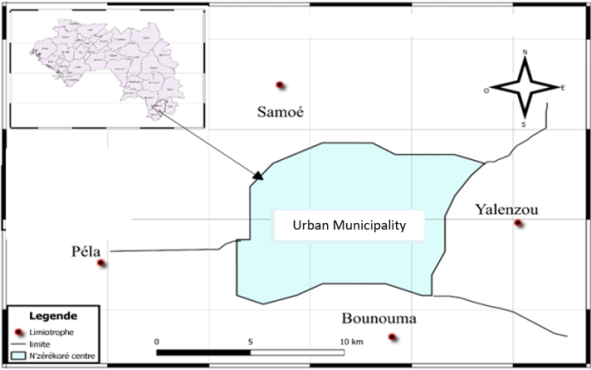
This study was conducted in the Urban Commune of N’Zérékoré (
Figure 1). It is one of the 33 prefectures of the Republic of Guinea, located approximately 1005 km from the capital, Conakry. It lies between 36° and 37°22' North latitude and 8° and 9°9' West longitude. The prefecture comprises approximately ten
| [10] | Asfaw A, Lemenih M, Kassa H, Ewnetu Z (2013) Forest Policy and Economics Importance, determinants and gender dimensions of forest income in eastern highlands of Ethiopia: The case of communities around Jelo Afromontane forest. For Policy Econ 28: -7.
https://doi.org/10.1016/j.forpol.2013.01.005 |
[10]
sub-prefectures within its geographical boundaries. It is bordered to the east by the Prefecture of Lola, to the west by the Prefecture of Macenta, to the north by the Prefecture of Pela, and to the south-south by the Prefecture of Yomou and the Republic of Liberia. It covers an area of 4,625 km
2 with a population of 396,949 inhabitants, representing an average density of 86 inhabitants per km
2 (RGPH-3, 2014). Agriculture plays a very important role among the socio-economic activities of the prefecture.
Figure 1. Map of the urban commune of N’Zerekore.
2.2. Laboratory Equipment Used
Incubator, flat-bottomed porcelain capsule, Erlenmeyer flask, 100 mL beaker, graduated pipette, graduated burette, 20 mL volumetric flask, desiccator, magnetic stirrer, fume hood, analytical balance.
2.3. Chemicals Used
All chemicals used in this study are of analytical grade. Absorbent paper, sodium thiosulfate (0.1N), starch solution, potassium iodide, carbon tetrachloride, phenolphthalein, acetic acid, potassium hydroxide (0.05N).
2.4. Sample Preparation
Targeted sampling was carried out to obtain Ricinodendron heudelotii seeds. These seeds were collected directly from traders at the main market in the urban commune of N’Zerekore. Five (5) kg of samples were purchased on August 20, 2024, and then packaged in opaque plastic bags to limit any alteration due to light. The samples were then grouped in a plastic bag, placed in a clean cooler, and transported to the National Office of Quality Control (ONCQ) laboratory in Matoto for extraction and physicochemical analysis. All necessary measures were taken to ensure the samples arrived at the laboratory in the required condition.
2.5. Oil Extraction
The oil extraction process was carried out in several stages. It involved extracting oil from
Ricinodendron heudelotii using the traditional method in a well-maintained environment and under optimal conditions. The extracted oils were then characterized at the ONCQ laboratory in Matoto. The
R. heudelotii seeds were received and systematically sorted to remove defective grains. After weighing, they were washed and ground to facilitate mixing with potable water. The oil was then heated at 180°C for 45 minutes, followed by separation by adding cold water, allowing the oil to rise to the surface. The oil was then manually collected, cooled to room temperature, and subdivided into four batches in 100 mL shaded glass flasks: the first batch represents the oil at day 1 (H0), and the subsequent batches are aged at days 10 (H10), 20 (H20), and 30 (H30). Details of this extraction are provided in
Table 2.
Table 1. Steps in the oil extraction process of R. heudelotii using the traditional method.
Extraction Steps | Operational Description | Step Objectives |
Seed Reception | Receiving seeds intended for processing. | Ensuring the conformity of the received seeds. |
Sorting | Separation of impurities, debris, and non-compliant seeds. | Ensuring the initial quality of the raw product. |
Weighing | Measuring the mass of the seeds before processing. | Quantifying the raw material for yield monitoring. |
Washing the seeds | Washing with water to remove dust and residue. | Obtaining clean seeds ready for milling. |
Sorting (2) | Final quality check after washing. | Remove damaged or non-compliant seeds. |
Milling | Mechanical grinding of the seeds to obtain a homogeneous paste. | Facilitates oil extraction by breaking down the cells. |
Mixing | Blending and homogenizing the resulting paste. | Promoting the coalescence of the oil droplets. |
Baking (180 °C / 45 min) | Release the oil and improve the separation of the oil/solid phase. | Release the oil and improve the separation of the oil/solid phase. |
Separation | Decantation or pressing to separate the oil from the solid residue. | Extracting the crude oil fraction. |
Oil recovery | Collecting the separated oil into clean containers. | Obtaining the crude oil ready for cooling |
Cooling | Lowering the temperature of the extracted oil. | Stabilizing the product and preventing oxidation. |
Packaging | Bottling or filling containers, labeling, and sealing. | Preparing the product for distribution or sale. |
Storage | Store in a dry, cool, and dark place. | Maintain the quality and shelf life of the finished product. |
2.6. Physicochemical Parameters Measurement
The extracted oils were evaluated over 30 days and samples were taken every 10 days (days 1, 10, 20 and 30) in order to evaluate the effects of storage time and traditional oil extraction techniques.
2.6.1. Moisture Measurement
The moisture content was determined using the method described in French standards (NFT) 60-201/ISO 662-1980. This determination is based on heating a test portion in an oven at 105°C until all water and volatile matter have evaporated, and then determining the mass loss. The procedure involved weighing 5 g of the test portion in a pre-dried and tare-marked capsule, which was placed in an oven set at 104°C for 4 hours, followed by cooling in a desiccator for approximately 15 minutes. A weighing to the nearest 0.0001 g was then performed. The sample was then re-introduced for 30 minutes until the mass loss between two successive weighings did not exceed 2 mg. Finally, a last weighing was performed.
The formula below was used to calculate the moisture content:
M0: mass in grams of the tare capsule;
M1: mass in grams of the tare capsule with the test sample before oven heating;
M2: mass in grams of the tare capsule with the test sample after oven heating.
2.6.2. Acid Value Measurement
The acid value was determined using the method of NFT 60-204/ISO 660-1983. The principle is based on dissolving a test portion in a solvent mixture, then titrating the free fatty acids in the sample with an alcoholic solution of potassium hydroxide. This measurement involves placing 1 g of oil in an Erlenmeyer flask to which 50 mL of ether and 5 drops of phenolphthalein are added. The solution is then neutralized by adding a 0.05 N potassium hydroxide (KOH) solution until a persistent pink color is observed. The acid value is calculated using the formula:
IA: acid value
V: volume in milliliters of potassium hydroxide used;
Pe: mass of the sample expressed in grams, i.e., the test portion;
56.11: molar mass of potassium hydroxide, expressed in g/mol;
N: normality of the potassium hydroxide solution (0.05N).
2.6.3. Peroxide Value Measurement
The method NF T 60-220/ISO 3960-1977 described by Boufelika et al.
| [17] | Codex alimentarius (1999) Standard for vegetable oils with a specific name. International food standards. CODEX STAN 210-1999. |
[17]
was followed with a slight modification to measure the peroxide value (PV). One gram of oil was placed in a pre-dried and stoppered flask. Ten mL of chloroform was then added to rapidly dissolve the sample under stirring. Following this, 15 mL of acetic acid and 1 mL of saturated potassium iodide solution were added. The mixture was stirred magnetically for 1 minute and then incubated for 5 minutes at a temperature between 15°C and 25°C. Finally, 75 mL of distilled water and 1 mL of 1% starch solution were added. The solution was titrated using 0.01 N sodium thiosulfate (Na
2S
2O
3). A blank sample was prepared under the same conditions, except that the sample volume was not to exceed 0.05 mL. The following formula was used to calculate the peroxide value:
V0: volume in mL of the sodium thiosulfate solution used for the blank;
V1: volume in mL of the thiosulfate solution used to titrate the sample;
N: normality of the sodium thiosulfate solution used;
m: mass in grams of the test portion.
2.6.4. Saponification Index Determination
The principle is based on refluxing the sample with an ethanolic solution of potassium hydroxide, followed by titration of the excess potassium hydroxide with a standardized hydrochloric acid solution. It consists of adding 25 mL of ethanolic potassium hydroxide solution and a few boiling regulators to the test sample using a pipette. Connect the reflux condenser to the flask, place the flask on the heating device, and boil gently, stirring occasionally, for 60 minutes, except for high-melting-point fats that are difficult to saponify, for which the boiling time should be two hours. Add 0.5 to 1 mL of phenolphthalein solution to the hot solution and titrate with hydrochloric acid until the pink color of the indicator disappears. If the solution is strongly colored, use 0.5 to 1 mL of alkaline blue solution. A blank test was performed under the same conditions as the samples, also using 25.0 mL of the potassium hydroxide ethanolic solution, but omitting the test portion.
The formula below was used for the calculation of Saponification index:
V0: volume in milliliters of hydrochloric acid used for the blank test;
V1: volume in milliliters of hydrochloric acid used for the determination;
C: exact concentration of hydrochloric acid;
m: mass in grams of the test sample.
2.6.5. Measurement of Insoluble Impurities
The principle of this analysis is based on treating a test sample with an excess of n-hexane or petroleum ether, followed by filtration of the resulting solution. The filter and residue are washed with the same solvent. The sample is then dried at 103°C ± 2°C and weighed. The procedure involves preparing a mixture of 2 g of kieselguhr and approximately 30 mL of petroleum ether in a 100 mL glass beaker. The mixture is then poured into a filtering crucible under reduced pressure to obtain a layer of kieselguhr on the glass filter. The prepared glass filtering crucible is then dried in an oven set at 103°C for 1 hour. It is then allowed to cool in a desiccator and weighed to the nearest 0.001 g.
The formula below is used for the calculation:
M0: mass, in grams, of the test sample;
M1: mass, in grams, of the vessel and its lid and the filter paper containing the dry residue, or of the filter crucible and the dry residue;
M2: mass, in grams, of the vessel and its lid and the filter paper containing the dry residue, or of the filter crucible and the dry residue.
2.6.6. Refractive Index Measurement
The refractive index was measured at 27°C using the CONVEX refractometer model No. O42952, CETI-BELGIUM. The NF T 60-212/ISO 6320-1983 method was used to measure the refractive index. This method involves first setting the refractometer temperature so that it does not deviate by more than 3°C from the reference temperature (40°C for solid oils). Next, clean the refractometer slide using absorbent paper. Calibrate the instrument with distilled water, which has a refractive index of 1.33. Then, clean the refractometer slide again using absorbent paper and place a few drops of the oil to be analyzed onto the slide. When the refractive index measurement is carried out at a temperature not very different from the reference temperature (T), the refractive index is calculated at the reference temperature, hence the expression is:
nd20: refractive index at 40 °C;
ndT: refractive index at the analysis temperature;
T: temperature of the sample during analysis;
40 °C: reference temperature;
F: correction factor depending on temperature (equal to 0.00035 for oils at 20 °C and 0.00036 for solid fats or mixtures of fatty acids at 40 °C).
2.7. Statistical Analysis of Data
Statistical analyses were performed using XLSTAT software (version 2019). Analysis of variance (ANOVA) was conducted to evaluate the effect of storage duration (30 days) on the physicochemical parameters of traditionally extracted oils. To determine the significance of the observed differences, Fisher's exact test was applied as a post-hoc procedure. This test determines whether inter-group variations are statistically robust at a 95% confidence level. Results are expressed as means ± standard deviations, reflecting the dispersion of values around the central tendency and allowing for an assessment of intra-sample variability. A difference was considered statistically significant when the probability associated with the test was less than or equal to p ≤ 0.05.
3. Results
The physicochemical parameters evaluated on the extracted oil samples included the determination of moisture content, saponification value, peroxide value, acid value, insoluble impurities, and refractive index.
3.1. Moisture Measurement
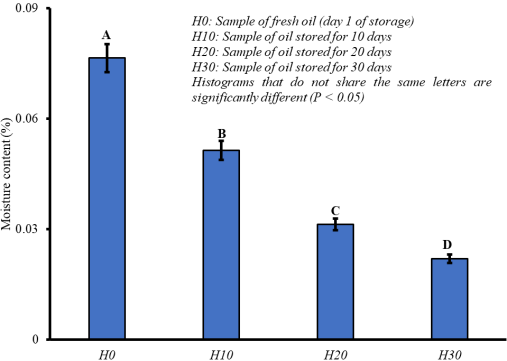
The moisture content found in the extracted oil samples is shown in
Figure 2. The results obtained highlight a progressive decrease in the moisture content of the oils during storage, from 0.076% at the initial time (H0) to 0.022% after 30 days (H30), with an average of 0.047%.
Figure 2. Moisture contents.
3.2. Acid Value Measurement
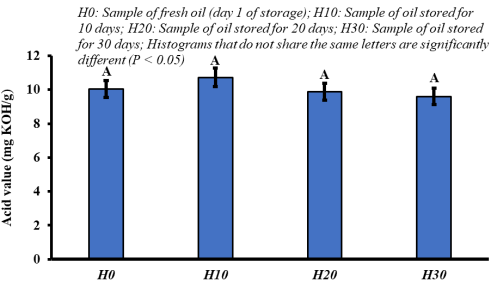
The results of the acid value assessment of the oil samples studied are presented in
Figure 3. The values obtained range from 3.66 to 4.09 mg KOH/g, with an average of 3.93 mg KOH/g. These values show a slight increase in free acidity during storage, particularly notable on day 10 (H10) (4.09 mg KOH/g), before decreasing slightly on day 30 (H30) (3.66 mg KOH/g). This dynamic suggests a transient hydrolysis of triglycerides, followed by stabilization, probably due to endogenous enzymatic activity and storage conditions. Despite this visually observable difference, the analysis of variance (ANOVA) followed by the Fisher test revealed no significant difference between the different storage times at the 95% confidence level. This indicates that, although fluctuations are observed, they do not reflect a statistically robust evolution of free acidity.
3.3. Peroxide Value Measurement
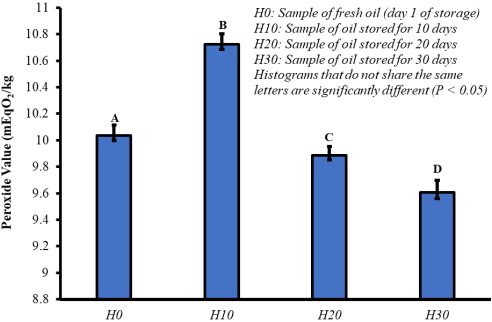
The peroxide value (PV) was determined to assess the oxidation level of the extracted oils, and the results obtained are shown in
Figure 4. The evolution of PV during the storage period (day 0 to day 30) reveals fluctuations between 9.60 and 10.72 mEqO
2/kg. Although the ANOVA did not show significant differences at the 95% confidence level, the capital letters indicated in the results suggest differential trends between the samples, notably a slight increase on day 10 (H0) followed by a gradual decrease until day 30 (H30). This dynamic reflects an initial oxidation phenomenon, probably linked to exposure to oxygen and light, followed by stabilization due to the depletion of oxidizable substrates.
Figure 4. Peroxide values.
3.4. Saponification Index Determination
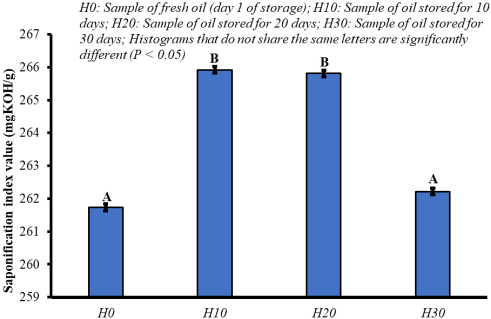
As part of the evaluation of the amount of KOH needed to ensure the complete saponification of the triglycerides present in the oil studied, we determined the saponification value, the values of which are presented in
Figure 5 (mean ± standard deviation). The results obtained were 261.735 ± 1.05; 265.915 ± 1.83; 265.81 ± 1.78; and 262.215 ± 0.33 mg KOH/g on days 0, 10, 20, and 30, respectively. These values highlight a significant influence of storage time on the reactivity of the oils towards potassium hydroxide. The ANOVA, followed by Fisher's exact test at a 95% confidence level, indicates that the samples from day 0 differ significantly from those from days 10 and 20. However, on day 30, the value obtained (262.215 mg KOH/g) is close to that of day 0 (261.735 mg KOH/g) and no longer shows a significant difference.
Figure 5. Saponification index.
3.5. Measurement of Insolubles Impurites and Refractive Index
Table 2 presents the values of impurities and refractive index determined on the extracted oil samples (mean ± standard deviation).
Table 2. Results of insoluble impurity and refractive index values obtained from the samples.
Samples during storage | Impurities | Refractive index |
H0 | 0.088 ± 0.120A | 3.845 ± 0.042B |
H10 | 0.084 ± 0.014B | 4.08 ± 0.021A |
H20 | 0.082 ± 0.007B | 4.015 ± 0.012A |
H30 | 0.088 ± 0.014A | 4.020 ± 0.014A |
H0: Sample of fresh oil (day 1 of storage); H10: Sample of oil stored for 10 days; H20: Sample of oil stored for 20 days; H30: Sample of oil stored for 30 days. The values represent the mean ± standard deviation; n=3; values in the same row that do not share the same letters in the exponent are significantly different (P < 0.05).
Regarding impurities values, the values were found to fluctuate between 0.082% and 0.089% throughout the storage period.
Indeed, the refractive index, the results show that during storage, the values were 3.845 ± 0.042, 4.080 ± 0.020, 4.015 ± 0.012, and 4.020 ± 0.014 on days 1, 10, 20, and 30, respectively. Fisher's exact test revealed a significant difference between the samples from day 1 (H0) and those from subsequent days (10, 20, and 30). However, no statistically significant difference was observed between the samples from days 20 and 30, indicating relative stability of the parameter over the last ten days of storage.
4. Discussion
The moisture content of the extracted oil samples shown in
Figure 2 reveals results below the threshold set by the Codex Alimentarius (CXS 210 1999), which allows up to 0.2%
| [18] | Grosso M, Batista EAC, Sampaio KA, Maximo GJ (2026) Compositional Characterization, Quality Parameters, and Physicochemical and Bioactive Properties of Pequi (Caryocar brasiliense) Oils From Xingu and Cerrado in Mato Grosso, Brazil. J Am Oil Chem Soc 103: 09-622.
https://doi.org/10.1002/aocs.70074 |
[18]
. The moisture contents are lower than those reported by Grosso
et al. | [19] | Emebu S, Osaikhuiwuomwan O, Mankonen A, et al (2022) Influence of moisture content, temperature, and time on free fatty acid in stored crude palm oil. Sci Rep 12: -11.
https://doi.org/10.1038/s41598-022-13998-1 |
[19]
, who obtained contents of 0.16 ± 0.02% and 0.28 ± 0.01% in Pequi oils from the Cerrado and Xingu regions, respectively. This difference could be attributed, on the one hand, to the extraction conditions and, on the other hand, to the effects of storage time, which can significantly influence the water content. Although the 95% confidence interval ANOVA did not reveal a significant difference, the observed trend remains scientifically relevant and warrants discussion in light of previous studies. According to Emebu et
al. , the combination of moisture and temperature accelerates the release of free fatty acids in palm oil, confirming that even low moisture content can compromise quality. Furthermore, Oyem and Oyem,
| [21] | Bruun N, Tesfaye F, Hemming J, et al (2021) Effect of Storage Time on the Physicochemical Properties of Waste Fish Oils and Used Cooking Vegetable Oils. Energiesnergies 14.
https://doi.org/10.3390/en14010101 |
[21]
showed that increased humidity raises peroxide and free fatty acid levels in palm and peanut oils, supporting the idea that water acts as a catalyst for lipid oxidation. In a study on fish and cooking oils, Bruun
et al. reported that prolonged storage leads to an increase in diglycerides and free fatty acids, even at low moisture contents, highlighting the importance of controlling this parameter. Finally, the work of Zhang
et al. | [23] | Deni A, Mohammad B, Revandy, I. M. D, et al (2025) Physicochemical qualities of low-lipase oil palm (Elaeis guineensis Jacq.) during fruit ripening on tree. OCL - Ol Corps Gras Lipides 32: -7. |
[23]
demonstrated that moisture provides a medium for microbial growth, accelerating oil degradation through biological mechanisms. Thus, the trend observed in the studied data, while not statistically significant at the 95% significance level, is consistent with sound scientific principles: low moisture content is essential to limit hydrolysis, oxidation, and microbial proliferation. The conformity of the values obtained to Codex standards confirms the quality of the oils and their suitability for long-term storage.
The acidity values shown in
Figure 3 are higher than those reported by Grosso
et al. | [19] | Emebu S, Osaikhuiwuomwan O, Mankonen A, et al (2022) Influence of moisture content, temperature, and time on free fatty acid in stored crude palm oil. Sci Rep 12: -11.
https://doi.org/10.1038/s41598-022-13998-1 |
[19]
, who obtained acidity values of 1.36 ± 0.01 mg KOH/kg and 2.09 ± 0.03 mg KOH/kg in pequi oils from the Cerrado and Xingu regions, respectively. This variation could be attributed to the extraction method and the effects of storage time. In contrast, our results are similar to those reported by Deni
et al. | [24] | Cuvelier M, Maillard M, Cuvelier M, et al (2012) Stability of edible oils during storage. Archives-ouvertes.fr 19: 25-132. |
[24]
, who noted that the variability in acidity levels can be strongly influenced by post-harvest and drying conditions, but can also remain within stable ranges when the oils are stored under the required conditions. Furthermore, by comparing our results to the Codex Alimentarius standards (≤ 4.0 mg KOH/g)
| [18] | Grosso M, Batista EAC, Sampaio KA, Maximo GJ (2026) Compositional Characterization, Quality Parameters, and Physicochemical and Bioactive Properties of Pequi (Caryocar brasiliense) Oils From Xingu and Cerrado in Mato Grosso, Brazil. J Am Oil Chem Soc 103: 09-622.
https://doi.org/10.1002/aocs.70074 |
[18]
, it turns out that the values obtained are at the upper limit, which would be due to a triggering of the hydrolysis process as reported by Cuvelier et
al. | [25] | Coulibaly M, Adam, Camille K, Denis, Yao N, et al (2018) Effect of Post-Harvest Traditional Technologies on the Nutrient Content and Antioxidant Compounds of Defatted Flours from Ricinodendron heudelotti (Baill. Pierre ex Pax) Seed Kernels. Technologies 6: -16.
https://doi.org/10.3390/technologies6020037 |
[25]
. However, our results remain significantly lower than the results reported by Immaculate,
| [8] | Moussa AKIEDKEABF (2020) Domestication of Ricinodendron heudelotii (Baill.) Pierre ex Heckel: traditional knowledge, germination and growth of young plants in a controlled environment. 35: 47-269. |
[8]
on
Ricinidendron heudelotii seed oil, where an average of 10.17 ± 0.02 mg KOH/g was observed. This difference can be attributed to the endogenous lipase of the fruits before harvest, post-harvest management methods and techniques, as well as the quality of drying and clarification which are determining factors in the stability of the oils. In addition, the trend observed in this study corroborates the work of Coulibaly et
al. , which indicates that the increase in the acid index is often linked to poor conduct of the drying and storage stages, favoring the hydrolysis of triglycerides. The relative stability of the values obtained in our study suggests that the conservation conditions have limited the intensity of the phenomenon, despite a slight occasional increase.
The
Figure 4 presents the peroxide value values determined for the samples during the storage period. The values obtained differ from those reported by Coulibaly
et al. , who observed higher concentrations (17.7 ± 0.9 mEqO
2/kg) in oils obtained by traditional extraction from
Ricinodendron heudelotii kernels. This discrepancy can be attributed to differences in extraction technologies, storage conditions, and often, poor storage practices, which promote oxidation. Furthermore, Magdalena
et al. reported that the exposure time of the kernels before extraction, as well as the temperature and cooking time, strongly influence the oxidative stability of the oils. These parameters could explain the conformity of the current results to international standards. In addition, Purdom
et al. | [28] | Ake AY, Anon N., Kouame P, et al (2014) Assessment of the Exposure to Benzo(a) Pyrene (BaP) Contained in Sardines (Clupeidae) Consumed by the Ivorian Adult in the Area of Abidjan. IJSR: 2455-2461. |
[28]
emphasize that fat oxidation is strongly initiated by oxygen and light, which supports the hypothesis of increased sensitivity of samples to storage conditions. Thus, the evolution observed during storage, although not statistically significant, illustrates the complexity of lipid oxidation mechanisms and underscores the importance of technological and environmental conditions for preserving oil quality.
The saponification value values are within the reference range established by the Codex Alimentarius for coconut oil, i.e., 248 to 265 mg KOH/g. However, they are higher than those reported by Coulibaly et al.
| [4] | Coulibaly M, N’dri, Y D, Kouassi, K N, et al (2018) Impact of traditional extraction processes of Ricinodendron heudelotii seeds kernels on physico-chemical characteristics of extracted oil. J Rech Sci Univ 20: 79-192. |
[4]
, who observed values ranging from 163.13 ± 15.8 to 202.3 ± 6.2 mg KOH/g in a study on the impact of traditional extraction processes of
Ricinodendron heudelotii kernels on the physicochemical characteristics of the oil obtained. Such variation could be attributed to the samples and extraction techniques. Similarly, our results are higher than those of Ake et al.
| [29] | Adome NF, Chadare FJ, Honfo F (2022) Composition, nutritional value, and uses of Ricinodendron heudelotii, Vitex doniana, and Cleome gynandra seed oil, three indigenous oil species sources of omega 3, 6, and 9 fatty acids: A review. Eng Reports 1-14. https://doi.org/10.1002/eng2.12507 |
[29]
, whose study of seven wild food species from west-central Côte d'Ivoire revealed an average of 169.50 mg KOH/g. Conversely, the values measured in our samples remain lower than those reported by Adome et al.
| [30] | Nutioils Pvt Ltd (2026) Global Analysis of Insoluble Impurity Limits in Edible Fats and Oils: Regulatory Standards, Analytical Methodologies, and Commercial Implications. |
[30]
, who documented saponification indices ranging from 104.20 to 190.50 mg KOH/g. The differences observed between our results and those in the literature could be explained by several factors, including edaphic and climatic conditions, which can influence the lipid composition of the seeds; the saturated fatty acid content, which can modulate reactivity towards potassium hydroxide; the extraction processes applied, particularly artisanal versus mechanized techniques; and the nature of the solvents used during extraction, which determine the purity and final composition of the oil
| [15] | Nzali HG, Tchiegang C, Sandjon B, Meurens M (2016) Comparison of some physicochemical properties of oil extracted from Ricinodendron heudelotii (Bail.) kernels by UV spectrophotometer. Int J Biosci 8: 3-102.
https://doi.org/10.12692/ijb/8.6.93-102 |
[15]
.
Regarding impurities values, the values were found to fluctuate between 0.082% and 0.089% throughout the storage period. The values obtained ranged between 0.082% and 0.089% throughout the storage period and are higher than the threshold set by the Codex Alimentarius, which must be ≤ 0.05%
| [18] | Grosso M, Batista EAC, Sampaio KA, Maximo GJ (2026) Compositional Characterization, Quality Parameters, and Physicochemical and Bioactive Properties of Pequi (Caryocar brasiliense) Oils From Xingu and Cerrado in Mato Grosso, Brazil. J Am Oil Chem Soc 103: 09-622.
https://doi.org/10.1002/aocs.70074 |
[18]
. Although these levels slightly exceed the standard, they remain low and do not compromise the product's sanitary quality. Furthermore, the absence of significant differences between the samples (p > 0.05) suggests that the storage period did not have a marked effect on the impurity content. This stability may be due to the efficiency of the filtration system and the storage conditions, as also reported by Coulibaly
et al. in their studies on traditional oils. Furthermore, comparative studies on soybean and rapeseed oils confirm that the insoluble impurity content is more influenced by the extraction and refining processes than by storage time, which corroborates the observations of
| [31] | Yao NJC, Amissa, Augustin A, Bobelé, Florence N, et al (2018) Antioxidant activity, physicochemical properties and retinol and α-tocopherol composition of refined palm oil and oils from six oilseed plants in Côte d'Ivoire. Afrique Sci 14: 5-27. |
[31]
.
Regarding the refractive index, the results corroborate the observations of Tchiégang
et al. | [3] | Tchiégang C, Oum MN, Dandjouma AA, Kapseu C (2004) Qualité et stabilité de l’huile extraite par pressage des amandes de Ricinodendron heudelotii (Bail.) Pierre ex Pax pendant la conservation a temp e rature ambiante Clerg. J Food Eng 62 62: 9-77. https://doi.org/10.1016/S0260-8774(03)00172-9 |
[3]
, who found no significant difference in their work on local vegetable oils. The values obtained in the present study remain slightly lower than those reported by Yao
et al. | [32] | Simo K, Césaire T, Albert DJ, Sastile MN (2019) Study of the Origin and Identity of Some Types of Refined Vegetable Oils Marketed in Douala / Cameroon. Rev L’Académie des Sci du Cameroun 15: 5-38. https://doi.org/10.4314/jcas.v15i1.3 |
[32]
(1.499 ± 0.001) for refined oils, suggesting an influence of insoluble impurities and extraction residues. This hypothesis is corroborated by the work of Simo
et al. | [33] | Diakite K, Diagouraga S, Diawara M, Fane M (2012) Study of the physicochemical parameters of cottonseed oils produced in the CMDT zone in Mali. Int J Biol Chem Sci 6: 320-1330. https://doi.org/10.4314/ijbcs.v16i3.33 |
[33]
, who showed that the presence of insoluble particles and technological residues directly affects the optical properties of unrefined oils. The absence of significant variation between samples during storage confirms the physicochemical robustness of this parameter, reflecting a homogeneous lipid composition and low sensitivity to storage conditions. These results align with the conclusions of Diakite
et al. | [34] | Mukhametov A, Mamayeva L, Kazhymurat A, Akhlan T (2023) Food Chemistry: X Study of vegetable oils and their blends using infrared reflectance spectroscopy and refractometry. Food Chem X 17: 00386.
https://doi.org/10.1016/j.fochx.2022.100386 |
[34]
, who demonstrated that the refractive index is strongly influenced by lipid composition, extraction processes, and measurement temperature, and that it constitutes a determining criterion for the purity of edible oils. More recent research, notably that of Mukhametov
et al. on sunflower oil and Xu and Li,
| [36] | Delphin, Justin RR (2013) Production and analysis of essential oils from aromatic and medicinal plants of Madagascar. Characterization by 13C NMR, GC(Ir) and GC-MS. Master's thesis, Faculty of Sciences, University of Antananarivo, Madagascar. |
[36]
on corn oil, confirm that the refractive index varies according to the proportion of polyunsaturated fatty acids, reinforcing the idea that the discrepancies observed in this study are attributable to technological processes and extraction conditions. It should also be emphasized that inadequate storage conditions can induce variations in the refractive index. In the absence of appropriate measures, the progressive degradation of oils is promoted by chemical reactions such as triglyceride hydrolysis and fatty acid oxidation
| [34] | Mukhametov A, Mamayeva L, Kazhymurat A, Akhlan T (2023) Food Chemistry: X Study of vegetable oils and their blends using infrared reflectance spectroscopy and refractometry. Food Chem X 17: 00386.
https://doi.org/10.1016/j.fochx.2022.100386 |
[34]
. These alterations lead to a loss of essential physicochemical characteristics and compromise the product's sanitary quality, rendering it unfit for human consumption. Finally, other studies have emphasized the role of the refractive index as an indicator of stability and quality in lipid systems
| [37] | Diakite, K., Diagouraga, S., Diawara, M., & Fane, M. (2012). Study of the physicochemical parameters of cottonseed oils produced in the CMDT zone in Mali. International Journal of Biological and Chemical Sciences, 6, 1320–1330.
https://doi.org/10.4314/ijbcs.v16i3.33 |
[37]
and
| [4] | Coulibaly M, N’dri, Y D, Kouassi, K N, et al (2018) Impact of traditional extraction processes of Ricinodendron heudelotii seeds kernels on physico-chemical characteristics of extracted oil. J Rech Sci Univ 20: 79-192. |
[4]
. This work, combined with the results obtained here, reinforces the idea that this parameter is a relevant analytical tool for assessing oil quality, both in terms of purity and the detection of storage-related alterations.





 Share This Article
 Twitter
 Linked In
 Facebook
 Copy
Copy Download