
Rapid socioeconomic developments have spurred urban sprawl in Nepal. Bharatpur Metropolitan City (BMC) in recent decades, resulting in notable changes to the land use and environment. Using Landsat images and GIS-based methods, this study examines the spatial and temporal dynamics of urban sprawl from 1990 to 2020 and projects future growth through 2040. Built-up areas expanded by over 20 times, from 3.29 km2 in 1990 to 64.32 km2 in 2020, according to the Land Use and Land Cover (LULC) categorization. At the same time, there was a significant amount of land conversion as agricultural land decreased from 221.88 km2 to 193.90 km2 and barren land decreased by more than 60%. Three predominant types of urban sprawl were found: leapfrog (important within 0–30 km buffers), infill (8.94 km2), and extension (103.48 km2). The most common areas for extension-type sprawl were those between 0 and 5 km. Built-up area is expected to rise by 132% from 2020 levels to 113.25 km2 by 2030 and 149.33 km2 by 2040, according to spatiotemporal analysis and CA-Markov modelling. By 2040, this growth is expected to further reduce the amount of agricultural land to 118.78 km2. These results underline how urgently urban planning interventions are needed to manage haphazard development, protect arable land, and direct sustainable growth. The study shows how important it is to combine predictive modelling, spatial analysis, and remote sensing to inform land use regulations in areas that are rapidly becoming more urbanized.
| Published in | Urban and Regional Planning (Volume 11, Issue 2) |
| DOI | 10.11648/j.urp.20261102.11 |
| Page(s) | 96-109 |
| Creative Commons |
This is an Open Access article, distributed under the terms of the Creative Commons Attribution 4.0 International License (http://creativecommons.org/licenses/by/4.0/), which permits unrestricted use, distribution and reproduction in any medium or format, provided the original work is properly cited. |
| Copyright |
Copyright © The Author(s), 2026. Published by Science Publishing Group |
Urban Sprawl, LULC, RS and GIS, CA-Markov Modeling, Bharatpur Metropolitan City
Year | 1990 | 2000 | 2010 | 2020 |
|---|---|---|---|---|
Land Use | Area (Km2) | |||
Agriculture Land | 221.88 | 238.38 | 233.08 | 193.90 |
Barren Land | 12.14 | 8.92 | 18.18 | 4.88 |
Built-up Area | 3.29 | 6.79 | 17.28 | 64.32 |
Forest Land | 192.08 | 174.98 | 159.70 | 164.02 |
Water Bodies | 3.56 | 3.87 | 4.71 | 5.84 |
AHP | Analytical Hierarchy Process |
BMC | Bharatpur Metropolitan City |
CA | Cellular Automata |
CBS | Central Bureau of Statistics |
DEM | Digital Elevation Model |
GIS | Geographic Information System |
LCM | Land Change Modeller |
LULC | Land Use Land Cover |
OLI | Operational Land Imager |
RS | Remote Sensing |
TIRS | Thermal Infrared Sensor |
UGM | Urban Growth Model |
ULAT | Urban Landscape Analysis Tool |
| [1] | B. Bhatta, “Analysis of Urban Growth and Sprawl from Remote Sensing Data,” pp. 14–26, Jan. 2010, |
| [2] | S. Allah Yar, “Study of Urban Sprawl and its Social and Environmental Impacts on Urban Society in Latifabad Town, Hyderabad, Pakistan,” J Civil Environ Eng, vol. 07, no. 06, p. 6, 2017, |
| [3] | R. M. Chitrakar, D. C. Baker, and M. Guaralda, “Urban growth and development of contemporary neighborhood public space in Kathmandu Valley, Nepal,” Habitat International, vol. 53, pp. 30–38, Apr. 2016, |
| [4] | S. Bakrania, “Urbanisation and urban growth in Nepal,” GSDRC, University of Birmingham, Birmingham, UK: GSDRC, University of Birmingham., GSDRC Helpdesk Research Report, Oct. 2015. Accessed: Oct. 03, 2021. Available: |
| [5] | G. Metternicht, A. Sabelli, and J. Spensley, “Climate change vulnerability, impact and adaptation assessment: Lessons from Latin America,” International Journal of Climate Change Strategies and Management, vol. 6, no. 4, pp. 442–476, Nov. 2014, |
| [6] | BMC, “Welcome to Bharatpur Metropolitan City,” Bharatpur Metropolitan City Office of Municipal Executive, Bharatpur, 2018. |
| [7] | CBS, “National Population and Housing Census 2011,” Nepal, National Report, 2011. Accessed: Mar. 15, 2021. Available: |
| [8] | E. Muzzini and G. Aparicio, Urban Growth and Spatial Transition in Nepal. The World Bank, 2013. |
| [9] | B. Antalyn and V. P. A. Weerasinghe, “Assessment of Urban Sprawl and Its Impacts on Rural Landmasses of Colombo District: A Study Based on Remote Sensing and GIS Techniques,” Asia-Pacific Journal of Rural Development, vol. 30, no. 1–2, pp. 139–154, Dec. 2020, |
| [10] | B. Rimal, L. Zhang, D. Fu, R. Kunwar, and Y. Zhai, “Monitoring Urban Growth and the Nepal Earthquake 2015 for Sustainability of Kathmandu Valley, Nepal,” Land, vol. 6, no. 2, p. 42, Jun. 2017, |
| [11] | Z. Shao, N. S. Sumari, A. Portnov, F. Ujoh, W. Musakwa, and P. J. Mandela, “Urban sprawl and its impact on sustainable urban development: a combination of remote sensing and social media data,” Geo-spatial Information Science, pp. 1–15, Jul. 2020, |
| [12] |
B. S. Almeida, “A GIS Assessment of Urban Sprawl in Richmond, Virginia,” Virginia Polytechnic Institute and State University, Blacksburg, VA 24060 10 May 2005, 2005. Accessed: May 03, 2020. Available:
https://vtechworks.lib.vt.edu/bitstream/handle/10919/33264/AlmeidaThesis.pdf?sequence=1 |
| [13] | L. Gervasoni, M. Bosch, S. Fenet, and P. Sturm, “Calculating spatial urban sprawl indices using open data,” p. 23, 2017. |
| [14] | N. Falah, A. Karimi, and A. T. Harandi, “Urban growth modeling using cellular automata model and AHP (case study: Qazvin city),” Model. Earth Syst. Environ., vol. 6, no. 1, pp. 235–248, Mar. 2020, |
| [15] | T. Litman, “Analysis of Public Policies That Unintentionally Encourage and Subsidize Urban Sprawl,” Victoria Transport Policy Institute, Canada, Mar. 2015. Accessed: May 03, 2021. Available: |
| [16] | W. Suwal, “A Study of Land Use Planning Practices and the Relationship Between Population Distribution and Transportation Infrastructure in Kathmandu, Nepal.” p. 95, 2009. |
| [17] |
H. B. Wakode, “Analysis of Urban Growth and Assessment of Impact of Urbanization on Water Resources- A Case Study of Hyderabad, India,” RWTH Aachen University, Templergraben 55, 52062 Aachen, Germany, 2016. Accessed: Apr. 15, 2021. Available:
http://publications.rwth-aachen.de/record/570520/files/570520.pdf |
| [18] | R. Pendall, “Do Land-Use Controls Cause Sprawl?,” Environment and Planning B: Planning and Design, vol. 26, no. 4, pp. 555–571, 1999, |
| [19] | J. Carruthers and G. Ulfarsson, “Fragmentation and Sprawl: Evidence from Interregional Analysis,” Growth and Change, vol. 33, pp. 312–340, Jun. 2002, |
| [20] | J. K. Brueckner, “Urban Sprawl: Diagnosis and Remedies,” International Regional Science Review, vol. 23, no. 2, pp. 160–171, Apr. 2000, |
| [21] | S. Jaquet, T. Kohler, and G. Schwilch, “Labour Migration in the Middle Hills of Nepal: Consequences on Land Management Strategies,” Sustainability, vol. 11, no. 5, pp. 1–19, Mar. 2019, |
| [22] | T. Noszczyk, “A review of approaches to land use changes modeling,” Human and Ecological Risk Assessment, vol. 25, pp. 1377–1405, Aug. 2019, |
| [23] | A. Ishtiaque, M. Shrestha, and N. Chhetri, “Rapid Urban Growth in the Kathmandu Valley, Nepal: Monitoring Land Use Land Cover Dynamics of a Himalayan City with Landsat Imageries,” Environments, vol. 4, no. 4, p. 72, Oct. 2017, |
| [24] | P. H. Verburg et al., “Land system science and sustainable development of the earth system: A global land project perspective,” Anthropocene, vol. 12, pp. 29–41, 2015, |
| [25] | O. Gillham, O. G. A. S. MacLean, A. S. MacLean, and I. Press, The Limitless City: A Primer on the Urban Sprawl Debate. Island Press, 2002. Available: |
| [26] | T. Zhang, “Community features and urban sprawl: the case of the Chicago metropolitan region,” Land Use Policy, vol. 18, no. 3, pp. 221–232, 2001, |
| [27] | M. Kasanko et al., “Are European cities becoming dispersed?: A comparative analysis of 15 European urban areas,” Landscape and Urban Planning, vol. 77, no. 1, pp. 111–130, 2006, |
| [28] | G. Galster, R. Hanson, M. Ratcliffe, H. Wolman, S. Coleman, and J. Freihage, “Wrestling Sprawl to the Ground: Defining and Measuring an Elusive Concept,” Housing Policy Debate, vol. 12, pp. 681–717, 2001, |
| [29] | P. Nikolov, “A Survey of Bulgarian (National) Planning and Regulation Acts and Documents Concerning Urban Sprawl,” presented at the 2nd International Scientific Conference, Bulgaria, May 2013, pp. 2–12. Available: |
| [30] | P. Christiansen and T. Loftsgarden, “Drivers behind urban sprawl in Europe,” Institute of Transport Economics (TØI), pp. 1–29, 2011. |
| [31] | R. B. Thapa and Y. Murayama, “Scenario-based urban growth allocation in Kathmandu Valley, Nepal,” Landscape and Urban Planning, vol. 105, no. 1–2, pp. 140–148, Mar. 2012, |
| [32] | X. Li, L. Yang, Y. Ren, H. Li, and Z. Wang, “Impacts of Urban Sprawl on Soil Resources in the Changchun−Jilin Economic Zone, China, 2000−2015,” Int J Environ Res Public Health, vol. 15, no. 6, p. 1186, Jun. 2018, |
| [33] | K. Lynch, Theory of Good City, 2nd ed. MIT Press, Cambridge, MA, 1984. Available: |
| [34] | L. Feyen and R. Dankers, “Impact of global warming on streamflow drought in Europe,” J. Geophys. Res., vol. 114, no. D17, pp. 1–17, Sep. 2009, |
| [35] | J. R. Kenworthy and F. B. Laube, “Patterns of automobile dependence in cities: an international overview of key physical and economic dimensions with some implications for urban policy,” Transportation Research Part A: Policy and Practice, vol. 33, no. 7–8, pp. 691–723, 1999. |
| [36] | J. Hirschhorn, “Environment, Quality of Life, and Urban Growth in the New Economy,” Environmental Quality Management, vol. 10, pp. 1–8, Apr. 2001, |
| [37] |
M. Kahn, “The Environmental Impact of Suburbanization,” Journal of Policy Analysis and Management, vol. 19, pp. 569–586, Sep. 2000,
https://doi.org/10.1002/1520-6688(200023)19:4<569::AID-PAM3>3.0.CO;2-P |
| [38] | T. J. Nechyba and R. P. Walsh, “Urban Sprawl,” Journal of Economic Perspectives, vol. 18, no. 4, pp. 177–200, 2004. |
| [39] | R. B. Thapa and Y. Murayama, “Urban growth modeling of Kathmandu metropolitan region, Nepal,” Computers, Environment, and Urban Systems, vol. 35, no. 1, pp. 25–34, Jan. 2011, |
| [40] | C. Xu, M. Liu, C. Zhang, S. An, W. Yu, and J. M. Chen, “The spatiotemporal dynamics of rapid urban growth in the Nanjing metropolitan region of China,” Landscape Ecol, vol. 22, no. 6, pp. 925–937, May 2007, |
| [41] | R. A. Francis and M. A. Chadwick, “Urban Ecosystems Understanding the Human Environment,” London, Mar. 2013, |
| [42] | C. Dietzel, M. Herold, J. J. Hemphill, and K. C. Clarke, “Spatio‐temporal dynamics in California’s Central Valley: Empirical links to urban theory,” International Journal of Geographical Information Science, vol. 19, no. 2, pp. 175–195, 2005, |
| [43] | G.-J. Knaap and E. Talen, “New Urbanism and Smart Growth: A Few Words from the Academy,” International Regional Science Review - INT REG SCI REV, vol. 28, pp. 107–118, Apr. 2005, |
| [44] | Y. Song and G.-J. Knaap, “Measuring Urban Form: Is Portland Winning the War on Sprawl?,” Journal of the American Planning Association, vol. 70, pp. 210–225, Jun. 2004, |
| [45] | Y. Song, “Smart Growth and Urban Development Pattern: A Comparative Study,” International Regional Science Review, vol. 28, pp. 239–265, Apr. 2005, |
| [46] | F. K. Benfield, M. Raimi, and D. Chen, “Once There Were Greenfields: How Urban Sprawl is Undermining America’s Environment, Economy, and Social Fabric,” 1999. |
| [47] | R. E. Heimlich and W. D. Anderson, “Development at the Urban Fringe and Beyond: Impacts on Agriculture and Rural Land,” p. 88, 2001. |
| [48] | Torrens and Alberti - Measuring Sprawl. |
| [49] | Y.-H. Tsai, “Quantifying Urban Form: Compactness versus ‘Sprawl,’” Urban Studies, vol. 42, no. 1, pp. 141–161, Jan. 2005, |
| [50] | S. Angel, J. Parent, and D. Civco, “Urban Sprawl Metrics: An Analysis of Global Urban Expansion Using GIS,” p. 12, 2007. |
| [51] | M. Batty, E. Besussi, and N. Chin, “Traffic, urban growth, and suburban sprawl,” 2003. |
| [52] | E. Besussi, N. Chin, M. Batty, and P. Longley, “Chapter 2 The Structure and Form of Urban Settlements,” 2017. |
| [53] |
R. P. Jason, “Urban Landscape Analysis Tool,” Center for Land Use Education & Research, 2009.
https://clear.uconn.edu/tools/ugat/index.htm (accessed Jul. 09, 2021). |
| [54] | P. M. Torrens and M. Alberti, “Measuring Sprawl,” p. 34. |
| [55] | L. A. Mantelas, P. Prastacos, and T. Hatzichristos, “Modeling Urban Growth using Fuzzy Cellular Automata,” p. 12, 2008. |
| [56] | Y. Feng, Y. Liu, X. Tong, M. Liu, and S. Deng, “Modeling dynamic urban growth using cellular automata and particle swarm optimization rules,” Landscape and Urban Planning - LANDSCAPE URBAN PLAN, vol. 102, pp. 188–196, Sep. 2011, |
| [57] | A. E. Pravitasari, E. Rustiadi, S. P. Mulya, Y. Setiawan, L. N. Fuadina, and A. Murtadho, “Identifying the driving forces of urban expansion and its environmental impact in Jakarta-Bandung mega-urban region,” IOP Conf. Ser.: Earth Environ. Sci., vol. 149, p. 012044, May 2018, |
| [58] | K. Kityuttachai, N. Tripathi, T. Tipdecho, and R. Shrestha, “CA-Markov Analysis of Constrained Coastal Urban Growth Modeling: Hua Hin Seaside City, Thailand,” Sustainability, vol. 5, no. 4, pp. 1480–1500, Apr. 2013, |
| [59] | P. K. Mallupattu and J. R. Sreenivasula Reddy, “Analysis of Land Use/Land Cover Changes Using Remote Sensing Data and GIS at an Urban Area, Tirupati, India,” The Scientific World Journal, vol. 2013, pp. 1–6, 2013, |
APA Style
Lamichhane, S. (2026). Geospatial Modeling of Urban Sprawl in Bharatpur Metropolitan City. Urban and Regional Planning, 11(2), 96-109. https://doi.org/10.11648/j.urp.20261102.11
ACS Style
Lamichhane, S. Geospatial Modeling of Urban Sprawl in Bharatpur Metropolitan City. Urban Reg. Plan. 2026, 11(2), 96-109. doi: 10.11648/j.urp.20261102.11
@article{10.11648/j.urp.20261102.11,
  author = {Sadhuram Lamichhane},
  title = {Geospatial Modeling of Urban Sprawl in Bharatpur Metropolitan City},
  journal = {Urban and Regional Planning},
  volume = {11},
  number = {2},
  pages = {96-109},
  doi = {10.11648/j.urp.20261102.11},
  url = {https://doi.org/10.11648/j.urp.20261102.11},
  eprint = {https://article.sciencepublishinggroup.com/pdf/10.11648.j.urp.20261102.11},
  abstract = {Rapid socioeconomic developments have spurred urban sprawl in Nepal. Bharatpur Metropolitan City (BMC) in recent decades, resulting in notable changes to the land use and environment. Using Landsat images and GIS-based methods, this study examines the spatial and temporal dynamics of urban sprawl from 1990 to 2020 and projects future growth through 2040. Built-up areas expanded by over 20 times, from 3.29 km2 in 1990 to 64.32 km2 in 2020, according to the Land Use and Land Cover (LULC) categorization. At the same time, there was a significant amount of land conversion as agricultural land decreased from 221.88 km2 to 193.90 km2 and barren land decreased by more than 60%. Three predominant types of urban sprawl were found: leapfrog (important within 0–30 km buffers), infill (8.94 km2), and extension (103.48 km2). The most common areas for extension-type sprawl were those between 0 and 5 km. Built-up area is expected to rise by 132% from 2020 levels to 113.25 km2 by 2030 and 149.33 km2 by 2040, according to spatiotemporal analysis and CA-Markov modelling. By 2040, this growth is expected to further reduce the amount of agricultural land to 118.78 km2. These results underline how urgently urban planning interventions are needed to manage haphazard development, protect arable land, and direct sustainable growth. The study shows how important it is to combine predictive modelling, spatial analysis, and remote sensing to inform land use regulations in areas that are rapidly becoming more urbanized.},
 year = {2026}
}
TY  - JOUR
T1  - Geospatial Modeling of Urban Sprawl in Bharatpur Metropolitan City
AU  - Sadhuram Lamichhane
Y1  - 2026/04/28
PY  - 2026
N1  - https://doi.org/10.11648/j.urp.20261102.11
DO  - 10.11648/j.urp.20261102.11
T2  - Urban and Regional Planning
JF  - Urban and Regional Planning
JO  - Urban and Regional Planning
SP  - 96
EP  - 109
PB  - Science Publishing Group
SN  - 2575-1697
UR  - https://doi.org/10.11648/j.urp.20261102.11
AB  - Rapid socioeconomic developments have spurred urban sprawl in Nepal. Bharatpur Metropolitan City (BMC) in recent decades, resulting in notable changes to the land use and environment. Using Landsat images and GIS-based methods, this study examines the spatial and temporal dynamics of urban sprawl from 1990 to 2020 and projects future growth through 2040. Built-up areas expanded by over 20 times, from 3.29 km2 in 1990 to 64.32 km2 in 2020, according to the Land Use and Land Cover (LULC) categorization. At the same time, there was a significant amount of land conversion as agricultural land decreased from 221.88 km2 to 193.90 km2 and barren land decreased by more than 60%. Three predominant types of urban sprawl were found: leapfrog (important within 0–30 km buffers), infill (8.94 km2), and extension (103.48 km2). The most common areas for extension-type sprawl were those between 0 and 5 km. Built-up area is expected to rise by 132% from 2020 levels to 113.25 km2 by 2030 and 149.33 km2 by 2040, according to spatiotemporal analysis and CA-Markov modelling. By 2040, this growth is expected to further reduce the amount of agricultural land to 118.78 km2. These results underline how urgently urban planning interventions are needed to manage haphazard development, protect arable land, and direct sustainable growth. The study shows how important it is to combine predictive modelling, spatial analysis, and remote sensing to inform land use regulations in areas that are rapidly becoming more urbanized.
VL  - 11
IS  - 2
ER  -
Department of Civil Engineering, Universal Engineering and Science College, Lalitpur, Nepal
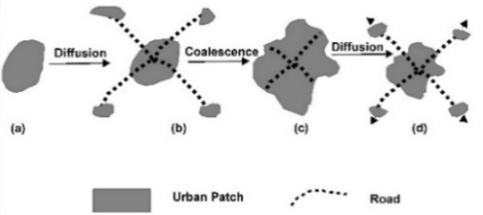
Figure 1. Hypothetical sequence of the spatial evolution of an urban area.
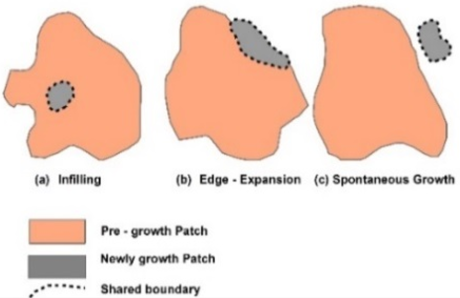
Figure 2. Three urban growth types.
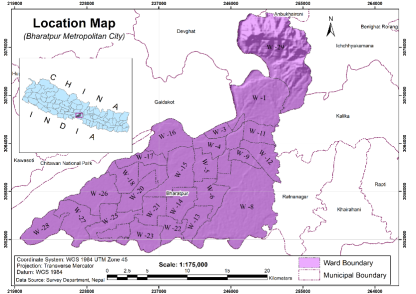
Figure 3. Location map of Bharatpur Metropolitan City.
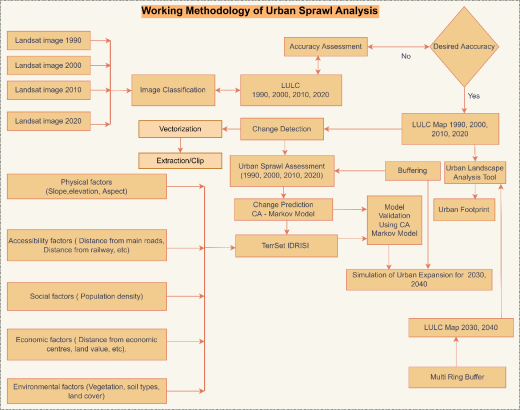
Figure 4. Schematic presentation of Methodology.
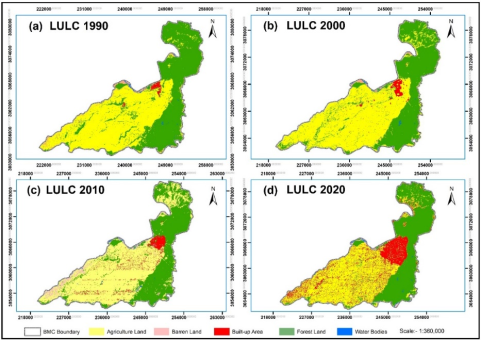
Figure 5. LULC maps for 1990, 2000, 2010, and 2020 of Bharatpur Metropolitan City.
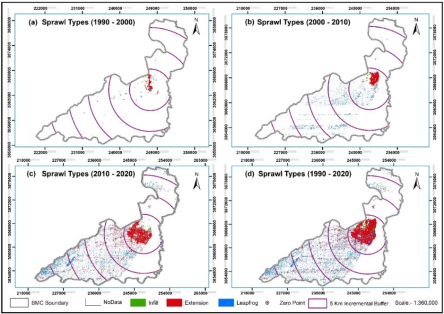
Figure 6. Urban sprawl types for the study period.
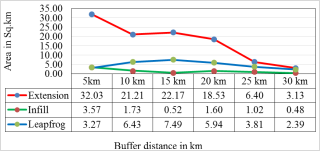
Figure 7. Types of Urban Sprawl within 5 km incremental buffer (1990 - 2020).
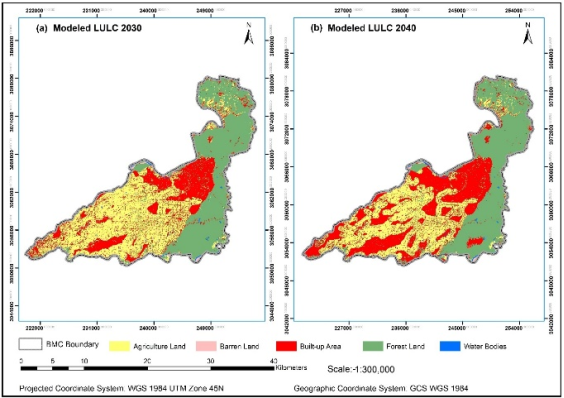
Figure 8. Modeled LULC of 2030 and 2040.
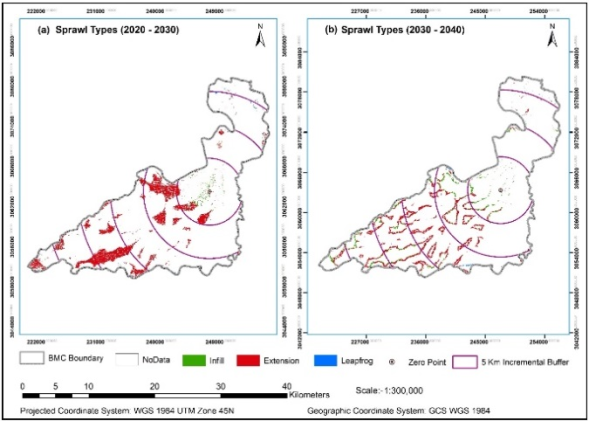
Figure 9. Types of Urban Sprawl from 2020 to 2040.
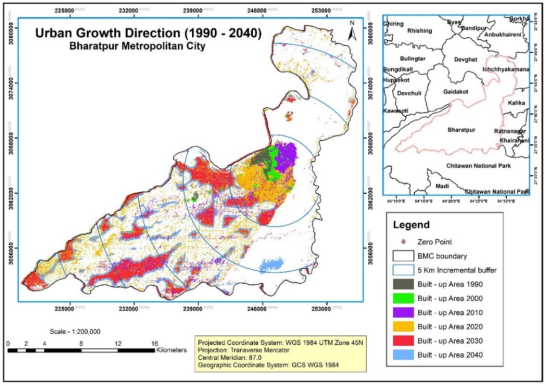
Figure 10. Direction of Urban Sprawl from 1990 to 2040.

Information



 Share This Article
 Twitter
 Linked In
 Facebook
 Copy
Copy Download