Abstract
In the context of a globalized world with its crossing dimensions, the philosophy that bridges cultures is known by various names: intercultural and transcultural philosophy, comparative philosophy, global philosophy, international philosophy, and so on. This article focuses specifically on comparative philosophy: chapter 1. Chapter 2: As Ch. A. Moore in the US in the middle of the 20th century represented, Comparative reflection accompanies every step of philosophy. Yet, in the past, comparative thinking often amounted to only a selective listing of similarities and differences, with further steps in dialectical confrontation frequently lacking. In what respects did these similarities or differences between the two thinkers and their intellectual horizons arise? Is there another aspect to their integration? This article presents the methodological construction beginning with the example of Plato and Laozi. Chapter 3: The discourse explains the methodological framework for constructing comparative philosophy in general schemes. Clarifying its methodology and originality, the discourse concentrates on the dynamics from the initial stage through dynamic development to the highest stadium: the dialectical sublation and integration of both contradictions in acknowledgment of a further problem. However, it does not remain static on Parnassus. With a “beginner’s mind,” it refreshes its content and continues to develop its dialectics systematically, communicating and integrating the human mind deeply and creatively. Chapter 4: The comparative approach is not limited to intercultural and transcultural contexts; it is also currently being applied to other areas, including interdisciplinary philosophy, which will be discussed further in light of the methodology of the Chap. 3. The discourse concludes with a concrete interim assessment in Chapter 5.
|
Published in
|
Science Research (Volume 14, Issue 4)
|
|
DOI
|
10.11648/j.sr.20261404.13
|
|
Page(s)
|
146-152 |
|
Creative Commons
|

This is an Open Access article, distributed under the terms of the Creative Commons Attribution 4.0 International License (http://creativecommons.org/licenses/by/4.0/), which permits unrestricted use, distribution and reproduction in any medium or format, provided the original work is properly cited.
|
|
Copyright
|
Copyright © The Author(s), 2026. Published by Science Publishing Group
|
Keywords
Comparative Philosophy, Comparative Thinking Method, Interactive Reflection East and West, Dialectical Thinking, Autonomous Transformation of Our Thinking, Recognition in Cross-Cultural Dimensions
1. Introduction
Comparative philosophy as an independent field—including its methodological approach—has received intensive attention in German-speaking countries in recent decades. Amid a growing intellectual trend toward a global philosophy, some thinkers have adopted a methodological framework to conceive of a comprehensive universal philosophy for the world. Previously, it seemed that a comparative method of thought—“comparison”—was open to everyone as a simple way of thinking, which often resulted in nothing more than a selective listing of similarities and differences. Such a tendency was especially common in the early years of comparative philosophy, when there was a sense of “wonder” at discovering the contrasts and echoes between different cultures. However, if one remains merely in a state of wonder, this does not give rise to critical-reflective thinking about philosophy. For beginners and laypeople, this initial phase is acceptable, but if one aims at any serious attempt at comparative philosophy then several further steps must be taken, as will be outlined in this article.
After emerging in the United States in the mid-20th century, comparative philosophy began to attract the interest of philosophers in Asia, as well as the Pan-Pacific region in general, in the 1960s. One of the reasons for this was that not all of the categories or key concepts of Asian schools of thought have direct counterparts or similar concepts in Western philosophy. At the same time, numerous comparable concepts appear in different intellectual horizons and structures. If one isolates the Western and Eastern traditions, then a large number of factors still emerge in their individual ideas and key concepts that could lead to integrative interactions between them, to the enrichment of both.
Comparative reflection accompanies every step taken in philosophy, and this was the view of Charles A. Moore, a philosopher at the University of Hawaiʻi, who laid the groundwork for international seminars and conferences on comparative philosophy, with a focus on the East and West as a result of such efforts, comparative philosophy as a sub-discipline became established at the University of Hawaiʻi
| [1] | Moore, Charles Alexander (1967): The Comprehensive Indian Mind, in The Indian Mind—Essential of Indian Philosophy and Culture, Honolulu: University of Hawaiʻi Press, 1-18. |
[1]
(Moore, Charles Alexander: 1-18). Moore (1901-1967) demonstrated his particular approach to thought as the editor and author of the anthology
The Indian Mind (1967), arguing that understanding and recognizing another culture and way of thinking can be a decisive step toward successful reflection in comparative philosophy, through a consideration of the inner and outer worlds, the affirmation and negation of certain expectations, a reflection on one’s own preferences with regard to common assumptions, or an autonomous self-negation of the same, and claiming that such moves can constitute a decisive step toward productive work in comparative philosophy
. [2] (Moore: 9-12)Since then, this field has become better known throughout the world with the publication of the quarterly journal Philosophy East and West, which began in 1951. In response to the argument that “comparison” remains merely a tool of simple thinking in this context, and thus could never be significant for the methodology of philosophy, the following explanation regarding critical reflection is useful. Advocates of a global philosophy who do not recognize comparative philosophy—along with its method of thought—as a scientifically equal school of thought, fall into a self-contradiction: one compares comparative philosophy with one’s own mode of thought by consciously or unconsciously presupposing one’s own as authoritative or, implicitly, as superior. The act of thinking—the comparison of oneself (X) with another (non-X)—is presumably included in this. Yet there is a lack of self-reference in the thought directed back to one’s own thinking.
Excursus: The Question at Hand—Scientific Rigor and Empiricism in Life
The question arises as to whether a “comparison” at the level of philosophy and at the level of mundane, everyday life can in no way be linked: What, then, constitutes scientific rigor concerning the comparative method of thinking?
From the perspective of non-European philosophy, for ex ample, in the schools of thought found in North and East Asia, there is a direct answer to this: there, the prevailing way of thinking is that the recognition of truth should ultimately find a connection in the thinker’s life, so that the recognized truth is incorporated into the thinker’s lived experience. This direct connection between philosophy and life is generally not common in the history of Western philosophy. Exceptions include parts of Christian philosophy and other philosophical schools of thought associated with religion.
2. Identity and Difference in Comparative Philosophy
2.1. The Beginnings of the History of Philosophy: The Case of Plato and Laozi
A comparative philosophy of different cultures demonstrates that, from the outset, the recognition of identity and difference between [A] and [B] occurs sequentially. Viewed from a specific aspect [X, A] and [B] exhibit an identity (or commonality) with one another. From another aspect [Y], the parts of [A] and [B] do indeed show a difference. This recognition of the two basic concepts leads the thinker to a further step: it involves reflexive thinking about the relation between the two concepts—the identity between [A] and [B] through [X] and their difference through the aspect [Y].
Looking back at the history of philosophy, Plato taught the fundamentals of his thought at his
Akadēmia in ancient Greece, as Aristotle recounted in his
Metaphysics | [3] | Aristotle (2007): Metaphysik, Stuttgart: Reclam. [987b]. |
[3]
(Aristotle, [987b]). The beginning of philosophy was marked by the recognition of the “One” and the “indeterminate duality,” the “Great and the Small.” According to Aristotle’s account, the One is a being, a principle that gives form to the unfolding of all thought. The Great and the Small, as a paired concept, belongs to the One as the material with which we can continue to think. In both Plato and Aristotle, philosophy, as scientific thought, is oriented toward the search for causality and the effects of all that exists.
| [4] | Klein, Hans-Dieter (2002), Der Begriff der Seele in Philosophie und Religion (The Concept of the Soul in Philosophy and Religious Science), in Johann Figl, Hans-Dieter Klein (Eds.), Der Begriff der Seele in Religionswissenschaft (The Concept of the Soul in Religious Sciences), Würzburg: Königshausen & Neumann. |
[4]
(Klein, Hans-Dieter, 2002): The Great and the Small now stand in a relationship to one another, and as a paired concept, they stand in a relationship to the One. The Great and Small, as a pair of relative opposites, can be expressed in different ways, such as the Long and Short, the High and Low, the Thick and Thin, and so on.
H.-D. Klein
| [5] | H.-D. Klein (2002): see Cf. Plato, Phaedrus 245d; Aristotle, De anima, III 8, 431b 21: “The soul is, in a sense, all that exists.” |
[5]
(Klein, Hans-Dieter, 2002) argues that the philosophy of ancient Greece was clearly oriented toward scientific thought. Unlike modern and postmodern thought, this scientific approach demonstrated a holistic connection with life. For example, in concepts such as autokinesis in Plato and the psyche (soul) in Aristotle, the soul and life were virtually equated and presented in a holistic context.
In this context, Plato’s One is fundamentally different from Plotinus’s One as the Absolute. For Plato, the One manifests itself, on the one hand, as a specific “unity.” In contrast, there is an “indeterminate duality” of various kinds. The two manifest themselves as sameness and difference, as identity and distinction. However, unlike the categorically clear distinction between identity and difference in Aristotle
| [6] | Aristotle (2007): Metaphysik, Book Delta [1018a]: the same and the different, the identical and the distinct, the differentiated and the diverse; Cf. [987b]. |
[6]
(Aristotle,
Metaphysics, [1018a]). Plato has left the two (the One and the indeterminate duality) open, on the one hand in their separate units and on the other in a mutual relationship.
Let us now turn to the beginning of Chapter 2 of Laozi’s
Daodejing. There is a well-known statement here, which runs as follows:
| [7] | Laozi (1978): Original: Laozi, Daodejing, in Rōshi—Sōji (Laozi—Zhuangzi), Ogawa, Tamaki (Ed.), Tokyo: Chūō-kōron-sha. |
[7]
(Laozi,
Daodejing Chapter 2)
| [8] | Hashi, Hisaki (2026): Methodologische Grundlage der Komparativen Philosophie (Methodological Principles in Comparative Philosophy), in Phaidra, University of Vienna, chap. 2.1. 4-5. https://phaidra.univie.ac.at/detail/o:2275656 |
[8]
Hashi, Hisaki (2026), Chap. 2.1., 4 - 5.)
| [9] | Gloy, Karen (2026): Die diversen Kulturtheorien (The Various Cultural Theories) in Knowledge Commons Works (USA), chap. 5, Komparative Philosophie bzw. Kulturtheorien (Comparative Philosophy or Cultural Theories), pp. 19-22, May 2026, from https://doi.org/10.17613/0vn5y-bfz34 |
[9]
(Gloy, Karen: 2026, 19 - 22).
All people under heaven recognize beauty as beauty: yet this is bad, because from it the opposite is defined as ugliness [and fixed by their language]. Everyone knows that the good is good; yet this is bad, because from it the bad is defined as the opposite of the good [and fixed by their language].—Truly, being and non-being arise together; ease and difficulty with one another; length and shortness likewise. High and low are relative to one another; sounds and voices are in harmony; front and back belong together.
(Note that the text in square brackets was added by the author of this article during translation to clarify the original statement.)
In this context, two main themes are relevant. The first is the paradox in question, for we know that beauty must be recognized as such. Now, from there, one reflexively assumes, without thinking, that beauty can only be recognized as such by defining its opposite as the ugly, the hideous, to be eliminated. The good is good, but if one thereby condemns everything opposite to it as simply bad, then this will now give rise to evil, for the dao always encompasses the two opposites.
The other axis is the mutual interdependence of the two opposites. One determines the other, and vice versa. What is authentic is the unfolding of thought in Laozi, according to which the recognition of identity (good as good, beautiful as beautiful, etc.) simultaneously postulates a turn toward the opposite, thereby creating a strengthened relationship between the two. The recognition of the identity of the self is accompanied by the recognition of the difference between the self and other. The recognition of the difference is, in any case, accompanied by a comparison between the self and other.
Seen in this light, Plato and Laozi share a way of thinking that cannot be confined to dualism
per se. Of course, there is a fundamental difference between the two. Plato’s doctrine of indeterminate duality can be developed in the direction of number theory
| [10] | Aristotle (2007): Metaphysik [991b, 992a]. |
[10]
(Aristotle, [991b, 992a]). Guided by a scientific approach, Plato conceived his Theory of Forms (or Ideas) as a metaphysics of all-encompassing, eternal truth
| [11] | Cf. Plato, Timaios (Timaeus) (1972):, in: Platon, Werke in acht Bänden, Bd. 7, Darmstadt: Wissenschaftliche Buchgesellschaft Darmstadt. |
| [12] | Plato (1986) Phaidros, in: Platon, Sämtliche Werke Bd. IV (Complete Works, vol. IV), Hamburg: Rowohlt. |
[11, 12]
(Plato, Timaeus, Phaidros).
In contrast, the language in Laozi’s Daodejing leans toward poetry. Emerging from the source of comprehensive wisdom, the language flows into life, accompanied by aphorisms imbued with profound irony in a unique style. This teaching offers an independent philosophy of being for human life and its necessary ethics.
2.2. Identity and Difference in a Relation: Their Leading Power of Dialectical Solution
If one considers the fundamental difference between Plato and Laozi, one does not simply conclude that Plato and Laozi must be kept in isolation from one another.
| [13] | Wallner, Friedrich G. (Wallner, Fritz) (1992): Acht Vorlesungen über den Konstruktiven Realismus (Eight Lectures for the Constructive Realism), Wien: WUV. |
[13]
(Wallner: 1992, 2005). Through this confrontation, one experiences the dimensions of the other. A succession of shifts in horizon and perspective takes place, similar those seen in a role-playing game: this corresponds, in Friedrich Wallner’s epistemology, to the “strangification / alienation” in Wallner’s “Constructive Realism”.
| [14] | Cf. Wallner, Friedrich (2005): Structure and Relativity, Frankfurt a. M.: Peter Lang. |
[14]
(Wallner: 1992, 2005).
If one takes critical-reflective thinking in comparative philosophy a step further, a new perspective opens up. Here, in the space between Plato and Laozi, there is common ground for the two systems of thought: 1. the One / dao; 2. the Great and Small / the Long and Short in their difference; 3. the relation between the different and their connections to the One / dao.
The recognition of each individual component occurs through “comparison,” or comparative studies. However, this is not reduced to the recognition of quantitatively measurable differences, but rather aims to recognize each individual in its essence with reference to the comprehensive One.
If, following this discourse, one regards comparative studie as the comparative method of thought, one recognizes that network can be established between Plato and Laozi through independent thinking. Identity and difference are arranged in sequence because they enable a connection between the respective aspects. When we view the categories of identity and difference through this lens, the two modes of thought (Plato and Laozi) present themselves with a new abundance of cognitive insight.
1 (Cf. Nishida: Vol. 9)
From the perspective of Nishida’s philosophy, the following can be said: The self experiences the dimensions of another self’s thinking. The self and other cannot be equated; yet the self confronts itself by putting itself in the other’s place in order to achieve a unity of opposites between itself and the other. Through this exercise, the dimension of the self’s thinking expands. It is no longer a unity identifiable solely with itself, but an “absolutely contradictory unity” of the self and other: through this self-transformation, the self becomes an “absolutely contradictory self-identity” as a rich, developed dimension.
| [15] | Nishida, Kitarō (1965): Collected Works (Zenshū), Vol. 9, Tokyo: Iwanami. |
[15]
(Nishida: Vol. 9)
| [16] | Nishida’s “Absolutely Contradictory Self-Identity”: Hashi, Hisaki (2016): Die Aktualität der Philosophie—Grundriss des Denkweges der Kyoto-Schule (The Vivid Philosophy. The Guideline of the Way of Thinking of the Kyoto School), in Komparative Philosophie für eine globale Welt (Comparative Philosophy for a Global World), Wien: LIT, Main Section I, chap. 6, 60-69. |
[16]
(Hashi: 2016, I. 6.)
In their mutual reflection, both Plato and Laozi reveal new facets, enabling our thinking to take a further step forward.
3. The Methodology of Comparative Philosophy and Its Dynamics
To clarify the scientific nature of the comparative method of thinking, I will next present a series of methodological frameworks
(Cf. Hashi: 2024
1, 1 - 3, 2024
2, 68 - 70), but in brief, comparative philosophy is a culture of interactive dialogue. Interconnected through tension, commonalities, differences, conflict, contradiction, reconciliation, integration, and so on, comparative philosophy is a system of thought that is relevant to contemporary life. Below is a schematic, keyword-based outline of the thought process in comparative philosophy. 1. The thinker positions themselves between the works of the different thinkers ([A] and [non-A]).
2. The thinker identifies a subject matter that is common (or similar) to both systems of thought, [A] and [non-A].
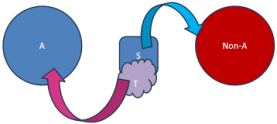
3. The thinker first places themselves within the horizon [non-A] and attempts to grasp it thoroughly. The dynamics of thought move horizontally toward the horizon [non-A], and then vertically into its depths.
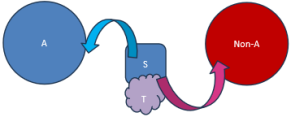
4. The thinker then places themselves within the horizon [A] and attempts to grasp this from the ground up as well. The dynamic moves horizontally toward the horizon [A], and then vertically into its depths.
5. Stimulated and enriched by these two distinct ways of thinking and systems of thought, the thinker needs time for independent reflection to give rise to questions and problems. The flow of thought emerges from this in a non-linear manner, first toward the horizon of [A].
6. It then in the opposite direction [non-A]. The more, the more frequently, and the more dynamically thinking proceeds, the more strongly independent thinking becomes pronounced.
An objectively detached perspective on the two horizons is possible, in which one fundamentally detaches oneself from the (unspoken) preference for the “self” and lets go of preconceptions and prejudices toward the “other.”
An interim assessment of stages 1-6 thus serves to answer the question that has been raised (in the initial stage 1) in a well-founded philosophical manner, thereby integrating incompatibilities, conflicts, opposites, and so on.
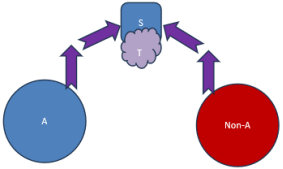
7. As reflection matures, the thinker transcends the boundary of the frame of system [A] as well as that of [non-A], thereby reaching a meta-philosophical level. The dynamic now moves in a vertical direction. A transcendence of the boundary of the dimension of [thought system A]: one arrives at a meta-level. Thereafter, one follows the same vertical path of thought, starting from [thought system non-A] and crossing its boundary, thereby reaching the meta-level.
Reflections on what has been gained from the discourse thus far yield a result. This result is simultaneously recognizable as a productive integration of the two distinct conceptual horizons, A and non-A.
This level of “integration” serves as an interim assessment, much like how Hegel’s dialectic ascends to a further, newer level immediately after the sublation of opposites. Sublation does not mean the cessation of opposites, but rather a necessary process that carries the philosophical questions forward into a further discourse.
With stage 7-9, the schematic circle of the dynamic dimensions of comparative philosophy is closed. If a new question arises from the insights of stages 1-9, a return to stage 1 is necessary, and a return with the ever-fresh “beginner’s mind.”
It is important that comparative philosophy never “absolutizes” its own position, findings, or method. It should instead present itself as a well-founded method and independent field of philosophical research, without any “dogmatic doctrine” or “ideology.”
Diagrams of Stages 1-9 with General Remarks
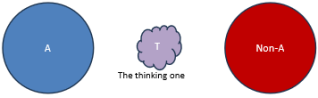
Stage 1. Everyone has a natural tendency to prefer what is familiar to them (what is their own) or what is unfamiliar and new to them (what is “the other”). One is called an [intrasystem]/[the internal system], and the other an [extrasystem]/[the external system]. Unbound by preferences or self-preference, one positions oneself between the two systems
(Hashi, 2022): Positioning within the realm of the [between], and the subsequent development aimed at enabling the interaction of [A] and [non-A], constitutes the principle of logic known as “The Field of ‘Between’”.
| [20] | Hashi, Hisaki (2022): The Field of Between: The Field of Inter-Action and Intra-Relation—Toward a Logic for a Global World, The Bulletin vol. 17 (2022), Tokyo: The Japan Society for Global System and Ethics, 37-44. |
[20]
(Hashi, 2022).
Figure 1. Setting the position of thinking one.
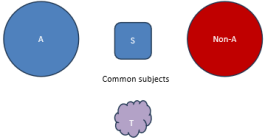
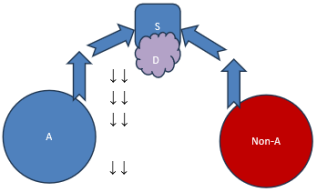
Stage 2. The aim is to identify a common thematic subject that serves as a basis for posing philosophical questions. By engaging with the question, one gradually develops independent thinking in order to arrive at an answer that guides understanding. However, it is precisely at this stage that self-misleading reflection occurs. The thematic subject of the same category X often exhibits different fundamental characteristics across different cultures. An example:
[A is at the same time non-A: a clear contradiction].
Here (primarily in Western philosophy), the issue is the pure logical contradiction, which can be resolved by the law of non-contradiction.
The same statement, when expressed in Asian philosophical traditions—such as Mahayana Buddhism (the Diamond Sutra) or the koan (test question) of Zen Buddhism—conveys a fundamentally different concept:
[A is simultaneously non-A: a clear contradiction that frequently occurs in life and is inevitable in a confrontation].
From there, the approach to the contradiction shifts: What significance does the contradiction hold in life? What can one learn from the given contradiction?—This confrontation also leads to the insight that the category of “contradiction” can reveal a multidimensional world
| [21] | Karen Gloy and Hisaki Hashi (2026): Was ist Philosophie für eine globale Welt von Heute? – Zwischen Universalismus und Relativismus in der Kulturphilosophie (What is Philosophy for a Global World Today? Between Universalism and Relativism in the Cultural Philosophy) in Hisaki Hashi and Karen Gloy (Eds.), Interdisziplinäre Beiträge zum Buddhismus—Erkenntnis zum offenen Tor: (Interdisciplinary Studies to Buddhism. Cognition to the Open Gate), Wien: LIT, 172 – 210. |
[21]
(Hashi, Gloy, 2026).
From this, for example, a fundamental philosophical question regarding the common subject matter can be posed: What does a “contradiction” actually mean in this context?
Figure 2. Define the common subject between [A] and [Non-A].
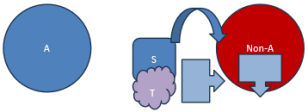
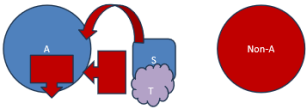
Stages 3 and 4. The two modes of thought, A and non-A, manifest themselves in differences. This shows that the two exist in a mutually dependent relationship. The schema does not follow from an irreconcilable opposition, “A versus non-A,” but rather [A and non-A] in a mutually dependent relationship. One may reflect on what kind of relationship exists between the two.
To do this, the thinker needs to engage in the activity of placing themselves within the horizon of [Non-A] in order to recognize an essential depth of [Non-A]. The activity in the opposite direction is equally significant. It is important that the activity be attempted in both directions.
Figure 3. Engaging and settling the thinker within the horizon of [Non-A].
Figure 4. Engaging and settling the thinker within the horizon of [A].
Mastering these stages leads to a release from unreflective self-preference, as well as from preconceptions and prejudices.
Stages 5 and 6. In carrying out the activities of the previous stages, the thinker’s competence has expanded. The thinker experiences and recognizes that their thinking (T) can be equated with both the mode of thinking [Non-A] and that of [A]. An “absolutely contradictory unity” of oneself with every other comes to the fore here. Through the experience of this dynamic, one achieves intellectual enrichment of an immeasurable kind. The competence of independent thinking is strengthened and expanded by the suggestions and impulses of others.
Stage 5: The subject is settled in the horizon [Non-A] deeply, whereas the thinker activates the method of the horizon [A].
Figure 5. The thinker’s expanding dynamics settle and confront the horizon [A],as well as the [Non-A]. The thinker’s expanding dynamics settle and confront the horizon [A],as well as the [Non-A].
Stage 6, Vice versa of Stage 5: The subject is settled in the horizon [A] deeply, whereas the thinker activates the method of the horizon [Non-A].
Figure 6. The thinker’s expanding dynamics settle and confront the horizon [A], as well as the [Non-A].
The goal of mastering these stages is to develop and strengthen independent thinking on the subject from the ground up.
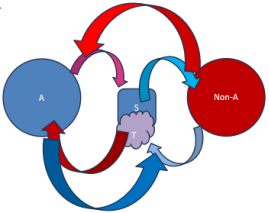
Stage 7. The currents of thought, reflection, and influence are currently flowing in various directions.
Mastering the previous stages guides the thinker toward forming their own understanding of the question posed. As mentioned earlier, this answer is an interim assessment that can serve as a new starting point for further inquiry.
Figure 7. Scrambling and streaming the interactions between polar horizons.
Stage 8. Mastering the previous stages leads the thinker to arrive at their own understanding of the question at hand. As mentioned earlier, this answer serves as an interim assessment that can be regarded as a new starting point for further inquiry.
Figure 8. Raising to the highest dialectical stadium.
Figure 9. Completion of the Dialectics: Transitioning from the highest Parnassus to the deepest "beginner's mind" regarding the next cycle of development.
Stage 9.
This position cannot be taken as absolute. An independent thesis emerged as an interim conclusion, one that was derived from the initial question regarding the shared subject matter. As the “sublation” in the sense of Hegel’s dialectic makes clear, it is neither the cessation nor the abandonment of opposites, but rather an ongoing dynamic, spurred on by a renewed line of inquiry. The process continues, one accompanied by the “beginner’s mind.”
4. Applications of the Comparative Philosophy Approach: Discussion
This multidimensional approach of comparative philosophy offers the following possibilities for application.
A) Discourse on specific philosophical works from different cultures and languages.
B) Discourse on philosophical works within a specific school of philosophical history. For example, Plato and Aristotle; Kant and Hegel; Spinoza and Leibniz; Jaspers and Heidegger. This approach would serve to enrich the dimensions of traditional philosophy.
C) This way of thinking is significant for interdisciplinary philosophical dialogue between different academic disciplines. For example, philosophy and physics (regarding the concepts of space and time/spacetime, Hashi, 2024)
1(H. Hashi, 2024
1, chap. III). The tendency that has frequently arisen thus far toward a centrism of one’s own intellectual horizon, toward an absolutism of one’s own field of study, and the accompanying ignorance of the other, etc., will be reversed only if and when the thinker takes the step, with courage and without hesitation, to allow their own perspective to be illuminated by the other’s way of seeing and thinking.
5. Conclusion
An essential foundation of comparative philosophy is that the thinker allows their own perspective to be objectively reflected through the perspectives of others. Through this process, they become aware of the environment and their connection to others. One’s own perspective is not judged and determined solely by aspects of the self, but also by the aspects and positions of others. Both participate in a specific dimension of the environment. Illuminated by the participation and presence of others, one’s own perspective can be recognized for what it is and how it appears within a whole comprising the self and other. Between the positions and aspects of the self and other lies, of course, interactions—the Field of Between. In this field, the other is not dominated by the thoughts and perspectives of the self and partially subsumed, but rather, through mutual perception of the truth, one is able to recognize new aspects that emerge in the field of interaction between self and other, which can then lead to new insights. Comparative philosophy thrives in the realm of dialogic culture, accompanied by horizontal and vertical dynamics that transcend the conventional framing of the self and other. The meta-philosophy of the self and other enables an autonomous self-transformation of both and creates a space of Co-Naissance.
Author Contributions
Hisaki Hashi: Methodology
Conflicts of Interest
The author declares no conflicts of interest.
References
| [1] |
Moore, Charles Alexander (1967): The Comprehensive Indian Mind, in The Indian Mind—Essential of Indian Philosophy and Culture, Honolulu: University of Hawaiʻi Press, 1-18.
|
| [2] |
Moore, Charles Alexander (1967): The Comprehensive Indian Mind, in The Indian Mind—Essential of Indian Philosophy and Culture, Honolulu: University of Hawaiʻi Press, 9-12.
|
| [3] |
Aristotle (2007): Metaphysik, Stuttgart: Reclam. [987b].
|
| [4] |
Klein, Hans-Dieter (2002), Der Begriff der Seele in Philosophie und Religion (The Concept of the Soul in Philosophy and Religious Science), in Johann Figl, Hans-Dieter Klein (Eds.), Der Begriff der Seele in Religionswissenschaft (The Concept of the Soul in Religious Sciences), Würzburg: Königshausen & Neumann.
|
| [5] |
H.-D. Klein (2002): see Cf. Plato, Phaedrus 245d; Aristotle, De anima, III 8, 431b 21: “The soul is, in a sense, all that exists.”
|
| [6] |
Aristotle (2007): Metaphysik, Book Delta [1018a]: the same and the different, the identical and the distinct, the differentiated and the diverse; Cf. [987b].
|
| [7] |
Laozi (1978): Original: Laozi, Daodejing, in Rōshi—Sōji (Laozi—Zhuangzi), Ogawa, Tamaki (Ed.), Tokyo: Chūō-kōron-sha.
|
| [8] |
Hashi, Hisaki (2026): Methodologische Grundlage der Komparativen Philosophie (Methodological Principles in Comparative Philosophy), in Phaidra, University of Vienna, chap. 2.1. 4-5.
https://phaidra.univie.ac.at/detail/o:2275656
|
| [9] |
Gloy, Karen (2026): Die diversen Kulturtheorien (The Various Cultural Theories) in Knowledge Commons Works (USA), chap. 5, Komparative Philosophie bzw. Kulturtheorien (Comparative Philosophy or Cultural Theories), pp. 19-22, May 2026, from
https://doi.org/10.17613/0vn5y-bfz34
|
| [10] |
Aristotle (2007): Metaphysik [991b, 992a].
|
| [11] |
Cf. Plato, Timaios (Timaeus) (1972):, in: Platon, Werke in acht Bänden, Bd. 7, Darmstadt: Wissenschaftliche Buchgesellschaft Darmstadt.
|
| [12] |
Plato (1986) Phaidros, in: Platon, Sämtliche Werke Bd. IV (Complete Works, vol. IV), Hamburg: Rowohlt.
|
| [13] |
Wallner, Friedrich G. (Wallner, Fritz) (1992): Acht Vorlesungen über den Konstruktiven Realismus (Eight Lectures for the Constructive Realism), Wien: WUV.
|
| [14] |
Cf. Wallner, Friedrich (2005): Structure and Relativity, Frankfurt a. M.: Peter Lang.
|
| [15] |
Nishida, Kitarō (1965): Collected Works (Zenshū), Vol. 9, Tokyo: Iwanami.
|
| [16] |
Nishida’s “Absolutely Contradictory Self-Identity”: Hashi, Hisaki (2016): Die Aktualität der Philosophie—Grundriss des Denkweges der Kyoto-Schule (The Vivid Philosophy. The Guideline of the Way of Thinking of the Kyoto School), in Komparative Philosophie für eine globale Welt (Comparative Philosophy for a Global World), Wien: LIT, Main Section I, chap. 6, 60-69.
|
| [17] |
Hashi, Hisaki (20241): The Multidimensionality of Comparative Philosophy, December 2024 from “Phaidra”, from
https://phaidra.univie.ac.at/detail/o:2112406
|
| [18] |
Hashi, Hisaki (20242): The Bulletin vol. 19, Tokyo: The Japan Society for Global System and Ethics, 68 –73, November 2024, Copyright from
https://drive.google.com/file/d/1mAIr0G0SzHTcm9297cCbbuZFTvjcj7KO/view
|
| [19] |
Hashi, Hisaki (2022): The Field of Between: The Field of Inter-Action and Intra-Relation—Toward a Logic for a Global World, in Phaidra, retrieved on December 26th, 2024.
https://phaidra.univie.ac.at/detail/o:2112407
|
| [20] |
Hashi, Hisaki (2022): The Field of Between: The Field of Inter-Action and Intra-Relation—Toward a Logic for a Global World, The Bulletin vol. 17 (2022), Tokyo: The Japan Society for Global System and Ethics, 37-44.
|
| [21] |
Karen Gloy and Hisaki Hashi (2026): Was ist Philosophie für eine globale Welt von Heute? – Zwischen Universalismus und Relativismus in der Kulturphilosophie (What is Philosophy for a Global World Today? Between Universalism and Relativism in the Cultural Philosophy) in Hisaki Hashi and Karen Gloy (Eds.), Interdisziplinäre Beiträge zum Buddhismus—Erkenntnis zum offenen Tor: (Interdisciplinary Studies to Buddhism. Cognition to the Open Gate), Wien: LIT, 172 – 210.
|
Cite This Article
-
APA Style
Hashi, H. (2026). The Methodological Foundation of Comparative Philosophy. Science Research, 14(4), 146-152. https://doi.org/10.11648/j.sr.20261404.13
 Copy
|
Copy
|
 Download
ACS Style
Hashi, H. The Methodological Foundation of Comparative Philosophy. Sci. Res. 2026, 14(4), 146-152. doi: 10.11648/j.sr.20261404.13
Copy
|
Download
AMA Style
Hashi H. The Methodological Foundation of Comparative Philosophy. Sci Res. 2026;14(4):146-152. doi: 10.11648/j.sr.20261404.13
Copy
|
Download
-
@article{10.11648/j.sr.20261404.13,
  author = {Hisaki Hashi},
  title = {The Methodological Foundation of Comparative Philosophy},
  journal = {Science Research},
  volume = {14},
  number = {4},
  pages = {146-152},
  doi = {10.11648/j.sr.20261404.13},
  url = {https://doi.org/10.11648/j.sr.20261404.13},
  eprint = {https://article.sciencepublishinggroup.com/pdf/10.11648.j.sr.20261404.13},
  abstract = {In the context of a globalized world with its crossing dimensions, the philosophy that bridges cultures is known by various names: intercultural and transcultural philosophy, comparative philosophy, global philosophy, international philosophy, and so on. This article focuses specifically on comparative philosophy: chapter 1. Chapter 2: As Ch. A. Moore in the US in the middle of the 20th century represented, Comparative reflection accompanies every step of philosophy. Yet, in the past, comparative thinking often amounted to only a selective listing of similarities and differences, with further steps in dialectical confrontation frequently lacking. In what respects did these similarities or differences between the two thinkers and their intellectual horizons arise? Is there another aspect to their integration? This article presents the methodological construction beginning with the example of Plato and Laozi. Chapter 3: The discourse explains the methodological framework for constructing comparative philosophy in general schemes. Clarifying its methodology and originality, the discourse concentrates on the dynamics from the initial stage through dynamic development to the highest stadium: the dialectical sublation and integration of both contradictions in acknowledgment of a further problem. However, it does not remain static on Parnassus. With a “beginner’s mind,” it refreshes its content and continues to develop its dialectics systematically, communicating and integrating the human mind deeply and creatively. Chapter 4: The comparative approach is not limited to intercultural and transcultural contexts; it is also currently being applied to other areas, including interdisciplinary philosophy, which will be discussed further in light of the methodology of the Chap. 3. The discourse concludes with a concrete interim assessment in Chapter 5.},
 year = {2026}
}
Copy
|
Download
-
TY  - JOUR
T1  - The Methodological Foundation of Comparative Philosophy
AU  - Hisaki Hashi
Y1  - 2026/08/11
PY  - 2026
N1  - https://doi.org/10.11648/j.sr.20261404.13
DO  - 10.11648/j.sr.20261404.13
T2  - Science Research
JF  - Science Research
JO  - Science Research
SP  - 146
EP  - 152
PB  - Science Publishing Group
SN  - 2329-0927
UR  - https://doi.org/10.11648/j.sr.20261404.13
AB  - In the context of a globalized world with its crossing dimensions, the philosophy that bridges cultures is known by various names: intercultural and transcultural philosophy, comparative philosophy, global philosophy, international philosophy, and so on. This article focuses specifically on comparative philosophy: chapter 1. Chapter 2: As Ch. A. Moore in the US in the middle of the 20th century represented, Comparative reflection accompanies every step of philosophy. Yet, in the past, comparative thinking often amounted to only a selective listing of similarities and differences, with further steps in dialectical confrontation frequently lacking. In what respects did these similarities or differences between the two thinkers and their intellectual horizons arise? Is there another aspect to their integration? This article presents the methodological construction beginning with the example of Plato and Laozi. Chapter 3: The discourse explains the methodological framework for constructing comparative philosophy in general schemes. Clarifying its methodology and originality, the discourse concentrates on the dynamics from the initial stage through dynamic development to the highest stadium: the dialectical sublation and integration of both contradictions in acknowledgment of a further problem. However, it does not remain static on Parnassus. With a “beginner’s mind,” it refreshes its content and continues to develop its dialectics systematically, communicating and integrating the human mind deeply and creatively. Chapter 4: The comparative approach is not limited to intercultural and transcultural contexts; it is also currently being applied to other areas, including interdisciplinary philosophy, which will be discussed further in light of the methodology of the Chap. 3. The discourse concludes with a concrete interim assessment in Chapter 5.
VL  - 14
IS  - 4
ER  -
Copy
|
Download





 Share This Article
 Twitter
 Linked In
 Facebook