A Comparative Case Study of Chongli on Resource Restructuring Pathways for the Four-Season Operation of Ice and Snow Tourism Destinations in the Post-Winter Olympics Era
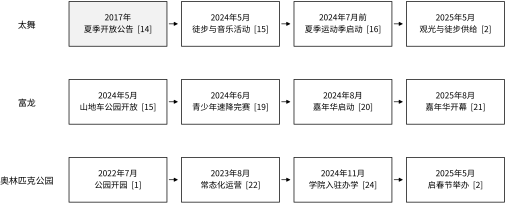
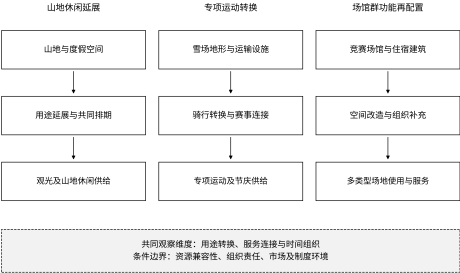
How ice-and-snow tourism destinations transform the resource base developed during the snow season into cross-season service provision is a challenge shared by the continued use of Olympic legacy and the transformation of tourism operations. Taking Thaiwoo Ski Resort, Forlong Four Seasons Resort, and Zhangjiakou Chong li Olympic Park as cases, this study draws on verified public documents and employs event tracing, comparisons of facility uses, and cross-case analysis to examine the sequences of resource reconfiguration actions and the conditions under which they occur. The findings identify three empirical pathways, respectively centered on the extension of mountain leisure offerings, the conversion of facilities for specialized sports, and the functional reconfiguration of venue clusters. Differences among these pathways primarily concern the resources being reconfigured, service connections, and organizational arrangements. Facility opening, product combinations, and repeated implementation constitute different levels of evidence of service provision. The available evidence supports the expansion of non-winter offerings but is insufficient to establish uninterrupted year-round operation or increased net returns. The study proposes an interpretive framework of “changes in use—service connections—temporal organization, ”conceptualizing year-round operations as a continuous process of adapting resources and services across seasons. This framework provides a reference for operators to undertake differentiated facility adaptation and prudent evaluation.
This is an Open Access article, distributed under the terms of the Creative Commons Attribution 4.0 International License (http://creativecommons.org/licenses/by/4.0/), which permits unrestricted use, distribution and reproduction in any medium or format, provided the original work is properly cited.
METZINGER P, SCHMUDE J, MAYER M. Classifying climate change adaptation measures for ski areas and ski lifts: The case of Bavaria, Germany [J]. Journal of Outdoor Recreation and Tourism, 2025, 52: 100939.
ZACH F J, SCHNITZER M, FALK M. Product diversification and isomorphism: The case of ski resorts and “me-too”innovation [J]. Annals of Tourism Research, 2021, 90: 103267.
SIRMON D G, HITT M A, IRELAND R D, et al. Resource orchestration to create competitive advantage: Breadth, depth, and life cycle effects [J]. Journal of Management, 2011, 37(5): 1390-1412.
SIRMON D G, HITT M A, IRELAND R D, et al. Resource orchestration to create competitive advantage: Breadth, depth, and life cycle effects [J]. Journal of Management, 2011, 37(5): 1390-1412.
ZACH F J, SCHNITZER M, FALK M. Product diversification and isomorphism: The case of ski resorts and “me-too”innovation [J]. Annals of Tourism Research, 2021, 90: 103267.
METZINGER P, SCHMUDE J, MAYER M. Classifying climate change adaptation measures for ski areas and ski lifts: The case of Bavaria, Germany [J]. Journal of Outdoor Recreation and Tourism, 2025, 52: 100939.
ZACH F J, SCHNITZER M, FALK M. Product diversification and isomorphism: The case of ski resorts and “me-too”innovation [J]. Annals of Tourism Research, 2021, 90: 103267.
SIRMON D G, HITT M A, IRELAND R D, et al. Resource orchestration to create competitive advantage: Breadth, depth, and life cycle effects [J]. Journal of Management, 2011, 37(5): 1390-1412.
Cao, H., Li, H., Cheng, J., Zhang, J., Hu, Z. (2026). A Comparative Case Study of Chongli on Resource Restructuring Pathways for the Four-Season Operation of Ice and Snow Tourism Destinations in the Post-Winter Olympics Era. Science Innovation, 14(6), 223-232. https://doi.org/10.11648/j.si.20261406.12
Cao, H.; Li, H.; Cheng, J.; Zhang, J.; Hu, Z. A Comparative Case Study of Chongli on Resource Restructuring Pathways for the Four-Season Operation of Ice and Snow Tourism Destinations in the Post-Winter Olympics Era. Sci. Innov.2026, 14(6), 223-232. doi: 10.11648/j.si.20261406.12
Cao H, Li H, Cheng J, Zhang J, Hu Z. A Comparative Case Study of Chongli on Resource Restructuring Pathways for the Four-Season Operation of Ice and Snow Tourism Destinations in the Post-Winter Olympics Era. Sci Innov. 2026;14(6):223-232. doi: 10.11648/j.si.20261406.12
@article{10.11648/j.si.20261406.12,
  author = {Huannan Cao and Hongmei Li and Junjie Cheng and Jialiang Zhang and Zhiteng Hu},
  title = {A Comparative Case Study of Chongli on Resource Restructuring Pathways for the Four-Season Operation of Ice and Snow Tourism Destinations in the Post-Winter Olympics Era},
  journal = {Science Innovation},
  volume = {14},
  number = {6},
  pages = {223-232},
  doi = {10.11648/j.si.20261406.12},
  url = {https://doi.org/10.11648/j.si.20261406.12},
  eprint = {https://article.sciencepublishinggroup.com/pdf/10.11648.j.si.20261406.12},
  abstract = {How ice-and-snow tourism destinations transform the resource base developed during the snow season into cross-season service provision is a challenge shared by the continued use of Olympic legacy and the transformation of tourism operations. Taking Thaiwoo Ski Resort, Forlong Four Seasons Resort, and Zhangjiakou Chong li Olympic Park as cases, this study draws on verified public documents and employs event tracing, comparisons of facility uses, and cross-case analysis to examine the sequences of resource reconfiguration actions and the conditions under which they occur. The findings identify three empirical pathways, respectively centered on the extension of mountain leisure offerings, the conversion of facilities for specialized sports, and the functional reconfiguration of venue clusters. Differences among these pathways primarily concern the resources being reconfigured, service connections, and organizational arrangements. Facility opening, product combinations, and repeated implementation constitute different levels of evidence of service provision. The available evidence supports the expansion of non-winter offerings but is insufficient to establish uninterrupted year-round operation or increased net returns. The study proposes an interpretive framework of “changes in use—service connections—temporal organization, ”conceptualizing year-round operations as a continuous process of adapting resources and services across seasons. This framework provides a reference for operators to undertake differentiated facility adaptation and prudent evaluation.},
 year = {2026}
}
TY  - JOUR
T1  - A Comparative Case Study of Chongli on Resource Restructuring Pathways for the Four-Season Operation of Ice and Snow Tourism Destinations in the Post-Winter Olympics Era
AU  - Huannan Cao
AU  - Hongmei Li
AU  - Junjie Cheng
AU  - Jialiang Zhang
AU  - Zhiteng Hu
Y1  - 2026/11/10
PY  - 2026
N1  - https://doi.org/10.11648/j.si.20261406.12
DO  - 10.11648/j.si.20261406.12
T2  - Science Innovation
JF  - Science Innovation
JO  - Science Innovation
SP  - 223
EP  - 232
PB  - Science Publishing Group
SN  - 2328-787X
UR  - https://doi.org/10.11648/j.si.20261406.12
AB  - How ice-and-snow tourism destinations transform the resource base developed during the snow season into cross-season service provision is a challenge shared by the continued use of Olympic legacy and the transformation of tourism operations. Taking Thaiwoo Ski Resort, Forlong Four Seasons Resort, and Zhangjiakou Chong li Olympic Park as cases, this study draws on verified public documents and employs event tracing, comparisons of facility uses, and cross-case analysis to examine the sequences of resource reconfiguration actions and the conditions under which they occur. The findings identify three empirical pathways, respectively centered on the extension of mountain leisure offerings, the conversion of facilities for specialized sports, and the functional reconfiguration of venue clusters. Differences among these pathways primarily concern the resources being reconfigured, service connections, and organizational arrangements. Facility opening, product combinations, and repeated implementation constitute different levels of evidence of service provision. The available evidence supports the expansion of non-winter offerings but is insufficient to establish uninterrupted year-round operation or increased net returns. The study proposes an interpretive framework of “changes in use—service connections—temporal organization, ”conceptualizing year-round operations as a continuous process of adapting resources and services across seasons. This framework provides a reference for operators to undertake differentiated facility adaptation and prudent evaluation.
VL  - 14
IS  - 6
ER  -




 Share This Article
 Twitter
 Linked In
 Facebook

 Copy
 Download