Abstract
Researchers found that peer learning approach was impactful to bring students to the same discussion table. Majority of students who joined in computing and informatics college in our university have no prior experience in programming course and usually found it difficult. From those students, who joined college of computing and informatics there are few students who have less interest in programming courses. Having this in mind, this action research mainly focuses on to enhancing those students programming skill using peer learning approach. senior top scorer students were assigned as a teaching assistant. Researchers suggest that use of top scorer student as a teaching assistant helps to create closest relationship and sense of community among students. Through peer learning approach students gradually develop team sprit while creating a sense of motivation and encouragement for their success. This action research investigated the use of peer-approach learning to enhance both practical and theoretical skill, confidence, and score of their programming course. Certain students were selected for the case study and they were evaluated before and after the peer learning approach was implemented. As planned, students programming skill were seen improved after practicing the peer learning approach.
Keywords
Peer-Approach, Action Research, Computer Programming Skills, Data Collection
1. Introduction
1.1. Background
Programming is an activity of performing a particular computation by designing an executable computer instruction. It includes designing algorithms, evaluating algorithms' accuracy, resource consumption, and implementation
| [1] | Bati, T. B., Gelderblom, H., & Biljion, J. v. (2014). Blended learning of programming in large classes: a reflection of students. Computer Science Education. |
[1]
. Generally, the main purpose of learning programming is to design and develop a sequence of instructions that will solve a particular problem on a computer. Not only that computer programming is a very useful skill, but also it can be rewarding career.
Both learning and teaching computer programming for new students are difficult. Teachers face obstacles in making students understand coding skill and able to create a program to solve a problem
| [2] | Rozita Kadar, Naemah Abdul Wahab, Jamal Othman, Maisurah Shamsuddin & Siti Balqis Mahlan. (2021). A Study of Difficulties in Teaching and Learning Programming: A Systematic Literature Review. International Journal of Academic Research in Progressive Education and Development, 591–605. |
[2]
. This could be due to the fear of students about the course and nature of course itself. Specially, in the case where the size of the class is large, lack of adequate laboratory infrastructure, are among the challenges that hinder from delivering the course effectively. Beginner programmer tends to make limited progress in learning to program, resulting in high failure and dropout in programming courses.
Peer learning model is implemented by empowering the ability of students with good understanding capabilities. the selected student teaches his co-learners so that it fulfills all learning completeness
| [3] | BayisaNateaSima, Sasikumar Perumal. (2019). Comparative Analysis of Improving Computer Programming Skills of Information Technology First Year Students at Ambo University - An Action Research. IOSR Journal of Computer Engineering (IOSR-JCE), 08-15. |
[3]
. Having that in mind, it is expected that with peer learning approach, those students in need will become good. Applying peer learning has many advantages, like, improving teamwork, helps to have better feedback and supports diversity between students. It is obvious that most students usually find it easier to accept information provided by peers, as they do not feel embarrassed to ask questions and discuss.
Researcher in
| [4] | Heaney, Joo-Gim, Gatfield, Terence John, Clarke, Peter, Caelli, Joan. (2006). Using Action Research to Implement and Evaluate Peer Learning in Marketing courses: Engaging Students Through Self-Learning. ANZMAC Conference Proceedings. |
[4]
describe action research as ‘an action research is an enquiry which is carried out to understand, to evaluate and then to change, in order to improve educational practice’. Having this in mind, the main objective was to improve understanding teaching practice, to provide immediate solution to the problems that occurred in the teaching learning process of computer programming courses. Based on this motivation, this action research comes from what we have observed in the programming course that we have conducted in classes and laboratories in order to help computing instructors develop various alternative approaches and technique for teaching programming concept. Another motivation is one of the researchers when he studied his BSc degree program, he is one of the main beneficiaries from such type of action research.
Different studies suggested that instead of applying only lecture method it is better to include collaborative approach mainly in a form of small group activities (Heaney, et al., 2006). The use of senior top performer as a teaching assistant performed by
| [5] | Dickson, P. (2011). Using Undergraduate Teaching Assistants in a Small. In Proceedings of the 42nd ACM technical symposium on Computer science education (pp. 75-80). ACM. |
[5]
.
As reported their experience in appointing an undergraduate student as teaching assistant. The outcome was observed to be positive for both senior and beginner learners. In other side, the use of top scorer student as a teaching assistant helps to create closest relationship and sense of community among student. Student gradually develop team sprit with their trainers while developing a sense of sympathy for student success.
at Wolkite university, college of computing and informatics (CCI), there are four departments: Software engineering, Information Technology, Computer Science, and Information Systems.
1.2. Problem Statement
As we have specified under introduction part, the course programming is major course which is given in the college of computing and informatics. Based on our class room observations and while we teach this course, a majority of new student who join college of computing and informatics in our university encounter difficulties to understand easily computer programming and they got low result in computer programming courses. As many of the students and instructors are aware that, the course is considered as challenging. the main problem is that assuming the programming subject is difficult. This sort of idea blocks the chance to train and retain understanding on the subject matter. For someone who deliver the course both technical assistance and instructors, the main challenge is ensuring the students understanding.
Specifically, when class size increase and on new students (second year student) the challenge of delivering this course increase. In our observation the student not only does not know how to write a simple programming code using basic programming languages but also, they do not know how to apply the basic programming skill.
Many studies suggest that programming courses by their nature need collaboration between students. But the main issue we observed was lack of formalized environment for practicing and implementing collaborative peer approach. Many students are practicing this active learning method in a poor fashion and are expected to bring solution for the problem which is specified above.
This action research answered the following questions:
1) What are the main gaps observed on student’s computer Programming courses?
2) What is the impact of practicing peer learning approach to second year students’ programming courses?
3) Does using Peer Learning Method enhance students’ programming skill?
1.3. Objectives
1.3.1. General Objective
The general objective of this action research is to include peer learning method to enhance second year student’s programming skill on Fundamentals of Programming II course.
1.3.2. Specific Objectives
The specific objective of this action research includes: -
1) To find out the main gaps observed on student’s computer programming skill
2) To search for strategies that can be applied to improve students programming skill
3) To evaluate the effectiveness of peer mentoring on students programming skill
1.4. Scope of the Study
This study mainly focuses to evaluate the effectiveness of using Peer Learning approach in order to improve new students (second year student) programming skill both in theoretical and practical at Wolkite university, college of computing and informatics.
The study mainly focusses: -
1) To investigate whether students benefit from a peer approach intervention in learning and evaluate by continues assessment and final examination.
2) To observe students’ participation during peer programming practice and how this directly relates to the actual skill the student has developed through peer learning approach.
1.5. Significance of the Study
This action research tried to add one input by adding new feature of learning style for the computing college. Directly or indirectly, the whole college student, instructors and other supporting bodies are beneficiary from this research. Particularly, second year students and top scorer senior students are directly benefited from this action research. By the help of this study, second year student who are joined college of computing and informatics for the first time they can able to improve their programming skill with the help of senior students and the researchers.
2. Literature Review
2.1. Overview
Here, the review of literatures related to the Peer Learning approach are presented. The aim of this action research is intended to identify factors affecting peer learning, and thereby to improving students’ academic performance through strengthening peer learning.
2.2. Peer Learning
The Peer learning model is carried out by empowering the ability of students who have high understanding capabilities and absorption, the student teaches the material to his friends who do not understand so that it fulfills all learning completeness. In other words, this approach is a ‘two-way reciprocal learning activity’
| [6] | Boud, D. C. (1999). Peer learning and assessment. Assessment & evaluation in higher education. 413-426. |
[6]
, which means there is mutual benefits to the parties involved. This implies one student have no power over the other in the case of peer learning process. “Peer learning can be both informal and formal. The later one, formal peer learning occurs when group work or group projects are explicitly scheduled into courses in
| [7] | Keppell, M. A. (2006). peer learning and learning-oriented assessment in technology-enhanced environments. Assessment & Evaluation in Higher Education., 453-464. |
[7]
. It is a “social process, in which peer interactions are fundamental. Informal peer learning approach implicitly occurs when students discuss lectures, assignments, projects, and exams in casual social settings. Those two definitions indicate that peer learning is cognitive, intellectual, cooperative, productive and demanding. So, the action of peer learning depends mainly in idea sharing, and discussion.
This time, many institutions (university, college and schools) currently focuses in instructional methods, discussion, and in cooperative learning by working in teams. In a similar fashion, this study is promoting peer to peer learning with a view to helping students prepare for lifelong learning and continuous enhancement of their performance. Working in a group exposes students to an opportunity of understanding through discussion and rehearsal. But we were able to observe that there are still students not willing to involve in the process of peer learning approach. Having this in mind, this action research is specific to second year students to all departments at the college of computing and informatics.
2.3. Review of Related Works
2.3.1. Local Research Works
Two researchers in
| [8] | Regasa, B. G. (2016). Improving Peer Learning for Students’ Academic Performance: The Case of Second Year Rural Development and Agricultural Extension Students, College of Agriculture, Wolaita Sodo University. Journal of Education and Practice, Vol. 7, No. 34. |
[8]
introduced a peer learning practice for Students’ learning status: universities and colleges are facing with the increase of young people attending higher education. In the last two decades, ‘student-centered’ instructional methods were introduced in universities. This action research identified factors affecting peer learning method, and strengthening peer learning approach.
2.3.2. Global Research Works
The outcome from the work in
| [9] | Keenan, C. (n.d.). Mapping student-led peer learning in the UK.: The Higher Education Academy. |
[9]
showed that students who involved in peer learning practices as ‘peer leaders’ acquire higher levels of personal and professional, and over all skills. The work also proved that students who participated in peer learning activities enhanced academic confidence. As seen from previous works peer learning is advantageous in developing self-directed learning, critical thinking, communication, interpersonal, and teamwork skills in
| [10] | Byl, E. S. (2016). The Value of Peer Learning for First-Year Postgraduate University Students’ Social and Academic Integration. Procedia - Social and Behavioral Sciences, 299-304. |
[10]
explored “group approaches” to graduate students issues related to dissatisfaction, delay, and withdrawal from study. This approach provides graduate students with opportunities in skill development and social interaction. Moreover, it is also studied its suitability for some students teaching strategies.
Research in
| [11] | Sedghi, G. &. (November 2015). The development and implementation of a Peer Assisted Learning programme at the University of Liverpool. Journal of Learning Development in Higher Education, Special Edition: Academic Peer Learning, 1-17. |
[11]
presented that peer coaching had a beneficial impact in particular for those in their first year of study with poor performance. It deepens students’ involvement and participation in the learning process beyond the traditional roles. Peer learning approach has been identified as a vital technique for students with special needs in
| [12] | Dorian, S., & Gunawardena, E. (2010). Gender differences in the use of computers, programming, and peer interactions in computer science. Computer Science Education. |
[12]
. One of the techniques used for peer learning was “supervisory groups” which allows graduate students to discuss ideas and experiences. Supervisory groups were proven to be similar to supplemental instruction, which was developed in 1973 at the University of Kansas City at Missouri. Australian universities, supplementary Instruction is also known as Peer Assisted Study Sessions. Researchers in
| [13] | Ford, N. T. (November 2015). peer learning leaders: developing employability through facilitating the learning of other students. Journal of Learning Development in Higher Education, Special Edition: Academic Peer Learning, 1-23. |
[13]
showed that peer mentors developed employability including leadership, time management, communication, cultural awareness, and confidence.
In
| [14] | Hope, R. &. (n.d.). Supplemental instruction: SI leader manual. School of Instructional Support, Chaffey College. |
[14]
, the author recorded various benefits such as academic, personal and professional from peer mentors. In personally case, it helps them gain self- confidence, build interpersonal relationships, improve their communication skills. Due to the advancement of technology and Artificial intelligence, many studies intensively assured the necessity to include use of technology in peer learning approach.
In
| [15] | Becejac, B. S. (n.d.). The Impact of Peer Learning within a Group of International Post-graduate Students. Athens Journal of Education -, Volume 5(Issue 1), Pages 7-2. |
[15]
, they investigated if peer learning method is effective in a small group, so as to enhance the students’ overall performance. The students were initially briefed as to the purpose of this study. The instructional approach implemented to help students actively engaged in their own learning process involved in the formation of self-selected learning sets. The key findings showed that students practiced peer learning in the classroom successfully achieved the course learning outcomes.
3. Methodology
3.1. Study Site
This action research is conducted from April, 2023 – June, 2023 at college of computing and informatics, Wolkite university. College of computing and informatics have four departments. Many programming courses are delivered by different instructors in each of those departments. This time, all the department has a course called “Fundamentals of Programming II” to delivered for second year students. We have conducted this research on this course.
3.2. Data Collection Techniques
3.2.1. Primary Sources
(i). Questionary
For this work specifically, we prepared well formatted questions and present it to the selected students to fill their answers, ideas, comments regarding their programming skills on the provided questionary form. From the forms filed by selected students, we have gathered a lot of information regarding those students’ knowledge, skills, grades, and academic performance about their previous programming courses and what they need for future to improve their academic performance and skills with respect to their programming courses’ grade. From the forms filed by the selected students, we observed that most of the students didn’t engage in peer learning practice. They were all interested to get assistance from their peers regarding programming and others courses also. But they are afraid to ask high level batches for help because they thought that they may not help.
(ii). Personal Interviews
We have used personal interviews because we want to fully understand a selected students’ opinions or point of view or to get additional information to a questionnaire. We have interviewed each selected student personally about their programming courses skills, academic grades, studying styles, and most of the time whether they need help from their peers from high level batches and their batches or from courses instructors. Using these techniques, we have also identified that most of the time they do not engage in peer learning and most of the time they are dependent on the course instructor.
3.2.2. Secondary Sources
We have used these techniques in order to gather information about their previous programming courses performance, skills, knowledge, and grades. We gathered their grades of respective programming courses from their respective departments. We also gathered information such as their results in each and every quiz, tests, laboratory practices, laboratory test results in addition to the results of theoretical part of the programming courses. We have also gathered information of their programming writing skills which includes program syntax. The documents we have used for gathering information includes quizzes, tests, grades regarding programming course they have previously took. Our conclusion is that, they need to improve their skills, academic performance and grades regarding major programming course given through their study years in the university as well as in their future work place.
3.3. Data Analysis
3.3.1. Data Analysis Tools
For data analysis we used Excel. key reasons we picked this over other data analysis tools are:
1) Due to its dynamic and useful tables and graphical libraries.
2) Due to its large number of statistical tests.
3) The users get the freedom of selecting a preferable graph type that matches the requirements of their data distribution.
4) Due to its flexibility to create charts, and decision trees ready for publication in a single tool.
5) Not much effort is needed for the researcher to use this software.
3.3.2. Sampling
Through this action research, from each four departments 10 students have been included as a study participant. With a distribution of 3 female and 7 male students. Totally from 4 department 40 students are included for this study. Those forty students were selected based on systematic random sampling. it is a sampling technique where the researcher chooses elements from a target population by selecting randomly from starting point and choosing sample members after a fixed ‘sampling interval.’ We picked this method as it provides a distribution of members to form a sample. And it is known that when researchers know exactly the number of population systematics random sampling method gives clear and representative samples. Again, this method is quick and cost effective for us that is why we selected this sampling method. So, first we have got all second-year students’ information from each department head. For each department we have classified students based on gender (female and male.) and we gave number for each student. From 1 up to the number of student available in each batch based on gender distribution. Then based on given interval we have selected those students using systematic random sampling. The interval varies based on the number of student available in each department.
Additionally, we have selected ten (10) senior top scorer students as student mentor. We applied purposive sampling method to select those ten top scorer students from third year students. This Purposive sampling technique is used to pick students based on their judgment. Since we as a researcher used the students score as judgment to select those students the sample selection mechanism is considered as purposive sampling technic. We have selected those 10 top performing male and female students from third year batches based on their programming courses’ grade and their academic performances. All trainers are selected from third year students across CCI college. Here, our criteria for selecting them are their previous programming skills, their academic performance in programming courses, their coding skills, their ability to deliver their knowledge for others such communication skills, leadership skills and their grades in programming courses as well all academic performance in the department.
4. Result and Discussion
4.1. Overview
The focus of the study is to examine whether Peer Learning improves or enhances Students Programming Skill particularly in second year students: In case of CCI college 2nd Year students 2014 batch. This chapter covers, Data sample information, Pre-action phase Implementation of action/intervention phase and evaluation.
4.2. Pre-action Phase
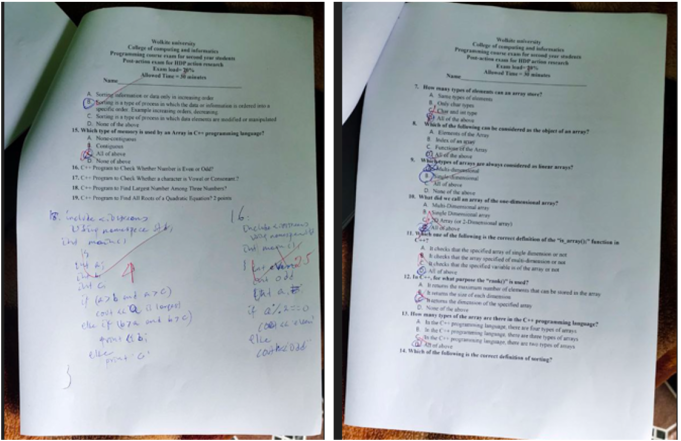
In pre-cation stage, programming questions were given to test students as pre-action exam to understand their current status. Additionally, programming task is given to students to assess their practical problem-solving skill besides to theoretical knowledge. Students took a seat in Computer Laboratory and worked independently to develop an instruction for a given task. The laboratory classes lasted for three hours and were assessed after they explained how their code delivers the required functionality. We assigned 20% mark for the lab exam, and 30% mark for the written exam. The exam result is attached in appendix I. The result obtained by 40 students are depicted in the
Table 1.
Table 1. Pre-Exam and Laboratory exam.
Student Code | Written exam result (30%) | Lab exam result (20%) | Total 50% |
Stud_1 | 12 | 5 | 17 |
Stud_2 | 10 | 6 | 16 |
Stud_3 | 6 | 10 | 16 |
Stud_4 | 8 | 6 | 14 |
Stud_5 | 9 | 6 | 15 |
Stud_6 | 13 | 8 | 21 |
Stud_7 | 9 | 13 | 22 |
Stud_8 | 1 | 8 | 9 |
Stud_9 | 7.5 | 6 | 13.5 |
Stud_10 | 6.5 | 14 | 20.5 |
Stud_11 | 7 | 11 | 18 |
Stud_12 | 3 | 6 | 9 |
Stud_13 | 4 | 3 | 7 |
Stud_14 | 3 | 6 | 9 |
Stud_15 | 10 | 11 | 21 |
Stud_16 | 17 | 4 | 21 |
Stud_17 | 12.5 | 10 | 22.5 |
Stud_18 | 8 | 6 | 14 |
Stud_19 | 9 | 10 | 19 |
Stud_20 | 9 | 5 | 14 |
Stud_21 | 14 | 7 | 21 |
Stud_22 | 13.5 | 7 | 20.5 |
Stud_23 | 1.5 | 6 | 7.5 |
Stud_24 | 7.5 | 5 | 12.5 |
Stud_25 | 9 | 11 | 20 |
Stud_26 | 7 | 9 | 16 |
Stud_27 | 6 | 6 | 12 |
Stud_28 | 4 | 3 | 7 |
Stud_29 | 3 | 4 | 7 |
Stud_30 | 19 | 10 | 29 |
Stud_31 | 12 | 7 | 19 |
Stud_32 | 13 | 7 | 20 |
Stud_33 | 2 | 6 | 8 |
Stud_34 | 7.5 | 6 | 13.5 |
Stud_35 | 9 | 11 | 20 |
Stud_36 | 7 | 6 | 13 |
Stud_37 | 6 | 5 | 11 |
Stud_38 | 4 | 4 | 8 |
Stud_39 | 7 | 4 | 11 |
Stud_40 | 19 | 7 | 26 |
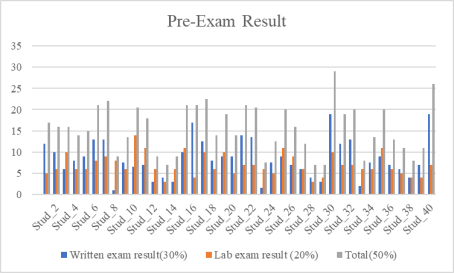
As the table data shows almost all students attempt to the theoretical and practical have got lower result in terms of theoretical and practical exam. The analysis result is shown in the
Figure 1.
Figure 1. Pre-Action-Exam Result Analysis.
In addition to this we prepared pre-intervention questionnaire to assess student’s background knowledge in computer programming and perceived programming ability and confidence in solving programming problems individually.
The importance of this phase was to rate students’ attitude and level of understanding in computer programming, self-efficacy, and confidence in writing a program to solve a particular task. They were also checked whether they ever requested assistance from others and they ever helped others.
4.3. Implementation of Action/Intervention Phase
In this phase we introduced Peer Learning approach. Peer programming involved a setup where the paired student took place at a particular Computer and take turns to write a code. Selected students are paired up with senior selected top scorer students. Initially, students were required to work out a logical structure to the program together, creating common understanding on the development of their program.
The assignment of student to cooperate practice in programming as explored, we use top scorer senior students as a teaching assistant to engage students in programming course. The benefit was found to be mutual for both senior students.
The question and discussion topics raised by the instructors. Those selected students are team up with one senior student and they critically think on the real-world problems. They participate in each of the tasks by demonstrating the entire code which improves the student’s ability to have strong performance in the lecture to build up their programming skill. Instead of the Instructor assistance during practical activity we observe that students are more comfortable with senior students to solve a given problem.
The action research lasted for four laboratory sessions. In each laboratory session students are given topic and problems to be solved. In this action research Peer approach exposed students to practice through activities and discussions in the laboratory sessions. It highlights top level thinking and often incorporates group work and sharing experience from the senior students
| [16] | Freeman, S., Sarah, L., Eddy, Miles, M., & Michell, K. (2014). Active learning increases student performance in science, engineering, and mathematics. University of California, San Francisco, CA: https://doi.org/10.1073/pnas.1319030111 |
[16]
.
Therefore, each of those selected students has been engaged in each of the laboratory activity and topic given by the instructor and they have their own responsibility to solve problems independently together with the help and discussion with senior student. To foster their individual effort on active learning, the instructor let the students to work questions for assessing and take their final result based on the demonstration they made on the entire practical works. The students are inclusive and they easily construct better knowledge by understanding how to solve real world problems thinking critically. Therefore, all students are benefited from active learning method. The benefit was found to be mutual for both senior students.
4.4. Evaluation
A total of 40 students participated in the two-phase tasks (pre-action and intervention). Therefore, the analysis presented below is based only on these 40 student’s responses.
4.4.1. Evaluation of Pre-action Phase
In the pre-action phase, an initial questionnaire was distributed to gather feedback from students regarding their perception in programming course, their current status, and their feeling to work with senior students.
Table 2 below presents the descriptive statistics of the key questions and response about the preliminary questionnaire. As shown, participants rated their skill in the course quite differently, leading to consistently strong correlations between the chosen questions and their programming skill.
Table 2. Pre-action Phase Questionnaire Analysis.
Questions | Number of respondents say YES | Number of respondents say NO | Yes, response in (%) |
Did you aware about the computer programming before joining to the department? | 11 | 29 | 27.5 |
Did you enjoy programming courses in the classroom? | 19 | 21 | 47.5 |
Did your programming class is participatory? | 11 | 29 | 27.5 |
Did you have an idea about Active Learning Method? | 3 | 37 | 7.5 |
Can you write programming codes to solve simple problems? | 12 | 28 | 30 |
Do you confused when you look at programming code? | 35 | 5 | 87.5 |
Do you think that computer programming is better understood by working with class group members? | 37 | 3 | 92.5 |
Did you get help from senior students related with programming courses? | 11 | 29 | 27.5 |
Do you feel comfortable to work with senior students? | 35 | 5 | 87.5 |
Are you interested to take tutorial on programming course by senior students? | 40 | 0 | 100 |
Responses to questions were also positively linked with student’s performance, perception about practical programming and their interest to work with senior students. From the above table we observed that out of 40 students being considered only 27.5 percent student have awareness about computer programing before joining Wolkite University. After they took fundamentals of programming I and Fundamentals of Programming II courses as the table shows 30 percent of the students tried to write programming codes to solve simple problems. As per the response only 27.5 percent of the respondent only get help from senior student. All students under consideration were agreed that computer programming is better understood by working with others in the laboratories. As the response data shows 87.5 percent of the students are feel comfortable to work programming course with senior students. All the students are agreed to take tutorial and courses by senor students.
4.4.2. Post Action Phase Evaluation
After the Peer learning approach was implemented, the researchers evaluated the theoretical and practical skill of the students using written and laboratory exam. The students scored as shown in the
Table 3.
Table 3. Student post action exam result.
Student Code | Written exam result (30%) | Lab exam result (20%) | Total 50% |
Stud_1 | 19 | 10 | 29 |
Stud_2 | 15 | 10 | 25 |
Stud_3 | 11 | 14 | 25 |
Stud_4 | 14 | 10 | 24 |
Stud_5 | 10 | 11 | 21 |
Stud_6 | 20 | 10 | 30 |
Stud_7 | 18 | 15 | 33 |
Stud_8 | 8 | 15 | 23 |
Stud_9 | 14 | 13 | 27 |
Stud_10 | 14 | 18 | 32 |
Stud_11 | 12 | 20 | 32 |
Stud_12 | 8 | 16 | 24 |
Stud_13 | 18 | 13 | 31 |
Stud_14 | 12 | 12 | 24 |
Stud_15 | 20 | 11 | 31 |
Stud_16 | 17 | 10 | 17 |
Stud_17 | 12.5 | 18 | 30.5 |
Stud_18 | 15 | 12 | 27 |
Stud_19 | 19 | 10 | 29 |
Stud_20 | 19 | 15 | 34 |
Stud_21 | 14 | 17 | 31 |
Stud_22 | 21 | 17 | 38 |
Stud_23 | 15 | 16 | 31 |
Stud_24 | 11 | 15 | 26 |
Stud_25 | 14 | 11 | 24 |
Stud_26 | 11 | 19 | 30 |
Stud_27 | 16 | 10 | 26 |
Stud_28 | 14 | 10 | 24 |
Stud_29 | 13 | 8 | 21 |
Stud_30 | 19 | 20 | 39 |
Stud_31 | 8 | 17 | 25 |
Stud_32 | 13 | 17 | 30 |
Stud_33 | 12 | 14 | 26 |
Stud_34 | 9 | 12 | 21 |
Stud_35 | 19 | 11 | 30 |
Stud_36 | 17 | 10 | 27 |
Stud_37 | 6 | 15 | 21 |
Stud_38 | 12 | 8 | 20 |
Stud_39 | 14 | 10 | 24 |
Stud_40 | 21 | 12 | 33 |
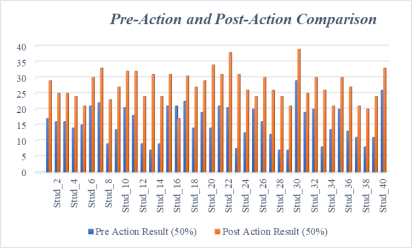
The above table showed most of the participants have significant change in both theoretical and practical exam after the intervention. Particularly the data in the above table shows the student have significant improvement in the practical skill.
In general, the analysis result of pre-action phase and post-action phase have been shown in the
Figure 2.
Figure 2. Pre-Action and Post-Action Comparison.
At the end of the action phase to know their experience on programming skill applying peer learning method with senior students, the questionnaire has been distributed among each of the students in addition to written exam to assess where the students are after taking course with senior students. Therefore, the analysis made based on the questionnaire has illustrated on the
Table 4.
Table 4. Post Action Phase Data Analysis.
Questions | Total No of respondents | Number of respondents say YES | Number of respondents say No | Yes, response in (%) |
Do you like Peer learning by working with your senior student? | 40 | 30 | 10 | 75 |
Can you solve programming problems easily with your peer group? | 40 | 31 | 9 | 77.5 |
Do you learn programming skills from being paired with others? | 40 | 35 | 5 | 87.5 |
Is peer learning help you to know more people in the class? | 40 | 40 | 0 | 100 |
Is Peer learning developing your communication skills with your classmates and senior students? | 40 | 38 | 2 | 95 |
Did you resolve that you have been boring at the programming class? | 40 | 28 | 12 | 70 |
Have you enjoyed working with senior students? | 40 | 40 | 0 | 100 |
As it is shown in the above table participants rated their programming skill positively, that leads to strong correlations between the questions and programming awareness, active learning method, and their attitude towards working with senior students. As we can see form the
Table 4, 100 percent of the students like learning programming by working with senior student in a peer learning manner. The table also show the percentage score rate of students’ agreement with a number of line codes Solving programming tasks easily with peer group, learning programming skills from pairing with others.
With directions form instructors peer learning approach allows participants to improve their practical skill. Besides to those selected student’s peer learning method helps senior students with the opportunity to teach and to be taught by one another.
5. Conclusion and Recommendation
5.1. Conclusion
In addition to improving students’ fundamentals of programming theoretical and practical skill, peer learning practice allows participants to work through new concept with other individuals engaged in the same work and provides them with the opportunities to teach and taught by one another, expanding their perspectives and fostering lasting connections. One clear positive aspect on which students agreed was that Peer Learning approach helped them connect with more people in the class and senior students.
additionally, in order to be fully realized, peer learning approach should be supplemented with instruction on how to collaborate most effectively. students who participated in peer learning has showed a change in their programming skill. So, generally rather than applying only lecture method it is better to include collaborative learning method, as it helps students to discuss freely and share their ideas.
5.2. Recommendation
This action research can bring more significant improvement if it also includes for all students throughout the college. We recommend this action research to be done for a long period of time as much as possible to see more changes in students’ academic performance. We also recommend to apply these kinds of action research in other coursers and colleges. Again, if there are other methods of collaborative learning methods, dealing on those methods could be one issue for future works.
Abbreviations
CCI | College of Computing and Informatics |
Stud | Student |
Lab | Laboratory |
Author Contributions
Kahsay Nguse Gebrekidan: Conceptualization, Methodology, Resources
Asfaw Kiros Dessalegn: Data curation, Writing – review & editing
Conflicts of Interest
There is no conflict of interest in this action research.
Appendix
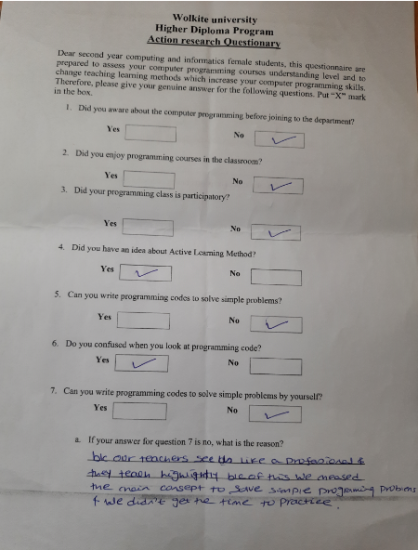
Appendix I: Questionnaires
Figure A1. Questionnaire Filled by students.
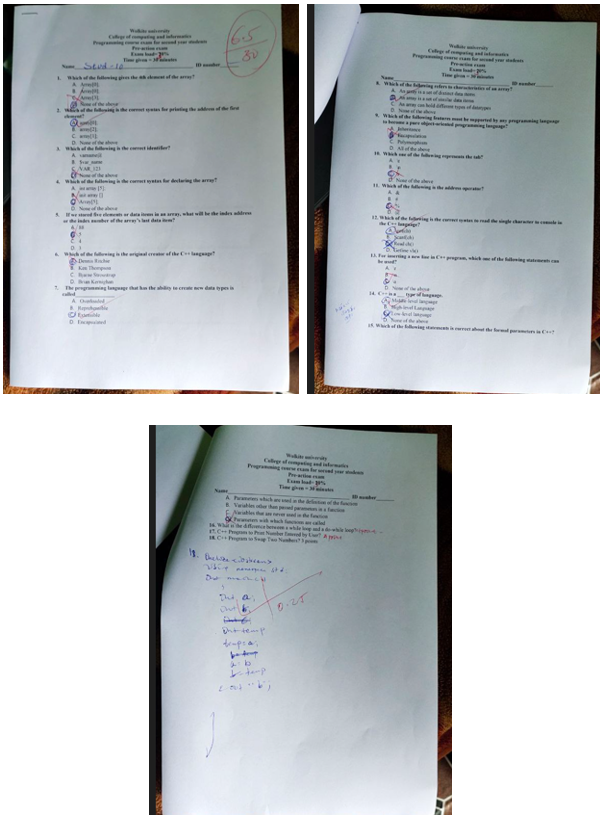
Appendix II: Exam Result Before Intervention
Figure A2. Sample Scores of students before Peer learning was implemented.
Appendix III: Exam Result After Intervention
Figure A3. Sample Scores after the implementation of Peer learning.
References
| [1] |
Bati, T. B., Gelderblom, H., & Biljion, J. v. (2014). Blended learning of programming in large classes: a reflection of students. Computer Science Education.
|
| [2] |
Rozita Kadar, Naemah Abdul Wahab, Jamal Othman, Maisurah Shamsuddin & Siti Balqis Mahlan. (2021). A Study of Difficulties in Teaching and Learning Programming: A Systematic Literature Review. International Journal of Academic Research in Progressive Education and Development, 591–605.
|
| [3] |
BayisaNateaSima, Sasikumar Perumal. (2019). Comparative Analysis of Improving Computer Programming Skills of Information Technology First Year Students at Ambo University - An Action Research. IOSR Journal of Computer Engineering (IOSR-JCE), 08-15.
|
| [4] |
Heaney, Joo-Gim, Gatfield, Terence John, Clarke, Peter, Caelli, Joan. (2006). Using Action Research to Implement and Evaluate Peer Learning in Marketing courses: Engaging Students Through Self-Learning. ANZMAC Conference Proceedings.
|
| [5] |
Dickson, P. (2011). Using Undergraduate Teaching Assistants in a Small. In Proceedings of the 42nd ACM technical symposium on Computer science education (pp. 75-80). ACM.
|
| [6] |
Boud, D. C. (1999). Peer learning and assessment. Assessment & evaluation in higher education. 413-426.
|
| [7] |
Keppell, M. A. (2006). peer learning and learning-oriented assessment in technology-enhanced environments. Assessment & Evaluation in Higher Education., 453-464.
|
| [8] |
Regasa, B. G. (2016). Improving Peer Learning for Students’ Academic Performance: The Case of Second Year Rural Development and Agricultural Extension Students, College of Agriculture, Wolaita Sodo University. Journal of Education and Practice, Vol. 7, No. 34.
|
| [9] |
Keenan, C. (n.d.). Mapping student-led peer learning in the UK.: The Higher Education Academy.
|
| [10] |
Byl, E. S. (2016). The Value of Peer Learning for First-Year Postgraduate University Students’ Social and Academic Integration. Procedia - Social and Behavioral Sciences, 299-304.
|
| [11] |
Sedghi, G. &. (November 2015). The development and implementation of a Peer Assisted Learning programme at the University of Liverpool. Journal of Learning Development in Higher Education, Special Edition: Academic Peer Learning, 1-17.
|
| [12] |
Dorian, S., & Gunawardena, E. (2010). Gender differences in the use of computers, programming, and peer interactions in computer science. Computer Science Education.
|
| [13] |
Ford, N. T. (November 2015). peer learning leaders: developing employability through facilitating the learning of other students. Journal of Learning Development in Higher Education, Special Edition: Academic Peer Learning, 1-23.
|
| [14] |
Hope, R. &. (n.d.). Supplemental instruction: SI leader manual. School of Instructional Support, Chaffey College.
|
| [15] |
Becejac, B. S. (n.d.). The Impact of Peer Learning within a Group of International Post-graduate Students. Athens Journal of Education -, Volume 5(Issue 1), Pages 7-2.
|
| [16] |
Freeman, S., Sarah, L., Eddy, Miles, M., & Michell, K. (2014). Active learning increases student performance in science, engineering, and mathematics. University of California, San Francisco, CA:
https://doi.org/10.1073/pnas.1319030111
|
Cite This Article
-
ACS Style
Gebrekidan, K. N.; Dessalegn, A. K. Enhancing Second Year Students' Computer Programming Skills Through Peer Learning: An Action Research. Softw. Eng. 2026, 12(2), 19-32. doi: 10.11648/j.se.20261202.11
 Copy
|
 Download
AMA Style
Gebrekidan KN, Dessalegn AK. Enhancing Second Year Students' Computer Programming Skills Through Peer Learning: An Action Research. Softw Eng. 2026;12(2):19-32. doi: 10.11648/j.se.20261202.11
Copy
|
Download
-
@article{10.11648/j.se.20261202.11,
  author = {Kahsay Nguse Gebrekidan and Asfaw Kiros Dessalegn},
  title = {Enhancing Second Year Students' Computer Programming Skills Through Peer Learning: An Action Research},
  journal = {Software Engineering},
  volume = {12},
  number = {2},
  pages = {19-32},
  doi = {10.11648/j.se.20261202.11},
  url = {https://doi.org/10.11648/j.se.20261202.11},
  eprint = {https://article.sciencepublishinggroup.com/pdf/10.11648.j.se.20261202.11},
  abstract = {Researchers found that peer learning approach was impactful to bring students to the same discussion table. Majority of students who joined in computing and informatics college in our university have no prior experience in programming course and usually found it difficult. From those students, who joined college of computing and informatics there are few students who have less interest in programming courses. Having this in mind, this action research mainly focuses on to enhancing those students programming skill using peer learning approach. senior top scorer students were assigned as a teaching assistant. Researchers suggest that use of top scorer student as a teaching assistant helps to create closest relationship and sense of community among students. Through peer learning approach students gradually develop team sprit while creating a sense of motivation and encouragement for their success. This action research investigated the use of peer-approach learning to enhance both practical and theoretical skill, confidence, and score of their programming course. Certain students were selected for the case study and they were evaluated before and after the peer learning approach was implemented. As planned, students programming skill were seen improved after practicing the peer learning approach.},
 year = {2026}
}
Copy
|
Download
-
TY  - JOUR
T1  - Enhancing Second Year Students' Computer Programming Skills Through Peer Learning: An Action Research
AU  - Kahsay Nguse Gebrekidan
AU  - Asfaw Kiros Dessalegn
Y1  - 2026/11/11
PY  - 2026
N1  - https://doi.org/10.11648/j.se.20261202.11
DO  - 10.11648/j.se.20261202.11
T2  - Software Engineering
JF  - Software Engineering
JO  - Software Engineering
SP  - 19
EP  - 32
PB  - Science Publishing Group
SN  - 2376-8037
UR  - https://doi.org/10.11648/j.se.20261202.11
AB  - Researchers found that peer learning approach was impactful to bring students to the same discussion table. Majority of students who joined in computing and informatics college in our university have no prior experience in programming course and usually found it difficult. From those students, who joined college of computing and informatics there are few students who have less interest in programming courses. Having this in mind, this action research mainly focuses on to enhancing those students programming skill using peer learning approach. senior top scorer students were assigned as a teaching assistant. Researchers suggest that use of top scorer student as a teaching assistant helps to create closest relationship and sense of community among students. Through peer learning approach students gradually develop team sprit while creating a sense of motivation and encouragement for their success. This action research investigated the use of peer-approach learning to enhance both practical and theoretical skill, confidence, and score of their programming course. Certain students were selected for the case study and they were evaluated before and after the peer learning approach was implemented. As planned, students programming skill were seen improved after practicing the peer learning approach.
VL  - 12
IS  - 2
ER  -
Copy
|
Download





 Share This Article
 Twitter
 Linked In
 Facebook