
The interconnections among food systems, poverty, and malnutrition remain central to Bangladesh’s development trajectory. Despite substantial agricultural growth and notable reductions in poverty over the past two decades, structural challenges continue to constrain equitable access to food and nutrition. This study analyzes agricultural production trends, food system drivers, and consumption behaviors, situating Bangladesh in a comparative South Asian context. Using national survey data and secondary statistics, it further examines poverty dynamics, both income-based and multidimensional and their implications for food insecurity and nutrition outcomes. The empirical evidence highlights persistent disparities in dietary diversity, caloric intake, and affordability of healthy diets across rural–urban and socio-economic groups. Moreover, the prevalence of child undernutrition and the double burden of malnutrition underscore the fragility of current nutrition gains. The findings suggest that external shocks, including climate variability, market volatility, and global food price fluctuations, exacerbate systemic vulnerabilities. Policy analysis indicates that while government interventions in agriculture, poverty alleviation, and nutrition have achieved incremental success, gaps remain in coordination, targeting, and long-term sustainability. The paper argues for integrated, multisectoral strategies that enhance agricultural productivity, strengthen social protection mechanisms, and promote resilient, nutrition-sensitive food systems. Such approaches are essential to achieving the Sustainable Development Goals (SDGs) on zero hunger, poverty reduction, and improved health outcomes in Bangladesh.
| Published in | Science Discovery Nutrition (Volume 1, Issue 1) |
| DOI | 10.11648/j.sdnutr.20260101.11 |
| Page(s) | 1-14 |
| Creative Commons |
This is an Open Access article, distributed under the terms of the Creative Commons Attribution 4.0 International License (http://creativecommons.org/licenses/by/4.0/), which permits unrestricted use, distribution and reproduction in any medium or format, provided the original work is properly cited. |
| Copyright |
Copyright © The Author(s), 2026. Published by Science Publishing Group |
Food System, Poverty Reduction, Malnutrition, Nutrition Security, Bangladesh, Food Security, Policy
Commodity | Bangladesh (MT) | India (MT) | Pakistan (MT) |
|---|---|---|---|
Rice | 39.1 | 130.0 | 9.0 |
Wheat | 1.2 | 110.0 | 31.4 |
Maize | 4.8 | 34.6 | 10.2 |
Sugarcane | 10.5 | 405.4 | 90.0 |
Onion | 2.5 | 26.7 | 2.1 |
Chili | 0.13 | 1.9 | 0.15 |
Fish | 4.6 | 14.2 | 0.8 |
Eggs | 17.1 | 122.1 | 20.0 |
Milk | 10.9 | 210.0 | 65.0 |
Meat | 1.7 | 8.8 | 4.5 |
Mango | 1.2 | 20.0 | 1.8 |
Banana | 1.0 | 30.5 | 0.9 |
Nuts | 0.05 | 1.5 | 0.1 |
Poverty Line | Number of Poor (Thousands) | Rate (%) | Year |
|---|---|---|---|
National Poverty Line | 30,884.7 | 18.7 | 2022 |
International Poverty Line ($2.15/day) | 8,483.6 | 5.0 | 2022 |
Lower Middle Income Class Poverty Line ($3.65/day) | 50,872.7 | 30.0 | 2022 |
Upper Middle Income Class Poverty Line ($6.85/day) | 125,506.9 | 74.1 | 2022 |
Multidimensional Poverty Measure | – | 6.6 | 2022 |
Poverty Line | HIES 2000 | HIES 2005 | HIES 2010 | HIES 2016/17 | HIES 2022 |
|---|---|---|---|---|---|
Using the Upper Poverty Line | 18.7 | 24.3 | 31.5 | 40.0 | 48.9 |
Using the Lower Poverty Line | 5.6 | 12.9 | 17.6 | 25.1 | 34.3 |
Sector | 2019-20 (%) | 2020-21 (%) | 2021-22 (%) | 2022-23 (%) |
|---|---|---|---|---|
Agriculture | 7.64 | 7.94 | 8.49 | 10.91 |
- Crops & Horticulture | 7.35 | 7.26 | 7.88 | 11.21 |
- Animal Farming | 8.20 | 9.20 | 9.60 | 9.80 |
- Forest & Related Services | 7.50 | 7.60 | 7.70 | 7.80 |
- Fishing | 8.00 | 8.10 | 8.20 | 8.30 |
Industry | 9.60 | 11.20 | 12.30 | 13.40 |
- Mining & Quarrying | 5.50 | 5.60 | 5.70 | 5.80 |
- Manufacturing | 9.80 | 11.50 | 12.60 | 13.70 |
- Large & Medium Scale Manufacturing | 10.00 | 11.70 | 12.80 | 13.90 |
- Small Scale Manufacturing | 8.50 | 9.00 | 9.50 | 10.00 |
- Electricity, Gas & Water Supply | 8.00 | 8.50 | 9.00 | 9.50 |
- Construction | 9.00 | 9.50 | 10.00 | 10.50 |
Services | 6.50 | 6.80 | 7.10 | 7.40 |
- Wholesale & Retail Trade | 6.00 | 6.20 | 6.40 | 6.60 |
- Transport, Storage & Communication | 6.50 | 6.70 | 6.90 | 7.10 |
- Financial Intermediation | 7.00 | 7.20 | 7.40 | 7.60 |
- Real Estate, Renting & Business | 6.20 | 6.40 | 6.60 | 6.80 |
- Public Administration & Defense | 6.80 | 7.00 | 7.20 | 7.40 |
- Education | 6.30 | 6.50 | 6.70 | 6.90 |
- Health & Social Work | 6.40 | 6.60 | 6.80 | 7.00 |
Model/framework and institution(s) | Question asked and time frame | Investments included | Hunger target and key modeling factors included | Annual cost (US$) |
|---|---|---|---|---|
Achieving Zero Hunger (FAO, IFAD, WFP) | What are the additional transfers and investments needed to end poverty and hunger in all countries by 2030? | Poverty gap transfers and pro-poor public investment in irrigation, genetic resources, mechanization, geoprocessing, infrastructure, institutions, and agricultural R&D | Zero hunger target | 265 billion |
IMPACT (International Model for Policy Analysis of Agricultural Commodities and Trade, IFPRI) | How much would hunger decrease given investments to achieve the target yield increases by 2030? | Agricultural R&D, irrigation expansion, water use efficiency, soil management, and infrastructure | 5% hunger target; effects of climate change included 5% hunger target; bottom-up approach with household-level targeted interventions | 52 billion |
MIRAGRODEP (MIRAGE model developed by AGRODEP (IFPRI–IISD) | What is the minimum cost to end hunger for vulnerable households in all countries by 2030? | Social safety nets, farm support, and rural development | 11 billion | |
Investment Framework for Nutrition (World Bank) | What is the minimum cost to meet the World Health Assembly (WHA) goals on reducing undernutrition by 2025? | Targeted nutrition interventions (micronutrient and protein supplementation, promoting good health and hygiene, complementary foods) and select nutrition-sensitive interventions (staple fortification and pro-breastfeeding policies) | 40% reduction in child stunting; 50% reduction in anemia in women; 50% increase in exclusive breastfeeding rates; 5% reduction in child wasting | 7 billion |
Year | Rural stunting | Urban stunting | Rural wasting | Urban wasting |
|---|---|---|---|---|
2014 | 38% | 31% | 15% | 12% |
2017 | 33% | 25% | 8% | 9% |
2022 | 24% | 22% | 11% | 11% |
Year | Rural Women | Rural Men | Urban Women | Urban Men |
|---|---|---|---|---|
2011 | 12% | 4% | 29% | 4% |
2014 | 19% | - | 36% | - |
2017 | 28% | 15% | 43% | 24% |
2022 | 35% | 17% | % | 29% |
Indicator | National (%) | Rural (%) | Urban (%) | Barisal (%) | Chittagong (%) | Dhaka (%) | Mymensingh (%) | Khulna (%) | Rajshahi (%) | Rangpur (%) | Sylhet (%) |
|---|---|---|---|---|---|---|---|---|---|---|---|
Moderate Food Insecurity | 21.91 | 22.83 | 19.66 | 22.07 | 26.00 | 16.40 | 25.01 | 26.48 | 21.91 | 29.98 | 26.48 |
Severe Food Insecurity | 0.83 | 0.95 | 0.67 | 0.87 | 0.87 | 0.64 | 0.87 | 0.87 | 0.51 | 0.87 | 1.42 |
ADB | Asian Development Bank |
AGRODEP | African Growth and Development Policy Modeling Consortium |
BBS | Bangladesh Bureau of Statistics |
BDHS | Bangladesh Demographic and Health Survey |
BDP 2100 | Bangladesh Delta Plan 2100 |
BDT | Bangladeshi Taka |
BIDS | Bangladesh Institute of Development Studies |
CIP3 | Third Country Investment Plan – Sustainable, Nutrition-Sensitive and Resilient Food Systems |
COVID-19 | Coronavirus Disease 2019 |
DBM | Double Burden of Malnutrition |
DHS | Demographic and Health Surveys |
DPs | Development Partners |
EU | European Union |
FAO | Food and Agriculture Organization of the United Nations |
FAOSTAT | FAO Statistical Database |
FNS | Food and Nutrition Security |
FPMU | Food Planning and Monitoring Unit |
GDP | Gross Domestic Product |
GoB | Government of Bangladesh |
HCR | Head Count Rate |
HIES | Household Income and Expenditure Survey |
IFAD | International Fund for Agricultural Development |
IFPRI | International Food Policy Research Institute |
IISD | International Institute for Sustainable Development |
IMPACT | International Model for Policy Analysis of Agricultural Commodities and Trade |
IOM | International Organization for Migration |
IPC | Integrated Food Security Phase Classification |
MAM | Moderate Acute Malnutrition |
MIRAGE | MIRAGE Model |
MIRAGRODEP | MIRAGRODEP Model |
MoP | Ministry of Planning |
MT | Million Tonnes |
NFNSP | National Food and Nutrition Security Policy |
NIPORT | National Institute of Population Research and Training |
PoA | Plan of Action |
PP2041 | Perspective Plan of Bangladesh 2021–2041 |
R&D | Research and Development |
SAM | Severe Acute Malnutrition |
SDGs | Sustainable Development Goals |
SSN | Social Safety Net |
UN | United Nations |
UNFPA | United Nations Population Fund |
USAID | United States Agency for International Development |
US$ | United States Dollar |
WFP | World Food Programme |
WHA | World Health Assembly |
WHO | World Health Organization |
WRI | World Risk Index |
8FYP | Eighth Five-Year Plan |
9FYP | Ninth Five-Year Plan |
| [1] |
Asian Development Bank. (2021). Asian development outlook 2021 update: Transforming agriculture in Asia.
https://www.adb.org/publications/asian-development-outlook-2021-update |
| [2] | Bangladesh Bureau of Statistics. (2023). Yearbook of agricultural statistics 2023. Statistics and Informatics Division, Ministry of Planning, Government of the People’s Republic of Bangladesh. |
| [3] | Bangladesh Bureau of Statistics. (2023, December). Final report: Household Income and Expenditure Survey (HIES) 2022. Statistics and Informatics Division, Ministry of Planning, Government of Bangladesh. |
| [4] | Bangladesh Bureau of Statistics. (2024). National accounts statistics 2024. Statistics and Informatics Division, Ministry of Planning, Government of the People’s Republic of Bangladesh. |
| [5] | Bangladesh Bureau of Statistics. (2025, February 4). Poverty map of Bangladesh 2022: Small area estimation – District and Upazila results. |
| [6] | Banis, Z. O., Hasan, M., Rosario, F. S. R., & Mohammad, J. D. (2024, May). An overview of the Bangladesh food system: Outcomes, drivers & activities. Foresight Food. |
| [7] | Finance Division, Ministry of Finance. (2024). Bangladesh economic review 2024. Government of the People’s Republic of Bangladesh. |
| [8] | Food and Agriculture Organization of the United Nations. (2023). FAOSTAT: Crops and livestock products [Data set]. |
| [9] | Food and Agriculture Organization of the United Nations. (2024). FAOSTAT: Suite of food security indicators [Data set]. |
| [10] | Food and Agriculture Organization of the United Nations, International Fund for Agricultural Development, United Nations Children’s Fund, World Food Programme, & World Health Organization. (2020). The state of food security and nutrition in the world 2020: Transforming food systems for affordable healthy diets. Food and Agriculture Organization of the United Nations. |
| [11] | Food Planning and Monitoring Unit (FPMU), Ministry of Food, Government of the People’s Republic of Bangladesh. (2023). Bangladesh national food and nutrition security policy plan of action 2021–2030 [PDF]. FAOLEX. Retrieved from |
| [12] | Food Planning and Monitoring Unit (FPMU), Ministry of Food, Government of Bangladesh. (2022, March). Bangladesh Third Country Investment Plan – Sustainable, Nutrition-Sensitive and Resilient Food Systems (2021-2025). FAOLEX. Food and Agriculture Organization of the United Nations. Retrieved from |
| [13] |
Global Nutrition Report. (2024). Bangladesh nutrition profile.
https://globalnutritionreport.org/resources/nutrition-profiles/asia/southern-asia/bangladesh/ |
| [14] | Hossain, M. A., et al. (2025). Identifying determinants of malnutrition in children in Bangladesh. Scientific Reports. |
| [15] | Integrated Food Security Phase Classification [IPC]. (2025, July 4). Bangladesh: IPC acute food insecurity and acute malnutrition analysis, January–December 2025. IPC Global Support Unit. |
| [16] |
International Organization for Migration. (2022). World migration report 2022.
https://publications.iom.int/books/world-migration-report-2022 |
| [17] | Islam, M. S., & Sowdagar, M.-U.-A. (2021–2022). Poverty reduction in Bangladesh: Policy, achievement, and setbacks. Jagannath University Journal of Social Sciences, 11(1–2), 38–54. |
| [18] | Margolies, A., Choo, E., Singh, N., Parvin, A., Ruel, M. T., & Olney, D. K. (2024). Bangladesh urban nutrition profile. Initiative on Sustainable Healthy Diets & Initiative on Resilient Cities, International Food Policy Research Institute. Retrieved from Aklima Parvin | IFPRI. |
| [19] | Ministry of Planning. (2018, September 4). Bangladesh Delta Plan 2100: A long-term integrated techno-economic plan for water resources management [Policy document]. Government of the People’s Republic of Bangladesh. Retrieved from FAOLEX website: |
| [20] | Ministry of Planning. (2020, March). Making Vision 2041 a Reality: Perspective Plan of Bangladesh 2021–2041 (Publication of the General Economics Division, Planning Commission, Government of the People’s Republic of Bangladesh). Retrieved from GED Knowledge Portal: [“Perspective Plan of Bangladesh 2021-2041” document]. |
| [21] | Mohajan, H. K. (2018). Analysis of food production and poverty reduction in Bangladesh. Annals of Spiru Haret University. Economic Series, 18(1), 191–205. |
| [22] | Mozdalifa, J. (2012). Elusive progress: State of food security in Bangladesh. Unnayan Onneshan – The Innovators, Center for Research and Action Development. |
| [23] | Nath, N. C. (2015). Food security in Bangladesh: Status, challenges and strategic policy options. Bangladesh Economic Association. |
| [24] | National Institute of Population Research and Training (NIPORT), Medical Education and Family Welfare Division, Ministry of Health and Family Welfare [Bangladesh], & ICF. (2023). Bangladesh demographic and health survey 2022: Key indicators report. Dhaka, Bangladesh, and Rockville, Maryland, USA: NIPORT and ICF. |
| [25] | Osmani, S. R. (1980). Poverty, inequality, and the problem of nutrition in Bangladesh. The Bangladesh Development Studies, 8(1/2), 121–142. |
| [26] | Prothom Alo. (2025, April 24). 3m more to fall into extreme poverty in Bangladesh: World Bank. Prothom Alo English. |
| [27] | Safety Net System for the Poorest project: Brief on the Strengthening of the MoDMR Program Administration (SNSP-DDM) Project. (2025, August 17). Ministry of Disaster Management and Relief. |
| [28] | Sarker, M. M. R., Aleen, M. J., & Datta, T. (2025a). Agricultural Transformation and Its Contribution to Economic Development in South Asian and African Countries. Asian Journal of Advances in Agricultural Research, 25(1), 19–31. |
| [29] | Sarker, M. M. R., Aleen, M. J., & Datta, T. (2025b). Productivity of food and self-sufficiency in rice production in Bangladesh. Economics World, 12(3), 214–226. |
| [30] | Sarker, M. M. R., Jannat, S., Mohanta, A. R., & Anjum, R. (2025). Food and nutrition security in Bangladesh: Trends, challenges, and policy interventions. European Journal of Nutrition & Food Safety, 17(10), 93–112. |
| [31] | Sarker, M. M. R., Jury, F. H., & Khan, M. (2022). Micro-level study of ethnic and non-ethnic households’ food security and dietary diversity. International Journal of Agricultural Economics, 7(2), 75–81. |
| [32] | Sarker, M. M. R., Khan, M., Parvin, M. M., & Islam, S. (2022). Economic impact of COVID-19 on different groups of people in South Asia: Evidence from Bangladesh. Journal of Health and Environmental Research, 8(1), 43–46. |
| [33] | Sarker, M. M. R., Nishat, N. I., Parvin, M. M., & Fagun, A. N. (2021). Determinants of fertility trend at district, divisional, and regional levels and policy implications for poverty alleviation. International Journal of Health Economics and Policy, 6(3), 92–99. |
| [34] | The Financial Express. (2025, August 16). Poverty in Bangladesh stages a comeback. |
| [35] | Wikipedia contributors. (2025). Poverty. Wikipedia. |
| [36] | World Bank Group. (2023, April). Poverty & equity brief: Bangladesh (South Asia). |
| [37] | World Bank. (2025, April). Poverty & equity brief: Bangladesh. Poverty Economist: Sergio Olivieri & Nethra Palaniswamy. World Bank Group. |
| [38] |
World Bank. (2021). Urban population (% of total population)—Bangladesh [Data set]. World Development Indicators.
https://data.worldbank.org/indicator/SP.URB.TOTL.IN.ZS?locations=BD |
| [39] | World Health Organization. (2024). Nutrition. |
APA Style
Sarker, M. M. R., Jannat, S., Himany, M. U., Anjum, R., Tamanna, S. (2026). Food System, Poverty, and Malnutrition in Bangladesh: Challenges and Policy Implications. Science Discovery Nutrition, 1(1), 1-14. https://doi.org/10.11648/j.sdnutr.20260101.11
ACS Style
Sarker, M. M. R.; Jannat, S.; Himany, M. U.; Anjum, R.; Tamanna, S. Food System, Poverty, and Malnutrition in Bangladesh: Challenges and Policy Implications. Sci. Discov. Nutr. 2026, 1(1), 1-14. doi: 10.11648/j.sdnutr.20260101.11
AMA Style
Sarker MMR, Jannat S, Himany MU, Anjum R, Tamanna S. Food System, Poverty, and Malnutrition in Bangladesh: Challenges and Policy Implications. Sci Discov Nutr. 2026;1(1):1-14. doi: 10.11648/j.sdnutr.20260101.11
@article{10.11648/j.sdnutr.20260101.11,
  author = {Md Mizanur Rahman Sarker and Sumaia Jannat and Momena Ulfat Himany and Ramisa Anjum and Sanjida Tamanna},
  title = {Food System, Poverty, and Malnutrition in Bangladesh: Challenges and Policy Implications},
  journal = {Science Discovery Nutrition},
  volume = {1},
  number = {1},
  pages = {1-14},
  doi = {10.11648/j.sdnutr.20260101.11},
  url = {https://doi.org/10.11648/j.sdnutr.20260101.11},
  eprint = {https://article.sciencepublishinggroup.com/pdf/10.11648.j.sdnutr.20260101.11},
  abstract = {The interconnections among food systems, poverty, and malnutrition remain central to Bangladesh’s development trajectory. Despite substantial agricultural growth and notable reductions in poverty over the past two decades, structural challenges continue to constrain equitable access to food and nutrition. This study analyzes agricultural production trends, food system drivers, and consumption behaviors, situating Bangladesh in a comparative South Asian context. Using national survey data and secondary statistics, it further examines poverty dynamics, both income-based and multidimensional and their implications for food insecurity and nutrition outcomes. The empirical evidence highlights persistent disparities in dietary diversity, caloric intake, and affordability of healthy diets across rural–urban and socio-economic groups. Moreover, the prevalence of child undernutrition and the double burden of malnutrition underscore the fragility of current nutrition gains. The findings suggest that external shocks, including climate variability, market volatility, and global food price fluctuations, exacerbate systemic vulnerabilities. Policy analysis indicates that while government interventions in agriculture, poverty alleviation, and nutrition have achieved incremental success, gaps remain in coordination, targeting, and long-term sustainability. The paper argues for integrated, multisectoral strategies that enhance agricultural productivity, strengthen social protection mechanisms, and promote resilient, nutrition-sensitive food systems. Such approaches are essential to achieving the Sustainable Development Goals (SDGs) on zero hunger, poverty reduction, and improved health outcomes in Bangladesh.},
 year = {2026}
}
TY  - JOUR
T1  - Food System, Poverty, and Malnutrition in Bangladesh: Challenges and Policy Implications
AU  - Md Mizanur Rahman Sarker
AU  - Sumaia Jannat
AU  - Momena Ulfat Himany
AU  - Ramisa Anjum
AU  - Sanjida Tamanna
Y1  - 2026/09/30
PY  - 2026
N1  - https://doi.org/10.11648/j.sdnutr.20260101.11
DO  - 10.11648/j.sdnutr.20260101.11
T2  - Science Discovery Nutrition
JF  - Science Discovery Nutrition
JO  - Science Discovery Nutrition
SP  - 1
EP  - 14
PB  - Science Publishing Group
UR  - https://doi.org/10.11648/j.sdnutr.20260101.11
AB  - The interconnections among food systems, poverty, and malnutrition remain central to Bangladesh’s development trajectory. Despite substantial agricultural growth and notable reductions in poverty over the past two decades, structural challenges continue to constrain equitable access to food and nutrition. This study analyzes agricultural production trends, food system drivers, and consumption behaviors, situating Bangladesh in a comparative South Asian context. Using national survey data and secondary statistics, it further examines poverty dynamics, both income-based and multidimensional and their implications for food insecurity and nutrition outcomes. The empirical evidence highlights persistent disparities in dietary diversity, caloric intake, and affordability of healthy diets across rural–urban and socio-economic groups. Moreover, the prevalence of child undernutrition and the double burden of malnutrition underscore the fragility of current nutrition gains. The findings suggest that external shocks, including climate variability, market volatility, and global food price fluctuations, exacerbate systemic vulnerabilities. Policy analysis indicates that while government interventions in agriculture, poverty alleviation, and nutrition have achieved incremental success, gaps remain in coordination, targeting, and long-term sustainability. The paper argues for integrated, multisectoral strategies that enhance agricultural productivity, strengthen social protection mechanisms, and promote resilient, nutrition-sensitive food systems. Such approaches are essential to achieving the Sustainable Development Goals (SDGs) on zero hunger, poverty reduction, and improved health outcomes in Bangladesh.
VL  - 1
IS  - 1
ER  -
Department of Agricultural Statistics, Sher-e-Bangla Agricultural University, Dhaka, Bangladesh
Department of Agricultural Statistics, Sher-e-Bangla Agricultural University, Dhaka, Bangladesh
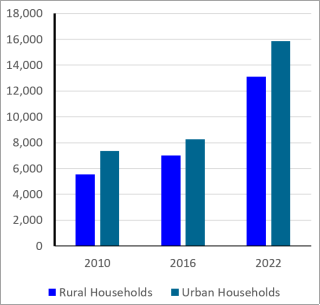
Figure 1. A comparison of food expenditure in Bangladesh between rural and urban households in 2010, 2016, and 2022.
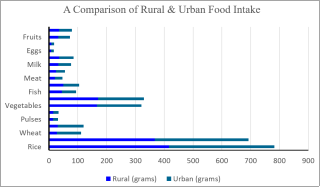
Figure 2. A comparison of food intake between 2010 and 2022 between rural and urban households.
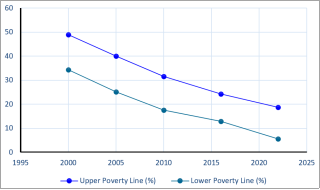
Figure 3. Population living below the poverty line in Bangladesh.
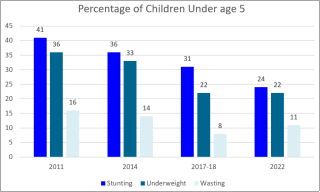
Figure 4. Trends in Nutritional Status of Children.
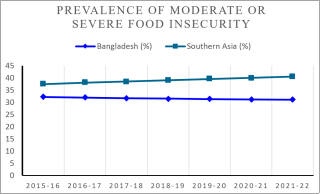
Figure 5. A comparison between the prevalence of moderate or severe food insecurity in Bangladesh and the average regional data for Southern Asia between 2015 and 2022.

Information



 Share This Article
 Twitter
 Linked In
 Facebook
 Copy
Copy Download