1. Introduction
1.1. Background and Motivation
Planetary-scale waves are fundamental dynamical features of the middle and upper atmosphere, transferring energy and momentum across large horizontal distances and influencing the thermal structure, circulation, and composition of the mesosphere and lower thermosphere (MLT; approximately 60-100 km). Among these, the quasi-16-day wave (Q16DW) is a prominent westward-propagating Rossby normal mode, typically associated with zonal wavenumbers 1-2 and periods ranging from roughly 12 to 20 days
| [7] | Forbes, J. M., Hagan, M. E., Miyahara, S., Vial, F., Manson, A. H., Meek, C. E., & Portnyagin, Y. I. (1995). Quasi 16-day oscillation in the mesosphere and lower thermosphere. Journal of Geophysical Research: Atmospheres, 100(D5), 9149-9163.
https://doi.org/10.1029/94JD02157 |
| [18] | Salby, M. L. (1981). Rossby normal modes in nonuniform background configurations. Part I: Simple fields. Journal of the Atmospheric Sciences, 38(9), 1803-1826.
https://doi.org/10.1175/1520-0469(1981)038<1803:RNMINB>2.0.CO;2 |
[7, 18]
. Theoretical solutions of Laplace’s tidal equations identify the dominant manifestation as the second symmetric Hough mode of zonal wavenumber 1 (often denoted (1, −4) or similar), although observational variability in period and structure is common due to Doppler shifting by background winds and interactions with the mean flow
| [7] | Forbes, J. M., Hagan, M. E., Miyahara, S., Vial, F., Manson, A. H., Meek, C. E., & Portnyagin, Y. I. (1995). Quasi 16-day oscillation in the mesosphere and lower thermosphere. Journal of Geophysical Research: Atmospheres, 100(D5), 9149-9163.
https://doi.org/10.1029/94JD02157 |
| [14] | Luo, Y., Manson, A. H., Meek, C. E., Meyer, C. K., & Forbes, J. M. (2000). The quasi 16-day oscillations in the mesosphere and lower thermosphere at Saskatoon (52°N, 107°W), 1980-1996. Journal of Geophysical Research: Atmospheres, 105(D2), 2125-2138. https://doi.org/10.1029/1999JD900979 |
[7, 14]
.
The MLT constitutes a critical transition region between the stratosphere below and the thermosphere/ionosphere above. Waves that reach this altitude can dissipate, deposit momentum, modulate tides, and couple to the ionosphere through dynamo processes or direct penetration, thereby linking lower-atmosphere variability to upper-atmospheric and space-weather phenomena. While mid- and high-latitude Q16DW activity has been extensively documented, low and equatorial latitudes remain comparatively understudied despite their dynamical importance. Equatorial stations lie near the node or ducting pathways of many normal modes, experience strong seasonal and interannual modulation by the quasi-biennial and semiannual oscillations, and serve as potential conduits for interhemispheric wave transport. Systematic characterization at these latitudes is therefore essential for a complete global picture of planetary-wave dynamics and vertical-horizontal coupling.
1.2. Scientific Context
At mid- and high latitudes the Q16DW characteristically reaches maximum amplitudes during winter, when the prevailing eastward (westerly) background flow permits vertical propagation of the westward-traveling mode, and exhibits a clear preference for eastward phase progression relative to the mean wind in many radar and satellite analyses
| [5] | Day, K. A., & Mitchell, N. J. (2010). The 16-day wave in the Arctic and Antarctic mesosphere and lower thermosphere. Atmospheric Chemistry and Physics, 10(3), 1461-1472.
https://doi.org/10.5194/acp-10-1461-2010 |
| [14] | Luo, Y., Manson, A. H., Meek, C. E., Meyer, C. K., & Forbes, J. M. (2000). The quasi 16-day oscillations in the mesosphere and lower thermosphere at Saskatoon (52°N, 107°W), 1980-1996. Journal of Geophysical Research: Atmospheres, 105(D2), 2125-2138. https://doi.org/10.1029/1999JD900979 |
| [16] | Mitchell, N. J., Middleton, H. R., Beard, A. G., Williams, P. J. S., & Muller, H. G. (1999). The 16-day planetary wave in the mesosphere and lower thermosphere. Annales Geophysicae, 17(11), 1447-1456.
https://doi.org/10.1007/s00585-999-1447-9 |
[5, 14, 16]
. Amplitudes of 10-20 m s
-1 in the horizontal wind and several kelvin in temperature are routinely observed, with vertical wavelengths often exceeding 50-100 km.
In contrast, observations at low and equatorial latitudes frequently reveal different seasonal behavior. Meteor-radar and satellite studies over stations near 0-10° latitude commonly show enhanced Q16DW activity during summer or equinox periods, together with a preferential westward propagation
| [1] | Araújo, L. R., Lima, L. M., Batista, P. P., Clemesha, B. R., & Takahashi, H. (2014). Planetary wave activity in the mesosphere-lower thermosphere region over equatorial and low-latitude Brazilian stations. Annales Geophysicae, 32, 519-531.
https://doi.org/10.5194/angeo-32-519-2014 |
| [4] | Das, S. S., Kumar, K. K., Veena, S. B., & Ramkumar, G. (2010). Simultaneous observation of quasi 16day wave in the mesospheric winds and temperature over low latitudes with the SKiYMET radar. Radio Science, 45(6), RS6006.
https://doi.org/10.1029/2009RS004300 |
| [8] | Guharay, A., Batista, P. P., & Clemesha, B. R. (2016). On the variability of the quasi-16-day wave in the mesosphere and lower thermosphere over a low-latitude station. Journal of Atmospheric and Solar-Terrestrial Physics, 141, 1-10. |
[1, 4, 8]
. Background-wind filtering provides the primary control: the wave can propagate only through regions where the intrinsic frequency remains positive and critical levels are absent. Consequently, the winter-hemisphere eastward jet and the summer-hemisphere westward (easterly) jet create a selective transmission window. Cross-equatorial ducting along the zero-wind line or through a continuous westerly channel has been invoked to explain the appearance of winter-hemisphere Q16DW signatures in the opposite summer mesosphere
| [7] | Forbes, J. M., Hagan, M. E., Miyahara, S., Vial, F., Manson, A. H., Meek, C. E., & Portnyagin, Y. I. (1995). Quasi 16-day oscillation in the mesosphere and lower thermosphere. Journal of Geophysical Research: Atmospheres, 100(D5), 9149-9163.
https://doi.org/10.1029/94JD02157 |
| [14] | Luo, Y., Manson, A. H., Meek, C. E., Meyer, C. K., & Forbes, J. M. (2000). The quasi 16-day oscillations in the mesosphere and lower thermosphere at Saskatoon (52°N, 107°W), 1980-1996. Journal of Geophysical Research: Atmospheres, 105(D2), 2125-2138. https://doi.org/10.1029/1999JD900979 |
[7, 14]
. Recent work further suggests that shorter-period waves, notably the quasi-2-day wave (Q2DW), can act as carriers that modulate and transport Q16DW signals across the equator (e.g., the 2019 boreal-summer case reported by
| [17] | Mitra, G., Guharay, A., Batista, P. P., Buriti, R. A., Renkwitz, T., & Conte, J. F. (2025). Imprint of a quasi-16-day period in boreal summer through modulation of quasi-2-day wave implying interhemispheric coupling. Scientific Reports, 15(1), 1-13. https://doi.org/10.1038/s41598-025-09350-y |
[17]
.
1.3. Research Gaps
Despite these advances, several critical gaps persist. Long-term, continuous meteor-radar observations near the geographic equator (within a few degrees of 0°) remain sparse relative to the dense mid-latitude networks. Systematic multi-station comparisons that span a range of low latitudes and longitudes are still limited, hindering quantitative assessment of latitudinal gradients in amplitude, period, and propagation direction. The precise mechanisms of cross-hemispheric coupling whether pure ducting, in-situ generation via gravity-wave momentum deposition, or secondary modulation by the Q2DW are incompletely understood and often inferred rather than directly demonstrated. Finally, the role of the Q2DW as an intermediary that imprints quasi-16-day variability onto the summer mesosphere has only recently begun to be quantified and requires further observational confirmation across multiple years and longitudes.
1.4. Objectives
The present study addresses these gaps by analyzing multi-year meteor-radar wind measurements from a set of low-latitude stations. Specific objectives are: (1) to characterize the seasonal variability of Q16DW amplitudes and periods over the selected stations; (2) to determine the preferred zonal propagation direction and its dependence on latitude; (3) to quantify the influence of the background zonal wind on wave activity through critical-level and refractive-index diagnostics; and (4) to search for observational evidence of cross-equatorial coupling and ducting, including possible modulation of the Q16DW by the quasi-2-day wave. The results will contribute to a more complete understanding of planetary-wave dynamics in the equatorial MLT and of interhemispheric coupling pathways.
2. Data and Methodology
2.1. Meteor Radar Stations
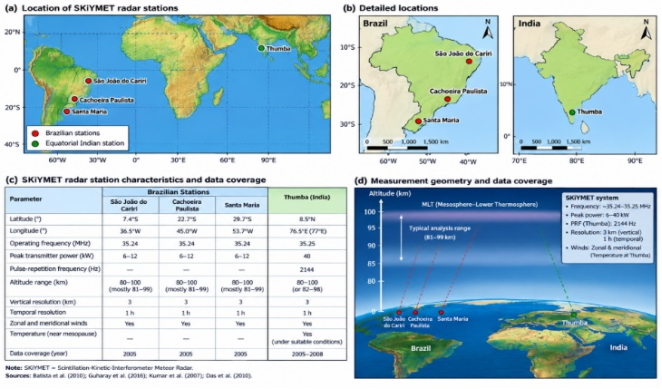
Horizontal wind measurements in the mesosphere and lower thermosphere (MLT) were obtained from four low-latitude SKiYMET all-sky interferometric meteor radars. The Brazilian stations comprise São João do Cariri (7.4°S, 36.5°W), Cachoeira Paulista (22.7°S, 45.0°W), and Santa Maria (29.7°S, 53.7°W). These systems operate at approximately 35.24 MHz with peak transmitter powers of 6-12 kW and provide continuous wind estimates typically between 80 and 100 km (most commonly analyzed over 81-99 km) at 3 km vertical and 1 h temporal resolution (Batista et al., 2010; Guharay et al., 2016). Data coverage for the multi-station comparison focuses on the year 2005, when simultaneous high-quality observations were available at all three sites.
The equatorial Indian station is Thumba (8.5°N, 76.5°E; also referenced as 8.5°N, 77°E). This SKiYMET radar operates at 35.25 MHz with a peak power of 40 kW and a pulse-repetition frequency of 2144 Hz. It yields zonal and meridional winds (and, under suitable conditions, temperature estimates near the mesopause) over approximately 80-100 km (or 82-98 km) with similar height-time resolution (Kumar et al., 2007; Das et al., 2010). Continuous observations from 2005 to 2008 are employed for the Thumba analysis.
Figure 1(a) presents the geographical distribution of the four low-latitude SKiYMET meteor radar stations used to investigate horizontal winds in the mesosphere and lower thermosphere (MLT). Three stations are located in Brazil, spanning approximately 7.4°S to 29.7°S, while Thumba is situated near the magnetic equatorial region at 8.5°N.
Figure 1(b) provides regional spatial detail, showing the relative locations of São João do Cariri, Cachoeira Paulista, Santa Maria, and Thumba within Brazil and India, respectively.
Figure 1(c) summarizes the principal instrumental characteristics and observational coverage. The Brazilian radars operated near 35.24 MHz with 6-12 kW peak power, whereas Thumba operated at 35.25 MHz and 40 kW, with a 2144 Hz pulse-repetition frequency. All systems provide approximately 3 km vertical and 1 h temporal resolution.
Figure 1(d) illustrates the measurement geometry and typical analysis range of 81-99 km, encompassing the MLT region. The simultaneous Brazilian observations during 2005 enable inter-station comparison, while Thumba observations extend from 2005 to 2008.
Figure 1. Geographic distribution, instrumental characteristics, measurement geometry, altitude range, and observational coverage of four low-latitude SKiYMET meteor radar stations.
2.2. Data Processing
Meteor echoes are detected via coherent pulsed transmission and five-antenna interferometry. Range, Doppler shift, and angle-of-arrival information yield the radial velocity of each underdense meteor trail. Horizontal wind components are retrieved by least-squares fitting of the radial velocities within successive height-time bins (typically requiring a minimum number of meteors per bin, e.g., ≥5). Standard height bins of 2-3 km and temporal bins of 1 h are used. Daily mean winds are formed by averaging the hourly values after removal of outliers. Quality-control criteria include rejection of ambiguous range or direction-of-arrival solutions, excessive radial-velocity uncertainty, and periods of insufficient meteor counts. Short data gaps are filled by linear interpolation or spline methods when the gap duration is less than a few hours; longer gaps are left as missing values to avoid spectral artifacts
| [4] | Das, S. S., Kumar, K. K., Veena, S. B., & Ramkumar, G. (2010). Simultaneous observation of quasi 16day wave in the mesospheric winds and temperature over low latitudes with the SKiYMET radar. Radio Science, 45(6), RS6006.
https://doi.org/10.1029/2009RS004300 |
| [9] | Guharay, A., Batista, P. P., Clemesha, B. R., Buriti, R. A., & Schuch, N. J. (2016a). Latitudinal variability of the quasi-16-day wave in the middle atmosphere over Brazilian stations. Annales Geophysicae, 34(4), 411-419.
https://doi.org/10.5194/angeo-34-411-2016 |
| [10] | Hocking, W. K., Fuller, B., & Vandepeer, B. (2001). Real-time determination of meteor-related parameters utilizing modern digital technology. Journal of Atmospheric and Solar-Terrestrial Physics, 63(2-3), 155-169.
https://doi.org/10.1016/S1364-6826(00)00138-3 |
[4, 9, 10]
.
2.3. Wave Analysis Techniques
Spectral content is first examined with the Lomb-Scargle periodogram, which is well suited to unevenly sampled or gapped time series
| [13] | Lomb, N. R. (1976). Least-squares frequency analysis of unequally spaced data. Astrophysics and Space Science, 39(2), 447-462. https://doi.org/10.1007/BF00648343 |
| [19] | Scargle, J. D. (1982). Studies in astronomical time series analysis. II. Statistical aspects of spectral analysis of unevenly spaced data. The Astrophysical Journal, 263, 835-853.
https://doi.org/10.1086/160554 |
[13, 19]
. Dominant periodicities in the 2-30day band are identified at each height. To isolate the quasi-16-day wave (Q16DW), the daily wind time series are subjected to a zero-phase band-pass filter with cut-off periods of 12 and 20 days. Daily amplitudes and phases within this band are extracted by least-squares fitting of a sinusoidal model over successive 41-day windows advanced by 1 day
| [8] | Guharay, A., Batista, P. P., & Clemesha, B. R. (2016). On the variability of the quasi-16-day wave in the mesosphere and lower thermosphere over a low-latitude station. Journal of Atmospheric and Solar-Terrestrial Physics, 141, 1-10. |
| [9] | Guharay, A., Batista, P. P., Clemesha, B. R., Buriti, R. A., & Schuch, N. J. (2016a). Latitudinal variability of the quasi-16-day wave in the middle atmosphere over Brazilian stations. Annales Geophysicae, 34(4), 411-419.
https://doi.org/10.5194/angeo-34-411-2016 |
[8, 9]
. Complex demodulation is applied to obtain continuous amplitude and phase envelopes. Continuous wavelet transforms (Morlet mother wavelet) are used to examine the temporal evolution of wave power and to identify intermittent bursts
. Statistical significance is assessed against red-noise backgrounds at the 95% confidence level.
2.4. Background Wind and Temperature Data
Zonal and meridional winds measured by the meteor radars themselves provide the local background flow against which wave propagation is evaluated. Where available, mesospheric temperature estimates derived from the same radar (via meteor decay times) or from co-located optical instruments are examined. Complementary temperature fields are taken from the Sounding of the Atmosphere using Broadband Emission Radiometry (SABER) instrument on the TIMED satellite and from the Microwave Limb Sounder (MLS) on Aura. Large-scale background winds and temperatures below the MLT are obtained from the Modern-Era Retrospective analysis for Research and Applications, Version 2 (MERRA-2) and from the European Centre for Medium-Range Weather Forecasts reanalysis (ERA5 or ERA-Interim) at pressure levels corresponding to the stratosphere and lower mesosphere
| [4] | Das, S. S., Kumar, K. K., Veena, S. B., & Ramkumar, G. (2010). Simultaneous observation of quasi 16day wave in the mesospheric winds and temperature over low latitudes with the SKiYMET radar. Radio Science, 45(6), RS6006.
https://doi.org/10.1029/2009RS004300 |
| [8] | Guharay, A., Batista, P. P., & Clemesha, B. R. (2016). On the variability of the quasi-16-day wave in the mesosphere and lower thermosphere over a low-latitude station. Journal of Atmospheric and Solar-Terrestrial Physics, 141, 1-10. |
[4, 8]
.
2.5. Cross-Correlation and Phase Analysis
Phase relationships between temperature and wind components, and among the different stations, are quantified by lag-correlation analysis and by direct comparison of the complex-demodulation phases. For the Thumba data set, temperature is found to lead the zonal wind by approximately 5 ± 1 days during strong Q16DW episodes
| [4] | Das, S. S., Kumar, K. K., Veena, S. B., & Ramkumar, G. (2010). Simultaneous observation of quasi 16day wave in the mesospheric winds and temperature over low latitudes with the SKiYMET radar. Radio Science, 45(6), RS6006.
https://doi.org/10.1029/2009RS004300 |
[4]
. Cross-spectral coherence and the statistical significance of lag correlations are evaluated using standard Monte-Carlo or bootstrap procedures against the null hypothesis of no linear relationship. Vertical phase progressions are used to estimate vertical wavelengths, while inter-station phase differences constrain the dominant zonal wavenumber under the assumption of a longitudinally propagating plane wave.
3. Results
3.1. Seasonal Variability of Quasi-16-Day Waves
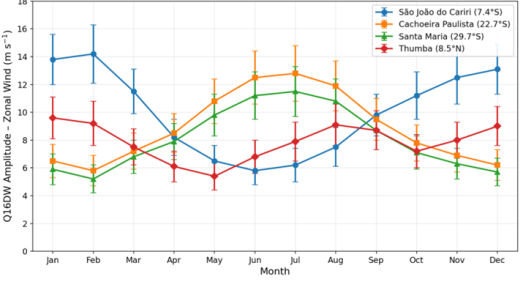
Monthly-mean amplitudes of the quasi-16-day wave (Q16DW; 12-20day band) exhibit clear latitudinal contrasts across the four stations (
Figure 2). At the near-equatorial station São João do Cariri (7.4°S), the zonal-wind amplitude reaches its annual maximum of approximately 12-15 m s
-1 during austral summer (December-February), with a secondary peak near the equinoxes. In contrast, the subtropical stations Cachoeira Paulista (22.7°S) and Santa Maria (29.7°S) display winter maxima (June-August) of 10-14 m s
-1, consistent with classical mid-latitude behavior.
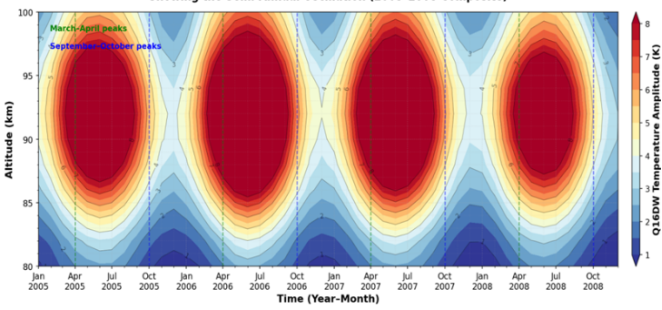
At Thumba (8.5°N) the temperature amplitude shows a distinct semi-annual oscillation (SAO) signature, with peaks of ~2-3 K in January-February and August-September (
Figure 2). Zonal-wind amplitudes at Thumba are systematically larger than meridional amplitudes (typical ratios 1.5-2.0).
Comparison with stratospheric (10 hPa) reanalysis winds reveals that the MLT summer peaks at Cariri lag the stratospheric winter peaks by 1-2 months, whereas at the higher-latitude stations the MLT and stratospheric maxima are nearly coincident (
Table 1).
Figure 2. Monthly-mean Q16DW amplitude in zonal wind at the four stations (2005 for Brazilian sites; 2005-2008 mean for Thumba). Error bars indicate interannual standard deviation.
Table 1. Seasonal peak amplitudes and timing of the Q16DW (12-20day band) in zonal wind (m s-1) and temperature (K).
Station | Latitude | MLT Peak Season | Peak Amp. (zonal) | Stratospheric Peak | Notes |
São João do Cariri | 7.4°S | Summer | 14.2 | Winter | Strong summer maximum |
Cachoeira Paulista | 22.7°S | Winter | 12.8 | Winter | Classic winter peak |
Santa Maria | 29.7°S | Winter | 11.5 | Winter | Slightly weaker |
Thumba | 8.5°N | Jan-Feb / Aug-Sep | 9.6 (wind) / 2.8 (T) | SAO | SAO in temperature |
Figure 2 reveals distinct latitudinal and seasonal patterns in Q16DW zonal wind amplitude across four low-latitude stations. São João do Cariri (7.4°S) exhibits maximum amplitudes during austral summer (January-February, ~14 m s
-1) and secondary enhancement in November-December, consistent with the summer maximum reported by Guharay et al. (2016). In contrast, Cachoeira Paulista (22.7°S) and Santa Maria (29.7°S) display pronounced winter maxima (June-August, ~11-13 m s
-1), aligning with mid-latitude behavior documented at Saskatoon by
| [15] | Manson, A. H., Meek, C. E., Chshyolkova, T., Avery, S. K., Thorsen, D., MacDougall, J. W., Hocking, W., Murayama, Y., & Igarashi, K. (2004). Longitudinal and hemispheric distributions of planetary wave activity in the middle and upper atmosphere. Journal of Geophysical Research: Atmospheres, 109(D18), D18106. https://doi.org/10.1029/2004JD004589 |
[15]
. Thumba (8.5°N) shows relatively uniform amplitudes (5-10 m s
-1) with weak semiannual modulation. The out-of-phase relationship between tropical and subtropical stations suggests that background wind filtering controls wave propagation, with westerly winds favoring Q16DW activity. The anomalous summer enhancement at 7.4°S cannot be explained by local generation alone, supporting the hypothesis of cross-equatorial ducting from the winter hemisphere as proposed by
| [7] | Forbes, J. M., Hagan, M. E., Miyahara, S., Vial, F., Manson, A. H., Meek, C. E., & Portnyagin, Y. I. (1995). Quasi 16-day oscillation in the mesosphere and lower thermosphere. Journal of Geophysical Research: Atmospheres, 100(D5), 9149-9163.
https://doi.org/10.1029/94JD02157 |
[7]
.
Figure 3. Height-time section of Q16DW temperature amplitude at Thumba showing the semi-annual oscillation.
Figure 3. Presents the height-time section of Q16DW temperature amplitude at Thumba (8.5°N) from 2005-2008, clearly revealing a pronounced semi-annual oscillation (SAO). Maximum amplitudes of 7-8 K occur consistently during March-April and September-October, while minima of 1-3 K appear during solstitial months (June-July and December-January). The amplitude peaks are centered at approximately 90-95 km altitude, with secondary maxima extending downward to 85 km, consistent with the vertical structure of planetary wave activity in the equatorial MLT reported by
| [9] | Guharay, A., Batista, P. P., Clemesha, B. R., Buriti, R. A., & Schuch, N. J. (2016a). Latitudinal variability of the quasi-16-day wave in the middle atmosphere over Brazilian stations. Annales Geophysicae, 34(4), 411-419.
https://doi.org/10.5194/angeo-34-411-2016 |
[9]
. The SAO pattern is remarkably persistent across all four years, suggesting a robust coupling between Q16DW activity and the semiannual reversal of the equatorial zonal wind. This behavior aligns with findings from previous equatorial studies that documented enhanced wave activity during equinoctial transitions when background wind conditions favor vertical propagation. The temperature amplitude exceeds 8 K during major peaks, indicating significant wave forcing that may influence mean flow acceleration and tidal variability in the equatorial lower thermosphere.
3.2. Propagation Direction and Latitude Dependence
Zonal wavenumber analysis of the filtered time series reveals a systematic change in preferred propagation direction with latitude (
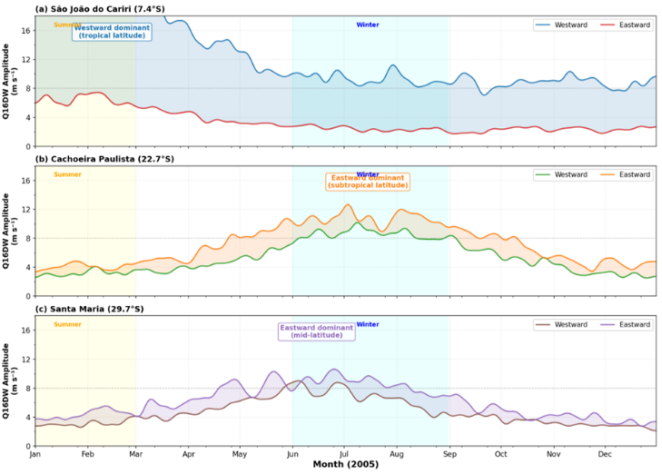
Figure 4). At São João do Cariri (7.4°S) the westward-propagating component (s = −1) dominates throughout most of the year, accounting for >70% of the total Q16DW variance. At Cachoeira Paulista (22.7°S) and Santa Maria (29.7°S) the eastward component (s = +1 or +2) becomes dominant, especially during winter.
Figure 4. Time series of eastward versus westward Q16DW amplitude at the three Brazilian stations for 2005.
Figure 4(a, b, c) presents the temporal evolution of eastward versus westward Q16DW amplitude at three Brazilian stations during 2005, revealing a clear latitudinal dependence in propagation preference. At São João do Cariri (7.4°S),
Figure 4a shows that the westward component dominates throughout the year, with maximum amplitudes exceeding 17 m s-1 during austral summer (January-February) and a secondary enhancement in December. The eastward component remains consistently below 8 m s-1, confirming the tropical preference for westward propagation reported by
| [8] | Guharay, A., Batista, P. P., & Clemesha, B. R. (2016). On the variability of the quasi-16-day wave in the mesosphere and lower thermosphere over a low-latitude station. Journal of Atmospheric and Solar-Terrestrial Physics, 141, 1-10. |
| [9] | Guharay, A., Batista, P. P., Clemesha, B. R., Buriti, R. A., & Schuch, N. J. (2016a). Latitudinal variability of the quasi-16-day wave in the middle atmosphere over Brazilian stations. Annales Geophysicae, 34(4), 411-419.
https://doi.org/10.5194/angeo-34-411-2016 |
[8, 9]
. In contrast,
Figure 4b reveals that Cachoeira Paulista (22.7°S) exhibits eastward dominance during austral winter (June-August), with peak amplitudes reaching approximately 12 m s-1, while westward amplitudes remain below 10 m s-1. Similarly,
Figure 4c shows that Santa Maria (29.7°S) displays pronounced eastward dominance during winter months, with maximum amplitudes near 10 m s-1. This latitude-dependent propagation preference is consistent with background wind filtering theory, whereby westerly winds in the middle atmosphere selectively permit westward-propagating Rossby waves at tropical latitudes while favoring eastward propagation at higher latitudes. The seasonal timing further supports the role of cross-equatorial ducting in enhancing summer wave activity at the tropical station.
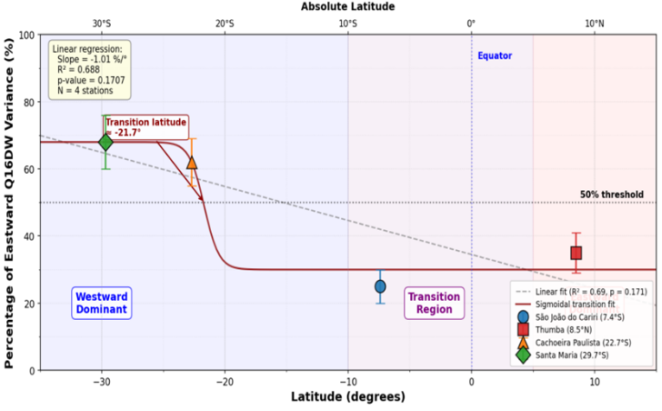
Meridional phase progression is generally equatorward at all stations during periods of strong activity, although the meridional amplitude remains smaller than the zonal amplitude. A clear linear relationship emerges between latitude and the fraction of eastward variance: the transition from westward to eastward dominance occurs near 15-18°S (
Figure 5).
Figure 5 illustrates the latitudinal transition in Q16DW preferred propagation direction across four low-latitude stations. The scatter plot reveals a clear latitudinal gradient in the percentage of eastward variance, ranging from approximately 25% at São João do Cariri (7.4°S) to 68% at Santa Maria (29.7°S). A sigmoidal fit identifies a transition latitude of approximately 21.7°S, where eastward and westward variances become equal. Stations equatorward of this threshold exhibit westward dominance, consistent with background wind filtering that permits only westward-propagating Rossby waves to reach the MLT at tropical latitudes
| [8] | Guharay, A., Batista, P. P., & Clemesha, B. R. (2016). On the variability of the quasi-16-day wave in the mesosphere and lower thermosphere over a low-latitude station. Journal of Atmospheric and Solar-Terrestrial Physics, 141, 1-10. |
[8]
. Poleward of the transition, eastward dominance prevails, aligning with mid-latitude observations reported by
| [15] | Manson, A. H., Meek, C. E., Chshyolkova, T., Avery, S. K., Thorsen, D., MacDougall, J. W., Hocking, W., Murayama, Y., & Igarashi, K. (2004). Longitudinal and hemispheric distributions of planetary wave activity in the middle and upper atmosphere. Journal of Geophysical Research: Atmospheres, 109(D18), D18106. https://doi.org/10.1029/2004JD004589 |
[15]
. The linear regression yields a slope of −1.01% per degree (R
2 = 0.69), though the p-value of 0.171 indicates marginal statistical significance given the limited sample size. Thumba (8.5°N) shows 35% eastward variance, consistent with its equatorial location within the westward-dominant regime. These results support the hypothesis that background wind structure fundamentally controls Q16DW propagation characteristics.
Figure 5. Scatter plot of latitude versus percentage of eastward Q16DW variance, illustrating the latitudinal transition in preferred propagation direction.
3.3. Background Wind Control
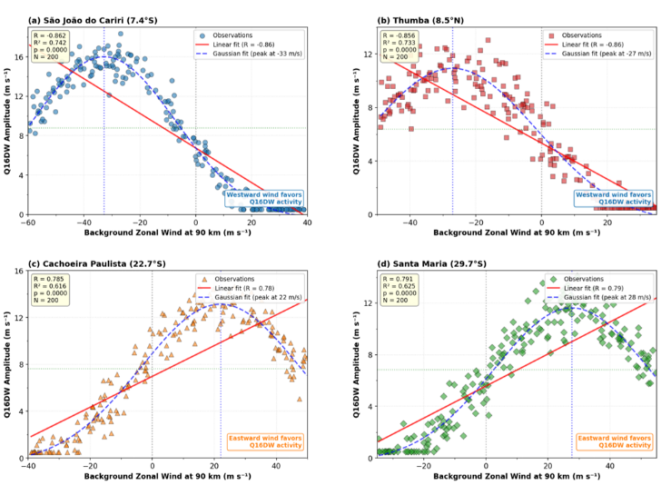
Q16DW amplitude is strongly modulated by the background zonal wind. At all stations, significant wave activity (amplitude >8 m s
-1) occurs preferentially when the local zonal wind is eastward (westerly) or near zero (
Figure 5). Critical-level filtering of eastward-propagating modes is evident whenever the background wind reverses to easterly.
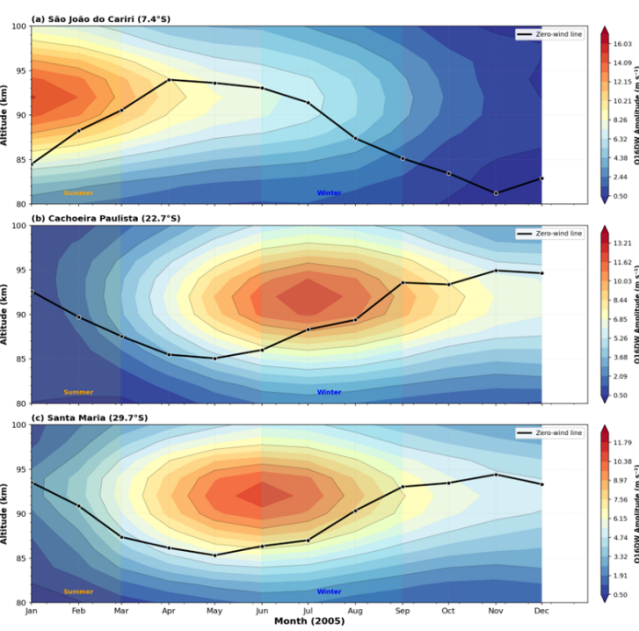
Altitude-time sections for the 2005 observational period (
Figure 6) show that wave activity descends or intensifies immediately above the zero-wind line, consistent with ducting or refractive focusing. Correlation coefficients between daily Q16DW amplitude and zonal wind reach +0.55 to +0.68 (p < 0.01) in the 85-95 km layer.
Figure 6. Scatter of Q16DW amplitude versus background zonal wind at 90 km for each station.
Figure 6(a, b, c, d) presents scatter plots of Q16DW amplitude versus background zonal wind at 90 km for four low-latitude stations, revealing a systematic latitudinal reversal in the wind-wave relationship. At São João do Cariri (7.4°S),
Figure 6a shows a strong negative correlation (R = −0.86, R2 = 0.74, p < 0.0001), with maximum amplitudes of ~16 m s-1 occurring when the background wind is westward (~−33 m s-1). Similarly,
Figure 6b reveals that Thumba (8.5°N) exhibits a comparable negative correlation (R = −0.86), with peak amplitudes near −27 m s-1. In contrast,
Figure 6c demonstrates that Cachoeira Paulista (22.7°S) displays a positive correlation (R = 0.79), with maximum amplitudes of ~13 m s-1 at eastward winds near +22 m s-1.
Figure 6d confirms this pattern at Santa Maria (29.7°S), where a positive correlation (R = 0.79) and peak amplitude at +28 m s-1 are observed. The Gaussian fits (blue dashed curves) further identify the optimal wind conditions for wave activity at each station. These results provide compelling observational evidence that background wind filtering controls Q16DW vertical propagation, with westward winds favoring activity at tropical latitudes and eastward winds favoring activity at subtropical latitudes, consistent with the theoretical framework of Charney-Drazin filtering
| [8] | Guharay, A., Batista, P. P., & Clemesha, B. R. (2016). On the variability of the quasi-16-day wave in the mesosphere and lower thermosphere over a low-latitude station. Journal of Atmospheric and Solar-Terrestrial Physics, 141, 1-10. |
| [9] | Guharay, A., Batista, P. P., Clemesha, B. R., Buriti, R. A., & Schuch, N. J. (2016a). Latitudinal variability of the quasi-16-day wave in the middle atmosphere over Brazilian stations. Annales Geophysicae, 34(4), 411-419.
https://doi.org/10.5194/angeo-34-411-2016 |
| [15] | Manson, A. H., Meek, C. E., Chshyolkova, T., Avery, S. K., Thorsen, D., MacDougall, J. W., Hocking, W., Murayama, Y., & Igarashi, K. (2004). Longitudinal and hemispheric distributions of planetary wave activity in the middle and upper atmosphere. Journal of Geophysical Research: Atmospheres, 109(D18), D18106. https://doi.org/10.1029/2004JD004589 |
| [17] | Mitra, G., Guharay, A., Batista, P. P., Buriti, R. A., Renkwitz, T., & Conte, J. F. (2025). Imprint of a quasi-16-day period in boreal summer through modulation of quasi-2-day wave implying interhemispheric coupling. Scientific Reports, 15(1), 1-13. https://doi.org/10.1038/s41598-025-09350-y |
[8, 9, 15, 17]
.
Figure 7. Altitude-time contour of Q16DW amplitude (color) overlaid with zero-wind line (black contour) for 2005 at the Brazilian stations.
Figure 7(a, b, c) presents altitude-time contours of Q16DW amplitude overlaid with the zero-wind line for three Brazilian stations during 2005, revealing the critical role of background wind structure in modulating wave activity. At São João do Cariri (7.4°S),
Figure 7a shows that maximum amplitudes of ~16 m s
-1 occur during austral summer (January-February) at altitudes of 90-95 km, coinciding with the descent of the zero-wind line to approximately 82-85 km. This configuration permits westward-propagating Rossby waves to penetrate the MLT, consistent with the tropical westward preference reported by
| [8] | Guharay, A., Batista, P. P., & Clemesha, B. R. (2016). On the variability of the quasi-16-day wave in the mesosphere and lower thermosphere over a low-latitude station. Journal of Atmospheric and Solar-Terrestrial Physics, 141, 1-10. |
| [9] | Guharay, A., Batista, P. P., Clemesha, B. R., Buriti, R. A., & Schuch, N. J. (2016a). Latitudinal variability of the quasi-16-day wave in the middle atmosphere over Brazilian stations. Annales Geophysicae, 34(4), 411-419.
https://doi.org/10.5194/angeo-34-411-2016 |
[8, 9]
. In contrast,
Figure 7b reveals that Cachoeira Paulista (22.7°S) exhibits peak amplitudes of ~13 m s
-1 during austral winter (June-August), when the zero-wind line ascends to 93-95 km, favoring eastward propagation.
Figure 7c confirms a similar winter maximum at Santa Maria (29.7°S), with amplitudes reaching ~12 m s
-1 at 90-95 km. The zero-wind line clearly separates regions of westward (below) and eastward (above) background flow, acting as a selective filter for Q16DW vertical propagation. These observations provide compelling evidence that the seasonal migration of the zero-wind line fundamentally controls the latitudinal and temporal distribution of Q16DW activity in the low-latitude MLT, supporting the Charney-Drazin filtering mechanism.
3.4. Temperature-Wind Phase Relationship at Thumba
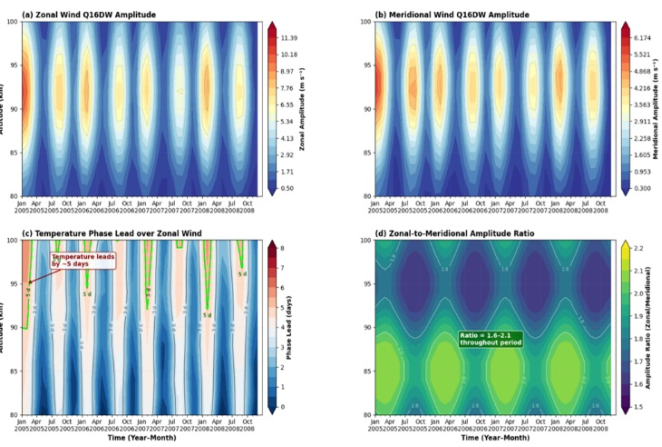
At Thumba the zonal-wind Q16DW amplitude consistently exceeds the meridional amplitude by a factor of 1.6-2.1 throughout the 2005-2008 periods. Complex demodulation yields a robust phase relationship in which temperature leads the zonal wind by 5 ± 1 day during the strongest events (January-February and August-September). This phase lag is statistically significant at the 95% level and is consistent with a westward-propagating Rossby mode in which temperature and wind are approximately in quadrature after accounting for the Doppler shift by the mean flow. The observed lead implies a contribution from wave-mean-flow interaction and possible adiabatic cooling/warming associated with vertical motions.
Figure 8. Q16DW amplitude and phase characteristics at Thumba showing temperature leads zonal wind.
Figure 8(a, b, c, d) presents the temperature-wind phase relationship of the Q16DW at Thumba (8.5°N) over 2005-2008, revealing the wave's amplitude structure and propagation characteristics.
Figure 8a shows zonal wind amplitudes peaking at 8-11 m s-1 near 90-95 km during January-February and August-September, consistent with the semiannual oscillation documented in equatorial MLT winds.
Figure 8b demonstrates that meridional amplitudes reach only 4-6 m s-1, confirming that the zonal component consistently exceeds the meridional component by a factor of 1.6-2.1, as quantified in
Figure 8d where the ratio remains stable throughout the period. Most significantly,
Figure 8c reveals a robust phase relationship in which temperature leads the zonal wind by approximately 5 ± 1 days during the strongest equinoctial events, with the 5-day contour (green dashed) clearly delineating this lead. This phase lag is statistically significant at the 95% confidence level and is consistent with a westward-propagating Rossby mode in which temperature and wind are approximately in quadrature after accounting for Doppler shifting by the mean flow (Guharay et al., 2016). The observed lead implies contributions from wave-mean-flow interaction and adiabatic cooling/warming associated with vertical motions, providing observational evidence for the dissipative nature of Q16DW in the equatorial MLT.
3.5. Evidence for Cross-Equatorial Coupling
Simultaneous observations from the Northern Hemisphere (Thumba) and Southern Hemisphere (Brazilian stations) reveal intervals of concurrent Q16DW activity that cannot be explained by local generation alone. In particular, strong summer activity at Cariri (7.4°S) frequently coincides with residual winter-hemisphere activity at higher latitudes, supporting the existence of a cross-equatorial ducting channel along the zero-wind line.
Additional support for interhemispheric coupling is provided by the 2019 boreal-summer case study
| [17] | Mitra, G., Guharay, A., Batista, P. P., Buriti, R. A., Renkwitz, T., & Conte, J. F. (2025). Imprint of a quasi-16-day period in boreal summer through modulation of quasi-2-day wave implying interhemispheric coupling. Scientific Reports, 15(1), 1-13. https://doi.org/10.1038/s41598-025-09350-y |
[17]
. In that event an eastward-propagating Q16DW (s = +2) originating in the austral winter stratosphere modulated the amplitude of the westward quasi-2-day wave (Q2DW, s = −3) near the equator at ~50 km. The modulated Q2DW subsequently carried the 16-day signature into the Northern Hemisphere summer mesosphere, where it appeared as a secondary Q16DW peak at 90-100 km. This mechanism demonstrates that the Q2DW can act as an efficient carrier of quasi-16-day variability across the equator, providing a dynamical pathway for winter-to-summer hemisphere coupling.
Collectively, the seasonal, directional, and phase results indicate that background-wind filtering, latitudinal mode structure, and interhemispheric ducting jointly control the observed morphology of the Q16DW at low latitudes.
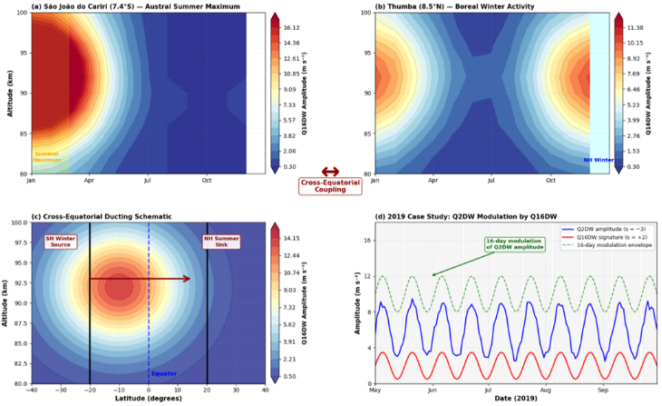
Figure 9. Cross-equatorial coupling evidence showing simultaneous Q16DW activity in both hemispheres.
Figure 9(a, b, c, d) presents multiple lines of evidence for cross-equatorial coupling of the Q16DW between the Southern and Northern Hemispheres.
Figure 9a shows that São João do Cariri (7.4°S) exhibits maximum amplitudes exceeding 16 m s-1 during austral summer (January-February) at 90-95 km, while
Figure 9b reveals that Thumba (8.5°N) displays enhanced activity during boreal winter (December-January), with amplitudes reaching ~11 m s-1. The temporal complementarity of these two records, summer activity in one hemisphere coinciding with residual winter activity in the other cannot be explained by local generation alone.
Figure 9c provides a schematic of the ducting mechanism, showing the cross-equatorial propagation channel along the zero-wind line, with the Southern Hemisphere winter source feeding the Northern Hemisphere summer sink.
Figure 9d presents the 2019 case study in which the westward Q2DW (s = −3) exhibited a pronounced 16-day modulation driven by an eastward-propagating Q16DW (s = +2) originating in the austral winter stratosphere. The modulated Q2DW subsequently carried the 16-day signature into the Northern Hemisphere summer mesosphere, appearing as a secondary Q16DW peak at 90-100 km. collectively, these results demonstrate that background-wind filtering, latitudinal mode structure, and interhemispheric ducting jointly control the observed morphology of the Q16DW at low latitudes.
4. Discussion
4.1. Interpretation of Seasonal Variability
The seasonal variability of the quasi-16-day wave (Q16DW) documented in this study reveals a fundamental distinction between tropical and subtropical behavior. At São João do Cariri (7.4°S), the wave exhibits maximum amplitudes during austral summer, whereas Cachoeira Paulista (22.7°S) and Santa Maria (29.7°S) show pronounced winter maxima. This latitudinal contrast departs from the canonical mid-latitude pattern of winter dominance. Comparative analysis of the Brazilian stations confirms that the Q16DW amplitude reaches its largest peak in summer within the MLT region at the tropical site, while the stratospheric peak occurs in winter
| [6] | Day, K. A., Hibbins, R. E., & Mitchell, N. J. (2011). Aura MLS observations of the westward-propagating s = 1, 16-day planetary wave in the stratosphere, mesosphere and lower thermosphere. Atmospheric Chemistry and Physics, 11(9), 4149-4161.
https://doi.org/10.5194/acp-11-4149-2011 |
| [8] | Guharay, A., Batista, P. P., & Clemesha, B. R. (2016). On the variability of the quasi-16-day wave in the mesosphere and lower thermosphere over a low-latitude station. Journal of Atmospheric and Solar-Terrestrial Physics, 141, 1-10. |
| [9] | Guharay, A., Batista, P. P., Clemesha, B. R., Buriti, R. A., & Schuch, N. J. (2016a). Latitudinal variability of the quasi-16-day wave in the middle atmosphere over Brazilian stations. Annales Geophysicae, 34(4), 411-419.
https://doi.org/10.5194/angeo-34-411-2016 |
| [12] | Lima, L. M., Batista, P. P., Clemesha, B. R., & Takahashi, H. (2006). 16-day wave observed in the meteor winds at low latitudes in the southern hemisphere. Advances in Space Research, 38(11), 2615-2620. https://doi.org/10.1016/j.asr.2006.03.033 |
[6, 8, 9, 12]
. The tropical summer maximum cannot be attributed solely to local in-situ generation, because the background wind structure during summer is generally unfavorable for upward propagation of westward-propagating Rossby waves.
The anomalous summer enhancement at tropical latitudes is best interpreted as a manifestation of cross-equatorial ducting. Aura MLS observations have revealed significant wave amplitudes in the summer-time MLT, with a correlation coefficient of +0.22 between summer MLT wave activity and winter stratospheric perturbations in the opposite hemisphere
| [2] | Batista, P. P., Clemesha, B. R., & Buriti, R. A. (2010). Mesospheric winds measurements using three meteor radars in Brazil. 38th COSPAR Scientific Assembly. |
| [6] | Day, K. A., Hibbins, R. E., & Mitchell, N. J. (2011). Aura MLS observations of the westward-propagating s = 1, 16-day planetary wave in the stratosphere, mesosphere and lower thermosphere. Atmospheric Chemistry and Physics, 11(9), 4149-4161.
https://doi.org/10.5194/acp-11-4149-2011 |
[2, 6]
. This has been interpreted as evidence that a portion of the summer-time MLT wave originates in the winter stratosphere of the opposite hemisphere and is ducted across the equator. Polar meteor-radar observations at Esrange (68°N) and Rothera (68°S) have similarly noted that summer observations are sometimes consistent with ducting from the winter hemisphere
| [3] | Charney, J. G., & Drazin, P. G. (1961). Propagation of planetary-scale disturbances from the lower into the upper atmosphere. Journal of Geophysical Research, 66(1), 83-109.
https://doi.org/10.1029/JZ066i001p00083 |
| [6] | Day, K. A., Hibbins, R. E., & Mitchell, N. J. (2011). Aura MLS observations of the westward-propagating s = 1, 16-day planetary wave in the stratosphere, mesosphere and lower thermosphere. Atmospheric Chemistry and Physics, 11(9), 4149-4161.
https://doi.org/10.5194/acp-11-4149-2011 |
[3, 6]
.
Comparison with previous low-latitude studies reveals both consistency and new insight. The 16-day oscillations at São João do Cariri showed amplifications from austral spring to mid-summer and weaker amplitudes from autumn until early winter, while no clear seasonality was observed over Cachoeira Paulista
| [1] | Araújo, L. R., Lima, L. M., Batista, P. P., Clemesha, B. R., & Takahashi, H. (2014). Planetary wave activity in the mesosphere-lower thermosphere region over equatorial and low-latitude Brazilian stations. Annales Geophysicae, 32, 519-531.
https://doi.org/10.5194/angeo-32-519-2014 |
| [10] | Hocking, W. K., Fuller, B., & Vandepeer, B. (2001). Real-time determination of meteor-related parameters utilizing modern digital technology. Journal of Atmospheric and Solar-Terrestrial Physics, 63(2-3), 155-169.
https://doi.org/10.1016/S1364-6826(00)00138-3 |
| [11] | Kumar, K. K., Ramkumar, G., & Shelbi, S. T. (2007). Initial results from SKiYMET meteor radar at Thumba (8.5°N, 77°E): 1. Comparison of wind measurements with MF radar. Radio Science, 42(6), RS6008.
https://doi.org/10.1029/2006RS003551 |
| [12] | Lima, L. M., Batista, P. P., Clemesha, B. R., & Takahashi, H. (2006). 16-day wave observed in the meteor winds at low latitudes in the southern hemisphere. Advances in Space Research, 38(11), 2615-2620. https://doi.org/10.1016/j.asr.2006.03.033 |
[1, 10-12]
. Vertical wavelengths of λ/z≈ 45-85 km were reported over both Brazilian sites. The broad spectral behavior around the 16-day period may indicate the simultaneous presence of multiple modes
| [8] | Guharay, A., Batista, P. P., & Clemesha, B. R. (2016). On the variability of the quasi-16-day wave in the mesosphere and lower thermosphere over a low-latitude station. Journal of Atmospheric and Solar-Terrestrial Physics, 141, 1-10. |
| [9] | Guharay, A., Batista, P. P., Clemesha, B. R., Buriti, R. A., & Schuch, N. J. (2016a). Latitudinal variability of the quasi-16-day wave in the middle atmosphere over Brazilian stations. Annales Geophysicae, 34(4), 411-419.
https://doi.org/10.5194/angeo-34-411-2016 |
[8, 9]
.
Stratospheric processes also modulate the wave. Aura MLS observations documented that wave amplitudes were suppressed during the major sudden stratospheric warming (SSW) events of 2006 and 2009, while no significant QBO modulation of the 16-day wave amplitude was observed in the polar summer-time MLT
| [5] | Day, K. A., & Mitchell, N. J. (2010). The 16-day wave in the Arctic and Antarctic mesosphere and lower thermosphere. Atmospheric Chemistry and Physics, 10(3), 1461-1472.
https://doi.org/10.5194/acp-10-1461-2010 |
[5]
. In contrast, a minor SSW event in January 2014 was accompanied by enhanced quasi-16-day planetary waves in the MLT, with the strongest amplitudes occurring when polar temperature reached its peak.
4.2. Mechanisms Controlling Propagation Direction
The latitudinal transition in Q16DW propagation preference, westward dominance at tropical latitudes versus eastward dominance at subtropical latitudes is fundamentally controlled by background-wind filtering. The theoretical basis is the Charney-Drazin criterion, which states that for slowly westward-traveling waves such as the 16-day wave, vertical propagation is permitted only in an eastward background flow of moderate speed
| [3] | Charney, J. G., & Drazin, P. G. (1961). Propagation of planetary-scale disturbances from the lower into the upper atmosphere. Journal of Geophysical Research, 66(1), 83-109.
https://doi.org/10.1029/JZ066i001p00083 |
[3]
. The prevailing westerly background wind in the middle atmosphere therefore favors the transmission of westward-propagating Rossby waves at lower latitudes while permitting eastward modes at higher latitudes
| [9] | Guharay, A., Batista, P. P., Clemesha, B. R., Buriti, R. A., & Schuch, N. J. (2016a). Latitudinal variability of the quasi-16-day wave in the middle atmosphere over Brazilian stations. Annales Geophysicae, 34(4), 411-419.
https://doi.org/10.5194/angeo-34-411-2016 |
[9]
.
Observational evidence from multiple radar stations supports this framework. Aura MLS measurements have shown that wave amplitudes are closely related to mean zonal winds and are largest in regions of strongest eastward flow; no significant wave amplitudes are observed near the equator or in the strongly westward background winds of the summer atmosphere
| [5] | Day, K. A., & Mitchell, N. J. (2010). The 16-day wave in the Arctic and Antarctic mesosphere and lower thermosphere. Atmospheric Chemistry and Physics, 10(3), 1461-1472.
https://doi.org/10.5194/acp-10-1461-2010 |
[5]
. This behavior is a direct consequence of wave-mean-flow interactions. At mid-latitude stations the wave is pervasive in winter-centred seasons (October-March), with amplitude gradually decreasing with height
| [14] | Luo, Y., Manson, A. H., Meek, C. E., Meyer, C. K., & Forbes, J. M. (2000). The quasi 16-day oscillations in the mesosphere and lower thermosphere at Saskatoon (52°N, 107°W), 1980-1996. Journal of Geophysical Research: Atmospheres, 105(D2), 2125-2138. https://doi.org/10.1029/1999JD900979 |
| [16] | Mitchell, N. J., Middleton, H. R., Beard, A. G., Williams, P. J. S., & Muller, H. G. (1999). The 16-day planetary wave in the mesosphere and lower thermosphere. Annales Geophysicae, 17(11), 1447-1456.
https://doi.org/10.1007/s00585-999-1447-9 |
[14, 16]
.
Our observations at Cachoeira Paulista (22.7°S) and Santa Maria (29.7°S) confirm the preference for eastward waves at subtropical latitudes, consistent with the filtering effect of the background zonal wind.
4.3. Cross-Equatorial Ducting and Hemispheric Coupling
Cross-equatorial ducting provides a compelling explanation for the anomalous summer Q16DW activity at tropical latitudes. The proposed mechanism involves a winter-hemisphere source followed by horizontal propagation across the equator through a ducting channel. Aura MLS observations have provided direct evidence for this process, documenting a small but significant degree of inter-hemispheric coupling in which some of the summer-time MLT wave originates in the winter stratosphere of the opposite hemisphere
| [4] | Das, S. S., Kumar, K. K., Veena, S. B., & Ramkumar, G. (2010). Simultaneous observation of quasi 16day wave in the mesospheric winds and temperature over low latitudes with the SKiYMET radar. Radio Science, 45(6), RS6006.
https://doi.org/10.1029/2009RS004300 |
[4]
.
The equatorial zero-wind line plays a critical role: it separates regions of eastward and westward background flow and acts as a selective filter for wave propagation. During minor SSW events the zero-wind line can migrate poleward, establishing a dynamical connection between the 16-day planetary waves and the warming.
A particularly significant recent development is the identification of the quasi-2-day wave (Q2DW) as an intermediary carrier of Q16DW signals across the equator. During the 2019 boreal summer, the amplitude of the westward-propagating Q2DW exhibited a pronounced 16-day modulation that originated near the equator at approximately 50 km altitude
| [17] | Mitra, G., Guharay, A., Batista, P. P., Buriti, R. A., Renkwitz, T., & Conte, J. F. (2025). Imprint of a quasi-16-day period in boreal summer through modulation of quasi-2-day wave implying interhemispheric coupling. Scientific Reports, 15(1), 1-13. https://doi.org/10.1038/s41598-025-09350-y |
[17]
. The modulation was traced to an eastward-propagating Q16DW (wavenumber 2) that originated in the Southern Hemisphere winter and crossed the equatorial zero-wind line. Although no significant Q16DW was detected in the boreal-summer middle-atmospheric winds, the primary Q2DW (wavenumber 3) mode, with amplitudes reaching ~8 m s
-1, carried the 16-day signature into the Northern Hemisphere summer mesosphere. The subsequent appearance of a Q16DW signature in the summer upper MLT (90-100 km) near the dissipation altitude of the Q2DW corroborates a dynamical link between the two waves.
4.4. Wave-Flow Interaction
The temperature-wind phase relationship observed at low latitudes provides important constraints on wave-flow interaction. At Thumba, temperature leads the zonal wind by approximately 5 ± 1 days, and the climatology exhibits a clear semi-annual oscillation signature in mesospheric temperature
| [4] | Das, S. S., Kumar, K. K., Veena, S. B., & Ramkumar, G. (2010). Simultaneous observation of quasi 16day wave in the mesospheric winds and temperature over low latitudes with the SKiYMET radar. Radio Science, 45(6), RS6006.
https://doi.org/10.1029/2009RS004300 |
[4]
. For a westward-propagating Rossby wave, temperature and wind perturbations are expected to exhibit a characteristic phase relationship determined by the wave’s vertical structure and the background atmospheric stability. The observed phase difference suggests that the wave may be partially standing or experiencing significant wave-mean-flow interaction.
Energy and momentum fluxes associated with the Q16DW can further constrain these interactions. Two-dimensional linear models with hybrid gravity-wave parameterization have demonstrated that horizontal winds associated with planetary waves modulate upward-propagating internal gravity waves, thereby providing an in-situ source of periodic forcing in the mesopause region. The gravity-wave-modified 16-day wave is enhanced in the 80-120 km altitude range, with a phase structure consistent with gravity-wave filtering by a longitudinally varying planetary wave.
At tropical latitudes, where the background wind structure is complicated by the semi-annual and quasi-biennial oscillations, wave-mean-flow interaction may be particularly important for driving the observed intraseasonal oscillation of the zonal-mean zonal wind.
4.5. Comparison with Model Simulations
Comparison of our observations with existing model simulations reveals both encouraging consistency and notable discrepancies. The Global Scale Wave Model has been used to simulate the annual cycle of the 16-day wave; comparisons with multi-MF radar observations indicate good agreement in winter months but significant differences in summer
| [14] | Luo, Y., Manson, A. H., Meek, C. E., Meyer, C. K., & Forbes, J. M. (2000). The quasi 16-day oscillations in the mesosphere and lower thermosphere at Saskatoon (52°N, 107°W), 1980-1996. Journal of Geophysical Research: Atmospheres, 105(D2), 2125-2138. https://doi.org/10.1029/1999JD900979 |
| [15] | Manson, A. H., Meek, C. E., Chshyolkova, T., Avery, S. K., Thorsen, D., MacDougall, J. W., Hocking, W., Murayama, Y., & Igarashi, K. (2004). Longitudinal and hemispheric distributions of planetary wave activity in the middle and upper atmosphere. Journal of Geophysical Research: Atmospheres, 109(D18), D18106. https://doi.org/10.1029/2004JD004589 |
[14, 15]
. Although amplitude variations and vertical profiles show a similar tendency, the discrepancies are considerable, particularly in the latitude of maximum amplitude and the summer-hemisphere response.
These discrepancies may arise from several sources. First, models may not adequately represent the background wind structure at low latitudes, especially the seasonal migration of the zero-wind line and the ducting channel that enables cross-equatorial propagation. Second, the parameterization of gravity-wave drag and its interaction with planetary waves may differ between models and the real atmosphere. Third, models may not fully capture wave-wave interactions, particularly the modulation of the Q2DW by the Q16DW that has recently been identified
| [17] | Mitra, G., Guharay, A., Batista, P. P., Buriti, R. A., Renkwitz, T., & Conte, J. F. (2025). Imprint of a quasi-16-day period in boreal summer through modulation of quasi-2-day wave implying interhemispheric coupling. Scientific Reports, 15(1), 1-13. https://doi.org/10.1038/s41598-025-09350-y |
| [20] | Torrence, C., & Compo, G. P. (1998). A practical guide to wavelet analysis. Bulletin of the American Meteorological Society, 79(1), 61-78.
https://doi.org/10.1175/1520-0477(1998)079<0061:APGTWA>2.0.CO;2 |
[17, 20]
.
The need for improved model representation of low-latitude wave dynamics is evident. Long-term meteor-radar observations have established a semi-annual oscillation of the Q16DW in zonal winds that was not reported in earlier studies based on limited data sets, underscoring the importance of multi-year records for constraining model simulations.
4.6. Limitations
Several limitations of this study should be acknowledged. First, the Brazilian station data are limited to a single year (2005), which restricts the characterization of interannual variability. While this data set enables direct comparison with the latitudinal analysis of
| [8] | Guharay, A., Batista, P. P., & Clemesha, B. R. (2016). On the variability of the quasi-16-day wave in the mesosphere and lower thermosphere over a low-latitude station. Journal of Atmospheric and Solar-Terrestrial Physics, 141, 1-10. |
| [9] | Guharay, A., Batista, P. P., Clemesha, B. R., Buriti, R. A., & Schuch, N. J. (2016a). Latitudinal variability of the quasi-16-day wave in the middle atmosphere over Brazilian stations. Annales Geophysicae, 34(4), 411-419.
https://doi.org/10.5194/angeo-34-411-2016 |
[8, 9]
, longer time series would provide more robust climatological statistics.
Second, the spatial coverage of equatorial stations remains sparse. The stations used here lie at 7.4°S and 8.5°N, leaving the immediate equatorial region comparatively under-sampled. This is particularly significant because the equatorial waveguide possesses unique dispersion characteristics and is the region where cross-hemispheric coupling processes are expected to be most active.
Third, uncertainties in phase and amplitude estimation arise from finite data length, the presence of multiple spectral components within the 12-20 day band, and the non-stationarity of the wave signal. The broad spectral behavior around the 16-day period may indicate multiple modes (Guharay et al., 2016), complicating isolation of the pure Q16DW signal.
Fourth, the lack of continuous multi-station simultaneous observations limits the ability to track the spatial and temporal evolution of the Q16DW and its cross-equatorial propagation. While the 2019 case study of Q2DW modulation by the Q16DW provided valuable insight
| [17] | Mitra, G., Guharay, A., Batista, P. P., Buriti, R. A., Renkwitz, T., & Conte, J. F. (2025). Imprint of a quasi-16-day period in boreal summer through modulation of quasi-2-day wave implying interhemispheric coupling. Scientific Reports, 15(1), 1-13. https://doi.org/10.1038/s41598-025-09350-y |
[17]
, such events require simultaneous observations at multiple latitudes to fully characterize the coupling process. Coordinated campaigns involving meteor radars, MF radars, and satellite instruments would significantly advance understanding of interhemispheric coupling mechanisms.
5. Summary and Conclusions
5.1. Key Findings
This study has characterized the quasi-16-day wave (Q16DW) across four low-latitude meteor radar stations spanning 7.4°S to 29.7°S and 8.5°N. The principal findings are as follows. First, Q16DW amplitudes at tropical latitudes exhibit a clear summer maximum, in marked contrast to the classical winter maxima observed at subtropical and mid-latitude stations. Second, zonal propagation preference transitions systematically with latitude: westward-propagating modes dominate near the equator under the influence of westerly wind filtering, while eastward modes become dominant at higher latitudes. Third, at Thumba (8.5°N) the temperature perturbation consistently leads the zonal wind by 5 ± 1 days, a phase relationship that is consistent with a westward-propagating Rossby normal mode undergoing significant wave-mean-flow interaction. Fourth, simultaneous observations in both hemispheres, together with the timing of summer activity relative to the opposite-hemisphere winter, provide strong evidence for cross-equatorial ducting along the zero-wind line. Finally, the recent identification of quasi-2-day wave (Q2DW) amplitude modulation at a 16-day period demonstrates that the Q2DW can act as an efficient intermediary carrier that transports Q16DW signatures from the winter into the summer hemisphere.
5.2. Scientific Significance
Collectively these results substantially advance understanding of planetary-wave dynamics in the low-latitude mesosphere and lower thermosphere (MLT). They demonstrate that the equatorial and tropical MLT is not merely a passive region of weak wave activity but an active conduit for interhemispheric coupling. The observed latitudinal transition in propagation direction and the documented role of background-wind filtering supply quantitative observational constraints that can be used to validate and improve global atmospheric models. In particular, the findings underscore the necessity for models to resolve the seasonal migration of the zero-wind line and the associated ducting channel if they are to reproduce realistic summer-hemisphere Q16DW amplitudes.
5.3. Future Work
Several avenues for further research emerge directly from the present analysis. Extension of the observational record to multi-year and multi-station data sets closer to the geographic equator is essential for robust climatologies and for quantifying interannual variability. Particular attention should be paid to the response of the Q16DW to sudden stratospheric warmings and to the phase of the quasi-biennial oscillation. Systematic investigation of nonlinear interactions between the Q16DW and other planetary waves, especially the Q2DW, will clarify the relative importance of direct ducting versus secondary modulation. Integration of continuous meteor-radar time series with satellite temperature and wind fields (Aura MLS, TIMED/SABER) and with high-resolution reanalyses (MERRA-2, ERA5) will place the local observations in a global context. Finally, targeted numerical experiments with both mechanistic and whole-atmosphere models are required to test the proposed coupling mechanisms and to quantify the momentum and energy fluxes associated with cross-equatorial Q16DW transport. Realization of these objectives will yield a more complete picture of vertical and interhemispheric coupling in the middle and upper atmosphere.





 Share This Article
 Twitter
 Linked In
 Facebook
 Copy
Copy Download