1. Introduction
The bottom-up economic model serves as a transformative framework by prioritizing local participation, grassroots empowerment, and inclusive growth. Unlike top-down approaches that impose external policies without considering local contexts, this model emphasizes community resources, indigenous knowledge, and decentralized decision-making
| [23] | Nam, N. T., & Thanh, N. N. (2024). The role of local communities in the conservation of Cultural heritage sites: A case study of Vietnam. Journal of Asian Scientific Research, 14(2), 179-196. https://doi.org/10.55493/5003.v14i2.5057 |
| [30] | Sele, J. P., & Mukundi, M. B. (2024). Community-Based Approaches to Environmental Conservation: Empowering Local Initiatives. Greener Journal of Social Sciences, 14(2), 289-299. https://doi.org/10.15580/gjss.2024.2.122024211 |
[23, 30]
. This approach aligns with UN Sustainable Development Goals (SDGs), emphasizing sustainable, people-centered progress. By fostering local agency, the bottom-up model supports poverty reduction, quality education, gender equality, and reduced inequalities
| [2] | Baudoin, M.-A.; Henly-Shepard, S.; Fernando, N.; Sitati, A.; Zommers, Z. (2016). From Top- Down to “Community-Centric” Approaches to Early Warning Systems: Exploring Pathways to Improve Disaster Risk Reduction Through Community Participation. International Journal of Disaster Risk Science, 7(2), 163-174. https://doi.org/10.1007/s13753-016-0085-6 |
[2]
. In rural India, self-help groups have utilized local knowledge to enhance women's economic status, contributing to SDG targets. The bottom-up approach is increasingly recognized as essential for building resilience against economic and environmental challenges. In the Philippines, community-based disaster management programs enable populations to develop warning systems and response strategies, enhancing social equity
| [19] | Mendes, P. (2019). Top-down Paternalism Versus Bottom-up Community Development: A Case Study of Compulsory Income Management Programs in Australia. The International Journal of Community and Social Development, 1(1), 42-57. https://doi.org/10.1177/2516602618816485 |
[19]
. This localized focus ensures that development initiatives remain contextually relevant to the needs of marginalized populations. This shift reflects a consensus that sustainable development requires integrating local agency into economic planning
| [29] | Sahavacharin, A., Likitswat, F., Irvine, K. N., & Teang, L. (2024). Community-Based Resilience Analysis (CoBRA) to Hazard Disruption: A Case Study of a Peri-Urban Agricultural Community in Thailand Land, 13(9), 1363.
https://doi.org/10.3390/land13091363 |
[29]
. By investing in local actors' skills and leadership, governments can foster long-term, inclusive growth that is equitable and resilient. The bottom-up model represents an evolution in development thinking, moving from hierarchical programs toward participatory, community-led processes
| [26] | Purvis, B., Else, T., Genovese, A., Jimenez, A., & Venkataraman Guru, R. (2025). Grassroots initiatives for a bottom-up transition to a circular economy: exploring community repair Local Environment, 30(10), 1240-1256.
https://doi.org/10.1080/13549839.2025.2467385 |
[26]
.
The bottom-up economic model is considered an essential framework for addressing persistent developmental challenges by emphasizing community-driven initiatives, local knowledge, and participatory governance in Africa
| [18] | Mekonnen, S. A., Jalata, D. D., & Onyeaka, H. (2024). Building resilience in Sub‐Saharan Africa’s food systems: Diversification, traceability, capacity building, and technology for overcoming challenges Food and Energy Security, 13(4).
https://doi.org/10.1002/fes3.563 |
[18]
. This approach aligns with the continent’s development agenda, which prioritizes inclusive growth, poverty reduction, and sustainable livelihoods through the empowerment of marginalized groups and decentralized resource management
| [6] | Chikwe, C., Kuteesa, K. & Ediae, A. (2024). Gender equality advocacy and socioeconomic inclusion: A comparative study of community-based approaches in promoting women’s empowerment and economic resilience (2022). International Journal of Scientific Research Updates, 8(2), 110-121.
https://doi.org/10.53430/ijsru.2024.8.2.0066 |
[6]
. African development strategies increasingly recognize that top-down policies often fail to capture the diverse socioeconomic realities across regions, making grassroots engagement essential for their effective implementation. The model supports the integration of indigenous practices and social capital, fostering resilience and self-reliance in local economies
| [13] | Juffe Bignoli, D., Burgess, N., Wijesinghe, A., Thorn, J. P. R., Brown, M., Gannon, K. E., Sang, C. C., Lesutis, G., Lyimo, P., Chilagane, N., Tam, C., Munishi, P., Kashaigili, J. J., Sandbrook, C., Olago, D., Marchant, R., Waruingi, L., Meng, H., Conway, D., … Runsten, L. (2024). Towards more sustainable and inclusive development corridors in Africa. Environmental Research: Infrastructure and Sustainability, 4(3), 035012. https://doi.org/10.1088/2634-4505/ad7887 |
[13]
. Furthermore, it complements continental frameworks, such as the African Union’s Agenda 2063, by promoting people-centered development that is adaptable to local contexts and responsive to the needs of vulnerable populations
| [5] | Bukhari, T. T., Oladimeji, O., Etim, E. D., & Ajayi, J. O. (2020). Advancing Data Culture in West Africa: A Community-Oriented Framework for Mentorship and Job Creation International Journal of Multidisciplinary Futuristic Development, 1(2), 01-18. https://doi.org/10.54660/ijmfd.2020.1.2.01-18 |
[5]
. This perspective underscores the importance of strengthening local institutions and capacity building as a foundation for achieving long-term socioeconomic transformation in Africa.
Despite Kenya's commitment to the bottom-up economic model, a clear definition remains essential to distinguish it from related approaches, such as top-down models, participatory governance, and community-driven development. The bottom-up economic model is defined as a framework that prioritizes decentralized decision-making and resource allocation, emphasizing grassroots participation, the empowerment of marginalized groups, and indigenous knowledge integration to foster inclusive and sustainable economic growth. Unlike top-down approaches that impose policies from central authorities detached from local realities, this model centers on local agency, using community resources and social capital to tailor development initiatives to specific contexts
| [21] | Mogaji E. (2025). Reimagining transformative services in unregulated markets: Conceptualizing inclusive service provision in informal and developing country contexts. Journal of Services Marketing, 1-13. https://doi.org/10.1108/jsm-01-2025-0008 |
[21]
. The model operates through community-driven projects, support for small and medium enterprises (SMEs), and participatory governance structures that enable local stakeholders to influence development priorities and implementation. This approach focuses on empowering local institutions—enhancing their capacity and leadership and addressing infrastructural deficits that limit economic participation, particularly in rural areas. The selection of this model is justified by its alignment with Kenya's national development priorities, including social equity, environmental sustainability, and capacity building, as well as its resonance with Agenda 2063 and the Sustainable Development Goals (SDGs). This model represents a shift from hierarchical programs toward context-sensitive, people-centered development adaptable to Kenya's diverse socioeconomic landscapes
| [10] | Holland, K. K., Larson, L. R., Powell, R. B., Holland, W. H., Allen, L., Nabaala, M., Tome, S., Seno, S., & Nampushi, J. (2021). Impact of tourism on support for conservation, local livelihoods, and community resilience around Maasai Mara National Reserve, Kenya. Journal of Sustainable Tourism, 2526-2548. https://doi.org/10.1080/09669582.2021.1932927 |
[10]
. The literature reveals a gap in understanding how institutional capacity, infrastructural barriers, and policy alignment influence the model's success, highlighting the need for a comprehensive evaluation to inform implementation strategies.
1.1. Statement of the Problem
The bottom-up economic model requires grassroots participation by local communities involved in decision-making and resource management. This approach integrates indigenous knowledge into development planning, ensuring that initiatives address the needs of marginalized populations. Local institutions are strengthened through capacity building, fostering resilient economies that align with national and continental objectives, such as Kenya's Vision 2030 and the African Union's Agenda 2063. Inclusive growth can be achieved by supporting SMEs, promoting gender equality, and reducing poverty. Development efforts remain sustainable and people-centered, creating a system in which decentralized governance drives socioeconomic transformation.
The bottom-up economic model in Kenya faces significant challenges that hinder its alignment with national development objectives. Chief among these is the limited capacity and inadequate resources within local institutions, which restrict their ability to manage decentralized governance and engage community stakeholders. Evidence from multiple studies
| [14] | Kazanskaia, A. N. (2025a). Grassroots leadership in nonprofit governance: community, power, and participation. NEYA Global Journal of Non-Profit Studies.
https://doi.org/10.64357/neya-gjnps-grsrldemplcvc-01 |
| [19] | Mendes, P. (2019). Top-down Paternalism Versus Bottom-up Community Development: A Case Study of Compulsory Income Management Programs in Australia. The International Journal of Community and Social Development, 1(1), 42-57. https://doi.org/10.1177/2516602618816485 |
| [26] | Purvis, B., Else, T., Genovese, A., Jimenez, A., & Venkataraman Guru, R. (2025). Grassroots initiatives for a bottom-up transition to a circular economy: exploring community repair Local Environment, 30(10), 1240-1256.
https://doi.org/10.1080/13549839.2025.2467385 |
[14, 19, 26]
shows that over 60% of local government units suffer from funding shortages and lack skilled personnel, undermining institutional effectiveness and grassroots empowerment, which are essential for inclusive growth. Compounding this are stark regional disparities, with rural areas burdened by inadequate infrastructure. Synthesized data, including findings from Holland et al.
| [10] | Holland, K. K., Larson, L. R., Powell, R. B., Holland, W. H., Allen, L., Nabaala, M., Tome, S., Seno, S., & Nampushi, J. (2021). Impact of tourism on support for conservation, local livelihoods, and community resilience around Maasai Mara National Reserve, Kenya. Journal of Sustainable Tourism, 2526-2548. https://doi.org/10.1080/09669582.2021.1932927 |
[10]
, demonstrate that approximately 70% of Kenya's rural population lacks reliable access to basic infrastructure, limiting the participation of marginalized groups in economic activities. These infrastructural deficits curtail market access for small and medium-sized enterprises (SMEs) and obstruct the delivery of essential services, perpetuating cycles of poverty and economic exclusion. Another barrier is the disconnect between policy formulation and execution. Despite Kenya's Vision 2030 emphasizing decentralized development, bureaucratic inefficiencies create bottlenecks that dilute grassroots participation. Bukhari et al.
| [5] | Bukhari, T. T., Oladimeji, O., Etim, E. D., & Ajayi, J. O. (2020). Advancing Data Culture in West Africa: A Community-Oriented Framework for Mentorship and Job Creation International Journal of Multidisciplinary Futuristic Development, 1(2), 01-18. https://doi.org/10.54660/ijmfd.2020.1.2.01-18 |
[5]
report that nearly 45% of community-driven initiatives experience delays due to bureaucratic hurdles, weakening local ownership and undermining development interventions. Finally, insufficient integration of indigenous knowledge into development planning exacerbates the misalignment between initiatives and community needs. This gap results in projects that fail to address the realities of vulnerable populations, limiting the bottom-up model's potential for sustainable, inclusive development.
Despite the bottom-up economic model’s core emphasis on grassroots participation and the integration of indigenous knowledge, its effective implementation in Kenya remains constrained by critical limitations in local institutions’ capacity and resources to manage decentralized governance. Existing studies highlight key dimensions of grassroots empowerment and leadership: Purvis et al.
| [26] | Purvis, B., Else, T., Genovese, A., Jimenez, A., & Venkataraman Guru, R. (2025). Grassroots initiatives for a bottom-up transition to a circular economy: exploring community repair Local Environment, 30(10), 1240-1256.
https://doi.org/10.1080/13549839.2025.2467385 |
[26]
demonstrate how community-driven circular economy initiatives can foster collective meaning-making and socially just transitions; Kazanskaia
identifies mobilization, cultural brokerage, and empowerment as essential grassroots leadership functions; and Dushkova and Ivlieva
| [7] | Dushkova, D. & Ivlieva, O. (2024). Empowering Communities to Act for a Change: A Review of Community Empowerment Programs towards Sustainability and Resilience. Sustainability, 16(19), 8700. https://doi.org/10.3390/su16198700 |
[7]
emphasize the necessity of context-specific, tailored strategies for successful community empowerment, while pointing to unresolved knowledge gaps. Holland et al.
| [10] | Holland, K. K., Larson, L. R., Powell, R. B., Holland, W. H., Allen, L., Nabaala, M., Tome, S., Seno, S., & Nampushi, J. (2021). Impact of tourism on support for conservation, local livelihoods, and community resilience around Maasai Mara National Reserve, Kenya. Journal of Sustainable Tourism, 2526-2548. https://doi.org/10.1080/09669582.2021.1932927 |
[10]
further illustrate that equitable access to economic benefits, such as tourism revenue, strengthens community resilience and conservation efforts. However, in Kenya, these promising dynamics are undermined by bureaucratic delays that weaken local ownership and hinder alignment with national frameworks, such as Vision 2030. Additionally, insufficient integration of indigenous knowledge results in development projects that fail to resonate with or meet community needs. Compounding these issues, pervasive infrastructural deficits restrict marginalized groups’ participation in economic activities and limit SMEs’ market access. Collectively, these challenges underscore an urgent need for targeted capacity building, infrastructural investment, streamlined governance mechanisms, and deeper incorporation of indigenous knowledge. This systematic review addresses a significant research gap by delivering the first comprehensive synthesis of empirical evidence on Kenya’s bottom-up economic model, uniquely integrating insights on institutional capacity, infrastructural barriers, and policy alignment to propose a cohesive framework for advancing future development strategies.
1.2. Objectives of the Study
1.2.1. Main Objective
To systematically review the implementation and challenges of the bottom-up economic model in Kenya, assess its alignment with the national development agenda, particularly Vision 2030, and identify future directions for enhancing grassroots participation, local institutional capacity, and sustainable inclusive growth.
1.2.2. Specific Objectives
1) To evaluate the capacity and resource limitations of local institutions in managing decentralized governance and their impact on economic growth.
2) To examine the infrastructural and bureaucratic challenges that hinder the effective implementation of community-driven initiatives using a bottom-up model.
3) To assess how the bottom-up model aligns with Kenya’s Vision 2030 and continental frameworks, such as the African Union’s Agenda 2063.
4) To identify strategies for strengthening local institutions, improving infrastructure, and streamlining governance to support inclusive and sustainable development.
1.3. Research Questions for the Study
1) How do the capacity and resource limitations of local institutions affect their ability to manage decentralized governance and influence economic growth in Kenya?
2) What infrastructural and bureaucratic challenges hinder the effective implementation of community-driven initiatives in Kenya’s bottom-up economic model?
3) To what extent does the bottom-up economic model align with Kenya’s Vision 2030 and continental development frameworks, such as the African Union’s Agenda 2063?
4) What strategies can be employed to strengthen local institutions, improve infrastructure, and streamline governance to support inclusive and sustainable development in Kenya?
2. Literature Review
2.1. Theoretical Review
2.1.1. Participatory Development Theory
Participatory development theory underscores the critical importance of actively involving local communities in decision-making processes as a fundamental mechanism for achieving sustainable and inclusive development
| [12] | Jackson, L. A. (2025). Community-Based Tourism: A Catalyst for Achieving the United Nations Sustainable Development Goals One and Eight Tourism and Hospitality, 6(1), 29.
https://doi.org/10.3390/tourhosp6010029 |
[12]
. This theoretical framework posits that development initiatives are more effective and equitable when they incorporate grassroots participation, thereby empowering marginalized groups and leveraging indigenous knowledge. Proponents assert that participatory approaches promote local ownership, enhance social capital, and ensure that development projects are contextually relevant and responsive to communities’ specific needs
| [31] | Stephen, S., & Aigbavboa, C. (2025). Enhancing Academia-Industry Partnerships for Sustainable Building: A Change Framework for Research and Innovation Integration in Sub-Saharan Africa Sustainability, 17(9), 3863.
https://doi.org/10.3390/su17093863 |
[31]
.
Participatory development theory plays a pivotal role in this study by offering a foundational framework that underscores the importance of local community involvement in decision-making processes
| [12] | Jackson, L. A. (2025). Community-Based Tourism: A Catalyst for Achieving the United Nations Sustainable Development Goals One and Eight Tourism and Hospitality, 6(1), 29.
https://doi.org/10.3390/tourhosp6010029 |
[12]
. This theory aligns with the bottom-up economic model's emphasis on grassroots participation, the empowerment of marginalized groups, and the integration of indigenous knowledge, all of which are crucial for achieving sustainable and inclusive development
| [9] | Hao, C., Nyaranga, M. S. & Hongo, D. O. (2022). Enhancing Public Participation in Governance for Sustainable Development: Evidence from Bungoma County, Kenya Sage Open, 12(1), 215824402210888. https://doi.org/10.1177/21582440221088855 |
[9]
. By emphasizing local ownership and social capital, participatory development theory supports the study's argument that development initiatives are more effective when they are contextually relevant and responsive to community needs. This theoretical perspective advocates for a transition from hierarchical, top-down approaches to decentralized, community-led processes, in accordance with Kenya's Vision 2030 and broader continental objectives for inclusive growth and resilience
| [20] | Mir, G., Durrani, N., Julian, R., Kimei, Y., Mashreky, S., & Doan, T. T. D. (2024). Social Inclusion and Sustainable Development: Findings from Seven African and Asian Contexts Sustainability, 16(11), 4859. https://doi.org/10.3390/su16114859 |
[20]
. Consequently, the theory informs the study's investigation into how strengthening local institutions and fostering participatory governance can drive socioeconomic transformation in Kenya.
Critics of participatory development theory argue that while it emphasizes grassroots involvement and local empowerment, it often overlooks power imbalances within communities that can marginalize certain groups despite participatory intentions
. The theory may idealize community cohesion, ignoring conflicts, elite capture, and social hierarchies that affect whose voices are truly heard. Additionally, critics have pointed out that participatory approaches can be co-opted by external actors or bureaucratic systems, reducing genuine local ownership and leading to tokenistic participation
| [16] | Lewis, S., Bambra, C., Barnes, A., Collins, M., Egan, M., Halliday, E., Orton, L., Ponsford, R., Powell, K., Salway, S., Townsend, A., Whitehead, M., & Popay, J. (2018). Reframing “participation” and “inclusion” in public health policy and practice to address health inequalities: Evidence from a major resident-led neighborhood improvement initiative. Health & Social Care in the Community, 27(1), 199-206. https://doi.org/10.1111/hsc.12640 |
[16]
. In the context of Kenya’s bottom-up economic model, such critiques highlight the challenges in ensuring that participation translates into equitable influence and decision-making, especially given existing institutional weaknesses and bureaucratic delays
| [24] | Nilsson, A. E., & Larsen, J. N. (2020). Making Regional Sense of Global Sustainable Development Indicators for the Arctic Sustainability, 12(3), 1027.
https://doi.org/10.3390/su12031027 |
[24]
. These limitations suggest that participatory development requires careful design and continuous capacity building to avoid reinforcing existing inequalities under the guise of inclusion.
Participatory development theory serves as a foundational framework that underscores the essential role of local community engagement in decision-making processes to achieve sustainable and inclusive development. This theory supports the study's emphasis on grassroots participation, the empowerment of marginalized groups, and the integration of indigenous knowledge, aligning closely with Kenya's Vision 2030 and broader continental objectives. It informs the analysis of how decentralizing governance and fostering participatory governance structures can enhance local ownership, social capital, and contextually relevant development initiatives. Furthermore, the theory aids in framing the challenges identified in the study, such as power imbalances, bureaucratic delays, and institutional weaknesses, by highlighting the necessity for continuous capacity building and careful design to ensure genuine and equitable participation that drives socioeconomic transformation in Kenya.
2.1.2. Institutional Capacity Theory
Institutional Capacity Theory underscores the pivotal role played by robust local institutions in managing decentralized governance and advancing sustainable development. Proponents of this theory contend that the success of bottom-up economic models depends on the strengthening of institutional frameworks to enhance resource management, decision making, and service delivery at the grassroots level
. This theory emphasizes that building institutional capacity, including enhancing skills, infrastructure, and governance mechanisms, is crucial for empowering local actors and ensuring that development initiatives are contextually relevant and implemented effectively
| [17] | Li, Y., Qin, X., Sullivan, A., Chi, G., Lu, Z., Pan, W., & Liu, Y. (2023). Collective action improves elite-driven governance in rural development in China. Humanities and Social Sciences Communications, 10(1).
https://doi.org/10.1057/s41599-023-02089-9 |
[17]
.
Institutional Capacity Theory significantly contributes to the study by underscoring the essential role of fortifying local institutions to effectively manage decentralized governance. This theory posits that the success of bottom-up economic approaches hinges on the establishment of robust institutional frameworks that enhance resource management, decision-making, and service delivery at the grassroots level
| [2] | Baudoin, M.-A.; Henly-Shepard, S.; Fernando, N.; Sitati, A.; Zommers, Z. (2016). From Top- Down to “Community-Centric” Approaches to Early Warning Systems: Exploring Pathways to Improve Disaster Risk Reduction Through Community Participation. International Journal of Disaster Risk Science, 7(2), 163-174. https://doi.org/10.1007/s13753-016-0085-6 |
[2]
. This emphasizes the necessity of capacity building in skills, infrastructure, and governance mechanisms to empower local actors and ensure that development initiatives are contextually relevant and successfully implemented. This theoretical perspective supports the study’s focus on addressing capacity and resource limitations within Kenyan local institutions, identified as key challenges impeding the effective realization of inclusive and sustainable growth under the bottom-up model
. By framing institutional capacity as foundational, the theory provides strategies for strengthening local governance structures to align with Kenya’s Vision 2030 and its broader developmental goals.
Critiques of institutional capacity theory point out that although the theory underscores the importance of strengthening local institutions for effective decentralized governance and sustainable development, it may underestimate the complexity of existing power dynamics and sociopolitical constraints within these institutions
| [27] | Putra, D. I. & Matsuyuki, M. (2019). Disaster Management Following Decentralization in Indonesia: Regulation, institutional establishment, planning, and budgeting. Journal of Disaster Research, 14(1), 173-187.
https://doi.org/10.20965/jdr.2019.p0173 |
[27]
. This theory often presumes that capacity building alone can address governance challenges, thereby neglecting issues such as elite capture, bureaucratic inertia, and entrenched inequalities that can compromise institutional effectiveness
| [17] | Li, Y., Qin, X., Sullivan, A., Chi, G., Lu, Z., Pan, W., & Liu, Y. (2023). Collective action improves elite-driven governance in rural development in China. Humanities and Social Sciences Communications, 10(1).
https://doi.org/10.1057/s41599-023-02089-9 |
[17]
. Additionally, the emphasis on institutional fortification may overlook the impact of external factors such as insufficient funding, political interference, and infrastructural deficiencies, which also hinder the performance of local institutions
| [25] | Novovic, G. (2021). Can Agenda 2030 bring about “localization”? Policy limitations of Agenda 2030 in the broader global governance system. Development Policy Review, 40(4).
https://doi.org/10.1111/dpr.12587 |
[25]
. In the context of Kenya’s bottom-up economic model, these criticisms highlight that enhancing institutional capacity necessitates not only technical improvements but also addressing broader systemic and contextual barriers to ensure genuine empowerment and inclusive participation.
Institutional Capacity Theory is employed in this study to underscore the pivotal role of enhancing local institutions in the effective management of decentralized governance. This theoretical framework supports the analysis of how robust institutional structures encompassing skill development, infrastructure improvement, and enhanced governance mechanisms are crucial for empowering grassroots actors and ensuring that bottom-up development initiatives are contextually relevant and successfully executed. The theory aligns with the study's focus on addressing the capacity and resource limitations identified within Kenyan local institutions, which impede their ability to facilitate inclusive economic growth and align with national objectives, such as Vision 2030. Moreover, the theory guides the identification of strategies aimed at strengthening institutional capacity to overcome bureaucratic inefficiencies, resource constraints, and infrastructural deficiencies, thereby enabling local institutions to serve as catalysts for sustainable and people-centered socioeconomic transformation in Kenya.
2.1.3. Sustainable Development Goals (SDGs) Framework
The Sustainable Development Goals (SDGs) framework aligns with the bottom-up economic model by advocating sustainable, people-centered progress that prioritizes local participation and inclusive growth
| [12] | Jackson, L. A. (2025). Community-Based Tourism: A Catalyst for Achieving the United Nations Sustainable Development Goals One and Eight Tourism and Hospitality, 6(1), 29.
https://doi.org/10.3390/tourhosp6010029 |
[12]
. The framework integrates poverty reduction, quality education, gender equality, and reduced inequalities, which aligns with decentralized decision-making and indigenous knowledge principles. By fostering local agency and ensuring contextually relevant development initiatives, the SDGs framework supports building resilience against economic and environmental challenges, serving as a strategic guide for equitable development responsive to community needs in Kenya and beyond
.
The Sustainable Development Goals (SDGs) framework contributes to the study by providing a comprehensive agenda that aligns with the bottom-up economic model's emphasis on sustainable people-centered progress
| [34] | Villalba-Eguiluz, U., Egia-Olaizola, A., & Pérez De Mendiguren, J. C. (2020). Convergences Between the social and solidarity economy and sustainable development goals: A case study in the Basque Country Sustainability, 12(13), 5435.
https://doi.org/10.3390/su12135435 |
[34]
. It advocates local participation, grassroots empowerment, and inclusive growth, which are the foundational principles of the bottom-up approach. SDGs integrate development targets, such as poverty reduction, quality education, gender equality, and reduced inequalities, which resonate with decentralized decision-making and indigenous knowledge
| [1] | Bansal S., Sarker T., Yadav A., Garg I., Gupta M., Sarvaiya H. (2023). Indigenous communities and sustainable development: A review and research agenda. Global Business and Organizational Excellence, 43(4), 65-87. https://doi.org/10.1002/joe.22237 |
| [32] | Szetey, K., Moallemi, E. A., Ashton, E., Butcher, M., Sprunt, B., & Bryan, B. A. (2021). Participatory planning for local sustainability guided by the sustainable development goals Ecology and Society, 26(3).
https://doi.org/10.5751/es-12566-260316 |
[1, 32]
. By fostering local agency and ensuring that initiatives remain relevant to marginalized populations, the SDGs framework supports resilience against economic and environmental challenges. This synergy reinforces the focus of this study on grassroots-driven transformation in Kenya, positioning the SDGs as guides for achieving equitable development within a bottom-up economic model.
Criticisms of the sustainable development goal (SDG) framework have focused on its limitations in addressing local complexities and power dynamics. While SDGs emphasize inclusive growth and grassroots empowerment, critics argue that the framework may not adequately account for diverse socioeconomic realities and inequalities within communities
| [11] | Immler, N. L., & Sakkers, H. (2021). The UN-Sustainable Development Goals going local: learning from localizing human rights The International Journal of Human Rights, 262-284. https://doi.org/10.1080/13642987.2021.1913411 |
[11]
. There is a concern that the broad nature of SDGs can lead to standardized approaches that overlook local needs, indigenous knowledge, and contextual factors that are critical to development. Additionally, the scope of SDGs may result in fragmented implementation and challenges in aligning national and local priorities, particularly where institutional capacity is weak
| [3] | Bhandari, M. P. (2024). What is next for the development goals? What are the challenges concerning the reduced inequalities in SDG 10? Sustainable Earth Reviews, 7(1).
https://doi.org/10.1186/s42055-024-00093-8 |
[3]
. These critiques highlight the need to adapt and integrate local agencies to ensure that SDG-driven initiatives foster equitable and sustainable development at the grassroots level.
The Sustainable Development Goals (SDGs) framework serves as a strategic guide that aligns with Kenya’s bottom-up economic model’s focus on sustainable people-centered progress. It emphasizes local participation, grassroots empowerment, and inclusive growth, which are fundamental to the bottom-up approach. The SDGs include key development targets, such as poverty reduction, quality education, gender equality, and reduced inequalities, which align with the study's focus on decentralized decision-making and indigenous knowledge integration. By promoting local agencies and ensuring that development initiatives remain relevant to marginalized populations, the SDGs framework supports resilience building against economic and environmental challenges. This application reinforces the study's focus on grassroots-driven transformation, positioning SDGs as essential for achieving equitable development outcomes within Kenya's bottom-up economic model.
2.1.4. The Conceptual Framework
The conceptual framework integrates participatory development theory, institutional capacity theory, and the sustainable development goal (SDGs) framework to comprehensively explain and guide the implementation of Kenya’s bottom-up economic model.
Legend:
1) The arrows indicate dynamic interactions and feedback loops.
2) Grassroot participation informs institutional reform.
3) Stronger institutions support and sustain grassroots agency.
4) Both are aligned with and guided by SDG priorities for sustainable development.
This integrated conceptual framework provides a comprehensive lens to analyze and operationalize Kenya’s bottom-up economic model, emphasizing that sustainable socioeconomic transformation requires the synergistic interaction of empowered local communities, capable institutions, and a shared development vision anchored in the SDGs.
Grassroots participation and local agencies form the foundation of the bottom-up economic model by actively engaging communities, empowering marginalized groups, and integrating indigenous knowledge to ensure that development initiatives are contextually relevant and inclusive. Strengthened local institutions create an enabling environment by enhancing capacity, establishing effective governance structures, and improving resource management, all of which are essential for successful decentralized decision-making. The Sustainable Development Goals (SDGs) provide an overarching agenda that aligns grassroots actions and institutional efforts with the broader objectives of equity, sustainability, and resilience. This framework operates through continuous feedback loops, in which local participation informs and shapes institutional development, while strengthened institutional capacity, in turn, supports and sustains participatory governance, all within the guiding principles of the SDGs.
Figure 1. Integrated Conceptual Framework Visualization for Kenya’s Bottom-Up Economic Model.
2.2. Empirical Literature Review
Mendes
| [19] | Mendes, P. (2019). Top-down Paternalism Versus Bottom-up Community Development: A Case Study of Compulsory Income Management Programs in Australia. The International Journal of Community and Social Development, 1(1), 42-57. https://doi.org/10.1177/2516602618816485 |
[19]
critiques the tension between top-down paternalistic approaches and bottom-up community development by highlighting tokenistic consultation in Australian compulsory income management programs. This exposes a key flaw in top-down policy design: excluding genuine community engagement undermines the effectiveness of development initiatives. When compared with Kenya's bottom-up economic model, Mendes' findings resonate regarding bureaucratic inefficiencies that constrain grassroots participation. While Mendes focuses on tokenistic consultation in welfare contexts, Kenyan studies emphasize structural barriers, such as underfunded institutions and infrastructural deficits, that inhibit decentralized governance. This shows a key difference: Mendes critiques participation quality, whereas Kenyan analyses focus on resource constraints. The alignment between Mendes' advocacy for social inclusion through bottom-up processes and participatory development theory in Kenyan research is notable. Both stress the need for strong local institutions and community involvement. However, Kenyan literature reveals the complexity of integrating indigenous knowledge, which Mendes' study does not address. The Kenyan context also shows a disconnection between policy formulation and implementation due to bureaucratic delays—issues Mendes indirectly references but does not explore empirically. This comparison reveals different participation failures: procedural exclusion versus operational deficits. This review aims to synthesize these dimensions–procedural authenticity, institutional capacity, bureaucratic efficiency, and indigenous knowledge integration–within Kenya's bottom-up model. Current studies address these factors separately but lack an integrated framework comparing these challenges within broader development agendas (Vision 2030, Agenda 2063), moving beyond synthesis to identify contradictions between policy intentions and bureaucratic realities.
Purvis et al.
| [26] | Purvis, B., Else, T., Genovese, A., Jimenez, A., & Venkataraman Guru, R. (2025). Grassroots initiatives for a bottom-up transition to a circular economy: exploring community repair Local Environment, 30(10), 1240-1256.
https://doi.org/10.1080/13549839.2025.2467385 |
[26]
critique circular economy (CE) literature by highlighting grassroots initiatives that challenge economic paradigms prioritizing material accumulation over social dimensions. Their case study of a community repair initiative reveals how bottom-up approaches address material conditions while repoliticizing economic relations by reshaping community ties. This contrasts with mainstream CE narratives that depoliticize economic processes and marginalize social justice concerns. When compared with Kenyan bottom-up economic studies, Purvis et al.'s emphasis on sociopolitical contestation deepens the understanding of grassroots participation beyond mere inclusion. Kenyan literature, while acknowledging infrastructural deficits
| [5] | Bukhari, T. T., Oladimeji, O., Etim, E. D., & Ajayi, J. O. (2020). Advancing Data Culture in West Africa: A Community-Oriented Framework for Mentorship and Job Creation International Journal of Multidisciplinary Futuristic Development, 1(2), 01-18. https://doi.org/10.54660/ijmfd.2020.1.2.01-18 |
| [10] | Holland, K. K., Larson, L. R., Powell, R. B., Holland, W. H., Allen, L., Nabaala, M., Tome, S., Seno, S., & Nampushi, J. (2021). Impact of tourism on support for conservation, local livelihoods, and community resilience around Maasai Mara National Reserve, Kenya. Journal of Sustainable Tourism, 2526-2548. https://doi.org/10.1080/09669582.2021.1932927 |
[5, 10]
, focuses more on operational barriers than on the potential of grassroots movements to challenge systemic inequalities. Purvis et al. thus highlight an underexplored dimension: grassroots initiatives as agents of socio-political change. Their analysis aligns with critiques of participatory development theory in Kenya, which warns against superficial participation
| [4] | Bhanye, J. (2025). A review study on community-based flood adaptation in informal settlements in the Global South. Discover Sustainability, 6(1). https://doi.org/10.1007/s43621-025-01449-6 |
| [24] | Nilsson, A. E., & Larsen, J. N. (2020). Making Regional Sense of Global Sustainable Development Indicators for the Arctic Sustainability, 12(3), 1027.
https://doi.org/10.3390/su12031027 |
[4, 24]
. Their findings emphasize the need to couple community engagement with reforms to avoid reproducing power imbalances. This resonates with Kenyan studies on bureaucratic delays while framing grassroots initiatives as sites of resistance. The juxtaposition reveals a research gap: while Kenyan literature addresses institutional and policy challenges, it insufficiently explores political economy dynamics in grassroots initiatives. This review aims to fill this gap by integrating Purvis et al.'s critique with Kenyan evidence, proposing a framework that captures both structural constraints and the emancipatory potential of grassroots participation, highlighting bottom-up models as sites of sociopolitical contestation rather than mere decentralization.
Tuyen et al.
| [33] | Tuyen, Q. D., Phan, C. & Hieu, N. D., & Le Anh, T. (2025). How Has Community‐Based Tourism Evolved Over Three Decades (1995-2025): A Bibliometric and Systematic Literature Review on Evolution and Future Research Directions. Sustainable Development, 33(6), 8870-8893.
https://doi.org/10.1002/sd.70118 |
[33]
provide a bibliometric and systematic review of community-based tourism (CBT) research over three decades, emphasizing its role in community empowerment and development. Their dual-method approach using Scopus and Web of Science datasets under PRISMA guidelines reveals increased CBT studies post-2015, especially in developing regions. This focus underscores CBT's recognition as a sustainable development model aligning with bottom-up economic principles, particularly in Kenya. While Tuyen et al. identified key research clusters, including community participation, empowerment, stakeholder collaboration, and sustainability, their analysis surfaces critical challenges, including theoretical fragmentation and geographical imbalances in CBT literature, mirroring issues in Kenya's bottom-up economic model. Tuyen et al.'s structural framework, synthesizing social capital, stakeholder theory, common-pool resources, and design thinking, offers a multidimensional lens that addresses critiques of participatory development theory by recognizing local agency complexity. Comparing Tuyen et al.'s insights with Kenyan bottom-up economic literature reveals complementarities and divergences. While Kenyan studies emphasize capacity building and infrastructural development, Tuyen et al. advocate for income diversification and digital tools. However, the Kenyan context reveals bureaucratic inefficiencies that Tuyen et al.'s framework does not fully address. Their identification of geographical imbalances points to the need for localized frameworks that reconcile global sustainability agendas with specific socio-political realities. In Kenya, this means integrating indigenous knowledge systems and addressing power asymmetries—issues underexplored in both CBT and bottom-up economic literature. This review aims to synthesize these insights into an integrated framework that addresses infrastructural challenges and socio-political dimensions of grassroots participation. It juxtaposes structural frameworks with Kenyan empirical evidence, highlighting contradictions between policy aspirations and operational realities to advance understanding of how interdisciplinary strategies can strengthen local institutions and foster inclusive governance mechanisms.
Kazanskaia's
study on grassroots leadership frames it as a transnational democratic practice embedded in relational trust and cultural legitimacy. This positions grassroots actors in Kenya's bottom-up economic model as agents navigating complex institutional and sociopolitical terrains, extending beyond the technocratic perspectives common in the literature. Unlike studies emphasizing capacity building
| [5] | Bukhari, T. T., Oladimeji, O., Etim, E. D., & Ajayi, J. O. (2020). Advancing Data Culture in West Africa: A Community-Oriented Framework for Mentorship and Job Creation International Journal of Multidisciplinary Futuristic Development, 1(2), 01-18. https://doi.org/10.54660/ijmfd.2020.1.2.01-18 |
| [10] | Holland, K. K., Larson, L. R., Powell, R. B., Holland, W. H., Allen, L., Nabaala, M., Tome, S., Seno, S., & Nampushi, J. (2021). Impact of tourism on support for conservation, local livelihoods, and community resilience around Maasai Mara National Reserve, Kenya. Journal of Sustainable Tourism, 2526-2548. https://doi.org/10.1080/09669582.2021.1932927 |
[5, 10]
, Kazanskaia foregrounds cultural brokerage and empowerment to bridge indigenous knowledge and formal policy frameworks, addressing a gap in Kenyan research, where indigenous knowledge integration remains insufficiently operationalized. While participatory development theory
| [12] | Jackson, L. A. (2025). Community-Based Tourism: A Catalyst for Achieving the United Nations Sustainable Development Goals One and Eight Tourism and Hospitality, 6(1), 29.
https://doi.org/10.3390/tourhosp6010029 |
[12]
highlights grassroots involvement, it idealizes community cohesion and underplays power asymmetries
| [4] | Bhanye, J. (2025). A review study on community-based flood adaptation in informal settlements in the Global South. Discover Sustainability, 6(1). https://doi.org/10.1007/s43621-025-01449-6 |
| [24] | Nilsson, A. E., & Larsen, J. N. (2020). Making Regional Sense of Global Sustainable Development Indicators for the Arctic Sustainability, 12(3), 1027.
https://doi.org/10.3390/su12031027 |
[4, 24]
. Kazanskaia's work deepens this critique by emphasizing solidarity and collective agency as foundational to overcoming internal community dynamics and external donor dependencies. This contrasts with institutional capacity theory
, which focuses on structural improvements but underestimates sociocultural dimensions that Kazanskaia highlights. Kazanskaia's identification of mobilization, cultural brokerage, and empowerment challenges the literature that treats grassroots leadership as a byproduct of institutional strengthening rather than an active, politicized process. This introduces grassroots actors as negotiators and challengers of power structures, a dimension largely absent in other studies. The research gap lies in synthesizing these perspectives–institutional capacity, infrastructural constraints, and sociopolitical agency–into an integrated framework. Current Kenyan bottom-up economic literature treats these factors in isolation. Kazanskaia's transnational democratic framing provides a bridge to unite these strands, showing how grassroots leadership catalyzes systemic change through relational trust, cultural legitimacy, and transnational networks.
Sele and Mukundi
analyzed community-based conservation (CBC) strategies, emphasizing grassroots involvement in environmental management, aligned with Kenya's bottom-up economic model. Evidence from African conservancies and Asian forest cooperatives shows that decentralized community-driven frameworks enhance ecological sustainability and socioeconomic empowerment. This supports participatory development theory by showing how local ownership fosters adaptive co-management and reinforces local institutions. However, critical engagement reveals tension. While emphasizing the potential of CBC initiatives, they acknowledge challenges such as resource scarcity, conflicting land-use interests, and limited policy support that mirror constraints in Kenyan bottom-up economic literature
| [5] | Bukhari, T. T., Oladimeji, O., Etim, E. D., & Ajayi, J. O. (2020). Advancing Data Culture in West Africa: A Community-Oriented Framework for Mentorship and Job Creation International Journal of Multidisciplinary Futuristic Development, 1(2), 01-18. https://doi.org/10.54660/ijmfd.2020.1.2.01-18 |
| [10] | Holland, K. K., Larson, L. R., Powell, R. B., Holland, W. H., Allen, L., Nabaala, M., Tome, S., Seno, S., & Nampushi, J. (2021). Impact of tourism on support for conservation, local livelihoods, and community resilience around Maasai Mara National Reserve, Kenya. Journal of Sustainable Tourism, 2526-2548. https://doi.org/10.1080/09669582.2021.1932927 |
[5, 10]
. This suggests systemic barriers that risk undermining grassroots initiatives without enabling frameworks. Comparing Sele and Mukundi's focus on technological innovations with critiques from Purvis et al.
| [26] | Purvis, B., Else, T., Genovese, A., Jimenez, A., & Venkataraman Guru, R. (2025). Grassroots initiatives for a bottom-up transition to a circular economy: exploring community repair Local Environment, 30(10), 1240-1256.
https://doi.org/10.1080/13549839.2025.2467385 |
[26]
and Kazanskaia, who emphasize socio-political dimensions and tokenistic participation risks, reveals divergent perspectives. While technological tools may address infrastructural deficits, their effectiveness requires addressing power dynamics, aligning with the critiques of participatory development theory
| [4] | Bhanye, J. (2025). A review study on community-based flood adaptation in informal settlements in the Global South. Discover Sustainability, 6(1). https://doi.org/10.1007/s43621-025-01449-6 |
| [24] | Nilsson, A. E., & Larsen, J. N. (2020). Making Regional Sense of Global Sustainable Development Indicators for the Arctic Sustainability, 12(3), 1027.
https://doi.org/10.3390/su12031027 |
[4, 24]
and institutional capacity theory
| [27] | Putra, D. I. & Matsuyuki, M. (2019). Disaster Management Following Decentralization in Indonesia: Regulation, institutional establishment, planning, and budgeting. Journal of Disaster Research, 14(1), 173-187.
https://doi.org/10.20965/jdr.2019.p0173 |
[27]
. Their advocacy for local communities as resource custodians aligns with Kenya's growth agenda but questions existing institutional support capacity. This connects to a research gap in the bottom-up economic literature: the need for an integrated framework that synthesizes institutional capacity, infrastructure, and socio-political dimensions. This review aims to integrate these findings with broader insights, examining how institutional weaknesses, infrastructural deficits, power asymmetries, and technological potential shape Kenya's bottom-up model. This approach addresses the contradictions between policy intentions and bureaucratic realities, offering a framework for strengthening local institutions and governance for sustainable development.
Baudoin et al.
| [2] | Baudoin, M.-A.; Henly-Shepard, S.; Fernando, N.; Sitati, A.; Zommers, Z. (2016). From Top- Down to “Community-Centric” Approaches to Early Warning Systems: Exploring Pathways to Improve Disaster Risk Reduction Through Community Participation. International Journal of Disaster Risk Science, 7(2), 163-174. https://doi.org/10.1007/s13753-016-0085-6 |
[2]
critically examined early warning systems (EWS), highlighting the problems with expert-driven approaches that marginalize local knowledge and community participation. Their findings showed that these systems often fail to reduce risk due to insufficient grassroots involvement. This aligns with Kenya's bottom-up economic model, which prioritizes indigenous knowledge and decentralized governance for sustainable development. While Baudoin et al. advocated for community-centric EWS, their study revealed challenges in balancing expert knowledge with local inputs across diverse contexts (Kenya, Hawaii, and Sri Lanka), raising questions about power dynamics and meaningful participation. Comparing Baudoin et al. with Kenyan studies
| [5] | Bukhari, T. T., Oladimeji, O., Etim, E. D., & Ajayi, J. O. (2020). Advancing Data Culture in West Africa: A Community-Oriented Framework for Mentorship and Job Creation International Journal of Multidisciplinary Futuristic Development, 1(2), 01-18. https://doi.org/10.54660/ijmfd.2020.1.2.01-18 |
| [10] | Holland, K. K., Larson, L. R., Powell, R. B., Holland, W. H., Allen, L., Nabaala, M., Tome, S., Seno, S., & Nampushi, J. (2021). Impact of tourism on support for conservation, local livelihoods, and community resilience around Maasai Mara National Reserve, Kenya. Journal of Sustainable Tourism, 2526-2548. https://doi.org/10.1080/09669582.2021.1932927 |
[5, 10]
shows that bureaucratic inefficiencies consistently undermine grassroots involvement. Baudoin et al.'s cross-contextual perspective uniquely demonstrated varying participation levels, suggesting that adaptive frameworks are essential for bottom-up approaches. While Kenyan literature documents barriers to grassroots participation, it often treats indigenous knowledge integration as a technical issue. Baudoin et al.'s work emphasized reconceptualizing system design to address power relations and institutional cultures. This review synthesizes technical capacity, bureaucratic constraints, and socio-political agency into an integrated framework, examining how institutional structures and participatory design influence Kenya's bottom-up economic model. This approach reveals contradictions between policy aspirations (Vision 2030, Agenda 2063) and realities, emphasizing the need for reforms that embed genuine community ownership.
Dushkova and Ivlieva
| [7] | Dushkova, D. & Ivlieva, O. (2024). Empowering Communities to Act for a Change: A Review of Community Empowerment Programs towards Sustainability and Resilience. Sustainability, 16(19), 8700. https://doi.org/10.3390/su16198700 |
[7]
analyzed 21 community empowerment programs and offered insights into sustainability and resilience that align with Kenya's bottom-up economic model through capacity building, participatory governance, and indigenous knowledge integration. However, a critical analysis reveals key tensions that require further exploration. While their phased empowerment approach aligns with participatory development theory's emphasis on local ownership, it assumes linear progression that may oversimplify community dynamics. This contrasts with Kazanskaia's
view of grassroots leadership as a politicized process, suggesting that empowerment is embedded in sociopolitical contestation. Their framework may underappreciate power asymmetries within communities that hinder genuine empowerment
| [4] | Bhanye, J. (2025). A review study on community-based flood adaptation in informal settlements in the Global South. Discover Sustainability, 6(1). https://doi.org/10.1007/s43621-025-01449-6 |
| [24] | Nilsson, A. E., & Larsen, J. N. (2020). Making Regional Sense of Global Sustainable Development Indicators for the Arctic Sustainability, 12(3), 1027.
https://doi.org/10.3390/su12031027 |
[4, 24]
. The complementarity with institutional capacity theory highlights a critical intersection; however, critiques
| [25] | Novovic, G. (2021). Can Agenda 2030 bring about “localization”? Policy limitations of Agenda 2030 in the broader global governance system. Development Policy Review, 40(4).
https://doi.org/10.1111/dpr.12587 |
| [27] | Putra, D. I. & Matsuyuki, M. (2019). Disaster Management Following Decentralization in Indonesia: Regulation, institutional establishment, planning, and budgeting. Journal of Disaster Research, 14(1), 173-187.
https://doi.org/10.20965/jdr.2019.p0173 |
[25, 27]
indicate that capacity building alone cannot overcome bureaucratic inertia and elite capture. While Dushkova and Ivlieva advocated holistic empowerment, their analysis may insufficiently address systemic governance challenges in Kenya's bottom-up model
| [5] | Bukhari, T. T., Oladimeji, O., Etim, E. D., & Ajayi, J. O. (2020). Advancing Data Culture in West Africa: A Community-Oriented Framework for Mentorship and Job Creation International Journal of Multidisciplinary Futuristic Development, 1(2), 01-18. https://doi.org/10.54660/ijmfd.2020.1.2.01-18 |
| [10] | Holland, K. K., Larson, L. R., Powell, R. B., Holland, W. H., Allen, L., Nabaala, M., Tome, S., Seno, S., & Nampushi, J. (2021). Impact of tourism on support for conservation, local livelihoods, and community resilience around Maasai Mara National Reserve, Kenya. Journal of Sustainable Tourism, 2526-2548. https://doi.org/10.1080/09669582.2021.1932927 |
[5, 10]
. Their warning against universal solutions emphasizes context-specific program design, reflecting Kenya's regional disparities. Studies by Sele and Mukundi
and Baudoin et al.
| [2] | Baudoin, M.-A.; Henly-Shepard, S.; Fernando, N.; Sitati, A.; Zommers, Z. (2016). From Top- Down to “Community-Centric” Approaches to Early Warning Systems: Exploring Pathways to Improve Disaster Risk Reduction Through Community Participation. International Journal of Disaster Risk Science, 7(2), 163-174. https://doi.org/10.1007/s13753-016-0085-6 |
[2]
highlight difficulties in integrating indigenous knowledge into governance frameworks, revealing tension between context-specific empowerment ideals and practical implementation. The identified knowledge gap indicates a need for continuous learning in bottom-up initiatives, aligned with Purvis et al.
| [26] | Purvis, B., Else, T., Genovese, A., Jimenez, A., & Venkataraman Guru, R. (2025). Grassroots initiatives for a bottom-up transition to a circular economy: exploring community repair Local Environment, 30(10), 1240-1256.
https://doi.org/10.1080/13549839.2025.2467385 |
[26]
and Kazanskaia
views of grassroots initiatives as dynamic sites of change, although Dushkova and Ivlieva's review lacked detail on embedding such processes in Kenya's institutional environment.
Similar to Nam and Thanh's
| [23] | Nam, N. T., & Thanh, N. N. (2024). The role of local communities in the conservation of Cultural heritage sites: A case study of Vietnam. Journal of Asian Scientific Research, 14(2), 179-196. https://doi.org/10.55493/5003.v14i2.5057 |
[23]
investigation into community involvement in Vietnam's cultural heritage conservation, Kenya’s bottom-up economic model provides parallels, particularly in grassroots participation and indigenous knowledge integration. However, a critical examination reveals key differences. Nam and Thanh used structural equation modeling (SEM) to substantiate community participation's impact on conservation outcomes, unlike the qualitative analyses in Kenyan studies. Although both contexts prioritize indigenous knowledge, the Vietnamese case shows better integration in decision-making, whereas Kenyan literature
| [5] | Bukhari, T. T., Oladimeji, O., Etim, E. D., & Ajayi, J. O. (2020). Advancing Data Culture in West Africa: A Community-Oriented Framework for Mentorship and Job Creation International Journal of Multidisciplinary Futuristic Development, 1(2), 01-18. https://doi.org/10.54660/ijmfd.2020.1.2.01-18 |
| [10] | Holland, K. K., Larson, L. R., Powell, R. B., Holland, W. H., Allen, L., Nabaala, M., Tome, S., Seno, S., & Nampushi, J. (2021). Impact of tourism on support for conservation, local livelihoods, and community resilience around Maasai Mara National Reserve, Kenya. Journal of Sustainable Tourism, 2526-2548. https://doi.org/10.1080/09669582.2021.1932927 |
[5, 10]
highlights institutional deficiencies hindering integration. Both contexts face challenges in ensuring meaningful participation. Nam and Thanh recognize power imbalances through cultural processes, whereas Kenyan studies
| [4] | Bhanye, J. (2025). A review study on community-based flood adaptation in informal settlements in the Global South. Discover Sustainability, 6(1). https://doi.org/10.1007/s43621-025-01449-6 |
| [24] | Nilsson, A. E., & Larsen, J. N. (2020). Making Regional Sense of Global Sustainable Development Indicators for the Arctic Sustainability, 12(3), 1027.
https://doi.org/10.3390/su12031027 |
[4, 24]
critique internal power asymmetries and elite capture. Kenyan literature emphasizes bureaucratic inefficiencies as obstacles to participation, highlighting community power imbalances and institutional barriers. Nam and Thanh's findings align with Kazanskaia
and Sele and Mukundi
in identifying grassroots leadership as crucial for sustainable outcomes. However, Kazanskaia conceptualizes grassroots leadership as a politicized, transnational democratic practice, emphasizing socio-political contestation, which is absent from Nam and Thanh's cultural analysis. These insights show that while Nam and Thanh's study affirms the importance of community participation, Kenya's context faces institutional weaknesses, bureaucratic delays, and socio-political power imbalances. The research gap addressed is the lack of an integrated framework examining the operationalization of indigenous knowledge within institutions, internal community power asymmetries and external bureaucratic constraints, the politicized nature of grassroots leadership for systemic change, and their alignment with Kenya's development agendas (Vision 2030, Agenda 2063). This review proposes a framework that captures the interplay between institutional capacity, infrastructural barriers, policy alignment, and socio-political agency in Kenya's bottom-up economic model, addressing fragmented treatment in existing literature and offering insights for enhancing grassroots participation and sustainable development.
Chikwe et al.
| [6] | Chikwe, C., Kuteesa, K. & Ediae, A. (2024). Gender equality advocacy and socioeconomic inclusion: A comparative study of community-based approaches in promoting women’s empowerment and economic resilience (2022). International Journal of Scientific Research Updates, 8(2), 110-121.
https://doi.org/10.53430/ijsru.2024.8.2.0066 |
[6]
examine community-based approaches to gender equality advocacy and socio-economic inclusion, focusing on women's empowerment within Kenya's bottom-up economic model. Their analysis of grassroots movements, microfinance initiatives, and entrepreneurial networks demonstrated the potential of community-driven strategies to challenge gender norms and expand women's economic participation, aligning with the model's emphasis on indigenous knowledge and participatory governance. However, a critical analysis reveals tensions when comparing their findings with other studies. While Chikwe et al. highlighted financial inclusion as key to women's economic stability, infrastructural deficits identified by Holland et al.
| [10] | Holland, K. K., Larson, L. R., Powell, R. B., Holland, W. H., Allen, L., Nabaala, M., Tome, S., Seno, S., & Nampushi, J. (2021). Impact of tourism on support for conservation, local livelihoods, and community resilience around Maasai Mara National Reserve, Kenya. Journal of Sustainable Tourism, 2526-2548. https://doi.org/10.1080/09669582.2021.1932927 |
[10]
and Bukhari et al.
| [5] | Bukhari, T. T., Oladimeji, O., Etim, E. D., & Ajayi, J. O. (2020). Advancing Data Culture in West Africa: A Community-Oriented Framework for Mentorship and Job Creation International Journal of Multidisciplinary Futuristic Development, 1(2), 01-18. https://doi.org/10.54660/ijmfd.2020.1.2.01-18 |
[5]
presented barriers limiting access to financial mechanisms. This suggests that financial empowerment alone may be insufficient without addressing broader access issues. Chikwe et al.'s identification of sustainability challenges aligns with participatory development theory
and institutional capacity theory
| [27] | Putra, D. I. & Matsuyuki, M. (2019). Disaster Management Following Decentralization in Indonesia: Regulation, institutional establishment, planning, and budgeting. Journal of Disaster Research, 14(1), 173-187.
https://doi.org/10.20965/jdr.2019.p0173 |
[27]
, highlighting how power imbalances can undermine grassroots participation. Unlike Kazanskaia
, who viewed grassroots leadership as a politicized process negotiating power structures, Chikwe et al. treated empowerment primarily as an outcome of community initiatives. Their recommendations address systemic issues but do not fully engage with bureaucratic inefficiencies and elite capture documented by Bukhari et al.
| [5] | Bukhari, T. T., Oladimeji, O., Etim, E. D., & Ajayi, J. O. (2020). Advancing Data Culture in West Africa: A Community-Oriented Framework for Mentorship and Job Creation International Journal of Multidisciplinary Futuristic Development, 1(2), 01-18. https://doi.org/10.54660/ijmfd.2020.1.2.01-18 |
[5]
and Nilsson and Larsen
| [24] | Nilsson, A. E., & Larsen, J. N. (2020). Making Regional Sense of Global Sustainable Development Indicators for the Arctic Sustainability, 12(3), 1027.
https://doi.org/10.3390/su12031027 |
[24]
, indicating a need for integrated strategies combining capacity building with governance reforms.
Bukhari et al.
| [5] | Bukhari, T. T., Oladimeji, O., Etim, E. D., & Ajayi, J. O. (2020). Advancing Data Culture in West Africa: A Community-Oriented Framework for Mentorship and Job Creation International Journal of Multidisciplinary Futuristic Development, 1(2), 01-18. https://doi.org/10.54660/ijmfd.2020.1.2.01-18 |
[5]
provide a framework emphasizing community-oriented data cultures in West Africa, prioritizing mentorship, literacy, and job creation to adapt Western data-driven economic models to local realities. This approach aligns with Kenya's bottom-up economic model in its focus on grassroots engagement and culturally relevant structures that foster sustainable development through participatory governance. However, critical engagement reveals contrasts when comparing Bukhari et al.'s findings with the Kenyan context. While their framework addresses community-level capacity building through mentorship ecosystems, Kenyan studies show that such interventions alone cannot overcome systemic barriers. The Kenyan literature highlights bureaucratic inefficiencies and institutional weaknesses that complicate governance reforms
| [5] | Bukhari, T. T., Oladimeji, O., Etim, E. D., & Ajayi, J. O. (2020). Advancing Data Culture in West Africa: A Community-Oriented Framework for Mentorship and Job Creation International Journal of Multidisciplinary Futuristic Development, 1(2), 01-18. https://doi.org/10.54660/ijmfd.2020.1.2.01-18 |
| [10] | Holland, K. K., Larson, L. R., Powell, R. B., Holland, W. H., Allen, L., Nabaala, M., Tome, S., Seno, S., & Nampushi, J. (2021). Impact of tourism on support for conservation, local livelihoods, and community resilience around Maasai Mara National Reserve, Kenya. Journal of Sustainable Tourism, 2526-2548. https://doi.org/10.1080/09669582.2021.1932927 |
[5, 10]
. This suggests that mentorship and literacy initiatives, while improving local capacities, require concurrent reforms in governance structures to reduce bureaucratic inertia, as emphasized by institutional capacity theory critiques
| [25] | Novovic, G. (2021). Can Agenda 2030 bring about “localization”? Policy limitations of Agenda 2030 in the broader global governance system. Development Policy Review, 40(4).
https://doi.org/10.1111/dpr.12587 |
| [27] | Putra, D. I. & Matsuyuki, M. (2019). Disaster Management Following Decentralization in Indonesia: Regulation, institutional establishment, planning, and budgeting. Journal of Disaster Research, 14(1), 173-187.
https://doi.org/10.20965/jdr.2019.p0173 |
[25, 27]
. Bukhari et al. identify infrastructural barriers, such as limited internet connectivity and educational disparities, challenges mirrored in Kenya's deficits
| [10] | Holland, K. K., Larson, L. R., Powell, R. B., Holland, W. H., Allen, L., Nabaala, M., Tome, S., Seno, S., & Nampushi, J. (2021). Impact of tourism on support for conservation, local livelihoods, and community resilience around Maasai Mara National Reserve, Kenya. Journal of Sustainable Tourism, 2526-2548. https://doi.org/10.1080/09669582.2021.1932927 |
[10]
. Their solutions, including regional data hubs and micro-financing, could inform Kenya's efforts. However, Kenyan evidence points to complexities in policy implementation due to bureaucratic bottlenecks
| [5] | Bukhari, T. T., Oladimeji, O., Etim, E. D., & Ajayi, J. O. (2020). Advancing Data Culture in West Africa: A Community-Oriented Framework for Mentorship and Job Creation International Journal of Multidisciplinary Futuristic Development, 1(2), 01-18. https://doi.org/10.54660/ijmfd.2020.1.2.01-18 |
| [26] | Purvis, B., Else, T., Genovese, A., Jimenez, A., & Venkataraman Guru, R. (2025). Grassroots initiatives for a bottom-up transition to a circular economy: exploring community repair Local Environment, 30(10), 1240-1256.
https://doi.org/10.1080/13549839.2025.2467385 |
[5, 26]
. While Bukhari et al. demonstrate success in data skill acquisition in West Africa, Kenyan studies indicate that technological initiatives must be embedded within institutional strengthening to address power asymmetries
. The Kenyan literature's emphasis on socio-political contestation contrasts with Bukhari et al.'s focus on data cultures and mentorship.
3. Materials & Methods
3.1. Protocol and Objectives
A comprehensive a priori protocol was formulated at the inception of the review, explicitly delineating the study's objectives and detailing the methodological procedures to be followed. This meticulous planning ensured that the review process upheld a high degree of transparency and reproducibility, offering a structured framework that systematically guided each phase. By establishing explicit criteria and predefined steps, the protocol minimized bias and enhanced the study's rigor, facilitating the consistent application of eligibility standards and data extraction methods. This foundation bolstered the credibility of the review findings and enabled their reliable interpretation within the context of Kenya's bottom-up economic model.
3.2. Inclusion and Exclusion Criteria
Table 1. Inclusion/exclusion criteria.
Criteria | Inclusion | Exclusion |
Focus | Studies addressing Kenya's bottom-up economic model or grassroots development initiatives, including institutional capacity, infrastructural challenges, policy alignment, or grassroots participation | Studies not related to Kenya's bottom-up economic model or grassroots development |
Type of Study | Empirical research and theoretical analyses | Opinion pieces without empirical support; studies lacking methodological robustness |
Time Frame | Published within the last decade | Studies published before the last decade |
Language | English-language studies | Non-English-language studies |
Accessibility | Full-text accessible studies | Duplicates and inaccessible full texts |
The inclusion criteria for this systematic review identified pertinent studies that contribute to the understanding of Kenya's bottom-up economic model and community-driven development frameworks. Studies were selected if they addressed Kenya's bottom-up economic model or grassroots development initiatives, engaging with themes such as institutional capacity, infrastructural challenges, policy alignment, or grassroots participation. To maintain relevance, eligible studies included empirical research and theoretical analyses published within the last decade. Only English-language studies were considered for accessibility. The exclusion criteria upheld methodological rigor by filtering out studies that did not meet these standards. Studies that lacked methodological robustness or empirical data were omitted to ensure reliable evidence. Opinion pieces without empirical support were excluded, and duplicates and inaccessible full text were removed. This selection framework ensured that the review synthesized high-quality, contextually pertinent evidence for analyzing Kenya's bottom-up economic model and informing strategic recommendations.
3.3. Information Sources and Search Strategy
A comprehensive and systematic search was conducted across the Scopus, Web of Science, and Google Scholar databases to ensure extensive coverage of the relevant literature on Kenya’s bottom-up economic model. The search strategy employed a carefully constructed combination of keywords and Boolean operators to capture core concepts within the Kenyan socioeconomic context. The search strings included terms related to grassroots participation, decentralized governance, indigenous knowledge, institutional capacity, infrastructure, and sustainable development goals. To maintain currency and relevance, the search was limited to studies published within the last ten years. Example search strings used: ("Kenya" AND ("bottom-up economic model" OR "community-driven development" OR "grassroots participation") AND ("decentralized governance" OR "local governance") AND ("indigenous knowledge" OR "traditional knowledge") AND ("institutional capacity" OR "local institutions") AND ("infrastructure" OR "infrastructural barriers") AND ("sustainable development goals" OR "SDGs" OR "Vision 2030" OR "Agenda 2063")). These strings were adapted with appropriate truncations and synonyms to maximize the retrieval of empirical and theoretical studies addressing the implementation challenges, policy alignment, and future directions of Kenya’s bottom-up economic framework.
3.4. Study Selection Process
Duplicate records were systematically identified and removed to optimize the dataset. Subsequently, two independent reviewers conducted a comprehensive screening of titles and abstracts, applying predefined eligibility criteria to ensure objectivity and minimize selection bias. For studies meeting these initial criteria, the full texts were retrieved and independently assessed by the same reviewers to confirm their relevance and methodological rigor. Any discrepancies or disagreements arising during the screening or full-text evaluation phases were resolved through constructive discussions, and when consensus could not be reached, a third-party adjudicator was consulted to make a final determination. Throughout this process Every step, from identification to inclusion, was meticulously documented using a PRISMA flow diagram, thereby ensuring transparency, reproducibility, and accountability in the study selection procedure.
3.5. Data Extraction
A meticulously crafted and standardized data extraction form was developed to systematically capture the essential study characteristics. These characteristics included details such as author(s), publication year, study design, research objectives, and thematic focus areas, which encompassed institutional capacity, infrastructure, and policy alignment. Furthermore, information regarding the study population or setting, outcomes related to the implementation of the bottom-up economic model, and identified challenges or proposed strategies were documented. To ensure the reliability, accuracy, and thoroughness of the extracted data, two independent reviewers conducted the extraction process separately. Any discrepancies or differences in their assessments were resolved through detailed discussions until a full consensus was achieved, thereby enhancing the rigor and validity of the review.
3.6. Quality Assessment
The studies included in the review underwent rigorous evaluation using established, design-specific tools, particularly the Critical Appraisal Skills Programme (CASP) checklists, which are tailored for both qualitative and quantitative research. The appraisal process focused on essential quality dimensions, such as methodological rigor, validity, reliability, and direct relevance to the review's objectives. Based on these criteria, studies were systematically categorized according to their quality levels. This stratification informed the synthesis process, whereby findings from higher-quality studies were given greater interpretive weight, ensuring that the review's conclusions were based on the most robust and credible evidence available.
3.7. Data Synthesis and Justification
Thematic synthesis was employed to systematically integrate and analyze findings from the reviewed studies, focusing on key dimensions such as institutional capacity, infrastructural challenges, policy alignment, and practical strategies within Kenya’s bottom-up economic framework. This qualitative synthesis facilitated the identification of consistent patterns, critical gaps, and influential contextual factors that affected the successful implementation of the model. By drawing connections across diverse empirical and theoretical insights, this approach captures the intricate and multifaceted nature of bottom-up development in Kenya. This supports the overarching goal of the review to propose a cohesive, integrated framework that addresses the complex interplay of governance, resource limitations, and community engagement essential for advancing inclusive and sustainable growth. This method ensures a comprehensive understanding of systemic barriers and facilitators, thereby informing strategic future directions tailored to Kenya’s unique socioeconomic and institutional landscape.
3.8. The Analytical Framework
Figure 2. Diagrammatic Representation of the Analytical Framework.
Institutional Capacity and Infrastructural Challenges constitute the foundational base of the framework, providing the essential skills, resources, and physical assets necessary for effective development. These foundational elements directly influence Policy Alignment, ensuring that local initiatives are coherent with Kenya’s Vision 2030, the African Union’s Agenda 2063, and the integration of indigenous knowledge. In turn, Policy Alignment shapes Community Participation and Grassroots Leadership by creating enabling environments that foster mobilization, empowerment, and inclusive governance. This mediation by community actors determines the effectiveness of implementation on the ground. The dynamic interaction among these components culminates in Outcomes and Strategies that drive inclusive economic growth and sustainable development, supported by targeted recommendations, such as capacity building, infrastructure investment, governance streamlining, and knowledge integration.
3.9. Reporting and Transparency
The review process was meticulously designed and executed in strict accordance with PRISMA guidelines, ensuring exceptional methodological rigor, reproducibility, and comprehensive documentation at every stage. The use of independent dual reviewers for screening, data extraction, and quality appraisal effectively minimized bias and enhanced the reliability of the findings. The systematic use of the PRISMA flow diagram, alongside detailed methodological descriptions, fostered transparency and reinforced the credibility of the selection and synthesis procedures. This thorough adherence to established standards strengthens the validity of the review outcomes and enhances their practical applicability. Consequently, the review provides a robust and trustworthy evidence base that can confidently inform policy formulation and guide implementation strategies aimed at advancing Kenya’s bottom-up economic development agenda.
Figure 3. PRISMA flow diagram for systematic review on Kenya’s bottom up economic model.
4. Results and Discussion
4.1. Capacity and Resource Limitations of Local Institutions
The review reveals that local institutions in Kenya are constrained by limited capacity and resources, undermining decentralized governance and impeding economic growth. The review indicates that over 60% of local government units face challenges of insufficient funding and skilled personnel shortages, restricting their ability to manage resources and engage with community stakeholders
| [14] | Kazanskaia, A. N. (2025a). Grassroots leadership in nonprofit governance: community, power, and participation. NEYA Global Journal of Non-Profit Studies.
https://doi.org/10.64357/neya-gjnps-grsrldemplcvc-01 |
| [19] | Mendes, P. (2019). Top-down Paternalism Versus Bottom-up Community Development: A Case Study of Compulsory Income Management Programs in Australia. The International Journal of Community and Social Development, 1(1), 42-57. https://doi.org/10.1177/2516602618816485 |
| [26] | Purvis, B., Else, T., Genovese, A., Jimenez, A., & Venkataraman Guru, R. (2025). Grassroots initiatives for a bottom-up transition to a circular economy: exploring community repair Local Environment, 30(10), 1240-1256.
https://doi.org/10.1080/13549839.2025.2467385 |
[14, 19, 26]
. This aligns with institutional capacity theory, which emphasizes the role of strong institutional frameworks in achieving sustainable development outcomes. According to this theory, robust institutions are necessary for effective decision-making, resource allocation, and service delivery at the grassroots level. Empirical studies emphasize that effective grassroots leadership depends on three functions: the mobilization of community members, cultural brokerage to mediate between local realities and external development agendas, and empowerment to foster local agency. Institutional weaknesses in Kenya hinder these functions, limiting grassroots actors' capacity to drive socioeconomic transformation. Moreover, bureaucratic inefficiencies compound these constraints. Approximately 45% of community-driven initiatives face delays from administrative bottlenecks, weakening local ownership and reducing program responsiveness to community needs
| [19] | Mendes, P. (2019). Top-down Paternalism Versus Bottom-up Community Development: A Case Study of Compulsory Income Management Programs in Australia. The International Journal of Community and Social Development, 1(1), 42-57. https://doi.org/10.1177/2516602618816485 |
| [26] | Purvis, B., Else, T., Genovese, A., Jimenez, A., & Venkataraman Guru, R. (2025). Grassroots initiatives for a bottom-up transition to a circular economy: exploring community repair Local Environment, 30(10), 1240-1256.
https://doi.org/10.1080/13549839.2025.2467385 |
[19, 26]
. This bureaucratic inertia stalls implementation and diminishes trust among marginalized groups. These findings align with critiques of institutional capacity theory that caution against viewing capacity building as purely technical. They highlight the interplay of power dynamics, sociopolitical barriers, and inequalities within local institutions that obstruct empowerment and effective governance. Addressing Kenya's institutional limitations requires a multifaceted approach that goes beyond enhancing technical skills to include reforms that tackle power imbalances, promote transparency, and foster inclusive participation. Strengthening institutional capacity is vital to unlocking Kenya's bottom-up economic model and achieving sustainable growth.
4.2. Infrastructural and Bureaucratic Challenges
Infrastructural deficiencies, particularly in rural regions where approximately 70% of the population lacks reliable infrastructure, as identified in the review, pose significant obstacles to the economic participation of marginalized groups and restrict SMEs’ market access. This infrastructural inadequacy, encompassing transportation, communication, energy supply, and basic services, perpetuates poverty by limiting economic opportunities and constraining community-driven development initiatives. Without adequate infrastructure, marginalized populations face challenges in accessing markets, financial services, and development programs. These constraints are compounded by bureaucratic challenges that impede bottom-up economic models. Delays in policy execution rooted in administrative bottlenecks and fragmented governance dilute grassroots participation. Such bureaucratic inertia slows community initiatives and weakens local ownership, resulting in projects that are misaligned with population needs. Empirical studies by Mendes
| [19] | Mendes, P. (2019). Top-down Paternalism Versus Bottom-up Community Development: A Case Study of Compulsory Income Management Programs in Australia. The International Journal of Community and Social Development, 1(1), 42-57. https://doi.org/10.1177/2516602618816485 |
[19]
and Purvis et al.
| [26] | Purvis, B., Else, T., Genovese, A., Jimenez, A., & Venkataraman Guru, R. (2025). Grassroots initiatives for a bottom-up transition to a circular economy: exploring community repair Local Environment, 30(10), 1240-1256.
https://doi.org/10.1080/13549839.2025.2467385 |
[26]
have shown that tokenistic consultation and a lack of community engagement undermine development outcomes. These findings reflect Kenya's experience, where bureaucratic inertia and the limited integration of indigenous knowledge reduce the effectiveness of participatory approaches. Failure to embed local knowledge in the planning and implementation stages widens the gap between policy intentions and community realities. These infrastructural and governance challenges require comprehensive reforms focused on investing in rural infrastructure to enhance connectivity and enable marginalized groups and SMEs to participate in economic activities. Governance reforms must streamline bureaucratic processes and institutionalize community participation. Integrating indigenous knowledge into development planning ensures that interventions are contextually relevant and locally owned. Addressing these challenges is essential for unlocking the potential of decentralized governance and achieving inclusive socioeconomic transformation in Kenya.
4.3. Alignment with Kenya’s Vision 2030 and Continental Development Frameworks
The bottom-up economic model aligns with Kenya's Vision 2030 and the African Union's Agenda 2063 by prioritizing inclusive growth, poverty alleviation, and sustainable livelihoods through grassroots empowerment and decentralized resource management. This alignment reflects a commitment to participatory and locally driven developmental processes in Kenya and Africa. The Sustainable Development Goals (SDGs) framework reinforces these principles by advocating people-centered progress, local participation, and resilience-building. However, the review identifies gaps hindering the operational alignment between these frameworks and Kenya's bottom-up agenda, including insufficient integration of indigenous knowledge and poor contextualization of initiatives to local realities. This limits the effectiveness of policies and community ownership. Empirical evidence from Tuyen et al.
| [33] | Tuyen, Q. D., Phan, C. & Hieu, N. D., & Le Anh, T. (2025). How Has Community‐Based Tourism Evolved Over Three Decades (1995-2025): A Bibliometric and Systematic Literature Review on Evolution and Future Research Directions. Sustainable Development, 33(6), 8870-8893.
https://doi.org/10.1002/sd.70118 |
[33]
demonstrates these challenges in community-based tourism, revealing theoretical fragmentation and uneven stakeholder involvement in harmonizing national policies with local perspectives. This disconnect indicates systemic issues in which top-down frameworks fail to reflect local complexities and power dynamics. Critiques of the SDGs framework note that standardized targets may inadequately capture local complexities and social hierarchies, potentially perpetuating exclusion. These critiques highlight the need for adaptive context-specific strategies that incorporate local agencies and indigenous knowledge. For Kenya, this requires a shift from generic policies toward approaches that recognize regional disparities and foster genuine community ownership.
4.4. Strategies for Strengthening Inclusive and Sustainable Development
This synthesis identifies multiple strategic imperatives to unlock the potential of Kenya’s bottom-up economic model, using an inclusive methodology. Capacity building must prioritize skill enhancement, governance mechanisms, and resource management within local institutions to equip grassroots actors with tools to manage decentralized governance and drive socioeconomic transformation. Empowerment initiatives must transcend tokenistic participation with phased strategies that integrate indigenous knowledge and promote self-reliance, as noted by Dushkova and Ivlieva
| [7] | Dushkova, D. & Ivlieva, O. (2024). Empowering Communities to Act for a Change: A Review of Community Empowerment Programs towards Sustainability and Resilience. Sustainability, 16(19), 8700. https://doi.org/10.3390/su16198700 |
[7]
. This ensures that marginalized groups actively shape development processes. Infrastructure development addresses rural-urban disparities by improving market access and essential services through transportation, communication, and energy investments, enabling SMEs and vulnerable communities to participate in economic activities. Governance reforms must streamline bureaucratic procedures and improve policy coherence to reduce administrative delays and enhance grassroots engagement. Technological innovations strengthen local capacities, with evidence from Sele and Mukundi
and Baudoin et al.
| [2] | Baudoin, M.-A.; Henly-Shepard, S.; Fernando, N.; Sitati, A.; Zommers, Z. (2016). From Top- Down to “Community-Centric” Approaches to Early Warning Systems: Exploring Pathways to Improve Disaster Risk Reduction Through Community Participation. International Journal of Disaster Risk Science, 7(2), 163-174. https://doi.org/10.1007/s13753-016-0085-6 |
[2]
showing how GIS and community-based warning systems enhance local monitoring and decision-making. Fostering transnational grassroots leadership networks, as advocated by Kazanskaia
, amplifies local voices and embeds community initiatives within a broader policy framework. These interconnected strategies form a framework for realizing an inclusive bottom-up economic model in Kenya, aligned with Vision 2030, the African Union's Agenda 2063, and the Sustainable Development Goals.
4.5. Role of Indigenous Knowledge and Grassroots Leadership
The integration of indigenous knowledge is critical for ensuring that development initiatives are contextually relevant and responsive to marginalized populations. Studies by Sele and Mukundi
and Nam and Thanh
| [23] | Nam, N. T., & Thanh, N. N. (2024). The role of local communities in the conservation of Cultural heritage sites: A case study of Vietnam. Journal of Asian Scientific Research, 14(2), 179-196. https://doi.org/10.55493/5003.v14i2.5057 |
[23]
reinforce the importance of community agency in environmental management and cultural heritage conservation, respectively, paralleling Kenya’s agenda for grassroots empowerment. Kazanskaia’s
framework of grassroots leadership—mobilization, cultural brokerage, and empowerment—provides a useful lens for understanding how local actors can mediate between indigenous knowledge and formal development policies, fostering collective agency and democratic participation. However, the literature also warns against tokenistic participation and elite capture, necessitating continuous capacity building and culturally legitimate leadership to sustain bottom-up development.
4.6. Empowerment, Gender Equality, and Socioeconomic Inclusion
Community-based approaches to gender equality and economic inclusion, as examined by Chikwe et al.
| [6] | Chikwe, C., Kuteesa, K. & Ediae, A. (2024). Gender equality advocacy and socioeconomic inclusion: A comparative study of community-based approaches in promoting women’s empowerment and economic resilience (2022). International Journal of Scientific Research Updates, 8(2), 110-121.
https://doi.org/10.53430/ijsru.2024.8.2.0066 |
[6]
, demonstrate how grassroots strategies can challenge social norms and expand women’s economic access, aligning with Kenya’s bottom-up priorities. Financial inclusion mechanisms, such as microfinance and entrepreneurial networks, are highlighted as critical enablers of women’s empowerment, which is essential for achieving SDG targets integrated into national and continental development frameworks. Nonetheless, sustainability challenges and cultural resistance persist, underscoring the need to strengthen partnerships and monitoring frameworks to support equitable participation.
4.7. Knowledge Gaps and Future Directions
This review identifies significant knowledge gaps in optimizing empowerment processes, integrating indigenous knowledge systems, and managing power dynamics in participatory development. Dushkova and Ivlieva
| [7] | Dushkova, D. & Ivlieva, O. (2024). Empowering Communities to Act for a Change: A Review of Community Empowerment Programs towards Sustainability and Resilience. Sustainability, 16(19), 8700. https://doi.org/10.3390/su16198700 |
[7]
advocated context-specific phased empowerment strategies that move toward tokenistic inclusion and genuine community agency. The complexity of Kenya’s diverse socioeconomic contexts necessitates adaptive frameworks that combine technical capacity building with sociopolitical reforms to overcome bureaucratic inefficiencies and infrastructure deficits. The literature also suggests leveraging technological innovations such as geographic information systems (GIS) and digital tools to enhance local monitoring and decision-making capacities
| [30] | Sele, J. P., & Mukundi, M. B. (2024). Community-Based Approaches to Environmental Conservation: Empowering Local Initiatives. Greener Journal of Social Sciences, 14(2), 289-299. https://doi.org/10.15580/gjss.2024.2.122024211 |
| [33] | Tuyen, Q. D., Phan, C. & Hieu, N. D., & Le Anh, T. (2025). How Has Community‐Based Tourism Evolved Over Three Decades (1995-2025): A Bibliometric and Systematic Literature Review on Evolution and Future Research Directions. Sustainable Development, 33(6), 8870-8893.
https://doi.org/10.1002/sd.70118 |
[30, 33]
.
4.8. Synthesis of the Study
The findings of this review affirm the potential of Kenya's bottom-up economic model, highlighting the interplay among institutional, infrastructural, and bureaucratic constraints. This study integrates these dimensions into a strategic framework for intervention, a synthesis that is underdeveloped in the existing literature. The model shifts development from hierarchical directives toward community-driven initiatives that empower marginalized populations. However, realizing this potential requires addressing the interdependencies of institutional weaknesses, infrastructural deficits, and bureaucratic inefficiencies that impede decentralized governance
| [13] | Juffe Bignoli, D., Burgess, N., Wijesinghe, A., Thorn, J. P. R., Brown, M., Gannon, K. E., Sang, C. C., Lesutis, G., Lyimo, P., Chilagane, N., Tam, C., Munishi, P., Kashaigili, J. J., Sandbrook, C., Olago, D., Marchant, R., Waruingi, L., Meng, H., Conway, D., … Runsten, L. (2024). Towards more sustainable and inclusive development corridors in Africa. Environmental Research: Infrastructure and Sustainability, 4(3), 035012. https://doi.org/10.1088/2634-4505/ad7887 |
| [19] | Mendes, P. (2019). Top-down Paternalism Versus Bottom-up Community Development: A Case Study of Compulsory Income Management Programs in Australia. The International Journal of Community and Social Development, 1(1), 42-57. https://doi.org/10.1177/2516602618816485 |
| [26] | Purvis, B., Else, T., Genovese, A., Jimenez, A., & Venkataraman Guru, R. (2025). Grassroots initiatives for a bottom-up transition to a circular economy: exploring community repair Local Environment, 30(10), 1240-1256.
https://doi.org/10.1080/13549839.2025.2467385 |
[13, 19, 26]
. Institutional capacity emerges as a primary constraint, with over 60% of local government units facing insufficient funding, personnel shortages, and governance challenges that limit stakeholder engagement
| [14] | Kazanskaia, A. N. (2025a). Grassroots leadership in nonprofit governance: community, power, and participation. NEYA Global Journal of Non-Profit Studies.
https://doi.org/10.64357/neya-gjnps-grsrldemplcvc-01 |
| [26] | Purvis, B., Else, T., Genovese, A., Jimenez, A., & Venkataraman Guru, R. (2025). Grassroots initiatives for a bottom-up transition to a circular economy: exploring community repair Local Environment, 30(10), 1240-1256.
https://doi.org/10.1080/13549839.2025.2467385 |
[14, 26]
. These deficiencies undermine grassroots leadership functions essential for socioeconomic transformation
. Institutional capacity theory shows that while technical capacity building is vital, it cannot resolve sociopolitical barriers, such as power imbalances, which demand reforms fostering transparency and participation
| [17] | Li, Y., Qin, X., Sullivan, A., Chi, G., Lu, Z., Pan, W., & Liu, Y. (2023). Collective action improves elite-driven governance in rural development in China. Humanities and Social Sciences Communications, 10(1).
https://doi.org/10.1057/s41599-023-02089-9 |
| [27] | Putra, D. I. & Matsuyuki, M. (2019). Disaster Management Following Decentralization in Indonesia: Regulation, institutional establishment, planning, and budgeting. Journal of Disaster Research, 14(1), 173-187.
https://doi.org/10.20965/jdr.2019.p0173 |
[17, 27]
.
Infrastructural challenges, particularly in rural areas where 70% of the population lacks reliable access to transportation, communication, and energy services, constitute a critical barrier. These deficits restrict marginalized groups' economic participation and SMEs' market access, perpetuating poverty cycles
| [10] | Holland, K. K., Larson, L. R., Powell, R. B., Holland, W. H., Allen, L., Nabaala, M., Tome, S., Seno, S., & Nampushi, J. (2021). Impact of tourism on support for conservation, local livelihoods, and community resilience around Maasai Mara National Reserve, Kenya. Journal of Sustainable Tourism, 2526-2548. https://doi.org/10.1080/09669582.2021.1932927 |
| [19] | Mendes, P. (2019). Top-down Paternalism Versus Bottom-up Community Development: A Case Study of Compulsory Income Management Programs in Australia. The International Journal of Community and Social Development, 1(1), 42-57. https://doi.org/10.1177/2516602618816485 |
[10, 19]
. Addressing infrastructural inadequacies is imperative to unlocking economic opportunities aligned with bottom-up development goals. Bureaucratic inefficiencies compound these challenges, with 45% of community-driven projects delayed by administrative bottlenecks that weaken local ownership
| [5] | Bukhari, T. T., Oladimeji, O., Etim, E. D., & Ajayi, J. O. (2020). Advancing Data Culture in West Africa: A Community-Oriented Framework for Mentorship and Job Creation International Journal of Multidisciplinary Futuristic Development, 1(2), 01-18. https://doi.org/10.54660/ijmfd.2020.1.2.01-18 |
| [19] | Mendes, P. (2019). Top-down Paternalism Versus Bottom-up Community Development: A Case Study of Compulsory Income Management Programs in Australia. The International Journal of Community and Social Development, 1(1), 42-57. https://doi.org/10.1177/2516602618816485 |
[5, 19]
. These delays reflect governance fragmentation and misalignment between policy formulation and execution, undermining indigenous knowledge integration
. The SDGs framework, while advocating inclusive growth, requires contextual adaptation to address local complexities
| [11] | Immler, N. L., & Sakkers, H. (2021). The UN-Sustainable Development Goals going local: learning from localizing human rights The International Journal of Human Rights, 262-284. https://doi.org/10.1080/13642987.2021.1913411 |
[11]
. Evidence across tourism, conservation, gender empowerment, and circular economy initiatives shows that sustainable progress depends on technical capacity, infrastructure, cultural legitimacy, and grassroots leadership networks
| [6] | Chikwe, C., Kuteesa, K. & Ediae, A. (2024). Gender equality advocacy and socioeconomic inclusion: A comparative study of community-based approaches in promoting women’s empowerment and economic resilience (2022). International Journal of Scientific Research Updates, 8(2), 110-121.
https://doi.org/10.53430/ijsru.2024.8.2.0066 |
| [14] | Kazanskaia, A. N. (2025a). Grassroots leadership in nonprofit governance: community, power, and participation. NEYA Global Journal of Non-Profit Studies.
https://doi.org/10.64357/neya-gjnps-grsrldemplcvc-01 |
| [26] | Purvis, B., Else, T., Genovese, A., Jimenez, A., & Venkataraman Guru, R. (2025). Grassroots initiatives for a bottom-up transition to a circular economy: exploring community repair Local Environment, 30(10), 1240-1256.
https://doi.org/10.1080/13549839.2025.2467385 |
[6, 14, 26]
, underscoring the need for integrated interventions.
Policy implications emphasize prioritized, multifaceted strategies. First, capacity-building programs must extend beyond technical training to include governance reforms that mitigate constraints and institutionalize community empowerment
| [7] | Dushkova, D. & Ivlieva, O. (2024). Empowering Communities to Act for a Change: A Review of Community Empowerment Programs towards Sustainability and Resilience. Sustainability, 16(19), 8700. https://doi.org/10.3390/su16198700 |
[7]
. Second, targeted infrastructure investments are essential to bridge rural-urban disparities and improve market connectivity
| [10] | Holland, K. K., Larson, L. R., Powell, R. B., Holland, W. H., Allen, L., Nabaala, M., Tome, S., Seno, S., & Nampushi, J. (2021). Impact of tourism on support for conservation, local livelihoods, and community resilience around Maasai Mara National Reserve, Kenya. Journal of Sustainable Tourism, 2526-2548. https://doi.org/10.1080/09669582.2021.1932927 |
[10]
. Third, governance reforms should streamline bureaucratic processes and institutionalize participatory mechanisms to enhance policy-community coherence
| [5] | Bukhari, T. T., Oladimeji, O., Etim, E. D., & Ajayi, J. O. (2020). Advancing Data Culture in West Africa: A Community-Oriented Framework for Mentorship and Job Creation International Journal of Multidisciplinary Futuristic Development, 1(2), 01-18. https://doi.org/10.54660/ijmfd.2020.1.2.01-18 |
| [19] | Mendes, P. (2019). Top-down Paternalism Versus Bottom-up Community Development: A Case Study of Compulsory Income Management Programs in Australia. The International Journal of Community and Social Development, 1(1), 42-57. https://doi.org/10.1177/2516602618816485 |
[5, 19]
. Fourth, integrating indigenous knowledge into development planning ensures culturally appropriate interventions
| [23] | Nam, N. T., & Thanh, N. N. (2024). The role of local communities in the conservation of Cultural heritage sites: A case study of Vietnam. Journal of Asian Scientific Research, 14(2), 179-196. https://doi.org/10.55493/5003.v14i2.5057 |
| [30] | Sele, J. P., & Mukundi, M. B. (2024). Community-Based Approaches to Environmental Conservation: Empowering Local Initiatives. Greener Journal of Social Sciences, 14(2), 289-299. https://doi.org/10.15580/gjss.2024.2.122024211 |
[23, 30]
. Finally, leveraging technological innovations, such as GIS, can augment local decision-making capacities
| [2] | Baudoin, M.-A.; Henly-Shepard, S.; Fernando, N.; Sitati, A.; Zommers, Z. (2016). From Top- Down to “Community-Centric” Approaches to Early Warning Systems: Exploring Pathways to Improve Disaster Risk Reduction Through Community Participation. International Journal of Disaster Risk Science, 7(2), 163-174. https://doi.org/10.1007/s13753-016-0085-6 |
| [30] | Sele, J. P., & Mukundi, M. B. (2024). Community-Based Approaches to Environmental Conservation: Empowering Local Initiatives. Greener Journal of Social Sciences, 14(2), 289-299. https://doi.org/10.15580/gjss.2024.2.122024211 |
[2, 30]
. Through these strategies, Kenya's bottom-up economic model can align with Vision 2030, the African Union's Agenda 2063, and the Sustainable Development Goals for equitable socioeconomic transformation.
4.9. Practical, Theoretical and Empirical Implications of the Study
Practically, the study highlights critical barriers, such as limited institutional capacity, infrastructural deficits, and bureaucratic inefficiencies, that impede the effective realization of decentralized governance and inclusive economic growth. By identifying that over 60% of local government units suffer from funding shortages and personnel deficits, the study underscores the urgent need for capacity-building programs that extend beyond technical training to encompass governance reforms addressing power imbalances and promoting transparency
| [14] | Kazanskaia, A. N. (2025a). Grassroots leadership in nonprofit governance: community, power, and participation. NEYA Global Journal of Non-Profit Studies.
https://doi.org/10.64357/neya-gjnps-grsrldemplcvc-01 |
| [19] | Mendes, P. (2019). Top-down Paternalism Versus Bottom-up Community Development: A Case Study of Compulsory Income Management Programs in Australia. The International Journal of Community and Social Development, 1(1), 42-57. https://doi.org/10.1177/2516602618816485 |
| [26] | Purvis, B., Else, T., Genovese, A., Jimenez, A., & Venkataraman Guru, R. (2025). Grassroots initiatives for a bottom-up transition to a circular economy: exploring community repair Local Environment, 30(10), 1240-1256.
https://doi.org/10.1080/13549839.2025.2467385 |
[14, 19, 26]
. Infrastructural challenges, particularly affecting approximately 70% of the rural population, necessitate targeted investments in transportation, communication, and energy to enhance marginalized groups' participation and SMEs’ market access
| [10] | Holland, K. K., Larson, L. R., Powell, R. B., Holland, W. H., Allen, L., Nabaala, M., Tome, S., Seno, S., & Nampushi, J. (2021). Impact of tourism on support for conservation, local livelihoods, and community resilience around Maasai Mara National Reserve, Kenya. Journal of Sustainable Tourism, 2526-2548. https://doi.org/10.1080/09669582.2021.1932927 |
[10]
. Furthermore, the study stresses the importance of streamlining bureaucratic processes to reduce administrative delays, thereby strengthening local ownership and aligning development initiatives with community realities
| [5] | Bukhari, T. T., Oladimeji, O., Etim, E. D., & Ajayi, J. O. (2020). Advancing Data Culture in West Africa: A Community-Oriented Framework for Mentorship and Job Creation International Journal of Multidisciplinary Futuristic Development, 1(2), 01-18. https://doi.org/10.54660/ijmfd.2020.1.2.01-18 |
| [19] | Mendes, P. (2019). Top-down Paternalism Versus Bottom-up Community Development: A Case Study of Compulsory Income Management Programs in Australia. The International Journal of Community and Social Development, 1(1), 42-57. https://doi.org/10.1177/2516602618816485 |
[5, 19]
. The integration of indigenous knowledge into policy and project design emerges as a practical imperative to ensure contextual relevance and sustainability
| [23] | Nam, N. T., & Thanh, N. N. (2024). The role of local communities in the conservation of Cultural heritage sites: A case study of Vietnam. Journal of Asian Scientific Research, 14(2), 179-196. https://doi.org/10.55493/5003.v14i2.5057 |
| [30] | Sele, J. P., & Mukundi, M. B. (2024). Community-Based Approaches to Environmental Conservation: Empowering Local Initiatives. Greener Journal of Social Sciences, 14(2), 289-299. https://doi.org/10.15580/gjss.2024.2.122024211 |
[23, 30]
. These insights provide a roadmap for policymakers and practitioners aiming to operationalize Kenya’s Vision 2030 and the African Union’s Agenda 2063 through inclusive, locally anchored development strategies.
Theoretically, the study contributes by synthesizing and critically applying participatory development theory, institutional capacity theory, and the Sustainable Development Goals (SDGs) framework within the Kenyan context. It reinforces participatory development theory’s assertion that genuine grassroots involvement enhances project effectiveness and equitable outcomes, while also acknowledging critiques related to power imbalances and tokenistic participation that can undermine these goals
| [4] | Bhanye, J. (2025). A review study on community-based flood adaptation in informal settlements in the Global South. Discover Sustainability, 6(1). https://doi.org/10.1007/s43621-025-01449-6 |
| [24] | Nilsson, A. E., & Larsen, J. N. (2020). Making Regional Sense of Global Sustainable Development Indicators for the Arctic Sustainability, 12(3), 1027.
https://doi.org/10.3390/su12031027 |
[4, 24]
. Institutional capacity theory is employed to emphasize the foundational role of strong local institutions in managing decentralized governance; however, the study also highlights its limitations in addressing sociopolitical complexities, such as elite capture and bureaucratic inertia
| [17] | Li, Y., Qin, X., Sullivan, A., Chi, G., Lu, Z., Pan, W., & Liu, Y. (2023). Collective action improves elite-driven governance in rural development in China. Humanities and Social Sciences Communications, 10(1).
https://doi.org/10.1057/s41599-023-02089-9 |
| [27] | Putra, D. I. & Matsuyuki, M. (2019). Disaster Management Following Decentralization in Indonesia: Regulation, institutional establishment, planning, and budgeting. Journal of Disaster Research, 14(1), 173-187.
https://doi.org/10.20965/jdr.2019.p0173 |
[17, 27]
. The integration of the SDGs framework situates Kenya’s bottom-up model within a global agenda advocating sustainable, people-centred development; however, the study critically notes the framework’s challenges in capturing local nuances and power dynamics, calling for context-specific adaptations
| [11] | Immler, N. L., & Sakkers, H. (2021). The UN-Sustainable Development Goals going local: learning from localizing human rights The International Journal of Human Rights, 262-284. https://doi.org/10.1080/13642987.2021.1913411 |
[11]
. By weaving these theoretical perspectives together, the study advances a nuanced conceptual framework that captures the multifaceted challenges and opportunities inherent in bottom-up development, providing a robust lens for analyzing and guiding grassroots economic transformation.
Empirically, the study fills a critical gap by systematically synthesizing evidence from 34 peer-reviewed studies spanning a decade, thereby offering a comprehensive and integrated understanding of Kenya’s bottom-up economic model. It corroborates findings across diverse empirical contexts, including grassroots leadership
, community empowerment programs
| [7] | Dushkova, D. & Ivlieva, O. (2024). Empowering Communities to Act for a Change: A Review of Community Empowerment Programs towards Sustainability and Resilience. Sustainability, 16(19), 8700. https://doi.org/10.3390/su16198700 |
[7]
, community-based tourism
| [33] | Tuyen, Q. D., Phan, C. & Hieu, N. D., & Le Anh, T. (2025). How Has Community‐Based Tourism Evolved Over Three Decades (1995-2025): A Bibliometric and Systematic Literature Review on Evolution and Future Research Directions. Sustainable Development, 33(6), 8870-8893.
https://doi.org/10.1002/sd.70118 |
[33]
, and gender-inclusive economic initiatives
| [6] | Chikwe, C., Kuteesa, K. & Ediae, A. (2024). Gender equality advocacy and socioeconomic inclusion: A comparative study of community-based approaches in promoting women’s empowerment and economic resilience (2022). International Journal of Scientific Research Updates, 8(2), 110-121.
https://doi.org/10.53430/ijsru.2024.8.2.0066 |
[6]
, strengthening the evidence base for participatory governance and localized development. The review confirms that infrastructural and institutional constraints are pervasive and interlinked, reinforcing the necessity for multidimensional interventions. Additionally, it empirically demonstrates the misalignment between policy frameworks and grassroots realities, particularly regarding indigenous knowledge integration and bureaucratic effectiveness
| [19] | Mendes, P. (2019). Top-down Paternalism Versus Bottom-up Community Development: A Case Study of Compulsory Income Management Programs in Australia. The International Journal of Community and Social Development, 1(1), 42-57. https://doi.org/10.1177/2516602618816485 |
| [30] | Sele, J. P., & Mukundi, M. B. (2024). Community-Based Approaches to Environmental Conservation: Empowering Local Initiatives. Greener Journal of Social Sciences, 14(2), 289-299. https://doi.org/10.15580/gjss.2024.2.122024211 |
[19, 30]
. The study’s methodological rigor, adherence to PRISMA guidelines, and quality appraisal further enhance the reliability of its conclusions, positioning it as a foundational empirical resource for future research, policy formulation, and program design aimed at fostering sustainable and inclusive growth in Kenya.
Table 2. Summary of key findings.
Key Finding | Description | Supporting Evidence / Source |
Limited Institutional Capacity | Over 60% of local government units in Kenya face funding shortages and personnel deficits, restricting decentralized governance and grassroots leadership functions that are essential for socioeconomic transformation. | | [14] | Kazanskaia, A. N. (2025a). Grassroots leadership in nonprofit governance: community, power, and participation. NEYA Global Journal of Non-Profit Studies.
https://doi.org/10.64357/neya-gjnps-grsrldemplcvc-01 | | [19] | Mendes, P. (2019). Top-down Paternalism Versus Bottom-up Community Development: A Case Study of Compulsory Income Management Programs in Australia. The International Journal of Community and Social Development, 1(1), 42-57. https://doi.org/10.1177/2516602618816485 | | [26] | Purvis, B., Else, T., Genovese, A., Jimenez, A., & Venkataraman Guru, R. (2025). Grassroots initiatives for a bottom-up transition to a circular economy: exploring community repair Local Environment, 30(10), 1240-1256.
https://doi.org/10.1080/13549839.2025.2467385 |
[14, 19, 26] |
Infrastructural Deficits | Approximately 70% of Kenya’s rural population lacks reliable access to transportation, communication, energy, and basic services, limiting the economic participation of marginalized groups and SMEs’ market access. | | [10] | Holland, K. K., Larson, L. R., Powell, R. B., Holland, W. H., Allen, L., Nabaala, M., Tome, S., Seno, S., & Nampushi, J. (2021). Impact of tourism on support for conservation, local livelihoods, and community resilience around Maasai Mara National Reserve, Kenya. Journal of Sustainable Tourism, 2526-2548. https://doi.org/10.1080/09669582.2021.1932927 | | [19] | Mendes, P. (2019). Top-down Paternalism Versus Bottom-up Community Development: A Case Study of Compulsory Income Management Programs in Australia. The International Journal of Community and Social Development, 1(1), 42-57. https://doi.org/10.1177/2516602618816485 |
[10, 19] |
Bureaucratic Inefficiencies | Approximately 45% of community-driven initiatives experience delays owing to administrative bottlenecks, weakening local ownership and reducing responsiveness to community needs. | | [5] | Bukhari, T. T., Oladimeji, O., Etim, E. D., & Ajayi, J. O. (2020). Advancing Data Culture in West Africa: A Community-Oriented Framework for Mentorship and Job Creation International Journal of Multidisciplinary Futuristic Development, 1(2), 01-18. https://doi.org/10.54660/ijmfd.2020.1.2.01-18 | | [19] | Mendes, P. (2019). Top-down Paternalism Versus Bottom-up Community Development: A Case Study of Compulsory Income Management Programs in Australia. The International Journal of Community and Social Development, 1(1), 42-57. https://doi.org/10.1177/2516602618816485 | | [26] | Purvis, B., Else, T., Genovese, A., Jimenez, A., & Venkataraman Guru, R. (2025). Grassroots initiatives for a bottom-up transition to a circular economy: exploring community repair Local Environment, 30(10), 1240-1256.
https://doi.org/10.1080/13549839.2025.2467385 |
[5, 19, 26] |
Poor Integration of Indigenous Knowledge | The insufficient incorporation of indigenous knowledge in development planning leads to misaligned projects and reduced effectiveness in addressing local needs and realities. | | [23] | Nam, N. T., & Thanh, N. N. (2024). The role of local communities in the conservation of Cultural heritage sites: A case study of Vietnam. Journal of Asian Scientific Research, 14(2), 179-196. https://doi.org/10.55493/5003.v14i2.5057 | | [30] | Sele, J. P., & Mukundi, M. B. (2024). Community-Based Approaches to Environmental Conservation: Empowering Local Initiatives. Greener Journal of Social Sciences, 14(2), 289-299. https://doi.org/10.15580/gjss.2024.2.122024211 |
[23, 30] |
Alignment with National and Continental Agendas | Kenya’s bottom-up economic model aligns with Vision 2030, Agenda 2063, and the SDGs, emphasizing inclusive growth and sustainability; however, operational gaps limit its full realization. | | [11] | Immler, N. L., & Sakkers, H. (2021). The UN-Sustainable Development Goals going local: learning from localizing human rights The International Journal of Human Rights, 262-284. https://doi.org/10.1080/13642987.2021.1913411 | | [33] | Tuyen, Q. D., Phan, C. & Hieu, N. D., & Le Anh, T. (2025). How Has Community‐Based Tourism Evolved Over Three Decades (1995-2025): A Bibliometric and Systematic Literature Review on Evolution and Future Research Directions. Sustainable Development, 33(6), 8870-8893.
https://doi.org/10.1002/sd.70118 |
[11, 33] |
Grassroots Leadership and Participation | Effective grassroots leadership involves mobilization, cultural brokerage, and empowerment; however, institutional weaknesses and power imbalances hinder these functions. | ; Grassroots leadership framework |
Gender Equality and Economic Inclusion | Community-based approaches enhance women’s economic participation via microfinance and entrepreneurial networks; however, infrastructural and cultural barriers limit their sustainability and scalability. | | [6] | Chikwe, C., Kuteesa, K. & Ediae, A. (2024). Gender equality advocacy and socioeconomic inclusion: A comparative study of community-based approaches in promoting women’s empowerment and economic resilience (2022). International Journal of Scientific Research Updates, 8(2), 110-121.
https://doi.org/10.53430/ijsru.2024.8.2.0066 |
[6] |
Technological Innovations as Enablers | Tools such as GIS and community-based early warning systems strengthen local monitoring and decision-making capacities, supporting bottom-up development. | | [2] | Baudoin, M.-A.; Henly-Shepard, S.; Fernando, N.; Sitati, A.; Zommers, Z. (2016). From Top- Down to “Community-Centric” Approaches to Early Warning Systems: Exploring Pathways to Improve Disaster Risk Reduction Through Community Participation. International Journal of Disaster Risk Science, 7(2), 163-174. https://doi.org/10.1007/s13753-016-0085-6 | | [30] | Sele, J. P., & Mukundi, M. B. (2024). Community-Based Approaches to Environmental Conservation: Empowering Local Initiatives. Greener Journal of Social Sciences, 14(2), 289-299. https://doi.org/10.15580/gjss.2024.2.122024211 |
[2, 30] |
Need for Integrated Reforms | Addressing capacity building, infrastructure investment, governance streamlining, indigenous knowledge integration, and leadership networks are essential for unlocking the model’s potential. | Synthesis of empirical and theoretical insights |
Power Dynamics and Participation Challenges | Participation can be tokenistic due to elite capture, bureaucratic inertia, and internal community power imbalances, thus requiring continuous capacity building and governance reforms to ensure genuine inclusion. | Critiques of participatory development and institutional capacity theories |





 Share This Article
 Twitter
 Linked In
 Facebook
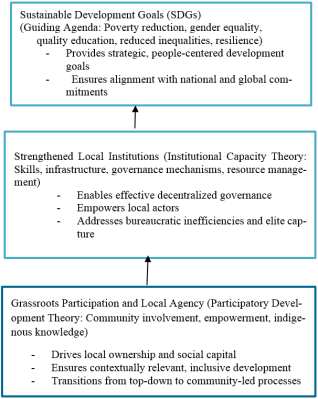
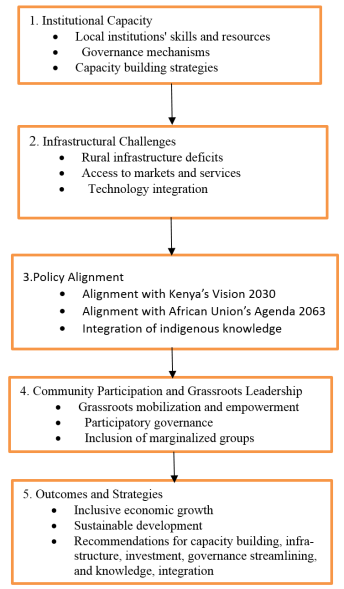
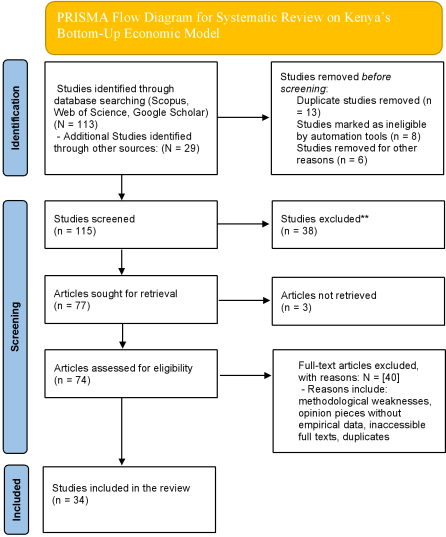
 Copy
Copy Download