Abstract
Violent conflict disrupts economic activity, alters household income, and reshapes everyday consumption behaviour. This study examines the impact of the 2023 Manipur violence on eating-out behaviour among restaurant consumers in a conflict-affected setting. The analysis focuses on four key conflict-related factors: income status, mobility restrictions, purchase-choice limitations, and stressful environment, and evaluates their influence on changes in the frequency of restaurant visits. Using primary survey data collected from 161 respondents across selected restaurants in the valley region, the study employs a logistic regression framework to estimate the relationship between these factors and consumer behaviour while controlling for demographic characteristics and prior eating-out habits. The results indicate that income decline, mental stress, and disruptions in online delivery services significantly affect consumption behaviour. Perceived insecurity also plays a stronger role than mobility restrictions such as curfews. In addition, prior eating-out habits emerge as a key determinant, suggesting that established consumption routines are particularly vulnerable to disruption during conflict. The findings provide micro-level evidence on how violent conflict influences discretionary consumption through economic, behavioural, and technological channels. The study contributes to the literature by highlighting the vulnerability of emerging service sectors in conflict-affected regions and underscores the importance of restoring stability, mobility, and consumer confidence for post-conflict economic recovery.
Keywords
Violent Conflict, Consumer Behaviour, Eating-out Frequency, Service Sector, Logistic Regression
1. Introduction
Violent conflict profoundly undermines economic development, with ethnic wars being especially destructive. Ethnic conflict is often fuelled by resource scarcity, demographic pressures, political exclusion, and identity-based grievances
| [1] | André, C., Platteau, J.-P. Land relations under unbearable stress: Rwanda caught in the Malthusian trap. Journal of Economic Behavior & Organization. 1998, 34(1), 1–47.
https://doi.org/10.1016/S0167-2681(97)00045-0 |
| [21] | Kalyvas, S. N. The logic of violence in civil war. Cambridge: Cambridge University Press; 2006. |
[1, 21]
. In Rwanda and Burundi, land scarcity, inequality, and ethnic polarization intensified competition, creating a Malthusian trap of violence and poverty
. Similar dynamics of ethnic exclusion and state weakness contributed to mass violence across Africa
| [12] | Collier, P., Elliott, V. L., Hegre, H., Hoeffler, A., Reynal-Querol, M., Sambanis, N. Breaking the conflict trap: Civil war and development policy. Washington, DC: World Bank and Oxford University Press; 2003. |
| [13] | Cramer, C. Civil war is not a stupid thing: Accounting for violence in developing countries. London: Hurst; 2006. |
[12, 13]
.
The economic consequences are severe. Conflicts destroy infrastructure, reduce household welfare, and stall recovery, with countries often failing to return to pre-war growth trajectories
| [9] | Cerra, V., Saxena, S. C. Growth dynamics: The myth of economic recovery. American Economic Review. 2008, 98(1), 439–457. https://doi.org/10.1257/aer.98.1.439 |
| [11] | Chen, S., Loayza, N. V., Reynal-Querol, M. The aftermath of civil war. World Bank Economic Review. 2008, 22(1), 63–85. https://doi.org/10.1093/wber/lhn001 |
[9, 11]
. In Burundi, repeated cycles of war eroded child health, food security, and rural livelihoods
. More broadly, civil wars reinforce the “conflict trap,” locking fragile states into recurrent violence and underdevelopment
| [12] | Collier, P., Elliott, V. L., Hegre, H., Hoeffler, A., Reynal-Querol, M., Sambanis, N. Breaking the conflict trap: Civil war and development policy. Washington, DC: World Bank and Oxford University Press; 2003. |
[12]
.
At the social level, conflict reshapes trust and cooperation. Wartime experiences sometimes strengthen local collective action, as in Sierra Leone
, or foster political engagement, as in Uganda
. Yet they can also harden parochial loyalties: field experiments in Burundi show survivors exhibiting greater egalitarian but also in-group preferences
| [29] | Voors, M. J., Nillesen, E. E. M., Verwimp, P., Lensink, R., Bulte, E. H., Van Soest, D. P. Violent conflict and behavior: A field experiment in Burundi. American Economic Review. 2012, 102(2), 941–964. https://doi.org/10.1257/aer.102.2.941 |
[29]
.
The human toll is equally deep. Conflict-induced trauma has been linked to depression, altered stress responses, and intergenerational effects
| [8] | Caspi, A., Sugden, K., Moffitt, T. E., et al. Influence of life stress on depression. Science. 2003, 301(5631), 386–389.
https://doi.org/10.1126/science.1083968 |
| [27] | Tedeschi, R. G., Calhoun, L. G. Posttraumatic growth: Conceptual foundations and empirical evidence. Psychological Inquiry. 2004, 15(1), 1–18.
https://doi.org/10.1207/s15327965pli1501_01 |
[8, 27]
. Beyond individuals, violence also restructures economies geographically: wartime destruction in Vietnam and elsewhere permanently shifted the distribution of population and industry
| [5] | Brakman, S., Garretsen, H., Schramm, M. The spatial distribution of wages: Estimating the Helpman–Hanson model for Germany. Journal of Regional Science. 2004, 44(3), 437–466.
https://doi.org/10.1111/j.0022-4146.2004.00344.x |
| [22] | Miguel, E., Roland, G. The long-run impact of bombing Vietnam. Journal of Development Economics. 2011, 96(1), 1–15. https://doi.org/10.1016/j.jdeveco.2010.07.004 |
[5, 22]
.
Ethnic conflict arises from the interplay of scarcity, inequality, and political exclusion, and its consequences extend from growth collapse and poverty to reshaped social norms and enduring trauma. Cases from Rwanda, Burundi, Sierra Leone, Uganda, and Vietnam highlight that recovery requires not just rebuilding infrastructure but also addressing the root causes of exclusion and restoring social trust
| [18] | Gilligan, M. J., Pasquale, B. J., Samii, C. Civil war and social capital: Behavioral-game evidence from Nepal. SSRN; 2011.
https://doi.org/10.2139/ssrn.1911969 |
| [21] | Kalyvas, S. N. The logic of violence in civil war. Cambridge: Cambridge University Press; 2006. |
[18, 21]
.
Unlike many communal conflicts in India rooted in religious differences, the 2023 Manipur violence stemmed largely from competition over scarce natural resources, demographic pressures, and land ownership rights
| [17] | Donthi, P. What’s behind the Manipur violence and why stopping it poses a test for Modi. The Wire. Available from:
https://thewire.in/ [Accessed 27 July 2023]. |
[17]
. Manipur’s valley, constituting just 10% of its land area, is densely inhabited by the Meitei and Meitei-Pangal communities, while the surrounding hills are reserved for tribal groups such as the Nagas and Kukis
| [16] | Directorate of Economics & Statistics, Government of Manipur. Economic Survey Manipur 2020–21. Imphal: Government of Manipur; 2021. |
[16]
, with constitutional protections restricting outside ownership.
The conflict led to over 200 deaths and 67,000 displacements, accounting for almost all conflict-driven displacement in South Asia in 2023
| [28] | The Hindu. Manipur violence accounted for 97% of displacements in South Asia in 2023: Report. Available from:
https://www.thehindu.com/ [Accessed 15 May 2024]. |
[28]
. Communities were uprooted, villages burned, and properties looted, with Meiteis and Kuki fleeing each other’s strongholds. Curfews and internet bans severely disrupted mobility, trade, and digital economic activities, though some valley residents managed to sustain livelihoods under restrictive conditions.
From an economic perspective, the violence of May 3, 2023 can be viewed as a case of resource contestation, although it also involves multiple political and socio-cultural dimensions. Rather than examining its underlying causes, this study focuses on its impact. Prior to the conflict, Manipur had a vibrant cultural life and a growing restaurant sector. However, the ensuing violence and prolonged instability altered consumer behaviour in the food sector, particularly eating-out practices. The study therefore examines how income losses, mobility restrictions, purchase limitations, and heightened stress influenced consumer behaviour during the conflict.
2. Literature Review
2.1. Violent Conflict and Socio-economic Variables
Violent conflict fundamentally disrupts the normal functioning of an economy by destroying productive assets, displacing populations, and interrupting markets and institutional arrangements. Empirical evidence shows that civil war leads to contractions in income, reduced investment, and long-term economic stagnation
| [9] | Cerra, V., Saxena, S. C. Growth dynamics: The myth of economic recovery. American Economic Review. 2008, 98(1), 439–457. https://doi.org/10.1257/aer.98.1.439 |
| [10] | Chavis, L., Leslie, P. Consumer boycotts: The impact of the Iraq war on French wine sales in the U.S. Quant Mark Econ 7, 37–67 (2009). https://doi.org/10.1007/s11129-008-9043-y |
| [12] | Collier, P., Elliott, V. L., Hegre, H., Hoeffler, A., Reynal-Querol, M., Sambanis, N. Breaking the conflict trap: Civil war and development policy. Washington, DC: World Bank and Oxford University Press; 2003. |
[9, 10, 12]
. At the micro level, households are often forced to abandon their regular economic activities, resulting in declines in income and consumption levels
| [6] | Bundervoet, T., Verwimp, P., Akresh, R. Health and civil war in rural Burundi. Journal of Human Resources. 2009, 44(2), 536–563. https://doi.org/10.3368/jhr.44.2.536 |
| [10] | Chavis, L., Leslie, P. Consumer boycotts: The impact of the Iraq war on French wine sales in the U.S. Quant Mark Econ 7, 37–67 (2009). https://doi.org/10.1007/s11129-008-9043-y |
| [29] | Voors, M. J., Nillesen, E. E. M., Verwimp, P., Lensink, R., Bulte, E. H., Van Soest, D. P. Violent conflict and behavior: A field experiment in Burundi. American Economic Review. 2012, 102(2), 941–964. https://doi.org/10.1257/aer.102.2.941 |
[6, 10, 29]
.
Violence also produces profound psychological shocks that affect individual decision-making, risk attitudes, and time preferences
| [7] | Carmil, D., Breznitz, S. Personal trauma and world view. Journal of Traumatic Stress. 1991, 4(3), 393–405.
https://doi.org/10.1002/jts.2490040307 |
| [8] | Caspi, A., Sugden, K., Moffitt, T. E., et al. Influence of life stress on depression. Science. 2003, 301(5631), 386–389.
https://doi.org/10.1126/science.1083968 |
| [30] | Yehuda, R. Post-traumatic stress disorder. New England Journal of Medicine. 2002, 346(2), 108–114.
https://doi.org/10.1056/NEJMra012941 |
[7, 8, 30]
. Exposure to traumatic events has been shown to alter worldviews, political attitudes, and future orientation, thereby influencing everyday economic behaviour
| [25] | Punamaki, R. L., Qouta, S., Sarraj, E. E. Relationships between traumatic events, children’s gender, political activity, and perceptions of parenting styles. International Journal of Behavioral Development. 1997, 21(1), 91–110.
https://doi.org/10.1080/016502597385009 |
| [27] | Tedeschi, R. G., Calhoun, L. G. Posttraumatic growth: Conceptual foundations and empirical evidence. Psychological Inquiry. 2004, 15(1), 1–18.
https://doi.org/10.1207/s15327965pli1501_01 |
[25, 27]
. Field and experimental studies further demonstrate that conflict exposure can modify social preferences, risk tolerance, and cooperative behaviour
.
Another important consequence of violent conflict is the restriction of mobility and communication. Governments often impose curfews, emergency regulations, or other control measures to contain violence, while civilians voluntarily limit their movements due to fear and insecurity. Such restrictions disrupt labour markets, supply chains, and everyday transactions
| [12] | Collier, P., Elliott, V. L., Hegre, H., Hoeffler, A., Reynal-Querol, M., Sambanis, N. Breaking the conflict trap: Civil war and development policy. Washington, DC: World Bank and Oxford University Press; 2003. |
| [13] | Cramer, C. Civil war is not a stupid thing: Accounting for violence in developing countries. London: Hurst; 2006. |
| [21] | Kalyvas, S. N. The logic of violence in civil war. Cambridge: Cambridge University Press; 2006. |
[12, 13, 21]
. Armed confrontations, destruction of infrastructure, and social unrest further weaken connectivity and reduce economic exchange, sometimes leading to a temporary or even permanent restructuring of local economies
| [9] | Cerra, V., Saxena, S. C. Growth dynamics: The myth of economic recovery. American Economic Review. 2008, 98(1), 439–457. https://doi.org/10.1257/aer.98.1.439 |
| [14] | Davis, D. R., Weinstein, D. E. Bones, bombs, and break points. American Economic Review. 2002, 92(5), 1269–1289.
https://doi.org/10.1257/000282802762024502 |
[9, 14]
.
2.2. Customer Behaviour and Income Status
Income is one of the central determinants of consumer behaviour. Standard economic theory suggests that consumption demand tends to increase with income, as higher purchasing power expands the feasible consumption set
| [2] | Becker, G. S., Mulligan, C. B. The endogenous determination of time preference. Quarterly Journal of Economics. 1997, 112(3), 729–758. https://doi.org/10.1162/003355397555334 |
| [20] | Kahneman, D., Tversky, A. Prospect theory: An analysis of decision under risk. Econometrica. 1979, 47(2), 263–291.
https://doi.org/10.2307/1914185 |
[2, 20]
. However, violent conflict typically reduces both aggregate and household income levels due to unemployment, asset destruction, and displacement
| [6] | Bundervoet, T., Verwimp, P., Akresh, R. Health and civil war in rural Burundi. Journal of Human Resources. 2009, 44(2), 536–563. https://doi.org/10.3368/jhr.44.2.536 |
| [10] | Chavis, L., Leslie, P. Consumer boycotts: The impact of the Iraq war on French wine sales in the U.S. Quant Mark Econ 7, 37–67 (2009). https://doi.org/10.1007/s11129-008-9043-y |
| [29] | Voors, M. J., Nillesen, E. E. M., Verwimp, P., Lensink, R., Bulte, E. H., Van Soest, D. P. Violent conflict and behavior: A field experiment in Burundi. American Economic Review. 2012, 102(2), 941–964. https://doi.org/10.1257/aer.102.2.941 |
[6, 10, 29]
.
These income shocks can significantly alter consumer behaviour, particularly in discretionary consumption such as eating out. Declining income often leads households to prioritise essential goods and reduce expenditure on non-essential services
| [9] | Cerra, V., Saxena, S. C. Growth dynamics: The myth of economic recovery. American Economic Review. 2008, 98(1), 439–457. https://doi.org/10.1257/aer.98.1.439 |
| [15] | Dercon, S. Risk, crop choice, and savings. Economic Development and Cultural Change. 1996, 44(3), 485–513.
https://www.journals.uchicago.edu/doi/abs/10.1086/452229 |
[9, 15]
. Moreover, the impact of income changes is not uniform across individuals; demographic characteristics, occupation, and social capital influence how households adjust their consumption strategies during crises
| [19] | Harbaugh, W. T., Krause, K., Vesterlund, L. Risk attitudes of children and adults. Experimental Economics. 2002, 5(1), 53–84. https://doi.org/10.1023/A:1016316725855 |
| [23] | Narayan, D., Pritchett, L. Cents and sociability: Household income and social capital in rural Tanzania. Economic Development and Cultural Change. 1999, 47(4), 871–897.
https://www.journals.uchicago.edu/doi/abs/10.1086/452436 |
[19, 23]
.
Given these considerations, it is important to examine the role of income status when analysing consumer behaviour during violent conflict.
H1: Income status during violent conflict affect frequency of visits.
2.3. Customer Behaviour and Mobility Limitations
Restrictions on mobility are a common feature of conflict environments. Curfews, checkpoints, security operations, and fear of violence significantly reduce the movement of individuals and goods
| [12] | Collier, P., Elliott, V. L., Hegre, H., Hoeffler, A., Reynal-Querol, M., Sambanis, N. Breaking the conflict trap: Civil war and development policy. Washington, DC: World Bank and Oxford University Press; 2003. |
| [21] | Kalyvas, S. N. The logic of violence in civil war. Cambridge: Cambridge University Press; 2006. |
[12, 21]
. Such restrictions disrupt local markets and reduce participation in economic and social activities, including consumption in hospitality sectors.
Empirical evidence from conflict-affected regions shows that insecurity and mobility constraints reduce collective activities, market participation, and political engagement
. Similarly, disruptions to transportation and infrastructure can reshape the spatial distribution of economic activity and reduce access to services
| [5] | Brakman, S., Garretsen, H., Schramm, M. The spatial distribution of wages: Estimating the Helpman–Hanson model for Germany. Journal of Regional Science. 2004, 44(3), 437–466.
https://doi.org/10.1111/j.0022-4146.2004.00344.x |
| [14] | Davis, D. R., Weinstein, D. E. Bones, bombs, and break points. American Economic Review. 2002, 92(5), 1269–1289.
https://doi.org/10.1257/000282802762024502 |
[5, 14]
.
In such environments, individuals may voluntarily restrict their movements due to perceived risks, even in the absence of formal restrictions. This behavioural response further reduces demand for services that require physical presence, such as restaurants or recreational spaces.
Based on these considerations, the following hypothesis is proposed:
H2: Mobility restrictions during violent conflict affect frequency of visits.
2.4. Customer Behaviour and Purchase-choice Limitations
Violent conflict often disrupts supply chains, market structures, and institutional arrangements, thereby limiting consumer choice. The destruction of infrastructure, closure of businesses, and breakdown of distribution networks reduce the availability of goods and services
| [11] | Chen, S., Loayza, N. V., Reynal-Querol, M. The aftermath of civil war. World Bank Economic Review. 2008, 22(1), 63–85. https://doi.org/10.1093/wber/lhn001 |
| [12] | Collier, P., Elliott, V. L., Hegre, H., Hoeffler, A., Reynal-Querol, M., Sambanis, N. Breaking the conflict trap: Civil war and development policy. Washington, DC: World Bank and Oxford University Press; 2003. |
[11, 12]
. In many cases, markets shrink or reorganise around essential goods, while discretionary consumption sectors experience significant contraction
.
Conflict environments also affect social networks and trust, which are important determinants of market transactions. Social capital tends to weaken in environments characterised by violence and insecurity, thereby affecting economic exchanges and consumer decisions
| [10] | Chavis, L., Leslie, P. Consumer boycotts: The impact of the Iraq war on French wine sales in the U.S. Quant Mark Econ 7, 37–67 (2009). https://doi.org/10.1007/s11129-008-9043-y |
| [18] | Gilligan, M. J., Pasquale, B. J., Samii, C. Civil war and social capital: Behavioral-game evidence from Nepal. SSRN; 2011.
https://doi.org/10.2139/ssrn.1911969 |
| [23] | Narayan, D., Pritchett, L. Cents and sociability: Household income and social capital in rural Tanzania. Economic Development and Cultural Change. 1999, 47(4), 871–897.
https://www.journals.uchicago.edu/doi/abs/10.1086/452436 |
[10, 18, 23]
. Additionally, disruptions in infrastructure and communication systems can limit access to modern payment systems and delivery mechanisms, thereby constraining purchase choices.
Thus, limitations in purchase options during violent conflict may influence the frequency of consumer visits to eat-out establishments.
H3: Purchase-choice limitations affect frequency of visits.
2.5. Customer Behaviour and Stressful Environments
One of the most pervasive consequences of violent conflict is psychological stress. Exposure to violence, insecurity, and traumatic events can significantly affect mental health and behavioural responses
| [8] | Caspi, A., Sugden, K., Moffitt, T. E., et al. Influence of life stress on depression. Science. 2003, 301(5631), 386–389.
https://doi.org/10.1126/science.1083968 |
| [30] | Yehuda, R. Post-traumatic stress disorder. New England Journal of Medicine. 2002, 346(2), 108–114.
https://doi.org/10.1056/NEJMra012941 |
[8, 30]
. Stressful experiences are often associated with changes in attitudes, decision-making, and future orientation
| [7] | Carmil, D., Breznitz, S. Personal trauma and world view. Journal of Traumatic Stress. 1991, 4(3), 393–405.
https://doi.org/10.1002/jts.2490040307 |
| [25] | Punamaki, R. L., Qouta, S., Sarraj, E. E. Relationships between traumatic events, children’s gender, political activity, and perceptions of parenting styles. International Journal of Behavioral Development. 1997, 21(1), 91–110.
https://doi.org/10.1080/016502597385009 |
[7, 25]
.
Behavioural and experimental studies suggest that stress and traumatic experiences can alter risk preferences, time preferences, and social behaviour
| [10] | Chavis, L., Leslie, P. Consumer boycotts: The impact of the Iraq war on French wine sales in the U.S. Quant Mark Econ 7, 37–67 (2009). https://doi.org/10.1007/s11129-008-9043-y |
| [20] | Kahneman, D., Tversky, A. Prospect theory: An analysis of decision under risk. Econometrica. 1979, 47(2), 263–291.
https://doi.org/10.2307/1914185 |
| [26] | Tanaka, T., Camerer, C. F., Nguyen, Q. Risk and time preferences: Linking experimental and household survey data from Vietnam. American Economic Review. 2010, 100(1), 557–571. https://doi.org/10.1257/aer.100.1.557 |
[10, 20, 26]
. In conflict settings, such behavioural changes may influence everyday consumption decisions, including the frequency and nature of eating-out behaviour. For instance, stress may lead some individuals to seek comfort or social interaction, while others may become more risk-averse and avoid public spaces.
Although the relationship between stress and economic behaviour has been widely studied, there is limited research examining how stress in violent conflict environments affects eating-out behaviour specifically. This study therefore considers stress as a key explanatory factor, operationalised through indicators such as insecurity and frustration arising from communication restrictions.
H4: Stress during violent conflict affect frequency of visits.
3. Materials and Methods
3.1. Research Design
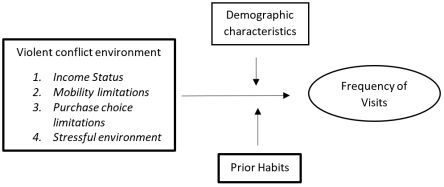
This study examines the responses of consumers visiting restaurants after the onset of violent conflict in the state. The research focuses on four key independent variables—income status, stressful environment, purchase-choice limitations, and mobility restrictions—which are expected to change as a consequence of the conflict. These variables are analysed to assess their impact on consumer behaviour, measured in terms of changes in the frequency of restaurant visits.
Figure 1. Conceptual framework.
Consumer behaviour during the conflict may also be influenced by prior eating-out habits, which are therefore included as an additional explanatory variable. Furthermore, income status and mobility constraints may vary across demographic characteristics of the respondents, and these demographic factors are incorporated into the model as control variables.
The research design is developed on the basis of relationships among these variables as established in the literature. Accordingly, the conceptual framework presented in the preceding section guides the empirical analysis of the study.
Table 1. Variables in the study.
Latent Independent Variables | Observed Independent Variables | Dependent Variables |
Income Status (IS) | Income level (IS1) Income type (IS2) | (Consumer Behaviour) Frequency of visits (CB1) |
Mobility (MR) | Risk (MR1) Curfew (MR2) |
Purchase choice (PC) | Payment limitations (PCL1) Delivery limitations (PCL2) Closure of food hubs (PCL3) |
Mental Stress (MS) | Internet ban (MS1) Insecurity (MS2) |
Prior Habits (PH) | Regular consumer (PH1) |
Table 2. Operational definitions.
Variables | Operational definitions |
CB1 | Average number of visits per week (6 months prior to conflict/ 6 months after conflict) |
IS1 | Decreased or increased during 6 months of conflict |
IS2 | Salaried or non–salaried |
MR2 | Frequent imposition of curfew during 6 months of conflict |
MR1 | Risk of meeting harm during 6 months of conflict |
PCL1 | Unavailability of online payment due to internet ban during 6 months of conflict |
PCL2 | Unavailability of home delivery service during 6 months of conflict |
PCL3 | Closure of food hubs during three months of conflict |
MS1 | Mental stress caused by the internet ban during three months of conflict |
MS2 | The feeling of insecurity of survival during three months of conflict |
PH1 | Consumers go for eat-out at least 4 per week before the conflict2. |
3.2. Sample Selections
Twenty restaurants located in the valley region, where the intensity of the conflict was relatively minimal, were selected through purposive sampling. This approach was adopted to ensure that establishments with continued operations during the conflict period could provide access to active consumers for the study. Structured questionnaires were then administered to customers visiting these restaurants in order to collect relevant data on their behaviour during the conflict.
The survey was conducted over a two-week period, from 5 December 2023 to 19 December 2023. Out of 200 questionnaires distributed, 177 were returned. After screening for completeness and consistency, 161 responses were considered valid and suitable for inclusion in the final analysis.
3.3. Model
The consumer responses were recorded in binary form. Accordingly, the study employed a logistic regression model to examine the relationship between consumer behaviour and the variables associated with the violent conflict environment. The specification of the study model is presented below.
Where, t = b0+ b1D1 + b2D2 + b3D3 + b4D4 + b5IS1 + b6IS2 + b7MR1 + b8MR2 + b9PCL1 + b10PCL2 + b11PCL3 + b12MS1 + b13PH1 + b14D1D2 + b15D1IS1 + b16D2IS1+ b17IS1PC1
The inclusion of interaction terms (e.g., D1D2, D1IS1, D2IS1, IS1PC1) here in this model is motivated by the possibility that the effects of demographic characteristics and income shocks may not operate independently. For instance, income decline may have differential behavioural impacts across demographic groups, while mobility constraints may interact with socio-economic status in shaping consumption responses. These interaction terms therefore allow the model to capture conditional and heterogeneous effects arising from the conflict environment.
3.4. Statements and Declarations
This statement declares that the author have seen and approved the submitted manuscript. The article is the author’s original work. It is not under consideration for publication or submitted for publication, nor has it been published in whole or in part elsewhere.
4. Results
4.1. Descriptive Summary
The descriptive analysis is organised into two components: the demographic characteristics of consumers and their behavioural responses during the period of violent conflict. Out of the total sample of 161 consumers, 85.71 per cent are male, while the remaining respondents are female. A substantial proportion of the respondents belong to the younger age groups, with 31.06 per cent falling within the 20–25 years category and 44.72 per cent within the 30–35 years category. The education profile is largely concentrated among highly educated individuals, with 62.73 per cent holding undergraduate degrees and 21.12 per cent postgraduate qualifications. In terms of marital status, 81.37 per cent of the respondents are unmarried, 17.39 per cent are married, and only two respondents are divorced.
These demographic characteristics indicate that eating-out behaviour is more prevalent among male, young, highly educated, and unmarried individuals. Such a pattern is consistent with consumption theory, where discretionary and leisure-oriented consumption is more common among younger and socially mobile population groups with fewer household responsibilities.
The descriptive findings also reveal substantial behavioural changes during the conflict period. More than 82.61 per cent of respondents reported a change in the frequency of restaurant visits, while 70.19 per cent indicated that they had regular eating-out habits prior to the conflict. A significant number of respondents reported adverse experiences during the conflict. Seventy-three respondents indicated that their income had declined, while 73.29 per cent reported feeling unsafe when going out. Mobility disruptions were also prominent, with 63.98 per cent reporting obstructions due to bandhs and strikes. The internet ban created additional difficulties, as 77.64 per cent reported problems due to the unavailability of online payment systems and 57.14 per cent experienced the absence of online food delivery services. Furthermore, 67.7 per cent of respondents reported experiencing mental stress during the conflict period.
4.2. Model Analysis
The econometric model investigates the causal relationship between consumer behaviour measured as changes in the frequency of restaurant visits and four conflict-related variables: income status, mobility restrictions, purchase-choice limitations, and stressful environment. Demographic characteristics and prior eating-out habits are incorporated as control variables in the model.
Table 3. Regression analysis results.
Logistic regression | Number of obs = 161 LR chi2 (17) = 113.97 |
Log likelihood = -17.403216 | Prob > chi2 = 0.0000 Pseudo R2 = 0.7660 |
CB1 | Odds Ratio | Std. Err. | z | P>|z| | [95% Conf. Interval] |
D1 | 3.04e+07 | 2.24e+08 | 2.33 | 0.020 | 15.61992 | 5.91e+13 |
D2 | 8.688176 | 9.143806 | 2.05 | 0.040 | 1.104302 | 68.35484 |
D3 | 2.704411 | 3.050118 | 0.88 | 0.378 | .296525 | 24.66517 |
D4 | .0399821 | .0615071 | -2.09 | 0.036 | .0019607 | .8153158 |
IS1 | 329325 | 1.05e+09 | 0.00 | 0.997 | 0 | |
IS2 | 1936.328 | 5786.104 | 2.53 | 0.011 | 5.539018 | 676901 |
MR1 | 970.1246 | 2477.088 | 2.69 | 0.007 | 6.507203 | 144630.8 |
MR2 | 11.13371 | 14.02043 | 1.91 | 0.056 | .9434976 | 131.3829 |
PCL1 | .1595846 | .2807177 | -1.04 | 0.297 | .0050779 | 5.015325 |
PCL2 | .0052764 | .0115478 | -2.40 | 0.017 | .0000723 | .3848288 |
PCL3 | 95.75969 | 258.1933 | 1.69 | 0.091 | .4854224 | 18890.6 |
MS1 | 1329.061 | 4006.579 | 2.39 | 0.017 | 3.610095 | 489295.6 |
D1D2 | .0505398 | .0718572 | -2.10 | 0.036 | .0031146 | .820102 |
D1DIS1 | 3.37e-10 | 1.08e-06 | -0.01 | 0.995 | 0 | |
D2IS1 | 4.637651 | 8.651138 | 0.82 | 0.411 | .1197995 | 179.5317 |
IS1PC1 | 5.343856 | 12.46267 | 0.72 | 0.472 | .0553002 | 516.3964 |
PH1 | 51.49668 | 83.72872 | 2.42 | 0.015 | 2.127189 | 1246.672 |
Cons_ | 5.75e-09 | 4.98e-08 | -2.19 | 0.028 | 2.46e-16 | .1345951 |
Among the demographic variables of sex, age, education, and marital status, three variables sex, age, and marital status are statistically significant in explaining changes in visit frequency. Male consumers exhibit higher odds of changing their frequency of visits than female consumers, while age and marital status also significantly influence behavioural adjustments.
IS1 is measured through two indicators: salaried employment and lower income during the conflict. Among these, only lower IS1 emerges as a statistically significant determinant of changes in visit frequency. Consumers experiencing a decline in income are substantially more likely to change their frequency of restaurant visits.
PCL are captured through three observed variables, of which only the variable representing difficulty due to the unavailability of online delivery services is statistically significant. The results indicate a strong negative association between the absence of delivery services and the frequency of visits. This suggests that the lack of alternative consumption channels did not merely shift consumption patterns but instead reduced overall demand for restaurant services.
The stressful environment variable also shows a statistically significant relationship with changes in visit frequency. Consumers experiencing mental stress have substantially higher odds of altering their restaurant-visiting behaviour.
The model also reveals that prior eating-out habits are a significant predictor of behavioural change. Regular customers prior to the conflict have much higher odds of changing their frequency of visits compared to non-regular customers. This indicates that violent conflict disrupts established consumption routines more strongly than occasional or irregular behaviours. However, it is important to note that some estimated odds ratios are extremely large with wide confidence intervals. This may reflect issues of quasi-complete separation arising from the binary specification and relatively small sample size. While the direction and statistical significance remain informative, these magnitudes should be interpreted with caution.
5. Discussion
Violent conflict imposes both direct economic costs and indirect behavioural consequences on affected populations. The literature consistently shows that civil wars lead to declines in income, disruptions in markets, and changes in individual decision-making patterns
| [9] | Cerra, V., Saxena, S. C. Growth dynamics: The myth of economic recovery. American Economic Review. 2008, 98(1), 439–457. https://doi.org/10.1257/aer.98.1.439 |
| [12] | Collier, P., Elliott, V. L., Hegre, H., Hoeffler, A., Reynal-Querol, M., Sambanis, N. Breaking the conflict trap: Civil war and development policy. Washington, DC: World Bank and Oxford University Press; 2003. |
| [29] | Voors, M. J., Nillesen, E. E. M., Verwimp, P., Lensink, R., Bulte, E. H., Van Soest, D. P. Violent conflict and behavior: A field experiment in Burundi. American Economic Review. 2012, 102(2), 941–964. https://doi.org/10.1257/aer.102.2.941 |
[9, 12, 29]
. The findings of this study are consistent with these broader insights, while also offering micro-level evidence from the perspective of consumer behaviour in a service-sector context.
The demographic results show a higher incidence of eating-out behaviour among young, unmarried, and highly educated consumers. This pattern reflects the socio-economic characteristics of discretionary consumption, which tends to be concentrated among younger individuals with greater social mobility and fewer household responsibilities. However, the observed gender imbalance also reflects underlying social structures, where mobility and leisure consumption opportunities are often shaped by prevailing social norms. Thus, behavioural responses during conflict are influenced not only by economic factors but also by demographic and social constraints.
The results relating to income confirm that income decline is a key driver of behavioural change. Conflict-induced economic shocks reduce discretionary spending, including expenditure on restaurant services. This is consistent with the literature demonstrating that civil war leads to significant declines in household welfare and consumption levels
| [6] | Bundervoet, T., Verwimp, P., Akresh, R. Health and civil war in rural Burundi. Journal of Human Resources. 2009, 44(2), 536–563. https://doi.org/10.3368/jhr.44.2.536 |
| [10] | Chavis, L., Leslie, P. Consumer boycotts: The impact of the Iraq war on French wine sales in the U.S. Quant Mark Econ 7, 37–67 (2009). https://doi.org/10.1007/s11129-008-9043-y |
| [11] | Chen, S., Loayza, N. V., Reynal-Querol, M. The aftermath of civil war. World Bank Economic Review. 2008, 22(1), 63–85. https://doi.org/10.1093/wber/lhn001 |
[6, 10, 11]
. The stronger response among regular customers suggests that habitual consumption patterns are particularly sensitive to economic shocks, as households prioritise essential goods when income declines.
The findings on mobility restrictions indicate that perceived insecurity plays a more significant role than formal restrictions such as curfews or bandhs. Although many respondents reported mobility disruptions, only the feeling of being unsafe had a statistically significant impact on behavioural change. This suggests that subjective perceptions of risk may have a stronger influence on consumer behaviour than formal institutional measures. Existing research supports this interpretation, showing that fear and insecurity often lead individuals to voluntarily reduce movement, even in the absence of strict formal controls
| [3] | Bellows, J., Miguel, E. War and local collective action in Sierra Leone. Journal of Public Economics. 2009, 93(11–12), 1144–1157. https://doi.org/10.1016/j.jpubeco.2009.07.012 |
| [21] | Kalyvas, S. N. The logic of violence in civil war. Cambridge: Cambridge University Press; 2006. |
[3, 21]
.
The results relating to purchase-choice limitations reveal that the unavailability of online delivery services significantly affected consumer behaviour. Rather than substituting dine-in consumption with delivery options, the absence of delivery channels appears to have reduced overall consumption. This supports the argument that violent conflict contracts markets and reduces the diversity of consumption options by disrupting infrastructure, supply chains, and business operations
| [9] | Cerra, V., Saxena, S. C. Growth dynamics: The myth of economic recovery. American Economic Review. 2008, 98(1), 439–457. https://doi.org/10.1257/aer.98.1.439 |
| [12] | Collier, P., Elliott, V. L., Hegre, H., Hoeffler, A., Reynal-Querol, M., Sambanis, N. Breaking the conflict trap: Civil war and development policy. Washington, DC: World Bank and Oxford University Press; 2003. |
[9, 12]
.
Mental stress also emerges as a significant determinant of behavioural change. The findings indicate that stress is associated with a reduction in the frequency of restaurant visits. While some literature suggests that stress may increase consumption of comfort foods, conflict-related stress differs qualitatively from everyday stress. Trauma, insecurity, and fear often increase risk aversion and reduce participation in public activities
| [7] | Carmil, D., Breznitz, S. Personal trauma and world view. Journal of Traumatic Stress. 1991, 4(3), 393–405.
https://doi.org/10.1002/jts.2490040307 |
| [24] | Netzer, N. Evolution of time preferences and attitudes toward risk. American Economic Review. 2009, 99(3), 937–955.
https://doi.org/10.1257/aer.99.3.937 |
| [30] | Yehuda, R. Post-traumatic stress disorder. New England Journal of Medicine. 2002, 346(2), 108–114.
https://doi.org/10.1056/NEJMra012941 |
[7, 24, 30]
. Consequently, conflict-induced stress appears to discourage discretionary public consumption, reinforcing the contractionary effects of income shocks and mobility constraints.
The role of prior habits further illustrates the disruptive impact of conflict. Regular customers exhibited stronger behavioural adjustments than non-regular customers, indicating that established consumption routines are more vulnerable to conflict-related shocks. Behavioural research suggests that habits and routines are sensitive to changes in economic conditions and perceived risks
| [20] | Kahneman, D., Tversky, A. Prospect theory: An analysis of decision under risk. Econometrica. 1979, 47(2), 263–291.
https://doi.org/10.2307/1914185 |
| [26] | Tanaka, T., Camerer, C. F., Nguyen, Q. Risk and time preferences: Linking experimental and household survey data from Vietnam. American Economic Review. 2010, 100(1), 557–571. https://doi.org/10.1257/aer.100.1.557 |
[20, 26]
. Thus, violent conflict not only reduces consumption levels but also reshapes behavioural patterns.
From a policy perspective, the findings demonstrate that violent conflict undermines emerging service-sector markets through multiple channels, including income contraction, mobility disruptions, psychological stress, and shrinking market choices. This aligns with the conflict-trap literature, which argues that political instability and violence impede economic development and weaken institutional capacity
| [12] | Collier, P., Elliott, V. L., Hegre, H., Hoeffler, A., Reynal-Querol, M., Sambanis, N. Breaking the conflict trap: Civil war and development policy. Washington, DC: World Bank and Oxford University Press; 2003. |
[12]
. In developing regional economies, such disruptions can have long-term consequences, particularly for nascent service sectors that rely on stable demand and predictable institutional environments.
At the same time, the presence of regular eating-out habits prior to the conflict indicates that there was latent market potential. This suggests that policy responses should focus not only on conflict resolution but also on post-conflict economic recovery and market reconstruction. Restoring mobility, communication infrastructure, and consumer confidence would be essential for reviving such service-sector activities. Without such interventions, conflict-affected regions risk falling into persistent cycles of economic stagnation, as documented in the broader literature on conflict and development.
In terms of hypothesis testing, the results provide support for H1 (income decline), H3 (purchase-choice limitations, particularly delivery disruptions), and H4 (stressful environment), all of which significantly influence changes in visit frequency. Partial support is found for H2, as perceived risk (MR1) is significant, whereas formal restrictions such as curfews (MR2) are not consistently significant.
6. Conclusion
The ongoing violent conflict in Manipur has significant economic and developmental implications, not only for the state but also for broader regional policy objectives such as India’s Act East policy. The success of such initiatives depends heavily on the economic stability and integration of the North-eastern states. However, the current crisis has disrupted local markets, weakened consumer confidence, and undermined emerging entrepreneurial ecosystems that were beginning to take shape in the region.
The findings of this study indicate that the eating-out sector representing a relatively new and growing service-market segment has experienced substantial contraction during the conflict. This contraction is primarily driven by income shocks, mobility restrictions, disruptions in delivery and payment systems, and heightened psychological stress among consumers. These factors collectively illustrate how violent conflict affects not only production and employment but also everyday consumption patterns and service-sector demand.
Such effects are unlikely to be confined to the restaurant industry alone. Emerging markets and startup-driven initiatives typically depend on stable demand, predictable institutional environments, and secure physical infrastructure. Violent conflict erodes these conditions, discouraging investment and forcing businesses to either scale down operations or shut down entirely. In addition, prolonged instability may encourage a shift toward informal economic activities, as formal businesses struggle to operate under uncertainty. This transition can reduce regulatory oversight, weaken tax bases, and create long-term structural inefficiencies. Therefore, post-conflict recovery policies must address not only reconstruction but also the formalisation and stabilisation of economic activity.
The results of this study therefore underline the central importance of political stability and social peace for the growth of new market sectors and entrepreneurial activity. Without a secure and predictable environment, innovative initiatives are unlikely to flourish, regardless of policy support or market potential. Sustainable economic development in the state and by extension, the broader goals of regional integration depends fundamentally on restoring peace, rebuilding consumer confidence, and re-establishing the institutional and infrastructural conditions necessary for market expansion.
7. Limitations and Future Scope of the Study
This study is exploratory in nature and therefore subject to certain limitations. The sample is confined to consumers from twenty purposively selected restaurants in the valley region, where the intensity of conflict was relatively minimal, and may not fully represent behavioural responses in more severely affected areas or across different socio-economic contexts. The survey was conducted over a short period of two week, capturing only a snapshot of consumer responses, while behavioural patterns may evolve over time as individuals adapt to prolonged instability. The reliance on self-reported data may introduce recall or response bias, and the sample is demographically skewed toward male, young, and highly educated respondents, which may limit the generalisability of the findings. Moreover, the study focuses specifically on the restaurant sector and does not capture wider economic or sectoral impacts.
Despite these limitations, the study holds significance as an exploratory attempt to examine consumer behaviour in a violent conflict setting, an area that remains relatively underexplored in the literature. By providing micro-level evidence on how conflict-related factors influence discretionary consumption, the study offers a preliminary understanding of behavioural adjustments in emerging service markets. Future research can build upon these findings through longitudinal designs, broader geographic and demographic coverage, sectoral comparisons, and mixed-method approaches to develop a more comprehensive understanding of economic behaviour in conflict-affected environments.
Abbreviations
IS | Income Status |
IS1 | Income Level |
IS2 | Income Type |
MR | Mobility Restrictions |
MR1 | Perceived Risk |
MR2 | Curfew |
PC | Purchase Choice Limitations |
PCL1 | Payment Limitations |
PCL2 | Delivery Limitations |
PCL3 | Closure of Food Hubs |
MS | Mental Stress |
MS1 | Stress Due to Internet Ban |
MS2 | Insecurity |
PH | Prior Habits |
PH1 | Regular Consumer |
CB1 | Frequency of Visits |
Author Contributions
Mohammed Abrar Khan: Conceptualization, Methodology, Data curation, Formal analysis, Writing – original draft, Writing – review & editing
Conflicts of Interest
The author declares no conflicts of interest.
References
| [1] |
André, C., Platteau, J.-P. Land relations under unbearable stress: Rwanda caught in the Malthusian trap. Journal of Economic Behavior & Organization. 1998, 34(1), 1–47.
https://doi.org/10.1016/S0167-2681(97)00045-0
|
| [2] |
Becker, G. S., Mulligan, C. B. The endogenous determination of time preference. Quarterly Journal of Economics. 1997, 112(3), 729–758.
https://doi.org/10.1162/003355397555334
|
| [3] |
Bellows, J., Miguel, E. War and local collective action in Sierra Leone. Journal of Public Economics. 2009, 93(11–12), 1144–1157.
https://doi.org/10.1016/j.jpubeco.2009.07.012
|
| [4] |
Blattman, C. From violence to voting: War and political participation in Uganda. American Political Science Review. 2009, 103(2), 231–247.
https://doi.org/10.1017/S0003055409090212
|
| [5] |
Brakman, S., Garretsen, H., Schramm, M. The spatial distribution of wages: Estimating the Helpman–Hanson model for Germany. Journal of Regional Science. 2004, 44(3), 437–466.
https://doi.org/10.1111/j.0022-4146.2004.00344.x
|
| [6] |
Bundervoet, T., Verwimp, P., Akresh, R. Health and civil war in rural Burundi. Journal of Human Resources. 2009, 44(2), 536–563.
https://doi.org/10.3368/jhr.44.2.536
|
| [7] |
Carmil, D., Breznitz, S. Personal trauma and world view. Journal of Traumatic Stress. 1991, 4(3), 393–405.
https://doi.org/10.1002/jts.2490040307
|
| [8] |
Caspi, A., Sugden, K., Moffitt, T. E., et al. Influence of life stress on depression. Science. 2003, 301(5631), 386–389.
https://doi.org/10.1126/science.1083968
|
| [9] |
Cerra, V., Saxena, S. C. Growth dynamics: The myth of economic recovery. American Economic Review. 2008, 98(1), 439–457.
https://doi.org/10.1257/aer.98.1.439
|
| [10] |
Chavis, L., Leslie, P. Consumer boycotts: The impact of the Iraq war on French wine sales in the U.S. Quant Mark Econ 7, 37–67 (2009).
https://doi.org/10.1007/s11129-008-9043-y
|
| [11] |
Chen, S., Loayza, N. V., Reynal-Querol, M. The aftermath of civil war. World Bank Economic Review. 2008, 22(1), 63–85.
https://doi.org/10.1093/wber/lhn001
|
| [12] |
Collier, P., Elliott, V. L., Hegre, H., Hoeffler, A., Reynal-Querol, M., Sambanis, N. Breaking the conflict trap: Civil war and development policy. Washington, DC: World Bank and Oxford University Press; 2003.
|
| [13] |
Cramer, C. Civil war is not a stupid thing: Accounting for violence in developing countries. London: Hurst; 2006.
|
| [14] |
Davis, D. R., Weinstein, D. E. Bones, bombs, and break points. American Economic Review. 2002, 92(5), 1269–1289.
https://doi.org/10.1257/000282802762024502
|
| [15] |
Dercon, S. Risk, crop choice, and savings. Economic Development and Cultural Change. 1996, 44(3), 485–513.
https://www.journals.uchicago.edu/doi/abs/10.1086/452229
|
| [16] |
Directorate of Economics & Statistics, Government of Manipur. Economic Survey Manipur 2020–21. Imphal: Government of Manipur; 2021.
|
| [17] |
Donthi, P. What’s behind the Manipur violence and why stopping it poses a test for Modi. The Wire. Available from:
https://thewire.in/
[Accessed 27 July 2023].
|
| [18] |
Gilligan, M. J., Pasquale, B. J., Samii, C. Civil war and social capital: Behavioral-game evidence from Nepal. SSRN; 2011.
https://doi.org/10.2139/ssrn.1911969
|
| [19] |
Harbaugh, W. T., Krause, K., Vesterlund, L. Risk attitudes of children and adults. Experimental Economics. 2002, 5(1), 53–84.
https://doi.org/10.1023/A:1016316725855
|
| [20] |
Kahneman, D., Tversky, A. Prospect theory: An analysis of decision under risk. Econometrica. 1979, 47(2), 263–291.
https://doi.org/10.2307/1914185
|
| [21] |
Kalyvas, S. N. The logic of violence in civil war. Cambridge: Cambridge University Press; 2006.
|
| [22] |
Miguel, E., Roland, G. The long-run impact of bombing Vietnam. Journal of Development Economics. 2011, 96(1), 1–15.
https://doi.org/10.1016/j.jdeveco.2010.07.004
|
| [23] |
Narayan, D., Pritchett, L. Cents and sociability: Household income and social capital in rural Tanzania. Economic Development and Cultural Change. 1999, 47(4), 871–897.
https://www.journals.uchicago.edu/doi/abs/10.1086/452436
|
| [24] |
Netzer, N. Evolution of time preferences and attitudes toward risk. American Economic Review. 2009, 99(3), 937–955.
https://doi.org/10.1257/aer.99.3.937
|
| [25] |
Punamaki, R. L., Qouta, S., Sarraj, E. E. Relationships between traumatic events, children’s gender, political activity, and perceptions of parenting styles. International Journal of Behavioral Development. 1997, 21(1), 91–110.
https://doi.org/10.1080/016502597385009
|
| [26] |
Tanaka, T., Camerer, C. F., Nguyen, Q. Risk and time preferences: Linking experimental and household survey data from Vietnam. American Economic Review. 2010, 100(1), 557–571.
https://doi.org/10.1257/aer.100.1.557
|
| [27] |
Tedeschi, R. G., Calhoun, L. G. Posttraumatic growth: Conceptual foundations and empirical evidence. Psychological Inquiry. 2004, 15(1), 1–18.
https://doi.org/10.1207/s15327965pli1501_01
|
| [28] |
The Hindu. Manipur violence accounted for 97% of displacements in South Asia in 2023: Report. Available from:
https://www.thehindu.com/
[Accessed 15 May 2024].
|
| [29] |
Voors, M. J., Nillesen, E. E. M., Verwimp, P., Lensink, R., Bulte, E. H., Van Soest, D. P. Violent conflict and behavior: A field experiment in Burundi. American Economic Review. 2012, 102(2), 941–964.
https://doi.org/10.1257/aer.102.2.941
|
| [30] |
Yehuda, R. Post-traumatic stress disorder. New England Journal of Medicine. 2002, 346(2), 108–114.
https://doi.org/10.1056/NEJMra012941
|
Cite This Article
-
APA Style
Khan, M. A. (2026). Violent Conflict and Discretionary Consumption: Evidence from the Restaurant Sector in Manipur, India. Journal of Business and Economic Development, 11(1), 31-39. https://doi.org/10.11648/j.jbed.20261101.13
 Copy
|
Copy
|
 Download
ACS Style
Khan, M. A. Violent Conflict and Discretionary Consumption: Evidence from the Restaurant Sector in Manipur, India. J. Bus. Econ. Dev. 2026, 11(1), 31-39. doi: 10.11648/j.jbed.20261101.13
Copy
|
Download
AMA Style
Khan MA. Violent Conflict and Discretionary Consumption: Evidence from the Restaurant Sector in Manipur, India. J Bus Econ Dev. 2026;11(1):31-39. doi: 10.11648/j.jbed.20261101.13
Copy
|
Download
-
@article{10.11648/j.jbed.20261101.13,
  author = {Mohammed Abrar Khan},
  title = {Violent Conflict and Discretionary Consumption: Evidence from the Restaurant Sector in Manipur, India},
  journal = {Journal of Business and Economic Development},
  volume = {11},
  number = {1},
  pages = {31-39},
  doi = {10.11648/j.jbed.20261101.13},
  url = {https://doi.org/10.11648/j.jbed.20261101.13},
  eprint = {https://article.sciencepublishinggroup.com/pdf/10.11648.j.jbed.20261101.13},
  abstract = {Violent conflict disrupts economic activity, alters household income, and reshapes everyday consumption behaviour. This study examines the impact of the 2023 Manipur violence on eating-out behaviour among restaurant consumers in a conflict-affected setting. The analysis focuses on four key conflict-related factors: income status, mobility restrictions, purchase-choice limitations, and stressful environment, and evaluates their influence on changes in the frequency of restaurant visits. Using primary survey data collected from 161 respondents across selected restaurants in the valley region, the study employs a logistic regression framework to estimate the relationship between these factors and consumer behaviour while controlling for demographic characteristics and prior eating-out habits. The results indicate that income decline, mental stress, and disruptions in online delivery services significantly affect consumption behaviour. Perceived insecurity also plays a stronger role than mobility restrictions such as curfews. In addition, prior eating-out habits emerge as a key determinant, suggesting that established consumption routines are particularly vulnerable to disruption during conflict. The findings provide micro-level evidence on how violent conflict influences discretionary consumption through economic, behavioural, and technological channels. The study contributes to the literature by highlighting the vulnerability of emerging service sectors in conflict-affected regions and underscores the importance of restoring stability, mobility, and consumer confidence for post-conflict economic recovery.},
 year = {2026}
}
Copy
|
Download
-
TY  - JOUR
T1  - Violent Conflict and Discretionary Consumption: Evidence from the Restaurant Sector in Manipur, India
AU  - Mohammed Abrar Khan
Y1  - 2026/03/26
PY  - 2026
N1  - https://doi.org/10.11648/j.jbed.20261101.13
DO  - 10.11648/j.jbed.20261101.13
T2  - Journal of Business and Economic Development
JF  - Journal of Business and Economic Development
JO  - Journal of Business and Economic Development
SP  - 31
EP  - 39
PB  - Science Publishing Group
SN  - 2637-3874
UR  - https://doi.org/10.11648/j.jbed.20261101.13
AB  - Violent conflict disrupts economic activity, alters household income, and reshapes everyday consumption behaviour. This study examines the impact of the 2023 Manipur violence on eating-out behaviour among restaurant consumers in a conflict-affected setting. The analysis focuses on four key conflict-related factors: income status, mobility restrictions, purchase-choice limitations, and stressful environment, and evaluates their influence on changes in the frequency of restaurant visits. Using primary survey data collected from 161 respondents across selected restaurants in the valley region, the study employs a logistic regression framework to estimate the relationship between these factors and consumer behaviour while controlling for demographic characteristics and prior eating-out habits. The results indicate that income decline, mental stress, and disruptions in online delivery services significantly affect consumption behaviour. Perceived insecurity also plays a stronger role than mobility restrictions such as curfews. In addition, prior eating-out habits emerge as a key determinant, suggesting that established consumption routines are particularly vulnerable to disruption during conflict. The findings provide micro-level evidence on how violent conflict influences discretionary consumption through economic, behavioural, and technological channels. The study contributes to the literature by highlighting the vulnerability of emerging service sectors in conflict-affected regions and underscores the importance of restoring stability, mobility, and consumer confidence for post-conflict economic recovery.
VL  - 11
IS  - 1
ER  -
Copy
|
Download





 Share This Article
 Twitter
 Linked In
 Facebook