Abstract
This article addresses the problem of the transition from reflexivity (T2) to projective action (T3) within Margaret Archer’s morphogenetic approach. The argument is developed through a retroductive mode of explanation. Empirical evidence concerning young people’s digital activity points to a configuration of suspended agency that cannot be explained with sufficient precision by the classical morphogenetic model alone. As a possible solution, the article proposes the concept of T0, understood as a relational generative mechanism enabling the operational integration and stabilization of axiological orientations in action. T0 does not constitute an additional level within the morphogenetic sequence. Rather, it functions as an explanatory condition that accounts for the transition from reflexivity to relatively stable forms of projective action. The article further develops the concept of chronostructures, understood as temporal conditions that stabilize social practices, and demonstrates their complementarity with T0. While T0 concerns the axiological integration of action, chronostructures provide the temporal conditions necessary for the continuity and sustainability of purposeful agency. The empirical illustration of the problem draws on data from EU Kids Online 2026, reports published by NASK, and findings from the Youth 4.0 project. The analysis demonstrates that suspended agency can be more adequately explained as the outcome of the simultaneous weakening of two complementary conditions: T0, responsible for the axiological integration of action, and chronostructures, responsible for its temporal stabilization. The principal theoretical contribution of the article consists in reconstructing T0 as a retroductively inferred explanatory mechanism complementing Archer's morphogenetic model rather than extending its ontology. The proposed model provides a more adequate explanation why reflexivity and declared values do not necessarily develop into sustained forms of projective action, despite continued access to cultural resources.
Keywords
Critical Realism, Morphogenesis, Reflexivity, Suspended Agency, T0, Chronostructures
1. The Explanatory Gap: What the Morphogenetic Model Does Not Reconstruct
Margaret Archer’s morphogenetic approach analytically distinguishes structure, culture, and agency as temporally differentiated moments of the social process. While the model provides sophisticated tools for explaining social dynamics, it leaves partially open the question of the conditions that enable the transition from reflexivity to projective action. Archer acknowledges the possibility that the transition from T2 to T3 may fail to occur, yet she does not explicitly reconstruct the mechanisms responsible for the durable suspension of this transition
| [1] | Margaret S. Archer, Realist Social Theory: The Morphogenetic Approach, Cambridge: Cambridge University Press, 1995. |
| [2] | Margaret S. Archer, Structure, Agency and the Internal Conversation, Cambridge: Cambridge University Press, 2003. |
| [3] | Margaret S. Archer, The Reflexive Imperative in Late Modernity, Cambridge: Cambridge University Press, 2012. |
[1-3]
.
Archer identifies
fractured reflexivity as a mode of reflexive engagement in which individuals are unable to sustain coherent internal conversations or effectively coordinate action. This category primarily concerns disruptions within the reflexive process itself
| [2] | Margaret S. Archer, Structure, Agency and the Internal Conversation, Cambridge: Cambridge University Press, 2003. |
| [4] | Margaret S. Archer, Morphogenesis and Human Flourishing, Cham: Springer, 2019,
https://orcid.org/10.1007/978-3-319-49469-2 |
[2, 4]
. It does not, however, adequately explain situations in which individuals retain the capacity to identify their ultimate concerns and engage in internal deliberation, yet remain unable to initiate and sustain action directed toward their realization. In this respect, a theoretical gap emerges concerning the mechanisms that block the transition from reflexivity to agency. This gap may be interpreted as a rationale for distinguishing a specific mechanism of suspended agency.
The existence of this gap becomes particularly visible when the morphogenetic model is confronted with empirical evidence from digital environments. Findings from
EU Kids Online 2026 indicate that although Polish adolescents participate intensively in digital practices, their capacity to critically organize values, evaluate content, and understand the mechanisms that structure digital visibility remains limited. Knowledge concerning algorithms, personalization processes, and platform governance is frequently fragmented and uneven
| [5] | Jacek Pyzalski, Piotr Plichta and Lukasz Tomczyk, Polskie badanie EU Kids Online 2026. W stronę nowych wyzwan [Polish EU Kids Online 2026 Study: Towards New Challenges], Poznan: Wydawnictwo Naukowe UAM, 2026,
https://orcid.org/10.14746/amup.9788323245308 |
[5]
. This configuration is worth situating within Poland's specific institutional context: the relatively recent and uneven rollout of digital-literacy curricula in Polish schools, combined with adolescent smartphone and social-media usage rates among the highest in the EU, make Poland a particularly visible empirical site for the gap under discussion. This does not mean the proposed mechanism is Poland-specific - T0 is advanced as a general relational condition of digital modernity - but Poland's institutional profile helps explain why the gap is so empirically pronounced here, and offers a template for identifying comparable configurations elsewhere. A similar pattern emerges from reports published by
NASK, according to which most teenagers use artificial intelligence tools primarily in reactive and ad hoc ways, mainly for entertainment or instrumental support rather than for long-term developmental purposes
| [6] | Agnieszka Ladna et al., Nastolatki. Raport z ogolnopolskiego badania uczniow i rodzicow [Adolescents: Report from a Nationwide Survey of Students and Parents], Warsaw: NASK - National Research Institute, 2025. |
[6]
.
The proposal of T0 should not be interpreted as an unconditional endorsement of the classical morphogenetic model. Critics of Archer have pointed to the relatively abstract character of some components of the framework and to its insufficient consideration of the situational embeddedness of action and the diversity of practical contexts
| [7] | Nicos Mouzelis, Sociological Theory: What Went Wrong? Diagnosis and Remedies, London: Routledge, 1995. |
| [8] | Rob Stones, Structuration Theory, London: Palgrave Macmillan, 2005,
https://orcid.org/10.1007/978-0-230-21364-7 |
[7, 8]
. As a relational mechanism, T0 remains compatible with these critiques because it refers to the conditions under which action is organized rather than to the properties of the individual actor alone.
What is particularly significant is the coexistence of two phenomena: a high intensity of digital activity and a limited capacity to transform such activity into relatively stable forms of projective action. If reflexivity alone were sufficient to organize action, one would expect more frequent transitions from communicative activity to initiatives based on long-term commitments and sustained projects. Empirical evidence suggests the opposite. Digital participation is more often characterized by reactivity, adaptation, and fragmented forms of engagement than by durable project-oriented action
| [5] | Jacek Pyzalski, Piotr Plichta and Lukasz Tomczyk, Polskie badanie EU Kids Online 2026. W stronę nowych wyzwan [Polish EU Kids Online 2026 Study: Towards New Challenges], Poznan: Wydawnictwo Naukowe UAM, 2026,
https://orcid.org/10.14746/amup.9788323245308 |
[5]
.
This discrepancy requires explanation at the level of generative mechanisms. From a retroductive perspective, the question therefore becomes: what must exist for this empirical configuration to be possible? The proposed answer is T0, understood as a relational condition that stabilizes and hierarchizes axiological orientations, thereby enabling the translation of reflexive deliberation into projective action.
2. Why the Morphogenetic Model Cannot Explain the Gap Without T0
2.1. The Limits of the Morphogenetic Model
Margaret Archer’s morphogenetic model explains how structural and cultural conditions shape agency and how agency, in turn, contributes to the elaboration or reproduction of social structures. However, it does not treat as a distinct object of analysis the mechanism that explains why an actor who possesses reflexivity and access to cultural resources (T1) may nevertheless fail to engage in projective action.
A similar issue has been identified within theories of public values. Barry Bozeman argues that there is no universal pathway linking values to calculation, evaluation, and action, since this process depends upon initial conditions and competing axiological orientations
| [9] | Barry Bozeman, Public Values and Public Interest: Counterbalancing Economic Individualism, Washington, DC: Georgetown University Press, 2007. |
[9]
. The mere existence of values, therefore, does not explain the mechanism through which they become operationally ordered and translated into action. In this sense, T0 may be interpreted as a condition enabling the selective integration of cultural contents available at the level of T1 rather than as a level that is ontologically prior to T1.
Without T0, the morphogenetic model can only conclude that agency has been “blocked” or remains “underdeveloped.” Such formulations describe an outcome rather than reconstructing the mechanism that generates it. An individual may, for example, endorse education or personal development as highly valued goals, yet under conditions of attentional overload and competing stimuli fail to transform these orientations into systematic courses of action. This situation points not to the absence of values but to a weakened capacity for their operational ordering and coordination.
T0 functions here as a minimally sufficient explanatory condition because it allows a distinction to be drawn between the absence of values and situations in which values remain present but cannot be hierarchized and coordinated in practice. These represent different generative mechanisms and therefore require different explanatory accounts.
2.2. The Limits of the Concept of Ultimate Concerns
Margaret Archer conceptualizes
ultimate concerns as the central axiological orientations through which individuals organize reflexivity, life projects, and the ongoing construction of personal identity
| [2] | Margaret S. Archer, Structure, Agency and the Internal Conversation, Cambridge: Cambridge University Press, 2003. |
[2]
. T0 does not seek to reinterpret this category. Nevertheless, without introducing T0 it becomes difficult to explain why actors who possess ultimate concerns do not necessarily translate them into concrete courses of action.
Ultimate concerns specify the substantive content of axiological orientations, whereas T0 refers to the condition that enables their stabilization, prioritization, and operational organization within practice. In this sense, the existence of ultimate concerns does not in itself guarantee effective action coordination or the sustained realization of projects. Archer argues that
our ultimate concerns define who we are and what we care about most, while simultaneously emphasizing that reflexivity alone does not guarantee the effective coordination of action
| [2] | Margaret S. Archer, Structure, Agency and the Internal Conversation, Cambridge: Cambridge University Press, 2003. |
[2]
. Within digital environments, axiological commitments may remain weakly connected to practical action because they are continually exposed to competing rhythms of attention and visibility logics generated by digital platforms
| [5] | Jacek Pyzalski, Piotr Plichta and Lukasz Tomczyk, Polskie badanie EU Kids Online 2026. W stronę nowych wyzwan [Polish EU Kids Online 2026 Study: Towards New Challenges], Poznan: Wydawnictwo Naukowe UAM, 2026,
https://orcid.org/10.14746/amup.9788323245308 |
| [10] | Hartmut Rosa, Social Acceleration: A New Theory of Modernity, New York: Columbia University Press, 2013. |
[5, 10]
.
2.3. The Limits of Norm Circles
Dave Elder-Vass’s concept of
norm circles provides an important explanation of how norms are reproduced through social groups and collective practices
| [11] | Dave Elder-Vass, The Causal Power of Social Structures: Emergence, Structure and Agency, Cambridge: Cambridge University Press, 2010. |
[11]
. However, it does not primarily address the mechanism responsible for the selective hierarchization of norms and values within the actor’s reflexive deliberations. T0 operates precisely at this level. It is not a mechanism of norm reproduction but rather a condition enabling their selective internalization, prioritization, and integration.
Without such a mechanism, it becomes difficult to explain why the same individual, operating within the same cultural environment and exposed to the same normative expectations, may under some conditions engage in projective action while under others remain predominantly reactive and adaptive.
From the perspective developed here, the absence of T0 makes it difficult to distinguish analytically between three different configurations: the absence of values, the erosion of values under environmental pressures, and situations in which values remain present but cannot be operationally integrated into action. Each configuration refers to a different generative mechanism. Without T0, these mechanisms remain analytically indistinguishable.
3. T0 as a Condition of Selective Action
T0 is defined here as a retroductively reconstructed, relational operational condition - not an additional ontological level, not a substantive property of the individual actor, and not an extension of Archer's T1-T4 sequence. It designates the condition that enables values already identified through reflexivity (T1-T2) to be selectively ordered, stabilized, and translated into projective action (T3). Bhaskar's transcendental question - what must exist for a given phenomenon to be possible? - frames T0 as the answer to why the transition from T2 to T3 sometimes takes the form of projective action and sometimes does not. Roy Bhaskar characterizes the transcendental question as a question concerning what must exist for a given phenomenon to be possible
| [12] | Roy Bhaskar, A Realist Theory of Science, London: Routledge, 2008. |
| [13] | Roy Bhaskar, Dialectic: The Pulse of Freedom, London: Verso, 1993. |
[12, 13]
. In this sense, T0 constitutes an answer to the question:
what must exist for the transition from T2 to T3 to take the form of projective action rather than merely reactive adaptation?The present formulation does not replace earlier ontological interpretations of T0. Rather, it specifies how this ontological condition may operate as a relational generative mechanism within particular social configurations. The two perspectives are therefore complementary rather than competing. Against this background, the question is whether existing concepts are sufficient to explain the observed empirical configuration.
Neither the concept of ultimate concerns, nor norm reproduction, nor temporal conditions of action provide a sufficient explanation of situations in which actors retain reflexive capacities and articulate axiological orientations, yet remain unable to sustain them in stable forms of projective action. T0 is therefore introduced as a mechanism with greater explanatory power. It enables the analysis not only of the presence of values but also of the conditions under which values can be selectively ordered, stabilized, and translated into practical action. Its contribution lies not in replacing Archer’s categories but in specifying the condition that enables the transition from the reflexive identification of concerns to their practical realization
| [2] | Margaret S. Archer, Structure, Agency and the Internal Conversation, Cambridge: Cambridge University Press, 2003. |
| [4] | Margaret S. Archer, Morphogenesis and Human Flourishing, Cham: Springer, 2019,
https://orcid.org/10.1007/978-3-319-49469-2 |
| [12] | Roy Bhaskar, A Realist Theory of Science, London: Routledge, 2008. |
[2, 4, 12]
.
T0 does not denote an additional ontological level or a substantive property of the individual actor. Rather, it refers to a relational condition that enables the operational ordering of values in action. In contrast to the category of
ultimate concerns, which in Archer’s framework describes the substantive content of an actor’s concerns, T0 concerns the condition that allows these concerns to be operationally integrated within practice. It therefore does not constitute a competing level alongside T1-T4 but a mechanism that facilitates their effective coordination at the critical transition from T2 to T3
| [1] | Margaret S. Archer, Realist Social Theory: The Morphogenetic Approach, Cambridge: Cambridge University Press, 1995. |
| [12] | Roy Bhaskar, A Realist Theory of Science, London: Routledge, 2008. |
[1, 12]
.
As defined above, T0 should thus be conceptualized as an operational condition rather than as a separate segment of the morphogenetic sequence. Its designation is analytical in character: it points to a condition that precedes and enables the successful movement from the reflexive identification of values to their projective realization. The aim is not to introduce a new level alongside structure, culture, and agency but to identify a mechanism that permits their temporal and axiological coordination in action.
In this formulation, T0 refers not to the mere existence of values but to the possibility of sustaining relatively stable orientations of action over time. The issue is therefore not simply one of access to cultural repertoires or the possession of reflexive capacities, but of the ability to stabilize value hierarchies within practical conduct. T0 may be understood as a condition that enables the maintenance of an existential order, conceived as a relatively coherent organization of the lived world and the practices through which it is reproduced. Under conditions of erosion, values do not necessarily disappear; rather, they lose their capacity to organize action in durable and projective ways. Krzysztof Wielecki argues that a horizon of reference
defines the boundaries of an individual’s existential order, organizing the lived world and the practices through which life is conducted. Disruptions or disintegration of such horizons may lead to frustration, disorganization of action, and a weakening of the capacity to organize one’s own existence as a subject
| [14] | Krzysztof Wielecki, „Podmiotowosc i sprawczosc - z perspektywy realizmu krytycznego” [“Subjectivity and Agency from the Perspective of Critical Realism”], Edukacja Humanistyczna, 2022, 2(47). |
[14]
.
Functionally, T0 enables actors to distinguish between internalized values and values encountered situationally, to prioritize among them, and to initiate action in accordance with an accepted axiological order. This mechanism cannot be reduced to reactive responses to environmental stimuli. Instead, it organizes the possibility of relatively stable orientations of action. In this sense, T0 is treated as a generative mechanism that becomes visible through its effects in the form of specific practical orientations, although it is not directly observable in itself. According to critical realism, generative mechanisms are not identical with observable events but constitute real causal powers that make such events possible. Scientific explanation consists in identifying these mechanisms and the conditions under which they operate
| [12] | Roy Bhaskar, A Realist Theory of Science, London: Routledge, 2008. |
[12]
.
At the same time, T0 does not possess identical substantive content for all actors. It is not a catalogue of values but a condition for their relational ordering in action. Timo Meynhardt emphasizes the relational character of values, arguing that they emerge through the relationship between the valuing subject and the valued object, as well as through social practices, rather than existing as isolated contents of consciousness
| [15] | Timo Meynhardt, “Public Value: Turning a Conceptual Framework into a Scorecard”, in: John M. Bryson, Barbara C. Crosby and Laura Bloomberg (eds.), Public Value and Public Administration, Washington, DC: Georgetown University Press, 2015. |
[15]
. T0 may therefore be understood as a condition enabling the operational stabilization of these relations within action. What remains universal is its organizing function, whereas specific axiological contents are shaped through biographical, institutional, and educational processes. In this sense, T0 does not represent a universal set of values but a condition for their operational ordering.
The concept refers exclusively to the condition that enables the stabilization and hierarchization of values in action. The problem therefore concerns not the existence of values as such but the possibility of sustaining them over time under conditions shaped by competing social rhythms
| [10] | Hartmut Rosa, Social Acceleration: A New Theory of Modernity, New York: Columbia University Press, 2013. |
[10]
.
Nor should T0 be understood as an individual competence or cognitive capacity. Its operation is relational and emergent, and its effects become visible only within particular social, institutional, and temporal configurations
| [12] | Roy Bhaskar, A Realist Theory of Science, London: Routledge, 2008. |
[12]
. The capacity to organize values operationally therefore depends not solely upon the properties of the actor but upon the relations between actors, their environments of action, and the structures that organize the rhythm and durability of social practices. What may erode is not the capacity for valuation itself but the possibility of axiological stabilization necessary for projective action.
The erosion of T0 may occur through at least three pathways. The proposed typology is theoretical in character and seeks to integrate insights concerning value pluralism, social acceleration, and the axionormative conditions of education. It does not describe directly observable states of subjectivity but hypothetical generative mechanisms leading to the weakening of the operational integration of values in action. First, erosion may result from axiological overload, generated by an excess of competing value orientations without a mechanism capable of stabilizing them. Second, it may emerge through temporal desynchronization, which shortens planning horizons and impedes the accumulation of decisions over time. Third, it may result from the weakening of institutional environments that sustain the sequential organization of social practices and reinforce axiological orientations
| [9] | Barry Bozeman, Public Values and Public Interest: Counterbalancing Economic Individualism, Washington, DC: Georgetown University Press, 2007. |
| [10] | Hartmut Rosa, Social Acceleration: A New Theory of Modernity, New York: Columbia University Press, 2013. |
| [16] | Marek Wos, Aksjonormatywne wymiary wychowania do podmiotowosci spolecznej. Studium koncepcji wychowania Towarzystwa Salezjanskiego [Axionormative Dimensions of Education for Social Subjectivity: A Study of the Educational Concept of the Salesian Society], Warsaw, 2022,
https://orcid.org/10.21852/tnfs.2022.1 |
[9, 10, 16]
. Each of these configurations may generate distinct forms of suspended agency and different trajectories through which the transition from T2 to T3 becomes blocked.
Marek Wos argues that educational programmes present students with hierarchically organized structures of values, indicating which values are regarded as significant within a given social environment, while the educational process itself contributes to their internalization and practical elaboration
| [16] | Marek Wos, Aksjonormatywne wymiary wychowania do podmiotowosci spolecznej. Studium koncepcji wychowania Towarzystwa Salezjanskiego [Axionormative Dimensions of Education for Social Subjectivity: A Study of the Educational Concept of the Salesian Society], Warsaw, 2022,
https://orcid.org/10.21852/tnfs.2022.1 |
[16]
. T0 should therefore be understood as a potential condition for the operational integration of reflexivity, the activation of which depends upon specific social, institutional, and biographical configurations.
Although the present article focuses on the operational role of T0 in the transition from reflexivity to projective action, the concept remains compatible with earlier interpretations that linked T0 to broader horizons of meaning, transcendence, and hope. The present analysis does not seek to reconstruct the ultimate ontological grounding of these orientations. Rather, it examines the mechanism through which they become stabilized, hierarchized, and translated into sustained forms of social action. In this sense, the explanatory role of T0 complements rather than replaces its previously proposed ontological interpretation.
The substantive content of values is reconstructed at the cultural level of T1 rather than by T0 itself. Values, however, do not exist as a coherent and unambiguous system. Research on public values demonstrates that values remain plural, frequently conflict with one another, and require continuous decisions between competing orientations of action
| [9] | Barry Bozeman, Public Values and Public Interest: Counterbalancing Economic Individualism, Washington, DC: Georgetown University Press, 2007. |
[9]
. T0 refers precisely to the mechanism that enables their operational ordering and translation into practice.
This mechanism acquires particular significance within digital environments, where the visibility and attractiveness of content are actively organized in ways that compete with actors’ own hierarchies of value. When T0 erodes or remains insufficiently developed, actors do not so much organize action reflexively as respond to hierarchies of visibility generated by digital environments. Axiological orientations themselves, however, are formed through processes of socialization and education, within which individuals learn how to work with values and sustain them in practical action
| [16] | Marek Wos, Aksjonormatywne wymiary wychowania do podmiotowosci spolecznej. Studium koncepcji wychowania Towarzystwa Salezjanskiego [Axionormative Dimensions of Education for Social Subjectivity: A Study of the Educational Concept of the Salesian Society], Warsaw, 2022,
https://orcid.org/10.21852/tnfs.2022.1 |
[16]
.
4. Chronostructures and T0: The Coherent Core of the Theory
Chronostructures, understood as the temporal dimension of social structures endowed with their own generative powers, may undergo erosion independently of institutional durability and thereby affect the conditions of reflexivity. Hartmut Rosa argues that social acceleration destabilizes the continuity of action and shortens horizons of planning
| [10] | Hartmut Rosa, Social Acceleration: A New Theory of Modernity, New York: Columbia University Press, 2013. |
[10]
. The erosion of chronostructures does not mean the disappearance of values but the weakening of the possibility of stabilizing and sustaining them over time. Barbara Adam emphasizes that contemporary temporal regimes lead to the compression of horizons of action and weaken the possibility of organizing social practices over the long term
| [17] | Barbara Adam, Timescapes of Modernity: The Environment and Invisible Hazards, London: Routledge, 1998. |
[17]
. In this sense, the destabilization of chronostructures does not directly lead to the disappearance of values but restricts the possibility of cumulatively integrating them into long-term projects of action.
T0 and chronostructures should be treated as complementary conditions for explaining suspended agency. Chronostructures refer to the temporal conditions of action: without relative continuity of rhythm and sequence, projective action cannot accumulate. T0, by contrast, refers to the condition of axiological integration in action: without the possibility of operationally ordering values, the actor is unable to sustain a relatively stable orientation of action, regardless of the amount of time available. Neither of these elements explains the observed configuration on its own. An actor may have time but, without T0, remain unable to stabilize a hierarchy of values in action. Conversely, an actor may possess relatively ordered axiological orientations but, without stable chronostructures, be unable to sustain their practical continuity.
Henri Lefebvre and Barbara Adam both draw attention to the fact that contemporary social environments operate under conditions of fragmented life rhythms and destabilized temporal orientations of action. Under such conditions, the organization of social practices becomes increasingly dependent on short temporal horizons and shifting configurations of everyday life
| [17] | Barbara Adam, Timescapes of Modernity: The Environment and Invisible Hazards, London: Routledge, 1998. |
| [18] | Henri Lefebvre, Rhythmanalysis: Space, Time and Everyday Life, London: Continuum, 2004. |
[17, 18]
. Lefebvre describes this disintegration of rhythms as
arrhythmia, arguing that the breakdown of continuity in social practices makes it more difficult to sustain stable orientations of action and to accumulate projective practices
| [18] | Henri Lefebvre, Rhythmanalysis: Space, Time and Everyday Life, London: Continuum, 2004. |
[18]
. In digital environments, this category may be applied to situations in which sequences of action are permanently interrupted by the logic of updates, notifications, and the changing visibility of content
| [10] | Hartmut Rosa, Social Acceleration: A New Theory of Modernity, New York: Columbia University Press, 2013. |
[10]
. Under these conditions, the mere presence of cultural values is not sufficient to explain the capacity for projective action.
Chronostructures do not directly produce T0, but they condition the possibility of its stabilization and actualization. They operate primarily through the organization of action time: the length of sequences of practice, the rhythm of activity, and the possibility of cumulative decision-making. In this sense, they affect the transition from T2 to T3 rather than the axiological structure of the actor as such. T0 remains a relational condition for the integration of action, whereas chronostructures define the temporal possibilities of its realization. Only their interaction allows for a more precise account of the mechanism of transition from T2 to T3, which in the classical morphogenetic model did not constitute a distinct object of analysis
| [10] | Hartmut Rosa, Social Acceleration: A New Theory of Modernity, New York: Columbia University Press, 2013. |
| [17] | Barbara Adam, Timescapes of Modernity: The Environment and Invisible Hazards, London: Routledge, 1998. |
| [19] | Hartmut Rosa, Resonance: A Sociology of Our Relationship to the World, Cambridge: Polity Press, 2018. |
[10, 17, 19]
.
The transition from T2 to T3 becomes particularly visible in configurations in which values are connected with repeated and sequential practices of action. The issue is therefore not merely the reflexive recognition of values but the possibility of sustaining and stabilizing them over time within social practice.
From the perspective developed here, the transition from T2 to T3 should not be interpreted as a single act of decision-making. It should rather be understood as the effect of the temporal reintegration of the relationship between reflexivity, axiological orientation, and the rhythm of action. The “reactivation” of agency does not therefore consist in the sudden recovery of values but in the reconstruction of the conditions that enable their projective ordering and temporal sustainability. Particular significance should be attributed to social practices that rebuild the continuity of action, the relative stability of temporal orientations, and the possibility of cumulatively integrating values into projects of action. In this sense, the reconstruction of agency primarily means the reconstruction of the temporal and axiological conditions that make durable coordination of action possible. Lefebvre argues that the rhythm of social life conditions the organization of everyday practices and the maintenance of continuity in action
| [18] | Henri Lefebvre, Rhythmanalysis: Space, Time and Everyday Life, London: Continuum, 2004. |
[18]
. Rosa emphasizes, however, that social acceleration destabilizes temporal orientations and undermines the capacity for long-term, future-oriented action
| [10] | Hartmut Rosa, Social Acceleration: A New Theory of Modernity, New York: Columbia University Press, 2013. |
[10]
. Wielecki additionally notes that the crisis of contemporary subjectivity is connected with the breakdown of the existential order that organizes orientations of meaning and action
| [14] | Krzysztof Wielecki, „Podmiotowosc i sprawczosc - z perspektywy realizmu krytycznego” [“Subjectivity and Agency from the Perspective of Critical Realism”], Edukacja Humanistyczna, 2022, 2(47). |
[14]
.
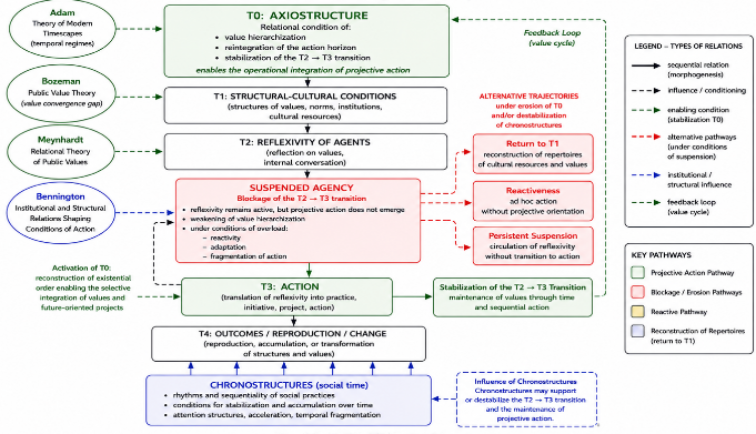
Figure 1. Analytical Model of Suspended Agency: T0 and Chronostructures in the Morphogenetic Approach.
Source: Author’s own elaboration based on
| [1] | Margaret S. Archer, Realist Social Theory: The Morphogenetic Approach, Cambridge: Cambridge University Press, 1995. |
| [9] | Barry Bozeman, Public Values and Public Interest: Counterbalancing Economic Individualism, Washington, DC: Georgetown University Press, 2007. |
| [12] | Roy Bhaskar, A Realist Theory of Science, London: Routledge, 2008. |
| [15] | Timo Meynhardt, “Public Value: Turning a Conceptual Framework into a Scorecard”, in: John M. Bryson, Barbara C. Crosby and Laura Bloomberg (eds.), Public Value and Public Administration, Washington, DC: Georgetown University Press, 2015. |
| [17] | Barbara Adam, Timescapes of Modernity: The Environment and Invisible Hazards, London: Routledge, 1998. |
[1, 9, 12, 15, 17].
The figure presents an extended morphogenetic model that includes two complementary conditions for the transition from reflexivity (T2) to projective action (T3): T0 as the condition of axiological integration in action, and chronostructures as the condition of temporal stabilization of social practices. The model also shows the possibility of suspended agency at the transition from T2 to T3 in situations where chronostructures erode or the operational integration of values is weakened. Solid arrows indicate the sequential relations of the morphogenetic model, while dashed lines indicate relations of conditioning, stabilization, and feedback.
Chronostructures do not directly create T0, but they may stabilize the conditions of its actualization. In educational practices, this is visible in the sequential organization of action: planning the process, preparing the conditions, consistently implementing educational activities, and evaluating their outcomes. This kind of rhythmization of practice does not itself constitute T0, but it may support the transition from internalized values to temporally ordered action
| [16] | Marek Wos, Aksjonormatywne wymiary wychowania do podmiotowosci spolecznej. Studium koncepcji wychowania Towarzystwa Salezjanskiego [Axionormative Dimensions of Education for Social Subjectivity: A Study of the Educational Concept of the Salesian Society], Warsaw, 2022,
https://orcid.org/10.21852/tnfs.2022.1 |
[16]
.
The digital environment provides an empirical context in which both forms of erosion occur simultaneously. Algorithms shorten the time of exposure to content and fragment the rhythm of social practices, while at the same time organizing the visibility of values according to platform logic rather than according to the actor’s own axiological hierarchy
| [5] | Jacek Pyzalski, Piotr Plichta and Lukasz Tomczyk, Polskie badanie EU Kids Online 2026. W stronę nowych wyzwan [Polish EU Kids Online 2026 Study: Towards New Challenges], Poznan: Wydawnictwo Naukowe UAM, 2026,
https://orcid.org/10.14746/amup.9788323245308 |
[5]
. This is precisely why the configuration of activity without accumulation becomes particularly visible in the digital practices of young people.
This mechanism is also supported by research on algorithmic management and the functioning of digital environments. Such research indicates that algorithmic systems not only organize the flow of information but also actively shape patterns of attention, rhythms of activity, and criteria for evaluating action. As a result, the actor may remain permanently active while simultaneously losing the capacity to sustain a long-term projective orientation. This phenomenon may be described as a shift from agency based on reflexive coordination of action toward reactivity steered by indicators, recommendations, and algorithmic logics of content selection. In this view, activity does not disappear; rather, it increasingly assumes a fragmented, situational, and weakly cumulative form over time
| [20] | Anna Rogozinska-Pawelczyk and Agnieszka Sitarska-Piwko, “Algorytmiczne zarzadzanie zasobami ludzkimi z perspektywy menedzerow i organizacji - przeglad literatury” [“Algorithmic Human Resource Management from the Perspective of Managers and Organizations: A Literature Review”], Zarzadzanie Zasobami Ludzkimi, 2025, no. 3-4. |
[20]
.
T0 and chronostructures remain complementary conditions for explaining projective action. The former refers to the possibility of axiological integration in action; the latter refers to the temporal conditions of its maintenance. Without their co-occurrence, reflexivity may remain active without being translated into relatively durable projective practices. Chronostructures do not determine individual action but modify its conditions of possibility. In a critical realist perspective, this means a tendential mode of causation that may be strengthened or neutralized by other social mechanisms.
5. Empirical Evidence as a Test: What the Data Support and What They Cannot Confirm
Empirical data cannot directly confirm the existence of T0 because this mechanism operates at the level of the real rather than the empirical. What empirical evidence can reveal, however, are the consequences of its weakening or ineffective actualization. If T0 and chronostructures functioned as stabilizing conditions of action within digital environments, one would expect intensive communicative activity to be more frequently transformed into relatively durable projective initiatives, such as content creation, civic engagement, or the organization of collective action. One would also expect a greater capacity to distinguish between values encountered situationally and values that have been internalized and integrated into the actor’s own hierarchy of concerns.
The findings of
EU Kids Online 2026 indicate a different configuration. Communicative and entertainment-oriented activities clearly predominate over practices requiring a greater degree of axiological stabilization and sustained commitment
| [6] | Agnieszka Ladna et al., Nastolatki. Raport z ogolnopolskiego badania uczniow i rodzicow [Adolescents: Report from a Nationwide Survey of Students and Parents], Warsaw: NASK - National Research Institute, 2025. |
[6]
. A substantial proportion of respondents also reported that exposure to harmful content resulted not from intentional searching but from accidental encounters
| [5] | Jacek Pyzalski, Piotr Plichta and Lukasz Tomczyk, Polskie badanie EU Kids Online 2026. W stronę nowych wyzwan [Polish EU Kids Online 2026 Study: Towards New Challenges], Poznan: Wydawnictwo Naukowe UAM, 2026,
https://orcid.org/10.14746/amup.9788323245308 |
[5]
. This suggests that the organization of content visibility remains largely dependent upon the logic of digital platforms rather than upon reflexively ordered choices made by actors themselves. A similar pattern emerges from reports published by
NASK, according to which the use of artificial intelligence tools is predominantly ad hoc and task-oriented, while comparatively less likely to take the form of a regular and consciously organized practice
| [6] | Agnieszka Ladna et al., Nastolatki. Raport z ogolnopolskiego badania uczniow i rodzicow [Adolescents: Report from a Nationwide Survey of Students and Parents], Warsaw: NASK - National Research Institute, 2025. |
[6]
.
It should be noted, however, that
EU Kids Online 2026 focuses on respondents aged 10-16, whereas the
Youth 4.0 project investigates a cohort aged 15-25. The comparison of these studies therefore does not constitute cumulative confirmation of the same hypothesis. Rather, it points to the recurrence of a similar problematic configuration across different biographical stages
| [6] | Agnieszka Ladna et al., Nastolatki. Raport z ogolnopolskiego badania uczniow i rodzicow [Adolescents: Report from a Nationwide Survey of Students and Parents], Warsaw: NASK - National Research Institute, 2025. |
[6]
.
Empirical research does not therefore test the definition of T0 or chronostructures directly. Instead, it examines the consequences of their erosion. This is precisely the logic of a retroductive use of evidence: empirical material does not prove the existence of a mechanism but allows an assessment of whether a proposed mechanism possesses explanatory power with regard to an observed social configuration. The T0 hypothesis would be weakened if empirical evidence consistently demonstrated that intensive digital activity regularly develops into stable forms of projective action without the need for additional mediating conditions. Since such a pattern is not observed, T0 remains a plausible response to the reconstructed explanatory gap
| [16] | Marek Wos, Aksjonormatywne wymiary wychowania do podmiotowosci spolecznej. Studium koncepcji wychowania Towarzystwa Salezjanskiego [Axionormative Dimensions of Education for Social Subjectivity: A Study of the Educational Concept of the Salesian Society], Warsaw, 2022,
https://orcid.org/10.21852/tnfs.2022.1 |
[16]
.
The significance of T0 is also evident in educational processes. Marek Wos argues that education organizes sequences of situations aimed at introducing, developing, and reinforcing dispositions while simultaneously making their meanings and purposes explicit
| [16] | Marek Wos, Aksjonormatywne wymiary wychowania do podmiotowosci spolecznej. Studium koncepcji wychowania Towarzystwa Salezjanskiego [Axionormative Dimensions of Education for Social Subjectivity: A Study of the Educational Concept of the Salesian Society], Warsaw, 2022,
https://orcid.org/10.21852/tnfs.2022.1 |
[16]
. This implies that individuals do not actualize T0 automatically but require social conditions that enable relatively durable connections between values and practical action.
Contemporary analyses of digital education likewise suggest that the development of technological competencies does not automatically increase the capacity to design and organize one’s own actions. Instead, they emphasize the need to maintain a balance between digital competencies and the development of critical thinking, cooperation, communication, and the reflexive ordering of experience
| [21] | Jolanta Blicharz and Renata Raszewska-Skalecka, Sztuczna inteligencja w edukacji. Wybrane aspekty teoretycznoprawne [Artificial Intelligence in Education: Selected Theoretical and Legal Aspects], Wroclaw, 2025,
https://doi.org/10.19195/978-83-68619-59-1 |
[21]
. Participation in technological environments alone therefore does not resolve the problem of the transition from reflexivity to action.
This conclusion receives partial support from the findings of the
Youth 4.0 project. Data from the cohort aged 15-25 indicate that aspirations related to self-realization, life goals, gaining the trust of others, and obtaining satisfying employment coexist with remarkably low levels of social engagement. As many as 80.6 percent of respondents declared no involvement in social activities
| [22] | Waldemar Urbanik, Portret wspolczesnej polskiej mlodziezy w swietle projektu Mlodziez 4.0 [Portrait of Contemporary Polish Youth in the Light of the Youth 4.0 Project], vol. II, Szczecin: Pedagogium Publishing House TWP Regional Branch in Szczecin, 2023 (see also the description of the nationwide sample (N = 24,303)). |
[22]
. This pattern suggests the existence of a gap between axionormative orientations and their durable operationalization in social practice.
These findings do not constitute direct proof of T0, but they are consistent with it and inconsistent with competing explanations that predict a closer fit between declared values and sustained action. This is the strongest form of support a retroductive argument can offer. T0 is interpreted here as a hypothetical mechanism that explains the conditions under which reflexivity may be translated into relatively stable forms of projective action
.
A limitation of the current stage of research is the absence of qualitative material capable of reconstructing the experience of being unable to translate reflexivity into action. Quantitative data make it possible to identify the problematic configuration, but they do not capture how actors themselves interpret difficulties associated with the hierarchization of values, the planning of action, and the maintenance of continuity over time. Future research should therefore include biographical analyses, narrative approaches, and qualitative reconstructions of the experiences of young people operating within algorithmic environments. Of particular importance would be the investigation of situations in which actors articulate specific values and goals while simultaneously describing difficulties in translating them into durable social practices.
Additional support for the proposed interpretation can be found in contemporary analyses of subjectivity that describe experiences of fragmented action, decision overload, and difficulties in maintaining biographical continuity. Such analyses suggest that the contemporary subject’s problem lies not merely in the loss of axiological orientations but also in the difficulty of integrating them durably into practical action. From the perspective advanced here, these configurations may be interpreted as manifestations of weakened conditions for the operational integration of reflexivity, temporality, and action
| [14] | Krzysztof Wielecki, „Podmiotowosc i sprawczosc - z perspektywy realizmu krytycznego” [“Subjectivity and Agency from the Perspective of Critical Realism”], Edukacja Humanistyczna, 2022, 2(47). |
| [19] | Hartmut Rosa, Resonance: A Sociology of Our Relationship to the World, Cambridge: Polity Press, 2018. |
[14, 19]
.
6. Conclusion
This article establishes that suspended agency - the coexistence of intensive digital activity with a persistent inability to convert it into durable, purposeful action - is best explained by the joint erosion of two previously unrecognized conditions: T0 (axiological integration) and chronostructures (temporal stabilization). Neither Archer's original morphogenetic model nor competing frameworks (ultimate concerns, norm circles, public-values theory) account for this configuration on their own. The argument has been developed retroductively. Rather than extending the ontology of the morphogenetic model, T0 is proposed as an explanatory condition that reconstructs the mechanism linking reflexivity with relatively durable projective action. While its organizing function is treated as universal, the substantive content of values remains historically, socially, and biographically variable. Chronostructures complement T0 by specifying the temporal conditions under which this mechanism may become stabilized.
The central contribution of the proposed framework lies in reconstructing a mechanism capable of explaining situations in which reflexivity remains active yet fails to develop into relatively stable projective action. T0 does not replace either culture or the category of ultimate concerns developed by Margaret Archer. Rather, it refers to a missing condition that integrates values, temporality, and action at the critical transition from T2 to T3
. Chronostructures and T0 should therefore be regarded as complementary explanatory mechanisms: the former concern the temporal conditions for the stabilization of social practices, whereas the latter concern the possibility of the axiological integration of action. Within the framework proposed here, the configuration of suspended agency becomes fully intelligible only when both conditions are simultaneously weakened or eroded
| [10] | Hartmut Rosa, Social Acceleration: A New Theory of Modernity, New York: Columbia University Press, 2013. |
| [16] | Marek Wos, Aksjonormatywne wymiary wychowania do podmiotowosci spolecznej. Studium koncepcji wychowania Towarzystwa Salezjanskiego [Axionormative Dimensions of Education for Social Subjectivity: A Study of the Educational Concept of the Salesian Society], Warsaw, 2022,
https://orcid.org/10.21852/tnfs.2022.1 |
| [17] | Barbara Adam, Timescapes of Modernity: The Environment and Invisible Hazards, London: Routledge, 1998. |
[10, 16, 17]
.
The findings of the
Youth 4.0 project reinforce this interpretation by revealing a configuration in which declared meaning-generating and projective orientations coexist with weak translation into sustained forms of social activity. Within the cohort aged 15-25, 80.6 percent of respondents reported no involvement in social activities, despite simultaneously expressing aspirations related to self-realization, goal attainment, trust, meaningful work, and social usefulness
| [22] | Waldemar Urbanik, Portret wspolczesnej polskiej mlodziezy w swietle projektu Mlodziez 4.0 [Portrait of Contemporary Polish Youth in the Light of the Youth 4.0 Project], vol. II, Szczecin: Pedagogium Publishing House TWP Regional Branch in Szczecin, 2023 (see also the description of the nationwide sample (N = 24,303)). |
[22]
. While these figures are drawn from a Polish cohort, the theoretical mechanism they illustrate — T0 as a condition of axiological-to-practical translation — is not presented as culturally bound; the Polish case functions here as an empirical entry point into a broader condition of late-modern digital agency, and cross-national replication is an open task for future research (see Section 4). These findings do not demonstrate the existence of T0 directly. Rather, they point to an empirical gap that the proposed mechanism seeks to explain: the presence of values and aspirations is insufficient for their durable operationalization in social practice. The
Youth 4.0 project therefore does not confirm T0 in a direct sense but provides empirical traces of a problem that requires retroductive explanation, namely why values, aspirations, and declared projectivity do not consistently develop into stable forms of agency
| [22] | Waldemar Urbanik, Portret wspolczesnej polskiej mlodziezy w swietle projektu Mlodziez 4.0 [Portrait of Contemporary Polish Youth in the Light of the Youth 4.0 Project], vol. II, Szczecin: Pedagogium Publishing House TWP Regional Branch in Szczecin, 2023 (see also the description of the nationwide sample (N = 24,303)). |
[22]
.
In this perspective, what becomes suspended is not T0 itself but the transition from reflexivity to action. T0 may remain weakly formed, subject to erosion, or insufficiently actualized where relational and institutional conditions necessary for the stabilization of axiological orientations are absent. Marek Wos demonstrates that educational processes involve confronting the value system of the learner with values proposed by the social environment and reinforcing them through practical action
| [16] | Marek Wos, Aksjonormatywne wymiary wychowania do podmiotowosci spolecznej. Studium koncepcji wychowania Towarzystwa Salezjanskiego [Axionormative Dimensions of Education for Social Subjectivity: A Study of the Educational Concept of the Salesian Society], Warsaw, 2022,
https://orcid.org/10.21852/tnfs.2022.1 |
[16]
. The problem therefore concerns not the disappearance of values as such but the weakening of the possibility of their operational integration within social practice.
Future research should focus on identifying the institutional and relational conditions that contribute to the formation, strengthening, or erosion of T0. This question remains empirically open and susceptible to further investigation. If T0 does indeed constitute a plausible explanatory mechanism, it should be possible to identify social configurations that facilitate or inhibit its actualization. Particularly important in this regard are qualitative studies capable of reconstructing experiences associated with difficulties in moving from reflexivity to projective action.
In critical realist terminology, T0 may be conceptualized as a relational generative mechanism possessing causal powers that operate tendentially and depend upon specific social configurations
| [12] | Roy Bhaskar, A Realist Theory of Science, London: Routledge, 2008. |
[12]
. It is not a substantive property of the individual actor but an emergent condition of action integration that becomes actualized through the relationship between actors, their environments, and the institutional organization of social practices. The introduction of T0 thus makes it possible to identify a condition without which projective action in complex social and digital environments remains insufficiently explained
| [10] | Hartmut Rosa, Social Acceleration: A New Theory of Modernity, New York: Columbia University Press, 2013. |
| [17] | Barbara Adam, Timescapes of Modernity: The Environment and Invisible Hazards, London: Routledge, 1998. |
[10, 17]
.
Abbreviations
T0-T4 | Stages of Archer's Morphogenetic Sequence (t0 as proposed in this article) |
NASK | National Research Institute (Poland) |
EU | European Union |
Author Contributions
Marek Wos: Conceptualization, Formal Analysis, Investigation, Methodology, Visualization, Writing – original draft, Writing – review & editing
Conflicts of Interest
The author declares no conflict of interest.
References
| [1] |
Margaret S. Archer, Realist Social Theory: The Morphogenetic Approach, Cambridge: Cambridge University Press, 1995.
|
| [2] |
Margaret S. Archer, Structure, Agency and the Internal Conversation, Cambridge: Cambridge University Press, 2003.
|
| [3] |
Margaret S. Archer, The Reflexive Imperative in Late Modernity, Cambridge: Cambridge University Press, 2012.
|
| [4] |
Margaret S. Archer, Morphogenesis and Human Flourishing, Cham: Springer, 2019,
https://orcid.org/10.1007/978-3-319-49469-2
|
| [5] |
Jacek Pyzalski, Piotr Plichta and Lukasz Tomczyk, Polskie badanie EU Kids Online 2026. W stronę nowych wyzwan [Polish EU Kids Online 2026 Study: Towards New Challenges], Poznan: Wydawnictwo Naukowe UAM, 2026,
https://orcid.org/10.14746/amup.9788323245308
|
| [6] |
Agnieszka Ladna et al., Nastolatki. Raport z ogolnopolskiego badania uczniow i rodzicow [Adolescents: Report from a Nationwide Survey of Students and Parents], Warsaw: NASK - National Research Institute, 2025.
|
| [7] |
Nicos Mouzelis, Sociological Theory: What Went Wrong? Diagnosis and Remedies, London: Routledge, 1995.
|
| [8] |
Rob Stones, Structuration Theory, London: Palgrave Macmillan, 2005,
https://orcid.org/10.1007/978-0-230-21364-7
|
| [9] |
Barry Bozeman, Public Values and Public Interest: Counterbalancing Economic Individualism, Washington, DC: Georgetown University Press, 2007.
|
| [10] |
Hartmut Rosa, Social Acceleration: A New Theory of Modernity, New York: Columbia University Press, 2013.
|
| [11] |
Dave Elder-Vass, The Causal Power of Social Structures: Emergence, Structure and Agency, Cambridge: Cambridge University Press, 2010.
|
| [12] |
Roy Bhaskar, A Realist Theory of Science, London: Routledge, 2008.
|
| [13] |
Roy Bhaskar, Dialectic: The Pulse of Freedom, London: Verso, 1993.
|
| [14] |
Krzysztof Wielecki, „Podmiotowosc i sprawczosc - z perspektywy realizmu krytycznego” [“Subjectivity and Agency from the Perspective of Critical Realism”], Edukacja Humanistyczna, 2022, 2(47).
|
| [15] |
Timo Meynhardt, “Public Value: Turning a Conceptual Framework into a Scorecard”, in: John M. Bryson, Barbara C. Crosby and Laura Bloomberg (eds.), Public Value and Public Administration, Washington, DC: Georgetown University Press, 2015.
|
| [16] |
Marek Wos, Aksjonormatywne wymiary wychowania do podmiotowosci spolecznej. Studium koncepcji wychowania Towarzystwa Salezjanskiego [Axionormative Dimensions of Education for Social Subjectivity: A Study of the Educational Concept of the Salesian Society], Warsaw, 2022,
https://orcid.org/10.21852/tnfs.2022.1
|
| [17] |
Barbara Adam, Timescapes of Modernity: The Environment and Invisible Hazards, London: Routledge, 1998.
|
| [18] |
Henri Lefebvre, Rhythmanalysis: Space, Time and Everyday Life, London: Continuum, 2004.
|
| [19] |
Hartmut Rosa, Resonance: A Sociology of Our Relationship to the World, Cambridge: Polity Press, 2018.
|
| [20] |
Anna Rogozinska-Pawelczyk and Agnieszka Sitarska-Piwko, “Algorytmiczne zarzadzanie zasobami ludzkimi z perspektywy menedzerow i organizacji - przeglad literatury” [“Algorithmic Human Resource Management from the Perspective of Managers and Organizations: A Literature Review”], Zarzadzanie Zasobami Ludzkimi, 2025, no. 3-4.
|
| [21] |
Jolanta Blicharz and Renata Raszewska-Skalecka, Sztuczna inteligencja w edukacji. Wybrane aspekty teoretycznoprawne [Artificial Intelligence in Education: Selected Theoretical and Legal Aspects], Wroclaw, 2025,
https://doi.org/10.19195/978-83-68619-59-1
|
| [22] |
Waldemar Urbanik, Portret wspolczesnej polskiej mlodziezy w swietle projektu Mlodziez 4.0 [Portrait of Contemporary Polish Youth in the Light of the Youth 4.0 Project], vol. II, Szczecin: Pedagogium Publishing House TWP Regional Branch in Szczecin, 2023 (see also the description of the nationwide sample (N = 24,303)).
|
Cite This Article
-
APA Style
Wos, M. (2026). Conditions for the Transition from Reflexivity to Projective Action in the Morphogenetic Approach: T0, Chronostructures, and the Problem of Suspended Agency. International Journal of Science, Technology and Society, 14(4), 140-148. https://doi.org/10.11648/j.ijsts.20261404.12
 Copy
|
Copy
|
 Download
ACS Style
Wos, M. Conditions for the Transition from Reflexivity to Projective Action in the Morphogenetic Approach: T0, Chronostructures, and the Problem of Suspended Agency. Int. J. Sci. Technol. Soc. 2026, 14(4), 140-148. doi: 10.11648/j.ijsts.20261404.12
Copy
|
Download
AMA Style
Wos M. Conditions for the Transition from Reflexivity to Projective Action in the Morphogenetic Approach: T0, Chronostructures, and the Problem of Suspended Agency. Int J Sci Technol Soc. 2026;14(4):140-148. doi: 10.11648/j.ijsts.20261404.12
Copy
|
Download
-
@article{10.11648/j.ijsts.20261404.12,
  author = {Marek Wos},
  title = {Conditions for the Transition from Reflexivity to Projective Action in the Morphogenetic Approach: T0, Chronostructures, and the Problem of Suspended Agency},
  journal = {International Journal of Science, Technology and Society},
  volume = {14},
  number = {4},
  pages = {140-148},
  doi = {10.11648/j.ijsts.20261404.12},
  url = {https://doi.org/10.11648/j.ijsts.20261404.12},
  eprint = {https://article.sciencepublishinggroup.com/pdf/10.11648.j.ijsts.20261404.12},
  abstract = {This article addresses the problem of the transition from reflexivity (T2) to projective action (T3) within Margaret Archer’s morphogenetic approach. The argument is developed through a retroductive mode of explanation. Empirical evidence concerning young people’s digital activity points to a configuration of suspended agency that cannot be explained with sufficient precision by the classical morphogenetic model alone. As a possible solution, the article proposes the concept of T0, understood as a relational generative mechanism enabling the operational integration and stabilization of axiological orientations in action. T0 does not constitute an additional level within the morphogenetic sequence. Rather, it functions as an explanatory condition that accounts for the transition from reflexivity to relatively stable forms of projective action. The article further develops the concept of chronostructures, understood as temporal conditions that stabilize social practices, and demonstrates their complementarity with T0. While T0 concerns the axiological integration of action, chronostructures provide the temporal conditions necessary for the continuity and sustainability of purposeful agency. The empirical illustration of the problem draws on data from EU Kids Online 2026, reports published by NASK, and findings from the Youth 4.0 project. The analysis demonstrates that suspended agency can be more adequately explained as the outcome of the simultaneous weakening of two complementary conditions: T0, responsible for the axiological integration of action, and chronostructures, responsible for its temporal stabilization. The principal theoretical contribution of the article consists in reconstructing T0 as a retroductively inferred explanatory mechanism complementing Archer's morphogenetic model rather than extending its ontology. The proposed model provides a more adequate explanation why reflexivity and declared values do not necessarily develop into sustained forms of projective action, despite continued access to cultural resources.},
 year = {2026}
}
Copy
|
Download
-
TY  - JOUR
T1  - Conditions for the Transition from Reflexivity to Projective Action in the Morphogenetic Approach: T0, Chronostructures, and the Problem of Suspended Agency
AU  - Marek Wos
Y1  - 2026/07/28
PY  - 2026
N1  - https://doi.org/10.11648/j.ijsts.20261404.12
DO  - 10.11648/j.ijsts.20261404.12
T2  - International Journal of Science, Technology and Society
JF  - International Journal of Science, Technology and Society
JO  - International Journal of Science, Technology and Society
SP  - 140
EP  - 148
PB  - Science Publishing Group
SN  - 2330-7420
UR  - https://doi.org/10.11648/j.ijsts.20261404.12
AB  - This article addresses the problem of the transition from reflexivity (T2) to projective action (T3) within Margaret Archer’s morphogenetic approach. The argument is developed through a retroductive mode of explanation. Empirical evidence concerning young people’s digital activity points to a configuration of suspended agency that cannot be explained with sufficient precision by the classical morphogenetic model alone. As a possible solution, the article proposes the concept of T0, understood as a relational generative mechanism enabling the operational integration and stabilization of axiological orientations in action. T0 does not constitute an additional level within the morphogenetic sequence. Rather, it functions as an explanatory condition that accounts for the transition from reflexivity to relatively stable forms of projective action. The article further develops the concept of chronostructures, understood as temporal conditions that stabilize social practices, and demonstrates their complementarity with T0. While T0 concerns the axiological integration of action, chronostructures provide the temporal conditions necessary for the continuity and sustainability of purposeful agency. The empirical illustration of the problem draws on data from EU Kids Online 2026, reports published by NASK, and findings from the Youth 4.0 project. The analysis demonstrates that suspended agency can be more adequately explained as the outcome of the simultaneous weakening of two complementary conditions: T0, responsible for the axiological integration of action, and chronostructures, responsible for its temporal stabilization. The principal theoretical contribution of the article consists in reconstructing T0 as a retroductively inferred explanatory mechanism complementing Archer's morphogenetic model rather than extending its ontology. The proposed model provides a more adequate explanation why reflexivity and declared values do not necessarily develop into sustained forms of projective action, despite continued access to cultural resources.
VL  - 14
IS  - 4
ER  -
Copy
|
Download





 Share This Article
 Twitter
 Linked In
 Facebook