
 ,
Ibrahima Bah,
Soriba Bangoura,
Amadou Yaya Diallo,
Fatoumata Kaba,
Fara Andre Sandouno,
Alseny Mariame Camara,
Mamadou Malal Diallo,
Kadiatou Mamadou Bobo Barry,
Aly Traore,
Mohamed Lamine Tegui Camara,
Damaris Yawa Leno,
M'ballou Fatoumata Bangoura,
Alpha Oumar Bah
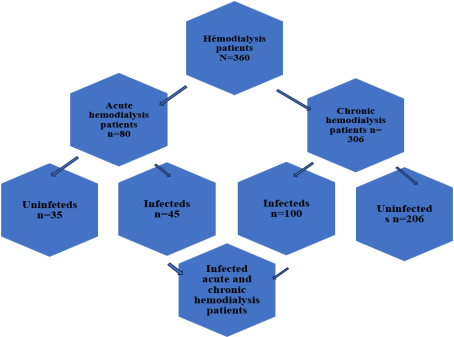
Introduction: Infections are the leading causes of morbidity and mortality among hemodialysis patients, and low socioeconomic status makes their management extremely complex. The objective of this study was to determine the frequency of the identified causes of infection and to report the role of each laboratory test in the diagnosis of infections. Patients and Methods: Our descriptive, prospective study was conducted from February 1 to July 31, 2025. Included were all hemodialysis patients, regardless of the type of extracorporeal renal replacement therapy, in whom the diagnosis of infection was established based on clinical evidence (functional, general, and physical signs) and/or paraclinical evidence (biological, radiological, and morphological findings), regardless of the vascular access or site of infection. Our variables were both quantitative and qualitative and were categorized into epidemiological, clinical, and paraclinical data to determine the etiology and identify the causative microorganism. Results: Of the 386 patients, 145 (37.6%) were diagnosed with an infectious syndrome. The most common general symptoms were fever (94%) and chills (29%). Blood cultures were ordered for 98 patients; 54% underwent the test, and 39.6% of those tested positive. Stool culture (98 requests, 47.9% performed, and 36.2% positive); cytology (67 requests, 95.5% performed, and 20.3% positive); catheter tip culture (36 requests, 91.7% performed, and 66.7% positive); chest X-ray (60 requests, 80% performed, and 77.1% positive). Conclusion: Infections affect more than one-third of hemodialysis patients, particularly those on temporary dialysis, where infections are both a cause and a serious complication.
| Published in | International Journal of Infectious Diseases and Therapy (Volume 11, Issue 4) |
| DOI | 10.11648/j.ijidt.20261104.11 |
| Page(s) | 52-60 |
| Creative Commons |
This is an Open Access article, distributed under the terms of the Creative Commons Attribution 4.0 International License (http://creativecommons.org/licenses/by/4.0/), which permits unrestricted use, distribution and reproduction in any medium or format, provided the original work is properly cited. |
| Copyright |
Copyright © The Author(s), 2026. Published by Science Publishing Group |
Infections, Clinical Presentation, Etiologies, Paraclinical Findings, Hemodialysis Patients, Donka
Variables | Sample Size (N=145) | Percentage |
|---|---|---|
Gender | ||
Male | 81 | 56 |
Female | 64 | 44 |
Sex-ratio = 1,26 | ||
Age (years) | ||
<29 | 20 | 14 |
30 – 44 | 46 | 32 |
45 – 54 | 29 | 20 |
55 – 64 | 32 | 22 |
65 – 74 | 12 | 08 |
≥75 | 06 | 04 |
Average age 46,65 ± 15,33 years extremes 14 et 80 ans | ||
Level of Education | ||
No formal education | 83 | 57.6 |
Elementary school | 13 | 9.1 |
High school | 18 | 12.1 |
College/University | 31 | 21.2 |
Place of Origin | ||
Rural | 19 | 13 |
Urban | 126 | 87 |
Socioeconomic Status | ||
Medium | 28 | 19.3 |
Low | 30 | 20.7 |
Very low | 87 | 60 |
Variables | Sample Size (N=145) | Percentage |
|---|---|---|
Functional Symptoms | ||
Low back pain | 135 | 93 |
Shortness of breath | 130 | 90 |
Itching | 125 | 86 |
Headache | 123 | 85 |
Abdominal pain | 110 | 76 |
Vomiting | 104 | 72 |
Cough | 103 | 71 |
Anuria | 97 | 67 |
Burning sensation during urination | 97 | 67 |
Itching | 84 | 58 |
Chest pain | 77 | 53 |
Vaginal discharge | 52 | 36 |
Heart palpitations | 46 | 32 |
Coughing up phlegm | 45 | 31 |
Diarrhea | 38 | 26 |
Frequent urination | 42 | 29 |
General symptoms | ||
Fever | 136 | 94 |
Chills | 42 | 29 |
Weakness | 136 | 96 |
Loss of appetite | 130 | 90 |
Weight loss | 81 | 56 |
Vascular Access | ||
Arteriovenous Fistula | 15 | 10 |
Tunneled Catheter | 43 | 30 |
Simple Femoral Catheter | 51 | 35 |
Simple Jugular Catheter | 36 | 25 |
Entry point for the source of infection | Sample Size (N=145) | Percentage |
|---|---|---|
Vascular | 36 | 24.8 |
Gastrointestinal | 98 | 67.6 |
Thoracic and Pulmonary | 46 | 31.7 |
Cardiac | 8 | 5.5 |
Cerebral | 1 | 0.07 |
Urogenital | 13 | 9 |
Otolaryngological | 32 | 22.1 |
Oral and Dental | 4 | 2.7 |
Blood | 22 | 15.1 |
Skin | 3 | 2.1 |
Etiology | Acute dialysis | Recurrent dialysis | ||
|---|---|---|---|---|
Type of dialysis | Sample Size N=45 | Percentage | Sample Size N=100 | Percentage |
Gastroenteritis | 21 | 46.7 | 77 | 77 |
Endocarditis | - | - | 8 | 8 |
Pleurisy | - | 25 | 25 | |
Pneumonia | 11 | 24.4 | 29 | 29 |
Tunnelitis | - | - | 5 | 5 |
Thrombophlebitis | - | - | 7 | 7 |
Other catheter-related infections | - | - | 24 | 24 |
Meningitis | 1 | 2.2 | - | - |
Sinusitis | - | - | 27 | 27 |
Nasopharyngitis | - | - | 11 | 11 |
Urinary tract infection | 13 | 28.9 | - | - |
Post-injection abscess | - | - | 7 | 7 |
Dental abscess | - | - | 2 | 2 |
Malaria | 10 | 22.2 | 3 | 3 |
Tests Requested | Performed | Diagnostic Value |
|---|---|---|
Blood culture (n=98) | 53 (54.1%) | 21 (39.6%) |
Urine cytology (n=67) | 64 (95.5%) | 13 (20.3%) |
Stool culture (n=98) | 47 (47.9%) | 17 (36.2%) |
Catheter tip culture (n=36) | 33 (91.7%) | 22 (66.7%) |
CSF analysis (n=1) | 1 (100%) | 1 (100%) |
Sputum (n=52) | 52 (100%) | 0 |
Gastric intubation (n=13) | 13 (100%) | 0 |
Biological fluid analysis (n=102) | 102 (100%) | 63 (61.8%) |
Thick smear (n=145) | 145 (100%) | 13 (9%) |
Chest X-ray (n=60) | 48 (80%) | 37 (77.1%) |
Cardiac ultrasound (n=52) | 36 (69.2%) | 8 (22.2%) |
Abdominal ultrasound (n=95) | 95 (100%) | 11 (11.6%) |
Isolated microbial pathogens | Acute dialysis (n=45) | Recurrent dialysis (n=100) | ||
|---|---|---|---|---|
Type of dialysis | Sample Size | Percentage | Sample Size | Percentage |
Klebsiella pneumonia | - | - | 25 | 25 |
Streptococcus dore | 16 | 35.5 | 7 | 7 |
Burkholderia cepaci | - | - | 2 | 2 |
Proteus mirabilis | - | - | 3 | 3 |
Staphylococcus aureus | 13 | 28.9 | 19 | 19 |
Enterococcus faecalis | - | - | 11 | 11 |
Plasmodium falciparum | 10 | 22.2 | 3 | 3 |
Escherichia coli | 6 | 13.3 | 63 | 63 |
Number of antibiotics | Number | percentage |
|---|---|---|
Monotherapy | 15 | 10.3 |
Combination therapy | 130 | 89.7 |
Prescribed antibiotics | ||
Céphalosporine 3G | 145 | 100 |
Amoxicilline +Acide clavulanique | 55 | 37.9 |
Erythromycine 500 mg | 23 | 15.9 |
Rovamycine 3M | 16 | 11 |
Ciprofloxacine 500 mg | 98 | 67.6 |
Gentamycine 80 mg | 11 | 7.6 |
Imipénème 0,5/1g | 42 | 29 |
Metronidazole perfusable 500 mg | 98 | 67.6 |
Vancomycine 500 mg | 10 | 6.9 |
Ofloxacine 200 mg | 33 | 22.7 |
Tazobactam+Piperaciline 1/125 mg | 11 | 7.6 |
Artésunate 60 mg injectable | 13 | 9 |
Clinical Course | ||
Favorable | 133 | 91.7 |
Death | 12 | 8.3 |
AVF | Arteriovenous Fistula |
CVC | Central Venous Catheter |
HIV | Human Immunodeficiency Virus |
HD | Hemodialysis |
CSF | Cerebrospinal Fluid |
ENT | Otolaryngology |
| [1] | Almeida BM, Moreno DH, Vasconcelos V, Cacione DG. Interventions for treating catheter‐related bloodstream infections in people receiving maintenance haemodialysis. Cochrane Database Syst Rev. 1 april 2022; 2022(4): CD013554. |
| [2] |
TRAORE O, SOUWEINE B. Expert Review: Dialysis Catheter-Related Infections in the ICU. 2008 Update from the 12th Consensus Conference on Critical Care and Emergency Medicine (Paris, 2004); available at
https://www.srlf.org/reactualisation-12-conf/bsouweineinfkt.htm |
| [3] | El Marnissi S, Khomsi Z, Kassy Raymond Sylvestre A, El Harti J, Taoufik J, Chaibi A, et al. Analysis of infection risk around the patient in the hemodialysis unit at Ibn Sina Hospital in Rabat using the Failure Mode, Effects, and Criticality Analysis (FMECA) method. Nephrology & Therapeutics. March 1, 2020; 16(2): 105–17. |
| [4] | Fisher M, Golestaneh L, Allon M, Abreo K, Mokrzycki MH. Prevention of Bloodstream Infections in Patients Undergoing Hemodialysis. Clin J Am Soc Nephrol. 7 jan 2020; 15(1): 132-51. |
| [5] | Schwanke AA, Danski MTR, Pontes L, Kusma SZ, Lind J. Central venous catheter for hemodialysis: incidence of infection and risk factors. Rev Bras Enferm. May 2018; 71(3). |
| [6] | Liaño, F. Pascual, J. Gámez, C. Gallego, A. Bajo, M. A. Sicilia, L. S. and al. Acute Renal Failure Study Group. Epidemiology of acute renal failure: a prospective, multicenter, community-based study. Kidney international, 1996, vol. 50, no 3, p. 811-818. |
| [7] | LADEGAILLERIE G, GUESNIER M, BAUDIN F, COUREUL H, FIGARD J, GARNIER S and al. The Short Peripheral Venous Catheter. Paris Public Hospital System, 2006; 23 p. 1115 21. |
| [8] | Golestaneh L, Mokrzycki MH. Prevention of hemodialysis catheter infections Ointments, dressings, locks, and catheter hub devices. Hemodialysis International. 2018; 22(S2): S75-82. |
| [9] | Krzanowski M, Janda K, Chowaniec E, Sułowicz W. Hemodialysis vascular access infection and mortality in maintenance hemodialysis patients. Przegl Lek. 2011; 68(12): 1157-61. |
| [10] | Diouf M. L, Diouf B, Niang A and al. Prevalence of Hepatitis B and C Viruses Among Patients on Chronic Hemodialysis in Dakar. Dakar Med, 2000, 45; 1, 1-4. |
| [11] | Ka EF, Diouf B, Mbengue M, Diouf ML, Boye CS, Moreira-Diop T. Nasal carriage of Staphylococcus aureus atahemodialysis unit in Dakar. Dakar Med, 2001; 46(2): 133-137. |
| [12] | Fouda H, Ashuntantang G, Kaze F, Halle MP. Survival in Chronic Hemodialysis in Cameroon. The Pan African Medical Journal [Internet]. 2017 [Cited June 10, 2023]; 26. Available from: |
| [13] | Ahoui S, Vigan J, Adoukonou T. A., Dovonou C. A., Boukary Y., Alassani A. Prevalence and factors associated with kidney damage in patients with type II diabetes followed at the diabetes unit of CHUD/Borgou in 2014. Ann Univers Parakou Health Sciences. 2016; 2: 17-9. |
| [14] | Victoria Birlutiu 1, 2, and Rares-Mircea Birlutiu 3, 4,*: Characteristics of Infections in Hemodialysis Patients: Results from a Single-Center 29-Month Observational Cohort Stud from Romania. Microorganisms 2026, 14, 230: 1-19. |
| [15] | Jean G, Vanel T, Bresson E, Terrat JC, and al. An effective strategy to reduce the use and complications of tunneled central venous catheters in hemodialysis. Nephrol Ther 2013; 5: 280-286. In Senegal. |
| [16] | Ait Taleb A. Infectious complications in patients on chronic hemodialysis. Medical Thesis; Casablanca, 2003; No. 362. |
| [17] | Dieng T, Ndir O, Diallo S, Coll-Seck AM, Dieng Y. Prevalence of Cryptosporidium sp and Isospora belli in patients with acquired immunodeficiency syndrome (AIDS) in Dakar Senegal. Dakar Med. 1994; 39(2): 1214. |
| [18] | Masson E. «Cryptosporidiose et VIH en milieu tropical» Disponible sur: |
| [19] | Coccidiose: Diagnosis, Treatment, and Prevention. Available on: |
| [20] | Xiao L, Fayer R, Ryan U, Upton SJ. Cryptosporidium taxonomy: recent advances and implications for public health. Clin Microbiol Rev. jan 2004; 17(1): 72-97. |
APA Style
Diakite, F., Bah, I., Bangoura, S., Diallo, A. Y., Kaba, F., et al. (2026). Clinical and Etiological Characteristics and the Diagnostic Value of Laboratory Tests in Hemodialysis Patients with Infections at the Donka National Hemodialysis Center. International Journal of Infectious Diseases and Therapy, 11(4), 52-60. https://doi.org/10.11648/j.ijidt.20261104.11
ACS Style
Diakite, F.; Bah, I.; Bangoura, S.; Diallo, A. Y.; Kaba, F., et al. Clinical and Etiological Characteristics and the Diagnostic Value of Laboratory Tests in Hemodialysis Patients with Infections at the Donka National Hemodialysis Center. Int. J. Infect. Dis. Ther. 2026, 11(4), 52-60. doi: 10.11648/j.ijidt.20261104.11
AMA Style
Diakite F, Bah I, Bangoura S, Diallo AY, Kaba F, et al. Clinical and Etiological Characteristics and the Diagnostic Value of Laboratory Tests in Hemodialysis Patients with Infections at the Donka National Hemodialysis Center. Int J Infect Dis Ther. 2026;11(4):52-60. doi: 10.11648/j.ijidt.20261104.11
@article{10.11648/j.ijidt.20261104.11,
  author = {Fousseny Diakite and Ibrahima Bah and Soriba Bangoura and Amadou Yaya Diallo and Fatoumata Kaba and Fara Andre Sandouno and Alseny Mariame Camara and Mamadou Malal Diallo and Kadiatou Mamadou Bobo Barry and Aly Traore and Mohamed Lamine Tegui Camara and Damaris Yawa Leno and M'ballou Fatoumata Bangoura and Alpha Oumar Bah},
  title = {Clinical and Etiological Characteristics and the Diagnostic Value of Laboratory Tests in Hemodialysis Patients with Infections at the Donka National Hemodialysis Center},
  journal = {International Journal of Infectious Diseases and Therapy},
  volume = {11},
  number = {4},
  pages = {52-60},
  doi = {10.11648/j.ijidt.20261104.11},
  url = {https://doi.org/10.11648/j.ijidt.20261104.11},
  eprint = {https://article.sciencepublishinggroup.com/pdf/10.11648.j.ijidt.20261104.11},
  abstract = {Introduction: Infections are the leading causes of morbidity and mortality among hemodialysis patients, and low socioeconomic status makes their management extremely complex. The objective of this study was to determine the frequency of the identified causes of infection and to report the role of each laboratory test in the diagnosis of infections. Patients and Methods: Our descriptive, prospective study was conducted from February 1 to July 31, 2025. Included were all hemodialysis patients, regardless of the type of extracorporeal renal replacement therapy, in whom the diagnosis of infection was established based on clinical evidence (functional, general, and physical signs) and/or paraclinical evidence (biological, radiological, and morphological findings), regardless of the vascular access or site of infection. Our variables were both quantitative and qualitative and were categorized into epidemiological, clinical, and paraclinical data to determine the etiology and identify the causative microorganism. Results: Of the 386 patients, 145 (37.6%) were diagnosed with an infectious syndrome. The most common general symptoms were fever (94%) and chills (29%). Blood cultures were ordered for 98 patients; 54% underwent the test, and 39.6% of those tested positive. Stool culture (98 requests, 47.9% performed, and 36.2% positive); cytology (67 requests, 95.5% performed, and 20.3% positive); catheter tip culture (36 requests, 91.7% performed, and 66.7% positive); chest X-ray (60 requests, 80% performed, and 77.1% positive). Conclusion: Infections affect more than one-third of hemodialysis patients, particularly those on temporary dialysis, where infections are both a cause and a serious complication.},
 year = {2026}
}
TY  - JOUR
T1  - Clinical and Etiological Characteristics and the Diagnostic Value of Laboratory Tests in Hemodialysis Patients with Infections at the Donka National Hemodialysis Center
AU  - Fousseny Diakite
AU  - Ibrahima Bah
AU  - Soriba Bangoura
AU  - Amadou Yaya Diallo
AU  - Fatoumata Kaba
AU  - Fara Andre Sandouno
AU  - Alseny Mariame Camara
AU  - Mamadou Malal Diallo
AU  - Kadiatou Mamadou Bobo Barry
AU  - Aly Traore
AU  - Mohamed Lamine Tegui Camara
AU  - Damaris Yawa Leno
AU  - M'ballou Fatoumata Bangoura
AU  - Alpha Oumar Bah
Y1  - 2026/10/31
PY  - 2026
N1  - https://doi.org/10.11648/j.ijidt.20261104.11
DO  - 10.11648/j.ijidt.20261104.11
T2  - International Journal of Infectious Diseases and Therapy
JF  - International Journal of Infectious Diseases and Therapy
JO  - International Journal of Infectious Diseases and Therapy
SP  - 52
EP  - 60
PB  - Science Publishing Group
SN  - 2578-966X
UR  - https://doi.org/10.11648/j.ijidt.20261104.11
AB  - Introduction: Infections are the leading causes of morbidity and mortality among hemodialysis patients, and low socioeconomic status makes their management extremely complex. The objective of this study was to determine the frequency of the identified causes of infection and to report the role of each laboratory test in the diagnosis of infections. Patients and Methods: Our descriptive, prospective study was conducted from February 1 to July 31, 2025. Included were all hemodialysis patients, regardless of the type of extracorporeal renal replacement therapy, in whom the diagnosis of infection was established based on clinical evidence (functional, general, and physical signs) and/or paraclinical evidence (biological, radiological, and morphological findings), regardless of the vascular access or site of infection. Our variables were both quantitative and qualitative and were categorized into epidemiological, clinical, and paraclinical data to determine the etiology and identify the causative microorganism. Results: Of the 386 patients, 145 (37.6%) were diagnosed with an infectious syndrome. The most common general symptoms were fever (94%) and chills (29%). Blood cultures were ordered for 98 patients; 54% underwent the test, and 39.6% of those tested positive. Stool culture (98 requests, 47.9% performed, and 36.2% positive); cytology (67 requests, 95.5% performed, and 20.3% positive); catheter tip culture (36 requests, 91.7% performed, and 66.7% positive); chest X-ray (60 requests, 80% performed, and 77.1% positive). Conclusion: Infections affect more than one-third of hemodialysis patients, particularly those on temporary dialysis, where infections are both a cause and a serious complication.
VL  - 11
IS  - 4
ER  -
Faculty of Health Sciences and Technology, Gamal Abdel Nasser University of Conakry, Conakry, Guinea; Nephrology and Hemodialysis Department, Donka University Hospital, Conakry, Guinea
Faculty of Health Sciences and Technology, Gamal Abdel Nasser University of Conakry, Conakry, Guinea; Department of Infectious and Tropical Diseases, Donka University Hospital, Conakry, Guinea
Faculty of Health Sciences and Technology, Gamal Abdel Nasser University of Conakry, Conakry, Guinea; Nephrology and Hemodialysis Department, Donka University Hospital, Conakry, Guinea
Faculty of Health Sciences and Technology, Gamal Abdel Nasser University of Conakry, Conakry, Guinea; Nephrology and Hemodialysis Department, Donka University Hospital, Conakry, Guinea
Nephrology and Hemodialysis Department, Donka University Hospital, Conakry, Guinea
Nephrology and Hemodialysis Department, Donka University Hospital, Conakry, Guinea
Nephrology and Hemodialysis Department, Donka University Hospital, Conakry, Guinea
Nephrology and Hemodialysis Department, Donka University Hospital, Conakry, Guinea
Faculty of Health Sciences and Technology, Gamal Abdel Nasser University of Conakry, Conakry, Guinea; Nephrology and Hemodialysis Department, Donka University Hospital, Conakry, Guinea
Faculty of Health Sciences and Technology, Gamal Abdel Nasser University of Conakry, Conakry, Guinea; Nephrology and Hemodialysis Department, Donka University Hospital, Conakry, Guinea
Faculty of Health Sciences and Technology, Gamal Abdel Nasser University of Conakry, Conakry, Guinea; Nephrology and Hemodialysis Department, Donka University Hospital, Conakry, Guinea
Nephrology and Hemodialysis Department, Donka University Hospital, Conakry, Guinea
Nephrology and Hemodialysis Department, Donka University Hospital, Conakry, Guinea
Faculty of Health Sciences and Technology, Gamal Abdel Nasser University of Conakry, Conakry, Guinea; Nephrology and Hemodialysis Department, Donka University Hospital, Conakry, Guinea

Information


 Share This Article
 Twitter
 Linked In
 Facebook

 Copy
 Download