
In textile spinning and weaving shops, air temperature and relative humidity are process parameters. In a hot dry climate, adiabatic humidification of outdoor air in a spray chamber is energetically attractive, but its capability is limited by the outdoor air state. This study quantifies the limits of maintaining the indoor state of a textile shop adiabatically in the climate of Bukhara (Uzbekistan) and the air, water and electricity required. The heat and moisture balances were written jointly in enthalpy form, expressing the outdoor air fraction, the humidification load and the applicability condition of the adiabatic method through the indoor–outdoor enthalpy difference. Monthly Bukhara weather station data for 2021–2025 and a diurnal temperature model were used; the study is a model-based assessment not yet validated by measurements in an operating shop. For an indoor state of 26°C and 60%, the enthalpy difference is 48.8 kJ/kg in January and 7.7 kJ/kg in July and approaches zero during the hot hours of July days. At the design airflow, the indoor state cannot be maintained adiabatically for 522 hours per year for the multi-year mean climate (489–706 hours in the individual years 2021–2024), and for another 306 hours this would require a spray chamber efficiency above 0.85. Humidification consumes 0.68 kg of water in January and 2.32 kg in July per 1 kWh of process electricity. The supply fan power equals 18.5% of the process power, and the fans account for 90–95% of the estimated annual operating cost of 1.9–2.0 million UZS (158–166 USD) per 1 kW of process power. A summer indoor state of 28°C and 60% eliminates the restricted hours completely. A chiller operating only in the restricted hours would consume 64–102 kWh per 1 kW of process power per year, about one-eighth of the chiller electricity of a conventional system with a fixed outdoor air fraction, whereas the adiabatic system uses about three times more water in the warm season. The restricted hours depend mainly on the indoor design state and the outdoor humidity ratio. The results can support the design and the choice of the summer operating mode of air conditioning systems in textile enterprises in hot dry climates.
| Published in | International Journal of Energy and Power Engineering (Volume 15, Issue 6) |
| DOI | 10.11648/j.ijepe.20261506.11 |
| Page(s) | 160-174 |
| Creative Commons |
This is an Open Access article, distributed under the terms of the Creative Commons Attribution 4.0 International License (http://creativecommons.org/licenses/by/4.0/), which permits unrestricted use, distribution and reproduction in any medium or format, provided the original work is properly cited. |
| Copyright |
Copyright © The Author(s), 2026. Published by Science Publishing Group |
Spinning Mill, Air Conditioning, Spray Chamber, Evaporative Cooling, Enthalpy, Humidity Ratio, Hot Dry Climate, Humidification Load, Sensitivity Analysis
Month | t, °C | tmax, °C | tmin, °C | φ, % | d, g/kg | twb, °C | h, kJ/kg | Δd, g/kg | Δh, kJ/kg |
|---|---|---|---|---|---|---|---|---|---|
1 | 2.1 | 7.6 | −3.0 | 74 | 3.33 | −0.1 | 10.4 | 9.65 | 48.8 |
2 | 6.0 | 11.5 | 0.6 | 66 | 3.93 | 2.9 | 15.9 | 9.05 | 43.4 |
3 | 11.9 | 18.0 | 5.5 | 60 | 5.33 | 7.8 | 25.4 | 7.64 | 33.8 |
4 | 19.9 | 27.0 | 12.0 | 42 | 6.26 | 12.6 | 35.9 | 6.71 | 23.3 |
5 | 24.7 | 31.6 | 16.6 | 36 | 7.08 | 15.4 | 42.9 | 5.90 | 16.3 |
6 | 30.1 | 37.5 | 21.1 | 25 | 6.85 | 17.3 | 47.8 | 6.12 | 11.5 |
7 | 31.5 | 38.8 | 23.2 | 26 | 7.75 | 18.6 | 51.5 | 5.23 | 7.7 |
8 | 28.4 | 35.9 | 20.1 | 29 | 7.05 | 16.8 | 46.5 | 5.93 | 12.7 |
9 | 22.7 | 30.8 | 14.5 | 32 | 5.68 | 13.3 | 37.2 | 7.30 | 22.0 |
10 | 14.9 | 22.1 | 7.8 | 50 | 5.41 | 9.4 | 28.7 | 7.56 | 30.5 |
11 | 9.6 | 16.3 | 3.1 | 62 | 4.71 | 5.8 | 21.5 | 8.27 | 37.8 |
12 | 3.2 | 8.7 | −1.9 | 69 | 3.40 | 0.6 | 11.8 | 9.58 | 47.4 |
Year | 17.1 | 23.8 | 10.0 | 48 | 5.57 | 10.0 | 31.3 | 7.41 | 27.9 |
Month | x | g, kg/kWh | Required ε | Restricted hours | M, kg/kW |
|---|---|---|---|---|---|
1 | 0.11 | 0.68 | 0.61 | 0 | 507 |
2 | 0.13 | 0.71 | 0.63 | 0 | 484 |
3 | 0.16 | 0.77 | 0.66 | 0 | 586 |
4 | 0.24 | 0.98 | 0.75 | 0 | 749 |
5 | 0.34 | 1.23 | 0.83 | 0 | 1041 |
6 | 0.48 | 1.83 | 0.89 | 150 | 1624 |
7 | 0.71 | 2.32 | 0.87 | 279 | 1721 |
8 | 0.43 | 1.60 | 0.88 | 93 | 1490 |
9 | 0.25 | 1.14 | 0.79 | 0 | 882 |
10 | 0.18 | 0.85 | 0.70 | 0 | 649 |
11 | 0.15 | 0.75 | 0.65 | 0 | 548 |
12 | 0.12 | 0.69 | 0.62 | 0 | 517 |
Year | – | 1.23 | – | 522 | 10 798 |
Month | Hours | Normal | Chamber-limited (ε > εmax) | Restricted (Δh < cpΔtd) |
|---|---|---|---|---|
1–5 | 3624 | 3624 | 0 | 0 |
6 | 720 | 450 | 120 | 150 |
7 | 744 | 403 | 62 | 279 |
8 | 744 | 527 | 124 | 93 |
9–12 | 2928 | 2928 | 0 | 0 |
Year | 8760 | 7932 | 306 | 522 |
Year | July t, °C | July tmax, °C | July φ, % | July Δh, kJ/kg | Restricted hours | Chamber-limited hours | M, t/kW |
|---|---|---|---|---|---|---|---|
2021 | 31.7 | 39.3 | 26.1 | 7.4 | 646 | 215 | 11.16 |
2022 | 31.1 | 38.6 | 26.5 | 8.4 | 489 | 215 | 10.48 |
2023 | 31.7 | 39.2 | 25.7 | 7.7 | 584 | 184 | 10.86 |
2024 | 30.9 | 37.1 | 29.4 | 6.7 | 706 | 122 | 10.29 |
2025* | 32.1 | 39.7 | 23.6 | 8.5 | 584 | 215 | – |
Mean climate | 31.5 | 38.8 | 26.3 | 7.7 | 522 | 306 | 10.80 |
Item | Quantity per year | Cost, thousand UZS | Cost, USD |
|---|---|---|---|
Supply fans (ω = 0.185, 8760 h) | 1619 kWh | 1781 | 149.5 |
Humidification water, evaporated | 10.8 m3 | 103 | 8.6 |
Humidification water including drain (×1.9) | 20.5 m3 | 195 | 16.4 |
Optional chiller for restricted hours (COP 2.5–4.0) | 64–102 kWh | 70–112 | 5.9–9.4 |
Total, fans and water (without chiller) | – | 1884–1976 | 158–166 |
Indicator (May–September, per 1 kW of process power) | Adiabatic (this study) | Hybrid: adiabatic + chiller in restricted hours | Mechanical: chiller, xmin = 0.15 |
|---|---|---|---|
Indoor state 26°C, 60% held | except 522 h | all hours | all hours |
Chiller cooling, kWh | 0 | 254 | 2156 |
Chiller electricity (COP 2.5–4.0), kWh | 0 | 64–102 | 539–862 |
Chiller operating hours, h | 0 | 522 | 3672 |
Chiller capacity, kW per kW | 0 | 0.99 | 0.96 |
Fan electricity, kWh | 679 | 679 | 679 (530 at 7 K) |
Humidification water, m3 | 6.8 | 6.8 | 2.1 |
Reported electricity saving vs vapour compression | about 40–50% [7] | – | reference |
RH | Relative Humidity |
COP | Coefficient of Performance |
UZS | Uzbekistani Som |
VAT | Value Added Tax |
Parameter | Symbol | Value | Source / note |
|---|---|---|---|
Indoor temperature | tin | 26°C (25–27°C) | process requirement [3] |
Indoor relative humidity | φin | 60% (55–65%) | process requirement [3] |
Heat fraction of process power | kq | 0.95 | adopted value |
Specific heat of air | cp | 1.006 kJ/(kg·K) | – |
Latent heat at 0°C; specific heat of vapour | r0; cv | 2501 kJ/kg; 1.86 kJ/(kg·K) | – |
Air density | ρ | 1.15 kg/m3 | – |
Barometric pressure | p | 98.5 kPa | standard atmosphere, 235 m |
Total pressure of ventilation system | Δpf | 0.8 kPa | adopted design value |
Fan and drive efficiency | ηf | 0.65 (0.55–0.75) | adopted design value |
Maximum chamber efficiency | εmax | 0.85 (0.80–0.90) | adopted design value |
Design supply air temperature | tsup,d | 20.53°C | from (17) |
Design temperature difference | Δtd | 5.47 K | from (17) |
Design airflow | L | 541 m3/(h·kW) | from (3) |
Outdoor air fraction of mechanical reference | xmin | 0.15 | adopted for comparison |
Chiller coefficient of performance | COP | 2.5–4.0 | [7, 11] |
Outdoor air states | – | monthly means, 01.2021–08.2025 | [16] , Table 1 |
Diurnal temperature profile | – | cosine, maximum at 15:00 | (20) |
Hour | t, °C | h, kJ/kg | Δh, kJ/kg | x | Required ε | Category |
|---|---|---|---|---|---|---|
00:00 | 26.0 | 45.9 | 13.3 | 0.41 | 0.74 | normal |
01:00 | 24.7 | 44.6 | 14.6 | 0.38 | 0.72 | normal |
02:00 | 24.0 | 43.8 | 15.4 | 0.36 | 0.71 | normal |
03:00 | 23.7 | 43.6 | 15.7 | 0.35 | 0.70 | normal |
04:00 | 24.0 | 43.8 | 15.4 | 0.36 | 0.71 | normal |
05:00 | 24.7 | 44.6 | 14.6 | 0.38 | 0.72 | normal |
06:00 | 26.0 | 45.9 | 13.3 | 0.41 | 0.74 | normal |
07:00 | 27.6 | 47.5 | 11.7 | 0.47 | 0.76 | normal |
08:00 | 29.5 | 49.5 | 9.8 | 0.56 | 0.79 | normal |
09:00 | 31.5 | 51.5 | 7.7 | 0.71 | 0.83 | normal |
10:00 | 33.5 | 53.6 | 5.7 | 0.97 | 0.87 | chamber-limited |
11:00 | 35.4 | 55.5 | 3.7 | 1.00 | – | restricted |
12:00 | 37.0 | 57.2 | 2.1 | 1.00 | – | restricted |
13:00 | 38.3 | 58.4 | 0.8 | 1.00 | – | restricted |
14:00 | 39.0 | 59.2 | 0.0 | 1.00 | – | restricted |
15:00 | 39.3 | 59.5 | −0.2 | 1.00 | – | restricted |
16:00 | 39.0 | 59.2 | 0.0 | 1.00 | – | restricted |
17:00 | 38.3 | 58.4 | 0.8 | 1.00 | – | restricted |
18:00 | 37.0 | 57.2 | 2.1 | 1.00 | – | restricted |
19:00 | 35.4 | 55.5 | 3.7 | 1.00 | – | restricted |
20:00 | 33.5 | 53.6 | 5.7 | 0.97 | 0.87 | chamber-limited |
21:00 | 31.5 | 51.5 | 7.7 | 0.71 | 0.83 | normal |
22:00 | 29.5 | 49.5 | 9.8 | 0.56 | 0.79 | normal |
23:00 | 27.6 | 47.5 | 11.7 | 0.47 | 0.76 | normal |
| [1] | Nield, R., Ali, A. R. A. Some Effects of Humidity in Open-End Spinning. Part I: The Effect of the Relative Humidity During Spinning on Yarn Properties. Journal of the Textile Institute. 1977, 68(1), 12-17. |
| [2] | Gulsevincler, E., Usal, M. R., Yilmaz, D. The Effect of Humidified Air on Yarn Properties in a Jet-Ring Spinning System. Tekstilec. 2020, 63(4), 294-304. |
| [3] | Gvozdkov, A. N., Suslova, O. Yu. Regulation of Heat and Humidity Parameters of the Supply Air Treated in the Air Conditioning System. Izvestiya Vysshikh Uchebnykh Zavedenii, Seriya Teknologiya Tekstil'noi Promyshlennosti. 2019, 3(381), 186-191. (In Russian) |
| [4] | Hasanbeigi, A., Price, L. A Review of Energy Use and Energy Efficiency Technologies for the Textile Industry. Renewable and Sustainable Energy Reviews. 2012, 16(6), 3648-3665. |
| [5] | Gunturu, K. P. K., Kota, K. K., Sharma, M. Energy Efficiency Improvement Opportunities in Indian Textile Industries. Textile & Leather Review. 2022, 5, 296-326. |
| [6] | Rajasekaran, S., Prakasam, R., Dhandapani, S., David, V. Prediction of Humidification Power in Textile-Spinning Mills Using Functional and Neural Networks. Journal of Energy Engineering. 2003, 129(1), 2-15. |
| [7] | De Angelis, A., Saro, O., Truant, M. Evaporative Cooling Systems to Improve Internal Comfort in Industrial Buildings. Energy Procedia. 2017, 126, 313-320. |
| [8] | Breteau, A., Bozonnet, E., Salagnac, P., Caous, J.-M. Specific Metrics for Direct Adiabatic Cooling of Industrial Buildings and Climate Adaptation. Energy and Buildings. 2025, 332, 115472. |
| [9] | Cheban, D. N., Doroshenko, A. V. The Use of Porous Ceramics for Evaporative and Evaporative-Vapor-Compression Systems. Problemele Energeticii Regionale. 2013, 1(21), 57-64. (In Russian) |
| [10] | Mawson, V. J., Hughes, B. R. Thermal Modelling of Manufacturing Processes and HVAC Systems. Energy. 2020, 204, 117984. |
| [11] | Jo, M.-S., Shin, J.-H., Kim, W.-J., Jeong, J.-W. Energy-Saving Benefits of Adiabatic Humidification in the Air Conditioning Systems of Semiconductor Cleanrooms. Energies. 2017, 10(11), 1774. |
| [12] | Khalikov, T., Prus, Yu., Chelombitko, T., Urazov, K., Shirinov, U., Ratynskiy, V. Cotton Textile Industry. E3S Web of Conferences. 2023, 452, 01002. |
| [13] | Rakhmonov, I., Toirov, M., Obidov, K., Uzakov, N. Textile Process and Electrical Equipment Used in the Development and Production of the Textile Industry in Uzbekistan. E3S Web of Conferences. 2023, 461, 01079. |
| [14] |
Alduchov, O. A., Eskridge, R. E. Improved Magnus Form Approximation of Saturation Vapor Pressure. Journal of Applied Meteorology. 1996, 35(4), 601-609.
https://doi.org/10.1175/1520-0450(1996)035<0601:IMFAOS>2.0.CO;2 |
| [15] | Stull, R. Wet-Bulb Temperature from Relative Humidity and Air Temperature. Journal of Applied Meteorology and Climatology. 2011, 50(11), 2267-2269. |
| [16] |
Tutiempo Network. Climate Bukhara (Station 381415): Monthly Climate Data. Available from:
https://en.tutiempo.net/climate/ws-381415.html (accessed 30 October 2026) |
| [17] | Sadullayev, N. N., Hojimurodov, J. E., Muzaffarov, F. F. Ultrasonic Air Humidifier. Utility Model Patent No. FAP 3132 (Application No. FAP 20260248). Tashkent: Ministry of Justice of the Republic of Uzbekistan; 2026. (In Uzbek) |
| [18] |
STULZ GmbH. Ultrasonic Humidifiers. Available from:
https://www.stulz.com/en-in/products/detail/ultrasonic-humidifier/ (accessed 11 November 2026) |
| [19] |
Cabinet of Ministers of the Republic of Uzbekistan. Resolution No. 243 of 15 May 2026 “On Setting Prices for Fuel and Energy Resources”. Available from:
https://lex.uz/uz/docs/-8195731 (accessed 11 November 2026). (In Uzbek) |
| [20] |
Spot. uz. Drinking Water and Wastewater Tariffs in Bukhara to Rise from 1 July. 23 June 2025. Available from:
https://www.spot.uz/oz/2025/06/23/bukhara-water/ (accessed 11 November 2026). (In Uzbek) |
| [21] |
Zamin. uz. Exchange Rates for November 4 Announced. 4 November 2026. Available from:
https://zamin.uz/en/economy/226259-exchange-rates-for-november-4-announced.html (accessed 11 November 2026) |
| [22] | Koç, E., Kaplan, E. An Investigation on Energy Consumption in Yarn Production with Special Reference to Ring Spinning. Fibres & Textiles in Eastern Europe. 2007, 15(4), 18-24. |
APA Style
Sadullayev, N., Muzaffarov, F., Murtazoyev, F., Hojimurodov, J. (2026). Limits and Energy Consumption of Adiabatic Microclimate Control in Textile Shops Under the Climatic Conditions of Bukhara. International Journal of Energy and Power Engineering, 15(6), 160-174. https://doi.org/10.11648/j.ijepe.20261506.11
ACS Style
Sadullayev, N.; Muzaffarov, F.; Murtazoyev, F.; Hojimurodov, J. Limits and Energy Consumption of Adiabatic Microclimate Control in Textile Shops Under the Climatic Conditions of Bukhara. Int. J. Energy Power Eng. 2026, 15(6), 160-174. doi: 10.11648/j.ijepe.20261506.11
@article{10.11648/j.ijepe.20261506.11,
  author = {Nasullo Sadullayev and Firdavs Muzaffarov and Firdavs Murtazoyev and Jasur Hojimurodov},
  title = {Limits and Energy Consumption of Adiabatic Microclimate Control in Textile Shops Under the Climatic Conditions of Bukhara},
  journal = {International Journal of Energy and Power Engineering},
  volume = {15},
  number = {6},
  pages = {160-174},
  doi = {10.11648/j.ijepe.20261506.11},
  url = {https://doi.org/10.11648/j.ijepe.20261506.11},
  eprint = {https://article.sciencepublishinggroup.com/pdf/10.11648.j.ijepe.20261506.11},
  abstract = {In textile spinning and weaving shops, air temperature and relative humidity are process parameters. In a hot dry climate, adiabatic humidification of outdoor air in a spray chamber is energetically attractive, but its capability is limited by the outdoor air state. This study quantifies the limits of maintaining the indoor state of a textile shop adiabatically in the climate of Bukhara (Uzbekistan) and the air, water and electricity required. The heat and moisture balances were written jointly in enthalpy form, expressing the outdoor air fraction, the humidification load and the applicability condition of the adiabatic method through the indoor–outdoor enthalpy difference. Monthly Bukhara weather station data for 2021–2025 and a diurnal temperature model were used; the study is a model-based assessment not yet validated by measurements in an operating shop. For an indoor state of 26°C and 60%, the enthalpy difference is 48.8 kJ/kg in January and 7.7 kJ/kg in July and approaches zero during the hot hours of July days. At the design airflow, the indoor state cannot be maintained adiabatically for 522 hours per year for the multi-year mean climate (489–706 hours in the individual years 2021–2024), and for another 306 hours this would require a spray chamber efficiency above 0.85. Humidification consumes 0.68 kg of water in January and 2.32 kg in July per 1 kWh of process electricity. The supply fan power equals 18.5% of the process power, and the fans account for 90–95% of the estimated annual operating cost of 1.9–2.0 million UZS (158–166 USD) per 1 kW of process power. A summer indoor state of 28°C and 60% eliminates the restricted hours completely. A chiller operating only in the restricted hours would consume 64–102 kWh per 1 kW of process power per year, about one-eighth of the chiller electricity of a conventional system with a fixed outdoor air fraction, whereas the adiabatic system uses about three times more water in the warm season. The restricted hours depend mainly on the indoor design state and the outdoor humidity ratio. The results can support the design and the choice of the summer operating mode of air conditioning systems in textile enterprises in hot dry climates.},
 year = {2026}
}
TY  - JOUR
T1  - Limits and Energy Consumption of Adiabatic Microclimate Control in Textile Shops Under the Climatic Conditions of Bukhara
AU  - Nasullo Sadullayev
AU  - Firdavs Muzaffarov
AU  - Firdavs Murtazoyev
AU  - Jasur Hojimurodov
Y1  - 2026/11/25
PY  - 2026
N1  - https://doi.org/10.11648/j.ijepe.20261506.11
DO  - 10.11648/j.ijepe.20261506.11
T2  - International Journal of Energy and Power Engineering
JF  - International Journal of Energy and Power Engineering
JO  - International Journal of Energy and Power Engineering
SP  - 160
EP  - 174
PB  - Science Publishing Group
SN  - 2326-960X
UR  - https://doi.org/10.11648/j.ijepe.20261506.11
AB  - In textile spinning and weaving shops, air temperature and relative humidity are process parameters. In a hot dry climate, adiabatic humidification of outdoor air in a spray chamber is energetically attractive, but its capability is limited by the outdoor air state. This study quantifies the limits of maintaining the indoor state of a textile shop adiabatically in the climate of Bukhara (Uzbekistan) and the air, water and electricity required. The heat and moisture balances were written jointly in enthalpy form, expressing the outdoor air fraction, the humidification load and the applicability condition of the adiabatic method through the indoor–outdoor enthalpy difference. Monthly Bukhara weather station data for 2021–2025 and a diurnal temperature model were used; the study is a model-based assessment not yet validated by measurements in an operating shop. For an indoor state of 26°C and 60%, the enthalpy difference is 48.8 kJ/kg in January and 7.7 kJ/kg in July and approaches zero during the hot hours of July days. At the design airflow, the indoor state cannot be maintained adiabatically for 522 hours per year for the multi-year mean climate (489–706 hours in the individual years 2021–2024), and for another 306 hours this would require a spray chamber efficiency above 0.85. Humidification consumes 0.68 kg of water in January and 2.32 kg in July per 1 kWh of process electricity. The supply fan power equals 18.5% of the process power, and the fans account for 90–95% of the estimated annual operating cost of 1.9–2.0 million UZS (158–166 USD) per 1 kW of process power. A summer indoor state of 28°C and 60% eliminates the restricted hours completely. A chiller operating only in the restricted hours would consume 64–102 kWh per 1 kW of process power per year, about one-eighth of the chiller electricity of a conventional system with a fixed outdoor air fraction, whereas the adiabatic system uses about three times more water in the warm season. The restricted hours depend mainly on the indoor design state and the outdoor humidity ratio. The results can support the design and the choice of the summer operating mode of air conditioning systems in textile enterprises in hot dry climates.
VL  - 15
IS  - 6
ER  -
Department of Electrical and Power Engineering, Bukhara State Technical University, Bukhara, Uzbekistan
Biography: Nasullo Sadullayev is a professor at the Department of Energy Audit, Bukhara State Technical University, Uzbekistan. He holds a Doctor of Technical Sciences (DSc) degree. His research focuses on energy efficiency, energy auditing and reliable power supply, including micro-grids and energy storage systems for remote and low-power consumers and the integration of renewable energy sources. He is the author of monographs on monitoring technical losses in 6–10 kV distribution networks and industrial energy consumption. His recent work addresses energy efficiency indicators for industrial facilities, cooling of photovoltaic modules, and the energy performance of air-cooled heat exchangers.
Research Fields: Power Engineering, Energy Saving, Heat and Mass Transfer, Renewable Energy, Industrial Energy Efficiency

Department of Electrical and Power Engineering, Bukhara State Technical University, Bukhara, Uzbekistan
Biography: Firdavs Muzaffarov is an associate professor (docent) at Bukhara State Technical University, Uzbekistan. He holds a PhD degree. His research focuses on renewable energy sources and the energy efficiency of electrical and thermal power equipment. He has published works on the mathematical modelling of vertical-axis wind turbines, the cost-effective supply of alternative energy to consumers without access to the electricity grid, the use of photosensors and photorelays in solar power transmission systems, the causes of failure in DC motors, and the rational use of energy resources.
Research Fields: Power Engineering, Heat Exchangers, Energy Efficiency, Thermal Engineering, Energy Auditing

Department of Electrical and Power Engineering, Bukhara State Technical University, Bukhara, Uzbekistan
Biography: Firdavs Murtazoyev is a doctoral student (basic doctoral studies) at Bukhara State Technical University, Department of Electrical and Power Engineering. His research focuses on the energy efficiency of air coolers for natural gas, evaporative pre-cooling of the cooling air and two-stage humidification. He has built and operated an experimental rig for evaporative pre-cooling of a finned-tube air cooler in Bukhara and has developed registered software for thermal calculations of gas air coolers.
Research Fields: Natural Gas Cooling, Air-Cooled Heat Exchangers, Evaporative Cooling, Heat and Mass Transfer, Industrial Energy Efficiency, Psychrometrics

Department of Electrical and Power Engineering, Bukhara State Technical University, Bukhara, Uzbekistan
Biography: Jasur Hojimurodov is a doctoral student (basic doctoral studies) at the Department of Electrical and Power Engineering, Bukhara State Technical University. His research focuses on the energy efficiency of textile enterprises, including product energy intensity, the operating regimes of production shops and the energy consumption of microclimate systems with adiabatic and ultrasonic air humidification. He has developed heat and moisture balance models of textile shops for hot dry climates.
Research Fields: Energy Efficiency, Textile Industry, Microclimate Systems, Air Humidification, Heat and Moisture Balance

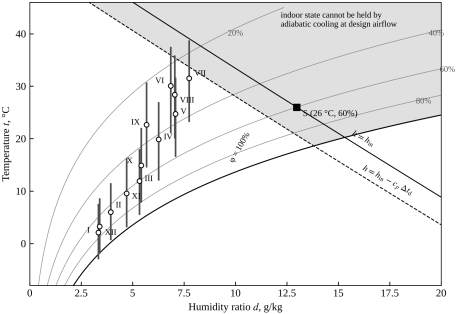
Figure 1. Monthly mean outdoor air states in Bukhara (I–XII: months; vertical bars: diurnal temperature range) and the required indoor state S on the t–d diagram.
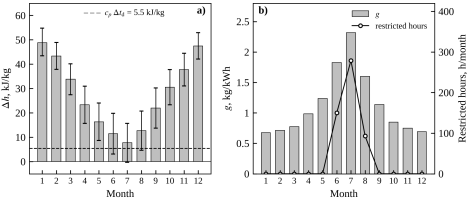
Figure 2. Monthly values in Bukhara: a) enthalpy reserve of outdoor air (bars: monthly mean; error bars: diurnal range); b) ratio of the humidification load to the process consumption and the number of restricted hours.
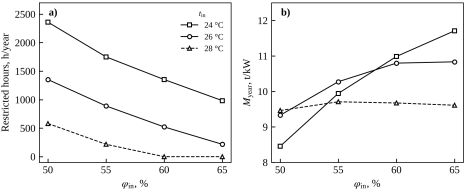
Figure 3. Dependence on the temperature and relative humidity of shop air: a) number of restricted hours; b) annual humidification water per 1 kW of process power (installed airflow 541 m3/(h·kW)).
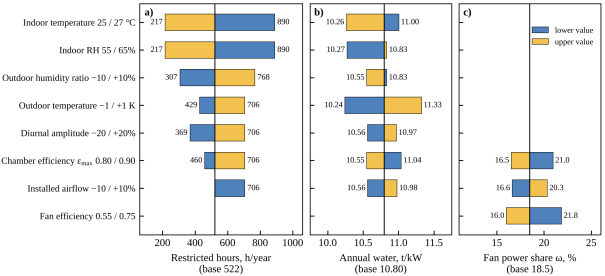
Figure 4. Sensitivity of the results to the model parameters (one at a time): a) restricted hours; b) annual humidification water per 1 kW of process power; c) ratio of fan power to process power. Blue bars: lower parameter value; yellow bars: upper parameter value.

Information



 Share This Article
 Twitter
 Linked In
 Facebook

 Copy
 Download