
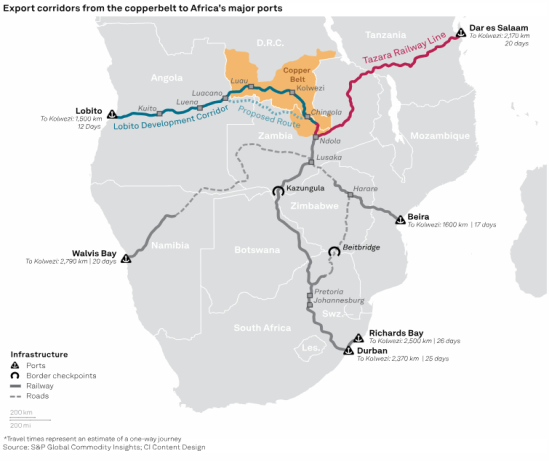
This paper examines how foreign direct investment (FDI) affects economic growth in four institutionally fragile SADC economies: the Democratic Republic of Congo, Angola, Zambia, and Tanzania from 2000 to 2024, arguing that the FDI–growth relationship depends on host-country institutional quality and the spatial dimension of investment through the Lobito, North–South, and Dar es Salaam corridors. Using fixed-effects, interaction, dynamic panel GMM, and panel smooth transition regression (PSTR) models with institutional quality as the transition variable, it finds that FDI is positively and significantly associated with growth in contemporaneous specifications, whereas the association is no longer significant in dynamic specifications, suggesting FDI is a short-term stimulus rather than a source of sustained growth; institutional quality positively moderates the relationship, while corridor effects are differentiated, with the Lobito and Dar es Salaam corridors amplifying FDI’s growth effect and the North–South Corridor mitigating that effect. The PSTR estimates identify an institutional threshold (c = −0.637) below which FDI’s marginal effect is substantially stronger, driven by heterogeneity between more fragile states (Angola and DRC) and relatively better-governed ones (Tanzania and Zambia). Although the small sample limits statistical power, the findings highlight the complementary roles of institutional development, corridor infrastructure, and productive diversification in converting FDI into durable and inclusive growth.
| Published in | International Journal of Economics, Finance and Management Sciences (Volume 14, Issue 6) |
| DOI | 10.11648/j.ijefm.20261406.14 |
| Page(s) | 503-513 |
| Creative Commons |
This is an Open Access article, distributed under the terms of the Creative Commons Attribution 4.0 International License (http://creativecommons.org/licenses/by/4.0/), which permits unrestricted use, distribution and reproduction in any medium or format, provided the original work is properly cited. |
| Copyright |
Copyright © The Author(s), 2026. Published by Science Publishing Group |
Foreign Direct Investment, Economic Growth, Institutional Quality, Economic Corridors, SADC, PSTR, GMM
Variable | N | Mean | SD | Minimum | Maximum |
|---|---|---|---|---|---|
RGDP/CG | 100 | 5.287 | 3.503 | -5.477 | 13,911 |
FDI | 100 | 13.145 | 16.131 | -22.705 | 22,524 |
IQI | 100 | -0.911 | 0.525 | -2.071 | -0.234 |
GFCF | 100 | 1.19×10¹⁰ | 1.10×10¹⁰ | −7.25×10⁹ | 4.20×10¹⁰ |
HC | 100 | 31.023 | 11,601 | 4.566 | 55,265 |
INFL | 100 | 6.633 | 18,695 | -57.487 | 54,473 |
FB | 100 | -1.305 | 3.694 | -7.020 | 14,362 |
Variable | Baseline FE | FE Interaction | Lagged FE |
|---|---|---|---|
FDI | 0.0793***(0.00971) | — | 0.0599(0.0443) |
IQI | 1.476(2.039) | — | -6.097(5.210) |
SFDI | — | -27.81*(9.536) | — |
SI | — | -0.667(0.846) | — |
FDI × institutions | — | 4.085**(0.833) | 0.0553(0.0472) |
FDI × Lobito | — | 30.11*(9.549) | — |
FDI × North-South | — | -9.508**(1.995) | — |
FDI × Dar Es Salaam | — | 4.136**(0.788) | — |
Observations | 100 | 100 | 96 |
Within R² | 0.399 | 0.456 | 0.431 |
Corridor | Coefficient | Sign | Interpretation |
|---|---|---|---|
IDE*Lobito | 30.11 | Positive | Amplifying effect |
IDE*Dar Es Salaam | 4.136 | Positive | Amplifier effect |
IDE*North-South | -9.508 | Negative | Mitigating effect |
Term | Coefficient | Std error | Reported inference |
|---|---|---|---|
Lagged growth | 0.502 | 0.278 | Not significant |
FDI | -0.0221 | 0.179 | Not significant |
Institutional quality | 4,900 | 9,980 | Not significant |
FDI × institutions | -4.918 | 6.379 | Not significant |
Human capital | 0.230** | 0.0591 | Positive |
Inflation | -0.0589** | 0.0169 | Negative |
Observations | 92 | — | — |
Parameter | Estimate | Robust SE | Approx. p-value |
|---|---|---|---|
FDI, low-institution regime (β₀) | 0.0972 | 0.00247 | <0.001 |
FDI transition component (β₁) | -0.0798 | 0.02187 | <0.001 |
FDI, high-institution regime (β₀+β₁) | 0.0173 | 0.02246 | Not reported |
Institutional threshold (c) | -0.6372 | 0.00020 | <0.001 |
Transition speed (γ) | 3,074.44 | 395.79 | <0.001 |
AR(1) | First-order Autocorrelation |
AR(2) | Second-order Autocorrelation |
DRC | Democratic Republic of Congo |
EU | European Union |
FB | Fiscal Balance |
FDI | Foreign Direct Investment |
FE | Fixed Effects |
GDP | Gross Domestic Product |
GFCF | Gross Fixed Capital Formation |
GMM | Generalized Method of Moments |
HC | Human Capital |
H1 | Hypothesis 1 |
H2 | Hypothesis 2 |
H3 | Hypothesis 3 |
INFL | Inflation |
INST | Institutions |
IQI | Institutional Quality Index |
LAR | Lobito Atlantic Railway |
N | Number of Observations |
PGII | Partnership for Global Infrastructure and Investment |
PSTR | Panel Smooth Transition Regression |
RGDP/CG | Real GDP Per Capita Growth |
R2 | Coefficient of Determination |
SADC | Southern African Development Community |
SD | Standard Deviation |
SE | Standard Error |
SFDI | Standardized Foreign Direct Investment |
SI | Standardized Institutions |
TAZARA | Tanzania-Zambia Railway Authority |
WDI | World Development Indicators |
WGI | Worldwide Governance Indicators |
| [1] | MacDougall, G. D. A. The Benefits and Costs of Private Investment from Abroad: A Theoretical Approach. Economic Record. 1960, 36(73), 13-35. |
| [2] | Chenery, H. B., Strout, A. M. Foreign Assistance and Economic Development. American Economic Review. 1966, 56(4), 679-733. |
| [3] | Carkovic, M., Levine, R. Does Foreign Direct Investment Accelerate Economic Growth? In: Moran, T. H., Graham, E. M., Blomström, M. (Eds.), Does Foreign Direct Investment Promote Development? Institute for International Economics: Washington, DC, USA; 2005; pp. 195–220. |
| [4] | Alfaro, L., Chanda, A., Kalemli-Özcan, S., Sayek, S. Does Foreign Direct Investment Promote Growth? Exploring the Role of Financial Markets on Linkages. Journal of Development Economics. 2010, 91(2), 242–256. |
| [5] | Romer, P. M. Endogenous Technological Change. Journal of Political Economy. 1990, 98(5), S71-S102. |
| [6] | Borensztein, E., De Gregorio, J., Lee, J.-W. How Does Foreign Direct Investment Affect Economic Growth? Journal of International Economics. 1998, 45(1), 115-135. |
| [7] | Durham, J. B. Absorptive Capacity and the Effects of Foreign Direct Investment and Equity Foreign Portfolio Investment on Economic Growth. European Economic Review. 2004, 48(2), 285-306. |
| [8] | Blonigen, B. A., Wang, M. Inappropriate Pooling of Wealthy and Poor Countries in Empirical FDI Studies. In Does Foreign Direct Investment Promote Development? Moran, T. H., Graham, E. M., Blomström, M., Eds., Institute for International Economics: Washington, DC, USA; 2005, pp. 221-244. |
| [9] | Shleifer, A., Vishny, R. W. Corruption. Quarterly Journal of Economics. 1993, 108(3), 599–617. |
| [10] | Alfaro, L., Chanda, A., Kalemli-Ozcan, S., Sayek, S. FDI and Economic Growth: The Role of Local Financial Markets. Journal of International Economics. 2004, 64(1), 89-112. |
| [11] | Afolabi, J. A., & Raifu, I. A. (2024). Toward economic resilience in Sub-Saharan Africa: The role of institutional quality and human capital development. Sustainable Development, 33(2), 2566–2578. |
| [12] | Acemoglu, D., Johnson, S., Robinson, J. A. The Colonial Origins of Comparative Development: An Empirical Investigation. American Economic Review. 2001, 91(5), 1369-1401. |
| [13] | Hall, R. E., Jones, C. I. Why Do Some Countries Produce So Much More Output per Worker than Others? Quarterly Journal of Economics. 1999, 114(1), 83-116. |
| [14] | Jensen, M. C., Meckling, W. H. Theory of the Firm: Managerial Behavior, Agency Costs and Ownership Structure. Journal of Financial Economics. 1976, 3(4), 305-360. |
| [15] | Knack, S., Keefer, P. Institutions and Economic Performance: Cross-Country Tests Using Alternative Institutional Measures. Economics & Politics. 1995, 7(3), 207-227. |
| [16] | Krueger, A. O. The Political Economy of the Rent-Seeking Society. American Economic Review. 1974, 64(3), 291-303. |
| [17] | North, D. C. Institutions, Institutional Change and Economic Performance. Cambridge University Press: Cambridge, UK; 1990. |
| [18] | North, D. C. Institutions. Journal of Economic Perspectives. 1991, 5(1), 97-112. |
| [19] | Rodrik, D. Institutions for High-Quality Growth: What They Are and How to Acquire Them. Studies in Comparative International Development. 2000, 35(3), 3-31. |
| [20] | Rodrik, D. Industrial Policy for the Twenty-First Century. CEPR Discussion Paper No. 4767. Centre for Economic Policy Research: London, UK; 2004. |
| [21] | Romer, P. M. Increasing Returns and Long-Run Growth. Journal of Political Economy. 1986, 94(5), 1002–1037. |
| [22] | Lucas, R. E. On the Mechanics of Economic Development. Journal of Monetary Economics. 1988, 22(1), 3–42. |
| [23] | African Development Bank. The Lobito Corridor: Regional Integration Opportunities. African Development Bank Group: Abidjan, Côte d'Ivoire; 2021. |
| [24] | Fujita, M., Krugman, P., Venables, A. J. The Spatial Economy: Cities, Regions, and International Trade. MIT Press: Cambridge, MA, USA; 1999. |
| [25] | Fujita, M., Thisse, J.-F. Economics of Agglomeration: Cities, Industrial Location, and Regional Growth. Cambridge University Press: Cambridge, UK; 2002. |
| [26] | Krugman, P. Increasing Returns and Economic Geography. Journal of Political Economy. 1991, 99(3), 483-499. |
| [27] | Monson, J. The TAZARA Railway: A History of the Dar es Salaam Corridor. African Economic History Working Paper Series. African Economic History Network: Stellenbosch, South Africa; 2021. |
| [28] | World Bank. Development Corridors: A Framework for Analysis. World Bank Group: Washington, DC, USA; 2020. |
| [29] | Afolabi, J. A., Raifu, I. A. Economic Resilience and Foreign Direct Investment in Sub-Saharan Africa. Journal of African Business. 2024, 25(2), 234-256. |
| [30] | Azman-Saini, W. N. W., Alwi, A. FDI and Economic Growth: The Role of Institutional Quality. International Journal of Economics and Management. 2010, 4(2), 277-291. |
| [31] | Azman-Saini, W. N. W., Law, S. H., Ahmad, A. H. FDI and Economic Growth: New Evidence on the Role of Financial Markets. Economics Letters. 2010, 107(2), 211-213. |
| [32] | Bokpin, G. A., Mensah, L., Asamoah, M. E. Legal Source, Institutional Quality and FDI Flows in Africa. International Journal of Law and Management. 2017, 59(5), 687-698. |
| [33] | Forget, P., Kasekende, E. Determinants of Foreign Direct Investment in the SADC Region. South African Journal of Economics. 2024, 92(1), 45-67. |
| [34] | Golo, Y. N. Institutional Heterogeneity and FDI Effectiveness in Africa. Journal of African Economies. 2026, 35(1), 78-102. |
| [35] | Guenichi, H., Omri, N. A. Institutional Thresholds and the FDI-Growth Nexus: A PSTR Approach. Economic Modelling. 2025, 142, 106-125. |
| [36] | Makalima, S. O., Nduna, S., Kapingura, F. M. Determinants of Foreign Direct Investment in SADC Region: Case of Financial Development, Institutions and Openness. South African Journal of Economic and Management Sciences. 2024, 27(1), 1-10. |
| [37] | Malindini, K. Impact Analysis of Institutional Quality on Foreign Direct Investment Inflows into the SADC Region. Doctoral Thesis, University of the Witwatersrand, Johannesburg, South Africa, 2022. |
| [38] | Mensah, L., Bokpin, G. A., Asamoah, M. E. Corruption and FDI in SADC Economies. African Development Review. 2025, 37(1), 89-105. |
| [39] | Ngundu, M., Ngepah, N. Institutional Thresholds and FDI-Growth Nexus in Sub-Saharan Africa: The Role of FDI Origin. Journal of African Trade. 2019, 6(1-2), 45-62. |
| [40] | Nubong, G. F., Ntuli, P. Institutions and FDI in the SADC: A Panel Analysis. Development Southern Africa. 2024, 41(3), 512-530. |
| [41] | Otisitswe, B. Foreign Direct Investment and Economic Growth in SADC: A Dynamic Panel Analysis. Master's Thesis, University of Botswana, Gaborone, Botswana, 2015. |
| [42] | Tshimbombu, C. K., Tshibambe, T. N. Port Infrastructure and the Projection of Economic Power in Sub-Saharan Africa. African Journal of Political Economy. 2025, 12(2), 145-168. |
| [43] | Arellano, M., Bond, S. Some Tests of Specification for Panel Data: Monte Carlo Evidence and an Application to Employment Equations. Review of Economic Studies. 1991, 58(2), 277-297. |
| [44] | Blundell, R., Bond, S. Initial Conditions and Moment Restrictions in Dynamic Panel Data Models. Journal of Econometrics. 1998, 87(1), 115-143. |
| [45] | González, A., Teräsvirta, T., van Dijk, D., Yang, Y. Panel Smooth Transition Regression Models. SSE/EFI Working Paper Series in Economics and Finance, No. 604. Stockholm School of Economics: Stockholm, Sweden; 2005. |
| [46] | Gujarati, D. N., Porter, D. C. Basic Econometrics. 5th ed. McGraw-Hill: New York, NY, USA; 2009. |
| [47] | Hansen, B. E. Threshold Effects in Non-Dynamic Panels: Estimation, Testing, and Inference. Journal of Econometrics. 1999, 93(2), 345-368. |
| [48] | Jude, C., Levieuge, G. Growth Effect of FDI in Developing Economies: The Role of Institutional Quality. Banque de France Working Paper No. 493. Banque de France: Paris, France; 2013. |
| [49] | Kaufmann, D., Kraay, A., Mastruzzi, M. The Worldwide Governance Indicators: Methodology and Analytical Issues. World Bank Policy Research Working Paper No. 5430. World Bank Group: Washington, DC, USA; 2010. |
| [50] | Windmeijer, F. A Finite Sample Correction for the Variance of Linear Efficient Two-Step GMM Estimators. Journal of Econometrics. 2005, 126(1), 25-51. |
| [51] | UNCTAD. World Investment Report 2023. United Nations Conference on Trade and Development: Geneva, Switzerland; 2023. |
| [52] | World Bank. World Development Indicators. World Bank Group: Washington, DC, USA; 2024. |
| [53] |
Bloomberg. Chinese Miners Back TAZARA Upgrade with $1.24 Billion. Bloomberg News. 2026. Available from:
https://www.bloomberg.com/ [Accessed 17 September 2026]. |
| [54] |
China Daily. TAZARA Modernization to Boost Capacity to 2.4 Million Tons per Year. China Daily. 2026. Available from:
https://www.chinadaily.com.cn/ [Accessed 17 September 2026]. |
| [55] | SADC. North-South Corridor: Trade and Transport Facilitation. Southern African Development Community: Gaborone, Botswana; 2025. |
| [56] |
Skillings.net. Lobito Corridor: Strategic Impact on the Global Copper Map. Skillings Mining Review. 2025. Available from:
https://skillings.net/ [Accessed 17 September 2026]. |
| [57] |
The Africa Report. Lobito or Tazara? The Battle Intensifies. The Africa Report. 2026. Available from:
https://www.theafricareport.com/ [Accessed 17 September 2026]. |
| [58] | Dunning, J. H. The Eclectic (OLI) Paradigm of International Production: Past, Present and Future. International Journal of the Economics of Business. 2001, 8(2), 173–190. |
APA Style
Mbo, B. C., Youzhen, C., Al-Muayad, K., Hyppolite, T. F. (2026). Foreign Direct Investment and Economic Growth Under Institutional Fragility: Evidence from Four SADC Economies. International Journal of Economics, Finance and Management Sciences, 14(6), 503-513. https://doi.org/10.11648/j.ijefm.20261406.14
ACS Style
Mbo, B. C.; Youzhen, C.; Al-Muayad, K.; Hyppolite, T. F. Foreign Direct Investment and Economic Growth Under Institutional Fragility: Evidence from Four SADC Economies. Int. J. Econ. Finance Manag. Sci. 2026, 14(6), 503-513. doi: 10.11648/j.ijefm.20261406.14
@article{10.11648/j.ijefm.20261406.14,
  author = {Bile Cédric Mbo and Chen Youzhen and Khalil Al-Muayad and Tchio Fothe Hyppolite},
  title = {Foreign Direct Investment and Economic Growth Under Institutional Fragility: Evidence from Four SADC Economies},
  journal = {International Journal of Economics, Finance and Management Sciences},
  volume = {14},
  number = {6},
  pages = {503-513},
  doi = {10.11648/j.ijefm.20261406.14},
  url = {https://doi.org/10.11648/j.ijefm.20261406.14},
  eprint = {https://article.sciencepublishinggroup.com/pdf/10.11648.j.ijefm.20261406.14},
  abstract = {This paper examines how foreign direct investment (FDI) affects economic growth in four institutionally fragile SADC economies: the Democratic Republic of Congo, Angola, Zambia, and Tanzania from 2000 to 2024, arguing that the FDI–growth relationship depends on host-country institutional quality and the spatial dimension of investment through the Lobito, North–South, and Dar es Salaam corridors. Using fixed-effects, interaction, dynamic panel GMM, and panel smooth transition regression (PSTR) models with institutional quality as the transition variable, it finds that FDI is positively and significantly associated with growth in contemporaneous specifications, whereas the association is no longer significant in dynamic specifications, suggesting FDI is a short-term stimulus rather than a source of sustained growth; institutional quality positively moderates the relationship, while corridor effects are differentiated, with the Lobito and Dar es Salaam corridors amplifying FDI’s growth effect and the North–South Corridor mitigating that effect. The PSTR estimates identify an institutional threshold (c = −0.637) below which FDI’s marginal effect is substantially stronger, driven by heterogeneity between more fragile states (Angola and DRC) and relatively better-governed ones (Tanzania and Zambia). Although the small sample limits statistical power, the findings highlight the complementary roles of institutional development, corridor infrastructure, and productive diversification in converting FDI into durable and inclusive growth.},
 year = {2026}
}
TY  - JOUR
T1  - Foreign Direct Investment and Economic Growth Under Institutional Fragility: Evidence from Four SADC Economies
AU  - Bile Cédric Mbo
AU  - Chen Youzhen
AU  - Khalil Al-Muayad
AU  - Tchio Fothe Hyppolite
Y1  - 2026/11/25
PY  - 2026
N1  - https://doi.org/10.11648/j.ijefm.20261406.14
DO  - 10.11648/j.ijefm.20261406.14
T2  - International Journal of Economics, Finance and Management Sciences
JF  - International Journal of Economics, Finance and Management Sciences
JO  - International Journal of Economics, Finance and Management Sciences
SP  - 503
EP  - 513
PB  - Science Publishing Group
SN  - 2326-9561
UR  - https://doi.org/10.11648/j.ijefm.20261406.14
AB  - This paper examines how foreign direct investment (FDI) affects economic growth in four institutionally fragile SADC economies: the Democratic Republic of Congo, Angola, Zambia, and Tanzania from 2000 to 2024, arguing that the FDI–growth relationship depends on host-country institutional quality and the spatial dimension of investment through the Lobito, North–South, and Dar es Salaam corridors. Using fixed-effects, interaction, dynamic panel GMM, and panel smooth transition regression (PSTR) models with institutional quality as the transition variable, it finds that FDI is positively and significantly associated with growth in contemporaneous specifications, whereas the association is no longer significant in dynamic specifications, suggesting FDI is a short-term stimulus rather than a source of sustained growth; institutional quality positively moderates the relationship, while corridor effects are differentiated, with the Lobito and Dar es Salaam corridors amplifying FDI’s growth effect and the North–South Corridor mitigating that effect. The PSTR estimates identify an institutional threshold (c = −0.637) below which FDI’s marginal effect is substantially stronger, driven by heterogeneity between more fragile states (Angola and DRC) and relatively better-governed ones (Tanzania and Zambia). Although the small sample limits statistical power, the findings highlight the complementary roles of institutional development, corridor infrastructure, and productive diversification in converting FDI into durable and inclusive growth.
VL  - 14
IS  - 6
ER  -
School of Economics and Management, Southwest Jiaotong University, China
School of Economics and Management, Southwest Jiaotong University, China
School of Digital Economy and Management, Sichuan Technology and Business University, China
Facultés des Sciences, Université de Yaoundé 1, Yaoundé, Cameroon

Information



 Share This Article
 Twitter
 Linked In
 Facebook

 Copy
 Download