
This paper investigates the monitoring and mitigation of electrical energy losses caused by corona discharge in high-voltage overhead transmission lines. The relevance of the study is associated with the growing need to improve the energy efficiency of power networks, reduce technical losses, and ensure the reliable operation of power supply systems under increasing electrical loads and more complex operating conditions. A detailed analysis of the factors affecting corona discharge intensity is carried out, including operating voltage levels, conductor design characteristics, surface conditions, meteorological influences, and environmental parameters. A comprehensive approach to continuous corona monitoring is proposed based on the integrated utilization of electrical, electromagnetic, and meteorological data. The potential of modern digital technologies for real-time condition assessment of overhead transmission lines and forecasting of energy losses is examined. The impact of corona discharge on power transmission efficiency is evaluated, and key directions for loss reduction through improvements in transmission line design and operational practices are identified. The obtained results demonstrate that the implementation of continuous monitoring systems enables the timely detection of network sections characterized by increased corona activity, improves the accuracy of energy loss assessment, and supports the development of effective technical measures for loss reduction. The practical significance of the research lies in the applicability of the proposed approach to the modernization of high-voltage power networks aimed at enhancing energy efficiency, operational reliability, and the overall performance of electric power infrastructure.
| Published in | American Journal of Electrical Power and Energy Systems (Volume 15, Issue 5) |
| DOI | 10.11648/j.epes.20261505.12 |
| Page(s) | 115-120 |
| Creative Commons |
This is an Open Access article, distributed under the terms of the Creative Commons Attribution 4.0 International License (http://creativecommons.org/licenses/by/4.0/), which permits unrestricted use, distribution and reproduction in any medium or format, provided the original work is properly cited. |
| Copyright |
Copyright © The Author(s), 2026. Published by Science Publishing Group |
Corona Discharge, Corona Power Losses, Condition-based Monitoring, Energy Efficiency, Intelligent Monitoring Systems, Power Transmission Networks, Digital Power Systems, Smart Grid Technologies
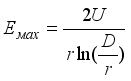 (1)
 )-Maximum electric field strength at the conductor surface, kV/m, (U)- where U is the voltage, V; r is the conductor radius, in cm or m; and D is the average distance between phases, in cm or m. To account for atmospheric conditions, the relative air density is determined using the following expression (2):
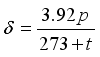 (2)
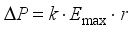 (3)
 (4)
ΔPcor | The Power Loss |
| [1] |
World reserves of natural resources: how many years will the Earth have enough minerals? [Electronic resource]: URL:
https://lindeal.com/trends/mirovye-zapasy-prirodnykh-resursovna-skolko-let-zemle-khvatit-poleznykh-iskopaemykh (date of access: 21.05.2023). |
| [2] | World Energy Council. 2014. Global Energy Transitions. Date of access: October 16, 2021. Archived December 14, 2017. |
| [3] | Allaev K. R. Electric power industry of Uzbekistan and the world. - Tashkent: Fan va technology. 2009. - 463 p. |
| [4] | Resolution of the Cabinet of Ministers of the Republic of Uzbekistan №. 204 "On Additional Measures for the Implementation of Market Mechanisms in the Fuel and Energy Sector" dated 16.04.2024. |
| [5] | Sitdikov R. A. Electricity Demand Response and Electric Power System Modes //Energy and Energy Resources, 2009. №. 3-4. - P. 42-47. |
| [6] | Re-powering markets. Market design and regulation during the transition to low-carbon power systems. International Energy Agency (March 2016). Archived from the original on 21 June 2017. |
| [7] | Charles Goldman, Michael Reid, Roger Levy, and Alison Silverstein. National Action Plan for Energy Efficiency (2010). Coordination of Energy Efficiency and Demand Response. epa. gov (2010). Date of access: 23 May 2017. Archived from the original on 9 May 2017. |
| [8] | European Union Electricity Market Glossary. Demand Side Response Aggregator (DSR Aggrega-tor). emissions-euets.com (16 June 2017). Date of access: 28 April 2017. Archived from the original on 20 February 2017. |
| [9] | The concept of functioning of distributed energy resource aggregators as part of the Unified Energy System of Russia. Electricity demand management aggregators. -M.: JSC"SOUES". 2018, May. |
| [10] | Allaev K. R. Modern energy and prospects for its development / edited by Salimov A. U. – T.: Fan va texnologiyalar nashriyot-manbaa uyi, 2021. – 952 p. |
| [11] | Peek, F. W. Dielectric Phenomena in High-Voltage Engineering. McGraw-Hill, 1929. |
| [12] | Bousiou, E. I., Mikropoulos, P. N. “Corona inception field of typical overhead line conductors under variable atmospheric conditions.” Electric Power Systems Research, 2020. |
| [13] | Gupta, P. K., Tuttelberg, K., Kilter, J. “Weather dependency of corona losses on 330 kV overhead transmission lines.” International Journal of Electrical Power & Energy Systems, 2024. |
| [14] | Library of Congress. (2026). The deterioration and preservation of paper: Some essential facts. Preservation, Library of Congress. |
| [15] | Simulation and Experimental Study of Rotary Tillage Blades. Agriculture Journal, 2023. |
APA Style
Nurmonovich, T. A., o‘g‘li, T. I. B. (2026). Comprehensive Monitoring and Intelligent Diagnostics Using Multifactor Assessment of Corona Losses to Improve Energy Efficiency in High-voltage Overhead Transmission Lines. American Journal of Electrical Power and Energy Systems, 15(5), 115-120. https://doi.org/10.11648/j.epes.20261505.12
ACS Style
Nurmonovich, T. A.; o‘g‘li, T. I. B. Comprehensive Monitoring and Intelligent Diagnostics Using Multifactor Assessment of Corona Losses to Improve Energy Efficiency in High-voltage Overhead Transmission Lines. Am. J. Electr. Power Energy Syst. 2026, 15(5), 115-120. doi: 10.11648/j.epes.20261505.12
AMA Style
Nurmonovich TA, o‘g‘li TIB. Comprehensive Monitoring and Intelligent Diagnostics Using Multifactor Assessment of Corona Losses to Improve Energy Efficiency in High-voltage Overhead Transmission Lines. Am J Electr Power Energy Syst. 2026;15(5):115-120. doi: 10.11648/j.epes.20261505.12
@article{10.11648/j.epes.20261505.12,
  author = {Tovbayev Akram Nurmonovich and Tog‘ayev Islom Bekpo‘lat o‘g‘li},
  title = {Comprehensive Monitoring and Intelligent Diagnostics Using Multifactor Assessment of Corona Losses to Improve Energy Efficiency in High-voltage Overhead Transmission Lines},
  journal = {American Journal of Electrical Power and Energy Systems},
  volume = {15},
  number = {5},
  pages = {115-120},
  doi = {10.11648/j.epes.20261505.12},
  url = {https://doi.org/10.11648/j.epes.20261505.12},
  eprint = {https://article.sciencepublishinggroup.com/pdf/10.11648.j.epes.20261505.12},
  abstract = {This paper investigates the monitoring and mitigation of electrical energy losses caused by corona discharge in high-voltage overhead transmission lines. The relevance of the study is associated with the growing need to improve the energy efficiency of power networks, reduce technical losses, and ensure the reliable operation of power supply systems under increasing electrical loads and more complex operating conditions. A detailed analysis of the factors affecting corona discharge intensity is carried out, including operating voltage levels, conductor design characteristics, surface conditions, meteorological influences, and environmental parameters. A comprehensive approach to continuous corona monitoring is proposed based on the integrated utilization of electrical, electromagnetic, and meteorological data. The potential of modern digital technologies for real-time condition assessment of overhead transmission lines and forecasting of energy losses is examined. The impact of corona discharge on power transmission efficiency is evaluated, and key directions for loss reduction through improvements in transmission line design and operational practices are identified. The obtained results demonstrate that the implementation of continuous monitoring systems enables the timely detection of network sections characterized by increased corona activity, improves the accuracy of energy loss assessment, and supports the development of effective technical measures for loss reduction. The practical significance of the research lies in the applicability of the proposed approach to the modernization of high-voltage power networks aimed at enhancing energy efficiency, operational reliability, and the overall performance of electric power infrastructure.},
 year = {2026}
}
TY  - JOUR
T1  - Comprehensive Monitoring and Intelligent Diagnostics Using Multifactor Assessment of Corona Losses to Improve Energy Efficiency in High-voltage Overhead Transmission Lines
AU  - Tovbayev Akram Nurmonovich
AU  - Tog‘ayev Islom Bekpo‘lat o‘g‘li
Y1  - 2026/10/31
PY  - 2026
N1  - https://doi.org/10.11648/j.epes.20261505.12
DO  - 10.11648/j.epes.20261505.12
T2  - American Journal of Electrical Power and Energy Systems
JF  - American Journal of Electrical Power and Energy Systems
JO  - American Journal of Electrical Power and Energy Systems
SP  - 115
EP  - 120
PB  - Science Publishing Group
SN  - 2326-9200
UR  - https://doi.org/10.11648/j.epes.20261505.12
AB  - This paper investigates the monitoring and mitigation of electrical energy losses caused by corona discharge in high-voltage overhead transmission lines. The relevance of the study is associated with the growing need to improve the energy efficiency of power networks, reduce technical losses, and ensure the reliable operation of power supply systems under increasing electrical loads and more complex operating conditions. A detailed analysis of the factors affecting corona discharge intensity is carried out, including operating voltage levels, conductor design characteristics, surface conditions, meteorological influences, and environmental parameters. A comprehensive approach to continuous corona monitoring is proposed based on the integrated utilization of electrical, electromagnetic, and meteorological data. The potential of modern digital technologies for real-time condition assessment of overhead transmission lines and forecasting of energy losses is examined. The impact of corona discharge on power transmission efficiency is evaluated, and key directions for loss reduction through improvements in transmission line design and operational practices are identified. The obtained results demonstrate that the implementation of continuous monitoring systems enables the timely detection of network sections characterized by increased corona activity, improves the accuracy of energy loss assessment, and supports the development of effective technical measures for loss reduction. The practical significance of the research lies in the applicability of the proposed approach to the modernization of high-voltage power networks aimed at enhancing energy efficiency, operational reliability, and the overall performance of electric power infrastructure.
VL  - 15
IS  - 5
ER  -
The Department of Electric Power Engineering, Navoi State University of Mining and Technologies, Navoi, Uzbekistan
Biography: Tovbayev Akram Nurmonovich is a Doctor of Technical Sciences (DSc) and Professor at Navoi State University of Mining and Technology, Navoi, Uzbekistan. His research interests include electrical power engineering, power supply systems, high-voltage overhead transmission lines, power quality, ferroresonance phenomena, subharmonic oscillations, corona discharge, electrical energy losses, monitoring and diagnostics of power transmission systems, and energy efficiency. His recent research focuses particularly on the analysis and reduction of corona-induced power losses in high-voltage overhead transmission lines and the development of monitoring approaches for improving the reliability and energy efficiency of electrical power systems.

The Department of Electric Power Engineering, Navoi State University of Mining and Technologies, Navoi, Uzbekistan
Biography: Tog‘ayev Islom Bekpo‘lat o‘g‘li is an Assistant at the Department of Electrical Power Engineering at Navoi State University of Mining and Technologies, Uzbekistan. His academic and research activities are focused on electrical power engineering, power transmission systems, overhead electrical transmission lines, and electrical energy losses. His research interests include the analysis of power losses in medium-voltage overhead transmission lines, statistical analysis of electrical energy losses, power system efficiency, and measures for reducing energy losses in electrical networks.
Research Fields: Electrical Power Engineering, Power Supply Systems, High-Voltage Transmission Lines, Power Quality, Energy Efficiency, Power Grid Monitoring and Diagnostics.

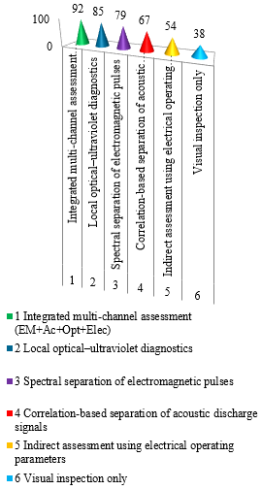
Figure 1. Dependence of corona losses on weather conditions and distance slong the line.
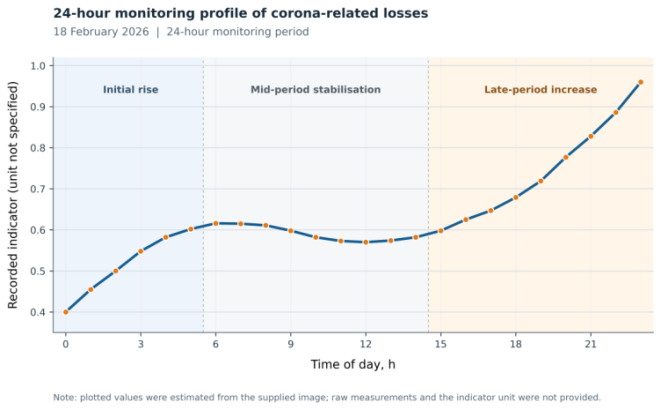
Figure 2. Temoreal varigatin of coronaa losses based on monitoring data.
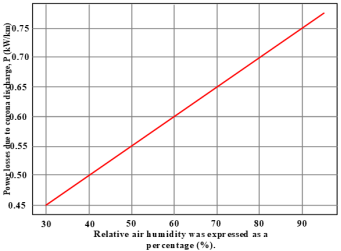
Figure 3. Relationship between humidity and corona losses based on monitoring data.
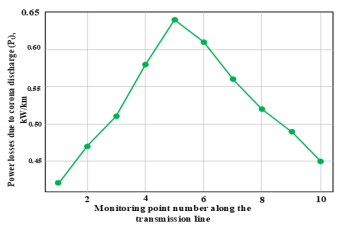
Figure 4. Distribution of corona losses in a 220 kV transmission line based on monitoring data.
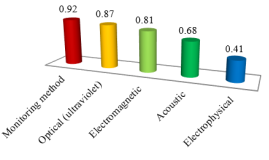
Figure 5. Comparison of Monitoring Methods for Corona-Loss Assessment.
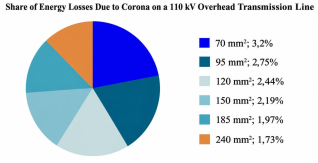
Figure 6. Comparison of corona-related energy-loss shares by conductor cross-section in a 110 kV overhead transmission line.
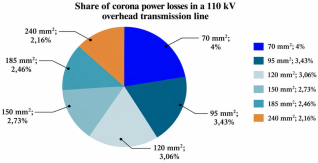
Figure 7. Comparison of corona-related energy-loss shares by conductor cross-section in a 110 kV overhead transmission line.
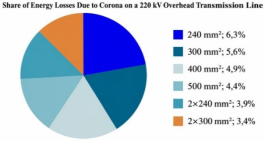
Figure 8. Share of Corona-Induced Energy Losses by Conductor Configuration on a 220 kV Overhead Transmission Line.
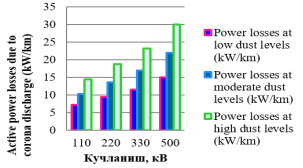
Figure 9. Active Power Losses Due to Corona Discharge at Different Voltage and Dust Levels.

Information



 Share This Article
 Twitter
 Linked In
 Facebook

 Copy
 Download