Research Article | | Peer-Reviewed

Improving the Electrical Energy Efficiency of a Cone Crusher in the Ore Crushing Process Through Adaptive Adjustment of Supply Frequency

Received: 12 October 2026     Accepted: 21 October 2026     Published: 31 October 2026
Views:       Downloads:
Abstract

Cone crushers in the mining and metallurgical industries operate under conditions where ore properties and throughput constantly fluctuate, yet many industrial electric drives are still controlled at a fixed nominal frequency. This study developed an adaptive frequency control system that treats the supply frequency (f) of a variable frequency drive (VFD) as the control variable, while accounting for external factors such as ore hardness (H) and mass flow rate (Q) measured via a belt scale. The objective of the research is to minimize the crusher’s specific electrical energy consumption (SEC = P/Q) while adhering to constraints regarding frequency, electric motor power, throughput, and product size. The study integrates the speed-frequency relationship of the induction motor, the crusher's electrical energy consumption, hardness and load factors, and a function representing the deviation from the optimal operating point for current conditions. Thirty planned experimental trials—covering ranges of H = 7–15, Q = 1900–2300 t/h, and f = 45–60 Hz—were compared against a standard 50 Hz operating mode. Adaptive modeling reduced the SEC by an average of 5.57% while maintaining throughput. The proposed approach aligns with existing preliminary scientific findings indicating that adjusting eccentric speed and utilizing mass flow feedback can enhance cone crusher efficiency; furthermore, the 30 experimental modeling results presented were validated against production-scale metrics and criteria prior to industrial implementation. Our research paper details the governing equations, the practical control architecture, and the experimental protocol dataset.

Published in American Journal of Electrical Power and Energy Systems (Volume 15, Issue 5)
DOI 10.11648/j.epes.20261505.13
Page(s) 121-129
Creative Commons

This is an Open Access article, distributed under the terms of the Creative Commons Attribution 4.0 International License (http://creativecommons.org/licenses/by/4.0/), which permits unrestricted use, distribution and reproduction in any medium or format, provided the original work is properly cited.

Copyright

Copyright © The Author(s), 2026. Published by Science Publishing Group

Keywords

Cone Crusher, Ore Hardness, Mass Flow, Frequency Converter, Specific Energy Consumption, Eccentric Speed, Energy Efficiency, Adaptive Control

1. Introduction
Crushing and grinding processes are among the primary consumers of electrical energy in mineral processing. Cone crushers are widely used in secondary and tertiary crushing stages due to their high productivity and the reliability of their compression-based crushing mechanism. However, the operational efficiency of these crushers is intrinsically linked to a number of factors, such as the properties of the feed material, the closed-side setting (CSS), the filling level of the crushing chamber, the eccentric speed, and the time-varying strength of the ore. Recent research on modeling and implementing optimal control systems for cone crushers indicates that while PID and expert control systems have predominantly been used in industrial settings, the demands of Industry 4.0, sustainability, and economic efficiency are now accelerating the implementation of optimization and data-driven control systems .
Electrical energy consumption in crushers is not determined solely by the variation in operating frequency. Factors such as ore strength, particle size distribution, throughput, compression pressure, residence time in the crushing chamber, and others influence power consumption. Experimental and modeling studies have shown that cone crusher energy consumption depends on operating speed and crushing chamber geometry , while rock strength characteristics correlate with crusher power and product size . Consequently, operating a cone crusher at a fixed frequency is not energetically optimal when processing ore streams with varying physico-mechanical properties. This is because fluctuations in ore competence and mass flow rates lead to changes in the crushing chamber's load level, the required crushing work, drive torque, and electrical power consumption. Therefore, the optimal supply frequency—which determines the rotational speed of the eccentric mechanism—should be established as a function of the input process parameters.
The scientific problem addressed in this study is the development of a simple control system that precisely defines the crusher’s VFD frequency as a function of two measurable variables—ore hardness and mass flow—and formulates the control objective based on the criterion of specific electrical energy consumption. The proposed method is validated through the results of 30 planned scientific experiments conducted during industrial trials.
2. Materials and Methods
Parameters such as the Bond Work Index, drop-weight parameters, uniaxial compressive strength, and the Protodyakonov strength index can be used to characterize ore undergoing comminution in industrial plants. In this study, since the hardness signal corresponds to operating conditions where the ore hardness level falls within the H=7–15 range, H is interpreted as an online hardness/competence index; it requires calibration against Bond Wi, SMC/JK drop-weight metrics, UCS, or a site-specific validated hardness estimator. The relationships between rock properties measured under operating conditions, Protodyakonov strength, and the Bond Work Index provide the basis for such a calibration strategy .
For the new control system, the mathematical model must be identifiable and computationally simple. We use the following expression:
P̂H,Q,f=P0+aHh+aQq+aHQhq+aff-f*(H,Q)2+av(f-50)2(1)
Where: P̂ — calculated electric power, kW; P0 — base power; h — normalized ore hardness; q — normalized mass flow rate; aH — coefficient representing the effect of hardness on power; aQ — coefficient representing the effect of mass flow rate; aHQ — combined effect of hardness and flow rate; f — current frequency, Hz; f*(H,Q) — optimal frequency for the specific ore condition; af — effect of deviation from the optimal frequency; av — coefficient representing the effect of deviation from the 50 Hz nominal operating mode; h=(H−Hmin)/(Hmax−Hmin) and q=(Q−Qmin)/(Qmax−Qmin) represent the normalized levels of hardness and mass flow rate, respectively. The first four terms represent the increase in load due to harder ore and higher throughput; the quadratic term represents the loss in energy and comminution efficiency occurring when the eccentric speed deviates from the optimal point under current conditions; and the final term represents minor additional losses in the drive/mechanical system. The dependence of specific energy consumption on the rotational speed of the eccentric mechanism may exhibit a minimum. Consequently, both an excessive decrease and an increase in rotational speed lead to a reduction in energy efficiency. The optimal speed varies depending on ore hardness, mass flow, and the loading conditions of the crushing chamber .
The frequency setting, determined by operating conditions, is inextricably linked to the VFD’s operating range:
f*H,Q=sat45,6045+kHh+kQq, kH>0, kQ>0(2)
Where: sat is the saturation operator, f*(H,Q) is the optimal frequency Hz, h is the normalized ore hardness, q is the normalized mass flow rate, and kH and kQ are the coefficients representing their influence on frequency. In the numerical study, values of kH = 8 Hz and kQ = 7 Hz were adopted; consequently, the target frequency increases as hardness or mass flow rate rises. These coefficients are not universal constants but rather calibration parameters that must be determined through production tests ..
minfJ=SEĈH,Q,f+λPP̂-Pmax+λD(f-fprev)2+λSP80̂-P80,target2(3)
Where: J — the overall criterion to be minimized; SEC (H,Q,f) — calculated specific energy consumption per tonne of product; Pmax — maximum permissible power kW; fprev — the previous frequency value Hz; P80̂ — calculated product size mm; P80,target — required product size mm; λP, λD,λS — corresponding penalty coefficients.
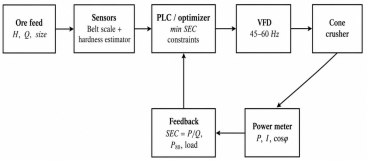
Figure 1. Closed-loop diagram of the proposed control system.Closed-loop diagram of the proposed control system.
In the control system, all sensor signals are synchronized in time, random spikes are filtered out, and time-averaged values are used to account for the material lag effect within the crusher. If the hardness sensor does not directly measure the Mohs scale, its output signal is treated not as Mohs hardness, but as a calibrated competence index characterizing ore grindability.
Table 1. Set of measurements required for industrial implementation and model validation.

Variable

Sensor / source

Typical update rate

Function

Mass flow Q

Conveyor belt scale / weigh roller

1–5 s

Primary throughput feedback

Hardness H

Online proxy based on power/force/acoustic signal; calibrated via laboratory rock tests

1–10 s

External input / ore competence

Electrical power

Three-phase power meter at VFD input

0.1–1 s

Energy KPI

VFD frequency

Drive register / PLC

0.1–1 s

Controlled variable

CSS

Hydraulic position sensor

1–5 s

Constraint / secondary variable

Crusher load

Motor current, hydraulic pressure, vibration

0.1–1 s

Protection / overload detection

Product size

Online camera/laser or belt sample

10 s – minutes

Quality validation

The study examined 30 operating scenarios covering ore hardness values of H = 7–15 and mass flow rates of Q = 1900–2300 t/h. For each scenario, the crusher’s constant 50 Hz mode was compared with an adaptive mode featuring automatic adjustment within the 45–60 Hz range. The computational model was adapted for an industrial electric drive with a power rating of 300–500 kW, accounting for the increase in electrical load associated with rising ore hardness and flow rates. The results obtained represent a deterministic simulation based on a mathematical model, intended for the preliminary assessment of the proposed control method and its subsequent calibration using actual production data.
Table 2. Planned experiments. P50, SEC50 — 50 Hz constant mode; P*, SEC* — adaptive frequency control mode results.

Experiment

H

Q (t/h)

f* (Hz)

P50 (kW)

P* (kW)

SEC50

SEC*

Result (%)

1

14.45

1900

52.45

369.8

361.1

0.1946

0.1901

2.35

2

11.14

1969

50.34

347.8

347.7

0.1767

0.1766

0.05

3

13.34

2176

56.17

470.1

414.9

0.2161

0.1907

11.75

4

11.69

2259

55.97

467.3

415.7

0.2069

0.1840

11.04

5

9.21

2079

50.34

352.6

352.4

0.1696

0.1695

0.05

6

9.48

1997

49.17

340.0

339.0

0.1703

0.1698

0.29

7

14.72

2190

57.79

521.6

433.6

0.2382

0.1980

16.88

8

13.62

2038

54.03

409.0

385.4

0.2007

0.1891

5.77

9

10.31

2066

51.21

362.0

359.9

0.1753

0.1743

0.58

10

7.00

2300

52.00

378.2

372.4

0.1644

0.1619

1.53

11

8.10

2231

51.90

376.2

371.0

0.1686

0.1663

1.39

12

11.41

2203

54.72

432.6

400.2

0.1963

0.1816

7.48

13

8.38

2121

50.24

352.7

352.6

0.1663

0.1663

0.02

14

10.59

1941

49.31

338.2

337.5

0.1742

0.1738

0.20

15

10.03

1914

48.28

332.0

327.7

0.1735

0.1712

1.30

16

13.07

2134

55.17

441.0

402.2

0.2066

0.1884

8.80

17

7.28

2010

47.21

334.4

323.1

0.1663

0.1607

3.38

18

7.55

1983

47.00

333.6

320.5

0.1682

0.1617

3.91

19

13.90

2217

57.45

511.4

431.0

0.2307

0.1944

15.73

20

7.83

1955

46.79

332.9

317.9

0.1702

0.1626

4.48

21

12.79

1928

51.28

355.5

353.1

0.1844

0.1832

0.66

22

14.17

2162

56.76

486.8

420.6

0.2252

0.1945

13.61

23

11.97

2052

52.62

382.5

372.6

0.1864

0.1816

2.60

24

15.00

2148

57.34

504.5

426.3

0.2348

0.1984

15.51

25

12.52

2245

56.55

484.1

421.9

0.2157

0.1879

12.86

26

8.93

2093

50.31

352.7

352.6

0.1685

0.1684

0.04

27

9.76

2107

51.38

365.8

363.1

0.1736

0.1723

0.75

28

10.86

2286

55.62

458.3

412.4

0.2004

0.1804

10.00

29

12.24

2272

56.76

491.4

425.2

0.2162

0.1871

13.48

30

8.66

2024

48.83

339.1

337.1

0.1675

0.1665

0.59

The results indicate that a single constant frequency cannot be considered energetically optimal for a cone crusher across all operational conditions. Variations in ore hardness and mass flow rate lead to changes in electric drive load and specific energy consumption. Consequently, adaptively adjusting the frequency to suit operating conditions yields significant energy savings in certain modes. Modeling results showed a peak efficiency of 16.88% and an average efficiency of 5.57% across all 30 operating points. These findings demonstrate the advisability of implementing a control algorithm that adjusts frequency based on ore properties and load.
3. Results
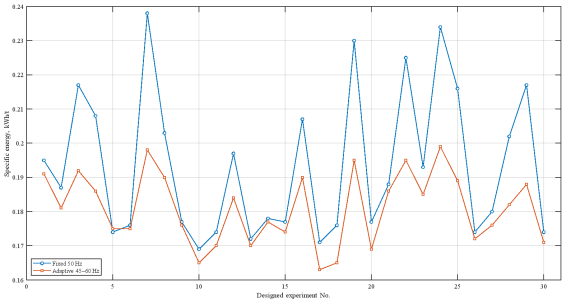
Modeling results demonstrated that adaptive frequency control improves the energy performance of the cone crusher. Across 30 tested operating conditions, the average specific energy consumption decreased from 0.1902 kWh/t to 0.1784 kWh/t, achieving an average energy saving of 5.57%. Concurrently, the average power consumption dropped from 400.8 kW to 375.0 kW. The energy efficiency gains were particularly significant in cases where the constant 50 Hz frequency deviated substantially from the optimal operating point for the given ore hardness and mass flow rate.
Figure 2. Comparative electrical energy consumption for the existing and new control systems.
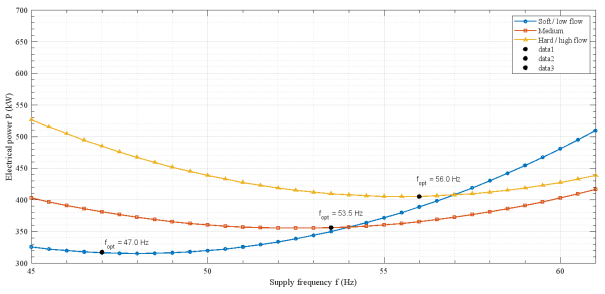
Under conditions of low ore hardness and low mass flow rates, the optimal operating frequency may fall below 50 Hz. However, as hardness and flow rate increase, the optimal frequency shifts toward higher values. This aligns with the technological hypothesis that increasing the eccentric mechanism's speed is necessary to maintain crushing productivity under conditions of high load and hard ore. Nevertheless, in actual crushers, the relationship between speed and efficiency may be non-monotonic at certain operating points. Therefore, the proposed model should be applied only within the experimentally verified range and calibrated based on production data.
Figure 3. Representative curves showing the variation of the optimal frequency value as a function of power for each ore condition.Representative curves showing the variation of the optimal frequency value as a function of power for each ore condition.
The rotational speed of a cone crusher directly affects the frequency of ore compression within the crushing chamber and the movement patterns of the particles. Changes in speed alter both the crusher's throughput and the particle size distribution of the crushed product . Existing research indicates that rotational speed, the eccentricity angle, and the CSS value significantly influence the crusher's energy consumption . Consequently, the frequency that ensures the lowest specific energy consumption for a specific ore condition may not be optimal under different circumstances. For instance, if the ore hardness increases or the conveyor load rises, the optimal frequency value for the crusher changes accordingly.
When analyzing the experimental results, it is important to evaluate the individual effects of ore hardness, conveyor load, and frequency on energy consumption. The following regression model can be used for this purpose:
SECi=β0+β1Hi+β2Qi+β3fi+β4fi2+β5Hifi+β6Qifi+bblok+εi(4)
Where: SECi — specific electrical energy consumption in the i-th experiment, typically in kWh/t; Hi — ore hardness in the i-th experiment; Qi — mass flow rate, t/h; fi — VFD frequency, Hz; fi2 — quadratic effect of frequency, helping to represent the existence of an optimal frequency; β0 — initial or baseline coefficient of the model and bblock is a random factor accounting for variations specific to a particular ore batch or work shift. εi represents random errors not accounted for in the model.
The optimal frequency for each ore condition can be determined from the model:
foptH,Q=-β3+β3H+β6Q2β4, β4>0 (5)
This expression demonstrates how the optimal frequency shifts in response to changes in ore hardness and feed rate. In other words, as ore hardness increases or the volume of material fed into the crusher rises, the frequency value that ensures minimum specific energy consumption may also change.
The advantage of such a model is that it allows not only for the determination of the optimal frequency but also for an assessment of the result's reliability. Scientific articles typically present model coefficients, their standard errors, statistical significance, confidence intervals, model validation errors, and residual error analyses. Furthermore, the uncertainty associated with the energy-saving results must be evaluated. While 30 experiments may suffice for a preliminary or pilot study, drawing reliable conclusions at an industrial scale requires repeating the experiments multiple times across different ore batches, shifts, and operating conditions.
The table below provides a clear and concise comparison of the proposed method with previous studies focused on cone crusher control and energy consumption reduction.
Table 3. Comparison of the proposed method with previous studies on cone crusher control and energy efficiency.

Study

Key parameters investigated

Type of study

Main result

Hulthén & Evertsson

Crusher eccentric speed and material flow

Dynamic, real-time control

Demonstrated potential to improve efficiency by approximately 5–20% in the tested crusher

Hulthén et al.

Frequency converter, SCADA system, and mass flow sensors

Iron ore industrial-scale tests

Determined that operating the crusher at variable speed, rather than a constant nominal speed, can be more efficient in certain cases

Liu et al.

Speed, eccentricity angle, and CSS

Energy model and experimental verification

Confirmed that crusher speed significantly affects energy consumption

Atta et al.

Control-oriented energy model of a cone crusher

Laboratory and industrial-scale verification

Developed a model accounting for energy consumption and verified it using practical data

This study

Selection of frequency (f) based on ore hardness (H) and mass flow (Q)

Preliminary numerical analysis based on 30 experiments

Proposed a control law aimed at reducing energy consumption and a procedure for its verification in an industrial setting

The primary distinction of our research is that, while previous studies typically examined parameters such as crusher speed, CSS, eccentricity, or material flow either in isolation or in pairs, this study considers ore hardness and mass flow simultaneously to determine the optimal operating frequency. Consequently, the control system is capable of adapting to varying ore conditions.
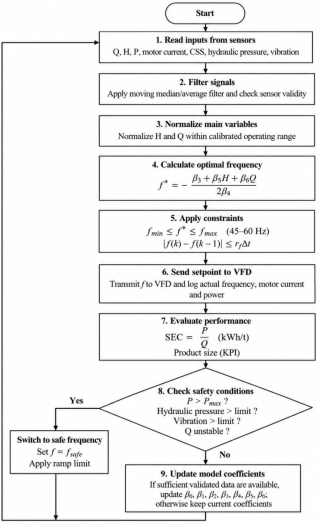
The automatic control system for the cone crusher's operating frequency is implemented via a PLC, which transmits control signals to a Variable Frequency Drive (VFD). Avoiding abrupt frequency changes is crucial, as mechanical wear, fluctuations in ore flow, and errors in hardness detection could adversely affect system performance.
The core principle of this algorithm is that the system monitors changes in ore hardness and material flow, selects the optimal frequency for the crusher based on this data, and controls it via a VFD. Simultaneously, protective parameters such as power, vibration, and hydraulic pressure are continuously monitored. As a result, the crusher can be operated not only in an energy-efficient manner but also safely and stably.
It is not recommended to make sudden, drastic changes to the crusher frequency using the proposed system. Therefore, the control system must transition gradually to the newly calculated frequency. This can be achieved using the following expression:
fcmdk=clipfcmdk-1+clipf*k-fcmdk-1+rfTs,45,60(6)
Figure 4. Practical algorithm for adaptive frequency control of a cone crusher.Practical algorithm for adaptive frequency control of a cone crusher.

Where: fcmd(k) — the new frequency command currently sent to the VFD, Hz; fcmd(k-1) — the frequency at the previous time step; f*(k) — the optimal frequency calculated by the model; Ts — the control system’s computation or update interval, s; rf — the permissible rate of frequency change, Hz/s; clip — an operation that constrains the value within specified limits; 45 and 60 — the minimum and maximum permissible frequencies, Hz. As a result, the calculated frequency is maintained within the 45–60 Hz range, and no excessively abrupt commands are sent to the VFD.
In this context, the objective of reducing energy consumption must not take precedence over the equipment's safe operating requirements. Constraints specified by the manufacturer regarding motor torque, rotational speed, lubrication systems, bearings, mechanical resonance, and minimum permissible speed always take priority.
During the crushing process, it is difficult to continuously and directly measure the actual hardness of the ore while the crusher is in operation. Therefore, in practical systems, hardness is estimated by jointly analyzing data from multiple measurements rather than relying on a single sensor. Data such as material flow on the conveyor, feed ore size, crusher hydraulic pressure, motor power, vibration, and acoustic signals can be utilized for this purpose. Based on these signals, a proxy index representing the ore's hardness or resistance to crushing is calculated. Meanwhile, strength parameters measured periodically in the laboratory—such as UCS, Bond, or SMC—serve as benchmarks for calibrating and validating this online estimation system. Previous studies have demonstrated that the Bond Work Index can be correlated with measurable properties such as compressive strength and the Protodyakonov strength coefficient . The stiffness assessment model can be written in a simplified form as follows:
Ĥ=ω0+ω1UCSnorm+ω2Pnorm+ω3Fhyd,norm+ω4Avib,norm(7)
Where: Ĥ — the calculated ore hardness or competency index; w0 — the initial coefficient; w1, w2, w3, w4 — coefficients indicating the degree of influence of each parameter; UCSnorm — the normalized value of compressive strength; Pnorm — the normalized value of crusher electric power; Fhyd,norm — the normalized value of hydraulic pressure or hydraulic force; Avib,norm — the normalized value of the vibration signal.
To ensure the model's reliability, it must be validated not only against the original training data but also against independent experimental data. This determines how accurately the ore hardness assessment system performs under actual industrial conditions.
4. Discussion
The proposed method is scientifically sound for three main reasons. First, the control strategy considers not merely the crusher’s electrical power consumption, but the specific energy expended to crush a ton of product; reducing power by lowering the crusher speed is not always advantageous. Second, ore hardness and mass flow are accounted for separately, as crushing efficiency depends not only on frequency but also on ore properties and the load level within the crushing chamber. Third, the VFD frequency is selected as the primary control variable; this is a parameter readily available in industrial settings that can be constrained within necessary safety limits.
The proposed approach also aligns with classical theories of comminution energy. For instance, Bond’s equation relates the specific energy required for crushing to the ore’s work index and the reduction ratio, while Morrell’s model extends energy consumption estimation to both conventional crushers and HPGR systems . However, these models do not directly provide an optimal VFD frequency value on a real-time (second-by-second) basis. Consequently, they serve as a theoretical foundation and a validation benchmark, while the practical optimal frequency is determined based on actual process data. If sufficient information regarding ore characteristics and the crushing process is available, it may be more appropriate to use a Morrell-type model for the cone crusher or a model based on an energy balance measured at the plant .
5. Conclusion
This article proposes a control method for a cone crusher that automatically adjusts the VFD frequency based on ore hardness and material flow. The study aims to reduce the specific energy consumption (SEC) per ton of ore while adhering to constraints regarding crusher power, frequency, and product quality. In 30 simulated experiments conducted within the ranges of H=7–15 and Q=1900–2300 t/h, the adaptive control method demonstrated an average SEC reduction of 5.57% compared to a constant 50 Hz operating mode. However, the primary achievement is not merely this percentage reduction, but the development of a control system architecture that can be validated through real-world testing. This system measures ore hardness and flow, determines the optimal frequency for the given conditions, constrains the frequency to the 45–60 Hz range, and evaluates efficiency in terms of SEC.
The proposed method aligns with findings from previous studies indicating that controlling eccentric speed and utilizing material flow feedback can enhance cone crusher efficiency.
Author Contributions
Olimov Jasurjon Sadriddin Ugli: Conceptualization, Data curation, Formal Analysis, Funding acquisition, Investigation, Methodology, Resources, Software, Validation, Writing – original draft, Writing – review & editing
Conflicts of Interest
The authors declare no conflicts of interest.
References
[1] Yamashita, A. S., Thivierge, A., Euzébio, T. A. M. (2021). A review of modeling and control strategies for cone crushers in the mineral processing and quarrying industries. Minerals Engineering, 170, 107036.
[2] Hulthén, E., Evertsson, C. M. (2009). Algorithm for dynamic cone crusher control. Minerals Engineering, 22(3), 296–303.
[3] Hulthén, E., Evertsson, C. M. (2011). Real-time algorithm for cone crusher control with two variables. Minerals Engineering, 24(9), 987–994.
[4] Hulthén, E., Evertsson, C. M., Hofling, K., Öberg, E., Apelqvist, A., Sundvall, A. (2014). Real-time optimization of a speed controlled cone crusher in an iron ore application. Proceedings of Comminution ’14.
[5] Liu, R., Shi, B., Li, G., Yu, H. (2018). Influence of operating conditions and crushing chamber on energy consumption of cone crusher. Energies, 11(5), 1102.
[6] Bearman, R. A., Barley, R. W., Hitchcock, A. (1991). Prediction of power consumption and product size in cone crushing. Minerals Engineering, 4(12), 1243–1256.
[7] Karra, R. C., Deo, S. N., Baliga, A. J. (2016). Prediction of Bond’s work index from field measurable rock properties. International Journal of Mineral Processing, 157, 134–144.
[8] Atta, K. T., Euzébio, T., Ibarra, H., Moreira, V. S., Johansson, A. (2019). Extension, validation, and simulation of a cone crusher model. IFAC-PapersOnLine, 52(14), 1–6.
[9] Morrell, S. (2008). A method for predicting the specific energy requirement of comminution circuits and assessing their energy utilisation efficiency. Minerals Engineering, 21(3), 224–233.
[10] Morrell, S. (2009). Predicting the overall specific energy requirement of crushing, high pressure grinding roll and tumbling mill circuits. Minerals Engineering, 22(6), 544–549.
[11] Li, H., Evertsson, M., Lindqvist, M., Hulthén, E., Asbjörnsson, G. (2018). Dynamic modeling and simulation of a SAG mill-pebble crusher circuit by controlling crusher operational parameters. Minerals Engineering, 127, 98–104.
[12] Lindqvist, M. (2008). Energy considerations in compressive and impact crushing of rock. Minerals Engineering, 21(9), 631–641.
[13] A. Tovbaev, G. Boynazarov, and I. Togaev, “Improving the quality of electricity using the application of reactive power sources,” in E3S Web of Conferences, Vol. 390, p. 06032, Jun. 2023,
[14] O. Ishnazarov, J. Mavlonov, and D. Mardonov, “Control of ball mill operation depending on ball load and ore properties,” in E3S Web of Conferences, Vol. 461, p. 01091, Dec. 2023,
[15] A. Taslimov, F. Rakhimov, and F. Rakhimov, “Economic interval analysis of loads for selection of cross-section surfaces of electrical transmission lines,” in E3S Web of Conferences, Vol. 384, p. 01037, Apr. 2023,
Cite This Article
  • APA Style

    Ugli, O. J. S. (2026). Improving the Electrical Energy Efficiency of a Cone Crusher in the Ore Crushing Process Through Adaptive Adjustment of Supply Frequency. American Journal of Electrical Power and Energy Systems, 15(5), 121-129. https://doi.org/10.11648/j.epes.20261505.13

    Copy | Download

    ACS Style

    Ugli, O. J. S. Improving the Electrical Energy Efficiency of a Cone Crusher in the Ore Crushing Process Through Adaptive Adjustment of Supply Frequency. Am. J. Electr. Power Energy Syst. 2026, 15(5), 121-129. doi: 10.11648/j.epes.20261505.13

    Copy | Download

    AMA Style

    Ugli OJS. Improving the Electrical Energy Efficiency of a Cone Crusher in the Ore Crushing Process Through Adaptive Adjustment of Supply Frequency. Am J Electr Power Energy Syst. 2026;15(5):121-129. doi: 10.11648/j.epes.20261505.13

    Copy | Download

  • @article{10.11648/j.epes.20261505.13,
      author = {Olimov Jasurjon Sadriddin Ugli},
      title = {Improving the Electrical Energy Efficiency of a Cone Crusher in the Ore Crushing Process Through Adaptive Adjustment of Supply Frequency},
      journal = {American Journal of Electrical Power and Energy Systems},
      volume = {15},
      number = {5},
      pages = {121-129},
      doi = {10.11648/j.epes.20261505.13},
      url = {https://doi.org/10.11648/j.epes.20261505.13},
      eprint = {https://article.sciencepublishinggroup.com/pdf/10.11648.j.epes.20261505.13},
      abstract = {Cone crushers in the mining and metallurgical industries operate under conditions where ore properties and throughput constantly fluctuate, yet many industrial electric drives are still controlled at a fixed nominal frequency. This study developed an adaptive frequency control system that treats the supply frequency (f) of a variable frequency drive (VFD) as the control variable, while accounting for external factors such as ore hardness (H) and mass flow rate (Q) measured via a belt scale. The objective of the research is to minimize the crusher’s specific electrical energy consumption (SEC = P/Q) while adhering to constraints regarding frequency, electric motor power, throughput, and product size. The study integrates the speed-frequency relationship of the induction motor, the crusher's electrical energy consumption, hardness and load factors, and a function representing the deviation from the optimal operating point for current conditions. Thirty planned experimental trials—covering ranges of H = 7–15, Q = 1900–2300 t/h, and f = 45–60 Hz—were compared against a standard 50 Hz operating mode. Adaptive modeling reduced the SEC by an average of 5.57% while maintaining throughput. The proposed approach aligns with existing preliminary scientific findings indicating that adjusting eccentric speed and utilizing mass flow feedback can enhance cone crusher efficiency; furthermore, the 30 experimental modeling results presented were validated against production-scale metrics and criteria prior to industrial implementation. Our research paper details the governing equations, the practical control architecture, and the experimental protocol dataset.},
     year = {2026}
    }
    

    Copy | Download

  • TY  - JOUR
    T1  - Improving the Electrical Energy Efficiency of a Cone Crusher in the Ore Crushing Process Through Adaptive Adjustment of Supply Frequency
    AU  - Olimov Jasurjon Sadriddin Ugli
    Y1  - 2026/10/31
    PY  - 2026
    N1  - https://doi.org/10.11648/j.epes.20261505.13
    DO  - 10.11648/j.epes.20261505.13
    T2  - American Journal of Electrical Power and Energy Systems
    JF  - American Journal of Electrical Power and Energy Systems
    JO  - American Journal of Electrical Power and Energy Systems
    SP  - 121
    EP  - 129
    PB  - Science Publishing Group
    SN  - 2326-9200
    UR  - https://doi.org/10.11648/j.epes.20261505.13
    AB  - Cone crushers in the mining and metallurgical industries operate under conditions where ore properties and throughput constantly fluctuate, yet many industrial electric drives are still controlled at a fixed nominal frequency. This study developed an adaptive frequency control system that treats the supply frequency (f) of a variable frequency drive (VFD) as the control variable, while accounting for external factors such as ore hardness (H) and mass flow rate (Q) measured via a belt scale. The objective of the research is to minimize the crusher’s specific electrical energy consumption (SEC = P/Q) while adhering to constraints regarding frequency, electric motor power, throughput, and product size. The study integrates the speed-frequency relationship of the induction motor, the crusher's electrical energy consumption, hardness and load factors, and a function representing the deviation from the optimal operating point for current conditions. Thirty planned experimental trials—covering ranges of H = 7–15, Q = 1900–2300 t/h, and f = 45–60 Hz—were compared against a standard 50 Hz operating mode. Adaptive modeling reduced the SEC by an average of 5.57% while maintaining throughput. The proposed approach aligns with existing preliminary scientific findings indicating that adjusting eccentric speed and utilizing mass flow feedback can enhance cone crusher efficiency; furthermore, the 30 experimental modeling results presented were validated against production-scale metrics and criteria prior to industrial implementation. Our research paper details the governing equations, the practical control architecture, and the experimental protocol dataset.
    VL  - 15
    IS  - 5
    ER  - 

    Copy | Download

Author Information
  • The Department of Electrical Power Engineering, Navoi State University of Mining and Technologies, Navoi, Uzbekistan

    Biography: Olimov Jasurjon Sadriddin Ugli is an Assistant in the Department of Electrical Power Engineering at Navoi State University of Mining and Technology, Navoi, Uzbekistan. His research focuses on electrical power engineering, electric drive systems, induction motors, and energy efficiency improvement in industrial electrical equipment.

    Research Fields: Electrical Power Engineering, Electric Drive Systems, Induction Motors, Energy Efficiency, Predictive Control Systems, Industrial Automation