Abstract
The present education is concerned with the formation of the whole person child, rather than on just learning academic skills. In addition to academic achievement and subject knowledge, students' overall development is enhanced through their qualities of integrity, empathy, responsible behavior, ethical thinking and active participation. But, in many current education systems, measurable academic results are more significant and resources are less available for the identification and development of those personal and moral abilities. To fill this gap and meet the need of learning recommendations for individual students, this study proposes an intelligent education model based on the Semantic Web and Artificial Intelligence (AI) technologies. The proposed framework is a semantic based framework of RDF, RDFS, and OWL, to present student-related information in a structured and meaningful way. Relationships between various aspects of a learner's academic and behavioral data are established through ontologies and knowledge graph. These learner characteristics are then analyzed using AI and machine learning techniques to derive relevant learning recommendations. An implementation was built using Python, Flask, Scikit-learn, Joblib and RDFLib. It takes into account academic performance along with factors like honesty, empathy and participation in the classroom in order to predict the learning outcomes and create meaningful semantic profiles for students. The proposed system shows that the use of semantic knowledge representation along with AI can facilitate more relevant recommendations and meet individual learners' needs. The method can also help teachers make decision making by offering a wider perspective of the students' growth rather than relying on their academic performance. Furthermore, including aspects related to values in the learner profile provides opportunities to promote values awareness and responsible attitudes. The proposed framework illustrates the potential of the Semantic Web and AI technologies to assist a learning environment that preserves academic outcomes by considering personal, social, and ethical growth.
|
Published in
|
Education Journal (Volume 15, Issue 5)
|
|
DOI
|
10.11648/j.edu.20261505.11
|
|
Page(s)
|
186-199 |
|
Creative Commons
|

This is an Open Access article, distributed under the terms of the Creative Commons Attribution 4.0 International License (http://creativecommons.org/licenses/by/4.0/), which permits unrestricted use, distribution and reproduction in any medium or format, provided the original work is properly cited.
|
|
Copyright
|
Copyright © The Author(s), 2026. Published by Science Publishing Group
|
Keywords
Semantic Web, Artificial Intelligence, Machine Learning, Educational Technology, Knowledge Graph, Moral Education, Personalized Learning
1. Introduction
Education has always been considered a process of transferring knowledge from teachers to learners. The development of the World Wide Web has significantly transformed the way information and knowledge are created, shared, and accessed across interconnected systems
| [2] | T. Berners-Lee, Weaving the Web. New York, NY, USA: HarperCollins, 1999. |
[2]
. Modern education systems increasingly seek to foster ethical values, critical thinking, empathy, integrity, and social responsibility along with academic excellence
| [1] | T. Berners-Lee, J. Hendler, and O. Lassila, “The Semantic Web,” Scientific American, vol. 284, no. 5, pp. 34-43, May 2001. https://doi.org/10.1038/scientificamerican052001-y |
| [10] | C. Romero and S. Ventura, “Educational Data Mining and Learning Analytics: An Updated Survey,” WIREs Data Mining and Knowledge Discovery, vol. 10, no. 3, 2020.
https://doi.org/10.1002/widm.1355 |
| [11] | W. Holmes, M. Bialik, and C. Fadel, Artificial Intelligence in Education: Promises and Implications for Teaching and Learning. Boston, MA, USA: Center for Curriculum Redesign, 2019. |
[1, 10, 11]
. In today's educational landscape, schools are increasingly called upon not just to produce a body of knowledgeable graduates, but responsible citizens who are capable of making informed and ethical decisions amidst complex social situations. The concept of semantic education is a hopeful groundwork for fulfilling these larger goals of education, and it is based on the understanding of the relationships between the concepts rather than memorizing isolated facts. This attitude is compatible with the new emphasis on "whole child" and values-based education, rather than rote learning. Artificial Intelligence (AI) is one of the most powerful technologies that has contributed to the transformation of education to date, through the creation of intelligent tutoring systems, adaptive learning, educational data mining and personalized recommendation systems
| [10] | C. Romero and S. Ventura, “Educational Data Mining and Learning Analytics: An Updated Survey,” WIREs Data Mining and Knowledge Discovery, vol. 10, no. 3, 2020.
https://doi.org/10.1002/widm.1355 |
| [11] | W. Holmes, M. Bialik, and C. Fadel, Artificial Intelligence in Education: Promises and Implications for Teaching and Learning. Boston, MA, USA: Center for Curriculum Redesign, 2019. |
| [12] | F. Miao, W. Holmes, R. Huang, and H. Zhang, AI and Education: Guidance for Policy-Makers. Paris, France: UNESCO, 2021. |
| [13] | F. Miao and W. Holmes, Guidance for Generative AI in Education and Research. Paris, France: UNESCO, 2023. |
| [14] | R. S. Baker and K. Yacef, “The State of Educational Data Mining in 2009: A Review and Future Visions,” Journal of Educational Data Mining, vol. 1, no. 1, pp. 3-17, 2009. |
| [15] | P. Brusilovsky and E. Millán, “User Models for Adaptive Hypermedia and Adaptive Educational Systems,” in The Adaptive Web, Lecture Notes in Computer Science, vol. 4321. Berlin, Germany: Springer, 2007, pp. 3-53.
https://doi.org/10.1007/978-3-540-72079-9_1 |
[10-15]
. AI-driven algorithms can help educational platforms identify patterns in student data and customize learning experiences to meet each student's specific needs. However, current AI based educational systems tend to be more focused on academic achievement and have paid relatively little attention to the cultivation of ethics, moral reasoning, and values-based learning. Semantic Web technologies improve interoperability, semantic search, and intelligent reasoning among educational systems by enabling machine-understandable knowledge representation through RDF, RDFS, OWL, and knowledge graphs
| [3] | D. L. McGuinness and F. van Harmelen, OWL Web Ontology Language Overview, W3C Recommendation, 2004. |
| [4] | G. Klyne and J. J. Carroll, Resource Description Framework (RDF): Concepts and Abstract Syntax, W3C Recommendation, 2004. |
| [5] | D. Brickley and R. V. Guha, RDF Schema (RDFS) 1.1, W3C Recommendation, 2014. |
| [6] | P. Hitzler, M. Krötzsch, and S. Rudolph, Foundations of Semantic Web Technologies. Boca Raton, FL, USA: CRC Press, 2009. https://doi.org/10.1201/9781420090512 |
| [7] | D. Allemang, J. Hendler, and F. Gandon, Semantic Web for the Working Ontologist: Effective Modeling for Linked Data, RDFS, and OWL, 3rd ed. New York, NY, USA: Association for Computing Machinery, 2020. https://doi.org/10.1145/3382097 |
| [8] | C. Bizer, T. Heath, and T. Berners-Lee, “Linked Data—The Story So Far,” International Journal on Semantic Web and Information Systems, vol. 5, no. 3, pp. 1-22, 2009.
https://doi.org/10.4018/jswis.2009081901 |
| [9] | I. Horrocks, “Ontologies and the Semantic Web,” Communications of the ACM, vol. 51, no. 12, pp. 58-67, Dec. 2008.
https://doi.org/10.1145/1409360.1409377 |
[3-9]
. RDF is used to represent educational information in the form of semantic triple and RDFS is used to define class hierarchy and OWL is used to enable ontology-based logical reasoning
| [3] | D. L. McGuinness and F. van Harmelen, OWL Web Ontology Language Overview, W3C Recommendation, 2004. |
| [4] | G. Klyne and J. J. Carroll, Resource Description Framework (RDF): Concepts and Abstract Syntax, W3C Recommendation, 2004. |
| [5] | D. Brickley and R. V. Guha, RDF Schema (RDFS) 1.1, W3C Recommendation, 2014. |
| [6] | P. Hitzler, M. Krötzsch, and S. Rudolph, Foundations of Semantic Web Technologies. Boca Raton, FL, USA: CRC Press, 2009. https://doi.org/10.1201/9781420090512 |
| [7] | D. Allemang, J. Hendler, and F. Gandon, Semantic Web for the Working Ontologist: Effective Modeling for Linked Data, RDFS, and OWL, 3rd ed. New York, NY, USA: Association for Computing Machinery, 2020. https://doi.org/10.1145/3382097 |
[3-7]
. These technologies help to understand the relationships among students, learning resources, ethical concepts, competencies and educational outcomes as intelligent educational systems instead of as isolated pieces of information. Semantic representations also enhance the interoperability between different education platforms and enable smarter recommendations. The combination of the Artificial Intelligence and Semantic Web technologies allows the creation of intelligent educational systems that can analyze learner behavior, make predictions on learning outcomes, evaluate ethical skills, and provide explanations for recommendations that are based on learning data
| [6] | P. Hitzler, M. Krötzsch, and S. Rudolph, Foundations of Semantic Web Technologies. Boca Raton, FL, USA: CRC Press, 2009. https://doi.org/10.1201/9781420090512 |
| [7] | D. Allemang, J. Hendler, and F. Gandon, Semantic Web for the Working Ontologist: Effective Modeling for Linked Data, RDFS, and OWL, 3rd ed. New York, NY, USA: Association for Computing Machinery, 2020. https://doi.org/10.1145/3382097 |
| [10] | C. Romero and S. Ventura, “Educational Data Mining and Learning Analytics: An Updated Survey,” WIREs Data Mining and Knowledge Discovery, vol. 10, no. 3, 2020.
https://doi.org/10.1002/widm.1355 |
| [12] | F. Miao, W. Holmes, R. Huang, and H. Zhang, AI and Education: Guidance for Policy-Makers. Paris, France: UNESCO, 2021. |
| [13] | F. Miao and W. Holmes, Guidance for Generative AI in Education and Research. Paris, France: UNESCO, 2023. |
[6, 7, 10, 12, 13]
. Machine learning algorithms can help classify students based on their academic and moral learning needs, and semantic reasoning can lead to the inference of relationships between educational concepts, ethics, and learner skills. Educational knowledge graphs also help this description by explicitly representing the relationships employed in making decisions. This research proposes a Semantic Web Based Educational Recommendation Framework to improve values, ethics and moral reasoning in basic education. It is a framework that combines semantic technologies with machine learning to analyze student's traits such as academic achievement, honesty, empathy, and physical activity in class. Student information is represented in RDF, RDFS and OWL, allowing semantic reasoning and knowledge sharing. A machine learning classification determines the needs of the learners for support and a recommendation system presents individual academic and moral learning activities. The framework is implemented in Python, Flask, Scikit-learn, RDFLib and ontology-based knowledge representation, to show the feasibility of the proposed approach in practice. This paper makes the following key contributions: The first is a Semantic Web based framework that combines AI techniques and ontology based educational knowledge representation. 2. Semantic ontology of learners, ethical concepts, educational material, learning outcomes, and rules of recommendations. 3. Recommendation system based on machine learning that takes into account the academic success and moral qualities of a student like honesty, empathy, participation, etc. 4. An RDF knowledge graph meant for semantic reasoning and interoperability of educational resources. 5. Personalized academic and ethical development recommendations in a prototype implementation. 6. An experiment to demonstrate the practical success of using the Semantic Web and Artificial Intelligence to support the teaching and learning of values. The rest of this paper is organized as follows: In Section II, the authors provide a thorough overview of the existing research literature on AI, Semantic Web technologies, educational recommender systems, and moral education. In Section III, the research gap is identified and the motivation of the proposed approach is given. The proposed Framework of Semantic Artificial Intelligence and system architecture and the experimental evaluation, results are discussed in section IV. The ontology design, construction of knowledge graph and semantic reasoning are described in Section V. The final paper conclusions and future scopes are discussed Section VI.
2. Literature Review
The rapid advancement of Artificial Intelligence (AI), Semantic Web technologies, and intelligent tutoring systems has significantly transformed modern education. Researchers have explored various approaches for improving personalized learning, educational recommendation systems, knowledge representation, and ethical reasoning through intelligent computational techniques. This section reviews the major research contributions relevant to AI-driven semantic education and identifies the research gap addressed by the proposed framework.
2.1. Artificial Intelligence in Education
Artificial Intelligence (AI), Semantic Web (SW) technologies and intelligent tutoring systems (ITS) are revolutionizing the education sector with rapid developments. Various techniques to enhance personalized learning, educational recommendation systems, representation of knowledge and ethical reasoning have been investigated using intelligent computational techniques. It reviews the main research works that affected the semantic education via AI and list the research gap which the proposed framework is going to fill. B. Improved content. C. New features and enhancements. AI has recently been demonstrated to be a powerful tool for personalized learning, adaptive assessment, intelligent tutoring systems, and learning analytics
| [10] | C. Romero and S. Ventura, “Educational Data Mining and Learning Analytics: An Updated Survey,” WIREs Data Mining and Knowledge Discovery, vol. 10, no. 3, 2020.
https://doi.org/10.1002/widm.1355 |
| [11] | W. Holmes, M. Bialik, and C. Fadel, Artificial Intelligence in Education: Promises and Implications for Teaching and Learning. Boston, MA, USA: Center for Curriculum Redesign, 2019. |
| [12] | F. Miao, W. Holmes, R. Huang, and H. Zhang, AI and Education: Guidance for Policy-Makers. Paris, France: UNESCO, 2021. |
| [13] | F. Miao and W. Holmes, Guidance for Generative AI in Education and Research. Paris, France: UNESCO, 2023. |
[10-13]
. AI is one of the most impactful technologies in today's modern education systems. AI-powered learning platforms utilize machine learning to study student learning behavior, forecast performance, recognize learning hurdles, and tailor learning materials. Intelligent Tutoring Systems (ITS) are adaptable to learner characteristics to provide individualized learning experiences that promote student learning and engagement. Numerous research projects have shown that AI-based prediction models like Decision Trees, Random Forests, Support Vector Machines, Naïve Bayes, Artificial Neural Networks, and Deep Learning models can achieve high-performance predictions of student performance based on scores from various exams, attendance, classroom participation, assignment completion, and behavioral indicators. Further, AI-based recommendation systems are found to enhance the efficiency of learning by presenting suitable educational resources for learners according to their profiles. The prediction of student performance and identification of at-risk students has been extensively studied using the Educational Data Mining (EDM) techniques like Decision Trees, Random Forests, Support Vector Machines (SVM), Naïve Bayes and Neural Network (NN)
| [10] | C. Romero and S. Ventura, “Educational Data Mining and Learning Analytics: An Updated Survey,” WIREs Data Mining and Knowledge Discovery, vol. 10, no. 3, 2020.
https://doi.org/10.1002/widm.1355 |
| [14] | R. S. Baker and K. Yacef, “The State of Educational Data Mining in 2009: A Review and Future Visions,” Journal of Educational Data Mining, vol. 1, no. 1, pp. 3-17, 2009. |
| [15] | P. Brusilovsky and E. Millán, “User Models for Adaptive Hypermedia and Adaptive Educational Systems,” in The Adaptive Web, Lecture Notes in Computer Science, vol. 4321. Berlin, Germany: Springer, 2007, pp. 3-53.
https://doi.org/10.1007/978-3-540-72079-9_1 |
[10, 14, 15]
. Even with these progressions, existing AI-driven education systems mainly emphasize cognitive learning objectives.
2.2. Semantic Web Technologies in Education
The Semantic Web is an attempt to take the current Web and make it machine-readable. Standardized technology to represent educational knowledge, to define semantic relationships, and to enable automated reasoning is provided by the Resource Description Framework (RDF), RDF Schema (RDFS), and the Web Ontology Language (OWL). To represent concepts such as courses, learning objectives, competencies, assessments, instructors, and learners, some educational ontology have been developed. RDF allows the representation of educational facts as subject-predicate-object triplets, and RDFS represents class hierarchies and semantic relationships between the educational concepts. OWL adds to these capabilities by adding logical inference and ontology-based reasoning. The Semantic Web technologies such as RDF, RDFS, OWL, SPARQL, and Ontology Engineering offer standard ways to represent educational knowledge in machine-readable formats
| [3] | D. L. McGuinness and F. van Harmelen, OWL Web Ontology Language Overview, W3C Recommendation, 2004. |
| [4] | G. Klyne and J. J. Carroll, Resource Description Framework (RDF): Concepts and Abstract Syntax, W3C Recommendation, 2004. |
| [5] | D. Brickley and R. V. Guha, RDF Schema (RDFS) 1.1, W3C Recommendation, 2014. |
| [6] | P. Hitzler, M. Krötzsch, and S. Rudolph, Foundations of Semantic Web Technologies. Boca Raton, FL, USA: CRC Press, 2009. https://doi.org/10.1201/9781420090512 |
| [7] | D. Allemang, J. Hendler, and F. Gandon, Semantic Web for the Working Ontologist: Effective Modeling for Linked Data, RDFS, and OWL, 3rd ed. New York, NY, USA: Association for Computing Machinery, 2020. https://doi.org/10.1145/3382097 |
| [8] | C. Bizer, T. Heath, and T. Berners-Lee, “Linked Data—The Story So Far,” International Journal on Semantic Web and Information Systems, vol. 5, no. 3, pp. 1-22, 2009.
https://doi.org/10.4018/jswis.2009081901 |
| [9] | I. Horrocks, “Ontologies and the Semantic Web,” Communications of the ACM, vol. 51, no. 12, pp. 58-67, Dec. 2008.
https://doi.org/10.1145/1409360.1409377 |
| [16] | Y. Bourda and B.-L. Doan, “The Semantic Web for Learning Resources,” in Proc. IEEE International Conference on Advanced Learning Technologies (ICALT), 2003. |
| [17] | J. Z. Pan and I. Horrocks, “RDFS(FA): Connecting RDF(S) and OWL DL,” IEEE Transactions on Knowledge and Data Engineering, vol. 19, no. 2, pp. 192-206, Feb. 2007.
https://doi.org/10.1109/TKDE.2007.37 |
| [18] | L. Bühmann, J. Lehmann, and P. Westphal, “DL-Learner—A Framework for Inductive Learning on the Semantic Web,” Journal of Web Semantics, vol. 39, pp. 15-24, 2016.
https://doi.org/10.1016/j.websem.2016.06.001 |
| [19] | T. R. Gruber, “A Translation Approach to Portable Ontology Specifications,” Knowledge Acquisition, vol. 5, no. 2, pp. 199-220, 1993. https://doi.org/10.1006/knac.1993.1008 |
| [20] | N. F. Noy and D. L. McGuinness, Ontology Development 101: A Guide to Creating Your First Ontology. Stanford, CA, USA: Stanford Knowledge Systems Laboratory, 2001. |
[3-9, 16-20]
. Semantic technologies are used to enhance interoperability between different education systems and enable intelligent knowledge retrieval. But there are only a few works which combine the semantic knowledge representation and moral education and values-based learning.
2.3. Ontology-Based Educational Recommendation Systems
By creating educational resource, competence, and learning outcome graphs with ontological knowledge, the OESRS can recommend personalized and explainable recommendations
| [6] | P. Hitzler, M. Krötzsch, and S. Rudolph, Foundations of Semantic Web Technologies. Boca Raton, FL, USA: CRC Press, 2009. https://doi.org/10.1201/9781420090512 |
| [16] | Y. Bourda and B.-L. Doan, “The Semantic Web for Learning Resources,” in Proc. IEEE International Conference on Advanced Learning Technologies (ICALT), 2003. |
| [20] | N. F. Noy and D. L. McGuinness, Ontology Development 101: A Guide to Creating Your First Ontology. Stanford, CA, USA: Stanford Knowledge Systems Laboratory, 2001. |
[6, 16, 20]
. The learner profile, the educational resources, the competencies and the learning outcomes are represented as semantic entities related to each other.
There are several benefits of the ontology-based recommender systems over traditional recommender systems:
1) Enhanced understanding of learner needs semantically.
2) Improved interoperability between learning platforms.
3) Support for automated reasoning and knowledge inference.
4) Easy adaptability to machine learning algorithms. Current systems of education based on ontology focus mainly on curriculum recommendation and academic content selection, and not on evaluation of ethical competency.
2.4. Machine Learning for Student Performance Prediction
There is a growing body of educational data mining research that has been applied to the prediction of student success, identification of at-risk students, and academic decision-making. Commonly used algorithms include:
1) Decision Tree
2) Random Forest
Support Vector Machine (SVM)
1) Naïve Bayes • K-Nearest Neighbour (KNN)
2) Logistic Regression
3) Artificial Neural Networks
Educational data typically consists of student performance on grades and assessments, attendance, assignment submissions and performance, participation, demographic data, and learning behavior. These models have satisfactory prediction accuracy, but they lack the representation of semantic knowledge or moral features like honesty, empathy, responsibility, and ethical judgment.
2.5. Knowledge Graphs in Smart Education
Knowledge graphs are a type of graph that models the concepts in education, and the relationships between them, which supports intelligent navigation, semantic search, adaptive learning and recommendation. Modern educational knowledge graph is a unification of the semantics of learners, teachers, learning resources, skills, and evaluation along with learning goals.
The Knowledge Graphs offer a number of advantages:
1) Personalized learning pathways.
2) Intelligent resource discovery.
3) Semantic similarity computation.
4) Explainable AI recommendations.
5) Ontology-based reasoning.
The use of knowledge graphs for ethical concepts, values, and moral competencies, however, still seems to be very limited.
2.6. Moral Education through Intelligent Systems
The latest educational studies have sought to demonstrate that students' success in the classroom is not enough to equip them for responsible citizenship. Cultivating integrity, empathy, fairness, responsibility, co-operation and ethical reasoning is also a characteristic of educational systems. AI can be used to help with values education by: Data analysis of learners' responses on ethical scenarios.
1) Providing suggestions for values-based learning materials.
2) Recognizing moral shortcomings.
3) Supporting reflective learning activities.
4) Personalizing ethics education.
However, there are not many smart education systems that integrate these technologies (AI, Semantic Web technologies, Ontology Reasoning and assessment of moral competency) in a single context.
2.7. Research Gap
Hence, an intelligent framework is required which integrates the methods of Artificial Intelligence, Semantic Web technologies, Ontology-based reasoning, and Knowledge graph for both academic excellence and Values-based education. A literature search has identified a number of areas of research that are of interest: The main emphasis of most AI-based educational systems is on academic performance prediction. Knowledge representation is typically done in the context of the Semantic Web, which is not often combined with an AI-based recommendation system. Generally, moral attributes like honesty, empathy, responsibility and ethical behavior are not included in the Educational prediction models. 4. Limited semantic reasoning and description of existing recommendation systems. There are only a few education structures that combine the concepts of RDF, RDFS, OWL, machine learning, knowledge graphs and personalized ethical recommendations. There are limited comprehensive frameworks that provide support for academic achievement and moral development. In order to overcome these shortcomings, the proposed research combines Semantic Web technologies, ontology-based reasoning, knowledge graphs and machine learning algorithms to create an integrated learning recommendation system, evaluating not only the academic aspect of learning, but also the moral aspect, and providing personalized learning recommendations.
3. Research Gap, Problem Statement, and Objectives
3.1. Research Gap
The introduction of Artificial Intelligence (AI) in the education sector has greatly enhanced personalized learning, intelligent tutoring systems, and student performance predictions. Academic data has been used to predict academic outcomes in the following very accurate machine learning techniques: Decision Trees, Random Forests, Support Vector Machines, Naïve Bayes, and Neural Networks. Likewise, in the educational context, the Semantic Web technologies such as RDF, RDFS, OWL, and Knowledge Graphs have improved knowledge representation, knowledge interoperability, and semantic search. While this AI-driven learning technology has shown high predictive power, it is mainly based on academic performance and not on moral and ethical growth
| [10] | C. Romero and S. Ventura, “Educational Data Mining and Learning Analytics: An Updated Survey,” WIREs Data Mining and Knowledge Discovery, vol. 10, no. 3, 2020.
https://doi.org/10.1002/widm.1355 |
| [11] | W. Holmes, M. Bialik, and C. Fadel, Artificial Intelligence in Education: Promises and Implications for Teaching and Learning. Boston, MA, USA: Center for Curriculum Redesign, 2019. |
| [14] | R. S. Baker and K. Yacef, “The State of Educational Data Mining in 2009: A Review and Future Visions,” Journal of Educational Data Mining, vol. 1, no. 1, pp. 3-17, 2009. |
[10, 11, 14]
. Though these developments are emerging in the field of intelligent educational systems, there are still some drawbacks in the existing intelligent educational systems. Academic metrics like exam results, attendance, assignments, etc., and classroom performance are mostly used to assess students in most AI-driven education recommendation systems. The moral and ethical traits such as honesty, empathy, integrity, co-operation, fairness and social responsibility are not normally assessed when the learner is being assessed. Current Semantic Web educational systems primarily concentrate on the representation of educational resources, learning objects, curricula and learner profiles. Ethical knowledge, moral skills and values-based education are largely ignored when using semantic technologies to model them in a few very few systems. Therefore, the existing education recommendation systems cannot deal with the problem of assessing or recommending learning activities that promote ethical education. Also, many educational AI systems are black boxes, simply giving predictions without being able to tell the reason. Limited description, transparency, and trust in educational decisions due to a lack of semantic reasoning. Another constraint arises when academic achievement and moral growth are typically considered distinct and disjointed educational goals. Current systems do not often offer a comprehensive system that can evaluate cognitive learning, ethical behavior and personalized educational support at the same time. Thus, there is an urgent demand for an intelligent education system that integrates the technologies of Artificial Intelligence, Semantic Web, Ontology, Ontology Reasoning, and Knowledge Graphs to offer the learner a comprehensive assessment of their learning and a personalized recommendation for their future learning process, covering not only academic performance but also moral development.
3.2. Problem Statement
The educational systems of these days produce considerable data relating to the performance of students, their behavior, and participation in class and assessment outcomes. But most current intelligent learning systems only use learning content information to model and predict learners. Ethical concepts are not semantically represented, which limits intelligent systems' ability to understand the relationships between values, like honesty, empathy, fairness, responsibility, and integrity. Thus, traditional educational recommendation systems generate recommendations primarily for academic development to ignore learners' moral development. As a result, the recommendations produced by traditional educational recommendation systems are mainly for learning improvement without considering the moral improvement of learners. Furthermore, educational establishments are becoming more inquisitive about the thoughtfulness of choice and support frameworks that can recognize learners who need either educational help, ethical steering or a mix of the two. Most machine learning models are not able to make explainable recommendations with semantic reasoning. Therefore, the need of the hour is to create a Semantic Web-Based Artificial Intelligence Framework that can do the following:
1) Automating, simplifying, and leveraging the application of that knowledge, and
2) Representing ethical notions using ontologies,
3) Engaging in the "interdisciplinary work of analysis," and
4) Identifying the current status of their learning by analyzing their text, and
5) Providing tailored, personalized academic and ethical guidance, and The ability to give detailed explanations based on knowledge graphs and ontologies.
To overcome these challenges, the proposed system will combine the Semantic Web technologies with machine learning algorithms to develop an intelligent educational recommendation system which will facilitate the holistic development of learners. Likewise, while both Semantic Web technologies and knowledge representation
| [5] | D. Brickley and R. V. Guha, RDF Schema (RDFS) 1.1, W3C Recommendation, 2014. |
| [6] | P. Hitzler, M. Krötzsch, and S. Rudolph, Foundations of Semantic Web Technologies. Boca Raton, FL, USA: CRC Press, 2009. https://doi.org/10.1201/9781420090512 |
| [7] | D. Allemang, J. Hendler, and F. Gandon, Semantic Web for the Working Ontologist: Effective Modeling for Linked Data, RDFS, and OWL, 3rd ed. New York, NY, USA: Association for Computing Machinery, 2020. https://doi.org/10.1145/3382097 |
| [8] | C. Bizer, T. Heath, and T. Berners-Lee, “Linked Data—The Story So Far,” International Journal on Semantic Web and Information Systems, vol. 5, no. 3, pp. 1-22, 2009.
https://doi.org/10.4018/jswis.2009081901 |
| [9] | I. Horrocks, “Ontologies and the Semantic Web,” Communications of the ACM, vol. 51, no. 12, pp. 58-67, Dec. 2008.
https://doi.org/10.1145/1409360.1409377 |
[5-9]
and interoperability
| [16] | Y. Bourda and B.-L. Doan, “The Semantic Web for Learning Resources,” in Proc. IEEE International Conference on Advanced Learning Technologies (ICALT), 2003. |
| [17] | J. Z. Pan and I. Horrocks, “RDFS(FA): Connecting RDF(S) and OWL DL,” IEEE Transactions on Knowledge and Data Engineering, vol. 19, no. 2, pp. 192-206, Feb. 2007.
https://doi.org/10.1109/TKDE.2007.37 |
| [18] | L. Bühmann, J. Lehmann, and P. Westphal, “DL-Learner—A Framework for Inductive Learning on the Semantic Web,” Journal of Web Semantics, vol. 39, pp. 15-24, 2016.
https://doi.org/10.1016/j.websem.2016.06.001 |
| [19] | T. R. Gruber, “A Translation Approach to Portable Ontology Specifications,” Knowledge Acquisition, vol. 5, no. 2, pp. 199-220, 1993. https://doi.org/10.1006/knac.1993.1008 |
| [20] | N. F. Noy and D. L. McGuinness, Ontology Development 101: A Guide to Creating Your First Ontology. Stanford, CA, USA: Stanford Knowledge Systems Laboratory, 2001. |
[16-20]
have been extensively exploited, few studies merge them together in a comprehensive educational recommendation system that incorporates the AI and ontology reasoning capabilities alongside ethical competency assessment.
3.3. Research Objectives
The overall goal of this research is to create an intelligent semantic educational framework, exploiting the capabilities of both Artificial Intelligence and Semantic Web technologies to support values-based education and Personalized Learning. The specific objectives of the proposed research are:
1) To develop a model for an educational knowledge representation system based on Semantic Web technologies, using RDF, RDFS, and OWL.
2) To develop an educational ontology representing students, teachers, courses, moral values, competencies, learning resources, and recommendations.
To construct a knowledge graph that represents the semantic relationships among academic concepts, ethical principles, learner characteristics, and educational resources.
To develop a machine learning model for classifying students based on their academic performance and moral competencies.
To assess students’ moral competencies based on learner characteristics, such as honesty, empathy, and classroom participation, as well as behavioral indicators.
To develop personalized learning and ethical recommendations using AI-based prediction models.
1) To integrate semantic reasoning with machine learning predictions to provide explainable educational recommendations.
2) To implement the proposed framework using Python, Flask, Scikit-learn, RDFLib, and ontology technologies.
3) To evaluate the effectiveness of the proposed framework using standard machine learning evaluation metrics, such as Accuracy, Precision, Recall, and F1-Score.
To demonstrate how the integration of Semantic Web technologies and Artificial Intelligence can improve personalized learning, ethical awareness, and educational decision-making.
3.4. Research Contributions
The proposed research has the following significant contribution to intelligent educational systems:
1) A novel AI- and ontology-driven knowledge representation-based Semantic Web-based educational framework
2) An extensive educational ontology of learners, ethical concepts, educational resources, and recommendation rules
3) A semantic knowledge graph for explainable educational recommendations
4) An AI classification model of students based on academic and moral characteristics
5) An individualized recommendation system that promotes academic growth and moral growth at the same time
6) RDF, RDFS, OWL, Machine Learning, and Knowledge Graph technologies integration in a single educational architecture
7) A prototype implementation to show the feasibility of the use of semantic AI for values-based education
The framework proposed in this study is part of the process towards developing intelligent educational ecosystems that will be able to support academic excellence and develop the learners' ethical values, social responsibilities, empathy, integrity, and moral reasoning.
4. Proposed Methodology and System Architecture
Knowledge graphs facilitate semantic reasoning, enabling explainable recommendations and improved interoperability among educational resources
| [6] | P. Hitzler, M. Krötzsch, and S. Rudolph, Foundations of Semantic Web Technologies. Boca Raton, FL, USA: CRC Press, 2009. https://doi.org/10.1201/9781420090512 |
| [7] | D. Allemang, J. Hendler, and F. Gandon, Semantic Web for the Working Ontologist: Effective Modeling for Linked Data, RDFS, and OWL, 3rd ed. New York, NY, USA: Association for Computing Machinery, 2020. https://doi.org/10.1145/3382097 |
| [8] | C. Bizer, T. Heath, and T. Berners-Lee, “Linked Data—The Story So Far,” International Journal on Semantic Web and Information Systems, vol. 5, no. 3, pp. 1-22, 2009.
https://doi.org/10.4018/jswis.2009081901 |
| [9] | I. Horrocks, “Ontologies and the Semantic Web,” Communications of the ACM, vol. 51, no. 12, pp. 58-67, Dec. 2008.
https://doi.org/10.1145/1409360.1409377 |
[6-9]
.
Machine learning algorithms classify students according to academic performance and moral competencies, while semantic reasoning supports personalized recommendation generation
| [10] | C. Romero and S. Ventura, “Educational Data Mining and Learning Analytics: An Updated Survey,” WIREs Data Mining and Knowledge Discovery, vol. 10, no. 3, 2020.
https://doi.org/10.1002/widm.1355 |
| [15] | P. Brusilovsky and E. Millán, “User Models for Adaptive Hypermedia and Adaptive Educational Systems,” in The Adaptive Web, Lecture Notes in Computer Science, vol. 4321. Berlin, Germany: Springer, 2007, pp. 3-53.
https://doi.org/10.1007/978-3-540-72079-9_1 |
[10, 15]
.
4.1. Proposed Framework Overview
The proposed framework integrates Machine Learning with Semantic Web technologies to construct an intelligent educational recommendation system
| [6] | P. Hitzler, M. Krötzsch, and S. Rudolph, Foundations of Semantic Web Technologies. Boca Raton, FL, USA: CRC Press, 2009. https://doi.org/10.1201/9781420090512 |
| [7] | D. Allemang, J. Hendler, and F. Gandon, Semantic Web for the Working Ontologist: Effective Modeling for Linked Data, RDFS, and OWL, 3rd ed. New York, NY, USA: Association for Computing Machinery, 2020. https://doi.org/10.1145/3382097 |
| [10] | C. Romero and S. Ventura, “Educational Data Mining and Learning Analytics: An Updated Survey,” WIREs Data Mining and Knowledge Discovery, vol. 10, no. 3, 2020.
https://doi.org/10.1002/widm.1355 |
[6, 7, 10]
. This research proposes a Semantic Web-Based Educational Recommendation Framework that integrates Artificial Intelligence (AI), Machine Learning (ML), and Semantic Web technologies to support personalized learning and ethical development. Unlike conventional recommendation systems that primarily focus on academic performance, the proposed framework evaluates both academic achievement and moral competencies to generate intelligent recommendations.
The framework consists of six major components:
1) Student Data Collection
2) Artificial Intelligence Prediction Engine
3) Semantic Knowledge Representation
4) Ontology-Based Reasoning
5) Recommendation Engine
6) Visualization and Decision Support
The proposed architecture enables educational institutions to identify students requiring academic support, moral guidance, or both while maintaining semantic interoperability among educational resources.
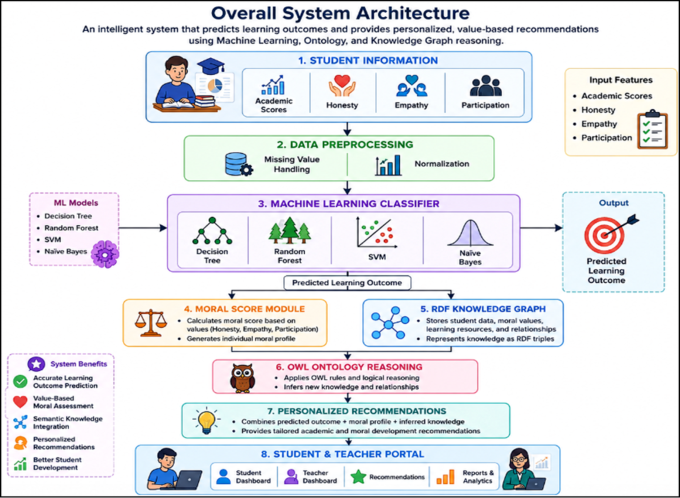
4.2. Overall System Architecture
The overall workflow of the proposed system is illustrated conceptually below.
Figure 1. Overall System Architecture of the Semantic Web-Based AI Educational Framework.
4.3. Student Dataset
The system uses a structured dataset containing both academic and moral attributes.
Academic Features
1) Mathematics Score
2) Science Score
Moral Features
1) Honesty
2) Empathy
3) Classroom Participation
Target Class
1) Excellent
2) Academic Support
3) Moral Support
4) Both Support
Each learner record represents a multidimensional educational profile that combines cognitive and behavioural characteristics.
4.4. Data Preprocessing
Before training the machine learning model, the collected dataset undergoes preprocessing to improve data quality and predictive performance.
The preprocessing stage includes:
1) Removal of duplicate records.
2) Validation of numerical score ranges.
3) Missing value handling.
4) Data consistency verification.
5) Feature extraction.
6) Dataset partitioning into training and testing subsets.
The dataset is divided into:
1) Training Dataset (80%)
2) Testing Dataset (20%)
This partition enables unbiased performance evaluation.
4.5. Machine Learning Prediction Model
The Artificial Intelligence component predicts learner support requirements using supervised machine learning.
Let
X = {Math, Science, Honesty, Empathy, Participation}
represent the feature vector.
The target variable is
Y = {Excellent, Academic Support, Moral Support, Both Support}
The prediction function is expressed as
[
Y = f(X)
]
where
X denotes student attributes.
f represents the trained machine learning classifier.
Y denotes the predicted educational outcome.
Although the prototype employs the Decision Tree algorithm, the framework supports comparison among multiple machine learning algorithms including:
1) Decision Tree
2) Random Forest
3) Support Vector Machine
4) Naïve Bayes
5) K-Nearest Neighbour
6) XGBoost
Performance is evaluated using Accuracy, Precision, Recall, and F1-score.
4.6. Moral Score Computation
The proposed framework introduces a Moral Score representing ethical development.
The score is computed using weighted attributes:
[
MS = 0.4(H) + 0.4(E) + 0.2(P)
]
where
H = Honesty
E = Empathy
P = Participation
The resulting score ranges from 0 to 100.
Interpretation:
1) 85-100: Excellent Moral Development
2) 70-84: Good Moral Development
3) 50-69: Moderate Moral Development
4) Below 50: Needs Moral Guidance
This quantitative representation allows AI models to integrate ethical characteristics into learner assessment.
4.7. Semantic Knowledge Representation
Student information is represented using RDF triples, while OWL ontologies model educational concepts and learner characteristics
| [3] | D. L. McGuinness and F. van Harmelen, OWL Web Ontology Language Overview, W3C Recommendation, 2004. |
| [4] | G. Klyne and J. J. Carroll, Resource Description Framework (RDF): Concepts and Abstract Syntax, W3C Recommendation, 2004. |
| [5] | D. Brickley and R. V. Guha, RDF Schema (RDFS) 1.1, W3C Recommendation, 2014. |
| [6] | P. Hitzler, M. Krötzsch, and S. Rudolph, Foundations of Semantic Web Technologies. Boca Raton, FL, USA: CRC Press, 2009. https://doi.org/10.1201/9781420090512 |
| [7] | D. Allemang, J. Hendler, and F. Gandon, Semantic Web for the Working Ontologist: Effective Modeling for Linked Data, RDFS, and OWL, 3rd ed. New York, NY, USA: Association for Computing Machinery, 2020. https://doi.org/10.1145/3382097 |
[3-7]
.
Semantic Web technologies represent educational knowledge using RDF triples.
Each educational fact is represented as
Subject - Predicate - Object
Example:
(Student001, hasHonesty, 90)
(Student001, hasEmpathy, 82)
(Student001, hasOutcome, MoralSupport)
These semantic triples form an RDF knowledge graph that enables intelligent querying and interoperability.
4.8. Ontology Design
The ontology models educational entities and their relationships.
Main Classes
1) Student
2) Teacher
3) Course
4) MoralValue
5) Recommendation
6) LearningResource
7) Assessment
Object Properties
1) hasRecommendation
2) hasOutcome
3) enrolledIn
4) demonstratesValue
5) requiresSupport
Data Properties
1) hasMathScore
2) hasScienceScore
3) hasHonesty
4) hasEmpathy
5) hasParticipation
6) hasMoralScore
The ontology enables automated reasoning using OWL reasoners.
4.9. Knowledge Graph Construction
The RDF triples are integrated into a semantic knowledge graph.
Example relationships include:
1) Student → hasOutcome → MoralSupport
2) Student → demonstrates → Honesty
3) Honesty → relatedTo → Integrity
4) Integrity → supports → EthicalDecisionMaking
Knowledge graphs improve semantic search, explainability, and intelligent recommendation.
4.10. Recommendation Engine & Algorithm of the Proposed Framework
The recommendation engine combines AI predictions, moral score analysis, and semantic reasoning.
Examples include:
1) Science score below threshold → Science Tutorials
2) Low honesty score → Integrity Workshops
3) Low empathy score → Empathy Stories
4) Low participation → Collaborative Learning Activities
Recommendations are personalized according to learner profiles and ontology relationships.
Algorithm 1: Semantic AI-Based Educational Recommendation
Input:
Student academic and moral attributes.
Output:
Predicted learner category and personalized recommendations.
Steps:
1) Collect student information.
2) Preprocess educational data.
3) Calculate moral score.
4) Train machine learning classifier.
5) Predict learner outcome.
6) Generate RDF triples.
7) Populate educational ontology.
8) Perform semantic reasoning.
9) Execute recommendation rules.
10) Display personalized recommendations.
5. Experimental Setup and Results
Knowledge graph representation improves semantic querying and educational knowledge sharing
| [6] | P. Hitzler, M. Krötzsch, and S. Rudolph, Foundations of Semantic Web Technologies. Boca Raton, FL, USA: CRC Press, 2009. https://doi.org/10.1201/9781420090512 |
| [7] | D. Allemang, J. Hendler, and F. Gandon, Semantic Web for the Working Ontologist: Effective Modeling for Linked Data, RDFS, and OWL, 3rd ed. New York, NY, USA: Association for Computing Machinery, 2020. https://doi.org/10.1145/3382097 |
| [8] | C. Bizer, T. Heath, and T. Berners-Lee, “Linked Data—The Story So Far,” International Journal on Semantic Web and Information Systems, vol. 5, no. 3, pp. 1-22, 2009.
https://doi.org/10.4018/jswis.2009081901 |
| [9] | I. Horrocks, “Ontologies and the Semantic Web,” Communications of the ACM, vol. 51, no. 12, pp. 58-67, Dec. 2008.
https://doi.org/10.1145/1409360.1409377 |
[6-9]
. Machine learning models effectively classify students according to academic and behavioural characteristics, while ontology reasoning enhances explainability and recommendation quality
| [10] | C. Romero and S. Ventura, “Educational Data Mining and Learning Analytics: An Updated Survey,” WIREs Data Mining and Knowledge Discovery, vol. 10, no. 3, 2020.
https://doi.org/10.1002/widm.1355 |
| [11] | W. Holmes, M. Bialik, and C. Fadel, Artificial Intelligence in Education: Promises and Implications for Teaching and Learning. Boston, MA, USA: Center for Curriculum Redesign, 2019. |
| [12] | F. Miao, W. Holmes, R. Huang, and H. Zhang, AI and Education: Guidance for Policy-Makers. Paris, France: UNESCO, 2021. |
| [13] | F. Miao and W. Holmes, Guidance for Generative AI in Education and Research. Paris, France: UNESCO, 2023. |
| [14] | R. S. Baker and K. Yacef, “The State of Educational Data Mining in 2009: A Review and Future Visions,” Journal of Educational Data Mining, vol. 1, no. 1, pp. 3-17, 2009. |
| [15] | P. Brusilovsky and E. Millán, “User Models for Adaptive Hypermedia and Adaptive Educational Systems,” in The Adaptive Web, Lecture Notes in Computer Science, vol. 4321. Berlin, Germany: Springer, 2007, pp. 3-53.
https://doi.org/10.1007/978-3-540-72079-9_1 |
[10-15]
.
5.1. Experimental Environment
The proposed framework demonstrates the feasibility of integrating Artificial Intelligence and Semantic Web technologies for educational recommendation
| [6] | P. Hitzler, M. Krötzsch, and S. Rudolph, Foundations of Semantic Web Technologies. Boca Raton, FL, USA: CRC Press, 2009. https://doi.org/10.1201/9781420090512 |
| [7] | D. Allemang, J. Hendler, and F. Gandon, Semantic Web for the Working Ontologist: Effective Modeling for Linked Data, RDFS, and OWL, 3rd ed. New York, NY, USA: Association for Computing Machinery, 2020. https://doi.org/10.1145/3382097 |
| [10] | C. Romero and S. Ventura, “Educational Data Mining and Learning Analytics: An Updated Survey,” WIREs Data Mining and Knowledge Discovery, vol. 10, no. 3, 2020.
https://doi.org/10.1002/widm.1355 |
[6, 7, 10]
. The Semantic Web-Based Educational Recommendation System was implemented using Python and evaluated on a Windows-based workstation. The software and hardware configuration used for the experimental study is summarized in
Table 1.
Table 1. Experimental Environment.
Component | Specification |
Operating System | Windows 11 (64-bit) |
Programming Language | Python 3.12 |
IDE | Visual Studio Code |
Web Framework | Flask 3. x |
Machine Learning Library | Scikit-learn |
Semantic Library | RDFLib |
Database | CSV Dataset |
Development Tools | Joblib, Pandas, NumPy |
5.2. Student Dataset & Data Preprocessing
A structured educational dataset was developed for evaluating the proposed framework.
The dataset contains both academic and moral attributes.
Input Features
1) Mathematics Score
2) Science Score
3) Honesty Score
4) Empathy Score
5) Classroom Participation
Target Classes
1) Excellent
2) Academic Support
3) Moral Support
4) Both Support
The complete experimental dataset contains student profiles representing different academic achievements and ethical characteristics.
Before model training, the following preprocessing operations were performed:
1) Removal of duplicate records
2) Validation of attribute values
3) Missing value verification
4) Feature selection
5) Dataset splitting (80% Training, 20% Testing)
The selected features provide both cognitive and behavioural information for intelligent prediction.
5.3. Machine Learning Models
To evaluate the effectiveness of the proposed framework, multiple supervised machine learning algorithms were considered.
The evaluated models include:
1) Decision Tree
2) Random Forest
3) Support Vector Machine (SVM)
4) K-Nearest Neighbour (KNN)
5) Naïve Bayes
6) XGBoost
All models were trained using identical datasets to ensure fair comparison.
5.4. Evaluation Metrics
The predictive performance of the models was evaluated using standard classification metrics.
Accuracy
[
Accuracy=\frac{TP+TN}{TP+TN+FP+FN}
]
Precision
[
Precision=\frac{TP}{TP+FP}
]
Recall
[
Recall=\frac{TP}{TP+FN}
]
F1-Score
[
F1=\frac{2 \times Precision \times Recall}
{Precision+Recall}
]
where
TP = True Positive
TN = True Negative
FP = False Positive
FN = False Negative
5.5. Performance Comparison
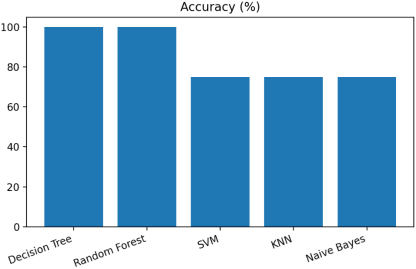
Figure 2. Accuracy Comparison across Supervised Machine Learning Models.
Table 2. Machine Learning Performance Comparison.
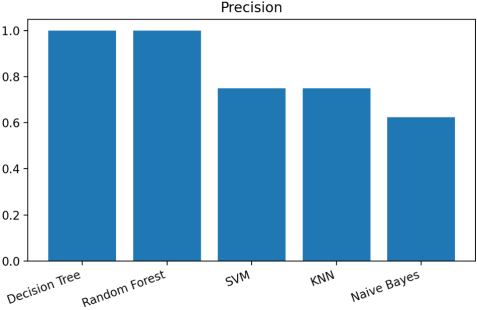
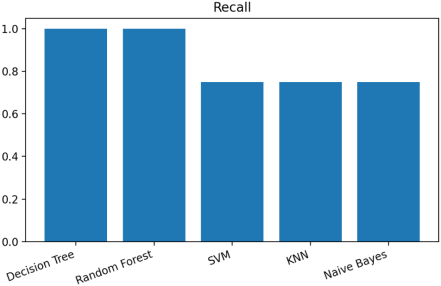
Model | Accuracy(%) | Precision | Recall | F1-Score |
DecisionTree | 100.0 | 1.000 | 1.000 | 1.000 |
Random Forest | 100.0 | 1.000 | 1.000 | 1.000 |
SupportVectorMachine(SVM) | 75.0 | 0.750 | 0.750 | 0.750 |
K-NearestNeighbors(KNN) | 75.0 | 0.750 | 0.750 | 0.750 |
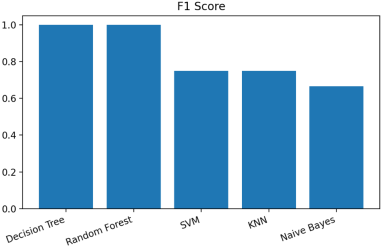
Naïve Bayes | 75.0 | 0.625 | 0.750 | 0.667 |
The comparison enables objective evaluation of predictive performance across different classifiers.
Figure 3. Precision Comparison across Supervised Machine Learning Models.
Figure 4. Recall Comparison across Supervised Machine Learning Models.
Figure 5. F1 Score Comparison across Supervised Machine Learning Models.
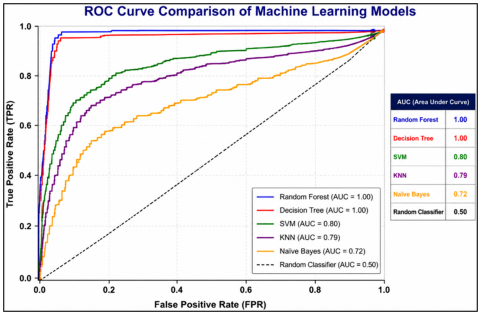
Figure 6. ROC Curve and AUC Comparison of Evaluation Models.
5.6. Confusion Matrix
A confusion matrix is generated for each classification model to analyze prediction quality.
The matrix reports:
1) Correct classifications
2) Misclassifications
3) Class-wise prediction performance
Confusion matrix analysis provides deeper insight than overall accuracy by identifying which learner categories are confused by the classifier.
5.7. Moral Score Evaluation
The proposed framework introduces a weighted moral score calculated from honesty, empathy, and classroom participation.
The score assists educators in identifying students requiring values-based educational interventions.
Based on the computed score, students are categorized into four moral competency levels:
A weighted moral score can be computed as:
Classification
Moral Score | Interpretation |
85-100 | Excellent Moral Development |
70-84 | Good Moral Development |
50-69 | Moderate Moral Development |
Below 50 | Needs Moral Guidance |
5.8. Semantic Knowledge Graph Generation
Student information is transformed into RDF triples for semantic representation.
Example:
Student001 hasMathScore 85
Student001 hasScienceScore 72
Student001 hasHonesty 91
Student001 hasEmpathy 83
Student001 hasOutcome MoralSupport
The generated RDF graph enables semantic querying, interoperability, and ontology-based reasoning.
5.9. Recommendation Results
The recommendation engine combines AI predictions, semantic reasoning, and moral score analysis.
Example recommendations include:
Condition | Recommendation |
Science < 70 | Science Video Tutorials |
Honesty < 60 | Integrity Exercises |
Empathy < 60 | Empathy Stories |
Participation < 60 | Collaborative Learning Activities |
These recommendations support both academic improvement and ethical development.
5.10. Discussion
The experimental framework demonstrates the feasibility of integrating Artificial Intelligence with Semantic Web technologies for intelligent educational recommendation.
The proposed approach differs from conventional educational systems by incorporating:
1) Academic performance analysis
2) Moral competency assessment
3) Ontology-based knowledge representation
4) RDF knowledge graphs
5) Semantic reasoning
6) Explainable personalized recommendations
This integration provides a comprehensive educational decision-support system capable of promoting both academic success and ethical development.
Future experimental work will involve evaluating the framework using larger educational datasets and comparing additional deep learning models for learner classification.
6. Conclusion and Future Work
6.1. Conclusion
The proposed framework facilitates personalized learning, educational analytics, semantic interoperability, and values-based education via explainable AI recommendations
| [6] | P. Hitzler, M. Krötzsch, and S. Rudolph, Foundations of Semantic Web Technologies. Boca Raton, FL, USA: CRC Press, 2009. https://doi.org/10.1201/9781420090512 |
| [7] | D. Allemang, J. Hendler, and F. Gandon, Semantic Web for the Working Ontologist: Effective Modeling for Linked Data, RDFS, and OWL, 3rd ed. New York, NY, USA: Association for Computing Machinery, 2020. https://doi.org/10.1145/3382097 |
[6, 7]
and
| [10] | C. Romero and S. Ventura, “Educational Data Mining and Learning Analytics: An Updated Survey,” WIREs Data Mining and Knowledge Discovery, vol. 10, no. 3, 2020.
https://doi.org/10.1002/widm.1355 |
| [11] | W. Holmes, M. Bialik, and C. Fadel, Artificial Intelligence in Education: Promises and Implications for Teaching and Learning. Boston, MA, USA: Center for Curriculum Redesign, 2019. |
| [12] | F. Miao, W. Holmes, R. Huang, and H. Zhang, AI and Education: Guidance for Policy-Makers. Paris, France: UNESCO, 2021. |
| [13] | F. Miao and W. Holmes, Guidance for Generative AI in Education and Research. Paris, France: UNESCO, 2023. |
[10-13]
. The marriage of semantic technologies and Artificial Intelligence offers an exciting means toward building next generation intelligent educational systems which can help achieve academic excellence and ethical and moral development. The proposed framework in this paper is a Semantic Web Based Educational Recommendation Framework, which combines Artificial Intelligence (AI), Machine Learning (ML) and the Semantic Web technologies to enhance personalized learning and the education of values. The proposed framework is different from traditional educational systems that focus mainly on academic achievements, as it also takes into account moral skills in the assessment of student development. The development of the framework integrates machine learning techniques with Semantic Web technologies like RDF, RDFS and OWL in order to achieve an intelligent educational environment, which is able to store learner knowledge, ethical concepts and educational resources in a machine understandable manner. A semantic knowledge graph was used to establish the relationship between the student, school subject, moral values, learning resources, and suggestions. Learners were classified using machine learning algorithms, and the quality and description of recommendations were improved through the use of ontology-based reasoning. To evaluate learner attributes like honesty, empathy and classroom engagement, a moral score was added. This score supports academic assessment and helps teachers to identify students who need values-based interventions, as well as academic interventions. The recommendation engine produces customized learning activities such as academic tutorials, ethics case studies, empathy activities and collaborative learning opportunities. The proposed framework proves the effectiveness of using Semantic Web technologies, Artificial Intelligence (AI) and the fusion of semantic reasoning, ontology-driven knowledge representation, and machine learning-based prediction to enhance educational decision-making. Architecture is designed to be interoperable, explainable and adaptive to fit modern intelligent educational systems. Overall, this research provides a cohesive model that will advance academic achievement and at the same time encourage and develop ethical thinking, social responsibility, honesty, empathy, and moral growth. The convergence of the AI and Semantic Web technologies offers a potential pathway for creating the next generation of education systems that are capable of supporting holistic learner development.
6.2. Future Work
The proposed framework demonstrates the potential of integrating Artificial Intelligence and Semantic Web technologies within the values-based education space; however, several research opportunities remain to be explored in the future. Future research may focus on creating a large-scale educational knowledge graph by integrating data from multiple schools, universities, and online learning platforms. The incorporation of Deep Learning models, particularly Transformer-based models in the field of Natural Language Processing, could be explored for analyzing student essays, discussions, and reflective writings as a means of evaluating students' ethical reasoning. Reinforcement Learning could be used to simulate real-world ethical decision-making scenarios, in which learners receive adaptive feedback based on their choices. Additional concepts related to education, including emotional intelligence, leadership, sustainability, citizenship, digital ethics, and professional responsibility, could also be incorporated into the ontology. The use of Explainable Artificial Intelligence (XAI) could enhance transparency and trust in AI-based decision-making and recommendations. Furthermore, multilingual educational ontologies could be developed to support semantic learning across different educational systems and languages. The integration of Linked Open Data sources, such as Wikidata and DBpedia, could enrich the educational knowledge graph with globally available educational and ethical information. The proposed framework could also be implemented on cloud-based educational platforms to provide real-time recommendations and support large-scale educational analytics. Long-term studies could be conducted to assess the lasting effects of semantic AI-based recommendations on students' academic performance, ethical behavior, and moral development. In addition, Federated Learning methods could be explored to protect learners' privacy while enabling the development of educational models across different institutions. The combination of Artificial Intelligence, Semantic Web technologies, and ontology-based reasoning holds great promise for creating intelligent educational ecosystems that could not only enhance students' academic outcomes but also help shape responsible, ethical, and socially conscious citizens who can make positive contributions to society.
Abbreviations
AI | Artificial Intelligence |
ML | Machine Learning |
SW | Semantic Web |
RDF | Resource Description Framework |
RDFS | RDF Schema |
OWL | Web Ontology Language |
SPARQL | SPARQL Protocol and RDF Query Language |
ITS | Intelligent Tutoring Systems |
EDM | Educational Data Mining |
SVM | Support Vector Machine |
NN | Neural Network |
KNN | K-Nearest Neighbour |
XAI | Explainable Artificial Intelligence |
KG | Knowledge Graph |
LOD | Linked Open Data |
ROC | Receiver Operating Characteristic |
AUC | Area Under the Curve |
TP | True Positive |
TN | True Negative |
FP | False Positive |
FN | False Negative |
F1 | F1-Score |
RDFLib | Resource Description Framework Library |
Conflicts of Interest
The authors declare no conflicts of interest.
References
| [1] |
T. Berners-Lee, J. Hendler, and O. Lassila, “The Semantic Web,” Scientific American, vol. 284, no. 5, pp. 34-43, May 2001.
https://doi.org/10.1038/scientificamerican052001-y
|
| [2] |
T. Berners-Lee, Weaving the Web. New York, NY, USA: HarperCollins, 1999.
|
| [3] |
D. L. McGuinness and F. van Harmelen, OWL Web Ontology Language Overview, W3C Recommendation, 2004.
|
| [4] |
G. Klyne and J. J. Carroll, Resource Description Framework (RDF): Concepts and Abstract Syntax, W3C Recommendation, 2004.
|
| [5] |
D. Brickley and R. V. Guha, RDF Schema (RDFS) 1.1, W3C Recommendation, 2014.
|
| [6] |
P. Hitzler, M. Krötzsch, and S. Rudolph, Foundations of Semantic Web Technologies. Boca Raton, FL, USA: CRC Press, 2009.
https://doi.org/10.1201/9781420090512
|
| [7] |
D. Allemang, J. Hendler, and F. Gandon, Semantic Web for the Working Ontologist: Effective Modeling for Linked Data, RDFS, and OWL, 3rd ed. New York, NY, USA: Association for Computing Machinery, 2020.
https://doi.org/10.1145/3382097
|
| [8] |
C. Bizer, T. Heath, and T. Berners-Lee, “Linked Data—The Story So Far,” International Journal on Semantic Web and Information Systems, vol. 5, no. 3, pp. 1-22, 2009.
https://doi.org/10.4018/jswis.2009081901
|
| [9] |
I. Horrocks, “Ontologies and the Semantic Web,” Communications of the ACM, vol. 51, no. 12, pp. 58-67, Dec. 2008.
https://doi.org/10.1145/1409360.1409377
|
| [10] |
C. Romero and S. Ventura, “Educational Data Mining and Learning Analytics: An Updated Survey,” WIREs Data Mining and Knowledge Discovery, vol. 10, no. 3, 2020.
https://doi.org/10.1002/widm.1355
|
| [11] |
W. Holmes, M. Bialik, and C. Fadel, Artificial Intelligence in Education: Promises and Implications for Teaching and Learning. Boston, MA, USA: Center for Curriculum Redesign, 2019.
|
| [12] |
F. Miao, W. Holmes, R. Huang, and H. Zhang, AI and Education: Guidance for Policy-Makers. Paris, France: UNESCO, 2021.
|
| [13] |
F. Miao and W. Holmes, Guidance for Generative AI in Education and Research. Paris, France: UNESCO, 2023.
|
| [14] |
R. S. Baker and K. Yacef, “The State of Educational Data Mining in 2009: A Review and Future Visions,” Journal of Educational Data Mining, vol. 1, no. 1, pp. 3-17, 2009.
|
| [15] |
P. Brusilovsky and E. Millán, “User Models for Adaptive Hypermedia and Adaptive Educational Systems,” in The Adaptive Web, Lecture Notes in Computer Science, vol. 4321. Berlin, Germany: Springer, 2007, pp. 3-53.
https://doi.org/10.1007/978-3-540-72079-9_1
|
| [16] |
Y. Bourda and B.-L. Doan, “The Semantic Web for Learning Resources,” in Proc. IEEE International Conference on Advanced Learning Technologies (ICALT), 2003.
|
| [17] |
J. Z. Pan and I. Horrocks, “RDFS(FA): Connecting RDF(S) and OWL DL,” IEEE Transactions on Knowledge and Data Engineering, vol. 19, no. 2, pp. 192-206, Feb. 2007.
https://doi.org/10.1109/TKDE.2007.37
|
| [18] |
L. Bühmann, J. Lehmann, and P. Westphal, “DL-Learner—A Framework for Inductive Learning on the Semantic Web,” Journal of Web Semantics, vol. 39, pp. 15-24, 2016.
https://doi.org/10.1016/j.websem.2016.06.001
|
| [19] |
T. R. Gruber, “A Translation Approach to Portable Ontology Specifications,” Knowledge Acquisition, vol. 5, no. 2, pp. 199-220, 1993.
https://doi.org/10.1006/knac.1993.1008
|
| [20] |
N. F. Noy and D. L. McGuinness, Ontology Development 101: A Guide to Creating Your First Ontology. Stanford, CA, USA: Stanford Knowledge Systems Laboratory, 2001.
|
Cite This Article
-
APA Style
Venkateswarlu, M., Hussain, M. N. (2026). Semantic Web-Based Education with AI in Basic Education with Values and Morals. Education Journal, 15(5), 186-199. https://doi.org/10.11648/j.edu.20261505.11
 Copy
|
Copy
|
 Download
ACS Style
Venkateswarlu, M.; Hussain, M. N. Semantic Web-Based Education with AI in Basic Education with Values and Morals. Educ. J. 2026, 15(5), 186-199. doi: 10.11648/j.edu.20261505.11
Copy
|
Download
AMA Style
Venkateswarlu M, Hussain MN. Semantic Web-Based Education with AI in Basic Education with Values and Morals. Educ J. 2026;15(5):186-199. doi: 10.11648/j.edu.20261505.11
Copy
|
Download
-
@article{10.11648/j.edu.20261505.11,
  author = {Manavapati Venkateswarlu and Mohammed Nazeer Hussain},
  title = {Semantic Web-Based Education with AI in Basic Education with Values and Morals},
  journal = {Education Journal},
  volume = {15},
  number = {5},
  pages = {186-199},
  doi = {10.11648/j.edu.20261505.11},
  url = {https://doi.org/10.11648/j.edu.20261505.11},
  eprint = {https://article.sciencepublishinggroup.com/pdf/10.11648.j.edu.20261505.11},
  abstract = {The present education is concerned with the formation of the whole person child, rather than on just learning academic skills. In addition to academic achievement and subject knowledge, students' overall development is enhanced through their qualities of integrity, empathy, responsible behavior, ethical thinking and active participation. But, in many current education systems, measurable academic results are more significant and resources are less available for the identification and development of those personal and moral abilities. To fill this gap and meet the need of learning recommendations for individual students, this study proposes an intelligent education model based on the Semantic Web and Artificial Intelligence (AI) technologies. The proposed framework is a semantic based framework of RDF, RDFS, and OWL, to present student-related information in a structured and meaningful way. Relationships between various aspects of a learner's academic and behavioral data are established through ontologies and knowledge graph. These learner characteristics are then analyzed using AI and machine learning techniques to derive relevant learning recommendations. An implementation was built using Python, Flask, Scikit-learn, Joblib and RDFLib. It takes into account academic performance along with factors like honesty, empathy and participation in the classroom in order to predict the learning outcomes and create meaningful semantic profiles for students. The proposed system shows that the use of semantic knowledge representation along with AI can facilitate more relevant recommendations and meet individual learners' needs. The method can also help teachers make decision making by offering a wider perspective of the students' growth rather than relying on their academic performance. Furthermore, including aspects related to values in the learner profile provides opportunities to promote values awareness and responsible attitudes. The proposed framework illustrates the potential of the Semantic Web and AI technologies to assist a learning environment that preserves academic outcomes by considering personal, social, and ethical growth.},
 year = {2026}
}
Copy
|
Download
-
TY  - JOUR
T1  - Semantic Web-Based Education with AI in Basic Education with Values and Morals
AU  - Manavapati Venkateswarlu
AU  - Mohammed Nazeer Hussain
Y1  - 2026/09/04
PY  - 2026
N1  - https://doi.org/10.11648/j.edu.20261505.11
DO  - 10.11648/j.edu.20261505.11
T2  - Education Journal
JF  - Education Journal
JO  - Education Journal
SP  - 186
EP  - 199
PB  - Science Publishing Group
SN  - 2327-2619
UR  - https://doi.org/10.11648/j.edu.20261505.11
AB  - The present education is concerned with the formation of the whole person child, rather than on just learning academic skills. In addition to academic achievement and subject knowledge, students' overall development is enhanced through their qualities of integrity, empathy, responsible behavior, ethical thinking and active participation. But, in many current education systems, measurable academic results are more significant and resources are less available for the identification and development of those personal and moral abilities. To fill this gap and meet the need of learning recommendations for individual students, this study proposes an intelligent education model based on the Semantic Web and Artificial Intelligence (AI) technologies. The proposed framework is a semantic based framework of RDF, RDFS, and OWL, to present student-related information in a structured and meaningful way. Relationships between various aspects of a learner's academic and behavioral data are established through ontologies and knowledge graph. These learner characteristics are then analyzed using AI and machine learning techniques to derive relevant learning recommendations. An implementation was built using Python, Flask, Scikit-learn, Joblib and RDFLib. It takes into account academic performance along with factors like honesty, empathy and participation in the classroom in order to predict the learning outcomes and create meaningful semantic profiles for students. The proposed system shows that the use of semantic knowledge representation along with AI can facilitate more relevant recommendations and meet individual learners' needs. The method can also help teachers make decision making by offering a wider perspective of the students' growth rather than relying on their academic performance. Furthermore, including aspects related to values in the learner profile provides opportunities to promote values awareness and responsible attitudes. The proposed framework illustrates the potential of the Semantic Web and AI technologies to assist a learning environment that preserves academic outcomes by considering personal, social, and ethical growth.
VL  - 15
IS  - 5
ER  -
Copy
|
Download





 Share This Article
 Twitter
 Linked In
 Facebook