Research Article | | Peer-Reviewed

Assessment of Patient Satisfaction in the Cardiology Department of Aristide Dantec Hospital (Senegal)

Received: 11 November 2025     Accepted: 5 February 2026     Published: 4 March 2026
Views:       Downloads:
Abstract

Introduction. The objective was to assess the level of satisfaction of patients hospitalized in the cardiology department of Aristide Dantec Hospital. Methodology. It was a descriptive cross-sectional study focusing on the level of satisfaction of patients hospitalized in the cardiology department during the period from February 15, 2020, to May 15, 2021. These patients are chosen at random (the patient sample was compiled as patients were discharged from the hospital). Previously, we conducted a preliminary survey on 7 patients to reformulate the questions and assess the time required to complete the test. The data were collected from a questionnaire, then entered and analysed (calculation of frequencies and averages) using Microsoft Excel software. Results. The average age was 55.6 years. The female population represented 54% and the sex ratio was 0.85. The proportion of patients without income was 41.3%. All patients found the reception as satisfactory. The respect for privacy was deemed satisfactory by 92% of the patients. A third (33%) of patients had always received explanations regarding their health condition and diagnosis. The layout and cleanliness of the hospital rooms were deemed satisfactory by 98% of the patients. The quality of the meals was deemed satisfactory by most (84.7%) of the patients. Conclusion. Patient satisfaction is a key dimension of hospital management and quality of care assessment. Thus, to improve patient satisfaction, it is necessary to strengthen human resources, tailor uniforms for each socio-professional category, and periodically train all medical, paramedical, and support staff on reception.

Published in Central African Journal of Public Health (Volume 12, Issue 2)
DOI 10.11648/j.cajph.20261202.11
Page(s) 57-63
Creative Commons

This is an Open Access article, distributed under the terms of the Creative Commons Attribution 4.0 International License (http://creativecommons.org/licenses/by/4.0/), which permits unrestricted use, distribution and reproduction in any medium or format, provided the original work is properly cited.

Copyright

Copyright © The Author(s), 2026. Published by Science Publishing Group

Keywords

Satisfaction, Hospitalization, Cardiology Department, Dantec Hospital, Senegal

1. Introduction
The development of infrastructure does not always go hand in hand with taking into account human and relational dimensions, while the needs and demands of the population in terms of care increasing . Users have an increasingly heightened perception of the healthcare system. Thus, patients’ opinions should help in improving the quality of care thru the selection of measures aimed at the quality of service provided, as it constitutes a significant resource in identifying dysfunctions in healthcare organizations . According to Donabedian, “patient satisfaction is of fundamental importance as a measure of quality of care” and “the objective of medical care is not only to improve the patient's health status but also to meet their expectations and ensure their satisfaction” .
In many developed countries, institutions are required to conduct regular patient satisfaction assessments as it is a measure of quality of care .
In Senegal, customer relations are regulated by a set of mechanisms (decentralization, community participation, financing strategies, etc.). This relationship helps institutions improve the efficiency of care, the patient journey, and achieve better satisfaction from users and consumers of their services. Despite all these actions, Senegal's healthcare system has not achieved complete equity in access to care . Apart from organizational imperatives, measuring satisfaction has become a necessity since it is strongly linked to adherence to treatment adherence, continuity of care, and improved health status . All this because the patient is no longer consultant or a user but a client just like their family and entourage, and they have become more demanding regarding the quality of service .
At the Aristide Dantec Hospital, there are issues with improving the care environment (physical and psychosocial), taking into account the expectations of users, and the quality of medical and non-medical services (care, catering, etc.) that can impact patient satisfaction.
Thus, to gain insight into the perceptions of clients regarding the services provided and the hospital environment, the study on the level of satisfaction of hospitalized patients was conducted in the cardiology department of Aristide Dantec Hospital.
2. Methodology
2.1. Study Framework
The Aristide Dantec Hospital Center is a level 3 public health institution. It must ensure equitable access to care for all patients. The funding for its activities the State, local authorities, development partners, and households. It experienced financial difficulties, characterized by a debt of one billion seven hundred million with suppliers, an insufficient subsidy to ensure the care of people aged 60 and over (Sesam plan). These buildings were dilapidated. Despite this situation, it had received 1,700 patients, who came from Senegal and the sub-region, including more than 3,500 social cases. The staff numbered more than 1,000 agents. The state was slow to clear the debts related to free services (Sesam plan, caesarean sections, care for children under five old, etc.).
The consequences of this situation were the refusal of the national supply pharmacy to deliver medications to the facility and the slowdown in the functioning of the cardiology, oncology, cardiology, laboratory, radiology, and all departments of the facility . The cardiology department has a triple vocation of care, training, and research. It provided care for cardiovascular emergencies and developed invasive procedures. He was located three hundred meters from the main entrance of the hospital. It had a reception and consultation unit, a hospitalization unit, a women's section, and a men's section. It had six rooms (angiography, coronary angiography, electrocardiography, Doppler ultrasound, non-invasive exploration, courses, and archives), ten offices (seven for doctors, one for the chief resident, and two secretariats). The staff consisted of doctors (three full professors, two associate professors, one assistant clinical director, thirty doctors in training, and six hospital interns), paramedical staff (five state-certified nurses, three licensed nurses, ten nursing assistants, five stretcher-bearers, and two ward clerks), and administrative staff (three secretaries and one archivist). On an organizational level, the service operates by sectorization (consultation, exploration, invasive procedures, and hospitalization). In hospitalization, on-call duties were covered by a team of doctors and nurses from 8 AM to 5 PM, and the guard by another team from 5 PM to 8 AM.
2.2. Type of Study
It was a descriptive cross-sectional study that focused on the level of satisfaction of patients hospitalized in the cardiology department during the period from February 15, 2020, to May 15.
2.3. Sampling
These patients are chosen at random (the patient sample was compiled as patients were discharged from the hospital). Previously, we conducted a preliminary survey on 7 patients to reformulate the questions and assess the time required to complete the test. Patients were selected at random. The inclusion criteria were acceptance to participate and clear and complete completion of the questionnaire. The exclusion criteria were poor general health and inability to give opinions.
2.4. Tools and Collection Technique
The questionnaire was used in data collection. It was given to patients during the study period upon their discharge from their hospital room and filled out either by the patient themselves or, if not, with the help of a relative or a healthcare worker.
2.5. Analysis Plan
The data were entered and analyzed on a computer using Microsoft Excel software. The description was carried out by calculating frequencies (qualitative variable) and averages (quantitative variable).
2.6. Ethical Considerations
A request for an investigation was submitted to the head of the institution. Which allowed the head of the cardiology department to give his favorable opinion. All patients who participated in the study had given their consent. There was no negative action for any patient who refused to participate in the study. The confidentiality and anonymity of the data were ensured for all participants.
3. Results
Out of two hundred and two distributed forms, there were one hundred and fifty forms filled out by the patients (representing a response rate of 75%).
3.1. Socio-demographic Data
The average age of the patients surveyed was 55.6 years. The minimum age was 17 and the maximum age was 91. Patients aged 60 and over accounted for just under half (40%) of the sample. There were a predominance of women (54%) and a sex ratio of 0.85. Patients who were in employment accounted for 58.7% of the study population and 41.3% had no income. In terms of educational attainment, 45.4% of patients had no formal education. Many patients (40%) came from the suburbs, and those from rural areas accounted for 18.6%. As for marital status, 62% of patients were married.
3.2. Quality of Care
3.2.1. Nurses
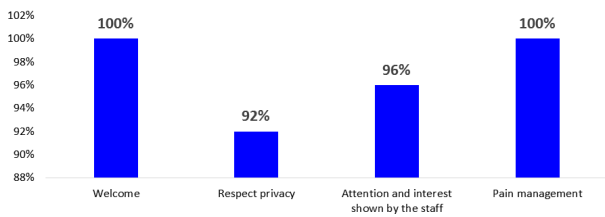
All patients were satisfied with the welcome they received. The level of satisfaction with respect for patient privacy was 92%. However, 1.3% were dissatisfied and 6.7% did not know. Ninety-six percent (96%) of patients were satisfied with the attention and interest shown by staff. All patients were satisfied with pain management. (Figure 1)
Figure 1. Quality assessment of nursing care and services.
3.2.2. Doctors
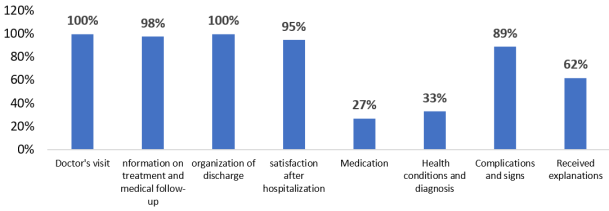
All patients were satisfied with the doctor's visit. Less than one-third (27%) had always received explanations about their medications. One-third (33%) of patients had always received explanations about their health condition and diagnosis, and 62% had often received explanations. More than half of patients (89%) were satisfied with the information they received about complications and warning signs. Regarding information about treatment and follow-up care, 98% of patients were satisfied. All patients were satisfied with the organization of their discharge. Almost all patients (95.3%) said they felt better after hospitalization. (Figure 2)
Figure 2. Evaluation of doctor's care and services.
3.3. Environment
The layout and cleanliness of the hospital rooms were deemed satisfactory by almost all patients (98%). All were satisfied with the layout and cleanliness of the bathrooms, the set hours for visitors. Thirty-eight percent (38%) of the patients had always rated the rest conditions in the rooms as good. The comfort in the rooms was satisfactory for more than half (94.7%) of the patients. Sixty-four-point seven percent (64.7%) of the patients had stated that they were often disturbed by the noise in the ward.
3.4. Catering
The quality of meals was considered satisfactory by most (84.7%) patients. Almost all patients (92.7%) considered the variety of meals to be satisfactory, while 7.3% were dissatisfied.
3.5. Overall Assessment
Overall, patients (96%) were satisfied with the conditions of their hospital stay. Sixty-eight percent (68%) said they would return to the department if they needed treatment for the same condition. Just over half of patients (56.7%) would recommend the department to a friend or family member if they needed treatment for the same condition. However, only 16% (n=24) of patients said they could always identify the roles of staff members.
4. Discussion
4.1. Limitations
The choice of a single case can be a limitation for the generalization of results. There are judgment biases due to the use of opinion variables, for example, satisfaction with reception and care. In this case, the responses provided by patients can be biased or even amplified based on their feelings.
4.2. Socio-demographic Data
The average age found in the study was 55.6 years. This result is comparable to the study conducted in Aquitaine, France, where the average age was 58 years . However, N'Guessan A and Wawa J A found average ages of 32 and 33 years, respectively. In Senegal, it was found that men over 55 and women over 65 were at risk of developing cardiovascular disease . In view of the demographic transition characterized by an aging population, it is important to strengthen the fight against these conditions through primary prevention and screening.
The study population consisted of 54% women with a sex ratio of 0.85. Studies conducted in Abidjan by Méité and Kouamé also found a female predominance, while those by Lataief in Tunisia and N'Guessan A. in Abidjan showed a male predominance. In Senegal, demographic data showed a predominance of women (7,658,408 women, or 50.2%, in 2018) .
The proportion of patients without income was 41.3%. The study conducted in Ho Chi Minh City, Vietnam, found that 36.4% of patients had no income . This situation can be explained by the low socioeconomic status of these two countries, which belong to the group of developing countries. In Senegal, more than one in two households (54.2%) lived below the poverty line .
4.3. Patient Satisfaction
4.3.1. Quality of Patient Reception
All patients rated the reception as satisfactory. Lohite S and N'Guessan A. found satisfaction rates of 95.3% and 90.7%, respectively. However, in a study of complaints conducted by the Paris Department of Health and Social Insurance , 64% of patients were satisfied with the reception. The hospital reception, the first link in the care chain, allows the interaction between caregiver and user to establish a relationship of mutual trust, security, and support . It plays an important role in patient satisfaction by reducing stress for patients and their companions. It reassures them about the quality of care. It is therefore necessary to provide regular training on reception procedures for all medical, paramedical, and support staff.
4.3.2. Respect for Patient Privacy
Respect for privacy was considered satisfactory by 92% of patients. This rate was identical to the results of the study conducted in hospitals in mainland France and by N'Guessan A. , with 93% and 99.3% respectively. However, it is significantly higher than the rate found (45.1%) in rural areas of Bangladesh. In Senegal, patients are very demanding when it comes to their privacy. This situation could be explained by the social and religious aspects of society, which is conservative on the whole. This is why the cardiology department at Aristide Dantec Hospital has been redesigned to include single rooms and barriers to separate hospital beds in shared wards and enhance privacy (especially for elderly patients)
4.3.3. Pain Management
Pain management was considered satisfactory by all patients (100%). A similar result (86.7%) was found in the study conducted by Ndongo in the cardiology department of Grand Yoff Hospital . Pain is one of the most common reasons for hospitalization in cardiology . Pain, whether physical or emotional, makes patients vulnerable, especially when they are weakened by illness . Therefore, relieving acute or chronic pain is an essential part of medical care.
4.3.4. Communication with Healthcare Professionals
One-third (33%) of patients had always received explanations about their health status and diagnosis. Studies conducted by Aldama K. J. in Bangladesh , N'Guessan A. in Côte d'Ivoire , and Avis M in Ontario found different results: 48.9%, 60%, and 78%, respectively. The same is true for Doering in Paris , Peyrot M and Cooper P. D at the Orléans Regional Hospital Center , and Sergine T. in healthcare facilities in metropolitan France , with results of 79%, 85%, and 83%, respectively. In the dermatology department of the Aristide Dantec Hospital, 51.1% of outpatients said they did not know the diagnosis for their condition and 42.9% of inpatients felt they did not understand their condition . The satisfaction rate depends on technical competence and the quality of relationships with caregivers .
4.3.5. Quality of the Service Environment
Almost all patients (98%) rated the layout and cleanliness of hospital rooms as satisfactory. The study conducted in the cardiology department of Yalgado Ouedraogo Hospital obtained a comparable satisfaction rate (89.4%). Comfort and cleanliness also depend on the socioeconomic status of the population studied, and therefore remain highly subjective . The layout of the hospital space has a positive impact on patients' ability to recover and on the physical and psychological well-being of healthcare staff .
4.3.6. Hospital Catering
The quality of meals was considered satisfactory by most (84.7%) patients. The study conducted in the endocrinology, pulmonology, oncology, and cardiology departments of the Hachedde F. University Hospital in Sousse showed that 33% of patients rarely eat hospital meals . Their main nutritional needs were met by food provided by their families . The results of our study reflected a commitment (staff catering for 39 150 $ USD, catering for hospitalized patients for 193 500 $ USD, and catering for resident doctors housed by the hospital for 34 200 $ USD) by the hospital to improve the catering service . In addition, nutrition is an important aspect of care in hospitals, especially for certain at-risk patients, given that most patients in cardiology departments are on special diets (diabetic, low-sodium or strict salt-free, low-calorie, low-fat, etc.).
4.3.7. Overall Satisfaction
Overall, patients (96%) were satisfied with the conditions of their hospital stay. In the dermatology department of Aristide Dantec Hospital, a comparable result of 92.4% was found . In contrast, the level of satisfaction at the International University Hospital in Casablanca, Morocco, was 77.2% . Between 2019 and 2021, the cardiology department underwent significant changes in terms of infrastructure and equipment, although there is still work to be done. In 2020, with the arrival of the new head of the department, the department was refurbished and the paramedical staff was reinforced. This change had a positive impact on the overall satisfaction of patients hospitalized in the cardiology department at Aristide Dantec Hospital.
5. Conclusion
Patient satisfaction is a key aspect of hospital management and healthcare quality assessment. Overall, the quality of care provided during hospitalization was satisfactory. However, interaction was often difficult because patients had trouble recognizing the different categories of staff. Respect for patient privacy was acceptable. In terms of the environment, the cleanliness and comfort of the rooms and bathrooms were appreciated, and some patients praised the regularity and punctuality of the cleaning services.
Thus, strengthening the hospital's human resources, continuously improving its physical environment, creating uniforms to identify different socio-professional categories, providing regular training on reception for all medical, paramedical, and support staff, and conducting satisfaction surveys (mailboxes, etc.) to encourage patients to give their opinions on their hospital stay and improve their satisfaction are actions to be implemented to strengthen the services offered to patients.
Conflicts of Interest
We declare that we have no financial, commercial, or other ties that could be perceived as a potential conflict of interest by the academic community.
Some are members of the academic community, while others are employees of the Ministry of Health and Social Action.
References
[1] Labarèse J, François P, Bertrand D, Fourry M, Olive F, Peyrin J C. Evaluation de la satisfaction des patients hospitalisés: Comparaison de plusieurs méthodes d’enquête [Evaluation of hospitalized patient satisfaction: Comparison of several survey methods]. Presse Med 10 juin 2000; 29(20): 1112-14.
[2] Nguyen P L, Lê T G, Empereur F, Briançen S. (2001) Satisfaction de patients hospitalisés à Hô Chi Minh Ville, Vietnam. Santé publique [Patient satisfaction in Ho Chi Minh City, Vietnam. Public health]; 14(4): 345-60.
[3] Sergine T. (2002) Qui sont les patients en consultations externes hospitalières ? Etude et rrésultats [Who are the patients in hospital outpatient consultations? Study and results] DRESS; 167: 1 - 11.
[4] Donabedian A. (1998) The quality of care: How can it be ossessed? Journal of American Medical Association; 240(1): 743 - 48.
[5] Fitzpatrick R. (1991) Surveys of patient’s satisfaction: Important general considerations. Bmj; 302: 887-889.
[6] France. Ministère du travail et des affaires sociales.
[7] Ministère de la santé et de l’action sociale. Stratégie nationale de financement de la santé pour tendre vers la couverture universelle, 2017. 82 p [Ministry of Health and Social Action. National Health Financing Strategy to Move Towards Universal Coverage, 2017. 82 p]
[8] Lataief M, Bochir A, Ben SK, Soltanif A S. (2001) Evaluation de la satisfaction des patients dans un hôpital universitaire en Tunisie. J Econ Med; 19(7-8): 527-32.
[9] Bielen F, Roch 1, Vandenbergh D. (2000) La satisfaction et les attentes du patient: Elaboration d’un questionnaire d’évaluation de l’opinion des patients hospitalisés concernant la qualité perçue des services hospitaliers. Gestion hospitalière: 171-75. [Patient satisfaction and expectations: Development of a questionnaire to assess the opinions of hospitalized patients regarding the perceived quality of hospital services. Hospital management: 171-75].
[10] le Blog du Boy Town. (2007) Hôpital Aristide le Dantec: un hôpital de référence en agonie [Aristide le Dantec Hospital: a leading hospital in its death throes]
[11] Cornay T S, Echohard R, Colin C. (1999) Qualité des soins: le programme de médicamentation des systèmes informatiques; outil de gestion et de mesure de la qualité [Quality of care: the medication management program of computer systems; a tool for quality management and measurement]. Presse Med; 28:1597-603.
[12] N’Guessan A. (2005) Appréciation de la qualité des soins par les clients vus en consultation de nnédecine de l'HMA [Thèse Med]. Abidjan: UFR Sces Méd Univer Cocody [Assessment of the quality of care by patients seen in neonatal consultations at HMA [Medical Thesis]. Abidjan: UFR Medical Sciences, University of Cocody]; 4201.
[13] Wawa A. J. (2004) Analyse de la satisfaction des besoins de santé des ménages à Abidjan [Thèse Med]. Abidjan: UFR Sces Méd Univer Bouaké [Analysis of household health needs satisfaction in Abidjan [Medical Thesis]. Abidjan: Faculty of Medicine, University of Bouaké]; 92.
[14] Ministère de l’économie et des finances-Direction de la prévention et de la statistique. La pauvreté au SENEGAL: de la dévaluation de 1994 [Ministry of Economy and Finance - Directorate of Prevention and Statistics. Poverty in Senegal: from the devaluation of 1994], pp 2001-2002.
[15] Meïté M. (2003) Evaluation de la satisfaction des patients hospitalisés: l’exemple du service d’hospitalisation de pneumo-phtisiologie du CHU de Cocody [Thèse Med]. UFR Sces Méd Univer Cocody [Meïté M. (2003) Evaluation of the satisfaction of hospitalized patients: the example of the pneumo-phthisiology hospitalization service of the CHU of Cocody [Med Thesis]. UFR Sces Méd Univer Cocody.].
[16] Kouamé K A. Délai d’attente de satisfaction des patients en consultation externe du PPH du CHU de Cocody [Thèse méd.]. UFR Sces Med Univer Cocody; 2003 [Patient satisfaction waiting time in outpatient consultations at the PPH of the Cocody University Hospital [Medical Thesis]. UFR Sces Med Univer Cocody; 2003].
[17] Lataief M, Bochir A, Ben S K et Soltanif A S. (2001) Evaluation de la satisfaction des patients dans un hôpital universitaire en Tunisie [Evaluation of patient satisfaction in a university hospital in Tunisia]. J Econ Med; 19(7-8): 527 32.
[18] Agence nationale de la Statistique et de la Démographie (ANSD), Sénégal. (2018) Projections démographiques [National Agency for Statistics and Demography (ANSD), Senegal. (2018) Demographic projections.].
[19] Sinha P K, Nada R S and IkeNeil D W. Perceived orthodontist behavior that predict patient satisfaction and patient adhérence in orthodontie treatment. Am J Orthod Dento facial orthop 1996; 110: 370 - 77.
[20] Lohité S. (2001) Evaluation de la satisfaction des patients, quelle place dans la performance d’un hôpital ? [Thèse Med]. UFR Sces Méd Univer Cocod [Patient satisfaction assessment: what role does it play in hospital performance? [Medical Thesis]. UFR Sces Méd Univer Cocod]; TJ72.
[21] De Vernejoul, Freud R, Gottto, Quidu E et Bigorie A. (1999) Les plaines sanitaires sont-elles un indicateur de la qualité des soins ? Santé Pub [Are health plains an indicator of the quality of care? Public Health]; 12(3): 253-69.
[22] Fitzpatrick R, and Hopkins A. (1983) “Problems in the conceptual framework of patient satisfaction research: an empirical exploration”, Sociology of Health and Illness, 5(3): 297.
[23] Ndongo B. (2010) Enquête d’évaluation de la satisfaction des patients en milieu hospitalier. Service de Cardiologie de l’Hôpital Grand Yoff Thèse Med. n° 122, Université Cheikh Anta Diop, Dakar. [Evaluation of patient satisfaction in a hospital setting. Cardiology Department of Grand Yoff Hospital. Medical Thesis No. 122, Cheikh Anta Diop University, Dakar.].
[24] Newby D. E et Grubbn R. (2006) Motif de consultation en cardiologie. Paris, Ed Elsevier [Reason for consultation in cardiology. Paris, Ed Elsevier.], pp 154-155.
[25] A4Perspectives. Hôpital Aristide le Dantec [Aristide le Dantec Hospital]. (2015 -03-28)
[26] Aldama M J, Piechulek H et Al-Sabir A. (2001) Satisfaction des patients et qualité de soins dans les zones rurales du Bangladesh. Bulletin of the World heaith Organisation [Patient satisfaction and quality of care in rural areas of Bangladesh. Bulletin of the World Health Organization]; 79(6): 512-17.
[27] Avis M, Bond M and Arthur A. (1995) “Satisfying solutions? A review of some unresolved issues in the measurement of patient satisfaction”, Journal of Advanced Nursing, 22(2): 316-22.
[28] Doering E R. (1983) Factor influencing Inpatient satisfaction with care. Quality review bulletin; 9(10): 33-48.
[29] Peyrot M., Cooper P. D. and Schnapf D. (1993) “Consumer satisfaction and perceived quality of outpatient health services”, Journal of Health Care Marketing, 13(1): 24-33.
[30] Salomon I, Gasquet I, Durieux P et Ravaud Ph. prise en compte des attentes des patients pour améliorer la qualité de soins: Résultats d’une enquête auprès de 500 personnes hospitalisés. Rev. Epidemiol Santé Pub I; Durieux P and Ravaud Ph. Taking into account patients' expectations to improve the quality of care: Results of a survey of 500 hospitalized people. Rev. Epidemiol Santé Pub@ I;16: 1699 - 704.
[31] Hall J A, Rater D L and Katz N R. (1988) Meta - analysis of correlates of provider’s behavior in medical encounters. Med Care; 26: 657 - 75.
[32] Yameogo A R, Millogo G R C, Palm A F et al. (2017) Évaluation de la satisfaction des patients dans le service de cardiologie du CHU Yalgado Ouedraogo. [Evaluation of patient satisfaction in the cardiology department of the Yalgado Ouedraogo University Hospital] Pan Afr Med J; 28: 267.
[33] Unité d’évaluation des technologies et des modes d’intervention en santé du Centre hospitalier universitaire de Sherbrooke (UETMIS-CHUS). Aménagement et espaces favorisant la santé et le mieux-être au Pavillon Enfant-Soleil du CHUS. Rapport d’évaluation préparé par Jean-François Fisette et Suzanne K. Bédard (UETMIS avril 2014) Sherbrooke [Health Technology and Intervention Assessment Unit of the Sherbrooke University Hospital Centre (UETMIS-CHUS). Design and spaces promoting health and well-being at the Enfant-Soleil Pavilion of the CHUS. Evaluation report prepared by Jean-François Fisette and Suzanne K. Bédard (UETMIS April 2014) Sherbrook"] 2014 ", XVII, 70 p.
[34] Abouda Y, Bouafia N, Nouira A and Njahm. (2007) Evaluation de la satisfaction des patients à propos de la prestation repas en milieu hospitalier. Microbiologie, Hygiène alimentaire [Evaluation of patient satisfaction with hospital meal services. Microbiology, Food Hygiene]; 19: 47-51.
[35] Portail marchés publics du Sénégal. (2020) Dossier d’appel d’offres pour le marché de restauration du personnel de l’hôpital Aristide le Dantec [Senegal Public Procurement Portal. (2020) Tender documents for the staff catering contract at Aristide Le Dantec Hospital].
[36] Moussadik Y. Management de la relation-client dans le contexte de la prise en charge des patients Thèse Med. n° 482, 2019, Université Mohamed 5 de Rabat [Customer relationship management in the context of patient care. Med. Thesis n° 482, 2019, Mohamed 5 University of Rabat.].
Cite This Article
  • APA Style

    Bop, M. C., Gueye, B., Ka, C., Sy, N. F. O., Bouchti, O., et al. (2026). Assessment of Patient Satisfaction in the Cardiology Department of Aristide Dantec Hospital (Senegal). Central African Journal of Public Health, 12(2), 57-63. https://doi.org/10.11648/j.cajph.20261202.11

    Copy | Download

    ACS Style

    Bop, M. C.; Gueye, B.; Ka, C.; Sy, N. F. O.; Bouchti, O., et al. Assessment of Patient Satisfaction in the Cardiology Department of Aristide Dantec Hospital (Senegal). Cent. Afr. J. Public Health 2026, 12(2), 57-63. doi: 10.11648/j.cajph.20261202.11

    Copy | Download

    AMA Style

    Bop MC, Gueye B, Ka C, Sy NFO, Bouchti O, et al. Assessment of Patient Satisfaction in the Cardiology Department of Aristide Dantec Hospital (Senegal). Cent Afr J Public Health. 2026;12(2):57-63. doi: 10.11648/j.cajph.20261202.11

    Copy | Download

  • @article{10.11648/j.cajph.20261202.11,
      author = {Martial Coly Bop and Boubacar Gueye and Coumba Ka and Ndeye Fatou Oumar Sy and Oussama Bouchti and Ndeye Fatou Ngom Gueye and Abdoul Aziz Ndiaye and Ousseynou Ka},
      title = {Assessment of Patient Satisfaction in the Cardiology Department of Aristide Dantec Hospital (Senegal)},
      journal = {Central African Journal of Public Health},
      volume = {12},
      number = {2},
      pages = {57-63},
      doi = {10.11648/j.cajph.20261202.11},
      url = {https://doi.org/10.11648/j.cajph.20261202.11},
      eprint = {https://article.sciencepublishinggroup.com/pdf/10.11648.j.cajph.20261202.11},
      abstract = {Introduction. The objective was to assess the level of satisfaction of patients hospitalized in the cardiology department of Aristide Dantec Hospital. Methodology. It was a descriptive cross-sectional study focusing on the level of satisfaction of patients hospitalized in the cardiology department during the period from February 15, 2020, to May 15, 2021. These patients are chosen at random (the patient sample was compiled as patients were discharged from the hospital). Previously, we conducted a preliminary survey on 7 patients to reformulate the questions and assess the time required to complete the test. The data were collected from a questionnaire, then entered and analysed (calculation of frequencies and averages) using Microsoft Excel software. Results. The average age was 55.6 years. The female population represented 54% and the sex ratio was 0.85. The proportion of patients without income was 41.3%. All patients found the reception as satisfactory. The respect for privacy was deemed satisfactory by 92% of the patients. A third (33%) of patients had always received explanations regarding their health condition and diagnosis. The layout and cleanliness of the hospital rooms were deemed satisfactory by 98% of the patients. The quality of the meals was deemed satisfactory by most (84.7%) of the patients. Conclusion. Patient satisfaction is a key dimension of hospital management and quality of care assessment. Thus, to improve patient satisfaction, it is necessary to strengthen human resources, tailor uniforms for each socio-professional category, and periodically train all medical, paramedical, and support staff on reception.},
     year = {2026}
    }
    

    Copy | Download

  • TY  - JOUR
    T1  - Assessment of Patient Satisfaction in the Cardiology Department of Aristide Dantec Hospital (Senegal)
    AU  - Martial Coly Bop
    AU  - Boubacar Gueye
    AU  - Coumba Ka
    AU  - Ndeye Fatou Oumar Sy
    AU  - Oussama Bouchti
    AU  - Ndeye Fatou Ngom Gueye
    AU  - Abdoul Aziz Ndiaye
    AU  - Ousseynou Ka
    Y1  - 2026/03/04
    PY  - 2026
    N1  - https://doi.org/10.11648/j.cajph.20261202.11
    DO  - 10.11648/j.cajph.20261202.11
    T2  - Central African Journal of Public Health
    JF  - Central African Journal of Public Health
    JO  - Central African Journal of Public Health
    SP  - 57
    EP  - 63
    PB  - Science Publishing Group
    SN  - 2575-5781
    UR  - https://doi.org/10.11648/j.cajph.20261202.11
    AB  - Introduction. The objective was to assess the level of satisfaction of patients hospitalized in the cardiology department of Aristide Dantec Hospital. Methodology. It was a descriptive cross-sectional study focusing on the level of satisfaction of patients hospitalized in the cardiology department during the period from February 15, 2020, to May 15, 2021. These patients are chosen at random (the patient sample was compiled as patients were discharged from the hospital). Previously, we conducted a preliminary survey on 7 patients to reformulate the questions and assess the time required to complete the test. The data were collected from a questionnaire, then entered and analysed (calculation of frequencies and averages) using Microsoft Excel software. Results. The average age was 55.6 years. The female population represented 54% and the sex ratio was 0.85. The proportion of patients without income was 41.3%. All patients found the reception as satisfactory. The respect for privacy was deemed satisfactory by 92% of the patients. A third (33%) of patients had always received explanations regarding their health condition and diagnosis. The layout and cleanliness of the hospital rooms were deemed satisfactory by 98% of the patients. The quality of the meals was deemed satisfactory by most (84.7%) of the patients. Conclusion. Patient satisfaction is a key dimension of hospital management and quality of care assessment. Thus, to improve patient satisfaction, it is necessary to strengthen human resources, tailor uniforms for each socio-professional category, and periodically train all medical, paramedical, and support staff on reception.
    VL  - 12
    IS  - 2
    ER  - 

    Copy | Download

Author Information
  • Health and Sustainable Development Training and Research Unit, Alioune Diop University, Bambey, Senegal

  • Health and Sustainable Development Training and Research Unit, Alioune Diop University, Bambey, Senegal

  • Health and Sustainable Development Training and Research Unit, Alioune Diop University, Bambey, Senegal;Mother and Child Health Department, Ministry of Health and Social Action, Dakar, Senegal

  • Health and Sustainable Development Training and Research Unit, Alioune Diop University, Bambey, Senegal

  • Cheikh Anta Diop University, Ministry of Higher Education, Research and Innovation, Dakar, Senegal;Aristide le Dantec Hospital, Ministry of Health and Social Action, Dakar, Senegal

  • Health and Sustainable Development Training and Research Unit, Alioune Diop University, Bambey, Senegal

  • Health and Sustainable Development Training and Research Unit, Alioune Diop University, Bambey, Senegal

  • Health and Sustainable Development Training and Research Unit, Alioune Diop University, Bambey, Senegal

  • Abstract
  • Keywords
  • Document Sections

    1. 1. Introduction
    2. 2. Methodology
    3. 3. Results
    4. 4. Discussion
    5. 5. Conclusion
    Show Full Outline
  • Conflicts of Interest
  • References
  • Cite This Article
  • Author Information