Research Article | | Peer-Reviewed

Effect of Precursor Solution Volume on Structural and Optical Properties of Iron Doped Titanium Dioxide Thin Films Prepared by Spin Coating

Received: 18 June 2026     Accepted: 1 July 2026     Published: 22 July 2026
Views:       Downloads:
Abstract

The influence of precursor solution volume on the characteristics of containing iron-doped titanium dioxide (Fe:TiO2) thin films was examined in this work. The coatings were prepared on transparent substrates by the spin-coating method using precursor volumes between 0.5 and 2.5 mL. Following deposition, the coatings were heat treated at 450°C and analyzed using X-ray diffraction (XRD), Fourier transform infrared (FTIR) spectroscopy, and ultraviolet-visible (UV-Vis) spectroscopy. XRD analysis revealed the presence of both rutile and anatase crystalline phases, evidenced by reflections near 27.4° and 49° corresponding to the (110) and (200) planes, respectively. Variations in precursor volume affected the crystallographic properties of the films, with the sample prepared using 1.0 mL exhibiting the largest crystallite size and sharper diffraction peaks, suggesting improved crystal growth. Increasing the precursor volume beyond this value resulted in peak broadening, which may be associated with greater lattice imperfections and strain within the films. The FTIR results identified characteristic vibrational bands assigned to Ti-O-Ti and Ti-O-Fe linkages, confirming the incorporation of iron species into the TiO2 network. Optical characterization showed that increasing precursor volume shifted the absorption threshold toward longer wavelengths and reduced the optical band gap. This behavior can be ascribed to the creation of defect-induced energy states and oxygen-vacancy states within the material. Overall, the findings demonstrate that precursor solution volume significantly affects both the crystallographic and photonic performance of Fe:TiO2 coatings, with the 1.0 mL sample providing the most favorable combination of crystallinity and film quality.

Published in Advances in Materials (Volume 15, Issue 3)
DOI 10.11648/j.am.20261503.12
Page(s) 91-98
Creative Commons

This is an Open Access article, distributed under the terms of the Creative Commons Attribution 4.0 International License (http://creativecommons.org/licenses/by/4.0/), which permits unrestricted use, distribution and reproduction in any medium or format, provided the original work is properly cited.

Copyright

Copyright © The Author(s), 2026. Published by Science Publishing Group

Keywords

Fe:TiO2 Thin Films, Spin Coating, Precursor Solution Volume, Anatase-rutile Phases, Thin Film Deposition

1. Introduction
Amongst the semiconductor metal oxides, titanium dioxide (TiO2) is among the most extensively investigated compounds, which is characterized by its notable chemical stability, non-toxicity, low cost, transparency and strong photocatalytic activity . The excellent properties of TiO2 thin films open up new application possibilities, such as in solar cells, the self-cleaning of surfaces, environmental purification, gas sensors, and photocatalytic applications . TiO2 is a semiconductor oxide that has received considerable attention because it can produce electron-hole pairs when exposed to illumination, and is therefore a good material for energy transformation and environmental cleanup applications. Pure TiO2 however, has a relatively large band gap (about 3.0 eV for rutile and 3.2 eV for anatase), which confines its optical absorption to the ultra violet (UV) range of the spectrum, which constitutes only a minor portion of the incident solar radiation. This restriction lowers its efficiency in applications using visible light .
Several methods have been employed to improve the optical and electronic characteristics of TiO2, such as the incorporation of TiO2 with metal ions, the doping of TiO2 with non-metals, and composites of TiO2 . Iron (Fe) has been extensively investigated among the transition metal dopants since the ionic radius of Fe3+ is close to that of Ti4+ which makes Fe ions to replace Ti ions in the TiO2 lattice without much structural changes . Fe doping creates a band gap narrowing and the increase the photo absorption of TiO2 in the visible spectrum due to the impurity energy levels in the band structure . Moreover, Fe ions serve as trapping sites, which decrease the electron-hole recombination, thereby enhancing the photocatalytic and photovoltaic efficiency . Previous research has reported that Fe:TiO2 thin films possess superior structural, optical and electronic properties than TiO2 films .
TiO2 thin layers can be produced using various preparation methods, such as chemical vapor deposition, sputtering, spray pyrolysis, pulsed laser deposition and spin coating. The spin coating method is popular among these methods owing to its simplicity, cost-effectiveness, reproducibility and capacity to produce uniform thin films on a large surface area of the substrates . The method also offers good control of film thickness, crystallinity and surface morphology by optimization of the deposition parameters like the concentration of the precursor, spin speed, annealing temperature, number of coating layers, and volume of the precursor solution. Research has revealed that the crystallite size, phase content, surface uniformity and optical properties of TiO2 thin films can be greatly affected by the conditions under which they are deposited .
The structure of TiO2 thin films doped with Fe is strongly affected by the annealing temperature and the thin film deposition method. X-ray diffraction analysis of the Fe-containing materials has revealed that incorporation of Fe can affect the phase transformation between anatase and rutile phases by creating oxygen vacancies and lattice distortions. In particular, the mixed anatase-rutile phases are significant due to its effect on charge separation and increased photocatalytic efficiency over single-phase TiO2 . Moreover, Fe doping has been reported to decrease the crystallite size and modify the lattice parameters as a consequence of strain induced in the crystal structure .
The optical characterization using ultraviolet-visible spectroscopy indicates that Fe doping causes a shift of the absorption edge toward longer wavelengths and leads to a reduction in the forbidden energy gap of the TiO2 coating . The decrease in the electronic energy gap is linked to the creation of energy bands and oxygen vacancies arising from the incorporation of iron dopant ions into the TiO2 framework . Such defect states allow for energy level transitions that are lower in energy which improves the absorption of visible light . The formation of Ti-O-Ti and Ti-O-Fe bonds has also been confirmed by FTIR studies, which suggest that Fe ions are successfully incorporated into the TiO2 structure .
Although Fe doped TiO2 thin films have been extensively researched, very few studies have examined the effect of the volume of precursor solution used in the spin coating deposition process. The volume of precursor solution is an important factor in determining the thickness, uniformity, crystallinity and optical properties of the film. Volume of precursors may be too low for proper coverage of the substrate and crystal growth and too high for good crystal structure and defects. Thus, it is critical to minimize the precursor volume to enhance the thin film quality and performance. A spin coating process was implemented to prepare Fe:TiO2 coatings of different precursor solution volume to study their effect on the crystal structure and optical behavior of the deposited layers. The precursor volume, crystallinity, phase formation, crystallite size and optical band gap were studied to find the optimum deposition condition for potential applications as solar cell and photocatalytic materials.
2. Materials and Method
2.1. Chemicals
The following chemicals were used: Titanium (IV) isopropoxide [Ti[OCH (CH3)2]4] (purity 97.0%), iron (III) nitrate nanohydrate [Fe (NO3)3·9H2O (purity 99.0%), Diethanolamine (DEA) (purity 99.9%), absolute ethanol [C2H6O] (purity 99.9%). The chemicals were supplied by Sigma Aldrich.
2.2. Experimental Procedure
In two separate 100mL beakers, 10 mL of titanium (IV) isopropoxide was mixed with 20 ml of absolute ethanol (Solution A) and 5 ml of DEA was mixed with 5 ml of absolute ethanol (Solution B) respectively. 3 mol% iron (III) nitrate nanohydrate (Fe(NO3)3·9H2O) was mixed in a 50mL beaker containing 5ml of absolute ethanol (Solution C). To prepare the Fe:TiO2 sol-gel, solution B was added to solution A and the mixture stirred using a magnetic stirrer at 250rpm at room temperature for 10 minutes (Solution D). Solution D was then added into solution C to form Solution E. The resultant solution was stirred continuously for 90 minutes at 75°C to form a homogeneous solution, which was aged for 24 hours. For film deposition, soda-lime silica glass slides (2 × 2 × 0.3 cm3) were thoroughly cleaned, rinsed and oven-dried at 373 K for 30 minutes. The prepared gel was spin-coated onto the substrates at 3000 rpm for 30 seconds, and the coating process was repeated until 0.5, 1.0, 1.5, 2.0 and 2.5 ml of the precursor was over to obtain uniform films. Each deposited layer was dried at 120°C for 2 hours. The films were then calcined in an electric furnace at 450°C for 2 hours. Finally, Fe:TiO2 crystalline thin films were successfully obtained.
2.3. Characterization Techniques
The light absorption behavior of Fe:TiO2 coatings was investigated using UV-Vis, while their crystallographic structure and lattice arrangement were examined via XRD. The obtained data were plotted using Origin software, compared with the standard reference patterns from the Joint committee on Powder Diffraction Standards (JCPDS). The Debye Scherrer equation was employed to determine the crystallite size of the thin films formed. In addition, FTIR was used to identify the functional groups and bonding characteristics of the Fe:TiO2 thin films.
3. Results and Discussion
3.1. XRD Characterization
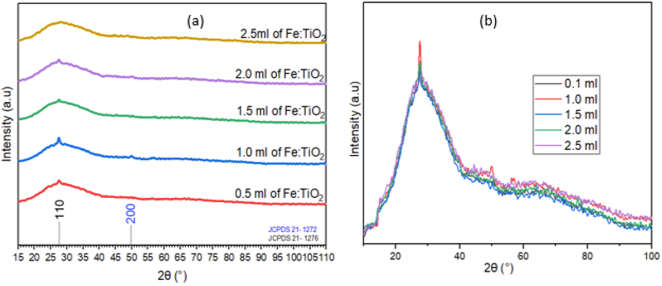
The structural characterization of the thin films was conducted using X-ray diffractometer. Figure 1 shows the XRD patterns of Fe:TiO2 thin films formed through spin coating with precursor volumes ranging from 0.5 ml to 2.5 ml. The prominent diffraction peaks observed at 2θ ≈ 27.4° and 2θ ≈ 49° correspond to the (110) plane of the rutile phase and (200) plane of the anatase phase of TiO2 consistent with the standard JCPDS card (21-1276) and (21-1272) respectively. The XRD pattern confirms the coexistence of both rutile and anatase phases in the Fe:TiO2 thin films, as indicated by the (110) rutile peak and the (200) anatase peak. This mixed-phase formation occurs because annealing at 450°C falls within the temperature range where anatase begins transforming into rutile but the conversion is not fully completed. In addition, Fe doping introduces lattice distortions and oxygen vacancies that stabilize the coexistence of both phases by hindering full phase transformation. The anatase to rutile phase transition is facilitated by Fe doping in conjunction with the annealing temperature. This finding is consistent with earlier research . The XRD patterns show no secondary phases related to iron oxides, suggesting that Fe ions are incorporated into the TiO2 lattice rather than forming separate phases. This confirms the structural purity of the films within the XRD detection limits and is consistent with previous work .
Figure 1. XRD spectra of Fe:TiO2 thin films of varying precursor volumes.
Figure 1 shows that the films made with 0.5 mL and 1.0 mL precursor volume have relatively sharp and well-defined diffraction peaks, suggesting good crystallinity and effective crystal growth in these two volumes. The intensity of the reflections, particularly in the (110), is seen to be the sharpest and most intense in the 1.0mL sample, indicating a good balance between the availability of suitable precursors and the process of nucleation which results in highly ordered grains. The results obtained in this study indicate that peaks become increasingly wide and less sharp as the volume of the precursor is increased, as seen from the films prepared with higher precursor volume 1.5 - 2.5 mL, this can be explained by the internal strain of the film and possible agglomeration effect which makes the crystal growth not uniform. The peaks are also broader at higher volumes, which indicates that the crystallite size is decreased and there is an increase in structural disorder.
The average crystal size of thin films was calculated using Debye Scherrer equation .
D = COS (1)
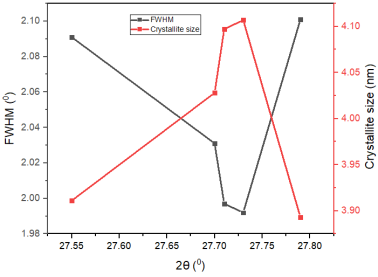
Where D is the crystallite size (usually in nm), K is constant commonly taken as 0.9, λ is the X-ray wavelength 0.15406 nm for Cu Kα used, β is full width at half maximum (FWHM) in radians and θ is Bragg’s angle which is half of 2θ. The average crystallite sizes of Fe:TiO2 coatings varied between 3.89 nm at 27.790 and 4.11 nm at 27.730 across all samples. This slight variation indicates that increasing the precursor volume has little effect on crystallite size, implying that grain growth is not significantly enhanced under the current deposition and annealing conditions, 4500 C. The consistent small crystallite sizes confirm the nanocrystalline nature of the films and are attributed to the presence of Fe dopants, which introduce lattice strain and defects that inhibit crystal growth.
Bragg’s equation was used to calculate the interplanar d spacing of Fe:TiO2 thin film.
nλ=2dsinθ(2)
Where X-ray wavelength λ used was of Cu Kα = 1.5406 Å, n is an integer 1, d is the inter-planar spacing and θ is the diffraction angle from XRD pattern. The lattice parameters were determined from the XRD data by assuming a tetragonal rutile structure and applying the relation
1d2=h2+k2a2 +l2c2(3)
using the measured d-spacing values and corresponding Miller indices. The lattice constant a was specifically calculated from the (110) diffraction plane.
Table 1. Following summarizes the crystallite size, FWHM and the lattice parameters of Fe:TiO2 thin films deposited using different volumes.

Sample (mL)

Plane (hkl)

2θ (°)

FWHM (°)

Crystallite size (nm)

dhkl (Å)

Lattice parameter a (Å)

0.5

110

27.79

2.101

3.893

3.208

4.537

1.0

110

27.73

1.992

4.107

3.214

4.545

200

49.60

2.078

4.211

1.836

3.672

1.5

110

27.71

1.997

4.097

3.216

4.548

2.0

110

27.70

2.031

4.028

3.218

4.550

2.5

110

27.55

2.091

3.911

3.235

4.575

The (110) diffraction peak position shifts from 27.79° to 27.5° as the volume increases. According to Bragg’s law, a 2θ decrease corresponds to an increase in interplanar spacing (d) as confirmed by the measured d-spacing values. This could be accredited to compositional or defect induced lattice expansion. The crystallite size initially increased from 3.893nm to 4.107 nm for volume 0.5mL to 1.0mL respectively. This increase in crystallite with increasing precursor concentration indicated an increase crystal growth and improved ordering or crystallinity. However, at high precursor concentration, there was a reduction in crystallite size which could be attributed to reduction in crystal growth and increase in defect and grain boundaries. The lattice parameters showed an increase from 4.537 Å for sample prepared from 0.5ml precursor volume to 4.575 Å for the 2.5mL sample. This increase indicated that higher precursor concentration supported expansion of the crystal lattice. The increase in lattice parameter may be attributed to increased density of defects and relaxation of lattice strain during crystal growth.
Initially, the values of FWHM decreased from 2.101° at 0.5mL to a minimum value of 1.992° at 1.0 mL. This reduction suggests an improvement in crystal quality. A narrower diffraction peak indicates reduced peak broadening associated with lower defect density and improved structural order. This observation agrees with increase in crystallite size observed at 1.0 mL. Beyond 1.0mL volume, the FWHM increases slightly from 1.99° to 2.091° as the precursor concentration rises to 2.5ml. The broadening of the diffraction peaks at higher concentrations suggests the introduction of additional structural imperfections such as crystal defects, grain boundary defects and lattice strain. The FWHM values then increased gradually to 2.091° at 2.5 mL since the values of FWHM are inversely related to crystallite size according to the Debye Schrerrer equation.
Figure 2 below shows the dependence of full width at half maximum (FWHM) and crystallite size with respect to the volume deposited on the substrate for Fe:TiO2 thin films annealed at 450°C.
Figure 2. Variation of FWHM and Crystallite Size of deposited Fe:TiO2 thin films using varying volumes of the precursor.
From the combined structural analysis, a precursor volume of 1.0 mL was found to be optimal for depositing Fe:TiO2 thin films via spin coating. At this volume, the films showed the highest XRD peak intensity, a low FWHM of 1.992°, a stable crystallite size of ~4.107 nm, and a moderate lattice parameter 'a' of 4.545 Å, indicating better crystallinity, effective Fe3⁺ incorporation, and controlled thickness. These characteristics reflect improved structural ordering and reduced strain compared to lower volume, which provide insufficient diffracting material, and the highest volume of 2.5 mL, which causes slight over-thickening. Overall, these results demonstrate that adjusting the precursor volume is a straightforward and effective way to optimize film quality.
3.2. FTIR Analysis
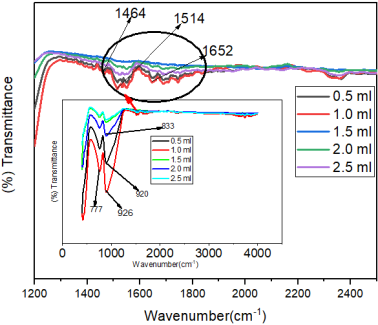
The functional groups and bonding nature of the Fe:TiO2 thin films were identified by FTIR spectroscopy. Figure 3 following presents the resulting spectra for the various samples.
Figure 3. FT-IR spectra of Fe:TiO2 thin films deposited using different precursor volumes.
The absorption bands at 777 cm-1 and 833 cm-1 are identified to be of Ti -O -Ti lattice vibrations, which proves the existence of the TiO2 network. The peaks of 920 cm-1 and 926 cm-1 are related to Ti-O-Fe and Ti-O-Ti stretches, which means the effective insertion of Fe ions into the TiO2 framework. The bands at 1464 cm-1 and 1514 cm-1 are C-H bending and potential C=C stretch vibrations, which indicate the existence of remaining organic species. The H-O-H bending vibrations of the adsorbed water molecules are attributed to the absorption peak of 1652 cm-1 which was observed earlier . The weak bands between 2800- 3000 cm-1 are associated with C -H stretching vibrations in the higher wavenumber region and the broad band in the 3200-3500 cm-1 region is due to O-H stretching modes of hydroxyl groups. In general, the spectrum indicates the the existence of the TiO2 structure and the addition of Fe as well as minor traces of hydroxyl and organic groups as a characteristic of sol -gel thin films.
3.3. UV-Vis Analysis
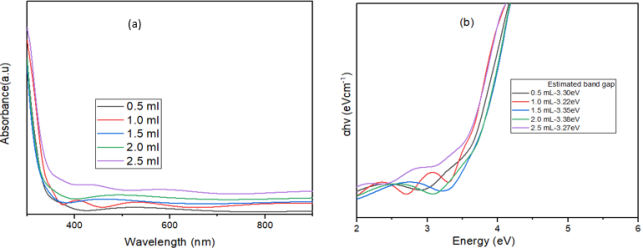
The optical properties and band gap of the Fe:TiO2 thin films prepared using different amounts of precursors were investigated using ultraviolet- visible spectroscopy (UV-Vis). Absorbance spectra were obtained between the wavelength (300-900 nm) and optical band gaps were estimated based on Tauc plots of the absorption data. Quantitative evaluation of the forbidden energy gap (Eg) was carried out using Tauc methodology through graphical Tauc plot construction. Equation (4) gives the Tauc relation, .
hv)n= A(hv-Eg)(4)
Figure 4 following presents (a) the absorbance spectra as a function of wavelength and (b) the Tauc plots of αhν)1/2 versus photon energy  for films deposited using precursor volumes ranging from 0.5 ml to 2.5 ml.
Figure 4. (a) Absorbance spectra as a function of wavelength and (b) Tauc plots of αhν1/2 versus photon energy  for Fe-doped TiO2 thin films deposited using precursor solution volumes ranging from 0.5 mL to 2.5 mL.
From Figure 4 it is observed that the precursor volume exerts a notable influence on the light harvesting characteristics and forbidden energy gap of the Fe:TiO2 coatings. The absorbance spectra show the change of the absorption edge when the volume of the precursor changes, which indicates that the electronic structure of the films has been changed. The Tauc plots of the corresponding samples show that the optical band gap reduces from 3.30 eV (0.5 mL) down to 3.22 eV (1.0 mL) and then increases to 3.35 eV (1.5 mL) and 3.38 eV (2.0 mL) as shown in the figure. The band gap is then reduced a little to 3.27 eV in the 2.5 mL sample. The observed reduction in band gap from 0.5 mL to 1.0 mL can be explained by the introduction of localized impurity states in the band gap structure of the TiO2 lattice, with the Fe ions allowing for lower-energy electronic transitions. This reduction in the band gap increases the amount of visible light absorbed by the film and indicates that 1.0 mL is the optimum amount of precursor to modify the refractive and absorptive behavior of the coatings. The following increase in the band gap at 1.5 mL and 2.0 mL could be related to variations in film microstructure, decreased efficiency of Fe substitution, or the introduction of structural disorder which diminishes the participation of Fe-induced intermediate energy states. The small band gap shrinkage at the highest volume of the precursor can be attributed to the higher number of defect states and oxygen vacancies, which lead to the presence of more intermediate energy levels in the band gap and facilitate the absorption of visible-light radiation. From the results obtained it can be concluded that the precursor volume has a critical role to tune the refractive and absorptive behavior of the Fe:TiO2 coating, with the lowest optical response corresponding to the lowest precursor volume of 1.0 ML.
4. Conclusion
The thin film of Fe:TiO2 was successfully prepared by sol-gel spin coating method with different volumes of precursor solution and the thin film was annealed at 450°C and it was confirmed that anatase and rutile phases co-existed by XRD analysis. The presence or absence of Fe doping and annealing resulted in the formation of anatase and rutile phases, as evidenced by the (110) rutile and (200) anatase peaks. The results demonstrated that the volume of precursor had significant influence on the crystallinity, with the volume between 0.5 and 1.0 mL gave better peak sharpness and quality of the crystals while the higher volumes resulted in broader peaks because of the increasing amount of strain and disorder in the crystals. FTIR revealed the formation of Ti-O-Ti and Ti-O-Fe bonds, which confirmed the incorporation of Fe into TiO2 lattice. The results obtained from UV-Vis showed a shift of the absorption edge toward longer wavelengths and a reduction of the band gap as the volume increases. Overall, it was determined that the best amount of precursor volume used was 1.0 mL, that resulted in better optical and structural properties.
5. Recommendations
Further investigation of the effect of other deposition parameters like spin speed, annealing temperature and film thickness on the structural and optical properties of Fe:TiO2 thin films are suggested for future studies. Furthermore, the optimized thin film should be tested for its photocatalytic and photovoltaic properties to understand the practical results it obtains.
Abbreviations

DEA

Diethanolamine

Fe

Iron

TiO2

Titanium Dioxide

UV

Ultra Violet

Fe:TiO2

Iron Doped Titanium Dioxide

FTIR

Fourier Transform Infrared Spectroscopy

UV-Vis

Ultraviolet-Visible Spectroscopy

XRD

X-ray Diffraction

FWHM

Full Width at Half Maximum

JCPDS

Joint Committee on Powder Diffraction Standards

Acknowledgments
The author wishes to thank Murang’a University of Technology for grant of access to synthesis and characterization equipment.
Author Contributions
Chemutai Sharon: Conceptualization, Data curation, Formal Analysis, Investigation, Methodology, Visualization, Writing – original draft
John Njagi: Supervision, Validation, Writing – review & editing
Jatani Ungula: Writing – review & editing
Sharon Kiprotich: Resources, Writing – review & editing
Conflicts of Interest
The authors declare no conflicts of interest.
References
[1] K. S. Swathi and K. Gopalakrishna Naik, “Structural, morphological, and optical studies of sol-gel spin coated TiO2 thin films,” Materials Today: Proceedings, vol. 92, pp. 1149-1153, Jan. 2023,
[2] A. M. Youssef and S. M. Yakout, “Mono, dual and tri-doped TiO2: Sunlight photocatalytic, room temperature ferromagnetic and dielectric constant properties,” Materials Chemistry and Physics, vol. 282, p. 125978, Apr. 2022,
[3] A. Seifi, D. Salari, A. Khataee, B. Çoşut, L. Ç. Arslan, and A. Niaei, “Enhanced photocatalytic activity of highly transparent superhydrophilic doped TiO2 thin films for improving the self-cleaning property of solar panel covers,” Ceramics International, vol. 49, no. 2, pp. 1678-1689, Jan. 2023,
[4] S. Ghosh, S. Saha, A. A. Moyeen, A. A. Mahmood, and M. B. Islam, “Tailoring the structural and optical properties of TiO2 thin films: A study of undoped, N-doped, and Fe-doped variants via sol-gel spin coating,” Next Materials, vol. 8, p. 100757, Jul. 2025,
[5] E. Radha, D. Komaraiah, R. Sayanna, and J. Sivakumar, “Photoluminescence and photocatalytic activity of rare earth ions doped anatase TiO2 thin films,” Journal of Luminescence, vol. 244, p. 118727, Apr. 2022,
[6] T. C. Paul, M. H. Babu, J. Podder, B. C. Dev, S. K. Sen, and S. Islam, “Influence of Fe3+ ions doping on TiO2 thin films: Defect generation, d-d transition and band gap tuning for optoelectronic device applications,” Physica B: Condensed Matter, vol. 604, p. 412618, Mar. 2021,
[7] J. Chen, L. Liu, L. Zheng, M. Liu, Y. Gao, and K. Zhao, “Structural and optical properties of Fe@C doped TiO2 thin films prepared by sol-gel method,” Inorganic Chemistry Communications, vol. 153, p. 110776, Jul. 2023,
[8] J. Aljuaid, A. Timoumi, and S. N. Alamri, “Investigation of the impact of iron amounts on optical and physical properties of coated TiO2 thin films used for PV solar cells,” Optical Materials: X, vol. 16, p. 100178, Oct. 2022,
[9] H.-J. Lin, T.-S. Yang, C.-S. Hsi, M.-C. Wang, and K.-C. Lee, “Optical and photocatalytic properties of Fe3+-doped TiO2 thin films prepared by a sol-gel spin coating,” Ceramics International, vol. 40, no. 7, Part B, pp. 10633-10640, Aug. 2014,
[10] N. Sharma and R. Kumar, “Effect of spin speed on the properties of TiO2 thin films,” Materials Today: Proceedings, vol. 62, pp. 6615-6618, Jan. 2022,
[11] N. E. Djehiche et al., “Sol-gel synthesis and spin-coating Nb-doped TiO2 anatase thin films,” J Sol-Gel Sci Technol, vol. 117, no. 3, p. 79, Mar. 2026,
[12] E. Radha, D. Komaraiah, R. Sayanna, and J. Sivakumar, “Influence of dysprosium ions on structural, optical, luminescence properties and photocatalytic ability of spin coated dysprosium ions doped TiO2 thin films,” Thin Solid Films, vol. 761, p. 139519, Nov. 2022,
[13] X. Dong, M. Mamat, Y. Baikeli, G. Liu, and F. Xiaerding, “Effect of Fe doping on crystalline phase, structure and photocatalytic properties of TiO2 thin films,” Optical Materials, vol. 150, p. 115196, Apr. 2024,
[14] T. Chandra Paul, J. Podder, and L. Paik, “Effect of Fe doping on the microstructure, optical and dispersion energy characteristics 10 of TiO2 thin films prepared via spray pyrolysis technique,” Results in Optics, vol. 8, p. 100235, Aug. 2022,
[15] A. M. Oviedo, H. Truong Thi, Q. C. Van, and H. H. Nguyen, “Physicochemical properties of Fe-doped TiO2 and the application in Dye-sensitized solar cells,” Optical Materials, vol. 137, p. 113587, Mar. 2023,
[16] M. Wang, S. Yuan, B. Lv, and H. Yang, “Electrochemical Synthesis of Mg-doped ZnO Nanotapers as Photocatalyst for Degradation of Bisphenol under Solar Light Irradiation,” International Journal of Electrochemical Science, vol. 16, no. 2, p. 210248, Feb. 2021,
[17] K. Albaidani, A. Timoumi, W. Belhadj, S. N. Alamri, and S. A. Ahmed, “Structural, electronic and optical characteristics of TiO2 and Cu-TiO2 thin films produced by sol-gel spin coating,” Ceramics International, vol. 49, no. 22, Part B, pp. 36265-36275, Nov. 2023,
[18] S. Ruzgar and S. A. Pehlivanoglu, “The effect of Fe dopant on structural, optical properties of TiO2 thin films and electrical performance of TiO2 based photodiode,” Superlattices and Microstructures, vol. 145, p. 106636, Sep. 2020,
[19] T. G. de Oliveira et al., “A comprehensive study of structural, optical, and magnetic Properties of Co and Fe-doped TiO2 prepared by different sol-gel routes,” J Sol-Gel Sci Technol, vol. 116, no. 3, pp. 2670-2691, Dec. 2025,
[20] N. H. S. Nasralla, M. Yeganeh, Y. Astuti, S. Piticharoenphun, and L. Šiller, “Systematic study of electronic properties of Fe-doped TiO2 nanoparticles by X-ray photoemission spectroscopy,” J Mater Sci: Mater Electron, vol. 29, no. 20, pp. 17956-17966, Oct. 2018,
[21] R. Varasada, D. Jadav, M. Trasadiya, P. Patel, A. Vora, and S. Vyas, “Investigation of structural, optical and dielectric properties of the zinc oxide thin films,” Next Nanotechnology, vol. 9, p. 100523, Jun. 2026,
[22] P. Phyu Cho, P. Phyu Mon, M. Kumar, S. Dobhal, and S. Challapalli, “Improving photocatalytic efficiency through Cu substitution in TiO2 /g-C 3 N 4 heterojunction nanocomposites for wastewater remediation,” Environmental Science: Advances, vol. 4, no. 9, pp. 1488-1500, 2025,
[23] X. Shi, X. Yu, C. Nie, F. Li, and S. Zhang, “Controlled growth of nanocrystalline aluminum nitride films for full color range,” Ceramics International, vol. 47, no. 15, pp. 21546-21553, Aug. 2021,
[24] Z.-Y. Deng, P.-C. Chiang, K.-L. Chen, J.-H. Chen, and C.-H. Wu, “Highly sensitive and rapid responding humidity sensors based on silver catalyzed Ag2S–TiO2 quantum dots prepared by SILAR,” RSC Adv., vol. 11, no. 17, pp. 10285–10290, Mar. 2021,
[25] P. Londhe, N. B. Chaure, and A. Athawale, “TiO2 thin films derived by facile sol-gel method: Influence of spin rate and Al-doping on the optical and electronic properties,” Materials Today Communications, vol. 29, p. 102924, Dec. 2021,
Cite This Article
  • APA Style

    Sharon, C., Njagi, J., Ungula, J., Kiprotich, S. (2026). Effect of Precursor Solution Volume on Structural and Optical Properties of Iron Doped Titanium Dioxide Thin Films Prepared by Spin Coating. Advances in Materials, 15(3), 91-98. https://doi.org/10.11648/j.am.20261503.12

    Copy | Download

    ACS Style

    Sharon, C.; Njagi, J.; Ungula, J.; Kiprotich, S. Effect of Precursor Solution Volume on Structural and Optical Properties of Iron Doped Titanium Dioxide Thin Films Prepared by Spin Coating. Adv. Mater. 2026, 15(3), 91-98. doi: 10.11648/j.am.20261503.12

    Copy | Download

    AMA Style

    Sharon C, Njagi J, Ungula J, Kiprotich S. Effect of Precursor Solution Volume on Structural and Optical Properties of Iron Doped Titanium Dioxide Thin Films Prepared by Spin Coating. Adv Mater. 2026;15(3):91-98. doi: 10.11648/j.am.20261503.12

    Copy | Download

  • @article{10.11648/j.am.20261503.12,
      author = {Chemutai Sharon and John Njagi and Jatani Ungula and Sharon Kiprotich},
      title = {Effect of Precursor Solution Volume on Structural and Optical Properties of Iron Doped Titanium Dioxide Thin Films Prepared by Spin Coating},
      journal = {Advances in Materials},
      volume = {15},
      number = {3},
      pages = {91-98},
      doi = {10.11648/j.am.20261503.12},
      url = {https://doi.org/10.11648/j.am.20261503.12},
      eprint = {https://article.sciencepublishinggroup.com/pdf/10.11648.j.am.20261503.12},
      abstract = {The influence of precursor solution volume on the characteristics of containing iron-doped titanium dioxide (Fe:TiO2) thin films was examined in this work. The coatings were prepared on transparent substrates by the spin-coating method using precursor volumes between 0.5 and 2.5 mL. Following deposition, the coatings were heat treated at 450°C and analyzed using X-ray diffraction (XRD), Fourier transform infrared (FTIR) spectroscopy, and ultraviolet-visible (UV-Vis) spectroscopy. XRD analysis revealed the presence of both rutile and anatase crystalline phases, evidenced by reflections near 27.4° and 49° corresponding to the (110) and (200) planes, respectively. Variations in precursor volume affected the crystallographic properties of the films, with the sample prepared using 1.0 mL exhibiting the largest crystallite size and sharper diffraction peaks, suggesting improved crystal growth. Increasing the precursor volume beyond this value resulted in peak broadening, which may be associated with greater lattice imperfections and strain within the films. The FTIR results identified characteristic vibrational bands assigned to Ti-O-Ti and Ti-O-Fe linkages, confirming the incorporation of iron species into the TiO2 network. Optical characterization showed that increasing precursor volume shifted the absorption threshold toward longer wavelengths and reduced the optical band gap. This behavior can be ascribed to the creation of defect-induced energy states and oxygen-vacancy states within the material. Overall, the findings demonstrate that precursor solution volume significantly affects both the crystallographic and photonic performance of Fe:TiO2 coatings, with the 1.0 mL sample providing the most favorable combination of crystallinity and film quality.},
     year = {2026}
    }
    

    Copy | Download

  • TY  - JOUR
    T1  - Effect of Precursor Solution Volume on Structural and Optical Properties of Iron Doped Titanium Dioxide Thin Films Prepared by Spin Coating
    AU  - Chemutai Sharon
    AU  - John Njagi
    AU  - Jatani Ungula
    AU  - Sharon Kiprotich
    Y1  - 2026/07/22
    PY  - 2026
    N1  - https://doi.org/10.11648/j.am.20261503.12
    DO  - 10.11648/j.am.20261503.12
    T2  - Advances in Materials
    JF  - Advances in Materials
    JO  - Advances in Materials
    SP  - 91
    EP  - 98
    PB  - Science Publishing Group
    SN  - 2327-252X
    UR  - https://doi.org/10.11648/j.am.20261503.12
    AB  - The influence of precursor solution volume on the characteristics of containing iron-doped titanium dioxide (Fe:TiO2) thin films was examined in this work. The coatings were prepared on transparent substrates by the spin-coating method using precursor volumes between 0.5 and 2.5 mL. Following deposition, the coatings were heat treated at 450°C and analyzed using X-ray diffraction (XRD), Fourier transform infrared (FTIR) spectroscopy, and ultraviolet-visible (UV-Vis) spectroscopy. XRD analysis revealed the presence of both rutile and anatase crystalline phases, evidenced by reflections near 27.4° and 49° corresponding to the (110) and (200) planes, respectively. Variations in precursor volume affected the crystallographic properties of the films, with the sample prepared using 1.0 mL exhibiting the largest crystallite size and sharper diffraction peaks, suggesting improved crystal growth. Increasing the precursor volume beyond this value resulted in peak broadening, which may be associated with greater lattice imperfections and strain within the films. The FTIR results identified characteristic vibrational bands assigned to Ti-O-Ti and Ti-O-Fe linkages, confirming the incorporation of iron species into the TiO2 network. Optical characterization showed that increasing precursor volume shifted the absorption threshold toward longer wavelengths and reduced the optical band gap. This behavior can be ascribed to the creation of defect-induced energy states and oxygen-vacancy states within the material. Overall, the findings demonstrate that precursor solution volume significantly affects both the crystallographic and photonic performance of Fe:TiO2 coatings, with the 1.0 mL sample providing the most favorable combination of crystallinity and film quality.
    VL  - 15
    IS  - 3
    ER  - 

    Copy | Download

Author Information
  • Department of Physical and Biological science, Murang’a University of Technology, Murang’a, Kenya
  • Department of Physical and Biological science, Murang’a University of Technology, Murang’a, Kenya

  • Department of Physical Sciences, Rongo University, Rongo, Kenya

  • Department of Physical and Biological science, Murang’a University of Technology, Murang’a, Kenya