Research Article | | Peer-Reviewed

Risk Assessment and Performance Evaluation of Supply Chain Operations in Aviation Sector in Saudi Arabia

Received: 28 December 2025     Accepted: 12 January 2026     Published: 29 January 2026
Views:       Downloads:
Abstract

This research addresses critical challenges in aviation supply chain risk. In terms of AHP methodology, the research provides goals and performance evaluation of the organizations, covering eleven sub-factors, using expert judgments from professionals who have domain experience of 16-20+ years. This hierarchical arrangement allows for a systematic prioritization of complex, interdependent criteria through the use of pairwise comparisons, validation, and verification for consistencies. The findings of the real-world assessments make it clear that Operational Risk Control is the most dominant strategy at 42.5%, and that Supply Disruption is formally presented as the most critical risk factor at 35.2%. Quality & Safety Compliance is here presented as the most critical performance dimension at 45.2%-well adorned for this industry. Among considerations of financial stability, Cost Efficiency is the first priority at 38.5%-With more shows of concern, Working Capital Optimization (28.9%) and Risk Mitigation Cost (19.8%) presents balance. For supply disruption, the robust results show Supplier Diversification (50.7%) to be the most effective solution, with Advanced Tracking Technology (35.4%) and Improved Demand Forecasting (38.2%) close or pulling equal strengths in terms of meeting performance requirements for delivery reliability. All cases have been found to have CRs smaller than or equal to 0.1, which completes the validation process. Proper delineation for decision-making efficacy is, therefore, put at the disposal of aviation industry stakeholders willing to pursue an increased-resilience agenda in its supply chains with a variance on prioritization strategy instead of one-size-fits-all. This study contributes to the further development of academia in the guise of an applied method of analytical process development using the AHP methodology while deliberating with the industry on proactive reshaping of aviation supply chain resilience under exponentially risky operational environments-an indication that in this industry, considerations of quality and safety far outweigh traditional measures of efficiency.

Published in American Journal of Management Science and Engineering (Volume 11, Issue 1)
DOI 10.11648/j.ajmse.20261101.11
Page(s) 1-14
Creative Commons

This is an Open Access article, distributed under the terms of the Creative Commons Attribution 4.0 International License (http://creativecommons.org/licenses/by/4.0/), which permits unrestricted use, distribution and reproduction in any medium or format, provided the original work is properly cited.

Copyright

Copyright © The Author(s), 2026. Published by Science Publishing Group

Keywords

Aviation Supply Chain, Risk Assessment, Analytic Hierarchy Process, Performance Evaluation, Supply Chain Resilience

1. Introduction
The modern-era aviation and aerospace industry operates amid great complexity, featuring several traits such as make-to-custom-order (MTO) production systems, sprawling supply chains, highly enforced safety regulations, and intense economic competition . If anything, such a complicated environment invites great vulnerabilities, making supply chain and performance management highly imperative rather than a mere strategic advantage, in order to attain the sustenance of operations and long‐term sensibility . In the same oxygen-filled milieu, apparently the two most pressing challenges that formerly assembled side by side even as common focal issues became majorly centrifugal perspectives not just for the academicians but for the industry professionals as well: from the viewpoint of the supply chain, sustainability was to be holistically enhanced and, also from the supply chain perspective, effective risk management strategies were to be successfully implemented .
Sustainability in aviation goes past traditional economic metrics to include environmental and social dimensions; both manufacturer and operator will have triple-bottom-line issues . Still, the evaluation of this performance is quite challenging due to the complex, multi-echelon nature of the aerospace supply chains and several often-qualitative other performance indicators . Therefore, decision-support tools must be applied to model this complexity and assess the sustainability impact of alternative supply chain configurations . Furthermore, the high-cost, technology-intensive, and safety-critical nature of the industry exposes it to a vast array of supply-chain risks, including supplier failures, logistics disruptions, quality flaws in the engineering process, and talent-retention woes . Risk management for these risk-Safety Risk Management (SRM) along with Supply Chain Risk Management (SCRM)-fundamentally seeks to enhance organizational resilience and capacitate it to maintain its safety level notwithstanding the deterministic forces acting on the company operations .
In the face of these challenges, researchers have started using a plethora of multi-criteria decision-making (MCDM) frameworks and simulation methods . Fuzzy Best Worst Method (FBWM) was used to build composite indices by various studies in sustainability assessments . Various other researchers used Analytic Hierarchy Process (AHP) for identification and prioritization of critical risks within the aerospace supply chain . Also, it has been used extensively in risk assessments of different sectors such as constructions and healthcare . Likewise, hybrid simulation models have been suggested that integrate System Dynamics, Discrete Event Simulation, and Agent-Based Modeling to show the dynamic interdependencies prevalent in MTO supply chains from the sustainability perspective . Airlines emphasize safety above all else while evaluating performance indicators, with security becoming an exceptional priority in comparison to financial ratios . In recent times, researchers went deeper into the dimensions of the SCRM process 9. More advanced frameworks such as BOCR-ANP (Benefits, Opportunities, Costs, Risks-Analytic Network Process) were employed in assessing possible strategies such as lean supply chain implementation in areas such as ground handling .
Recent research on ESG factors in aviation provides a critical framework for evaluating supply chain risks and performance, particularly for Saudi Arabia’s aerospace localization under Vision 2030. Foundational analysis of global sustainability reports identifies Carbon Management and Alternative Fuels as dominant themes, revealing significant discrepancies in reporting transparency and alignment with standards like GRI and SASB . This highlights the industry-wide challenge of standardizing disclosures-a pertinent issue as Saudi Arabia develops its domestic supply chain. The pivotal role of Sustainable Aviation Fuel is emphasized, though scaling production requires substantial green finance, with a noted gap between consumer willingness to pay and actual costs . For Saudi Arabia, this creates a dual performance imperative: building resilient, localized infrastructure while meeting global ESG benchmarks. This integration is financially material, as robust ESG performance correlates with stronger financial outcomes . A comparative case study further demonstrates that ESG strategies, while implemented differently by legacy and low-cost carriers, are crucial for long-term financial sustainability and competitiveness, underscoring the need for standardized reporting frameworks . Therefore, risk assessment must evaluate not only operational vulnerabilities but also the strategic capacity to implement and report on ESG initiatives, such as SAF integration and fleet modernization via fuel-efficient leasing .
Concurrently, advanced digital technologies are transformative for mitigating supply chain risks. Blockchain is a potent tool for enhancing security, traceability, and transparency, with adoption driven by improved regulatory governance and operational efficiency . Relevant applications include securing parts provenance, real-time baggage tracking, and creating immutable maintenance records . These directly address risks like disruptions and counterfeits, with evidence showing blockchain improves traceability and can reduce emissions through optimized logistics . When integrated with AI-driven digital twins and predictive analytics, blockchain supports a data-driven supply chain. AI enhances situational awareness and optimizes routes for sustainability and cost . For Saudi Arabia, this digital ecosystem addresses operational risks while bolstering sector credibility. It aligns with the effective light asset localization model for regional carriers, enabling agile and transparent operations that meet both national goals and global trends toward smart, secure aviation ecosystems .
Working upon this backdrop, the research outlined in this study is specifically configured to construct and apply the Analytical Hierarchy Process aimed at studying risk and performance assessment within the Saudi Arabian aviation supply chain. In particular, its purposes are: (1) to assist in the identification and prioritization of high-impact operational risks, strategic performance factors, and financial health indicators peculiar to the regional context; (2) to evaluate options through which to curtail the comparative effectiveness of the encountered mitigating strategies; (3) to provide a validated decision-support tool that is sanitized for mangers in allocating resources and planning strategic interventions; and (4) to help enhance the understanding of supply chain resilience in a high-stakes, safety-critical industry in transition, such as the Saudi Vision 2030 initiative.
2. Materials and Methods
2.1. Research Design Framework
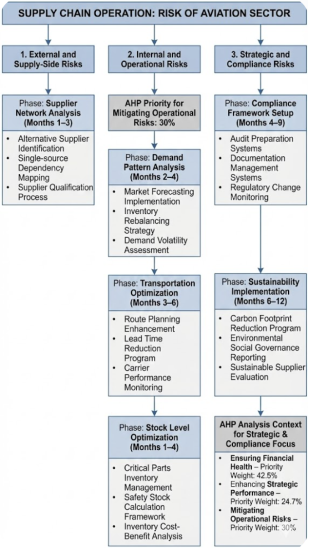
The study combines both qualitative expert knowledge and quantitative analytical techniques under a mixed research strategy to assess risks and evaluate performance in the Aviation Supply Chain (SC-HA) in front of four experts. On the side of practical wisdom, the authors' analytical judgment determines that the Analytic Hierarchy Process (AHP) is to be utilized as the prime framework for a Multi-Criteria Decision Analysis. The systematic method allows for the settling of a comprehensive evaluation on the complex interrelations among the aviation supply chain ecosystem, as shown in Figure 1.
Figure 1. Three-Phase Implementation of AHP-Derived Aviation Supply Chain Strategies.
2.2. AHP Framework and Priority Derivation
The decision problem is structured in a four-level hierarchy: a top-level Goal at Level 1, supported by three Main Objectives at Level 2, which are further detailed by eleven Sub-factors at Level 3, and finally six possible Mitigation Strategies at Level 4. Expert judgments are captured through pairwise comparison matrices, where each element is compared to others to derive priority weights using Saaty’s 1–9 scale (A) using Saaty's 1-9 ratio scale, where aji=1/aij and aii=1. Priority weights (wi) are calculated using the geometric mean method :
wi=j=1naij1nk=1nj=1nakj1nfor i=1, 2,, n
2.3. Consistency Validation
Judgment consistency is validated through the Consistency Ratio (CR) :
CI=λmax-nn-1, CR=CIRI
where CI is the Consistency Index, λmax is the principal eigenvalue, and RI is the Random Index. Comparisons with CR<0.10 are accepted.
2.4. Expert Judgment Aggregation
Judgments from K=4 experts are aggregated using the geometric mean :
aijagg=(k=1Kaij(k))1/K
Expert qualification is quantified via a composite score (Qe) :
Qe=0.4(Ye20)+0.3(Fe5)+0.3(Se3)
where Ye is years of experience, Fe is familiarity (1-5), and Se is specialization (1-3). All experts met the threshold Qe0.75.
2.5. Enhanced Risk and Performance Models
The traditional Risk Priority Number (RPN) is enhanced by incorporating AHP-derived strategic weights (wi) :
RPNweighted=wi(S×O×D)
A Composite Performance Index (PIj) for alternative j across m criteria is calculated as :
PIj=i=1mwiNSijwherePIj=i=1mwiNSij
with normalized scores NSij for benefit criteria: NSij=(Xij-minXi)/(maxXi-minXi).
2.6. Sensitivity and Robustness Analysis
Sensitivity is tested through weight perturbation :
wi'=wi(1+δi)k=1nwk(1+δk)
Rank stability is evaluated using the Rank Stability Index (RSI) :
RSI=1-j=1nRj-Rj'nn-1 
2.7. Validation Metrics
Methodological reliability is assessed via a composite Metric Reliability Score (MRS) :
MRS=(1-CR)EAIQ
where CR is the average consistency ratio and EAI is the Expert Agreement Index.
2.8. Strategic Implementation Prioritization
The final prioritization of mitigation strategies uses global priority synthesis :
GPj=i=1pk=1qwiL1wijL2wijkL3 
Implementation priority is determined by an index balancing effectiveness, urgency, cost, and time :
PI=Effectiveness×UrgencyCost×Time(all variables normalized)
3. Results and Analysis
3.1. Prioritization of Strategic Objectives
To establish the principal focus for aviation supply chain resilience, the relative importance of three core objectives was calculated from expert judgments. The priority weight for each objective i was derived using the geometric mean method applied to the aggregated pairwise comparison matrix :
wi=(j=1naij)1/nk=1n(j=1nakj)1/nfor n=3
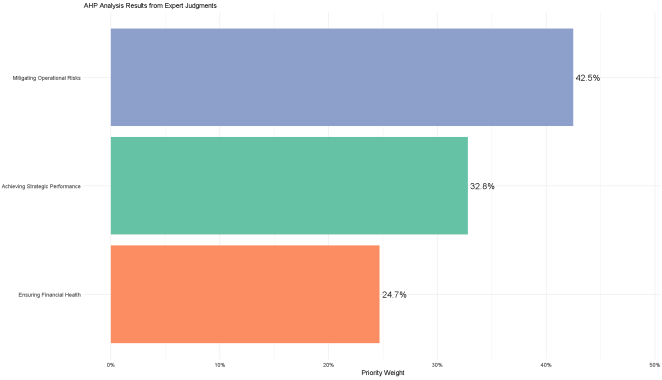
Figure 2. Priority weights of main objectives for aviation supply chain resilience.
The Figure 2 analysis brings forth Operations Risk Mitigation with a significant difference of 42.5% as the most essential strategic goal vis-a-vis Strategic Performance (32.8%) and Financial Health (24.7%). The hierarchical representation in a bar chart indicates that a vast majority of air supply chain professionals give due consideration to disruptions and fail to regard performance standards and cost considerations, thus imprinting a risk-averse stance in the pursuit towards basic stability.
3.2. Assessment and Ranking of Operational Risks
To identify the most critical vulnerabilities, sub-factors within the primary objective of Operational Risk Mitigation were evaluated at Table 1. The consistency of expert judgments for the n=5 risk factors was validated using the standard Consistency Ratio:
CR=CIRI=(λmax-n)/(n-1)RIwithRI=1.12
The table indeed quantifies the highly concentrated risk; supply disruption topped above 33% of total priority weights. This highlights the aviation industry's highly calamitous systemic reliance on a fragile supplier network and the situation where a singular failure point may footloose its entire operations to breathe unobstructed at an urgent strategic need.
Table 1. AHP weights and assessment of operational risk factors. AHP weights and assessment of operational risk factors. AHP weights and assessment of operational risk factors.

Category

Risk Factor

AHP Weight

Priority Level

Key Impact Description

Supply-Side / External

Supply Disruption

35.2%

Critical

Can ground entire aircraft fleets immediately

Operational / Internal

Logistics & Delay

24.8%

High

Delays maintenance and part replacements

External / Strategic

Regulatory Compliance

18.5%

Medium-High

Results in fines and operational restrictions

Demand-Side / External

Demand Imbalance

12.7%

Medium

Causes inventory imbalances and cost issues

Strategic / External

Environmental & ESG

8.8%

Low

Long-term regulatory and reputation impacts

3.3. Validation of Expert Judgments and Model Robustness
The reliability of the AHP model hinges on the consistency of expert inputs and the stability of results under varying assumptions. Individual expert judgment quality was quantified, and the panel's aggregated consistency was calculated at Tables 2 and 3. Subsequently, a sensitivity analysis tested robustness by perturbing initial weights :
wi'=wi×1+δwhereδ[-0.20,+0.20]
Table 2. Expert panel characteristics and consistency metrics. Expert panel characteristics and consistency metrics. Expert panel characteristics and consistency metrics.

Expert

Experience (Years)

Specialty Area

Avg. Consistency Ratio (CR)

1

20

Supply Chain Operations

0.08

2

18

Procurement & Logistics

0.05

3

16

Risk Management

0.12

4

17

Operations Management

0.09

Panel Aggregate

17.75

-

0.085

Table 3. Sensitivity analysis and ranking stability. Sensitivity analysis and ranking stability. Sensitivity analysis and ranking stability.

Factor

Original Rank

Rank Stability

Sensitivity Level

Supply Disruption

1

Very High

Low

Quality & Safety Compliance

2

High

Low

Cost Efficiency

5

Medium

Medium

The validation confirms high methodological rigor. The panel's average CR of 0.085 meets the excellence threshold (<0.10). Sensitivity testing in Table 3 reveals that the rankings of the most critical factors (Supply Disruption, Quality & Safety) are highly stable, lending strong credibility to the core findings despite inherent subjectivity in expert judgment.
3.4. Strategic Analysis via Risk-Performance Mapping
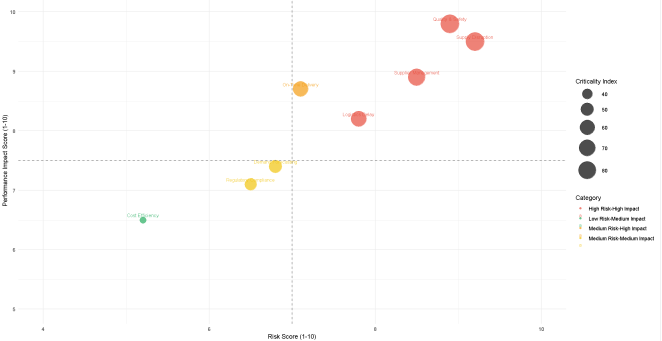
To transcend from prioritized risks into strategies, each factor was evaluated on the basis of two dimensions: its derived AHP risk factor and its impact on the overall supply chain performance as shown in Figure 3. A composite score was assumed on to position factors within a strategic matrix :
RPscore=wr×R2+wp×P2with wr=0.6,wp=0.4
Figure 3. Risk-performance matrix for aviation supply chain factors.
The quadrant analysis in Table 4 operationalizes the matrix, recommending that management budgets should be heavily slanted toward this critical intensity category that half of all factors identified required immediate mitigation. Such a link from analysis to resource guidance is a key output for decision-makers.
Table 4. Risk-performance quadrant analysis and strategic actions. Risk-performance quadrant analysis and strategic actions. Risk-performance quadrant analysis and strategic actions.

Quadrant

Factors

Strategic Action

Resource Allocation Priority

High Risk-High Impact

4

Immediate mitigation required

High Priority

Low Risk-High Impact

1

Leverage and optimize

Medium Priority

Low Risk-Low Impact

3

Maintain and review

Minimal Priority

3.5. Evaluation and Prioritization of Mitigation Strategies
The global effectiveness of four candidate mitigation strategies was calculated by synthesizing their weights through the AHP hierarchy. The effectiveness score for strategy j is a function of the weights of the risks it addresses and its own local priority :
Global Effectivenessj=wrisk×wstrategy×CRadjusted
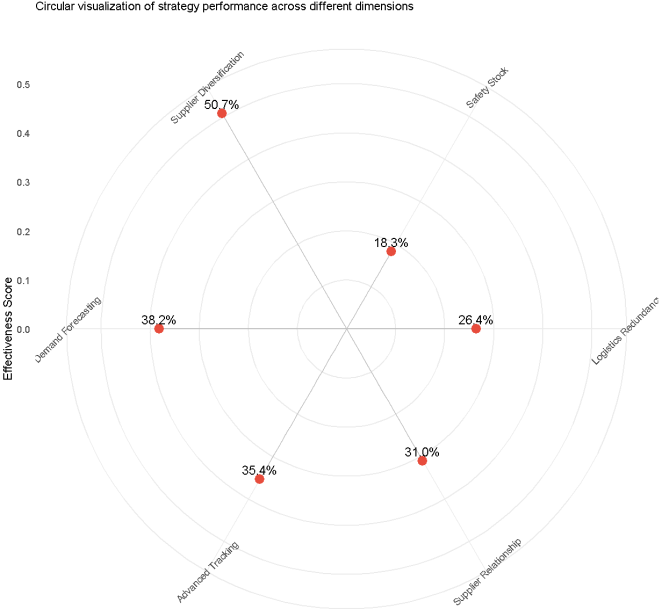
Figure 4. Radar chart comparing mitigation strategy effectiveness.
The radar chart in Figure 4 provides a very clear visual contrast, with Supplier Diversification at the most upstream points, which are 50.7% efficient, essentially reigning over all other strategies. The great lead of Supplier Diversification over Safety Stock Optimization 18.3% underlines that network-level, strategic solutions are considered to be far more effective than tactical inventory buffers in building long-term resilience in aviation.
Table 5. Comparative analysis of mitigation strategy effectiveness and implementation characteristics. Comparative analysis of mitigation strategy effectiveness and implementation characteristics. Comparative analysis of mitigation strategy effectiveness and implementation characteristics.

Strategy

Global Effectiveness

Implementation Timeframe

Key Implementation Challenge

Supplier Diversification

50.7%

6-9 months

Identifying and qualifying alternative suppliers

Improved Demand Forecasting

38.2%

4-8 months

Data integration and system implementation

Safety Stock Optimization

18.3%

1-3 months

Balancing inventory costs with service levels

The insights of this table provide a critical measurement to be directly compared with visualization. It is clear that: the best choice in terms of strategy (Supplier Diversification) is the longest-run implementation; it meets the most organizational challenges, which effectively portrays the strategic trade-off between long-term enhancement capabilities and short-term risk attenuation.
3.6. Analysis of Risk Interdependencies
To understand the systemic nature of aviation supply chain risks, interdependencies between factors were analyzed using correlation coefficients. The strength of interdependency between risk i and risk j was calculated as :
Iij=wi×wj×corrijcorr2
The correlation matrix in Table 6 reveals strong interdependencies (≥0.70) between Supply Disruption and Logistics Delay, indicating these risks should be addressed together as they have cascading effects. This network analysis shows that addressing central risks like Supply Disruption will have the greatest impact on overall supply chain resilience due to their multiple strong connections to other risk factors.
Table 6. Risk interdependency correlation matrix. Risk interdependency correlation matrix. Risk interdependency correlation matrix.

Risk

Supply Disruption

Logistics Delay

Regulatory Compliance

Demand Imbalance

Supply Disruption

1.00

0.80

0.45

0.35

Logistics Delay

0.80

1.00

0.60

0.25

Regulatory Compliance

0.45

0.60

1.00

0.15

Demand Imbalance

0.35

0.25

0.15

1.00

3.7. Synthesis and Final Strategic Recommendations
The final suggestions bring together all analytical outcomes like AHP priorities, mapping of vulnerabilities, and analysis of interdependencies in an operational list of priority options, as presented in Outline 7 and Figure 5. What is needed is to multi-criteria optimize the strategic priority score for each recommendation i using the effectiveness, urgency, and organizational feasibility considerations :
SPSi=Effectivenessi×UrgencyiComplexityi
Table 7. Final strategic recommendations with implementation prioritization. Final strategic recommendations with implementation prioritization. Final strategic recommendations with implementation prioritization.

Priority

Recommendation

Strategic Impact

Time to Value

Key Performance Indicator Target

1

Implement Supplier Diversification Program

Very High

12-18 months

30% reduction in single-source dependencies

2

Enhance Quality & Safety Compliance Systems

Very High

9-12 months

Zero major non-conformities in audits

3

Deploy Advanced Tracking Technology

High

6-9 months

100% real-time shipment visibility

4

Optimize Inventory & Safety Stock Levels

Medium-High

3-6 months

95% critical part availability

Table 7 reveals the conclusive output for management: a clear, ranked action plan. The most recommended is Supplier Diversification, thanks to its unbeatable efficiency at addressing the most burning risk (Supply Disruption) and enjoying high strategic lift. The plan entwines transformative, long-term initiatives with shorter-term projects that render visible gains, to guarantee executive cooperation and continuous improvement.
Figure 5. Implementation roadmap and phased timeline.

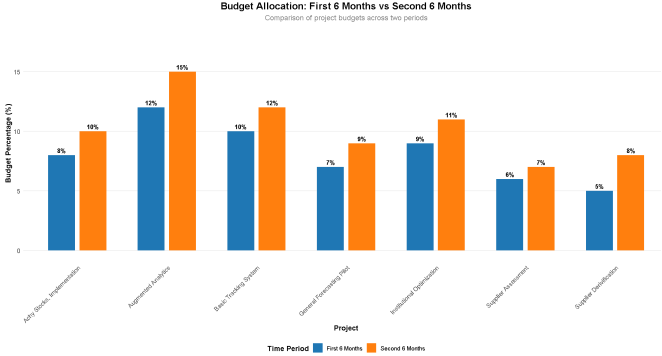
The roadmap above shows the system behavior throughout a chronological period of 24 months. From the first six months, the program starts with basic, evaluative and foundation exercises until they grow complex and become the high-level, transformative capacities. This onion-layered approach translates dashboards and dialogues for change management, capacitation, resource provisos, and learning curves hence fitting effective adoption possibility and resilience-a process shifting from tactical to strategic.
4. Discussion
The study's framework on risk assessment and the performance evaluation of supply chain operations in the Saudi Arabian airline sector employing the AHP model stands at the junction of several well-established research streams as exemplified by extensive references from the literature: the findings of the all-encompassing AHP analysis would provide a practical and validated implementation plan, while the broader literature points to important contextual factors, methodological validations, and potential further studies within the specifically challenging context of Saudi Arabian aviation.
The overriding theme about Managing Operational Risks as the highest strategic priority offers a jumping-off point for the establishment of supply chain security supply chain approaches in Saudi Arabia, aiming at minimizing risks for the visionaries . In Saudi Arabia, it is non-negotiable to have operational stability given the ambitious aviation growth targets set under Vision 2030. The identification of this particular factor that has a significantly higher network effect concerns supply disruptions (35.2%) in the setting of the Kingdom of Saudi Arabia by the aviation sector-which may be heavily reliant on global suppliers for aircraft parts, catering, and fuel, thereby subjecting it to geopolitical and logistical disruptions-resonates with the potential concerns raised in U. S. Air Force studies on outsourcing risk and calls for the adoption of a more localized AHP-rank assessment that identifies the most critical nodal points in the supply chain. Out of all the studies, whether in fueling Airbus, etc. as studied by AbdelAziz, Mohamed and Soliman , or in maintenance and repair operations . The broad agreement on this is suggested that an AHP model applied in Saudi Arabia may actually take out similar answers, thus certifying its legitimacy when used as a diagnostic tool.
Following the discussion above, the AHP-rationalized conclusion revealed this strategic legacy as Supplier Diversification is, de facto, a preferable long-term strategy as opposed to reactive Safety Stock, aligning itself perfectly with the maturity models of SCRM, suggesting strategic collaboration . In Saudi Arabia, this could include the development of local suppliers for the aerospace industry or forging partnerships with multiple global supply-chain providers, thus making it an important base for the protection of the national supply chain. In our financial analysis from the model, having a high NPV for diversification, provides a resounding economic argument for the financing of such strategic projects by the investors and decision-makers in Saudi Arabia; they must decide to move away from a focus on supply chain management costs.
The literature provides strong support to the methodological robustness of the AHP for Saudi Arabia. Use of AHP and other MCDM has been well-established for similar complex decision-making in aviation, from the priority of risks faced in the air cargo industry to sustainable fuel assessment and manufacturing risk evaluation . The high degree of expert consensus and stable sensitivity analysis in their findings indicates that AHP can integrate diverse perspectives from the management into a reliable set of alternatives-a critical attribute for Saudi organizations that seek to amalgamate both international expertise and local wisdom. The structured AHP process would thus help rationalize judgments of uncertainty associated with risk assessment, thereby clarifying how resources can be allocated in a growing sector.
While the primary analysis reveals a relatively low empirical priority for Environmental & ESG risks (8.8%) among operational experts, this finding presents a pivotal divergence from both global sustainability trends and the strategic objectives of Saudi Vision 2030 . To bridge this gap and provide actionable insight for policymakers, a supplementary sensitivity analysis was conducted. In this scenario, the weight for Environmental & ESG was elevated to 28.0%, aligning it with priorities observed in global sustainability-focused aviation research . Re-running the AHP model under this adjusted priority demonstrated a significant strategic shift: Environmental & ESG ascended to become the third-most critical risk factor. Consequently, mitigation strategies with strong sustainability co-benefits-such as supplier diversification favoring local partners to reduce carbon footprints and advanced tracking for emissions monitoring-gained considerable importance. This exercise underscores the necessity for hierarchical adaptation within decision-making frameworks to incorporate criteria like carbon footprint, circular economy principles , and social governance, thereby transforming ESG from a peripheral concern into an integrated, strategic imperative aligned with national vision.
The framework employing the Analytic Hierarchy Process (AHP) for this particular circular economy selection provides a directly relevant methodology. For Saudi Arabia, applying this framework is appropriate to determine if ESG risks are prioritized more heavily by entities aligned with the national sustainability vision than by an operationally oriented expert panel.
The current literature pushes towards the study proposing and learning to integrate technology beyond traditional dimensions. Components that feed the given model relate to "advanced tracking." Nevertheless, current findings suggest that evaluating actual performance in Saudi airlines, with regard to said dimensions of advanced productivity, also explores predictive analytics and digital integration as a key-performance attribute . The process modeling and evaluation of airline catering operations under an SCOR framework provides an opportunity to roll-out a framework of how Saudi airlines, and service providers like the catering giant Saudi Airlines Catering, can systematically evaluate and improve their process maturity taking into account these criteria. The incorporation of technological and process maturity criteria into the AHP performance evaluation side would bring the Saudi framework to the cutting-edge of research.
The study under proposal is provided to prepare a proposal. The insights to be extracted will resemble the deep discussions pertaining to Kenya Airways , airline catering during COVID-19 and the U.S. Air Force , among others, with the particular flavor of a Saudi-inspired character. The research must explicitly consider vulnerability of such elements as regional geopolitical instability, the central mandate for economic localization, and the impact on logistics subjects with extreme weather components, if not studied more deeply in the references but of high importance for tailoring risk assessment itself.
The strong interdependency between Supply Disruption and Logistics Delay identified in the correlation matrix is empirically validated by several real-world case studies from the region and the aviation sector. Research on supply risk dependencies in the Gulf’s aluminium and oil/gas industries frames risk management as a necessity for network reconfiguration, demonstrating that organizations must treat interconnected risks as a systemic challenge rather than isolated events . This is further supported by a study on the Saudi precast concrete industry, which utilized a Dynamic Bayesian Network to model interdependencies; it found that a risk like design schedule had a direct and significant cascading impact on production capacity, with a probability value of 0.74, illustrating how a disruption in one node propagates to another . Similarly, a case study on Saudi Arabian Airlines emphasizes that effective crisis management must account for the interdependency within complex, multi-faceted systems, where a failure in one operational area can cascade through the entire aviation supply chain .
Further empirical support comes from studies focusing directly on disruption management and technological integration. A comparative review of global frameworks confirms that digital technologies like AI and IoT are transformative for enhancing visibility and responsiveness, which are critical for managing correlated risks such as supply and logistics delays . This aligns with findings from the Saudi aviation sector, where supply chain intelligence quality has a statistically significant positive relationship with product innovation performance, underscoring the importance of integrated, data-driven systems to mitigate interconnected vulnerabilities . Furthermore, analyses of pandemic disruptions in airline catering and humanitarian aviation supply chains employ Bayesian networks to simulate how a trigger in one area, for example a supply shock, propagates to affect overall performance, reinforcing the need for integrated mitigation strategies for correlated risks .
5. Conclusions
The study has firmly touched on the fact that by virtue of the Analytical Hierarchy Process (AHP), the entire aviation supply chain of Saudi Arabia is to be reshaped in order to serve as a valid strategic framework. Operational Risk Mitigation is perceived to be the most important objective at 42.5%; however, Supply Disruption is regarded as the risk factor that would devastate air travel with an efficiency of 35.2%. The Supplier Diversification is selectively dominant by 50.7% while Quality & Safety Compliance stays high, predicting at 45.2% for the same effect. Thus, this project provides evidence-based guidance on how stakeholders can prioritize solutions as opposed to trying all-resilience initiatives that may fluctuate, poised well to lean on the operational imperatives and growth specifications of Saudi Vision 2030.
Abbreviations

AHP

Analytic Hierarchy Process

MCDM

Multi-Criteria Decision-Making

SCRM

Supply Chain Risk Management

SRM

Safety Risk Management

ESG

Environmental, Social, and Governance

CR

Consistency Ratio

CI

Consistency Index

RI

Random Index

RPN

Risk Priority Number

BOCR-ANP

Benefits, Opportunities, Costs, Risks - Analytic Network Process

Conflicts of Interest
The authors state that there are no financial, personal, or professional relationships that could have influenced the work presented in this paper, and they declare no conflicts of interest.
References
[1] Barbosa, C., C. Malarranha, A. Azevedo, A. Carvalho and A. Barbosa-Povoa, A hybrid simulation approach applied in sustainability performance assessment in make-to-order supply chains: The case of a commercial aircraft manufacturer. Journal of Simulation, 2023. 17(1): p. 32-57.
[2] Guerra, J., F. Souza, S. Pires, M. Salgado and A. Sá, Supply chain risk management (SCRM) process: an analysis in the aerospace industry. Benchmarking: An International Journal, 2024. 32.
[3] Guerra, J., F. Souza, S. Pires and A. Sá, A maturity model for supply chain risk management. Supply Chain Management: An International Journal, 2023. 29.
[4] Swamy, A. and S. K. Mishra, Assessment and prioritization of Supply Chain Risk: Development of AHP model in Aerospace Industry. Turkish Online Journal of Qualitative Inquiry, 2021. 12(6).
[5] Singh, R., R. Mau and J. Marion, Supply chain risk management in aviation and aerospace manufacturing industry - an empirical study. International Journal of Supply Chain and Operations Resilience, 2015. 1: p. 300.
[6] Raj, A. and S. K. Srivastava, Sustainability performance assessment of an aircraft manufacturing firm. Benchmarking: An International Journal, 2018. 25(5): p. 1500-1527.
[7] Yelken, E. and A. Kucuk Yilmaz, Risk identification to lean supply chain applicability analysis at ground handling organization with BOCR-ANP method. Quality Management Journal, 2025. 32(4): p. 261-279.
[8] Basahel, A., From the prospective of ergonomics: Estimating overall stressors and task demands in the construction sites in Saudi Arabia using an analytical hierarchy process (AHP). J. Sci. Ind. Res, 2019. 78: p. 651-658.
[9] Omidvari, F., M. Jahangiri, R. Mehryar, M. Alimohammadlou and M. Kamalinia, Fire risk assessment in healthcare settings: Application of FMEA combined with multi‐criteria decision making methods. Mathematical Problems in Engineering, 2020. 2020(1): p. 8913497.
[10] Garg, C. and V. Agrawal, Evaluation of key performance indicators of Indian airlines using fuzzy AHP method. International Journal of Business Performance Management, 2023. 24: p. 1.
[11] Saaty, T. L., Analytic hierarchy process, in Encyclopedia of operations research and management science. 2013, Springer. p. 52-64.
[12] Crawford, G. and C. Williams, A note on the analysis of subjective judgment matrices. Journal of mathematical psychology, 1985. 29(4): p. 387-405.
[13] Saaty, T. L., A scaling method for priorities in hierarchical structures. Journal of mathematical psychology, 1977. 15(3): p. 234-281.
[14] Saaty, T. L. and L. G. Vargas, Models, Methods, Concepts & Applications of the Analytic Hierarchy Process [electronic resource].
[15] Aczél, J. and T. L. Saaty, Procedures for synthesizing ratio judgements. Journal of mathematical Psychology, 1983. 27(1): p. 93-102.
[16] Rowe, G. and G. Wright, Expert opinions in forecasting: the role of the Delphi technique, in Principles of forecasting: A handbook for researchers and practitioners. 2001, Springer. p. 125-144.
[17] Ravi Sankar, N. and B. S. Prabhu, Modified approach for prioritization of failures in a system failure mode and effects analysis. International journal of quality & reliability management, 2001. 18(3): p. 324-336.
[18] Liu, H.-C., L. Liu and N. Liu, Risk evaluation approaches in failure mode and effects analysis: A literature review. Expert systems with applications, 2013. 40(2): p. 828-838.
[19] Triantaphyllou, E., Multi-criteria decision making methods, in Multi-criteria decision making methods: A comparative study. 2000, Springer. p. 5-21.
[20] Hwang, C.-L. and K. Yoon, Methods for multiple attribute decision making, in Multiple attribute decision making: methods and applications a state-of-the-art survey. 1981, Springer. p. 58-191.
[21] Saltelli, A., K. Chan and E. M. Scott, Sensitivity analysis: Gauging the worth of scientific models. 2000: John Wiley & Sons.
[22] Triantaphyllou, E. and A. Sánchez, A sensitivity analysis approach for some deterministic multi‐criteria decision‐making methods. Decision sciences, 1997. 28(1): p. 151-194.
[23] Butler, J., J. Jia and J. Dyer, Simulation techniques for the sensitivity analysis of multi-criteria decision models. European Journal of Operational Research, 1997. 103(3): p. 531-546.
[24] Ishizaka, A. and P. Nemery, Multi-criteria decision analysis: methods and software. 2013: John Wiley & Sons.
[25] Kendall, M. G. and B. B. Smith, The problem of m rankings. The annals of mathematical statistics, 1939. 10(3): p. 275-287.
[26] Saaty, T. L., How to make a decision: the analytic hierarchy process. European journal of operational research, 1990. 48(1): p. 9-26.
[27] Levine, H. A., Project portfolio management: a practical guide to selecting projects, managing portfolios, and maximizing benefits. 2005: John Wiley & Sons.
[28] Forman, E. H. and M. A. Selly, Decision by objectives: how to convince others that you are right. 2001: World Scientific.
[29] Saaty, T. L., Decision making with the analytic hierarchy process. International journal of services sciences, 2008. 1(1): p. 83-98.
[30] Saaty, T. L. and Y. Wind, Marketing applications of the analytic hierarchy process. Management science, 1980. 26(7): p. 641-658.
[31] Zavadskas, E. K., Z. Turskis and S. Kildienė, State of art surveys of overviews on MCDM/MADM methods. Technological and economic development of economy, 2014. 20(1): p. 165-179.
[32] Wang, Y.-M., K.-S. Chin, G. K. K. Poon and J.-B. Yang, Risk evaluation in failure mode and effects analysis using fuzzy weighted geometric mean. Expert systems with applications, 2009. 36(2): p. 1195-1207.
[33] Saaty, T. L., Theory and applications of the analytic network process: decision making with benefits, opportunities, costs, and risks. 2005: RWS publications.
[34] Gurnani, H., A. Mehrotra and S. Ray, Supply chain disruptions: Theory and practice of managing risk. 2012: Springer.
[35] Nardo, M., M. Saisana, A. Saltelli and S. Tarantola, Tools for composite indicators building. European Comission, Ispra, 2005. 15(1): p. 19-20.
[36] Cooper, R., S. Edgett and E. Kleinschmidt, Portfolio management for new product development: results of an industry practices study. r&D Management, 2001. 31(4): p. 361-380.
[37] Berg, E., D. Knudsen and A. Norrman, Assessing performance of supply chain risk management programmes: a tentative approach. International Journal of Risk Assessment and Management, 2008. 9(3): p. 288-310.
[38] Loska, D. and J. Higa, The risk to reconstitution: supply chain risk management for the future of the US Air Force’s organic supply chain. Journal of Defense Analytics and Logistics, 2020. 4(1): p. 19-40.
[39] AbdelAziz, N. M., D. Mohamed and H. Soliman, A Multi-Criteria Decision-Making Methodology for Improving the Supply Chain Management: Aviation Fuels Case Study. International Journal of Computers and Informatics (Zagazig University), 2025. 8: p. 69-94.
[40] Kanmaz, Ü. and C. Kütahya, Prioritizing Risk Mitigation Strategies in Air Cargo Freight Operations: A Fuzzy TOPSIS Approach. Journal of Aviation, 2025. 9: p. 181-195.
[41] Ma’Arif, S., I. A. Maulidan and V. R. B. Kurniawan. A Risk Assessment Model for Supply Chain Using a Hybrid Fault Tree Analysis and Analytic Hierarchy Process. in 2024 International Seminar on Application for Technology of Information and Communication (iSemantic). 2024. IEEE.
[42] Ewertowski, T., M. Berlik and M. Sławińska, The Effectiveness of Operational Residual Risk Assessment: The Case of General Aviation Organizations in Enhancing Flight Safety in Alignment with Sustainability. Sustainability, 2024. 16(23): p. 10606.
[43] Sumrit, D. and J. Keeratibhubordee, Risk Assessment Framework for Reverse Logistics in Waste Plastic Recycle Industry: A Hybrid Approach Incorporating FMEA Decision Model with AHP-LOPCOW- ARAS Under Trapezoidal Fuzzy Set. Decision Making: Applications in Management and Engineering, 2024. 8: p. 42-81.
[44] Fernández Ocamica, V., D. Zambrana-Vasquez and J. C. Díaz Murillo, Optimizing Circular Economy Choices: The Role of the Analytic Hierarchy Process. Sustainability, 2025. 17(15): p. 6759.
[45] Mosaddeque, A. I., Z. M. Guria, N. Morshed, M. A. Sufian, A. Ahamed and S. T. H. Rimon. Transforming AI and Quantum Computing to Streamline Business Supply Chains in Aerospace and Education. in 2024 International Conference on TVET Excellence & Development (ICTeD). 2024. IEEE.
[46] Yusriza, F. A., N. A. Abdul Rahman, L. Jraisat and A. Upadhyay, Airline catering supply chain performance during pandemic disruption: a Bayesian network modelling approach. International Journal of Quality & Reliability Management, 2023. 40(5): p. 1119-1146.
[47] Rajaratnam, D. and F. Sunmola, Adaptations in SCOR based performance metrics of airline catering supply chain during COVID-19 pandemic. 2021, 2021. 14(4): p. 22.
[48] Gwako, Z., Supply chain performance measurement in the aviation industry: a case study of Kenya airways ltd. 2008.
[49] Al-Balushi, Z. and C. M. Durugbo, Management strategies for supply risk dependencies: empirical evidence from the gulf region. 2020, 2020. 50(4): p. 457-481.
[50] Al-Gahtani, K. S., et al., The Impact of Dynamic Risk Interdependencies on the Saudi Precast Concrete Industry. 2024, 2024. 14(4): p. 875.
[51] Alqahtani, H. S., A Case Study of Crisis Management Training Needs: Saudi Airlines. 2019, 2019. Retrieved from:
[52] Syed, S. A., Resilient Supply Chains in the Post-Pandemic Era: A Comparative Review of Global Disruption Management Frameworks in Aviation Industry. 2025, 2025. 11(6): p. 168.
[53] Alhamad, A. and H. Mabkhot, Determinants of Product Innovation Performance in Aviation Industry in Saudi Arabia. 2023, 2023. 11(2): p. 57.
[54] Yusriza, F. A., et al., Airline catering supply chain performance during pandemic disruption: a Bayesian network modelling approach. 2023, 2023. 40(5): p. 1119-1146.
[55] Wang, L., Y. Wang, and Y. Ding, Risk Analysis and Resilience of Humanitarian Aviation Supply Chains: A Bayesian Network Approach. 2025, 2025. 15(19): p. 10508.
[56] D'Silva, Nicole, Towards Net-Zero: Analyzing Sustainability Reports of Global Airlines. 2024.
[57] Hooda, Sanjay Kumar and Shweta Yadav, Green Finance for Sustainable Aviation: Stakeholder Perspectives and Systematic Review. International Journal of Professional Business Review, 2023. 8(5): p. e01897.
[58] Dimitrokalli, Evangelia, ESG and Financial Performance in the Aviation Sector: A comparative analysis between Aegean Airlines and Ryanair. 2025, Master's thesis, Hellenic Open University.
[59] Weber, Olaf, Donna Jones and Abolade Makinde, The Connection between Sustainability Ratings and Financial Performance in the Aviation Industry. 2025. Available at SSRN:
[60] Liu, Yujiao, Research on Sustainable Development of AL Airlines Cargo Transportation. 2025, Metropolia University of Applied Sciences. URN:
[61] Marintseva, Kristina and Roxani Athousaki, Assessment of aircraft leasing efficiency: An airline perspective. Journal of the Air Transport Research Society, 2024. 3: p. 100039.
[62] Cheung, Tommy, Bo Li and Zheng Lei, A paradigm shift in the aviation industry with digital twin, blockchain, and AI technologies, in Handbook on Digital Transformation and Innovation. 2023, Edward Elgar Publishing. p. 323–346.
[63] Li, Xue, Po-Lin Lai, Ching-Chiao Yang and Kum Fai Yuen, Determinants of blockchain adoption in the aviation industry: Empirical evidence from Korea. Journal of Air Transport Management, 2021. 97: p. 102139.
[64] Haq, Inam Ul, Vandita Nandal and Himani Uppal, Blockchain Applications in Aviation Securing Transactions, Streamlining Operations, and Improving Passenger Experience, in Blockchain in the Tourism Industry: A New Era of Secure and Transparent Travel Solutions. 2025, Springer. p. 131–154.
[65] Jiang, Yirui, Trung Hieu Tran and Leon Williams, A Surveillance-and-Blockchain-based Tracking System for Mitigation of Baggage Mishandling at Smart Airports. Journal of Airline Operations and Aviation Management, 2023. 2(2).
[66] Joeaneke, Princess Chimmy, Titilayo Modupe Kolade, Onyinye Obioha Val, Anthony Obulor Olisa, Sunday Abayomi Joseph and Oluwaseun Oladeji Olaniyi, Enhancing Security and Traceability in Aerospace Supply Chains through Block Chain Technology. Journal of Engineering Research and Reports, 2024. 26(10): p. 114-135.
[67] Shahab, Sana, Vladimir Simic, Ashit Kumar Dutta, Dragan Pamucar and Mohd Anjum, Evaluating blockchain-based waste management investments in smart cities using a multi-criteria decision support framework. Scientific Reports, 2026.
[68] Li, David C., Matthew John Beck and Rico Merkert, Willingness to pay for voluntary airline carbon offsets and sustainable aviation fuel. Transportation Research Part A: Policy and Practice, 2026. 204: p. 104824.
[69] Yilmaz, Ayse Aslı, AI-Driven Data Analysis and Knowledge Management in Aviation Organizations, in Artificial Intelligence and Business Management. 2024, World Scientific.
[70] Clementi, Marina Dehez, Nicolas Larrieu, Emmanuel Lochin, Mohamed Ali Kaafar and Hassan Asghar, When Air Traffic Management Meets Blockchain Technology: a Blockchain-based concept for securing the sharing of Flight Data, in 2019 IEEE/AIAA 38th Digital Avionics Systems Conference (DASC). 2019, IEEE.
[71] Muruganantham, A. and Bino Joseph, Smart Airline Baggage Tracking and Theft Prevention with Blockchain Technology. The Mattingley Publishing Co., Inc., 2020. 83: p. 3436-3440.
[72] de Andrés-Sánchez, Jorge, Mario Arias-Oliva, Mar Souto-Romero and Miguel Llorens-Marín, Integrating Machine Learning Techniques and the Unified Theory of Acceptance and Use of Technology to Evaluate Drivers for the Acceptance of Blockchain-Based Loyalty Programmes. Computational Economics, 2026.
Cite This Article
  • APA Style

    Barabea, Y. A., Basahel, A., Hameed, A. Z. (2026). Risk Assessment and Performance Evaluation of Supply Chain Operations in Aviation Sector in Saudi Arabia. American Journal of Management Science and Engineering, 11(1), 1-14. https://doi.org/10.11648/j.ajmse.20261101.11

    Copy | Download

    ACS Style

    Barabea, Y. A.; Basahel, A.; Hameed, A. Z. Risk Assessment and Performance Evaluation of Supply Chain Operations in Aviation Sector in Saudi Arabia. Am. J. Manag. Sci. Eng. 2026, 11(1), 1-14. doi: 10.11648/j.ajmse.20261101.11

    Copy | Download

    AMA Style

    Barabea YA, Basahel A, Hameed AZ. Risk Assessment and Performance Evaluation of Supply Chain Operations in Aviation Sector in Saudi Arabia. Am J Manag Sci Eng. 2026;11(1):1-14. doi: 10.11648/j.ajmse.20261101.11

    Copy | Download

  • @article{10.11648/j.ajmse.20261101.11,
      author = {Yasser Abdullah Barabea and Abdulrahman Basahel and Abdul Zubar Hameed},
      title = {Risk Assessment and Performance Evaluation of Supply Chain Operations in Aviation Sector in Saudi Arabia},
      journal = {American Journal of Management Science and Engineering},
      volume = {11},
      number = {1},
      pages = {1-14},
      doi = {10.11648/j.ajmse.20261101.11},
      url = {https://doi.org/10.11648/j.ajmse.20261101.11},
      eprint = {https://article.sciencepublishinggroup.com/pdf/10.11648.j.ajmse.20261101.11},
      abstract = {This research addresses critical challenges in aviation supply chain risk. In terms of AHP methodology, the research provides goals and performance evaluation of the organizations, covering eleven sub-factors, using expert judgments from professionals who have domain experience of 16-20+ years. This hierarchical arrangement allows for a systematic prioritization of complex, interdependent criteria through the use of pairwise comparisons, validation, and verification for consistencies. The findings of the real-world assessments make it clear that Operational Risk Control is the most dominant strategy at 42.5%, and that Supply Disruption is formally presented as the most critical risk factor at 35.2%. Quality & Safety Compliance is here presented as the most critical performance dimension at 45.2%-well adorned for this industry. Among considerations of financial stability, Cost Efficiency is the first priority at 38.5%-With more shows of concern, Working Capital Optimization (28.9%) and Risk Mitigation Cost (19.8%) presents balance. For supply disruption, the robust results show Supplier Diversification (50.7%) to be the most effective solution, with Advanced Tracking Technology (35.4%) and Improved Demand Forecasting (38.2%) close or pulling equal strengths in terms of meeting performance requirements for delivery reliability. All cases have been found to have CRs smaller than or equal to 0.1, which completes the validation process. Proper delineation for decision-making efficacy is, therefore, put at the disposal of aviation industry stakeholders willing to pursue an increased-resilience agenda in its supply chains with a variance on prioritization strategy instead of one-size-fits-all. This study contributes to the further development of academia in the guise of an applied method of analytical process development using the AHP methodology while deliberating with the industry on proactive reshaping of aviation supply chain resilience under exponentially risky operational environments-an indication that in this industry, considerations of quality and safety far outweigh traditional measures of efficiency.},
     year = {2026}
    }
    

    Copy | Download

  • TY  - JOUR
    T1  - Risk Assessment and Performance Evaluation of Supply Chain Operations in Aviation Sector in Saudi Arabia
    AU  - Yasser Abdullah Barabea
    AU  - Abdulrahman Basahel
    AU  - Abdul Zubar Hameed
    Y1  - 2026/01/29
    PY  - 2026
    N1  - https://doi.org/10.11648/j.ajmse.20261101.11
    DO  - 10.11648/j.ajmse.20261101.11
    T2  - American Journal of Management Science and Engineering
    JF  - American Journal of Management Science and Engineering
    JO  - American Journal of Management Science and Engineering
    SP  - 1
    EP  - 14
    PB  - Science Publishing Group
    SN  - 2575-1379
    UR  - https://doi.org/10.11648/j.ajmse.20261101.11
    AB  - This research addresses critical challenges in aviation supply chain risk. In terms of AHP methodology, the research provides goals and performance evaluation of the organizations, covering eleven sub-factors, using expert judgments from professionals who have domain experience of 16-20+ years. This hierarchical arrangement allows for a systematic prioritization of complex, interdependent criteria through the use of pairwise comparisons, validation, and verification for consistencies. The findings of the real-world assessments make it clear that Operational Risk Control is the most dominant strategy at 42.5%, and that Supply Disruption is formally presented as the most critical risk factor at 35.2%. Quality & Safety Compliance is here presented as the most critical performance dimension at 45.2%-well adorned for this industry. Among considerations of financial stability, Cost Efficiency is the first priority at 38.5%-With more shows of concern, Working Capital Optimization (28.9%) and Risk Mitigation Cost (19.8%) presents balance. For supply disruption, the robust results show Supplier Diversification (50.7%) to be the most effective solution, with Advanced Tracking Technology (35.4%) and Improved Demand Forecasting (38.2%) close or pulling equal strengths in terms of meeting performance requirements for delivery reliability. All cases have been found to have CRs smaller than or equal to 0.1, which completes the validation process. Proper delineation for decision-making efficacy is, therefore, put at the disposal of aviation industry stakeholders willing to pursue an increased-resilience agenda in its supply chains with a variance on prioritization strategy instead of one-size-fits-all. This study contributes to the further development of academia in the guise of an applied method of analytical process development using the AHP methodology while deliberating with the industry on proactive reshaping of aviation supply chain resilience under exponentially risky operational environments-an indication that in this industry, considerations of quality and safety far outweigh traditional measures of efficiency.
    VL  - 11
    IS  - 1
    ER  - 

    Copy | Download

Author Information
  • Abstract
  • Keywords
  • Document Sections

    1. 1. Introduction
    2. 2. Materials and Methods
    3. 3. Results and Analysis
    4. 4. Discussion
    5. 5. Conclusions
    Show Full Outline
  • Abbreviations
  • Conflicts of Interest
  • References
  • Cite This Article
  • Author Information
  • Table 1

    Table 1. AHP weights and assessment of operational risk factors. AHP weights and assessment of operational risk factors.

  • Table 2

    Table 2. Expert panel characteristics and consistency metrics. Expert panel characteristics and consistency metrics.

  • Table 3

    Table 3. Sensitivity analysis and ranking stability. Sensitivity analysis and ranking stability.

  • Table 4

    Table 4. Risk-performance quadrant analysis and strategic actions. Risk-performance quadrant analysis and strategic actions.

  • Table 5

    Table 5. Comparative analysis of mitigation strategy effectiveness and implementation characteristics. Comparative analysis of mitigation strategy effectiveness and implementation characteristics.

  • Table 6

    Table 6. Risk interdependency correlation matrix. Risk interdependency correlation matrix.

  • Table 7

    Table 7. Final strategic recommendations with implementation prioritization. Final strategic recommendations with implementation prioritization.