Abstract
Antimicrobial resistance (AMR) is a major global health threat. As frontline providers, pharmacists play a crucial role in antimicrobial stewardship (AMS). However, data on their knowledge, attitudes, and practices (KAP) regarding AMS and guidelines in Balochistan, Pakistan, remain limited. The study was designed to assess the knowledge, attitudes and practices (KAP) with regard to antimicrobial stewardship (AMS) and clinical guidelines among pharmacists in Balochistan and also to determine the demographic and professional predictors of these, adherence to antimicrobial guidelines (AMGs) and impact on healthcare. A cross-sectional survey of 335 pharmacists across Balochistan utilized a structured questionnaire assessing demographics, knowledge (7 items), attitudes (8 items), and practices. Scores were dichotomized by median split into "good" or "poor/less favorable." Non-parametric tests (Mann-Whitney U, Kruskal-Wallis H), chi-square tests, and multivariable binary logistic regression evaluated subgroup differences and independent predictors (p < 0.05). The results showed that the overall, 73.4% of respondents demonstrated good knowledge, 60.3% positive attitudes, and 68.1% good practice. While 69.6% were aware of antimicrobial guidelines, only 32.8% had received formal AMS training. Female pharmacists scored significantly higher in knowledge and practice than males. Multivariable regression revealed that male gender was associated with lower odds of good knowledge (aOR=0.52, 95%CI, 0.28–0.94 and good practice (aOR=0.34, 95% CI, 0.19–0.62). Previous AMS training independently predicted good practice (aOR)=2.66, 95%CI 1.44–4.88). The pharmacists serving in the Balochistan show moderate knowledge, but gaps remain in attitudes and practices. Gender, experience, practice setting, and training significantly influence KAP outcomes. Our findings suggest that structured continuing professional development, point-of-dispensing guideline tools, and regulatory enforcement may help translate existing knowledge into practice, consistent with the priorities of Pakistan's National Action Plan on AMR.
Keywords
Antimicrobial Guidelines, Antimicrobial Stewardship, Pharmacists, Antimicrobial Resistance, Balochistan, Pakistan,
Guideline Adherence
1. Introduction
Antimicrobial resistance (AMR) is a key twenty-first century public health challenge that affects everyone in the world. Worldwide, it is estimated that 4.95 million people died in 2019 as a result of bacterial AMR, of which 1.27 million were directly caused by resistant infections
| [1] | Murray CJL, Ikuta KS, Sharara F, et al. Global burden of bacterial antimicrobial resistance in 2019: a systematic analysis. Lancet. 2022; 399(10325): 629-655. |
[1]
. Increased deaths due to AMR could be significant by 2050 if there is no action taken to curb the situation and the impact of these deaths is likely to be more significant in low and middle income countries (LMICs) than in high income countries
| [2] | GBD 2021 Antimicrobial Resistance Collaborators (Naghavi M, et al). Global burden of bacterial antimicrobial resistance 1990-2021: a systematic analysis with forecasts to 2050. Lancet. 2024; 404(10459): 1199-1226. |
| [3] | GBD 2021 Antimicrobial Resistance Collaborators. Burden of bacterial antimicrobial resistance in low-income and middle-income countries avertible by existing interventions: an evidence review and modelling analysis. Lancet. 2024; 403(10442): 2439-2454. |
[2, 3]
. The World Health Organization (WHO) in response, adopted the Global Action Plan on Antimicrobial Resistance in 2015
| [4] | World Health Organization. Global Action Plan on Antimicrobial Resistance. Geneva: WHO; 2015. |
[4]
which identified optimising antimicrobial use through stewardship as one of its 5 strategic objectives and later translated into tools including the optimised antibiotic classification Access, Watch, Reserve (AWaRe)
| [5] | World Health Organization. AWaRe Classification of Antibiotics for Evaluation and Monitoring of Use, 2023. Geneva: WHO; 2023 (WHO/MHP/HPS/EML/2023.04). |
[5]
and, in high income countries, structured frameworks like the United States Centers for Disease Control and Prevention (CDC) Core Elements of Antibiotic Stewardship
| [6] | Centers for Disease Control and Prevention. Core Elements of Hospital Antibiotic Stewardship Programs. Atlanta: US Department of Health and Human Services, CDC; 2019. |
[6]
.
The burden of antimicrobial consumption and resistance is high in Pakistan, in part due to lax enforcement of regulations, high rates of over-the-counter sales of antibiotics, and limited awareness among the public and professionals regarding rational use of antimicrobials
| [7] | Saleem Z, Hassali MA, Godman B, et al. Progress on the national action plan of Pakistan on antimicrobial resistance (AMR): a narrative review and the implications. Expert Rev Anti Infect Ther. 2022; 20(1): 71-93. |
| [8] | World Health Organization. Pakistan: National Action Plan for Antimicrobial Resistance 2.0 (2024-2028). Geneva: WHO; 2024. |
[7, 8]
. The revised National Action Plan for AMR (NAP 2.0) 2024–2028 explicitly identifies strengthening antimicrobial stewardship in community and hospital pharmacy practice as a priority intervention area
| [9] | Sitotaw B, Philipos W. Knowledge, attitude, and practices (KAP) on antibiotic use and disposal ways in Sidama region, Ethiopia: a community-based cross-sectional survey. ScientificWorldJournal. 2023; 2023: 8774634. |
[9]
. Community pharmacists in this system are arguably the most influential health care workers in many communities; they are the health care workers people most often interact with when they have suspected infections, they often counsel patients at the point of dispensing, they often refer or question prescriptions, and they ultimately have a significant impact on community-level antimicrobial use
| [32] | Author collective. Knowledge, attitude and practice of pharmacovigilance among community pharmacy in India: a questionnaire study. Int J Basic Clin Pharmacol. 2024; 13(5). |
| [33] | Frontiers Publishing Partnerships. Community pharmacists as antimicrobial resistance stewards: a narrative review on their contributions and challenges in low- and middle-income countries. J Pharm Pharm Sci. 2024; 27: 12721. |
| [34] | Bhutta ZA, Sohail S. Pakistan's national action plan for antimicrobial resistance: translating ideas into reality. Lancet Infect Dis. 2019; 19(1): 40-41. |
| [35] | Godman B, Fadare J, Kwon HY, et al. Concerns with current drug laws regarding the purchasing of antibiotics without a prescription in Pakistan; ways forward to assist the national action plan. Expert Rev Anti Infect Ther. 2023; 21(11): 1163-1165. |
[32-35]
.
There is emerging cross-sectional research on community pharmacists’ knowledge, attitudes, and practices (KAP) towards antimicrobial stewardship in various settings. In general, baseline knowledge of AMS has been reported as good across sub-Saharan Africa, but with varying levels of practice in the community for example, 86% of community pharmacists demonstrated good AMS knowledge in Zambia, yet practice gaps persisted while similar patterns of favourable awareness and weaker practice have been reported in Libya, Nigeria, and Ethiopia
| [10] | Mekonnen GA, et al. Knowledge, attitude and practice of pharmacy professionals against dispensing antibiotics without prescription in Ethiopia. Front Public Health. 2022; 10: 1074149. |
[10]
. In Pakistan specifically, a high prevalence of dispensing non-prescribed antibiotics has been reported in studies from Lahore
| [11] | Nabeel M, Ali K, Sarwar MR, Waheed I, Mubarak N. Assessment of knowledge, attitudes, and practices among community pharmacists in Lahore regarding antibiotic dispensing without prescription: a cross-sectional study. PLoS One. 2024; 19(6): e0304361. |
[11]
and Punjab
| [13] | Waheed KT, Khan MA, Abbas S, Tahir M, Aslam H, Akram W. Antibiotic dispensing practices in community pharmacies: implications for antimicrobial stewardship in resource-constrained settings and role of pharmacist in controlling antimicrobial resistance (AMR) in Lahore, Pakistan. J Health Wellness Community Res. 2026; 4(11): 1-13. |
| [14] | Atif M, Ihsan B, Malik I, Ahmad N, Saleem Z, Sehar A. Dispensing of non-prescribed antibiotics from community pharmacies of Pakistan: a cross-sectional survey of pharmacy staff's opinion. Antibiotics (Basel). 2021; 10(5): 482. |
[13, 14]
, alongside an increasing trend of antibiotic dispensing during and after the COVID-19 pandemic
| [15] | Saleem Z, Godman B, Hassali MA, et al. Antimicrobial dispensing practices during COVID-19 and the implications for Pakistan. Antibiotics (Basel). 2023; 12(6): 1018. |
[15]
, even though gaps persist in the knowledge of primary-care level antibiotic dispensers and prescribers
| [16] | Rehman IU, et al. Tackling antimicrobial resistance in primary care facilities across Pakistan: current challenges and implications for the future. J Infect Public Health. 2023; 16(Suppl 1): 97-110. |
[16]
. Self-medication with antibiotics is also prevalent among the general population of Pakistan, as revealed in population-level surveys where the public has easy access to antibiotics from pharmacies
| [17] | Iqbal MS, Ahmad Y, Ejaz A, Iqbal MZ. Self-medication with antibiotics: prevalence, practices and related factors among the Pakistani public. Antibiotics (Basel). 2022; 11(6): 795. |
[17]
.
Similar patterns have been observed elsewhere in the Gulf and Middle East, such as Saudi Arabia
| [18] | Alrasheedy AA, Alharbi RM, Alrehaili AS, et al. Knowledge, attitude, and perception of community pharmacists towards antimicrobial stewardship in Saudi Arabia: a descriptive cross-sectional study. Saudi Pharm J. 2022; 30(12): 1798-1806. |
[18]
, the United Arab Emirates (UAE)
| [19] | AlAhmad MM, Rabbani SA, Al-Salman R, Alameri H, Al Namer Y, Jaber AAS. Antimicrobial stewardship practices of community pharmacists in United Arab Emirates. Antibiotics (Basel). 2023; 12(8): 1238. |
| [20] | Darwish RM, Baqain G, Aladwan HS, Salamah LM, Madi RM, Masri RMA. Knowledge, attitudes, and practices (KAP) of community pharmacists regarding antibiotic use and resistance: a cross-sectional study from the United Arab Emirates. J Pharm Policy Pract. 2024. |
| [21] | Nadeem F, et al. Knowledge, attitudes, and practices (KAP) of community pharmacists in Karachi regarding antimicrobial stewardship (AMS) and its association with their perceived competence in patient counseling. 2024. |
[19-21]
, and Jordan
| [24] | Al-Taani GM, Karasneh RA, Al-Azzam S, Bin Shaman M, Jirjees F, Al-Obaidi H, Conway BR, Aldeyab MA. Knowledge, attitude, and behavior about antimicrobial use and resistance among medical, nursing and pharmacy students in Jordan: a cross-sectional study. Antibiotics (Basel). 2022; 11(11): 1559. |
[24]
, where pharmacists are generally well equipped with technical knowledge, but positive attitudes do not always translate into consistent stewardship behaviour, with numerous attitudinal and system-level barriers identified workload, lack of guideline access, and poor inter-professional collaboration among them
| [12] | Hashmi A, Haq MIU, Malik M, Hussain A, Gajdács M, Jamshed S. Perceptions of community pharmacists regarding their role in antimicrobial stewardship in Pakistan: a way forward. Heliyon. 2023; 9(4): e14843. |
| [27] | Author collective. Knowledge, attitude, and practices of pharmacy students in seven Middle Eastern countries regarding antibiotic resistance. Medicine (Baltimore). 2024; 103(36): e39485. |
| [29] | US Pharmacist Editorial. The pharmacist's role in antimicrobial stewardship. US Pharm. 2024; 49(10): HS12-HS16. |
| [30] | Chandy SJ, Naik GS, Balaji V, Jeyaseelan V, Thomas K, Lundborg CS. Antimicrobial stewardship programs in resource constrained environments: understanding and addressing the need of the systems. Front Public Health. 2020; 7: 415. |
[12, 27, 29, 30]
.
Balochistan is a unique socio-geographical area in the sense that it is the largest province in terms of land area accounting for almost 44% of total area of Pakistan while the population is the smallest. Most existing research in the country focuses on the uniformity of pharmacists across urban and rural areas without considering the influence of physical isolation of the rural area, scattered population and long distances to the formal health care facilities on the dispensing behavior of community pharmacists in remote areas (e. g. Zhob, Gwadar, Khuzdar). Community pharmacists in remote areas of Balochistan are facing huge structural challenges, which include lack of administrative control, poor health department regulatory oversight and limited assistance and support from the provincial health department
| [39] | Shobayo BI, Lundborg CS, Nordenstedt H, Saleh H, Babawarun T, Oyewole EA, Fallah MP, Sharma M. Perspectives and Challenges of Healthcare Professionals, Patients, and Caregivers Regarding Utilizing Antibiotics and Implementing Antibiotic Stewardship in Healthcare Facilities in Low-and Middle-Income Countries: A Systematic Review of Qualitative Studies. Antibiotics. 2026 May 5; 15(5): 468. |
[39]
. In the absence of formal medical doctors and public health facilities, community pharmacies will fall back on the primary care centres, while pharmacists are subjected to substantial public demands to provide a wide range of antibiotics to patients without doctors' prescriptions. There have been very few studies on the influence of perceived lack of institutional support, lack of continuing professional development (CPD) programmes and administrative isolation from the Balochistan Health Department on pharmacists attitudes and the adherence to the national guidelines.
National policies like NAP-AMR call for strict adherence to antibiotic guidelines, but there is still a great lack of empirical evidence on their implementation in geographically remote and structurally inaccessible areas. Most of the literature available on community pharmacists KAP on antimicrobial stewardship has been conducted in urban centres of Punjab and Sindh and, therefore, existing evidence does not reflect the operational challenges of community pharmacists in Balochistan, which is a province with large distances, sparse population density in rural areas and minimal oversight by the health department. Pharmacists in these hard-to-reach places typically serve as first-contact primary care practitioners without sufficient structural, training or regulatory support. To fill this gap, this study has been conducted on the first province wide KAP among the pharmacists of Balochistan province, a vast area with less regulatory control. This research provides evidence of attitudes, self-reported practices and demographic factors predicting adherence to the guidelines, which can be used to guide provincial antimicrobial stewardship strategies based on local, evidence-based findings.
2. Methods
2.1. Study Design
A descriptive cross-sectional survey was conducted among pharmacists working in independent and chain pharmacies, as well as hospital-based outpatient and indoor/ward pharmacies, across Balochistan province, Pakistan.
2.2. Study Population, Setting, and Sampling
The study was carried out in collaboration with licensed pharmacists from various areas of Balochistan. Participants were eligible for inclusion if they: (1) held a valid and active registration as a pharmacist (B-Pharm or Pharm-D) with the Balochistan Pharmacy Council; (2) had a minimum of six months of pharmacy practice experience in Balochistan; and (3) were willing to provide voluntary informed consent to participate. Pharmacists working in industrial, academic, or purely institutional settings (such as unlicensed interns or trainees) were excluded.
Using the Population Proportion Formula (Taro Yamane / Cochran's FPC) with a Z value of 1.96 for a 95% confidence level, maximum variability of 0.5 (p), and theoretical error (e) of 0.05, the ideal sample size for 2,200 pharmacists is 327.
A total of 335 pharmacy personnel who consented to participate were included using a cluster sampling approach across the four pharmacy-practice settings described above.
2.3. Data Collection Instrument
Data were collected using a structured, self-administered questionnaire comprising five sections: sociodemographic and professional characteristics; previous AMS training and guideline awareness; a seven-item knowledge assessment covering first-line antibiotic selection, treatment duration, and appropriate and inappropriate indications for antibiotic use in common infections, in accordance with national and WHO guidance; an eight-item attitude and perception battery assessing the perceived relevance and interpretability of antimicrobial guidelines, confidence in applying them, and the pharmacist’s perceived role in stewardship; and practice-frequency items assessing how often guidelines were consulted when dispensing antibiotics, how often prescription changes were recommended, and how often patients were educated about antibiotic use. The questionnaire also included items addressing perceived barriers to, and resources needed for, guideline-concordant practice.
Face and content validation was performed by two experts (one clinical pharmacist and one academic researcher with experience in AMS in Pakistan and one public health researcher) who individually rated each item for its relevance to the NAP-AMR priorities and WHO guidelines
| [28] | Sharland M, Zanichelli V, Ombajo LA, et al. WHO's essential medicines and AWaRe: recommendations on first- and second-choice antibiotics for empiric treatment of clinical infections. Clin Microbiol Infect. 2024; 30 Suppl 2: S1-S51. |
[28]
, and which did not agree were modified by consensus. The instrument was piloted with 25 pharmacists (not included in the main sample). The internal consistency of the knowledge subscale, attitude, and practice were acceptable with Cronbach's alpha of 0.68, 0.72, and 0.70, respectively.
2.4. Construction of Composite Scores
The seven knowledge items were totalled into a composite knowledge score. In the attitude domain, the eight attitude items were recoded to make higher scores indicative of a more positive attitude towards antimicrobial guidelines and stewardship, and then totalled to generate an attitude score. Likewise, the three practice-frequency items were recoded on a 1–5 scale and added together to create a practice score. All three composite scores were found to be non-normally distributed (Shapiro–Wilk p<0.001 for all three), so the scores were dichotomised as ‘Good/Positive’ and ‘Poor/Negative’, based on the median/Bloom's cut-off approach which is used in many similar KAP studies
| [40] | Afzal S, Khan FU, Aqeel MT, Ullah M, Bajwa M, Akhtar M, Majid M. Impact of a pharmacist-led educational intervention on knowledge, attitude, and practice toward the rational use of antibiotics among healthcare workers in a secondary care hospital in Punjab, Pakistan. Frontiers in Pharmacology. 2024 Jan 29; 14: 1327576. |
[40]
.
2.5. Statistical Analysis
Data were analysed in IBM SPSS Statistics using standard procedures for KAP studies. Sociodemographic characteristics and KAP scores were summarised using descriptive statistics (frequencies, percentages, medians, and interquartile ranges)
| [25] | Wahid A, Salam R, Urosa Bashir NN, Iqbal F, Khan A, Shahwani GM, Ghafar A, Sadique W. Treatment outcomes and risk factors associated with unsuccessful treatment outcomes among extra pulmonary tuberculosis patients. Asia-Pacific Journal of Pharmacotherapy & Toxicology. 2023; 3: 16-22. |
[25]
. Because score distributions were non-normal, the Mann–Whitney U test was used to compare knowledge, attitude, and practice scores between two independent groups, and the Kruskal–Wallis H test was used to compare scores across more than two independent groups. Associations between dichotomised KAP categories and categorical demographic and professional variables were tested using Pearson’s chi-square test of independence. To identify independent predictors of good knowledge, positive attitude, and good practice, multivariable binary logistic regression models were fitted, adjusting simultaneously for gender, age group, years of experience, highest qualification, type of pharmacy, previous AMS training, and awareness of national/international guidelines; results are reported as adjusted odds ratios (aOR) with 95% confidence intervals (CI). All tests were two-tailed, with statistical significance set at p<0.05.
2.6. Ethical Considerations
The study was conducted in accordance with the ethical principles of the Declaration of Helsinki, and ethical approval was obtained from the University. Participation was voluntary and anonymous and was preceded by informed consent; no personally identifying information was collected.
3. Results
3.1. Sociodemographic and Professional Characteristics of the Participants
The overall response rate was 335 community Pharmacists in Balochistan. Most respondents were male (n=221, 66.0%) and aged 31–40 years (n=207, 61.8%). Most (n=244 72.8%) had a Pharm-D degree, and more than half worked in hospital based indoor/ward pharmacies (n=187 55.8%). The majority of respondents experienced between 4 and 6 years of community practice experience (n=185, 55.2%) with 0–3 years having a slightly smaller representation (n=72, 21.5%) and 7–9 years a smaller proportion (n=60, 17.9%). Respondents with 10–13 years (n=14, 4.2%) and more than 14 years (n=4, 1.2%) of community practice experience were comparatively few. This is a distribution influenced by both the eligibility (at least 6 months of practice) and the fact that this is a workforce that is generally early to mid-career. Sociodemographic and professional characteristics are summarised in
Table 1.
Table 1. Sociodemographic and Professional Characteristics of Community Pharmacists in Balochistan (N=335).
Characteristic | N | % |
Age group (years) |
20–30 | 75 | 22.4% |
31–40 | 207 | 61.8% |
41–50 | 50 | 14.9% |
>50 | 3 | 0.9% |
Gender |
Female | 114 | 34% |
Male | 221 | 66% |
Years of experience as a community pharmacist |
0–3 years | 72 | 21.5% |
4–6 years | 185 | 55.2% |
7–9 years | 60 | 17.9% |
10–13 years | 14 | 4.2% |
more than 14 years | 4 | 1.2% |
Highest qualification |
B.Pharm | 65 | 19.4% |
Pharm-D | 244 | 72.8% |
M.Phil / M.Pharm | 22 | 6.6% |
PhD | 4 | 1.2% |
Type of pharmacy |
Independent pharmacy | 76 | 22.7% |
Chain pharmacy | 21 | 6.3% |
Hospital outpatient pharmacy | 51 | 15.2% |
Hospital indoor/ward pharmacy | 187 | 55.8% |
Formal AMS training and guideline awareness |
Received formal AMS training (Q1 = Yes) | 110 | 32.8% |
Aware of national/international AM guidelines (Q2 = Yes) | 233 | 69.6% |
Percentages are column percentages within N=335; totals for the age and experience categories sum to <100% of 335 owing to rounding. The experience frequency distribution (0–3, 4–6, 7–9, 10–13, and >14 years) reproduces the full five-category SPSS output for this variable.
Note on subgroup analyses: for the Kruskal-Wallis, chi-square, and multivariable logistic regression analyses reported in Sections 3.4–3.6, the 0–3-year and 4–6-year experience strata were analysed as a single combined reference category ("≤ 6 years", n=257, comprising the 72 pharmacists with 0–3 years and the 185 pharmacists with 4–6 years shown above), because the analysis dataset coded these two strata jointly. This does not affect the descriptive frequencies in
Table 1, which are reported for the full five-category variable.
3.2. Composite Knowledge, Attitude, and Practice Scores
Knowledge, attitude, and practice composite scores were all non-normally distributed (Shapiro–Wilk p<0.001 for each), supporting the use of non-parametric tests and median-split dichotomisation as pre-specified in the analysis plan. Descriptive statistics for each composite score are presented in
Table 2.
Table 2. Descriptive Statistics of Composite Knowledge, Attitude, and Practice Scores (N=335).
Domain (possible range) | Mean ± SD | Median (IQR) | Observed range | Good/Positive, n (%) |
Knowledge score (0–14 items derived) | 7.50 ± 1.56 | 7 (6–9) | 5–11 | 246 (73.4%) |
Attitude score (8 items, 8–40) | 25.06 ± 2.51 | 25 (24–27) | 19–29 | 202 (60.3%) |
Practice score (3 items, 3–15) | 11.33 ± 2.33 | 11 (10–13) | 6–15 | 228 (68.1%) |
Good/Positive status was defined as a score at or above the sample median (median-split method). SD = standard deviation; IQR = interquartile range.
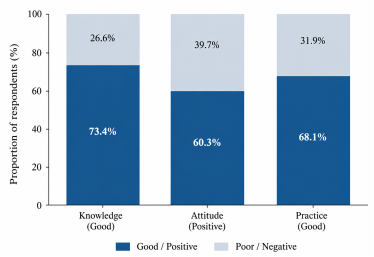
Overall, 246 respondents (73.4%) demonstrated good knowledge, 202 (60.3%) held a positive attitude toward antimicrobial guidelines and stewardship, and 228 (68.1%) reported good practice (
Figure 1). Attitude rather than practice had the lowest proportion of favourable status in this sample and the proportion demonstrating good practice was numerically lower than the proportion demonstrating good knowledge, consistent with hypothesis H1, that is, that there is a gap between good knowledge and good practice. There was a gap in the formal AMS training of only 110 (32.8%) respondents, although 233 (69.6%) had knowledge of national or international antimicrobial guidelines.
Figure 1. Overall knowledge, attitude, and good practice status among the pharmacists in Balochistan, Pakistan.
3.3. Comparison of KAP Scores by Gender
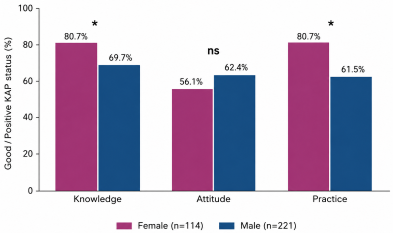
The female pharmacists demonstrated significantly more knowledge than the male pharmacists on the knowledge domain (median 7.5 vs 7.0, U=14,617.0, p=0.014) and the practice domain (median 12.0 vs 11.0, U=15; 54.5, p<0.001). Male pharmacists had slightly higher mean scores than female pharmacists in the attitude domain (25.30 vs 24.61) but this difference was not statistically significant at the conventional 0.05 level (U=11,024.5, p=0.058). These patterns were consistent when KAP scores were examined as dichotomised Good/Positive proportions (
Figure 2): 80.7% of female pharmacists demonstrated good knowledge versus 69.7% of male pharmacists, and 80.7% of female pharmacists demonstrated good practice versus 61.5% of male pharmacists, whereas the proportion with a positive attitude was similar between female (56.1%) and male (62.4%) pharmacists.
Figure 2. Good/Positive knowledge, attitude, and practice status by gender (Mann-Whitney U test on continuous composite scores; denotes p<0.05, ns = not significant).
3.4. Comparison of KAP Scores Across Demographic and Professional Subgroups
Kruskal-Wallis H tests were used to compare KAP scores across age group, years of experience, qualification, and type of pharmacy (
Table 3). Attitude scores differed significantly across age groups (H=11.25, df=3, p=0.011) and years of experience (H=13.95, df=3, p=0.003). Practice scores also differed significantly across years of experience (H=14.89, df=3, p=0.002) and type of pharmacy (H=10.06, df=3, p=0.018). Knowledge scores did not differ significantly across age, experience, qualification, or pharmacy type (all p>0.05), and neither attitude nor practice scores differed significantly by highest qualification.
Table 3. Kruskal-Wallis H Comparison of Knowledge, Attitude, and Practice Scores across Demographic and Professional Subgroups.
Grouping variable | Knowledge H (p) | Attitude H (p) | Practice H (p) | Df |
Age group | 3.10 (0.376) | 11.25 (0.011) | 4.56 (0.207) | 3 |
Years of experience | 3.40 (0.335) | 13.95 (0.003) | 14.89 (0.002) | 3 |
Highest qualification | 3.35 (0.341) | 1.73 (0.630) | 4.44 (0.218) | 3 |
Type of pharmacy | 0.95 (0.813) | 2.59 (0.459) | 10.06 (0.018) | 3 |
Values are Kruskal-Wallis H statistic (p-value). p<0.05. H = Kruskal-Wallis H statistic; df = degrees of freedom.
Mann-Whitney U comparisons additionally showed that pharmacists who had received formal AMS training reported significantly more favourable attitudes (median 26 vs 25; U=14,907.0, p=0.002) and significantly better practice (median 12 vs 11; U=14,497.0, p=0.010) than untrained pharmacists, although knowledge scores did not differ significantly by training status (p=0.339) a pattern consistent with hypothesis H3, which anticipated a training effect on attitude and practice but not necessarily on baseline knowledge.
3.5. Associations Between Dichotomised KAP Status and Demographic/Professional Characteristics
Chi-square tests of independence were used to examine associations between dichotomised (Good/Poor) KAP categories and categorical demographic and professional variables (
Table 4). Good knowledge was significantly associated with gender (χ
2=4.13, df=1, p=0.042) and awareness of national/international guidelines (χ
2=7.82, df=1, p=0.005). Good practice was significantly associated with gender (χ
2=11.84, df=1, p=0.001), years of experience (χ
2=13.26, df=3, p=0.004), and previous AMS training (χ
2=11.58, df=1, p=0.001). Positive attitude was not significantly associated with any single categorical demographic variable at the bivariate level, although the trends by age and experience described above (Section 3.4) were significant for the continuous attitude score.
Table 4. Chi-Square Associations between Dichotomised Knowledge, Attitude, and Practice Status and Demographic/Professional Variables.
KAP domain | Demographic/professional variable | χ2 (df) | p-value |
Knowledge (good) | Gender | 4.13 (1) | 0.042 |
Knowledge (good) | Age group | 1.53 (3) | 0.676 |
Knowledge (good) | Experience | 2.63 (3) | 0.453 |
Knowledge (good) | Qualification | 1.35 (3) | 0.718 |
Knowledge (good) | Pharmacy type | 3.30 (3) | 0.348 |
Knowledge (good) | AMS training | 0.96 (1) | 0.327 |
Knowledge (good) | Guideline awareness | 7.82 (1) | 0.005 |
Attitude (positive) | Gender | 1.00 (1) | 0.318 |
Attitude (positive) | Age group | 2.08 (3) | 0.557 |
Attitude (positive) | Experience | 4.11 (3) | 0.250 |
Attitude (positive) | Qualification | 0.64 (3) | 0.887 |
Attitude (positive) | Pharmacy type | 1.55 (3) | 0.671 |
Attitude (positive) | AMS training | 0.57 (1) | 0.451 |
Attitude (positive) | Guideline awareness | 0.23 (1) | 0.628 |
Practice (good) | Gender | 11.84 (1) | 0.001 |
Practice (good) | Age group | 6.71 (3) | 0.082 |
Practice (good) | Experience | 13.26 (3) | 0.004 |
Practice (good) | Qualification | 4.67 (3) | 0.198 |
Practice (good) | Pharmacy type | 5.96 (3) | 0.114 |
Practice (good) | AMS training | 11.58 (1) | 0.001 |
Practice (good) | Guideline awareness | 0.00 (1) | 0.984 |
p<0.05. Guideline awareness refers to Q2 (aware of national/international antimicrobial guidelines); AMS training refers to Q1 (received formal antimicrobial stewardship training).
3.6. Independent Predictors of Good Knowledge, Positive Attitude, and Good Practice
Three multivariable binary logistic regression models were fitted to identify independent predictors of good knowledge, positive attitude, and good practice, adjusting simultaneously for gender, age group, years of experience, highest qualification, type of pharmacy, previous AMS training, and guideline awareness (
Tables 5-7).
For good knowledge (
Table 5), male gender was independently associated with significantly lower odds of good knowledge relative to female pharmacists (aOR 0.52, 95% CI 0.28–0.94, p=0.030), while awareness of national/international guidelines was independently associated with more than double the odds of good knowledge (aOR 2.36, 95% CI 1.35–4.13, p=0.003). No other covariate reached statistical significance in this model (overall model likelihood-ratio p=0.038).
Table 5. Multivariable Logistic Regression: Independent Predictors of Good Knowledge.
Predictor | aOR | 95% CI | p-value |
Male gender (ref: Female) | 0.52 | 0.28–0.94 | 0.030 |
Age 31–40y (ref: 20–30y) | 0.60 | 0.30–1.18 | 0.136 |
Age ≥41y (ref: 20–30y) | 1.12 | 0.42–3.00 | 0.815 |
Experience 7–9y (ref: ≤6y) | 1.26 | 0.58–2.77 | 0.560 |
Experience ≥10y (ref: ≤6y) | 0.72 | 0.20–2.61 | 0.613 |
Pharm-D (ref: B.Pharm) | 1.25 | 0.65–2.41 | 0.496 |
Postgraduate (ref: B.Pharm) | 0.83 | 0.27–2.55 | 0.740 |
Chain pharmacy (ref: Independent) | 1.18 | 0.40–3.48 | 0.760 |
Hospital indoor/ward (ref: Independent) | 1.65 | 0.87–3.15 | 0.126 |
Hospital outpatient (ref: Independent) | 1.20 | 0.53–2.71 | 0.664 |
Previous AMS training (ref: No) | 1.40 | 0.78–2.50 | 0.255 |
Aware of AM guidelines (ref: No) | 2.36 | 1.35–4.13 | 0.003 |
aOR = adjusted odds ratio; CI = confidence interval. p<0.05. Model N=335; pseudo-R2=0.057; likelihood-ratio p=0.038.
For positive attitude (
Table 6), no covariate was an independent, statistically significant predictor after mutual adjustment (overall model likelihood-ratio p=0.908), despite the significant bivariate associations with age group and years of experience noted in Section 3.4. These are indications that the unadjusted associations for attitude were caused by the same common demographic characteristics (such as age being associated with experience), and not by any single independent characteristic.
Table 6. Multivariable Logistic Regression: Independent Predictors of Positive Attitude.
Predictor | aOR | 95% CI | p-value |
Male gender (ref: Female) | 1.24 | 0.76–2.02 | 0.396 |
Age 31–40y (ref: 20–30y) | 0.93 | 0.53–1.64 | 0.811 |
Age ≥41y (ref: 20–30y) | 0.81 | 0.34–1.91 | 0.632 |
Experience 7–9y (ref: ≤6y) | 1.42 | 0.72–2.81 | 0.315 |
Experience ≥10y (ref: ≤6y) | 1.76 | 0.51–6.09 | 0.375 |
Pharm-D (ref: B.Pharm) | 1.21 | 0.68–2.15 | 0.511 |
Postgraduate (ref: B.Pharm) | 1.04 | 0.39–2.79 | 0.943 |
Chain pharmacy (ref: Independent) | 0.73 | 0.26–2.02 | 0.546 |
Hospital indoor/ward (ref: Independent) | 1.01 | 0.56–1.80 | 0.980 |
Hospital outpatient (ref: Independent) | 0.70 | 0.34–1.45 | 0.333 |
Previous AMS training (ref: No) | 1.25 | 0.76–2.05 | 0.382 |
Aware of AM guidelines (ref: No) | 0.85 | 0.51–1.43 | 0.552 |
aOR = adjusted odds ratio; CI = confidence interval. Model N=335; pseudo-R2=0.014; likelihood-ratio p=0.908 (no significant predictors identified after adjustment).
For good practice (
Table 7), the model was highly significant overall (likelihood-ratio p<0.001, pseudo-R
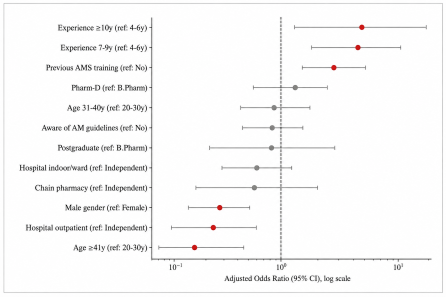
2=0.123) and identified the largest number of independent predictors. Male gender was associated with significantly lower odds of good practice (aOR 0.34, 95% CI 0.19–0.62, p=0.001). Previous AMS training was associated with 2.66-fold higher odds of good practice (95% CI 1.44–4.88, p=0.002), consistent with hypothesis. Pharmacists with 7–9 years of experience (aOR 4.11, 95% CI 1.67–10.09, p=0.002) and those with ≥10 years of experience (aOR 4.28, 95% CI 1.11–16.46, p=0.035) had substantially higher odds of good practice than those in the combined ≤6-year experience reference category. Conversely, pharmacists aged ≥41 years had lower odds of good practice than those aged 20–30 years (aOR 0.21, 95% CI 0.07–0.57, p=0.002), and those working in hospital outpatient pharmacies had lower odds of good practice than those in independent pharmacies (aOR 0.31, 95% CI 0.13–0.73, p=0.007).
Table 7. Multivariable Logistic Regression: Independent Predictors of Good Practice.
Predictor | aOR | 95% CI | p-value |
Male gender (ref: Female) | 0.34 | 0.19–0.62 | 0.001 |
Age 31–40y (ref: 20–30y) | 0.96 | 0.50–1.85 | 0.914 |
Age ≥41y (ref: 20–30y) | 0.21 | 0.07–0.57 | 0.002 |
Experience 7–9y (ref: ≤6y) | 4.11 | 1.67–10.09 | 0.002 |
Experience ≥10y (ref: ≤6y) | 4.28 | 1.11–16.46 | 0.035 |
Pharm-D (ref: B.Pharm) | 1.30 | 0.68–2.49 | 0.420 |
Postgraduate (ref: B.Pharm) | 0.90 | 0.28–2.90 | 0.862 |
Chain pharmacy (ref: Independent) | 0.66 | 0.22–2.03 | 0.472 |
Hospital indoor/ward (ref: Independent) | 0.67 | 0.34–1.33 | 0.255 |
Hospital outpatient (ref: Independent) | 0.31 | 0.13–0.73 | 0.007 |
Previous AMS training (ref: No) | 2.66 | 1.44–4.88 | 0.002 |
Aware of AM guidelines (ref: No) | 0.92 | 0.51–1.65 | 0.776 |
aOR = adjusted odds ratio; CI = confidence interval. p<0.05. Model N=335; pseudo-R2=0.123; likelihood-ratio p<0.001.
Figure 3. Forest plot of multivariable-adjusted odds ratios (95% CI) for good practice. Red markers denote statistically significant predictors (p<0.05); the vertical dashed line denotes an odds ratio of 1.0 (no association).
3.7. Perceived Barriers and Resource Needs
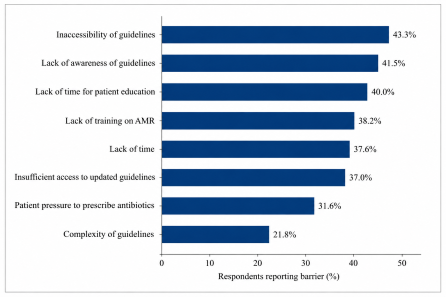
Pharmacists reported multiple, overlapping barriers to applying antimicrobial guidelines in practice (
Figure 4). The most frequently cited barrier was inaccessibility of guidelines (43.3%), followed by lack of awareness of guidelines (41.5%), lack of time for patient education (40.0%), lack of training on antimicrobial resistance (38.2%), lack of time generally (37.6%), and insufficient access to updated guidelines (37.0%). Complexity of the guidelines themselves (21.8%) and direct patient pressure to prescribe antibiotics (31.6%) were reported less frequently but remained non-trivial barriers.
When asked what resources would help them better follow antimicrobial guidelines, pharmacists most commonly identified more training on antimicrobial resistance (77.0%), followed by easy-to-use guideline summaries (43.9%) and better collaboration with physicians (38.8%); fewer respondents prioritised access to rapid diagnostic tests (19.1%) or stronger government enforcement of guidelines specifically as a resource (33.7%). At the community level, the interventions most frequently endorsed to reduce antibiotic misuse were public awareness campaigns (72.5%) and stricter regulations on antibiotic dispensing (52.2%).
Figure 4. Perceived barriers to antimicrobial guideline adherence reported by the pharmacists in Balochistan (N=335). Respondents could select more than one barrier.
4. Discussion
This cross-sectional survey of 335 community pharmacists across Balochistan provides, to our knowledge, the first province-wide empirical assessment of knowledge, attitudes, and practices toward antimicrobial stewardship and guideline adherence in this geographically remote and structurally underserved setting. Three main findings emerge. First, knowledge of antimicrobial stewardship was generally good (73.4%), broadly consistent with the pattern of favourable baseline knowledge reported among community pharmacists in other LMIC settings, including Zambia (86%), Libya, and parts of Nigeria and Ethiopia
| [9] | Sitotaw B, Philipos W. Knowledge, attitude, and practices (KAP) on antibiotic use and disposal ways in Sidama region, Ethiopia: a community-based cross-sectional survey. ScientificWorldJournal. 2023; 2023: 8774634. |
| [10] | Mekonnen GA, et al. Knowledge, attitude and practice of pharmacy professionals against dispensing antibiotics without prescription in Ethiopia. Front Public Health. 2022; 10: 1074149. |
[9, 10]
. Second, attitudes (60.3% positive) and practice (68.1% good) both lagged behind knowledge and echoing a knowledge–practice discordance that recurs throughout the international AMS literature, from the Gulf and Middle East
| [13] | Waheed KT, Khan MA, Abbas S, Tahir M, Aslam H, Akram W. Antibiotic dispensing practices in community pharmacies: implications for antimicrobial stewardship in resource-constrained settings and role of pharmacist in controlling antimicrobial resistance (AMR) in Lahore, Pakistan. J Health Wellness Community Res. 2026; 4(11): 1-13. |
| [18] | Alrasheedy AA, Alharbi RM, Alrehaili AS, et al. Knowledge, attitude, and perception of community pharmacists towards antimicrobial stewardship in Saudi Arabia: a descriptive cross-sectional study. Saudi Pharm J. 2022; 30(12): 1798-1806. |
| [26] | Jarab AS, AL-Alawneh TO, Alshogran OY, Abu Heshmeh S, Mukattash TL, Naser YA, Alefishat E. Knowledge and attitude of healthcare prescribers and pharmacists toward antimicrobial stewardship program and the barriers for its implementation. Antimicrob Resist Infect Control. 2024; 13: 36. |
[13, 18, 26]
to Pakistan’s own urban centres
| [11] | Nabeel M, Ali K, Sarwar MR, Waheed I, Mubarak N. Assessment of knowledge, attitudes, and practices among community pharmacists in Lahore regarding antibiotic dispensing without prescription: a cross-sectional study. PLoS One. 2024; 19(6): e0304361. |
| [14] | Atif M, Ihsan B, Malik I, Ahmad N, Saleem Z, Sehar A. Dispensing of non-prescribed antibiotics from community pharmacies of Pakistan: a cross-sectional survey of pharmacy staff's opinion. Antibiotics (Basel). 2021; 10(5): 482. |
[11, 14]
. Third, and most novel to this study, gender, years of experience, practice setting, and prior AMS training emerged as statistically robust, independent correlates of good practice after multivariable adjustment, while guideline awareness rather than formal training was the strongest independent correlate of good knowledge.
The gap between knowledge (73.4%) and practice (68.1%) identified here, although real, was less significant compared to some similar studies, which reported practice gaps of 20–30 percentage points from the knowledge
| [11] | Nabeel M, Ali K, Sarwar MR, Waheed I, Mubarak N. Assessment of knowledge, attitudes, and practices among community pharmacists in Lahore regarding antibiotic dispensing without prescription: a cross-sectional study. PLoS One. 2024; 19(6): e0304361. |
[11]
. In this sample, a much lower proportion had a positive attitude (60.3%) as compared to knowledge and practice. This is in contrast to the more common KAP pattern, where attitude follows knowledge and practice follows the least
| [22] | Elshenawy RA, Umaru N, Aslanpour Z. Cross-sectional descriptive study of pharmacists' knowledge, attitudes, and perceptions regarding antibiotic resistance and antimicrobial stewardship conducted post-COVID-19 pandemic at a UK NHS Foundation Trust. J Pharm Health Serv Res. 2025; 16(1): rmaf001. |
[22]
. The barriers reported (43.3% mentioned inaccessibility of guidelines and 41.5% lack of awareness) suggest one possible explanation for this, which is that whilst pharmacists are aware of the facts, they do not have institutional support, CPD access and regulatory oversight to turn facts into practice. In our survey, however, we did not directly ask about the frequency of contact with regulators nor perceived institutional support, so this interpretation should be treated with caution and investigated through future mixed-methods research
| [39] | Shobayo BI, Lundborg CS, Nordenstedt H, Saleh H, Babawarun T, Oyewole EA, Fallah MP, Sharma M. Perspectives and Challenges of Healthcare Professionals, Patients, and Caregivers Regarding Utilizing Antibiotics and Implementing Antibiotic Stewardship in Healthcare Facilities in Low-and Middle-Income Countries: A Systematic Review of Qualitative Studies. Antibiotics. 2026 May 5; 15(5): 468. |
[39]
. In this situation, knowledge can become entrenched while the professional attitude that would normally follow the development of knowledge is lost. This interpretation is shared by just 32.8% of pharmacists who reported formal AMS training, while 69.6% reported being aware of guidelines, suggesting that the awareness of guidelines was somewhat disconnected with the knowledge and attitude towards AMS captured in the attitude domain.
Female pharmacists demonstrated significantly better knowledge and practice than male pharmacists, both in bivariate comparisons (Mann-Whitney U, Section 3.3) and after multivariable adjustment (
Tables 5 and 7), with male gender independently associated with roughly half the odds of good knowledge and roughly a third of the odds of good practice. The attitude difference by gender was smaller and did not reach conventional statistical significance (p=0.058), suggesting this gender effect is concentrated specifically in what pharmacists know and do, rather than in how they feel about stewardship. This finding is directionally consistent with several regional KAP surveys that have reported better guideline-concordant performance among female pharmacy professionals
| [20] | Darwish RM, Baqain G, Aladwan HS, Salamah LM, Madi RM, Masri RMA. Knowledge, attitudes, and practices (KAP) of community pharmacists regarding antibiotic use and resistance: a cross-sectional study from the United Arab Emirates. J Pharm Policy Pract. 2024. |
| [31] | Abubakar U, Subramaniam L, Ayinla A, Ambali MN, Noor DAM, Daud NAA, Isah HK, Al-Shami HA. Knowledge, attitude and perception of community pharmacists towards pharmacogenomics services in northern Nigeria: a cross-sectional study. J Pharm Policy Pract. 2022; 15: 37. |
| [36] | World Health Organization. Aligning regional policy actions with global commitments: Accelerating the fight against AMR in the WHO South-East Asia Region. World Health Organization. Regional Office for South-East Asia; 2025 Sep 10. |
[20, 31, 36]
, although the underlying mechanism remains speculative. Female pharmacists in this sample, while a minority (34.0% of respondents), may be disproportionately represented in Pharm-D-qualified and hospital-based roles where structured protocols and closer clinical supervision are more common; alternatively, the finding could reflect differences in patient-facing communication style or risk aversion that were not captured by the present instrument. Because gender was not the primary hypothesis-driving variable in this study and the mechanism cannot be adjudicated with cross-sectional self-report data, we present this as a robust but exploratory association warranting confirmation in future, mixed-methods research rather than as a basis for policy targeting by gender per se.
Years of experience was independently associated with good practice in a non-linear fashion: pharmacists with 7–9 years and ≥10 years of experience had four-fold higher odds of good practice than those in the combined ≤6-year reference category (comprising the 0–3-year and 4–6-year strata, n=72 and n=185 respectively;
Table 1), even as the crude proportion with good practice among those with ≥10 years of combined experience (10–13y and >14y bands) was more mixed (42.9% and 100%, respectively, in small strata). This U-shaped or plateauing pattern, combined with the very small numbers of pharmacists in the highest experience bands (n=14 and n=4), should be interpreted cautiously, but it is broadly consistent with the idea that stewardship practice consolidates with a few years of consultative experience beyond early career, a pattern also reported in Jordanian and Saudi cohorts
| [23] | Alghamdi S, et al. Healthcare professionals' knowledge and attitudes toward antimicrobial stewardship programs in Aseer, Saudi Arabia: a cross-sectional study. Risk Manag Healthc Policy. 2025; 18: 1-14. |
| [26] | Jarab AS, AL-Alawneh TO, Alshogran OY, Abu Heshmeh S, Mukattash TL, Naser YA, Alefishat E. Knowledge and attitude of healthcare prescribers and pharmacists toward antimicrobial stewardship program and the barriers for its implementation. Antimicrob Resist Infect Control. 2024; 13: 36. |
[23, 26]
. Practice setting also mattered: hospital outpatient pharmacists had markedly lower odds of good practice than independent-pharmacy pharmacists (aOR 0.31), possibly reflecting higher patient throughput, less individualised patient contact time, or less pharmacist autonomy over dispensing decisions in outpatient hospital settings compared with independent community pharmacies where the pharmacist typically has more direct control over the dispensing encounter.
Previous AMS training was one of the most consistent and clinically meaningful predictors identified in this study, independently associated with 2.66-fold higher odds of good practice (
Table 7) and with significantly more favourable attitude scores in bivariate comparison (Section 3.4). Particularly, training was not independently associated with knowledge (
Table 5) guideline awareness, not training per se, was the significant knowledge correlate suggesting that the primary value of formal AMS training in this population lies less in transmitting new factual content (which pharmacists may already acquire through pharmacy education and guideline exposure) and more in translating existing knowledge into confident, consistent stewardship behaviour. This distinction has direct implications for how CPD programmes in Balochistan should be designed: rather than functioning primarily as knowledge-transmission exercises, effective programmes may need to emphasise applied, practice-based skills patient counselling scripts, structured approaches to recommending prescription changes, and confidence-building in confronting prescriber or patient pressure given that only 32.8% of this sample had received any such training to date.
The barriers pharmacists reported inaccessibility of guidelines (43.3%), lack of awareness of guidelines (41.5%), and lack of time for patient education (40.0%) point toward practical, point-of-care obstacles rather than purely attitudinal resistance to stewardship. It is reflected from the resource preferences expressed: more training on antimicrobial resistance (AMR) was endorsed by 77.0% while easy-to-use guideline summaries were endorsed by 43.9%, both of which are relatively low-cost and can be scaled up as interventions compared with structural interventions like diagnostic infrastructure (endorsed by only 19.1% of respondents, possibly because rapid diagnostics is not feasible in much of the remote setting of Balochistan) or broad regulatory reform. Together with the independent predictive effect of training on practice these results suggest a clear policy message – that point of dispensing guideline tools and structured, practice directed CPD are the low hanging fruit for provincial health authorities to close the observed knowledge–practice gap as soon as possible over more resource-heavy system reform.
Previous studies in Pakistan have focused on urban areas of Punjab and Sindh
| [11] | Nabeel M, Ali K, Sarwar MR, Waheed I, Mubarak N. Assessment of knowledge, attitudes, and practices among community pharmacists in Lahore regarding antibiotic dispensing without prescription: a cross-sectional study. PLoS One. 2024; 19(6): e0304361. |
| [13] | Waheed KT, Khan MA, Abbas S, Tahir M, Aslam H, Akram W. Antibiotic dispensing practices in community pharmacies: implications for antimicrobial stewardship in resource-constrained settings and role of pharmacist in controlling antimicrobial resistance (AMR) in Lahore, Pakistan. J Health Wellness Community Res. 2026; 4(11): 1-13. |
| [33] | Frontiers Publishing Partnerships. Community pharmacists as antimicrobial resistance stewards: a narrative review on their contributions and challenges in low- and middle-income countries. J Pharm Pharm Sci. 2024; 27: 12721. |
| [37] | Sarwar MR, Saqib A, Iftikhar S, Sadiq T. Knowledge of community pharmacists about antibiotics, and their perceptions and practices regarding antimicrobial stewardship: a cross-sectional study in Punjab, Pakistan. Infect Drug Resist. 2018; 11: 133-145. |
[11, 13, 33, 37]
but this study is in a large, under-researched and geographically distinct province. The overall pattern positive knowledge, less consistent guideline-concordant attitudes and actions, and training and experience as protective factors is consistent with overall regional literature from Saudi Arabia, the UAE, Australia and Jordan where training and experience are generally protective factors, whereas technical competence has been firmly established as a predictor of less consistent guideline-concordant attitudes and actions
| [20] | Darwish RM, Baqain G, Aladwan HS, Salamah LM, Madi RM, Masri RMA. Knowledge, attitudes, and practices (KAP) of community pharmacists regarding antibiotic use and resistance: a cross-sectional study from the United Arab Emirates. J Pharm Policy Pract. 2024. |
| [26] | Jarab AS, AL-Alawneh TO, Alshogran OY, Abu Heshmeh S, Mukattash TL, Naser YA, Alefishat E. Knowledge and attitude of healthcare prescribers and pharmacists toward antimicrobial stewardship program and the barriers for its implementation. Antimicrob Resist Infect Control. 2024; 13: 36. |
| [38] | Rizvi T, Thompson A, Williams M, Zaidi STR. Validation and implementation of a national survey to assess antimicrobial stewardship awareness, practices and perceptions amongst community pharmacists in Australia. J Glob Antimicrob Resist. 2020; 21: 28-33. |
[20, 26, 38]
. In the present study, the identification of guideline awareness (rather than training) as the predominant knowledge correlate, and training (rather than awareness) as the predominant practice correlate provides a more nuanced picture than most previous KAP surveys, which often report on a single combined training/awareness variable. It could be of interest to provincial planners when they are planning investment priority between dissemination of guidelines and delivery of structured CPD.
5. Conclusion
Attitudes (60.3% favourable) and, to a lesser degree than knowledge, practice (68.1% good) were also generally good among community pharmacists in Balochistan, but there was a measurable difference between what pharmacists know and how well it is reflected in their professional attitudes and dispensing practice in line with the guidelines. A significant gap in structured training also seemed to exist (only 32.8% had undergone formal AMS training, while 69.6% recognised that there was a national or international guideline for AMS training). Consistent and independent correlates of the KAP status were identified, such as female gender, moderate-to-high experience, independent practice setting (not hospital outpatient), and most actionably, previous AMS training, which was associated with 2.7-fold higher odds of good practice. The findings confirm the a priori hypotheses set forth by the study; namely, that there was a knowledge–practice gap, that there were demographic and professional differences in KAP scores, that there was a measurable training effect on attitude and practice, and that several independent multivariable predictors remained significant after adjustment. Overall, the findings suggest that filling the antimicrobial stewardship gap in Balochistan requires more than merely increasing baseline pharmacist knowledge, which is relatively high, and more than simply providing guideline tools at the point of dispensing and greater regulatory support; rather, it would seem to require structured continuing professional development.
6. Limitations
The following limitations should be considered.
1) Cluster sampling: This is an approach that participants were recruited using the four practice settings, rather than by sampling the entire population of registered community pharmacists in Balochistan. This may restrict the generalisability to pharmacists in the most remote districts (e. g., Zhob, Gwadar, Khuzdar) for whom we postulated isolation and low levels of oversight to be more challenging to stewardship. The level of KAP may have been overestimated at the province level if these pharmacists were under-represented and the need for interventions in remote areas may be higher than our findings indicate.
2) The findings of the study may not be generalizable to other provinces in Pakistan due to the differences in regulatory enforcement, urban-rural distribution and health infrastructure.
7. Recommendations
On the basis of the results of this study, the following recommendations are suggested for provincial health authorities, pharmacy regulatory bodies and future researchers:
Focus on structured, practice-based Continuing Professional Development (CPD) on antimicrobial stewardship over continued dissemination of general antimicrobial knowledge as only 32.8% of pharmacists had been formally trained, with training being the strongest independent predictor of good antimicrobial practice.
Develop and disseminate low-cost, readily available, point-of-dispensing guideline summaries (e. g., l aminated quick-reference cards or an app) in response to the needs of 43.3% of pharmacists who reported that guideline summaries were needed and 43.9% who reported guideline inaccessibility as a barrier.
Implement regulation of dispensing of prescription only medicines (POMs) from community pharmacies more strictly, as 52.2% of pharmacists supported this measure, but understand that this is unlikely to be effective without other interventions such as training and providing guidance on antibiotic use.
Conduct public awareness programs on rational antibiotic use in addition to pharmacist-level interventions, with the support of 72.5% of pharmacists who said this was a priority intervention to reduce antibiotic misuse at the community-level.
Create mentorship or peer-support programs that facilitate the transfer of benefits to early-career pharmacists in the areas of practice consolidation that are associated with longer years of experience, as seen within the current study, especially when between independent practitioners.
Provide active extension of CPD and guideline dissemination to the pharmacists in geographically remote districts of Balochistan (e. g., Zhobb, Gwadar, Khuzdar) instead of focusing on the provincial urban centres considering the administrative isolation that led to this study.
Abbreviations
AMGs | Antimicrobial Guidelines |
AMR | Antimicrobial Resistance |
AMS | Antimicrobial Stewardship |
CPD | Continuing Professional Development |
KAP | Knowledge, Attitude and Practice |
POMs | Prescription Only Medicines |
WHO | World Health Organization |
Acknowledgments
The authors have acknowledged the contribution of all participants, the coauthors and resource.
Author Contributions
Abdul Ghaffar: Conceptualization, Data curation, Formal Analysis, Investigation, Methodology, Project administration, Software, Supervision, Visualization, Writing – original draft
Azra Riaz: Conceptualization, Data curation, Formal Analysis, Methodology, Project administration, Supervision, Visualization
Abdul Wahid: Data curation, Formal Analysis, Visualization, Writing – review & editing
Abdul Manan: Investigation, Resources
Mohammad Aamir: Investigation, Resources
Yasir Ahmed: Investigation, Resources
Asma Manzoor: Investigation, Resources
Conflicts of Interest
The authors declare no conflicts of interest.
References
| [1] |
Murray CJL, Ikuta KS, Sharara F, et al. Global burden of bacterial antimicrobial resistance in 2019: a systematic analysis. Lancet. 2022; 399(10325): 629-655.
|
| [2] |
GBD 2021 Antimicrobial Resistance Collaborators (Naghavi M, et al). Global burden of bacterial antimicrobial resistance 1990-2021: a systematic analysis with forecasts to 2050. Lancet. 2024; 404(10459): 1199-1226.
|
| [3] |
GBD 2021 Antimicrobial Resistance Collaborators. Burden of bacterial antimicrobial resistance in low-income and middle-income countries avertible by existing interventions: an evidence review and modelling analysis. Lancet. 2024; 403(10442): 2439-2454.
|
| [4] |
World Health Organization. Global Action Plan on Antimicrobial Resistance. Geneva: WHO; 2015.
|
| [5] |
World Health Organization. AWaRe Classification of Antibiotics for Evaluation and Monitoring of Use, 2023. Geneva: WHO; 2023 (WHO/MHP/HPS/EML/2023.04).
|
| [6] |
Centers for Disease Control and Prevention. Core Elements of Hospital Antibiotic Stewardship Programs. Atlanta: US Department of Health and Human Services, CDC; 2019.
|
| [7] |
Saleem Z, Hassali MA, Godman B, et al. Progress on the national action plan of Pakistan on antimicrobial resistance (AMR): a narrative review and the implications. Expert Rev Anti Infect Ther. 2022; 20(1): 71-93.
|
| [8] |
World Health Organization. Pakistan: National Action Plan for Antimicrobial Resistance 2.0 (2024-2028). Geneva: WHO; 2024.
|
| [9] |
Sitotaw B, Philipos W. Knowledge, attitude, and practices (KAP) on antibiotic use and disposal ways in Sidama region, Ethiopia: a community-based cross-sectional survey. ScientificWorldJournal. 2023; 2023: 8774634.
|
| [10] |
Mekonnen GA, et al. Knowledge, attitude and practice of pharmacy professionals against dispensing antibiotics without prescription in Ethiopia. Front Public Health. 2022; 10: 1074149.
|
| [11] |
Nabeel M, Ali K, Sarwar MR, Waheed I, Mubarak N. Assessment of knowledge, attitudes, and practices among community pharmacists in Lahore regarding antibiotic dispensing without prescription: a cross-sectional study. PLoS One. 2024; 19(6): e0304361.
|
| [12] |
Hashmi A, Haq MIU, Malik M, Hussain A, Gajdács M, Jamshed S. Perceptions of community pharmacists regarding their role in antimicrobial stewardship in Pakistan: a way forward. Heliyon. 2023; 9(4): e14843.
|
| [13] |
Waheed KT, Khan MA, Abbas S, Tahir M, Aslam H, Akram W. Antibiotic dispensing practices in community pharmacies: implications for antimicrobial stewardship in resource-constrained settings and role of pharmacist in controlling antimicrobial resistance (AMR) in Lahore, Pakistan. J Health Wellness Community Res. 2026; 4(11): 1-13.
|
| [14] |
Atif M, Ihsan B, Malik I, Ahmad N, Saleem Z, Sehar A. Dispensing of non-prescribed antibiotics from community pharmacies of Pakistan: a cross-sectional survey of pharmacy staff's opinion. Antibiotics (Basel). 2021; 10(5): 482.
|
| [15] |
Saleem Z, Godman B, Hassali MA, et al. Antimicrobial dispensing practices during COVID-19 and the implications for Pakistan. Antibiotics (Basel). 2023; 12(6): 1018.
|
| [16] |
Rehman IU, et al. Tackling antimicrobial resistance in primary care facilities across Pakistan: current challenges and implications for the future. J Infect Public Health. 2023; 16(Suppl 1): 97-110.
|
| [17] |
Iqbal MS, Ahmad Y, Ejaz A, Iqbal MZ. Self-medication with antibiotics: prevalence, practices and related factors among the Pakistani public. Antibiotics (Basel). 2022; 11(6): 795.
|
| [18] |
Alrasheedy AA, Alharbi RM, Alrehaili AS, et al. Knowledge, attitude, and perception of community pharmacists towards antimicrobial stewardship in Saudi Arabia: a descriptive cross-sectional study. Saudi Pharm J. 2022; 30(12): 1798-1806.
|
| [19] |
AlAhmad MM, Rabbani SA, Al-Salman R, Alameri H, Al Namer Y, Jaber AAS. Antimicrobial stewardship practices of community pharmacists in United Arab Emirates. Antibiotics (Basel). 2023; 12(8): 1238.
|
| [20] |
Darwish RM, Baqain G, Aladwan HS, Salamah LM, Madi RM, Masri RMA. Knowledge, attitudes, and practices (KAP) of community pharmacists regarding antibiotic use and resistance: a cross-sectional study from the United Arab Emirates. J Pharm Policy Pract. 2024.
|
| [21] |
Nadeem F, et al. Knowledge, attitudes, and practices (KAP) of community pharmacists in Karachi regarding antimicrobial stewardship (AMS) and its association with their perceived competence in patient counseling. 2024.
|
| [22] |
Elshenawy RA, Umaru N, Aslanpour Z. Cross-sectional descriptive study of pharmacists' knowledge, attitudes, and perceptions regarding antibiotic resistance and antimicrobial stewardship conducted post-COVID-19 pandemic at a UK NHS Foundation Trust. J Pharm Health Serv Res. 2025; 16(1): rmaf001.
|
| [23] |
Alghamdi S, et al. Healthcare professionals' knowledge and attitudes toward antimicrobial stewardship programs in Aseer, Saudi Arabia: a cross-sectional study. Risk Manag Healthc Policy. 2025; 18: 1-14.
|
| [24] |
Al-Taani GM, Karasneh RA, Al-Azzam S, Bin Shaman M, Jirjees F, Al-Obaidi H, Conway BR, Aldeyab MA. Knowledge, attitude, and behavior about antimicrobial use and resistance among medical, nursing and pharmacy students in Jordan: a cross-sectional study. Antibiotics (Basel). 2022; 11(11): 1559.
|
| [25] |
Wahid A, Salam R, Urosa Bashir NN, Iqbal F, Khan A, Shahwani GM, Ghafar A, Sadique W. Treatment outcomes and risk factors associated with unsuccessful treatment outcomes among extra pulmonary tuberculosis patients. Asia-Pacific Journal of Pharmacotherapy & Toxicology. 2023; 3: 16-22.
|
| [26] |
Jarab AS, AL-Alawneh TO, Alshogran OY, Abu Heshmeh S, Mukattash TL, Naser YA, Alefishat E. Knowledge and attitude of healthcare prescribers and pharmacists toward antimicrobial stewardship program and the barriers for its implementation. Antimicrob Resist Infect Control. 2024; 13: 36.
|
| [27] |
Author collective. Knowledge, attitude, and practices of pharmacy students in seven Middle Eastern countries regarding antibiotic resistance. Medicine (Baltimore). 2024; 103(36): e39485.
|
| [28] |
Sharland M, Zanichelli V, Ombajo LA, et al. WHO's essential medicines and AWaRe: recommendations on first- and second-choice antibiotics for empiric treatment of clinical infections. Clin Microbiol Infect. 2024; 30 Suppl 2: S1-S51.
|
| [29] |
US Pharmacist Editorial. The pharmacist's role in antimicrobial stewardship. US Pharm. 2024; 49(10): HS12-HS16.
|
| [30] |
Chandy SJ, Naik GS, Balaji V, Jeyaseelan V, Thomas K, Lundborg CS. Antimicrobial stewardship programs in resource constrained environments: understanding and addressing the need of the systems. Front Public Health. 2020; 7: 415.
|
| [31] |
Abubakar U, Subramaniam L, Ayinla A, Ambali MN, Noor DAM, Daud NAA, Isah HK, Al-Shami HA. Knowledge, attitude and perception of community pharmacists towards pharmacogenomics services in northern Nigeria: a cross-sectional study. J Pharm Policy Pract. 2022; 15: 37.
|
| [32] |
Author collective. Knowledge, attitude and practice of pharmacovigilance among community pharmacy in India: a questionnaire study. Int J Basic Clin Pharmacol. 2024; 13(5).
|
| [33] |
Frontiers Publishing Partnerships. Community pharmacists as antimicrobial resistance stewards: a narrative review on their contributions and challenges in low- and middle-income countries. J Pharm Pharm Sci. 2024; 27: 12721.
|
| [34] |
Bhutta ZA, Sohail S. Pakistan's national action plan for antimicrobial resistance: translating ideas into reality. Lancet Infect Dis. 2019; 19(1): 40-41.
|
| [35] |
Godman B, Fadare J, Kwon HY, et al. Concerns with current drug laws regarding the purchasing of antibiotics without a prescription in Pakistan; ways forward to assist the national action plan. Expert Rev Anti Infect Ther. 2023; 21(11): 1163-1165.
|
| [36] |
World Health Organization. Aligning regional policy actions with global commitments: Accelerating the fight against AMR in the WHO South-East Asia Region. World Health Organization. Regional Office for South-East Asia; 2025 Sep 10.
|
| [37] |
Sarwar MR, Saqib A, Iftikhar S, Sadiq T. Knowledge of community pharmacists about antibiotics, and their perceptions and practices regarding antimicrobial stewardship: a cross-sectional study in Punjab, Pakistan. Infect Drug Resist. 2018; 11: 133-145.
|
| [38] |
Rizvi T, Thompson A, Williams M, Zaidi STR. Validation and implementation of a national survey to assess antimicrobial stewardship awareness, practices and perceptions amongst community pharmacists in Australia. J Glob Antimicrob Resist. 2020; 21: 28-33.
|
| [39] |
Shobayo BI, Lundborg CS, Nordenstedt H, Saleh H, Babawarun T, Oyewole EA, Fallah MP, Sharma M. Perspectives and Challenges of Healthcare Professionals, Patients, and Caregivers Regarding Utilizing Antibiotics and Implementing Antibiotic Stewardship in Healthcare Facilities in Low-and Middle-Income Countries: A Systematic Review of Qualitative Studies. Antibiotics. 2026 May 5; 15(5): 468.
|
| [40] |
Afzal S, Khan FU, Aqeel MT, Ullah M, Bajwa M, Akhtar M, Majid M. Impact of a pharmacist-led educational intervention on knowledge, attitude, and practice toward the rational use of antibiotics among healthcare workers in a secondary care hospital in Punjab, Pakistan. Frontiers in Pharmacology. 2024 Jan 29; 14: 1327576.
|
Cite This Article
-
APA Style
Ghaffar, A., Riaz, A., Wahid, A., Manan, A., Aamir, M., et al. (2026). Knowledge, Attitudes, and Practice: Adherence to Antimicrobial Guidelines Among Pharmacists in Balochistan. American Journal of Health Policy and Management, 1(1), 46-60. https://doi.org/10.11648/j.ajhpm.20260101.16
 Copy
|
Copy
|
 Download
ACS Style
Ghaffar, A.; Riaz, A.; Wahid, A.; Manan, A.; Aamir, M., et al. Knowledge, Attitudes, and Practice: Adherence to Antimicrobial Guidelines Among Pharmacists in Balochistan. Am. J. Health Policy Manag. 2026, 1(1), 46-60. doi: 10.11648/j.ajhpm.20260101.16
Copy
|
Download
AMA Style
Ghaffar A, Riaz A, Wahid A, Manan A, Aamir M, et al. Knowledge, Attitudes, and Practice: Adherence to Antimicrobial Guidelines Among Pharmacists in Balochistan. Am J Health Policy Manag. 2026;1(1):46-60. doi: 10.11648/j.ajhpm.20260101.16
Copy
|
Download
-
@article{10.11648/j.ajhpm.20260101.16,
  author = {Abdul Ghaffar and Azra Riaz and Abdul Wahid and Abdul Manan and Mohammad Aamir and Yasir Ahmed and Asma Manzoor},
  title = {Knowledge, Attitudes, and Practice: Adherence to Antimicrobial Guidelines Among Pharmacists in Balochistan},
  journal = {American Journal of Health Policy and Management},
  volume = {1},
  number = {1},
  pages = {46-60},
  doi = {10.11648/j.ajhpm.20260101.16},
  url = {https://doi.org/10.11648/j.ajhpm.20260101.16},
  eprint = {https://article.sciencepublishinggroup.com/pdf/10.11648.j.ajhpm.20260101.16},
  abstract = {Antimicrobial resistance (AMR) is a major global health threat. As frontline providers, pharmacists play a crucial role in antimicrobial stewardship (AMS). However, data on their knowledge, attitudes, and practices (KAP) regarding AMS and guidelines in Balochistan, Pakistan, remain limited. The study was designed to assess the knowledge, attitudes and practices (KAP) with regard to antimicrobial stewardship (AMS) and clinical guidelines among pharmacists in Balochistan and also to determine the demographic and professional predictors of these, adherence to antimicrobial guidelines (AMGs) and impact on healthcare. A cross-sectional survey of 335 pharmacists across Balochistan utilized a structured questionnaire assessing demographics, knowledge (7 items), attitudes (8 items), and practices. Scores were dichotomized by median split into "good" or "poor/less favorable." Non-parametric tests (Mann-Whitney U, Kruskal-Wallis H), chi-square tests, and multivariable binary logistic regression evaluated subgroup differences and independent predictors (p < 0.05). The results showed that the overall, 73.4% of respondents demonstrated good knowledge, 60.3% positive attitudes, and 68.1% good practice. While 69.6% were aware of antimicrobial guidelines, only 32.8% had received formal AMS training. Female pharmacists scored significantly higher in knowledge and practice than males. Multivariable regression revealed that male gender was associated with lower odds of good knowledge (aOR=0.52, 95%CI, 0.28–0.94 and good practice (aOR=0.34, 95% CI, 0.19–0.62). Previous AMS training independently predicted good practice (aOR)=2.66, 95%CI 1.44–4.88). The pharmacists serving in the Balochistan show moderate knowledge, but gaps remain in attitudes and practices. Gender, experience, practice setting, and training significantly influence KAP outcomes. Our findings suggest that structured continuing professional development, point-of-dispensing guideline tools, and regulatory enforcement may help translate existing knowledge into practice, consistent with the priorities of Pakistan's National Action Plan on AMR.},
 year = {2026}
}
Copy
|
Download
-
TY  - JOUR
T1  - Knowledge, Attitudes, and Practice: Adherence to Antimicrobial Guidelines Among Pharmacists in Balochistan
AU  - Abdul Ghaffar
AU  - Azra Riaz
AU  - Abdul Wahid
AU  - Abdul Manan
AU  - Mohammad Aamir
AU  - Yasir Ahmed
AU  - Asma Manzoor
Y1  - 2026/10/09
PY  - 2026
N1  - https://doi.org/10.11648/j.ajhpm.20260101.16
DO  - 10.11648/j.ajhpm.20260101.16
T2  - American Journal of Health Policy and Management
JF  - American Journal of Health Policy and Management
JO  - American Journal of Health Policy and Management
SP  - 46
EP  - 60
PB  - Science Publishing Group
UR  - https://doi.org/10.11648/j.ajhpm.20260101.16
AB  - Antimicrobial resistance (AMR) is a major global health threat. As frontline providers, pharmacists play a crucial role in antimicrobial stewardship (AMS). However, data on their knowledge, attitudes, and practices (KAP) regarding AMS and guidelines in Balochistan, Pakistan, remain limited. The study was designed to assess the knowledge, attitudes and practices (KAP) with regard to antimicrobial stewardship (AMS) and clinical guidelines among pharmacists in Balochistan and also to determine the demographic and professional predictors of these, adherence to antimicrobial guidelines (AMGs) and impact on healthcare. A cross-sectional survey of 335 pharmacists across Balochistan utilized a structured questionnaire assessing demographics, knowledge (7 items), attitudes (8 items), and practices. Scores were dichotomized by median split into "good" or "poor/less favorable." Non-parametric tests (Mann-Whitney U, Kruskal-Wallis H), chi-square tests, and multivariable binary logistic regression evaluated subgroup differences and independent predictors (p < 0.05). The results showed that the overall, 73.4% of respondents demonstrated good knowledge, 60.3% positive attitudes, and 68.1% good practice. While 69.6% were aware of antimicrobial guidelines, only 32.8% had received formal AMS training. Female pharmacists scored significantly higher in knowledge and practice than males. Multivariable regression revealed that male gender was associated with lower odds of good knowledge (aOR=0.52, 95%CI, 0.28–0.94 and good practice (aOR=0.34, 95% CI, 0.19–0.62). Previous AMS training independently predicted good practice (aOR)=2.66, 95%CI 1.44–4.88). The pharmacists serving in the Balochistan show moderate knowledge, but gaps remain in attitudes and practices. Gender, experience, practice setting, and training significantly influence KAP outcomes. Our findings suggest that structured continuing professional development, point-of-dispensing guideline tools, and regulatory enforcement may help translate existing knowledge into practice, consistent with the priorities of Pakistan's National Action Plan on AMR.
VL  - 1
IS  - 1
ER  -
Copy
|
Download





 Share This Article
 Twitter
 Linked In
 Facebook