Abstract
Intensifying competition among e-commerce platforms requires firms to strengthen customer retention through effective marketing strategies and trust building mechanisms. In Indonesia, Shopee recorded the highest number of website visits in 2023, driven by aggressive promotions such as vouchers, cash on delivery, and flash sale discounts. Beyond promotional appeal, consumer trust is essential in reducing perceived risk and sustaining long term relationships. This study examines the effects of promotion and consumer trust on customer satisfaction and their subsequent impact on customer loyalty toward Shopee among undergraduate students at Universitas Terbuka Purwodadi. A quantitative approach was employed using path analysis with multiple linear regression. Data were collected from primary and secondary sources, with 100 respondents. The results indicate that promotion and consumer trust simultaneously and partially explain 69.9% of the variance in customer satisfaction, with consumer trust exerting the strongest influence on customer satisfactio, followed by promotion. Furthermore, promotion, consumer trust, and customer satisfaction together account for 77.3% of the variance in customer loyalty. These findings demonstrate that effective promotional strategies and strong consumer trust significantly enhance customer satisfaction, which in turn strengthens customer loyalty. The study underscores the importance for e-commerce platforms of integrating competitive promotions with trust-building practices to improve customer experience and sustain loyalty in highly competitive digital markets.
Keywords
Customer Loyalty, Customer Satisfaction, Customer Trust, Promotion, Student
1. Introduction
The rapid advancement of digital technology has transformed consumer purchasing behavior from conventional transactions to online shopping through e-commerce platforms
| [1] | S. Molinillo, R. Aguilar-Illescas, R. Anaya-Sánchez, and E. Carvajal-Trujillo, “The customer retail app experience: Implications for customer loyalty,” J. Retail. Consum. Serv., vol. 65, 2022, https://doi.org/10.1016/j.jretconser.2021.102842 |
[1]
. This shift has accelerated the growth of e-commerce in Indonesia and intensified competition among platforms, requiring firms to enhance their ability to satisfy customer needs and maintain long term loyalty
| [2] | F. A. Katili, F. A. Robby, and P. W. Handayani, “The influence of the ride hailing apps loyalty program on customer loyalty: A case study in Indonesia,” Transp. Res. Interdiscip. Perspect., vol. 26, no. June, p. 101141, 2024,
https://doi.org/10.1016/j.trip.2024.101141 |
[2]
. In this context, customer retention has become a strategic priority for digital marketplace providers
| [3] | T. A. Mohamadabadi, J. Nazarian-Jashnabadi, M. A. Daryani, M. A. Al-Rashid, and T. Campisi, “Factors affecting online customer experience of food delivery services during crisis: TISM and Delphi techniques,” Sustain. Futur., vol. 9, no. July 2024, p. 100408, 2025, https://doi.org/10.1016/j.sftr.2024.100408 |
| [4] | D. F. R. Handayani, R. W. PA, and N. Nuryakin, “The influence of e-service quality, trust, brand image on Shopee customer satisfaction and loyalty,” J. Siasat Bisnis, vol. 25, no. 2, pp. 119–130, 2021, https://doi.org/10.20885/jsb.vol25.iss2.art3 |
[3, 4]
.
Based on SimilarWeb data, Shopee recorded the highest number of visits in Indonesia in 2023, reaching approximately 2.3 billion visits and surpassing major competitors. This performance is largely attributed to aggressive promotional strategies
| [5] | K. Wong, F. N. Widjaja, and V. M. Megawati, “The Influence of E-Service Quality and E-Trust on E-Satisfaction and E-Loyalty among Shopee Users,” J. Ilm. Bisnis dan Ekon. Asia, vol. 20, no. 1, pp. 37–47, 2026,
https://doi.org/10.32815/jibeka.v20i1.2409 |
[5]
such as discount vouchers, cash on delivery (COD), flash sales, free shipping, and live shopping incentives. From the perspective of Expectation Confirmation Theory (ECT), promotions shape consumers’
| [6] | A. S. Simangunsong and S. E. Putri, “Analysis of E-WOM and E-Trust on E-Satisfaction and E-Loyalty of Shopee Users,” Formosa J. Multidiscip. Res., vol. 4, no. 3, pp. 1179–1192, 2025, https://doi.org/10.55927/fjmr.v4i3.109 |
[6]
expectations prior to purchase, which, when confirmed by actual experience, lead to customer satisfaction and subsequent repurchase intentions. However, in online environments characterized by information asymmetry and perceived risk, promotional appeal alone is insufficient to sustain customer relationships
| [7] | L. Mekhail et al., “Intended Outcomes and Core Components of Primary Care-Based Literacy Promotion as Defined by Experts,” Acad. Pediatr., p. 103141, 2025,
https://doi.org/10.1016/j.acap.2025.103141 |
| [8] | H. Mohammed and M. Kebede, “Exploring Challenges, Opportunitie, and Policy Implications for Youth Entrepreneurship in Kellem Wollega, Ethiopia,” vol. 15, no. 2, pp. 16–28, 2026. |
[7, 8]
.
Trust therefore becomes a critical determinant in online transactions. Consumer trust
| [9] | D. A. R. Kuska, H. Wijayanto, and A. Santoso, “Improving The E-Satisfaction and E-Loyalty Based on E-Trust and E-Service Quality on Shopee Customer,” J. Consum. Sci., vol. 9, no. 1, pp. 22–39, 2024, https://doi.org/10.29244/jcs.9.1.22-39 |
[9]
, defined as beliefs regarding product reliability, attributes, and expected benefits, is central to Trust Commitment Theory, which posits that trust fosters commitment and ultimately drives customer loyalty. Within the Relationship Marketing framework, customer satisfaction acts as a mediating construct linking marketing activities such as promotion
| [10] | O. K. Konadu, B. J. Kwasi, and I. Mensah Bonsu, “Knowledge and perception of market women about the roles of physiotherapists in health promotion in Ghana: A qualitative phenomenological study,” Heliyon, vol. 11, no. 12, p. e43515, 2025, https://doi.org/10.1016/j.heliyon.2025.e43515 |
[10]
and trust building to relational outcomes, including loyalty. Prior studies confirm that promotion and trust influence loyalty
| [11] | J. Abigail, V. P. Sari, and D. Saputra, “The Influence of Product Quality and Online Shopping Experience (OSE) on Consumer Loyalty Through Customer Satisfaction on Local Skincare Products,” Procedia Comput. Sci., vol. 234, no. 2023, pp. 537–544, 2024, https://doi.org/10.1016/j.procs.2024.03.037 |
[11]
through satisfaction. Nevertheless, empirical research focusing on specific demographic segments, particularly undergraduate students with high price sensitivity and risk awareness, remains limited in the Indonesian e-commerce context
| [12] | Y. F. Cahaya and I. Siswanti, “Internet Banking Service Quality in Indonesia and Its Impact on E-Customer Satisfaction and E-Customer Loyalty,” Manag. Res. Stud. J., vol. 1, no. 1, pp. 75–83, 2020, https://doi.org/10.56174/mrsj.v1i1.350 |
[12]
.
This study addresses this research gap by examining the integrated effects of promotion and consumer trust on customer loyalty
, with customer satisfaction as a mediating variable, in the context of Shopee among undergraduate students at Universitas Terbuka (UT) Purwodadi. The novelty of this research lies in its application of ECT, Relationship Marketing, and Trust Commitment Theory to a specific academic consumer segment within a highly competitive digital marketplace
| [14] | A. Subrahmanyam, “Keeping It Simple : How Post-earnings Return Drift Can Exist and Not Exist Simultaneously,” vol. 15, no. 1, pp. 1–4, 2026. |
[14]
. Accordingly, this study aims to analyze the effect of promotion on customer satisfaction and loyalty; the effect of consumer trust on customer satisfaction and loyalty; and the mediating role of customer satisfaction in the relationship between promotion, trust, and customer loyalty. Practically, the findings are expected to provide managerial insights for e-commerce platforms in designing effective promotional strategies and trust-building mechanisms that enhance customer
| [15] | A. M. Haddadi and H. Hamidi, “A hybrid model for improving customer lifetime value prediction using stacking ensemble learning algorithm,” Comput. Hum. Behav. Reports, vol. 18, no. December 2024, p. 100616, 2025,
https://doi.org/10.1016/j.chbr.2025.100616 |
[15]
experience and foster sustainable loyalty, particularly within the student market segment.
2. Materials and Methods
Promotion is conceptualized as a marketing stimulus designed to enhance consumers’
| [16] | R. Shrestha, R. Kadel, and B. K. Mishra, “A two-phase confirmatory factor analysis and structural equation modelling for customer-based brand equity framework in the smartphone industry,” Decis. Anal. J., vol. 8, no. June, p. 100306, 2023,
https://doi.org/10.1016/j.dajour.2023.100306 |
[16]
perceived value through price incentives, discounts, vouchers, and free shipping. According to marketing communication theory and Expectation Confirmation Theory, promotional activities shape consumers’ expectations prior to purchase; when these expectations are confirmed through actual experience, customer
| [17] | S. M. Rahman, J. Carlson, S. P. Gudergan, M. Wetzels, and D. Grewal, “How do omnichannel customer experiences affect customer engagement? Theory and empirical validation,” J. Bus. Res., vol. 189, no. December 2024, p. 115196, 2025,
https://doi.org/10.1016/j.jbusres.2025.115196 |
[17]
satisfaction is likely to increase. Empirical studies report a positive association between promotion and satisfaction as well as between promotion and loyalty. Therefore, promotion is expected to directly influence both satisfaction and loyalty
| [18] | C. Zhengmeng, M. Malik, M. Hussain, and S. Hussain, “Exploring customer retention dynamics: A comparative investigation of factors affecting customer retention in the banking sector using mediation-moderation approach,” Heliyon, vol. 10, no. 19, p. e36919, 2024,
https://doi.org/10.1016/j.heliyon.2024.e36919 |
[18]
.
Consumer trust reflects beliefs regarding transaction security, product reliability, and service responsiveness
| [19] | I. G. N. S. Wijaya, E. Triandini, E. T. G. Kabnani, and S. Arifin, “E-commerce website service quality and customer loyalty using WebQual 4.0 with importance performances analysis, and structural equation model: An empirical study in shopee,” Regist. J. Ilm. Teknol. Sist. Inf., vol. 7, no. 2, pp. 107–124, 2021,
https://doi.org/10.26594/register.v7i2.2266 |
[19]
. Based on Trust Commitment Theory, trust fosters commitment and strengthens relational continuity, thereby enhancing customer satisfaction and loyalty
| [20] | J. Gong and S. Kanwal, “Exploring the influence of spiritual leadership on proactive customers service performance,” Acta Psychol. (Amst)., vol. 253, no. August 2024, p. 104721, 2025,
https://doi.org/10.1016/j.actpsy.2025.104721 |
[20]
. Prior evidence indicates that higher trust leads to greater customer satisfaction and subsequently increases loyalty in e-commerce contexts. Accordingly, trust is posited to exert both direct and indirect effects on loyalty
| [21] | I. Puspitasari, F. Rusydi, N. Nuzulita, and C. S. Hsiao, “Investigating the role of utilitarian and hedonic goals in characterizing customer loyalty in E-marketplaces,” Heliyon, vol. 9, no. 8, p. e19193, 2023,
https://doi.org/10.1016/j.heliyon.2023.e19193 |
| [22] | S. N and S. S, “E-Banking Service Qualities, E-Customer Satisfaction, and e-Loyalty: A conceptual Model,” Int. J. Soc. Sci. Humanit. Invent., vol. 5, no. 6, pp. 4808–4819, 2018,
https://doi.org/10.18535/ijsshi/v5i6.08 |
[21, 22]
.
Customer satisfaction
| [23] | S.-B. Kim and D.-Y. Kim, “The impacts of corporate social responsibility, service quality, and transparency on relationship quality and customer loyalty in the hotel industry,” Asian J. Sustain. Soc. Responsib., vol. 1, no. 1, pp. 39–55, 2016,
https://doi.org/10.1186/s41180-016-0004-1 |
[23]
represents a post purchase evaluative judgment of whether a product or service meets or exceeds expectations. Consumer behavior theory posits that satisfied customers are more likely to repurchase and maintain long term relationships. Previous studies demonstrate that satisfaction is a strong predictor of loyalty
| [24] | I. Purnamasari and R. T. Suryandari, “Effect of E-Service Quality on E-Repurchase Intention in Indonesia Online Shopping: E-Satisfaction and E-Trust as Mediation Variables,” Eur. J. Bus. Manag. Res., vol. 8, no. 1, pp. 155–161, 2023,
https://doi.org/10.24018/ejbmr.2023.8.1.1766 |
[24]
and frequently acts as a mediating variable between marketing stimuli and behavioral outcomes. Thus, satisfaction is expected to directly influence loyalty and to mediate the effects of promotion and trust on loyalty
| [25] | A. Hakam and N. Hidayati, “The Effect of E-Service Quality and E-Trust on Consumer Loyalty through Consumer Satisfaction as Intervening Variables (Case Study on Shopee Users in Malang Regency),” Eff. E-Service Qual. E-Trust Consum. Loyal. through Consum. Satisf. as Interv. Var. (Case Study Shopee Users Malang Regency), pp. 12678–12687, 2022, [Online]. Available:
https://bircu-journal.com/index.php/birci/article/view/5112 |
[25]
.
This research is of a quantitative type, which means the data is obtained in numerical form. Primary data sources were obtained from survey results distributed directly from October 19-26, 2024. The research was conducted at Salut UT Purwodadi, specifically on Jl. P. Diponegoro Gg Lukitosari II Purwodadi. The survey results were measured using a Likert scale and tested with path analysis using SPSS version 23. Secondary data were obtained from journals, books, and the internet.
The population of this study is all active students of UT Purwodadi with the criteria: (1) active students of the 2024 academic year. 2; (2) made purchases on Shopee at least 2 times in the last month. The number of research samples was selected using the Lameshow formula with a confidence level of 95% (p=0.5, z=1.96, d=10%) with the formula: n= (Z^2 P(1-P))/d^2 = ((1,96)^2 (0,5)(1-0,5))/〖(0,1)〗^2 = 96.04. The researcher added the sample to 100 respondents to make the research results more accurate. The lameshow formula is a formula that calculates the total sample with the entire population that cannot be precisely determined.
H1. Promotion → Customer Satisfaction theoretical basis: Expectation Confirmation Theory (ECT). According to the Expectation Confirmation Theory (Oliver, 1980), customer satisfaction arises when the experience received meets or exceeds the customer's initial expectations. In the context of e-commerce, promotions such as discounts, free shipping, cashback, or vouchers can enhance perceived value, thereby fulfilling consumer expectations of the service. When the benefits of the promotion meet customer expectations, the level of satisfaction will increase. Therefore, the more effective the promotional strategy implemented by Shopee, the higher the customer satisfaction experienced.
H2. Consumer Trust → Customer Satisfaction theoretical basis: Trust Commitment Theory. The Trust-Commitment Theory proposed by Morgan and Hunt (1994) explains that trust is the main foundation in building long-term relationships between companies and customers. In e-commerce transactions, trust in payment security, product quality, personal data protection, and seller credibility will reduce the perception of transaction risk, thereby increasing customer safety. When customers feel confident in the Shopee platform, they will be more satisfied with the shopping experience they receive.
H3. Promotion → Customer Loyalty theoretical basis: Relationship Marketing Theory. Relationship Marketing Theory explaining that the company needs to build long-term relationships with customers by providing value (customer value). One form of value creation is thru attractive and sustainable promotional programs. Promotions that meet customer needs can increase the frequency of repeat purchases and strengthen the relationship between customers and the company. Therefore, an effective promotional strategy is expected to increase customer loyalty toward the Shopee platform.
H4. Consumer Trust → Customer Loyalty theoretical basis: Trust Commitment Theory. Trust Commitment Theory states that customer loyalty develops when the relationship between customers and the company is built on trust. Customers with a high level of trust tend to make repeat purchases, recommend the company to others, and maintain a long-term relationship with the company. Therefore, the higher the level of consumer trust in Shopee, the greater the customer loyalty will be.
H5. Customer Satisfaction → Customer Loyalty theoretical basis: Expectation Confirmation Theory and Relationship Marketing Theory. Expectation Confirmation Theory explaining that customer satisfaction is the result of the confirmation between expectations and perceived performance. Customers who feel satisfied tend to make repeat purchases because a positive shopping experience has met their expectations. Relationship Marketing Theory also explains that satisfaction is one of the main factors in building long-term relationships between the company and customers, thereby increasing customer loyalty.
H6. Promotion and Consumer Trust → Customer Satisfaction theoretical basis: Expectation Confirmation Theory. Expectation Confirmation Theory explains that customer satisfaction is influenced by various factors that shape customers' perceptions of service value. In this study, promotions enhance the perception of benefits, while trust reduces the perception of transaction risk. The combination of these two factors is expected to simultaneously enhance customer satisfaction.
H7. Promotion, Consumer Trust, and Customer Satisfaction → Customer Loyalty theoretical basis: Relationship Marketing Theory. Relationship Marketing Theory explaining that customer loyalty is the result of a long-term relationship built thru the creation of value, trust, and customer satisfaction. Promotion serves as a strategy to enhance the perceived value for customers, trust strengthens the relationship between customers and the company, while satisfaction is a positive evaluation of the shopping experience. These three factors together will form customer loyalty toward the e-commerce platform.
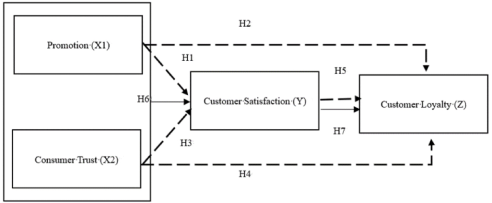
Based on the theoretical framework and prior empirical findings, the following hypotheses are proposed:
H1: Promotion has a positive effect on customer satisfaction.
H2: Promotion has a positive effect on customer loyalty.
H3: Consumer trust has a positive effect on customer.
satisfaction.
H4: Consumer trust has a positive effect on customer loyalty.
H5: Customer satisfaction has a positive effect on customer loyalty.
H6: Promotion and consumer trust simultaneously have a positive effect on customer satisfaction.
H7: Customer satisfaction mediates the effect of promotion and consumer trust on customer loyalty.
Figure 1. Conceptual Framework.
3. Results
3.1. Respondent Characteristics
Table 1. Characteristics of Gender.
Man | 27 | 27% |
Woman | 73 | 73% |
Total | 100 | 100% |
Based on
Table 1 above, the respondents of male gender amounted to 27 students, while the female gender amounted to 73 students.
Table 2. Age Characteristics.
< 20 | 18 | 18% |
21 - 25 | 65 | 65% |
26-30 | 12 | 12% |
> 31 | 5 | 5% |
Total | 100 | 100% |
Based on
Table 2, respondents aged < 20 years are 18 students, aged 21-25 years are 65 students, aged 26-30 years are 12 students, and those over 31 years old are 5 students.
Table 3. Validity Test Results.
Variable | Indicator | r table | r calculation | Validity |
Promotion (X1) | 1 | 0,195 | 0,73 | √ |
2 | 0,195 | 0,72 | √ |
3 | 0,195 | 0,79 | √ |
Consumer Trust (X2) | 1 | 0,195 | 0,85 | √ |
2 | 0,195 | 0,89 | √ |
3 | 0,195 | 0,76 | √ |
Customer Satisfaction (Y) | 1 | 0,195 | 0,84 | √ |
2 | 0,195 | 0,87 | √ |
3 | 0,195 | 0,78 | √ |
Customer Loyalty (Z) | 1 | 0,195 | 0,81 | √ |
2 | 0,195 | 0,89 | √ |
3 | 0,195 | 0,79 | √ |
4 | 0,195 | 0,89 | √ |
All variables have r count > r table with df = 98 and 0.05, which means these variables are valid.
Table 4. Reliability Test Results.
Variable | Cronbach's alpha value | Alpha | Reabilitas |
Promotion (X1) | 0,70 | 0,81682 | √ |
Consumer Trust (X2) | 0,70 | 0,784257 | √ |
Customer Satisfaction (Y) | 0,70 | 0,771104 | √ |
Customer Loyalty (Z) | 0,70 | 0,862336 | √ |
Each variable has an alpha value greater than the Cronbach alpha value, which means these variables are reliable.
3.2. Path Analysis Test
Path analysis was conducted using linear regression tests, divided into two models:
3.2.1. Analysis of the Relationship Between Promotion and Consumer Trust on Customer Satisfaction
Table 5. Path Coefficient Analysis Model I (Coefficient).
Model | Unstandardized Coefficients | Standardized Coefficients | t | Sig |
ß | Std. Error | Beta |
1. (Constant) | 1.085 | .858 | | 1.266 | .209 |
Promotion (X1) | .178 | .073 | .161 | 2.432 | .017 |
Consumer Trust (X2) | .732 | .066 | .737 | 11.103 | .000 |
1. Dependent Variable: Customer Satisfaction (Y)
Based on
Table 5, the equation Y= 1.085 + 0.178 X1 + 0.732 X2 is obtained. The promotion coefficient is 0.178 and consumer trust is 0.732, which means that if Promotion increases by 1, Customer Satisfaction increases by 0.178. If Consumer Trust increases by 1, Customer Satisfaction increases by 0.732, provided that other independent variables are considered constant.
In addition, the t value for Promotion is 2.432 > t table (df = 98) which is 1.987, while the significance value is 0.017 < α = 0.05, so Promotion has a partial and significant effect on Shopee Customer Satisfaction among UT Purwodadi students. The t value for Consumer Trust is 11.103 > the table t value of 1.987 (df = 98) and the significance value is 0.000 < α = 0.05, so Consumer Trust has a partial and significant effect on Shopee Customer Satisfaction among UT Purwodadi students.
Table 6. Analisis Uji F Model I (ANOVA).
Model | Sum of Squares | df | Mean Square | F | Sig |
1. Regression | 140.048 | 140.048 | 140.048 | 140.048 | 140.048 |
Residual | 60.392 | 60.392 | 60.392 | 60.392 | 60.392 |
Total | 200.440 | 200.440 | 200.440 | 200.440 | 200.440 |
1. Dependent Variable: Customer Satisfaction (Y)
2. Predictors: (Constant), Consumer Trust (X2), Promotion (X1)
Based on
Table 6, the F value of 112.470 > F Table 3.938 (df = 98) and the significance value of 0.000 < α = 0.05 indicate that Promotion and Consumer Trust simultaneously affect Customer Satisfaction on Shopee among UT Purwodadi students.
Table 7. Analysis of the Determination Coefficient Model I (Model Summary).
Model | R | R Square | Adjusted R Square | Std. Error of the Estimate |
1 | .836ª | .699 | .692 | .789 |
1. Predictors: (Constant), Consumer Trust (X2), Promotion (X1)
Based on
Table 7, the R Square value is 0.699, which means that Promotion and Consumer Trust influence Customer Satisfaction by 69.9%.
3.2.2. Analysis of the Relationship Between Promotion, Consumer Trust, and Customer Satisfaction on Customer Loyalty
Table 8. Path Coefficient Analysis Model II (Coefficient).
Model | Unstandardized Coefficients | Standardized Coefficients | t | Sig |
ß | Std. Error | Beta |
1. (Constant) | .816 | .958 | .150 | .852 | .396 |
Promotion (X1) | .210 | .084 | .501 | 2.515 | .014 |
Consumer Trust (X2) | .633 | .110 | .318 | 5.749 | .000 |
Customer Satisfaction (Y) | .404 | .112 | | 3.593 | .001 |
1. Dependent Variable: Customer Loyalty (Z)
Based on
Table 8, the equation Z= 0.816 + 0.210X1 + 0.633X2 + 0.404Y is obtained. The Promotion Coefficient in model II is positive 0.210, which means Customer Loyalty increases by 0.210 if Promotion increases by 1. Meanwhile, Consumer Trust has a coefficient value of positive 0.633, which means Customer Loyalty increases by 0.633 if Consumer Trust increases by 1. And Customer Satisfaction has a coefficient value of positive 0.404, which can also be interpreted that Customer Loyalty will increase by 0.404 if Customer Satisfaction increases by 1, provided that other independent variables are considered constant.
The t-value for Promotion is 2.515 > t-Table 1.987 (df = 98) and the significance value is 0.014 < α= 0.05, therefore Promotion partially has a significant effect on Shopee Customer Loyalty among UT Purwodadi students. Meanwhile, he t value for Consumer Trust is 5.749 > t Table 1.987 (df = 98) and the significance value is 0.00 < α= 0.05, so Consumer Trust partially has a significant effect on Shopee Customer Loyalty among UT Purwodadi students. And the t value for Customer Satisfaction is 3.593 > t Table 1.987 (df = 98) and the significance value is 0.001 < α= 0.05, so partially, Customer Satisfaction has a significant effect on Shopee Customer Loyalty among UT Purwodadi students.
Table 9. Analisis Uji F Model II (ANOVA).
Model | Sum of Squares | df | Mean Square | F | Sig |
Regression | 250.350 | 3 | 83.450 | 109.204 | .000b |
Residual | 73.360 | 96 | .764 | | |
Total | 323.710 | 99 | | | |
1. Dependent Variable: Customer Loyalty (Z)
2. Predictors: (Constant), Customer Satisfaction (Y), Promotion (X1), Consumer Trust (X2)
The calculated F in model II is 109.204 > the table F of 3.938 (df = 98) and the significance value is 0.000 < 0.05, which means that simultaneously, Promotion, Consumer Trust, and Customer Satisfaction affect Shopee Customer Loyalty among undergraduate students at UT Purwodadi.
Table 10. Analysis of the Determination Coefficient Model II (Model Summary).
Model | R | R Square | Adjusted R Square | Std. Error of the Estimate |
1 | .879ª | .773 | .766 | .874 |
1. Predictors: (Constant), Customer Satisfaction (Y), Promotion (X1), Consumer Trust (X2)
Based on the analysis of the coefficient of determination, the R Square value of model II is 0.773, which means that Promotion, Consumer Trust, and Customer Satisfaction have an influence on Shopee Customer Loyalty among undergraduate students at UT Purwodadi by 77.3%.
3.3. Classical Asummption Tests
3.3.1. Normality Test
The normality test was conducted using the Kolmogorov-Smirnov (K-S) test on the standardized residuals. The results show that the Asymp. Sig. (2-tailed) value is greater than 0.05, indicating that the residuals are normally distributed. Therefore, the normality assumption required for multiple linear regression is met.
Table 11. Normality Test.
Uji | Statistik | Asymp. Sig. (2-tailed) |
Kolmogorov-Smirnov (Lilliefors) | 0.176 | 0.001 |
Shapiro-Wilk | 0.936 | 0.0001 |
3.3.2. Multicollinearity Test
Multicollinearity was examined using Tolerance and Variance Inflation Factor (VIF) values. All independent variables had tolerance values greater than 0.10 and VIF values below 10, indicating that multicollinearity was not present.
Table 12. Multicollinearity Test.
Variabel | Tolerance | VIF |
Promotion (X1) | 0.664 | 1.505 |
Consumer Trust (X2) | 0.310 | 3.222 |
Customer Satisfaction (Y) | 0.301 | 3.319 |
3.3.3. Heteroscedasticity Test
The heteroscedasticity assumption was tested using the Glejser test. The significance values for all independent variables were greater than 0.05, indicating the absence of heteroscedasticity.
Table 13. Heteroscedasticity Test.
Variabel | t | Sig. |
(Constant) | -1.354 | 0.179 |
Promotion (X1) | -1.120 | 0.265 |
Consumer Trust (X2) | 1.547 | 0.125 |
Customer Satisfaction (Y) | 0.981 | 0.329 |
3.3.4. Linearity Test
The linearity between each independent variable and the dependent variable was evaluated using the ANOVA Test of Linearity. The significance value for Linearity was below 0.05, while the significance value for Deviation from Linearity exceeded 0.05. These findings indicate that the relationships among the variables are linear.
Table 14. Linearity Test.
Hubungan | F (Dev. from Linearity) | Sig. | Kesimpulan |
X1 * Z | 2.960 | 0.036 | Tidak linear |
X2 * Z | 2.249 | 0.056 | Linear |
Y * Z | 2.107 | 0.071 | Linear |
4. Discussion
These findings indicate that promotional activities positively contribute to customer satisfaction by increasing customers' perceived value and confirming their expectations on Shopee among UT Purwodadi students, with Consumer Trust having a greater impact. The F-test results show that both variables simultaneously have a significant impact on Customer Satisfaction. The R Square value of 69.9% indicates that this model is capable of explaining most of the variation in Customer Satisfaction, but there are still other factors that need to be considered. The implication for Shopee is the importance of balancing promotional strategies with efforts to build consumer trust in order to create sustainable customer satisfaction. By understanding the results of this research, Shopee can design more precise strategies to enhance customer satisfaction, strengthen user loyalty, and increase competitiveness in the e-commerce market.
Promotion, Consumer Trust, and Customer Satisfaction have a significant influence on Shopee Customer Loyalty among UT Purwodadi students, with Consumer Trust having the greatest impact. The F-test results show that the three variables simultaneously have a significant impact on Customer Loyalty. The R Square value of 77.3% indicates that this model is able to explain most of the variation in Customer Loyalty, but there are still other factors that need to be considered. The implication for Shopee is the importance of balancing promotional strategies, increasing customer trust, and maintaining customer satisfaction to create sustainable loyalty. By understanding the results of this research, Shopee can design more effective strategies to maintain and enhance customer loyalty in the future.
5. Conclusions
This study confirms that promotion and consumer trust are key determinants of customer satisfaction and customer loyalty toward Shopee among undergraduate students at Universitas Terbuka (UT) Purwodadi. The findings demonstrate that effective promotional strategies and strong consumer trust not only enhance customer satisfaction but also translate into sustained customer loyalty, with satisfaction functioning as a crucial mediating mechanism. These results support the theoretical perspective that marketing stimuli and relational factors are converted into long-term behavioral outcomes primarily through customers’ post purchase evaluations. Overall, the study highlights the strategic importance of integrating valueoriented promotions with trust building practices to strengthen customer relationships in highly competitive e-commerce environments.
Several limitations should be acknowledged in interpreting the results of this study. First, the research scope was limited to undergraduate students at a single study center (UT Purwodadi), which restricts the generalizability of the findings to other consumer segments, age groups, or geographic contexts. Second, the model focused only on promotion and consumer trust as antecedents of satisfaction and loyalty, while other relevant factors such as service quality, user experience, perceived price fairness, platform usability, and brand image were not incorporated.
This limited set of variables may have constrained the explanatory power of the model and influenced the interpretation of the relationships among constructs. Third, the cross sectional design captured respondents’ perceptions at one point in time, which may not fully reflect changes in attitudes or loyalty behavior over longer periods.
Based on the conclusions, several practical and academic recommendations are proposed. For practitioners, e-commerce platforms such as Shopee should continue to implement promotional strategies that emphasize not only short term price incentives but also consistent value delivery that aligns with customer expectations. In parallel, strengthening consumer trust through secure transaction systems, transparent product information, reliable logistics, and responsive customer service is essential to enhance satisfaction and foster long-term loyalty, particularly among student consumers who are highly sensitive to both value and perceived risk. For future research, scholars are encouraged to expand the research model by including additional variables such as service quality, user experience, and perceived value, as well as by applying longitudinal designs to capture changes in consumer behavior over time. Further studies may also examine different demographic segments or regional contexts to improve the generalizability and robustness of findings related to customer satisfaction and loyalty in the Indonesian e-commerce sector.
Author Contributions
Sunaryo: Conceptualization, Data curation, Formal Analysis, Investigation, Methodology, Project administration, Resources, Software, Validation, Visualization
Fajar Islam: Writing – original draft, Writing – review & editing
Conflicts of Interest
The authors declare no conflicts of interest.
References
| [1] |
S. Molinillo, R. Aguilar-Illescas, R. Anaya-Sánchez, and E. Carvajal-Trujillo, “The customer retail app experience: Implications for customer loyalty,” J. Retail. Consum. Serv., vol. 65, 2022,
https://doi.org/10.1016/j.jretconser.2021.102842
|
| [2] |
F. A. Katili, F. A. Robby, and P. W. Handayani, “The influence of the ride hailing apps loyalty program on customer loyalty: A case study in Indonesia,” Transp. Res. Interdiscip. Perspect., vol. 26, no. June, p. 101141, 2024,
https://doi.org/10.1016/j.trip.2024.101141
|
| [3] |
T. A. Mohamadabadi, J. Nazarian-Jashnabadi, M. A. Daryani, M. A. Al-Rashid, and T. Campisi, “Factors affecting online customer experience of food delivery services during crisis: TISM and Delphi techniques,” Sustain. Futur., vol. 9, no. July 2024, p. 100408, 2025,
https://doi.org/10.1016/j.sftr.2024.100408
|
| [4] |
D. F. R. Handayani, R. W. PA, and N. Nuryakin, “The influence of e-service quality, trust, brand image on Shopee customer satisfaction and loyalty,” J. Siasat Bisnis, vol. 25, no. 2, pp. 119–130, 2021,
https://doi.org/10.20885/jsb.vol25.iss2.art3
|
| [5] |
K. Wong, F. N. Widjaja, and V. M. Megawati, “The Influence of E-Service Quality and E-Trust on E-Satisfaction and E-Loyalty among Shopee Users,” J. Ilm. Bisnis dan Ekon. Asia, vol. 20, no. 1, pp. 37–47, 2026,
https://doi.org/10.32815/jibeka.v20i1.2409
|
| [6] |
A. S. Simangunsong and S. E. Putri, “Analysis of E-WOM and E-Trust on E-Satisfaction and E-Loyalty of Shopee Users,” Formosa J. Multidiscip. Res., vol. 4, no. 3, pp. 1179–1192, 2025,
https://doi.org/10.55927/fjmr.v4i3.109
|
| [7] |
L. Mekhail et al., “Intended Outcomes and Core Components of Primary Care-Based Literacy Promotion as Defined by Experts,” Acad. Pediatr., p. 103141, 2025,
https://doi.org/10.1016/j.acap.2025.103141
|
| [8] |
H. Mohammed and M. Kebede, “Exploring Challenges, Opportunitie, and Policy Implications for Youth Entrepreneurship in Kellem Wollega, Ethiopia,” vol. 15, no. 2, pp. 16–28, 2026.
|
| [9] |
D. A. R. Kuska, H. Wijayanto, and A. Santoso, “Improving The E-Satisfaction and E-Loyalty Based on E-Trust and E-Service Quality on Shopee Customer,” J. Consum. Sci., vol. 9, no. 1, pp. 22–39, 2024,
https://doi.org/10.29244/jcs.9.1.22-39
|
| [10] |
O. K. Konadu, B. J. Kwasi, and I. Mensah Bonsu, “Knowledge and perception of market women about the roles of physiotherapists in health promotion in Ghana: A qualitative phenomenological study,” Heliyon, vol. 11, no. 12, p. e43515, 2025,
https://doi.org/10.1016/j.heliyon.2025.e43515
|
| [11] |
J. Abigail, V. P. Sari, and D. Saputra, “The Influence of Product Quality and Online Shopping Experience (OSE) on Consumer Loyalty Through Customer Satisfaction on Local Skincare Products,” Procedia Comput. Sci., vol. 234, no. 2023, pp. 537–544, 2024,
https://doi.org/10.1016/j.procs.2024.03.037
|
| [12] |
Y. F. Cahaya and I. Siswanti, “Internet Banking Service Quality in Indonesia and Its Impact on E-Customer Satisfaction and E-Customer Loyalty,” Manag. Res. Stud. J., vol. 1, no. 1, pp. 75–83, 2020,
https://doi.org/10.56174/mrsj.v1i1.350
|
| [13] |
F. E. Jiddi, “Does corporate social responsibility result in better hotel guest attitudinal and behavioral loyalty?,” Heliyon, vol. 9, no. 8, p. e18669, 2023,
https://doi.org/10.1016/j.heliyon.2023.e18669
|
| [14] |
A. Subrahmanyam, “Keeping It Simple : How Post-earnings Return Drift Can Exist and Not Exist Simultaneously,” vol. 15, no. 1, pp. 1–4, 2026.
|
| [15] |
A. M. Haddadi and H. Hamidi, “A hybrid model for improving customer lifetime value prediction using stacking ensemble learning algorithm,” Comput. Hum. Behav. Reports, vol. 18, no. December 2024, p. 100616, 2025,
https://doi.org/10.1016/j.chbr.2025.100616
|
| [16] |
R. Shrestha, R. Kadel, and B. K. Mishra, “A two-phase confirmatory factor analysis and structural equation modelling for customer-based brand equity framework in the smartphone industry,” Decis. Anal. J., vol. 8, no. June, p. 100306, 2023,
https://doi.org/10.1016/j.dajour.2023.100306
|
| [17] |
S. M. Rahman, J. Carlson, S. P. Gudergan, M. Wetzels, and D. Grewal, “How do omnichannel customer experiences affect customer engagement? Theory and empirical validation,” J. Bus. Res., vol. 189, no. December 2024, p. 115196, 2025,
https://doi.org/10.1016/j.jbusres.2025.115196
|
| [18] |
C. Zhengmeng, M. Malik, M. Hussain, and S. Hussain, “Exploring customer retention dynamics: A comparative investigation of factors affecting customer retention in the banking sector using mediation-moderation approach,” Heliyon, vol. 10, no. 19, p. e36919, 2024,
https://doi.org/10.1016/j.heliyon.2024.e36919
|
| [19] |
I. G. N. S. Wijaya, E. Triandini, E. T. G. Kabnani, and S. Arifin, “E-commerce website service quality and customer loyalty using WebQual 4.0 with importance performances analysis, and structural equation model: An empirical study in shopee,” Regist. J. Ilm. Teknol. Sist. Inf., vol. 7, no. 2, pp. 107–124, 2021,
https://doi.org/10.26594/register.v7i2.2266
|
| [20] |
J. Gong and S. Kanwal, “Exploring the influence of spiritual leadership on proactive customers service performance,” Acta Psychol. (Amst)., vol. 253, no. August 2024, p. 104721, 2025,
https://doi.org/10.1016/j.actpsy.2025.104721
|
| [21] |
I. Puspitasari, F. Rusydi, N. Nuzulita, and C. S. Hsiao, “Investigating the role of utilitarian and hedonic goals in characterizing customer loyalty in E-marketplaces,” Heliyon, vol. 9, no. 8, p. e19193, 2023,
https://doi.org/10.1016/j.heliyon.2023.e19193
|
| [22] |
S. N and S. S, “E-Banking Service Qualities, E-Customer Satisfaction, and e-Loyalty: A conceptual Model,” Int. J. Soc. Sci. Humanit. Invent., vol. 5, no. 6, pp. 4808–4819, 2018,
https://doi.org/10.18535/ijsshi/v5i6.08
|
| [23] |
S.-B. Kim and D.-Y. Kim, “The impacts of corporate social responsibility, service quality, and transparency on relationship quality and customer loyalty in the hotel industry,” Asian J. Sustain. Soc. Responsib., vol. 1, no. 1, pp. 39–55, 2016,
https://doi.org/10.1186/s41180-016-0004-1
|
| [24] |
I. Purnamasari and R. T. Suryandari, “Effect of E-Service Quality on E-Repurchase Intention in Indonesia Online Shopping: E-Satisfaction and E-Trust as Mediation Variables,” Eur. J. Bus. Manag. Res., vol. 8, no. 1, pp. 155–161, 2023,
https://doi.org/10.24018/ejbmr.2023.8.1.1766
|
| [25] |
A. Hakam and N. Hidayati, “The Effect of E-Service Quality and E-Trust on Consumer Loyalty through Consumer Satisfaction as Intervening Variables (Case Study on Shopee Users in Malang Regency),” Eff. E-Service Qual. E-Trust Consum. Loyal. through Consum. Satisf. as Interv. Var. (Case Study Shopee Users Malang Regency), pp. 12678–12687, 2022, [Online]. Available:
https://bircu-journal.com/index.php/birci/article/view/5112
|
Cite This Article
-
ACS Style
Sunaryo; Islam, F. Revisiting Promotion and Trust Mechanisms in
E-Commerce Loyalty: Evidence from Universitas Terbuka Students. World J. Electron. Commer. 2026, 1(1), 1-9. doi: 10.11648/j.wjec.20260101.11
 Copy
|
Copy
|
 Download
AMA Style
Sunaryo, Islam F. Revisiting Promotion and Trust Mechanisms in
E-Commerce Loyalty: Evidence from Universitas Terbuka Students. World J Electron Commer. 2026;1(1):1-9. doi: 10.11648/j.wjec.20260101.11
Copy
|
Download
-
@article{10.11648/j.wjec.20260101.11,
  author = {Sunaryo and Fajar Islam},
  title = {Revisiting Promotion and Trust Mechanisms in
E-Commerce Loyalty: Evidence from Universitas Terbuka Students},
  journal = {World Journal of Electronic Commerce},
  volume = {1},
  number = {1},
  pages = {1-9},
  doi = {10.11648/j.wjec.20260101.11},
  url = {https://doi.org/10.11648/j.wjec.20260101.11},
  eprint = {https://article.sciencepublishinggroup.com/pdf/10.11648.j.wjec.20260101.11},
  abstract = {Intensifying competition among e-commerce platforms requires firms to strengthen customer retention through effective marketing strategies and trust building mechanisms. In Indonesia, Shopee recorded the highest number of website visits in 2023, driven by aggressive promotions such as vouchers, cash on delivery, and flash sale discounts. Beyond promotional appeal, consumer trust is essential in reducing perceived risk and sustaining long term relationships. This study examines the effects of promotion and consumer trust on customer satisfaction and their subsequent impact on customer loyalty toward Shopee among undergraduate students at Universitas Terbuka Purwodadi. A quantitative approach was employed using path analysis with multiple linear regression. Data were collected from primary and secondary sources, with 100 respondents. The results indicate that promotion and consumer trust simultaneously and partially explain 69.9% of the variance in customer satisfaction, with consumer trust exerting the strongest influence on customer satisfactio, followed by promotion. Furthermore, promotion, consumer trust, and customer satisfaction together account for 77.3% of the variance in customer loyalty. These findings demonstrate that effective promotional strategies and strong consumer trust significantly enhance customer satisfaction, which in turn strengthens customer loyalty. The study underscores the importance for e-commerce platforms of integrating competitive promotions with trust-building practices to improve customer experience and sustain loyalty in highly competitive digital markets.},
 year = {2026}
}
Copy
|
Download
-
TY  - JOUR
T1  - Revisiting Promotion and Trust Mechanisms in
E-Commerce Loyalty: Evidence from Universitas Terbuka Students
AU  - Sunaryo
AU  - Fajar Islam
Y1  - 2026/10/09
PY  - 2026
N1  - https://doi.org/10.11648/j.wjec.20260101.11
DO  - 10.11648/j.wjec.20260101.11
T2  - World Journal of Electronic Commerce
JF  - World Journal of Electronic Commerce
JO  - World Journal of Electronic Commerce
SP  - 1
EP  - 9
PB  - Science Publishing Group
UR  - https://doi.org/10.11648/j.wjec.20260101.11
AB  - Intensifying competition among e-commerce platforms requires firms to strengthen customer retention through effective marketing strategies and trust building mechanisms. In Indonesia, Shopee recorded the highest number of website visits in 2023, driven by aggressive promotions such as vouchers, cash on delivery, and flash sale discounts. Beyond promotional appeal, consumer trust is essential in reducing perceived risk and sustaining long term relationships. This study examines the effects of promotion and consumer trust on customer satisfaction and their subsequent impact on customer loyalty toward Shopee among undergraduate students at Universitas Terbuka Purwodadi. A quantitative approach was employed using path analysis with multiple linear regression. Data were collected from primary and secondary sources, with 100 respondents. The results indicate that promotion and consumer trust simultaneously and partially explain 69.9% of the variance in customer satisfaction, with consumer trust exerting the strongest influence on customer satisfactio, followed by promotion. Furthermore, promotion, consumer trust, and customer satisfaction together account for 77.3% of the variance in customer loyalty. These findings demonstrate that effective promotional strategies and strong consumer trust significantly enhance customer satisfaction, which in turn strengthens customer loyalty. The study underscores the importance for e-commerce platforms of integrating competitive promotions with trust-building practices to improve customer experience and sustain loyalty in highly competitive digital markets.
VL  - 1
IS  - 1
ER  -
Copy
|
Download





 Share This Article
 Twitter
 Linked In
 Facebook