
Coffee plays a significant role in the world economy next to oil. More than 80 countries produce coffee but only 60 developing country including Ethiopia depend on coffee as s major source of their foreign currency earnings. Ethiopia is African’s leading coffee producer and 5th major coffee producing country in the world. However, the production and productivity of coffee are low compared with the major coffee producing countries, this is due to inadequate extension service, limited improved coffee variety and traditional farming practices. Therefore, strategically development and applying coffee breeding principles are significant effects to improve the productivity, quality attribute and disease- pest resistance. However, the breeding methods and their principles are varied from country to country depending on the amount of genetic variability available, ecological conditions and prevailing problems. Even though, well organized documents and data on breeding methods, improved coffee varieties and adaptability of release coffee varieties information’s are limited in Ethiopia. Therefore, the main objective of this review paper is, systematically assesses coffee production system, total improved coffee varieties in Ethiopia through pure line and hybrid breeding methods and their agroecological suitability. The ultimate goal of arabica coffee breeding program in Ethiopia is, to develop new and high yielder, best quality, disease - pest resistance, and adaptable on different agroecology of coffee growing area of the country. Then, coffee berry disease resistance, low and midland targeted, hybrid, highland and landrace are 16, 5, 4, 4 and 12 in number respectively total 41 improved coffee varieties were released. The unique features of these released coffee varieties are high yielder, best quality, disease - pest resistance and adaptable. However, multiplication and distribution of the improved coffee variety to coffee growers are limited because of limited extension service, inadequate infrastructure and limited seed enterprise. In general, Ethiopia is not only the center and origin of coffee arabica but also indispensable coffee genetic reservoir. So, it’s better to develop strategic planning and integration with global breeding for sustainable coffee production, enhance productivity associated with quality, disease resistance and adaptability.
| Published in | World Journal of Agricultural Science and Technology (Volume 4, Issue 3) |
| DOI | 10.11648/j.wjast.20260403.13 |
| Page(s) | 61-72 |
| Creative Commons |
This is an Open Access article, distributed under the terms of the Creative Commons Attribution 4.0 International License (http://creativecommons.org/licenses/by/4.0/), which permits unrestricted use, distribution and reproduction in any medium or format, provided the original work is properly cited. |
| Copyright |
Copyright © The Author(s), 2026. Published by Science Publishing Group |
Adaptable, Breeding, Coffee, Genetic Resource, Variety Development
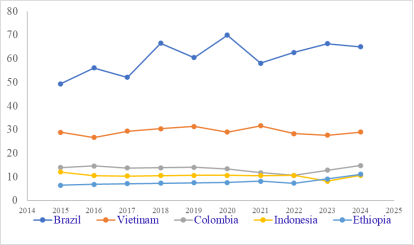
Market Year | Brazil | Vietnam | Colombia | Indonesia | Ethiopia | Honduras | India | Uganda | Peru | Mexico |
|---|---|---|---|---|---|---|---|---|---|---|
2015 | 49.4 | 28.9 | 14 | 12.1 | 6.5 | 5.3 | 5.8 | 3.5 | 3.5 | 2.5 |
2016 | 56.1 | 26.7 | 14.6 | 10.6 | 6.9 | 7.5 | 5.2 | 4.9 | 4.2 | 3.3 |
2017 | 52.1 | 29.3 | 13.8 | 10.4 | 7.1 | 7.6 | 5.3 | 4.6 | 4.4 | 4 |
2018 | 66.5 | 30.4 | 13.9 | 10.6 | 7.3 | 7.1 | 5.3 | 4.7 | 4.4 | 3.5 |
2019 | 60.5 | 31.3 | 14.1 | 10.7 | 7.5 | 5.2 | 5 | 5.5 | 3.9 | 3.7 |
2020 | 69.9 | 29 | 13.4 | 10.7 | 7.6 | 6.5 | 5.6 | 6.6 | 3.4 | 3.5 |
2021 | 58.1 | 31.6 | 11.8 | 10.6 | 8.2 | 4.8 | 5.7 | 6 | 4.2 | 3.7 |
2022 | 62.6 | 28.3 | 10.7 | 10.7 | 7.3 | 5.7 | 5.9 | 6.6 | 3.5 | 3.5 |
2023 | 66.3 | 27.6 | 12.8 | 8.2 | 9.1 | 5 | 6.6 | 6.4 | 3.9 | 3.9 |
2024 | 65 | 29 | 14.8 | 10.7 | 11.1 | 5 | 6.2 | 6.7 | 3.7 | 3.9 |
Year of release | Number of varieties | Clean coffee yield (Kg/ha) | Area of recommendation |
|---|---|---|---|
1978 -1981 | 13 | 1220 – 1970 | Low to High |
1997 | 3 | 1660 – 1940 | Low to High |
2002 | 2 | 2140 – 2540 | Low to Medium |
2006 | 5 | 1540 – 2350 | Medium to High |
2010 | 11 | 1190 – 2120 | Medium to High |
Total | 34 |
Variety group | Number of varieties | Year of release | Yield range (q/ha) | |
|---|---|---|---|---|
On station | On farm | |||
CBD Resistance | 16 | 1978 – 2018 | 12.2 – 23.8 | 6.0 – 10.0 |
Low and Midland | 5 | 1997 – 2002 | 16.6 – 23.4 | 9.0 – 20.0 |
Hybrid | 4 | 1997 – 2018 | 24.0 – 26.0 | 13.0 – 20.0 |
Highland | 4 | 2006 | 16.4 – 23.5 | 15.2 – 16.2 |
Landrace | 12 | 2006, 2010 | 11.9 – 20.4 | 7.2 – 16.2 |
Total | 41 | |||
Name of varieties | Year of release | Green bean Yield (Kg/ha) | Altitude | Recommended coffee growing area |
|---|---|---|---|---|
Ababuna | 1997 | 2380 | 1500-1752 | Southwest |
Melko CH2 | 1997 | 2400 | 1500-1752 | Southwest |
Gawe | 2002 | 2610 | 1500-1752 | Southwest |
EIAR50-CH | 2016 | 2650 | 1000-2000 | Southwest (Tepi, Bebeka) |
Melko Ibsitu | 2016 | 2490 | 1000-1752 | Southwest (Tepi, Bebeka) |
Tepi-CH5 | 2016 | 2340 | 1000-1752 | Southwest (Tepi, Bebeka) |
Gera-CH1 | 2018 | 2300 | 1940-2000 | Southwest |
Rorri | 2022 | 2464 | 1600-1850 | South (Sidama) |
AwadaHB1 | 2022 | 2168 | 1600-1850 | Southwest |
Name of varieties | Suitable altitude for coffee growing area | ||
|---|---|---|---|
High-altitude >1750 m.a.s.l | Mid-altitude (1500 -1750) m.a.s.l | Low -altitude (1000 -1500) m.a.s.l | |
Ababuna | |||
Melko CH2 | |||
Gawe | |||
EIAR50-CH | |||
Melko Ibsitu | |||
Tepi-CH5 | |||
Gera-CH1 | |||
Rorri | |||
AwadaHB1 | |||
CBD | Coffee Berry Disease |
CLR | Coffee Leaf Rust |
CWD | Coffee Wilt Disease |
CSA | Climate Smart Agriculture |
EIAR | Ethiopia Institution Agricultural Research |
ICO | International Coffee Organization |
JARC | Jimma Agricultural Research Center |
| [1] |
Seid, H (2022). Strategies to improve the quantity and quality of export coffee in Ethiopia, a look at multiple opportunities. Journal of Agriculture and Food Research,
https://www.sciencedirect.com/journal/journal-of-agriculture-and-food-research |
| [2] | Zainuri, D.; Nyoman, A.; Amira, F.; and Rini, N (2023). The Chemical Characteristics of Arabica and Robusta green coffee beans from Geopark Rinjani, Indonesia, Biotrophic, 30(3): 318 – 328. |
| [3] | Addisu, H.; and Kedir, W (2025). Analysis of Arabica Coffee Production Trend and Major Production Constraints in East and West Hararghe Zones, Ethiopia. Journal of coffee and sustainability, 1(3): 129 – 145 |
| [4] | International Coffee Organization (2024). Coffee production, consumption and Export. |
| [5] | Charrier, A. and Berthaud, J (1985). Botanical classification of coffee. In Coffee Botany, Biochemistry and Production of Beans and Beverage; Croom Helm: London, 13–47. |
| [6] | Gole, T. (2015). Coffee: Ethiopia’s gift to the world and the traditional production systems as living examples of crop domestication, and sustainable production and an assessment of different certification schemes. Environment and Coffee Forest, Addis Ababa. |
| [7] | Mohammed, W (2023). Production, productivity, quality and chemical composition of Ethiopian coffee. Cogent food& agricultu |
| [8] | Jorge, A.; Cardona, P.; Luis, F and Maldonado, M. (2024). Effect of demucilagination and soaking in water with organic acids on the microbial, chemical, and sensory characteristics of coffee (Coffea arabica) Coffee Science, e192191, |
| [9] | Mohammedsani, A (2017). Influence of harvesting and postharvest processing methods on the quality of Arabica coffee (Coffea arabica L.) in Eastern Ethiopia. Journal of food and Agriculture Science, 7(1): 1-9. |
| [10] | Bewketu, M.; Mesfin, R.; Bhagwan, S; and Minaleshewa, A. (2016). Profiling of phenolic compounds using UPLC–MS for determining the geographical origin of green coffee beans from Ethiopia, Journal of Food composition and Analysis |
| [11] | Tefera, A.; & Bickford, R. (2021). Coffee annual report, Global Agricultural Information Network (GAIN), report number: ET2021-0013. |
| [12] | Misgana B,; and Tegene A. (2024) Physicochemical and cup quality of coffee as affected by processing methods and growing locations. |
| [13] | Esayas, M.; Gezahegn, B.; Getachew, W.; Kifle, B and Taye, K (2019). ECSS: Proceedings of the Ethiopian Coffee Science Society (ECSS): Enhancing Coffee Science and Technology for Sustainable Development in Ethiopia. Inaugural Conference Held on 7 &. |
| [14] | Lola, R.; and Gregorian, J (2025). Competitiveness of major producing countries in world coffee trade. Website: jurnal.umj.ac.id/index.php/icecream |
| [15] | Berihun, T.; Habtemariam, K.; and Tigest, Z (2025). Analysis of Ethiopian Coffee Value Chain for Compliance with European Union Deforestation Regulation. Trees, Forests and People,: |
| [16] | Adugna, T (2021). Review on coffee production and quality in Ethiopia. |
| [17] | Tesfaye, T.; Bizuayehu, T.; and Girma, A (2020) Coffee production constraints and opportunities at major growing districts of southern Ethiopia, Cogent Food & Agriculture, 6: 1, 1741982, |
| [18] | Bealu, G (2017). Factors Affecting Coffee (Coffea Arabica L.) Quality in Ethiopia: A Review. American Journal of Agriculture and Forestry, 9(5): 288 – 296. |
| [19] | Godfrey, M.; and Kazuo, N (2024). Coffee sustainability: Leveraging collaborative breeding for variety improvement. |
| [20] | MOA (Ministry of Agriculture) (2013). Plant variety release, protection and seed quality control director, Crop varieties register, (16), 330. Addis Ababa, Ethiopia. |
| [21] | Addis, A.; Tassew, G.; Berecha, Y.; and Adugna, D (2022). Location, production systems, and processing method effects on qualities of Kafa Biosphere Reserve coffees. Agrosyst Geosci Environ. |
| [22] | Regassa,, F.; Genene, G.; Bayush, T.; andKassahun, T. (2013). Community management of forest coffee landscapes in Ethiopia. |
| [23] | Befikadu, M (2020). Coffee: The driver of economic development and socio-cultural Integration in Ethiopia. Journal of Culture, Society and Development. 61: 1 – 10. |
| [24] | Befikadu, M.; and Kifle, B (2018). Forest Coffee Production in Ethiopia: The Case of Gimbo District, Kaffa Zone, Southwest Ethiopia. Journal of natural science research, 8(12): 42 – 49. |
| [25] | Raf, A., Kitessa, H., Gezahegn, B., and Pieter, G (2011). Semi-forest coffee cultivation and the conservation of Ethiopian Afromontane rainforest fragments. Forest Ecology and Management. |
| [26] | Labouisse, J., Bellachew, B., Kotecha, S and Bertrand, B (2008). Current status of coffee (Coffea arabica L.) genetic resources in Ethiopia: implications for conservation. Genet. Res. Crop Evol. 55, 1079–1093. |
| [27] | International Coffee Organization (2017). Coffee Market price ends. |
| [28] | United State Department of America (USDA)(2024). Foreign Agricultural Service and International Coffee Organization. |
| [29] | Abebaw, Y., Tobiaw, D., Abate, B., and Tesfaye, K (2021). Plant Tissue Culture Research and Development in Ethiopia: A Case Study on Current Status, Opportunities, and Challenges. Adv. Agric. |
| [30] | Bayetta, B and Pierre, J (2006). Arabica coffee (Coffea arabica L.) Landrace Variety Development Strategy in Its Center of Origin and Diversity. In Proceedings of the 21th International Scientific Colloquium on Coffee, Montpelier, France, |
| [31] | Bayetta, B (2001). Arabica coffee breeding yield and resistance of coffee berry disease (Colletorichum kahawae sp), PhD thesis, University of London, UK. |
| [32] | Yebirzaf, Y. and Semagn A (2021). Coffee (Coffea arabica L.): Methods, Objectives, and Future Strategies of Breeding in Ethiopia: Review. Sustainability, 13, |
| [33] | Dadi, T and Habtamu, G (2021). Impact of Climate Change on East African Coffee Production and Its Mitigation Strategies, World Journal of Agricultural Sciences 17(2): 81-89, 2021. |
| [34] | Ayele, A.; Worku, M.; and Bekele, Y (2021). Trend, instability and decomposition analysis of coffee production in Ethiopia, |
| [35] | Aerts, R.; Gazahegni, B.; Gijbels, P.; Kittessa, H and Glabeke, S (2013). Genetic Variation and Risks of Introgression in the Wild Coffea arabica gene pool in South-Western Ethiopian Montane Rain Rorests. Evol, 6, 243–252. |
| [36] | Habtamu, G.; Gizachew, A.; Meseret, D and Ashenafi, A (2018). Arabica Coffee (Coffea arabica L.) Hybrid Genotypes evaluation for Growth Characteristics and Yield Performance under Southern Ethiopian Growing Condition. Acad. Res. J. Agri. Sci. Res, 6: 89–96. |
| [37] | Clarke, R.; Vitzthum, O (2008). Coffee: Recent Developments; John Wiley and Sons: Hoboken, NJ, USA. |
| [38] | EIAR. Research on Coffee and Tea (2020). |
| [39] | Ethiopian Institute of Agricultural Research (EIAR)(2022). Various annual reports and technical bulletins from the Jimma Agricultural Research Center (JARC). (Primary source for released varieties. |
| [40] | Meseret, D (2024). Over View of Coffee (Arabica Coffee) Breeding in Ethiopia. International journal of genetics and genomics, 12(1): 8 – 12 |
| [41] | Tadesse, B (2017). Progress in Arabica Coffee Breeding in Ethiopia: Achievements, Challenges and Prospects, International Journal of Sciences: 33(2): 15 -25. |
| [42] | Desalegn, A.; Tadesse, B.; Lemi, D and Merga, A (2023). The Exploration and Utilization of Coffee (Coffea arabica L.) Genetic Resource in Its Center of Origin. Journal of Global Agriculture and Ecology, 15(2): 45 – 57. |
| [43] | Degife. Z.; Seifu, F and Sabura, S (2022). Evaluation of agronomic performance of coffee (Coffea arabica L.) cultivars in Gamo and Gofa, southern Ethiopia. |
| [44] | Behailu, A.; Bayetta, B.; Fikadu, T.; Melaku, A and Tadesse, B (2008). Developing Coffee Hybrid Varieties, 99-105. |
| [45] | Girma, A.; Bayetta, B.; Tesfaye, S; and Endale, T (2007). Coffee Diversity and Knowledge. Proceedings of a National Workshop Four Decades of Coffee Research and Development in Ethiopia, 14-17 Addis Ababa, Ethiopia. |
| [46] | Geneti, D (2019). Progress of Coffee (Coffea arabica L) Hybridization Development Study in Ethiopia: A Review. Food Sci. Qual. Manag. 92, 22–28. |
| [47] | Adugna G.; Jafuka, C.; Zeru. A; and Tessfaye, A (2009). Advances in coffee diseases research in Ethiopia: Increasing crop production through improved plant protection. Volume II Proceeding of the 14th annual conference of the plant protection society of Ethiopia (PPSE); Addis Ababa, Ethiopia; 540: 275–303. |
| [48] | Yitagesu, T,; Dereje, A. and Asela, K (2021). Coffee Leaf Rust Disease and Climate Change. World Journal of Agricultural Sciences 17(5): 418-429. |
| [49] | Kumlachew, A.; Girma, A.; Fikre, L and Diriba, M (2017). Current status of coffee berry disease (Colletotrichum kahawae) in Ethiopia. Archives of phytopathology and plant protection, 49(17): 421 – 433 |
| [50] | Kumlachew, A (2025). Coffee berry disease: a threat to Arabica coffee production in Ethiopia. Discover Life, 55: 12 | |
| [51] | Adem A, Amin M and Mamo M (2020). Assessment of coffee berry disease in West Hararge Zone, Eastern Ethiopia. Int J Food Sci Agric, 4(4): 465–9. |
| [52] | Dadi, T and Damtew, A (2021). Review on Integrated Pest Management of Coffee Berry Disease and Coffee Berry Borer. International Journal of Plant Breeding and Crop Science 8(1): 1001-1008, |
| [53] | Guzzo, S (2004). Molecular biochemical aspects of systemic acquired resistance. International Jornal of rezurce agricultura, 7, 32. |
| [54] | Gichuru, E.; Agwanda, M.; Combes, E. and Ngugic, B (2008). Blackwell Publishing Ltd Identification of molecular markers linked to a gene conferring resistance to coffee berry disease (Colletotrichum kahawae) in Coffea arabica. Plant Pathology, 57, 1117–1124. |
| [55] | Adane, A (2009). Agricultural biotechnology research and development in Ethiopia. Afr. J. Biotechnol 8, 7196–7204. |
| [56] | Lashermes, P.; Trouslot, P.; Anthony, F and Combes, M (1996). Genetic Diversity for RAPD Markers between Cultivated and Wild Accessions of (Coffea arabica). Euphytica, 87, 59–64. |
| [57] | Emilly, R., Eveline, T., Tilago, V and Felipe, L. Designing the best breeding strategy for Coffea canphora: Genetic evaluation of pure and hybrid individuals aiming to select for productivity and disease resistance traits. PloS ONE. 2021, 1 -17. |
| [58] | Elias, G. In Vitro propagation of Coffea arabicacv. MCH2 using Nodal Explants. Journal of Natural Science Research. 2017, 7(1): 17 – 21. |
| [59] | Elyas, G. (2024). Hybrid Coffee (Coffea arabica L) Plantlet Production via Indirect Somatic Embryogenesis in Ethiopia: Current Statue and Future Direction. Plant, 12(4): 87 – 94 |
| [60] | Kumar, V., Naidu, M. and Ravishankar, G (2006). Developments in coffee biotechnology in vitro plant propagation and crop improvement. Plant Cell Tiss Organ Cult 87, 49–65. |
| [61] | Smertenko, A., and Bozhkov, P (2013). Somatic embryogenesis: life and death processes during apical–basal patterning. Journal of Experimental Botany, 65(5): 1343–1360. |
| [62] | Heringer., A., Santa, Cand Silveira, V (2018). Insights from proteomic studies into plant somatic embryogenesis. Prote omics, 18, 5-6. |
| [63] | Guta, R., Adugna, E and Weyessa, G (2025). Impact of climate change on Ethiopian Arabica coffee production and current challenges it poses to coffee value chain. |
| [64] | Akinyi, D., Ng’ang’a, K and Ngigi, M. (2022). Cost-benefit analysis of prioritized climate-smart agricultural practices among smallholder farmers: evidence from selected value chains across sub-Saharan Africa, |
| [65] | Berhanu, Z. BAyele, D. C. Dagnew, A. B. Fenta, K. E (2024). Smallholder farmers’ coping strategies to climate change and variability: evidence from Ethiopia, Clim. Serv. |
| [66] | Hirons, E., Beauchamp, S., Whitfield, D. and Conway, R. (2020). Resilience to climate shocks in the tropics, Env. Res. |
| [67] | Abidoye, A. and Odusola, F (2015). Climate change and economic growth in Africa: an econometric analysis, J. Afr. Econ. 24: 277–301. |
| [68] | Rezai, L., Taylor, D., and Foley (2018). Economic growth, income distribution, and climate change, Ecol. Econ. 146: 164–172, |
| [69] | Supriandi H (2014). Coffee Cultivation for Climate Change Adaptation and Mitigation IOP Publishing 13 35–52 |
| [70] | Aneteneh, S., and Demelash, K (2025). Effects of Climate Change and Variability on Coffee Production and Adaptation Mechanisms: The Case of Small-Holder Farmers at Dara Woreda, South Ethiopia. Journal of Environment and Earth Science, 15(4): |
| [71] | Meseret, D (2024). Production of Climate Smart Coffee (Coffea Arabica). American Journal of Enviromental and Resource Economics, 9(1): 1- 16 |
APA Style
Atumo, S. (2026). Ethiopia Coffee Variety Development for Modern Coffee Production (Review). World Journal of Agricultural Science and Technology, 4(3), 61-72. https://doi.org/10.11648/j.wjast.20260403.13
ACS Style
Atumo, S. Ethiopia Coffee Variety Development for Modern Coffee Production (Review). World J. Agric. Sci. Technol. 2026, 4(3), 61-72. doi: 10.11648/j.wjast.20260403.13
@article{10.11648/j.wjast.20260403.13,
  author = {Salasib Atumo},
  title = {Ethiopia Coffee Variety Development for Modern Coffee Production (Review)},
  journal = {World Journal of Agricultural Science and Technology},
  volume = {4},
  number = {3},
  pages = {61-72},
  doi = {10.11648/j.wjast.20260403.13},
  url = {https://doi.org/10.11648/j.wjast.20260403.13},
  eprint = {https://article.sciencepublishinggroup.com/pdf/10.11648.j.wjast.20260403.13},
  abstract = {Coffee plays a significant role in the world economy next to oil. More than 80 countries produce coffee but only 60 developing country including Ethiopia depend on coffee as s major source of their foreign currency earnings. Ethiopia is African’s leading coffee producer and 5th major coffee producing country in the world. However, the production and productivity of coffee are low compared with the major coffee producing countries, this is due to inadequate extension service, limited improved coffee variety and traditional farming practices. Therefore, strategically development and applying coffee breeding principles are significant effects to improve the productivity, quality attribute and disease- pest resistance. However, the breeding methods and their principles are varied from country to country depending on the amount of genetic variability available, ecological conditions and prevailing problems. Even though, well organized documents and data on breeding methods, improved coffee varieties and adaptability of release coffee varieties information’s are limited in Ethiopia. Therefore, the main objective of this review paper is, systematically assesses coffee production system, total improved coffee varieties in Ethiopia through pure line and hybrid breeding methods and their agroecological suitability. The ultimate goal of arabica coffee breeding program in Ethiopia is, to develop new and high yielder, best quality, disease - pest resistance, and adaptable on different agroecology of coffee growing area of the country. Then, coffee berry disease resistance, low and midland targeted, hybrid, highland and landrace are 16, 5, 4, 4 and 12 in number respectively total 41 improved coffee varieties were released. The unique features of these released coffee varieties are high yielder, best quality, disease - pest resistance and adaptable. However, multiplication and distribution of the improved coffee variety to coffee growers are limited because of limited extension service, inadequate infrastructure and limited seed enterprise. In general, Ethiopia is not only the center and origin of coffee arabica but also indispensable coffee genetic reservoir. So, it’s better to develop strategic planning and integration with global breeding for sustainable coffee production, enhance productivity associated with quality, disease resistance and adaptability.},
 year = {2026}
}
TY  - JOUR
T1  - Ethiopia Coffee Variety Development for Modern Coffee Production (Review)
AU  - Salasib Atumo
Y1  - 2026/07/22
PY  - 2026
N1  - https://doi.org/10.11648/j.wjast.20260403.13
DO  - 10.11648/j.wjast.20260403.13
T2  - World Journal of Agricultural Science and Technology
JF  - World Journal of Agricultural Science and Technology
JO  - World Journal of Agricultural Science and Technology
SP  - 61
EP  - 72
PB  - Science Publishing Group
SN  - 2994-7332
UR  - https://doi.org/10.11648/j.wjast.20260403.13
AB  - Coffee plays a significant role in the world economy next to oil. More than 80 countries produce coffee but only 60 developing country including Ethiopia depend on coffee as s major source of their foreign currency earnings. Ethiopia is African’s leading coffee producer and 5th major coffee producing country in the world. However, the production and productivity of coffee are low compared with the major coffee producing countries, this is due to inadequate extension service, limited improved coffee variety and traditional farming practices. Therefore, strategically development and applying coffee breeding principles are significant effects to improve the productivity, quality attribute and disease- pest resistance. However, the breeding methods and their principles are varied from country to country depending on the amount of genetic variability available, ecological conditions and prevailing problems. Even though, well organized documents and data on breeding methods, improved coffee varieties and adaptability of release coffee varieties information’s are limited in Ethiopia. Therefore, the main objective of this review paper is, systematically assesses coffee production system, total improved coffee varieties in Ethiopia through pure line and hybrid breeding methods and their agroecological suitability. The ultimate goal of arabica coffee breeding program in Ethiopia is, to develop new and high yielder, best quality, disease - pest resistance, and adaptable on different agroecology of coffee growing area of the country. Then, coffee berry disease resistance, low and midland targeted, hybrid, highland and landrace are 16, 5, 4, 4 and 12 in number respectively total 41 improved coffee varieties were released. The unique features of these released coffee varieties are high yielder, best quality, disease - pest resistance and adaptable. However, multiplication and distribution of the improved coffee variety to coffee growers are limited because of limited extension service, inadequate infrastructure and limited seed enterprise. In general, Ethiopia is not only the center and origin of coffee arabica but also indispensable coffee genetic reservoir. So, it’s better to develop strategic planning and integration with global breeding for sustainable coffee production, enhance productivity associated with quality, disease resistance and adaptability.
VL  - 4
IS  - 3
ER  -
Department of Coffee Science and Technology, Bonga University, Bonga, Ethiopia

Information



 Share This Article
 Twitter
 Linked In
 Facebook
 Copy
Copy Download