The emergence of nanotechnology has transformed drug delivery approaches, enabling the design of innovative nanocarriers that can precisely target diseased sites, enhance bioavailability, and minimize adverse effects. Herein, the green synthesized ZnO Nps were initially converted to -COOH functionalized nanoparticles which was then coupled with -NH2 group of glutamic acid (GLU). It was then encapsulated with CUR by making use of hydrogen bonds. The induced amide bonds in the drug carrier assured high drug loading capacity as the encapsulation and loading efficiencies were found to be 48.1% and 92.3% respectively. All the synthesis steps were carefully monitored using FTIR, XRD, SEM, DLS and Zeta potential measurements. All data suggested successful preparation of the drug delivery vehicle. The performance of the material was evaluated using in vitro release profiles and exhibited pH selective release of drug molecules with 59.0% CUR being delivered in a sustained manner at pH 7.4 within 3 days. However, at 1.2 pH, only 21% release was observed for the same time span. The absence of primary amine groups led to inertness in acidic pH whereas at basic conditions, the unreacted –COOH groups in GLU were deprotonated leading to swelling and thereby drug release. All these suggests the potential applicability of the prepared material in pH sensitive drug delivery of CUR.
This is an Open Access article, distributed under the terms of the Creative Commons Attribution 4.0 International License (http://creativecommons.org/licenses/by/4.0/), which permits unrestricted use, distribution and reproduction in any medium or format, provided the original work is properly cited.
Curcumin, Chemotherapy, Drug Delivery, Glutamic Acid, Zinc Oxide Nanoparticles
1. Introduction
A drug delivery system consists of a formulation and a device that work together to deliver a therapeutic substance directly to its target site, minimizing exposure to non-target cells, organs, and tissues
[1]
Rajesh Singh and James W. Lillard Jr. Nanoparticle based targeted drug delivery. Exp Mol Pathol 2009 June: 86(3): 215-223.
[1]
. In a controlled drug delivery system (DDS), the drug is transported to the place of action, thus, its influence on vital tissues and undesirable side effects can be minimized. DDS protects the drug from rapid degradation or clearances and enhances drug concentration in target tissues
[2]
Pradeep Singh Thakur, Maniappan Shankar. Bio inspired and biometric material for drug delivery 2021. chapter 17 Nanofibers for drug delivery advanced and modern approaches for drug delivery 2023. Pages (493-514).
[2]
which facilitates lower drug dosages.
Zinc oxide (ZnO) is the second most abundant metal oxide following iron and is appreciated for its low cost, safety, and ease of manufacturing. It is considered in modern DDS because of tunable structure, non-toxicity, high drug loading capacity, easy fabrication, controllable drug releasing and targeted delivery
[3]
Sumaira Anjum, Mariam Hashim, Sara Asad Malik Maha khan, Jose M Lorenzo, Bilal Haider, Abbasi cristonphe Hano, Recent advances in ZnO Nanoparticles for cancer diagnosis, Target drug delivery and treatment cancers, 2021, 13, 4570, 1-31.
[3]
. Due to these reasons, they are extensively used for biological labelling, biological sensing, drug delivery, nanomedicine, etc.
[4]
Md Abdus Subhan Newton Niyogi and Kristi Priya Choudhary. Industrial manufacturing applications of ZnO nanomaterials: A comprehensive study. Nano manufacturing 2022, 2(4), 265-291.
[4]
. ZnO can dissolve in acidic environments, making it a versatile nanocarrier that facilitates both drug delivery and controlled release. Glutamic acid (GLU) which is known as glutamate is a hydrophilic amino acid that's a di carboxylic amino acid
[5]
Yu Zhang, Wenliang song, Yiming Lu, Yixin Xu, Changpin wang, Deng Guang Yu and IIKim Yu Zhang, Wenliang song, Yiming Lu, Yixin Xu, Changpin wang, Deng Guang Yu and IIKim Recent Advances in poly (α-L-Glutamic Acid)-based nanomaterials for Drug delivery. Biomolecules 12, 636.
[5]
.
Turmeric (curcuma longa), is served as the primary source of curcumin (CUR) and is used as the active ingredient for variety of illness like inflammation, blood disorders, gastric and infectious diseases, anticancer agent, etc.
[6]
Susan J. Hewlings and Douglas S. Kalaman 2017. Curcumin a review of its effect on human health. Foods 2017, 6(10), 92.
[6]
. However, CUR have serious drawback like poor aqueous solubility and as a consequence, it exhibits limited bioavailability, which makes it a class II drug in the biopharmaceutical classification system
[7]
Zahra Mirzaie, Mohammad Barati, Mohammad Asadi Tokmedash, Anti-cancer drug delivery systems based on curcumin nanostructures: A review, 2020: 54, 353-360.
[7]
. Even in clinical studies, high dose of orally administrated CUR (8-10 g daily) result in low concentrations in the plasma which is not sufficient to exert any significant pharmacological or therapeutic activity
[8]
Shyam S Bensel, Mehak goe l Aqui l, Manicka V. vandhanam and Ramesh C. Guptha. Advanced drug delivery system of curcumin for cancer chemoprevention. 2011 may 5: 4(8): 1158-1171.
[8]
.
In the present work, a novel material capable of overcoming the poor aqueous stability of CUR and minimal toxic effects was looked upon. It was in this direction that ZnO Nps were synthesised using phytochemicals and the results proved sufficient aqueous stability without the use of external, toxic, chemical capping agents. To improve the efficiency of CUR, the encapsulation efficiency need to be improved. Recent reports suggested the presence of amide bond could improve drug encapsulation
[9]
TS Anirudhan, Anoop S Nair, Sabari J Bino, Nanoparticle assisted solvent selective transdermal combination therapy of curcumin and 5-flurouracil for efficient cancer treatment, Carbohydrate polymers 173, 131: 142.
[9]
and hence, an amide bond was synthesized using Zn-COOH and GLU coupling. By improving drug encapsulation, higher dosages could be delivered from the DDS. The controlled release formulation could further improve aqueous solubility of CUR, as only small amounts are released from the DDS periodically.
2. Materials and Methods
2.1. Materials
Zinc acetate dihydrate [Zn(CH3COO)2·2H2O] was procured from Spectrum Reagents and Chemicals Pvt. Ltd., Edayar, Cochin, India. Sodium hydroxide (NaOH) was obtained from Nice Chemicals Pvt. Ltd., Cochin, Kerala, India. Lactic acid was purchased from Spectrum Reagents and Chemicals Pvt. Ltd., Edayar, Cochin, India, while L-glutamic acid (C5H9NO4) was supplied by Loba Chemie Pvt. Ltd., Mumbai, India. Fresh leaves of Azadirachta indica (neem) were collected from Panjal Village, Thrissur District, Kerala, India, at approximately 8:00 a. m. during the winter season in December. Distilled water with a specific conductivity of 1 µΩ cm⁻¹ was used throughout the study.
2.2. Green Synthesis of ZnO Nps
20 g (w/w) of dried and cut neem leaves were mixed with 50 mL of distilled water and boiled for 2 hours at 90°C. The extract solution was mixed with the zinc precursor - 20 g (w/w) of zinc acetate and stirred for 20 minutes at 35°C to make a zinc acetate solution. It is considered as the best precursor owing to its benefits like low-cost, high aqueous solubility and non- toxic nature. Further, it can easily make zinc ions available for the phytochemicals to react with
[10]
M. Abisha Meji, D. Usha, M. Harihara Sankar, B. M. Ashwin, Synthesis of ZnO nanoparticles from zinc acetate dihydrate: An environmental friendly technique, Materials Today: Proceedings, 2023.
[10]
. It was mixed with 0.1 N NaOH solution with constant vigorous stirring at 35°C for 20 minutes. During stirring, 10 mL of neem leaf extract was added drop-wise. The white precipitate of ZnO nanoparticles was placed in the oven to dry at 60°C for 24 hours.
2.3. Synthesis of -COOH Functionalized ZnO Nps
To prepare, -COOH functionalized ZnO Nps, a novel procedure was adopted from previous literature
[11]
Richard R. Ahumada Álvarez, Oscar Fernando Silva, Alejandro M. Granados, “Eco-Friendly Synthesis of Ag and Au Nanoparticles Using Lactic Acid from Fermentation Waste and Cyclodextrins as Colloidal Stabilizers” Langmuir, 2025, 41, 36, 24711: 24722.
[11]
wherein, 1 g of ZnO Nps (w/w) and 1 g of lactic acid (w/w) were mixed with 10 mL distilled water and stirred vigorously for 8 hours in a magnetic stirrer at room temperature. NaOH solution was added drop wise. Upon formation of the white precipitate, it was stirred additionally for 30 minutes with 10 mL distilled water to loosen the solution. The precipitate was filter, washed thrice and dried in an air oven at 60°C for eight hours.
2.4. Synthesis of GLU-g- ZnO Nps
1 g of -COOH functionalized ZnO nanoparticles were combined with 0.5 g (w/w) GLU and 10 mL (v/v) of water. The pH of the mixture was adjusted to 3.2, and the solution was stirred vigorously using a magnetic stirrer at 35°C for 10 hours, followed by refrigeration for 24 hours. The resulting mixture was then centrifuged for 5 minutes and subsequently dried in an oven at 60°C for 3 hours.
2.5. Preparation of Curcumin-Loaded GLU-g- ZnO Nps
Briefly, 10 mL of a 1% CUR solution was mixed with 0.1 g of GLU-g-ZnO nanoparticles and dispersed in 50 mL (v/v) of distilled water. The mixture was shaken for 4 hours in an orbital shaker, with the pH maintained at 9.5. It was then centrifuged for 5 minutes, and the resulting precipitate was washed with water and dried in an oven at 75°C for 6 hours. The amide bonds present in the drug carrier assured high drug loading capacity as the encapsulation and loading efficiencies were found to be 48.1% and 92.3% respectively.
2.6. In vitro Release Profile
In vitro release studies were performed in phosphate-buffered saline (pH 7.4) and simulated gastric fluid (pH 1.2) using the dialysis bag technique. Approximately 0.001 g (w/w) of the drug-loaded sample, dispersed in 50 mL of buffer solution, was placed inside a dialysis bag and immersed in a receptor compartment containing 50 mL of dissolution medium maintained at 37°C. The receptor compartment was sealed to prevent evaporation, and the system was agitated at a constant speed of 100 rpm. At predetermined time intervals, 1 mL (v/v) of the sample was withdrawn and replaced with an equal volume of fresh dissolution medium. The samples were analyzed for CUR content using a UV-Vis spectrophotometer.
2.7. Statistical Analysis
Data were expressed as means of three separate experiments, and were compared by analysis of variance (ANOVA). A p-value < 0.05 was considered statistically significant in all cases.
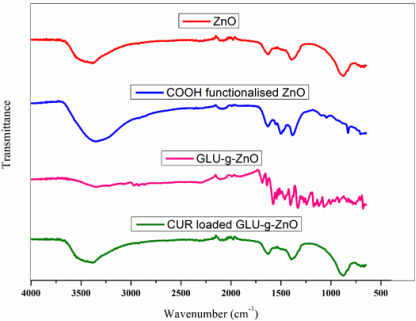
Figure 1. FTIR spectra of A) ZnO Nps, B). -COOH functionalised ZnO Nps, C). GLU-g-ZnO and D). CUR loaded GLU-g-ZnO.
The obtained FTIR is as shown in Figure 1. In the spectra of ZnO Nps, the characteristic peak of ZnO nanoparticles were observed at 560 cm-1 as a sharp peak (Figure 1A). After carboxyl functionalization, broad peaks were observed at 3345 cm-1 (Figure 1B) which is characteristic of -OH. On coupling carboxyl functionalized ZnO Nps with glutamic acid, a new peak could be observed at 3455 cm-1 in (Figure 1C) which may be assigned to the -NH group of the amide bond. The carboxyl group of the amide bond was observed around 1700 cm-1 as a new peak. After loading with CUR, small shoulders in the range 1300-1500 cm-1 appeared due to the functionalities present in the phenolic drug - CUR (Figure 1D). In addition, all the characteristic peaks of the monomers and GLU was well maintained in the drug loaded sample.
3.1.2. DLS and Zeta Potential
Table 1. DLS and zeta potential values of ZnO NPs, ZnO-COOH, GLU-g-ZnO and CUR loaded GLU-g-ZnO.
Sl. No.
Sample
Hydrodynamic diameter (nm)
Zeta Potential (mV)
1.
ZnO Nps
34
+24.5
2.
ZnO-COOH
47
+29.7
3.
GLU-g-ZnO
57
+38.3
4.
CUR loaded GLU-g-ZnO
75
+41.0
The particle size and zeta potential are as shown in Table 1. It was observed that a regular increase in size occurred after each modification. There was a drastic increase in particle size on loading CUR, which is an evidence for successful drug entrapment. Further, zeta potential value of + 41.0 mV encompasses the stability of the final material in physiological conditions.
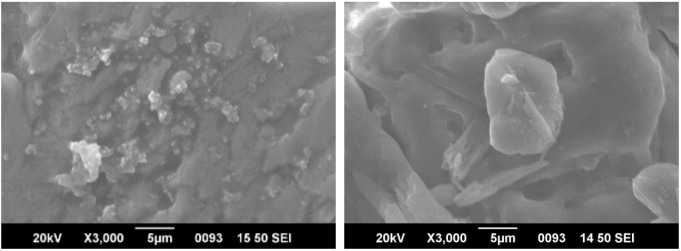
Figure 2. SEM images of A) GLU-g-ZnO and B). CUR loaded GLU-g-ZnO.
SEM images are as shown in Figure 2. ZnO Nps are reported to have a smooth and spherical type morphology. However, for drug entrapment and uniform drug release, a rough topology is preferred which was achieved by surface modification with GLU as evident from Figure 2. The grafted copolymer sample exhibited a dry and rough surface which in general is ideal for higher drug loading capacity. Upon loading with drug molecules, a significant change in surface was evident. The structure assumed much more organized pattern with spherical morphology which might be due to the higher interaction between the copolymer and CUR.
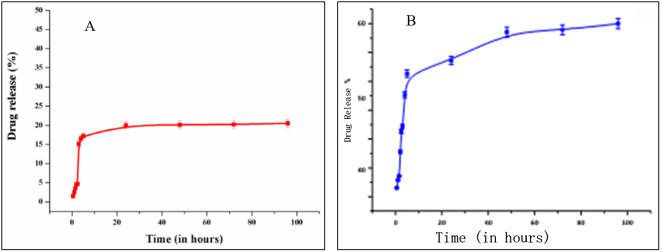
Figure 3. In vitro release of CUR from GLU-g-ZnO at A) pH 1.2 and B) pH 7.4 using dialysis bag technique (n =3 and data are presented as mean ± S. D).
Drug release pattern of the synthesized GLU-g-ZnO was assessed and the obtained curve is as shown in Figure 3A sustained release was observed at pH 7.4 with almost 59.0% drug released within 3 days. However, at acidic pH, only less than 21% drug could be released within the same time span. This confirmed the pH sensitivity of the material which could be attributed to the pH sensitive functionalities present within the polymer. At acidic pH, absence of primary amines retains the geometry of the material. Even then, a small amount of drug release was observed due to the presence of secondary amines. At basic pH, the unreacted - COOH group in GLU gets deprotonated and all the groups gets deprotonated with time. This eventually leads to swelling and thereby, leaching of the entrapped drug.
A comparison of results of the present work with those from literature is as shown in Table 2 below:
Table 2. Comparison of present work.
Sl. No.
Reference
Drug Carrier
Release Behaviour
Comparison with Present Study
1
[12]
M. N. Alshahrani, S. S. Alhakamy, M. M. Badr-Eldin, et al., “Preparation, Characterization, and Antioxidant Properties of Self-Assembled Nanomicelles of Curcumin-Loaded Amphiphilic Modified Chitosan,” Polymers, 2024, 16, 1606.
[12]
Amphiphilic chitosan nanomicelles
57.6% CUR release at pH 7.4 after 72 h
Present work showed a slightly higher sustained release (59.0%) over the same duration.
2
[13]
Y. Zhang, X. Li, H. Wang, et al., “Bone Healing via Carvacrol and Curcumin Nanoparticles on 3D-Printed Scaffolds,” Small, 2024,
51% release at pH 7.4 after 72 h and ~90% at acidic pH 5.4
Present material exhibited greater release at physiological pH while maintaining excellent gastric protection (21% at pH 1.2).
3
[14]
Danial Rahmani, Ramezan Ali Taheri, Mehrdad Moosazadeh Moghaddam, “Targeted Delivery of Curcumin and CM11 Peptide Against Hepatocellular Carcinoma Cells Based on Binding Affinity of PreS1-Coated Chitosan Nanoparticles to SB3 Protein”, Amino Acids, 2025, 57, 12.
[14]
Chitosan nanoparticles
Approximately 55% CUR release at pH 7.4 after 8 h, increasing gradually thereafter
The initial release from the presently reported formulation was more controlled and extended over three days, indicating prolonged sustained release.
On comparison, it is clearly evident that the present material offers an economical, safer and biodegradable pathway for the sustained as well as controlled release of CUR.
4. Conclusions
In the present work, a novel drug carrier of ZnO Nps was grafted with GLU, synthesized and characterized as a potential candidate for the controlled delivery of CUR. The pH sensitive groups incorporated into the material exhibited sufficient pH sensitivity to be used in tumour environment as observed from in vitro drug release profiles. From the results obtained, the present material seem to be a promising candidate for the economical and patient compliant chemotherapy with minimal toxicity towards healthy cells. With the results obtained, the material can be carefully imagined to be a potential candidate for in vivo animal model and pre-clinic studies.
Abbreviations
GLU
Glutamic Acid
ZnO
Zinc Oxide
Nps
Nanoparticles
CUR
Curcumin
GLU-g-ZnO
Glutamic Acid-Grafted-Zinc Oxide Nanoparticles
Author Contributions
Reshmi Kalathoorparangodathu: Formal Analysis, Investigation, Writing – original draft
Rajesh Singh and James W. Lillard Jr. Nanoparticle based targeted drug delivery. Exp Mol Pathol 2009 June: 86(3): 215-223.
[2]
Pradeep Singh Thakur, Maniappan Shankar. Bio inspired and biometric material for drug delivery 2021. chapter 17 Nanofibers for drug delivery advanced and modern approaches for drug delivery 2023. Pages (493-514).
[3]
Sumaira Anjum, Mariam Hashim, Sara Asad Malik Maha khan, Jose M Lorenzo, Bilal Haider, Abbasi cristonphe Hano, Recent advances in ZnO Nanoparticles for cancer diagnosis, Target drug delivery and treatment cancers, 2021, 13, 4570, 1-31.
[4]
Md Abdus Subhan Newton Niyogi and Kristi Priya Choudhary. Industrial manufacturing applications of ZnO nanomaterials: A comprehensive study. Nano manufacturing 2022, 2(4), 265-291.
[5]
Yu Zhang, Wenliang song, Yiming Lu, Yixin Xu, Changpin wang, Deng Guang Yu and IIKim Yu Zhang, Wenliang song, Yiming Lu, Yixin Xu, Changpin wang, Deng Guang Yu and IIKim Recent Advances in poly (α-L-Glutamic Acid)-based nanomaterials for Drug delivery. Biomolecules 12, 636.
[6]
Susan J. Hewlings and Douglas S. Kalaman 2017. Curcumin a review of its effect on human health. Foods 2017, 6(10), 92.
[7]
Zahra Mirzaie, Mohammad Barati, Mohammad Asadi Tokmedash, Anti-cancer drug delivery systems based on curcumin nanostructures: A review, 2020: 54, 353-360.
[8]
Shyam S Bensel, Mehak goe l Aqui l, Manicka V. vandhanam and Ramesh C. Guptha. Advanced drug delivery system of curcumin for cancer chemoprevention. 2011 may 5: 4(8): 1158-1171.
[9]
TS Anirudhan, Anoop S Nair, Sabari J Bino, Nanoparticle assisted solvent selective transdermal combination therapy of curcumin and 5-flurouracil for efficient cancer treatment, Carbohydrate polymers 173, 131: 142.
[10]
M. Abisha Meji, D. Usha, M. Harihara Sankar, B. M. Ashwin, Synthesis of ZnO nanoparticles from zinc acetate dihydrate: An environmental friendly technique, Materials Today: Proceedings, 2023.
[11]
Richard R. Ahumada Álvarez, Oscar Fernando Silva, Alejandro M. Granados, “Eco-Friendly Synthesis of Ag and Au Nanoparticles Using Lactic Acid from Fermentation Waste and Cyclodextrins as Colloidal Stabilizers” Langmuir, 2025, 41, 36, 24711: 24722.
[12]
M. N. Alshahrani, S. S. Alhakamy, M. M. Badr-Eldin, et al., “Preparation, Characterization, and Antioxidant Properties of Self-Assembled Nanomicelles of Curcumin-Loaded Amphiphilic Modified Chitosan,” Polymers, 2024, 16, 1606.
[13]
Y. Zhang, X. Li, H. Wang, et al., “Bone Healing via Carvacrol and Curcumin Nanoparticles on 3D-Printed Scaffolds,” Small, 2024,
Danial Rahmani, Ramezan Ali Taheri, Mehrdad Moosazadeh Moghaddam, “Targeted Delivery of Curcumin and CM11 Peptide Against Hepatocellular Carcinoma Cells Based on Binding Affinity of PreS1-Coated Chitosan Nanoparticles to SB3 Protein”, Amino Acids, 2025, 57, 12.
Kalathoorparangodathu, R., Balachandran, A. L., Nair, A. S., Chandraprabha, H. P., Jayapalan, S., et al. (2026). Synthesis, Characterization and Evaluation of Novel Glutamic Acid Grafted Zinc Oxide Nanoparticle as an Efficient Drug Carrier for Curcumin. World Journal of Applied Chemistry, 11(3), 59-64. https://doi.org/10.11648/j.wjac.20261103.11
Kalathoorparangodathu, R.; Balachandran, A. L.; Nair, A. S.; Chandraprabha, H. P.; Jayapalan, S., et al. Synthesis, Characterization and Evaluation of Novel Glutamic Acid Grafted Zinc Oxide Nanoparticle as an Efficient Drug Carrier for Curcumin. World J. Appl. Chem.2026, 11(3), 59-64. doi: 10.11648/j.wjac.20261103.11
Kalathoorparangodathu R, Balachandran AL, Nair AS, Chandraprabha HP, Jayapalan S, et al. Synthesis, Characterization and Evaluation of Novel Glutamic Acid Grafted Zinc Oxide Nanoparticle as an Efficient Drug Carrier for Curcumin. World J Appl Chem. 2026;11(3):59-64. doi: 10.11648/j.wjac.20261103.11
@article{10.11648/j.wjac.20261103.11,
  author = {Reshmi Kalathoorparangodathu and Aswathy Lalitha Balachandran and Archana Somasekharan Nair and Haripadmam Peethambaran Chandraprabha and Shereena Jayapalan and Sanal Kumar Sukumaran Nair and Rajesh Ravindran Nair and Jyothy Parvathy Valsalakumary and Rajesh Ramachandran Savithri and Anoop Somasekharan Nair},
  title = {Synthesis, Characterization and Evaluation of Novel Glutamic Acid Grafted Zinc Oxide Nanoparticle as an Efficient Drug Carrier for Curcumin},
  journal = {World Journal of Applied Chemistry},
  volume = {11},
  number = {3},
  pages = {59-64},
  doi = {10.11648/j.wjac.20261103.11},
  url = {https://doi.org/10.11648/j.wjac.20261103.11},
  eprint = {https://article.sciencepublishinggroup.com/pdf/10.11648.j.wjac.20261103.11},
  abstract = {The emergence of nanotechnology has transformed drug delivery approaches, enabling the design of innovative nanocarriers that can precisely target diseased sites, enhance bioavailability, and minimize adverse effects. Herein, the green synthesized ZnO Nps were initially converted to -COOH functionalized nanoparticles which was then coupled with -NH2 group of glutamic acid (GLU). It was then encapsulated with CUR by making use of hydrogen bonds. The induced amide bonds in the drug carrier assured high drug loading capacity as the encapsulation and loading efficiencies were found to be 48.1% and 92.3% respectively. All the synthesis steps were carefully monitored using FTIR, XRD, SEM, DLS and Zeta potential measurements. All data suggested successful preparation of the drug delivery vehicle. The performance of the material was evaluated using in vitro release profiles and exhibited pH selective release of drug molecules with 59.0% CUR being delivered in a sustained manner at pH 7.4 within 3 days. However, at 1.2 pH, only 21% release was observed for the same time span. The absence of primary amine groups led to inertness in acidic pH whereas at basic conditions, the unreacted –COOH groups in GLU were deprotonated leading to swelling and thereby drug release. All these suggests the potential applicability of the prepared material in pH sensitive drug delivery of CUR.},
 year = {2026}
}
TY  - JOUR
T1  - Synthesis, Characterization and Evaluation of Novel Glutamic Acid Grafted Zinc Oxide Nanoparticle as an Efficient Drug Carrier for Curcumin
AU  - Reshmi Kalathoorparangodathu
AU  - Aswathy Lalitha Balachandran
AU  - Archana Somasekharan Nair
AU  - Haripadmam Peethambaran Chandraprabha
AU  - Shereena Jayapalan
AU  - Sanal Kumar Sukumaran Nair
AU  - Rajesh Ravindran Nair
AU  - Jyothy Parvathy Valsalakumary
AU  - Rajesh Ramachandran Savithri
AU  - Anoop Somasekharan Nair
Y1  - 2026/08/24
PY  - 2026
N1  - https://doi.org/10.11648/j.wjac.20261103.11
DO  - 10.11648/j.wjac.20261103.11
T2  - World Journal of Applied Chemistry
JF  - World Journal of Applied Chemistry
JO  - World Journal of Applied Chemistry
SP  - 59
EP  - 64
PB  - Science Publishing Group
SN  - 2637-5982
UR  - https://doi.org/10.11648/j.wjac.20261103.11
AB  - The emergence of nanotechnology has transformed drug delivery approaches, enabling the design of innovative nanocarriers that can precisely target diseased sites, enhance bioavailability, and minimize adverse effects. Herein, the green synthesized ZnO Nps were initially converted to -COOH functionalized nanoparticles which was then coupled with -NH2 group of glutamic acid (GLU). It was then encapsulated with CUR by making use of hydrogen bonds. The induced amide bonds in the drug carrier assured high drug loading capacity as the encapsulation and loading efficiencies were found to be 48.1% and 92.3% respectively. All the synthesis steps were carefully monitored using FTIR, XRD, SEM, DLS and Zeta potential measurements. All data suggested successful preparation of the drug delivery vehicle. The performance of the material was evaluated using in vitro release profiles and exhibited pH selective release of drug molecules with 59.0% CUR being delivered in a sustained manner at pH 7.4 within 3 days. However, at 1.2 pH, only 21% release was observed for the same time span. The absence of primary amine groups led to inertness in acidic pH whereas at basic conditions, the unreacted –COOH groups in GLU were deprotonated leading to swelling and thereby drug release. All these suggests the potential applicability of the prepared material in pH sensitive drug delivery of CUR.
VL  - 11
IS  - 3
ER  -
Kalathoorparangodathu, R., Balachandran, A. L., Nair, A. S., Chandraprabha, H. P., Jayapalan, S., et al. (2026). Synthesis, Characterization and Evaluation of Novel Glutamic Acid Grafted Zinc Oxide Nanoparticle as an Efficient Drug Carrier for Curcumin. World Journal of Applied Chemistry, 11(3), 59-64. https://doi.org/10.11648/j.wjac.20261103.11
Kalathoorparangodathu, R.; Balachandran, A. L.; Nair, A. S.; Chandraprabha, H. P.; Jayapalan, S., et al. Synthesis, Characterization and Evaluation of Novel Glutamic Acid Grafted Zinc Oxide Nanoparticle as an Efficient Drug Carrier for Curcumin. World J. Appl. Chem.2026, 11(3), 59-64. doi: 10.11648/j.wjac.20261103.11
Kalathoorparangodathu R, Balachandran AL, Nair AS, Chandraprabha HP, Jayapalan S, et al. Synthesis, Characterization and Evaluation of Novel Glutamic Acid Grafted Zinc Oxide Nanoparticle as an Efficient Drug Carrier for Curcumin. World J Appl Chem. 2026;11(3):59-64. doi: 10.11648/j.wjac.20261103.11
@article{10.11648/j.wjac.20261103.11,
  author = {Reshmi Kalathoorparangodathu and Aswathy Lalitha Balachandran and Archana Somasekharan Nair and Haripadmam Peethambaran Chandraprabha and Shereena Jayapalan and Sanal Kumar Sukumaran Nair and Rajesh Ravindran Nair and Jyothy Parvathy Valsalakumary and Rajesh Ramachandran Savithri and Anoop Somasekharan Nair},
  title = {Synthesis, Characterization and Evaluation of Novel Glutamic Acid Grafted Zinc Oxide Nanoparticle as an Efficient Drug Carrier for Curcumin},
  journal = {World Journal of Applied Chemistry},
  volume = {11},
  number = {3},
  pages = {59-64},
  doi = {10.11648/j.wjac.20261103.11},
  url = {https://doi.org/10.11648/j.wjac.20261103.11},
  eprint = {https://article.sciencepublishinggroup.com/pdf/10.11648.j.wjac.20261103.11},
  abstract = {The emergence of nanotechnology has transformed drug delivery approaches, enabling the design of innovative nanocarriers that can precisely target diseased sites, enhance bioavailability, and minimize adverse effects. Herein, the green synthesized ZnO Nps were initially converted to -COOH functionalized nanoparticles which was then coupled with -NH2 group of glutamic acid (GLU). It was then encapsulated with CUR by making use of hydrogen bonds. The induced amide bonds in the drug carrier assured high drug loading capacity as the encapsulation and loading efficiencies were found to be 48.1% and 92.3% respectively. All the synthesis steps were carefully monitored using FTIR, XRD, SEM, DLS and Zeta potential measurements. All data suggested successful preparation of the drug delivery vehicle. The performance of the material was evaluated using in vitro release profiles and exhibited pH selective release of drug molecules with 59.0% CUR being delivered in a sustained manner at pH 7.4 within 3 days. However, at 1.2 pH, only 21% release was observed for the same time span. The absence of primary amine groups led to inertness in acidic pH whereas at basic conditions, the unreacted –COOH groups in GLU were deprotonated leading to swelling and thereby drug release. All these suggests the potential applicability of the prepared material in pH sensitive drug delivery of CUR.},
 year = {2026}
}
TY  - JOUR
T1  - Synthesis, Characterization and Evaluation of Novel Glutamic Acid Grafted Zinc Oxide Nanoparticle as an Efficient Drug Carrier for Curcumin
AU  - Reshmi Kalathoorparangodathu
AU  - Aswathy Lalitha Balachandran
AU  - Archana Somasekharan Nair
AU  - Haripadmam Peethambaran Chandraprabha
AU  - Shereena Jayapalan
AU  - Sanal Kumar Sukumaran Nair
AU  - Rajesh Ravindran Nair
AU  - Jyothy Parvathy Valsalakumary
AU  - Rajesh Ramachandran Savithri
AU  - Anoop Somasekharan Nair
Y1  - 2026/08/24
PY  - 2026
N1  - https://doi.org/10.11648/j.wjac.20261103.11
DO  - 10.11648/j.wjac.20261103.11
T2  - World Journal of Applied Chemistry
JF  - World Journal of Applied Chemistry
JO  - World Journal of Applied Chemistry
SP  - 59
EP  - 64
PB  - Science Publishing Group
SN  - 2637-5982
UR  - https://doi.org/10.11648/j.wjac.20261103.11
AB  - The emergence of nanotechnology has transformed drug delivery approaches, enabling the design of innovative nanocarriers that can precisely target diseased sites, enhance bioavailability, and minimize adverse effects. Herein, the green synthesized ZnO Nps were initially converted to -COOH functionalized nanoparticles which was then coupled with -NH2 group of glutamic acid (GLU). It was then encapsulated with CUR by making use of hydrogen bonds. The induced amide bonds in the drug carrier assured high drug loading capacity as the encapsulation and loading efficiencies were found to be 48.1% and 92.3% respectively. All the synthesis steps were carefully monitored using FTIR, XRD, SEM, DLS and Zeta potential measurements. All data suggested successful preparation of the drug delivery vehicle. The performance of the material was evaluated using in vitro release profiles and exhibited pH selective release of drug molecules with 59.0% CUR being delivered in a sustained manner at pH 7.4 within 3 days. However, at 1.2 pH, only 21% release was observed for the same time span. The absence of primary amine groups led to inertness in acidic pH whereas at basic conditions, the unreacted –COOH groups in GLU were deprotonated leading to swelling and thereby drug release. All these suggests the potential applicability of the prepared material in pH sensitive drug delivery of CUR.
VL  - 11
IS  - 3
ER  -





 Share This Article
 Twitter
 Linked In
 Facebook
 Copy
Copy Download