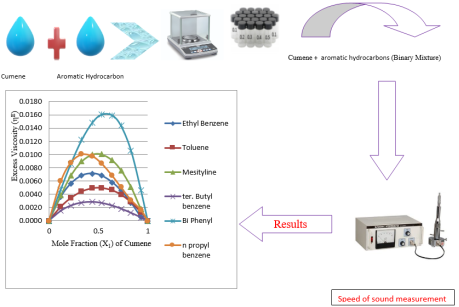
Research Article | | Peer-Reviewed

Volumetric, Ultrasonic and Viscometric Studies of Molecular Interactions in Binary Mixtures of Isopropyl Benzene (Cumene) with Aromatic Hydrocarbons at 298.15K

Received: 24 January 2026     Accepted: 4 February 2026     Published: 26 February 2026
Views:       Downloads:
Abstract

Theoretical and experimental research on binary liquid mixtures of isopropyl benzene (cumene) with aromatic hydrocarbons at 298.15 K is presented in this article. For these binary mixtures, experimental measurements of the density (ρ), viscosity (η), and speed of sound (u) have been made at 298.15 K. The excess molar volume (), excess adiabatic compressibility (), excess sound velocity (uᴱ), and deviation in viscosity (ηᴱ) have all been computed from the experimental measurements. These excess parameters have been correlated using the Redlich–Kister polynomial equation. Positive excess properties were discovered, reflecting the distinctive behavior of the liquid mixtures and suggesting the existence of particular molecular interactions. Significant specific interactions between the components, mainly controlled by molecular association, are suggested by the positive values of the excess properties. The molecular structure and intrinsic characteristics of the liquid mixtures determine how strong these interactions are in liquid mixtures. The results indicated the presence of weak interactions between 1,4-dioxane and aromatic hydrocarbon molecules, which follows the order: Ethyl benzene > toluene > mesitylene > n-propyl benzene> tert-butyl benzene > biphenyl. It is observed that the interactions depend on the number and position of the methyl groups in these aromatic hydrocarbons. The observed trends in the following systems indicate weak to moderate interactions, primarily π–π and solute-solvent interaction.

Published in World Journal of Applied Chemistry (Volume 11, Issue 1)
DOI 10.11648/j.wjac.20261101.11
Page(s) 1-13
Creative Commons

This is an Open Access article, distributed under the terms of the Creative Commons Attribution 4.0 International License (http://creativecommons.org/licenses/by/4.0/), which permits unrestricted use, distribution and reproduction in any medium or format, provided the original work is properly cited.

Copyright

Copyright © The Author(s), 2026. Published by Science Publishing Group

Keywords

Binary Mixtures, Density, Viscosity, Speed of Sound, Adiabatic Compressibility, Molar Volume, Cumene, Aromatic Hydrocarbon, Molecular Interaction

1. Introduction
Research on the transport and thermodynamic characteristics of binary liquid mixtures provides important information about how molecules interact with one another. While there is a wealth of literature on the density, sound speed, and viscosity of liquid mixtures, thorough studies that incorporate all three factors are still rather rare. We here provide the density, viscosity, and sound speed data for binary mixtures of isopropyl benzene (cumene) with aromatic hydrocarbons at 298.15 K, building on our previous research on binary mixtures of cyclic diether with n-alcohols. Previous studies have documented the impact of branching and alkyl chain length on solute-solvent interactions . The current study's goals are broadly applicable to large-scale chemical production systems. Specifically, isopropyl benzene (cumene) is used extensively as an industrial solvent and in the production of phenol, acetone, and high-octane fuel additives. Printing, textile dyeing, and the production of methyl styrene are just a few of the industries that employ n-propyl benzene as a non-polar organic solvent. Isopropyl benzene (cumene) is a naturally occurring chemical found in coal tar and petroleum. It is insoluble in water but readily soluble in many organic solvents. Cumene is primarily utilised as a feedstock for the synthesis of phenol and its co-product, acetone. It is also applied as a solvent for fats and resins. In industrial applications, where such solvent combinations can operate as selective media for a variety of chemical processes, the thermodynamic properties of isopropyl benzene (cumene) in mixes with aromatic hydrocarbons are of great interest. Data on the thermodynamic properties of these chemicals and their binary mixtures are vital for the calculation, design, and modeling of technical processes and equipment in chemical manufacturing. Measurements using ultrasound can reveal important details about the interactions and physical condition of liquid mixtures. Understanding the thermodynamic, acoustic, and transport behavior of liquid-liquid mixtures depends heavily on their ultrasonic characteristics. Both pure liquids and their mixes can be described using ultrasonic characteristics. The nature of molecular interactions in a liquid system can be determined from the propagation of ultrasonic vibrations through the liquid. Operations like distillation, extraction, and crystallization can be designed using the surplus thermodynamic properties of liquid mixtures. The textile, chemical, food processing, leather, and pharmaceutical sectors, as well as material testing and cleaning, are just a few of the businesses that use the understanding of ultrasonic qualities.
Strong dipole-induced dipole interactions between the aromatic rings' π-electron clouds provide an explanation for the excess molar volumes. Temperature also affects the surplus molar volume's size. For binary mixes of isopropyl benzene (cumene) and aromatic hydrocarbons, the interactions between esters and hydrocarbons have been investigated . By obtaining different thermodynamic parameters from volumetric, viscometric, and acoustic measurements of the binary mixtures, we have examined the thermodynamic characteristics of the previously mentioned mixtures in order to clarify the type and strength of interactions between the constituents.
For binary mixtures of isopropyl benzene (cumene) with aromatic hydrocarbons at 298.15 K, we report measurements of the speed of sound (u), density (ρ), and viscosity (η), as well as the derived excess properties, such as excess sound velocity (uᴱ), viscosity deviation (ηᴱ), excess molar volume (VmE) and excess adiabatic compressibility (βadE). The following binary liquid mixtures were examined in this work:
(i) Cumene, or isopropyl benzene Ethyl benzene (ii) Isopropyl benzene (Cumene) - Toluene (iii) Isopropyl benzene (Cumene) - Mesitylene (iv) Isopropyl benzene (Cumene) - n-propyl benzene (v) Isopropyl benzene (Cumene) - t-butyle benzene (vi) Isopropyl benzene (Cumene) – Biphenyl.
2.ExperimentalProcedure
2.1. Material
The chemicals used in the present work were of high-purity laboratory reagent grade, including isopropyl benzene (cumene), ethyl benzene, toluene, mesitylene, n-propyl benzene, tert-butyl benzene, and biphenyl, all purchased from CDH Ltd., New Delhi, India. The chemicals were stored over sodium hydroxide pellets for several days and kept in tightly sealed bottles to minimize the absorption of atmospheric moisture. The purity of each solvent was confirmed by comparing the measured density, dynamic viscosity, and sound velocity of the pure components at 298.15 K with the corresponding values reported in the literature , as summarized in Table 2.
Table 1. The details of the chemicals used, including their CAS Registry Numbers and mass fraction purities, are provided in Table 1.

Component

Formula

CAS Reg. No.

Supplier

Mass Fraction Purity (%)

Water Content

Method Purity analysis method

Cumene

C9H12

80-15-9

CDH, (P) Ltd. New Delhi, India

99.5%

0.1%

Double distillation

Mesitylene

C9H12

108-67-8

CDH, (P) Ltd. New Delhi, India

99.0%

0.01%

Double distillation

Ethyl benzene

C8H10

100-41-4

CDH, (P) Ltd. New Delhi, India

99.5%

0.1%

Double distillation

Toluene

C7H8

108-88-3

CDH, (P) Ltd. New Delhi, India

99.5%

0.1%

Double distillation

n-Propyl benzene

C9H12

103-65-1

CDH, (P) Ltd. New Delhi, India

99.3%

0.01%

Double distillation

t-Butyl benzene

C10H14

98-06-6

CDH, (P) Ltd. New Delhi, India

99.5%

0.1%

Double distillation

Biphenyl

C12H10

92-52-4

CDH, (P) Ltd. New Delhi, India

99.0%

0.05%

Double distillation

2.2. Measurements
Six binary systems were studied: isopropyl benzene (cumene) + ethyl benzene, isopropyl benzene (cumene) + toluene, isopropyl benzene (cumene) + mesitylene, isopropyl benzene (cumene) + n-propyl benzene, isopropyl benzene (cumene) + tert-butyl benzene, and isopropyl benzene (cumene) + biphenyl. Each sample mixture was prepared on a mass basis by mixing the calculated amounts of the liquid components in specially designed glass-stoppered bottles. All binary mixtures were prepared by accurately weighing components across the entire range of mole fractions. The components of the binary mixtures were injected using a syringe into glass vials sealed with rubber stoppers to minimize evaporation losses during sample preparation. All six binary liquid mixtures were prepared by accurately weighing the appropriate amounts of pure liquids using a digital electronic balance (Citizen Scale (I) Pvt. Ltd., Mumbai, India) with a precision of ±0.1 mg. The experimental uncertainty in the mole fractions did not exceed ±0.0005. For each binary system, five samples were prepared, and their densities, viscosities, and sound velocities were measured on the same day.
2.2.1. Density
The densities of pure components and binary mixtures were measured using a 25 ml specific gravity bottle by the relative measurement method, with an accuracy of ±0.01 g.cm-3. The specific gravity bottle containing the experimental mixture was immersed in a temperature-controlled water bath (MSI Goyal Scientific, Meerut, U.P., India), operating over a temperature range of –10°C to 85°C with an accuracy of ±0.1°C. Double-distilled water was used to calibrate the specific gravity bottle. For each composition, measurements were generally repeated at least three times, and the results were appropriately treated to ensure accuracy.
2.2.2. Viscosity
Viscosities were determined using a calibrated Ostwald viscometer. Care was taken to ensure that the capillary was perfectly vertical while mounting the viscometer in a water bath maintained at 298.15 ± 0.04 K. The viscometer containing the sample liquid was equilibrated in the water bath for 30 minutes prior to measuring the flow time. A digital stopwatch with a readability of 0.01 s was used to record the flow times. Each measurement was repeated at least five times, and the average values were used in all subsequent calculations.
2.2.3. Sound Velocity
The speed of sound (u) in the solutions was measured at a frequency of 3 MHz using the interferometric method (Model F-80D, Mittal Enterprise, New Delhi, India) at 298.15 K. A fixed-frequency generator operating at 3 MHz was used. At its resonant frequency, the crystal undergoes rapid mechanical oscillations, producing ultrasonic waves. These ultrasonic waves propagate through the liquid in the vessel, producing effects such as cavitation, acoustic streaming, and enhanced mixing. The interferometer cell was filled with the test liquid, with water circulated around the measuring cell from a water bath. The experimental uncertainty in the speed of sound measurements was estimated to be ±0.1%. The measured ultrasonic velocities of pure isopropyl benzene (cumene), ethyl benzene, toluene, mesitylene, n-propyl benzene, tert-butyl benzene, and biphenyl are in good agreement with the corresponding values reported in the literature. The ultrasonic velocity, u /ms−1 were computed using the standard relation:
u =f×λ (1)
where f is the operating frequency (3 MHz) and λ is the measured wavelength of the ultrasonic wave in the solution.
Table2.Viscosity (η), Sound Velocity (u), and Density (ρ) for Pure Components at 298.15 K and atmospheric pressure are compared between experimental and literature values.

component

Density(ρ)g.cm-3

Ultrasonic Velocities (u) m.s-1

Viscosity(η) mPa.s

Observed

Literature

Observed

Literature

Observed

Literature

Cumene

0.8532

0.858121

1326

132526

0.7337

0.738821

0.557422

130830

0.739022

Mesitylene

0.8616

0.861218

1338

133618

0.6049

0.66727

0.861119

133620

0.66032

Ethyl benzene

0.8674

0.86205

1324

13125

0.6299

0.6285

0.86266

131930

0.63735

Toluene

0.8576

0.86244

1306

130711

0.6026

0.552516

0.86227

130913

0.553117

n-Propyl benzene

0.8624

0.857723

1315

132028

0.7931

0.799525

0.857724

132029

0.782723

t-Butyl benzene

0.8624

0.862419

1316

131518

0.7449

NA

0.862218

131520

NA

Biphenyl

0.7920

NA

1118

NA

0.6108

NA

NA: Data not available
3. Theoretical
The excess sound velocity (uᴱ) was calculated from the experimental ultrasonic velocities of the pure components and their binary mixtures using the relation:
uE= u1,2- u1X1+ u2X2(2)
In this equation, u1,2 represents the ultrasonic velocity of the mixture, while u1 and u2, and X1 and X2 denote the ultrasonic velocities and mole fractions of component liquids 1 and 2, respectively. The ultrasonic velocity (u), density (ρ), and viscosity (η) of pure liquids and their mixtures at various concentrations were measured at 298.15 K.
The excess viscosity (ηᴱ) as a function of mole fraction was calculated using the following relation:
ηEmPa.s=η12-i=02Xiηi(3)
In this equation, 𝑥𝑖, 𝜂𝑖, and 𝜂12 refer, respectively, to the mole fraction and viscosities of the 𝑖th pure component and of the binary mixture.
Experimental values of density (ρ), viscosity (η), and speed of sound (u) for the mixtures at 298.15 K are listed as a function of mole fraction in Table 3. The density values were used to calculate the molar volumes (Vₘ) using the following equation:
Vm=X1M1+ X2M2ρ(4)
The speed of sound (u) was used to calculate the isentropic (adiabatic) compressibility (βad) using the following equation. The adiabatic compressibility (βad) is generally determined from:
βad=1u2ρ(5)
In this equation, ρ is the density (in g.cm-3 or kg.m-3) and u is the speed of sound (in ms⁻¹ or cm.s⁻¹). This equation is based on the relationship between compressibility and the propagation of sound waves in a medium. A lower speed of sound in a liquid corresponds to a higher compressibility.
The excess isentropic (adiabatic) compressibility,βadE, was calculated using the following relation:
βadE= βad12- X1βad1- X2βad2(6)
In this equation, βad12 is the experimental isentropic compressibility of the mixture; while X1, X2 and βad1, βad2 represent the mole fractions and isentropic compressibilities of the pure components, respectively.
The excess parameters for all acoustic properties were calculated using the following relation:
AE=Aexp.– Aideal(7)
In this equation, Aideal = X1 A1 + X2 A2, where A represents any acoustic parameter, and X1 and X2 are the mole fractions of isopropyl benzene and the aromatic hydrocarbon, respectively.
4. Result and Discussion
The experimental values of densities, sound velocity and viscosities of the hydrocarbons are compared with the literature values and are presented in Table 2. It was found that the experimental values are in proximity with the literature values. Insufficient data on densities, viscosities and sound velocity of pure cumene with ethyl benzene, toluene, mesitylene, n-propyl benzene, tert-butyl benzene, and biphenyl, is available. The densities, 𝜌, viscosities, 𝜂, and sound velocity, u, of binary mixtures were measured at 298.15 ± 0.01 K as a function of the composition of the corresponding binary mixtures. The results of the study are presented in Table 3. A perusal of Table 3 shows that the sound velocity increase with mole fraction of isopropyl benzene (Cumene) increases for all the binary mixtures. Ultrasonic wave are high frequency mechanical waves. Their velocities in a medium depend inversely on density and the compressibility of the medium.
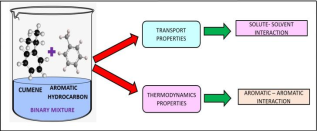
Figure 1. Scheme1. Interactions between Isopropyl Benzene with Aromatic Hydrocarbons at 298.15K.
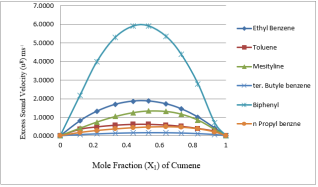
Table 3. Density (ρ), Sound Velocity (u), Viscosity (η), calculated parameter Adiabatic Compressibility (βad), and Molar Volume (Vₘ) of Binary Mixtures of Isopropyl Benzene with Aromatic Hydrocarbons at 298.15 K.

Mole fraction Cumene (x1)

Density (ρ)g.cm-3

Viscosity(η) mPa.s

Speed of Sound (u) ms-1

Adiabatic compressibility(βad)×10-7Pa-1

Molar volume (Vm) × 10-3 cm3.mole-1

Isopropyl benzene + ethyl benzene

0.0000

0.8630

0.6345

1308

0.6773

123.02

0.1193

0.8612

0.6472

1310

0.6763

125.16

0.2209

0.8600

0.6633

1314

0.6758

126.98

0.3312

0.8596

0.6715

1316

0.6751

128.97

0.4397

0.8592

0.3882

1317

0.6745

130.94

0.5319

0.8588

0.6931

1318

0.6739

132.61

0.6395

0.8580

0.7042

1320

0.6721

134.52

0.7301

0.8572

0.7124

1321

0.6709

136.13

0.8315

0.8564

0.7198

1322

0.6694

137.90

0.9313

0.8554

0.7249

1324

0.6681

139.66

1.0000

0.8532

0.7337

1326

0.6666

140.87

Isopropyl benzene + toluene

0.0000

0.8672

0.5691

1312

0.6699

106.25

0.1193

0.8628

0.5801

1314

0.6697

110.26

0.2209

0.8612

0.6046

1315

0.6695

113.82

0.3312

0.8600

0.6293

1316

0.6693

117.53

0.4397

0.8592

0.6457

1318

0.6691

121.23

0.5319

0.8584

0.6706

1390

0.669

124.43

0.6395

0.8576

0.6869

1320

0.6686

128.18

0.7301

0.8568

0.7032

1321

0.6682

131.44

0.8315

0.8556

0.7191

1322

0.6677

134.95

0.9313

0.8544

0.7266

1324

0.6671

138.42

1.0000

0.8532

0.7337

1326

0.6666

140.87

Isopropyl benzene + meistylene

0.0000

0.8616

0.6049

1338

0.6483

139.50

0.1193

0.8612

0.6216

1336

0.6509

139.59

0.2209

0.8608

0.6384

1335

0.653

139.66

0.3312

0.8604

0.6551

1334

0.6552

139.74

0.4397

0.8600

0.6718

1333

0.6574

139.76

0.5319

0.8596

0.6885

1332

0.6591

139.85

0.6395

0.8592

0.6967

1331

0.6608

139.89

0.7301

0.8588

0.7048

1330

0.6626

140.05

0.8315

0.8584

0.713

1329

0.6643

140.38

0.9313

0.8576

0.7293

1328

0.6658

140.54

1.0000

0.8532

0.7337

1326

0.6666

140.87

Isopropyl benzene + n-propyl benzene

0.0000

0.8624

0.7931

1315

0.6706

138.61

0.1193

0.8620

0.7896

1316

0.6703

138.90

0.2209

0.8618

0.7884

1317

0.6700

139.17

0.3312

0.8614

0.7724

1318

0.6669

139.45

0.4397

0.8604

0.7664

1319

0.6694

139.70

0.5319

0.8596

0.7626

1320

0.6692

139.95

0.6395

0.8588

0.7558

1321

0.6686

140.10

0.7301

0.8584

0.7524

1322

0.6681

140.30

0.8315

0.8576

0.74630

1324

0.6676

140.52

0.9313

0.8560

0.7422

1325

0.6669

140.74

1.0000

0.8532

0.7337

1326

0.6666

140.87

Isopropyl benzene + t-butyl benzene

0.0000

0.8624

0.7449

1316

0.6695

154.77

0.1193

0.8620

0.7445

1317

0.6699

153.17

0.2209

0.8612

0.7440

1318

0.6690

151.78

0.3312

0.8604

0.7436

1390

0.6691

150.27

0.4397

0.8596

0.7420

1320

0.6689

148.78

0.5319

0.8586

0.7398

1321

0.6684

147.56

0.6395

0.8572

0.7389

1322

0.6680

146.01

0.7301

0.8564

0.7373

1323

0.6677

144.72

0.8315

0.8556

0.7364

1324

0.6673

143.30

0.9313

0.8548

0.7351

1325

0.6669

141.90

1.0000

0.8532

0.7337

1326

0.6666

140.87

Isopropyl benzene + Biphenyl

0.0000

0.7920

0.6108

1118

0.9989

177.91

0.1193

0.7956

0.6215

1144

0.9694

173.45

0.2209

0.8036

0.6357

1174

0.9347

169.70

0.3312

0.8084

0.6510

1186

0.8970

165.65

0.4397

0.8144

0.6710

1198

0.8600

161.66

0.5319

0.8248

0.6932

1212

0.8281

158.31

0.6395

0.8276

0.7308

1242

0.7910

154.27

0.7301

0.8324

0.7161

1274

0.7597

150.90

0.8315

0.8436

0.7215

1286

0.7248

147.14

0.9313

0.8484

0.7295

1300

0.6904

143.44

1.0000

0.8532

0.7337

1326

0.6666

140.87

For the binary liquid mixture mixtures isopropyl benzene (cumene) + ethyl benzene, isopropyl benzene (cumene) + toluene, isopropyl benzene (cumene) + mesitylene, isopropyl benzene (cumene) + n-propyl benzene, isopropyl benzene (cumene) + tert-butyl benzene, and isopropyl benzene (cumene) + biphenyl, the obtained excess sound velocity (uE) values are positive over the whole composition range at 298.15 K as depicted in Figure 1. Various type of interaction which are possible and which can operate in the binary liquid mixtures containing isopropyl benzene (cumene) and aromatic hydrocarbon, that can produce positive deviation in excess sound velocity and excess viscosity. The excess sound velocity (uE) for the binary systems of isopropyl benzene (cumene) + ethyl benzene, isopropyl benzene (cumene) + toluene, isopropyl benzene (cumene) + mesitylene, isopropyl benzene (cumene) + n-propyl benzene, isopropyl benzene (cumene) + tert-butyl benzene, and isopropyl benzene (cumene) + biphenyl are graphically presented in Fig. 1, together with the Redlich-Kister correlation. It is evident that all six mixtures exhibit significant positive uE values, across the whole composition range and at working temperature 298.15K.
The deviation in ultrasonic velocity with the mole fraction of isopropyl benzene (cumene) for the six systems indicates that there is a non-linear decrease in velocity without having any minimum as shown in Fig.-1. The non-existence of maxima or dip at any intermediate concentration of isopropyl benzene (cumene) with ethyl benzene, toluene, mesitylene, n-propyl benzene, tert-butyl benzene, and biphenyl, indicate that there is no complex formation between components. These observations are in agreement with the general trends of the ultrasonic velocity variations in binary liquids. The existence of structure differences in species in solution is bound to have its effect in the other physical parameters.
The ultrasonic velocity in a mixture is mainly influenced by its molecular property. The results for the excess sound velocity (uE) plotted in Figure 1 are positive for all the binary system studied. The observed positive trends in excess sound velocity indicate that the effect due to the breaking up of self-associated structure of the components of the mixtures is dominant over the effect of π-π interaction between unlike molecule. The positive values of excess sound velocity (uE) increase with the increase in mole fraction which indicates the increase in strength of interaction with all six binary mixtures. The positive excess sound velocity (uE) clearly suggests that there exist weak and π-π molecular interaction between the molecules of all the six binary liquid mixtures.
Figure 1. Excess sound velocity (uᴱ) Vs mole fraction (X1) of binary liquid mixtures at 298.15K that contain aromatic hydrocarbons and isopropyl benzene (cumene).
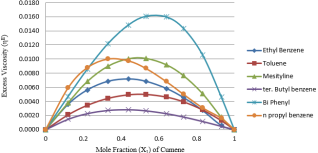
The viscosities of binary liquid mixture isopropyl benzene (cumene) + ethyl benzene, isopropyl benzene (cumene) + toluene, isopropyl benzene (cumene) + mesitylene, isopropyl benzene (cumene) + n-propyl benzene, isopropyl benzene (cumene) + tert-butyl benzene, and isopropyl benzene (cumene) + biphenyl at temperature T = 298.15 K decrease or increase linearly with increase in mole fraction of isopropyl benzene (cumene). Excess viscosity (ηE) values are positive for the all six binary system over the whole mole fraction range (Figure 2).
The excess transport properties of the mixtures are influenced by three main types of contributions, namely,
(i) due to non specific Vander Waals type forces, (ii) due to hydrogen bonding, dipole-dipole, and donor-acceptor interaction between unlike molecules, and (iii) due to the fitting of smaller molecules into the voids created by the bigger molecules. The first effect leads to contraction in volume hence leads to negative contribution towards uE and positive contribution towards (βadE). However, the second effect leads to negative contribution towards (βadE) and positive contribution towards uE.
The experimental values of viscosities as a function of mole fraction of isopropyl benzene (cumene) for six systems are shown in Figure 2. The six systems exhibit a positive deviation of excess viscosity over entire mole fraction range with a maximum corresponding to a mole fraction of about 0.5 at the temperature studied. These deviations indicate specific molecular interactions between different molecules. According to Fort and Moore, the excess viscosity gives the strength of the molecular interaction between the interacting molecules. The excess value of viscosity at the six binary mixtures isopropyl benzene (cumene) + ethyl benzene, isopropyl benzene (cumene) + toluene, isopropyl benzene (cumene) + mesitylene, isopropyl benzene (cumene) + n-propyl benzene, isopropyl benzene (cumene) + tert-butyl benzene, and isopropyl benzene (cumene) + biphenyl at the 298.15 K are shown in Figure 2. The Figure 2 represents the variation of excess viscosity (ηE)is found to be positive for all six binary liquid mixtures over the entire composition range at the 298.15 K. Which suggest the presence of weak intermolecular interactions . For systems where dispersion, induction and dipolar forces are operating, the values of excess viscosity are found to be positive, whereas the existence of specific interaction leading to the no formation of complexes in mixtures tends to make positive.
Figure 2. Excess viscosity (ηᴱ) Vs mole fraction (X1) of binary liquid mixtures at 298.15K that contain aromatic hydrocarbons and isopropyl benzene (cumene).
A reduction in viscosity with increase in mole fraction of isopropyl benzene (cumene) suggests that the existing intermolecular interactions are weakening in magnitude. However, the increasing sound velocity with increasing mole fraction of isopropyl benzene (cumene) leads to a notion that the system is getting more and more compact, which is not true as the interactions due to isopropyl benzene (cumene) are dispersive in nature.
The excess viscosity values, which represent the deviation from rectilinear dependence of ηexp of binary mixture on mole fraction, have been used to explain the mixture component’s intermolecular interaction. The positive ηE values might indicate that the average degree of cross-association between aromatic hydrocarbon and isopropyl benzene (cumene) gradually decreased as the chain length of hydrocarbon increased. Thus, the larger positive deviation for the system containing longer chain hydrocarbon confirmed weak dispersion forces in this system. It can be seen from Figure 2 that in the mixture, absolute value of (ηE) decrease at mole fraction in rose. Many workers have reported similar behavior where positive value of (ηE) indicates dispersive interaction. The positive values of excess viscosity (ηE) observed in isopropyl benzene (cumene) + ethyl benzene, isopropyl benzene (cumene) + toluene, isopropyl benzene (cumene) + mesitylene, isopropyl benzene (cumene) + n-propyl benzene, isopropyl benzene (cumene) + tert-butyl benzene, and isopropyl benzene (cumene) + biphenyl mixture indicate the presence of weak inter molecular interaction amongst the mixing components. The values of excess viscosity (ηE) for all the six system studied are indicative of the predominance of dispersion forces.
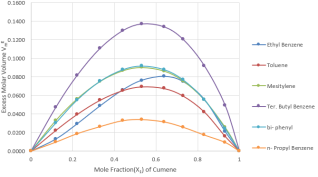
The molar volume (Vm) for the pure liquids isopropyl benzene (cumene), ethyl benzene, toluene, mesitylene, n-propyl benzene, tert-butyl benzene and biphenyl have been calculated using vide eq. 4. The calculated volumes for all the liquid are enlisted in Table 3. Determining the excess molar volume (VmE) of binary mixes depends on exact measurement of density. For this aim, several experimental approaches are extensively used, each with advantages and constraints. Figure 1 represent variation of excess molar volume (VmE) with x1 (isopropyl benzene (cumene)) at 298.15 yielding a U-shaped nature of the graph is attributed to the equilibria of State effects and steric factors arising from the change of orientation of cumene molecules with change in its mole fraction. For the solutions of cumene with ethyl benzene, toluene, mesitylene, n-propyl benzene, tert-butyl benzene and biphenyl the graphs are inverted v-shaped. Treszcznowicz et al. and later Aminabhavi et al. observed that excess molar volume (VmE) many be discussed in terms of several effects which may be arbitrarily divided into physical, chemical and geometrical contributions. The Physical interact involved mainly dispersion forces giving a positive contribution. The chemical or specific interactions result in a volume contraction and these include charge-transfer type forces.
The experimental results are consistent with this explanation, as most of the studied mixtures exhibit positive excess volumes. This indicates that changes in intermolecular forces dominate over packing effects caused by geometrical constraints, which explains the variation in excess molar volumes among different hydrocarbons. When comparing maximum excess molar volumes at equimolar composition, several trends emerge: mixtures with flat or small-substituted hydrocarbons (e.g., ethyl benzene, mesitylene, biphenyl) tend to show positive excess molar volume (VmE) mixtures with non-flat or moderately substituted hydrocarbons (e.g., t-butylbenzene, isopropylbenzene) exhibit intermediate values; and the highest(VmE) is observed for cumene + mesitylene, where mesitylene has a flat geometry with three methyl groups in the meta positions around the aromatic ring. These observations can be interpreted qualitatively in terms of steric and electronic effects. Bulky substituents in the hydrocarbon molecules prevent close approach of the acetate groups, weakening interactions and increasing the excess volume. In contrast, flat molecules with few substituents (toluene, ethyl benzene, mesitylene, bi phenyl) allow some residual interactions, resulting in(VmE). The steric hindrance imposed by three methyl groups in mesitylene obstructs the approach of the cumene molecules, increasing the occupied volume and thus the excess molar volume. Similar trends in excess volume with molecular size and substitution have been observed in other non-polar + non-polar mixtures, including cumene with aromatic compounds. These results highlight the importance of steric hindrance in controlling dispersive interactions and the progressive masking of non-polar effects of methyl groups during mixing.
Figure 3. Excess molar volume (VmE) Vs mole fraction (X1) of binary liquid mixtures at 298.15K that contain aromatic hydrocarbons and isopropyl benzene (cumene).
Regarding the binary systems of isopropyl benzene (cumene) + ethyl benzene, isopropyl benzene (cumene) + toluene, isopropyl benzene (cumene) + mesitylene, isopropyl benzene (cumene) + n-propyl benzene, isopropyl benzene (cumene) + tert-butyl benzene, and isopropyl benzene (cumene) + biphenyl at 298.15 K. Table 3 provide the corresponding values. Figure 5 reports the excess value of adiabatic compressibility (βadE) at six binary liquid mixtures: isopropyl benzene (cumene) + ethyl benzene, isopropyl benzene (cumene) + toluene, isopropyl benzene (cumene) + mesitylene, isopropyl benzene (cumene) + n-propyl benzene, isopropyl benzene (cumene) + tert-butyl benzene, and isopropyl benzene (cumene) + biphenyl at 298.15 K. It is possible to explain the excess adiabatic compressibility (βadE) values as a cumulative manifestation of various kinds of intermolecular interactions between the molecules that make up the mixtures that are being studied. Regarding the binary combinations of isopropyl benzene (cumene) + ethyl benzene, isopropyl benzene (cumene) + toluene, isopropyl benzene (cumene) + mesitylene, isopropyl benzene (cumene) + n-propyl benzene, isopropyl benzene (cumene) + tert-butyl benzene, and isopropyl benzene (cumene) + biphenyl because of isopropyl benzene (cumene).
The calculated excess adiabatic compressibility (βadE), values for the binary liquid mixture listed in Figure 5. The change of this property has been shown in Figure 5. The excess adiabatic compressibility (βadE), values are positive over the entire mole fraction range and become more positive isopropyl benzene (cumene) with increasing the mole fraction of second component for all binary mixtures. These results can be explained in term of molecular interactions and structured effects. The variation of excess adiabatic compressibility (βadE), with volume fraction of isopropyl benzene (cumene) is represent in Figure 5. Fort and Moore have suggested that excess adiabatic compressibility (βadE), is the result of several opposing effects. Strong molecular interactions occur through charge transfer, dipole- induced dipole and dipole-dipole interaction , interstitial accommodation and orientational ordering all lead to a more compact structure making excess adiabatic compressibility (βadE) positive.
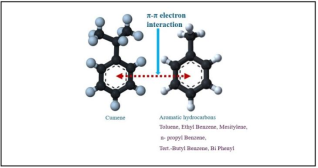
Figure 4. Molecular interaction between Cumene and aromatic hydrocarbons
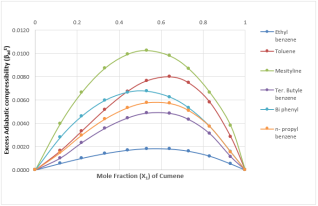
Figure 5 shows the excess adiabatic compressibility (βadE) information for every binary at 298.15 K and air pressure mixtures of isopropyl benzene (cumene) with aromatic hydrocarbons. All mixtures have positive values, according Observe how (βadE) changes in relation to the mole fraction of isopropyl benzene (X1). The cumene–mesitylene system, which has the highest positive (βadE) of the combinations being examined, exhibits the most noticeable effect. (βadE) results from multiple opposing molecular effects, according to Kiyohara and Benson . Table 3 and Figure 5 illustrate how the adiabatic compressibility values of six numbers of binary liquid systems rises as the mole fraction (X1) of isopropyl benzene (cumene). The way that structure influences compressibility is the primary reason for the change in ultrasonic velocity. Adiabatic compressibility changes when liquid mixtures are mixed, showing a noticeable contraction. The mutual disruption in molecules associated with pure liquids may be the reason behind the positive excess adiabatic compressibility (βadE) values, which show a poor level of interaction between molecules. Over the whole range of isopropyl benzene (cumene) composition, these positive excess adiabatic compressibility (βadE) values are decrease in sound velocity is linked to the creation of weak bonds through dipole-induced dipole interaction between molecules those are not similar and the geometrical fitting of component molecules into each other's structures may be responsible for the positive values of excess adiabatic compressibility (βadE).
Figure 5. Excess adiabatic compressibility (βadE) Vs mole fraction (X1) of binary liquid mixtures at 298.15K that contain aromatic hydrocarbons and isopropyl benzene (cumene).
For mixtures of isopropyl benzene (cumene) + ethyl benzene, isopropyl benzene (cumene) + toluene, isopropyl benzene (cumene) + mesitylene, isopropyl benzene (cumene) + n-propyl benzene, isopropyl benzene (cumene) + tert-butyl benzene, and isopropyl benzene (cumene) + biphenyl, (VmE), (uᴱ), (ηE) and (βadE).
Figure 6. The schematic structural presentation of the interactions between isopropyl benzene (cumene) and aromatic hydrocarbon molecules.

Ethyl benzene > toluene > mesitylene > n-propyl benzene> tert-butyl benzene > biphenyl is the sequence in which the magnitude of (VmE), (uᴱ), (ηE) and (βadE) values follow, suggesting the interactions in the same order. This mixtures of isopropyl benzene (cumene) + ethyl benzene, isopropyl benzene (cumene) + toluene, isopropyl benzene (cumene) + mesitylene, isopropyl benzene (cumene) + n-propyl benzene, isopropyl benzene (cumene) + tert-butyl benzene, and isopropyl benzene (cumene) + biphenyl have positive values over the entire mole fraction range.
Ethyl benzene > toluene > mesitylene > n-propyl benzene > tert-butyl benzene > biphenyl is the order in which the interactions in these mixes occur, according to these patterns in (VmE), (uᴱ), (ηE) and (βadE).Binary mixtures of tetrahydrofuran with aromatic hydrocarbons likewise exhibit similar trends in (VmE), (uᴱ), (ηE) and (βadE) values . These observations further corroborate the composition-dependent tendencies displayed by these excess properties.
5. Conclusions
In this paper the ultrasonic velocity (u), density (ρ) and viscosity (η) have been measure over the whole composition range at temperature T = 298.15 K for the binary mixture isopropyl benzene (cumene) + ethyl benzene, isopropyl benzene (cumene) + toluene, isopropyl benzene (cumene) + mesitylene, isopropyl benzene (cumene) + n-propyl benzene, isopropyl benzene (cumene) + tert-butyl benzene, and isopropyl benzene (cumene) + biphenyl. Excess sound velocity (uᴱ), excess viscosity (ηᴱ), excess molar volume (VmE) and excess adiabatic compressibility (βadE) for binary mixtures have been calculated and fitted to a Redlich–Kister equation. It is obvious that, there exist a molecular interaction between the components of the mixture. In specific weak molecular interaction like weak dispersive in nature and dispersive forces are found to exist between the components of the individual mixtures. The present results clearly justify the practical applicability of the simple models used.
Abbreviations

ρ

Density of Liquid

u

Sound Velocity

𝑢𝐸

Excess Sound Velocity

𝜂

Viscosity

ηE

Excess Viscosity

βad

Adiabatic Compressibility

βadE

Excess Adiabatic Compressibility

Vm

Molar Volume

VmE

Excess Molar Volume

X1

Mole Fraction of Isopropyl Benzene (Cumene)

A𝐸

Thermodynamic Excess Function

Acknowledgments
The authors thank the Hon’ble Vice Chancellor Prof. Mukesh Pandey Ji, Bundelkhand University authorities for providing the necessary facilities to carry out the work.
Author Contributions
Chandra Pal Prajapati: Data curation, Formal Analysis, Investigation, Software
Dhirendra Kumar Sharma: Methodology, Supervision, Writing – original draft
Suneel Kumar: Formal Analysis, Software
Data Availability Statement
Data will be made available on request.
Conflicts of Interest
The authors declare no conflicts of interest.
References
[1] Sharma, D. K.; Trivedi, A.; An Ultrasonic Exploration of Physico-chemical Properties for Mixtures of Cyclic Diether (1,3-dioxolane) with 1-alkanols (C5-C10) at 298.15K. American Journal of Physical Chemistry, 2025, 14 (3), 51- 62.
[2] Sharma, D. K.; Agarwal, S.; Viscosities and excess thermodynamic properties of binary liquid mixtures of cyclic ether with 1-alkanols at 303.15K.American Journal of Engineering Research (AJER). 2025, 14 (7),59-69.
[3] Sharma, D. K.; Density, Viscosity, sound velocity and excess thermodynamic properties of binary liquid mixtures of cyclic diether (1,3-dioxolane) with 1-alkanols at 303.15K. International Journal of Advanced Scientific and Technical Research, 2025, 4(15), 105-124.
[4] Sharma DK, Study of thermodynamic properties of six binary liquid mixtures of cyclic diether (1,4-dioxane) with 1-alkanols at 30315K., International Journal of Science and Research (IJSR), 2025:14(8):1162-1172.
[5] Sharma, D. K.; Khan, A.; Speed of sound and adiabatic compressibilities of binary liquid mixtures containing 1,3-dioxolane with1-alkanols at 298.15K and 3 MHz. International Refereed Journal of Engineering and Science (IRJES). 2025, 14(4), 56-62.
[6] Sakurai, M.; Nakamura, K.; Nitta, K.; Partial Molar Volumes of Alkyl Acetates in Water. J Chem. Eng Data.1996, 41, 1171-1175.
[7] Res, J. M.; Gonzalez, C.; Concha, R. G.; Iglesias, M.; Influence of temperature on excess molar volumes for butyl acetate + aromatic hydrocarbons. Phy. Chem. Liq. 2004, 42, 493-520.
[8] Hanan, E.; El-saye, M.; Abdul-Fattah, A. Asfour.; Density and viscosity of the regular quinary system: Benzene (1) + Toluene (2) + Ethyl benzene (3) + Heptane (4) + Cyclooctane (5) and its quaternary sub-systems at 293.15 and 298.15K. J. Solution Chem. 2013, 42, 136-150.
[9] Rattan, V. K.; Singh, S.; Sethi, B. P.S.; Viscosity, density and Ultrasonic velocities of binary mixtures of Ethyl benzene with ethanol, 1-propanol and 1-butanol at (298.15 and 308.15) K. J. Chem. Engg. Data, 2004, 49, 1074 - 1077.
[10] Riddick, J. A.; Bunger, W. B.; Sakano, T. K.; Organic solvents: Physical properties and Methods of Purification, 4thed.; Willey Interscience:NewYork,1986;
[11] Thermodynamic Research Center, Texas A & M University, College Station, T RC Thermodynamic Tables Hydrocarbons, Suppl. No. 1988; 92.
[12] Nain, A. K.; Chand, D.; Correlation between molecular interactions and excess thermodynamic parameters of binary mixtures. J. Pure Appl. Ultrason. 2021, 43, 8-16.
[13] Aralaguppi, M. I.; Aminabhav, T. M.; Harogoppad, S. B.; Balindgi, R. H.; Thermodynamic interactions in binary mixtures of dimethyl sulfoxide with benzene, toluene, 1,3-dimethylbenzene, 1,3,5-trimethylbenzene, and methoxybenzene from 298.15 to 308.15 K. J. Chem. Eng. Data, 1992, 37, 298.
[14] Sarkar, B. K.; Choudhury, A.; Sinha, B.; Excess molar volume, excess viscosities and ultrasonic speed of sound of binary mixtures of 1,2-Dimethoxyethane with some aromatic liquids at 298.15K. J. Solution Chem. 2012, 41, 53-74.
[15] Nain, A. K.; Ultrasonic and viscometric studies of molecular interactions in binary mixtures of tetra hydro furan with some aromatic hydrocarbons at temperatures from 288.15 to 318.145K. Physics and Chemistry of Liquids. 2007, 45(4), 371-388.
[16] Resa, J. M.; Gonzalez, C.; Concha, R. G.; Iglesias M, Prieto S, Diez E. Mixing properties of propyl acetate + aromatic hydrocarbons at 298.15K. Korean J. Chem. Eng. 2006, 23(1), 93-101.
[17] TRC thermodynamic tables, Thermodynamic Research Center, Texas A & M University, College Station, TX: 1994.
[18] Resa, J. M.; Gonzalez, C.; Ortiz, de. L.; Lanz, J.; Densities, excess molar volume and refractive indices of ethyl acetate and aromatic hydrocarbon binary mixtures. J. Chem. Thermodyn. 2002, 34 (7), 995.
[19] D. K. Sharma, C. P. Prajapati, S. Kumar, Density, Ultrasonic Velocity, Viscosity and their Excess Parameters of Some Binary Liquid Mixtures of Cumene with Aromatic Hydrocarbons at 298.15 K. Der Pharma Chemica.2024, 16(2), 301-306.
[20] Saleh, M. A.; Habibullah, M.; Ahmed, S.; Excess molar volume and viscosities of some alkanols with Cumene. Physics and Chemistry of liquids, 2006, 44(1), 31- 43.
[21] Aktar, S.; Abdur, Rahman. M.; Shahadat, Hossian. M..; Akhtar, S.; Excess molar volume and deviation in viscosity of the binary liquid mixtures of 1-Pentanol + Aromatic Hydrocarbons at 298.15K. European Scientific Journal. 2015, 11(5), 213-225.
[22] Page, M.; Huot, J.; Jolicoeur, A.; Comprehensive thermodynamic investigation of water-ethanolamine mixtures at 10, 25 and 40°C. Can. J. Chem. 1993, 45, 1064-1072.
[23] Tsierkezos, N. G.; Palaiologou, M. M.; Molinou, I. E.; Densities and Viscosities of 1-Pentanol binary mixtures at 293.15K. J. Chem. Eng. Data. 2000, 45, 272-275.
[24] Kumar, M.; Rattan, V. K.; Thermophysical properties for binary mixture of Di methyl sulfoxide and isopropyl benzene at various temperatures. Journal of Thermodynamics. 2013, 23.
[25] Riddick, J. A.; Bunger, W. B.; Techniques of Chemistry, Organic Solvents, Volume II, Wiley-Inter sciences: New York, 1970.;
[26] Fujii, Sh.; Tamura, K.; Murakam, S.; Thermodynamic properties of (an alkyl benzene+ cyclo hexane) at the temperature 298.15 K. J. Chem. Thermodynamics. 1995, 27, 1319-28.
[27] Prak, D. L.; Graft, S. L.; Johnson, Th. R.; Cowart, J. S.; Trulove, P. C.; Binary mixtures of aromatic compounds (n-Propyl benzene, 1, 3, 5-trimethylbenzene, and 1, 2, 4-trimethylbenzene) with 2, 2, 4, 6, 6-pentamethylheptane: densities, viscosities, speeds of sound, bulk moduli, surface tensions, and flash points at 0.1 MPa. J. Chem. Eng. Data, 2020, 65, 2625-2641.
[28] Padmanaban, R. K.; Gayathri, Ahobilam.; Kapoor, S.; Iyengar, G. A.; Lee, Dong-Eun.; Kannan, V.; Karthikeyan, V.; Assi, D. A.; Vellaisamy, Roy, A. L.; Comparative Evaluation of Thermophysical and Acoustical Properties of Binary Mixtures of Cumene + Methyl Acetate and Cumene + Ethyl Acetate over the Range of Molar Compositions and Temperatures from 298.15 to 318.15 K: Experimental Measurements and Application of Deviation Modeling. J. Chem. Eng. Data. 2025, 70, 3491−3508.
[29] Wankhede, D. S.; Isentropic Compressibility for Binary Mixtures of Propylene Carbonate with Benzene and Substituted Benzene. Journal of the Korean Chemical Society. 2012, 56(1),7-13.
[30] Bhatia, S. C.; Ruman, R.; Bhatia, R.; Viscosities, densities, speeds of sound and refractive indices of binary mixtures of o-xylene, m-xylene, p-xylene, ethylbenzene and mesitylene with 1-decanol at 298.15 and 308.15 K. Journal of Molecular Liquids. 2011,159, 132-141.
[31] Fort, R. J.; Moore, W. R.; Viscosities of binary liquid mixtures, Trans. Faraday Soc. 1966, 62, 1112.
[32] Treszczanowicz, A. J.; Kiyohara, O.; Benson, G. C.; Excess volumes for n-alkanols +n-alkanes IV. Binary mixtures of decan-1-ol +n-pentane, +n-hexane, +n-octane, +n-decane, and +n-hexadecane, J. Chem. Thermodyn. 1981, 13, 253-260.
[33] T. M. Aminabhavi, M. I. Aralaguppi, S. B. Harpogoppad and R. H. Bulundgi, Densities, viscosities, refractive indices, and speeds of sound in methyl aceto acetate + methyl acetate + ethyl acetate, + n-butyl acetate, + methyl benzoate, and + ethyl benzoate at 298.15, 303.15, and 308.15 K, J. Chem. Eng Data, 1993, 38(3), 441-445.
[34] Kiyohara, O.; Benson, G. C.; Ultrasonic speeds and isentropic compressibilities of n-alkanol+ n-heptane mixtures at 298.15 K. J Chem. Thermodyn. 1979, 11, 861-863.
[35] Cubero, E.; Orozco, M.; Hobza, P.; Luque, F.; Hydrogen Bond versus Anti- Hydrogen Bond: A Comparative Analysis Based on the Electron Density Topology. J Phys Chem. 1999, 103, 6394-6401.
[36] Sri Devi, U.; Samatha, K.; Visvanantasarma, A.; Excess Thermodynamic Properties in Liquid Mixtures. J. Pure & Appl. Ultrason. 2004, 26, 1-11.
[37] Drăgoescu, D.; Alexander, S.; Thermophysical Properties for Binary Mixtures of Cumene and Linear /Cyclic Ketones, at Several Temperatures and Atmospheric Pressure, Journal of Solution Chemistry, 2025, 54, 1-30.
Cite This Article
  • APA Style

    Sharma, D. K., Prajapati, C., Kumar, S. (2026). Volumetric, Ultrasonic and Viscometric Studies of Molecular Interactions in Binary Mixtures of Isopropyl Benzene (Cumene) with Aromatic Hydrocarbons at 298.15K. World Journal of Applied Chemistry, 11(1), 1-13. https://doi.org/10.11648/j.wjac.20261101.11

    Copy | Download

    ACS Style

    Sharma, D. K.; Prajapati, C.; Kumar, S. Volumetric, Ultrasonic and Viscometric Studies of Molecular Interactions in Binary Mixtures of Isopropyl Benzene (Cumene) with Aromatic Hydrocarbons at 298.15K. World J. Appl. Chem. 2026, 11(1), 1-13. doi: 10.11648/j.wjac.20261101.11

    Copy | Download

    AMA Style

    Sharma DK, Prajapati C, Kumar S. Volumetric, Ultrasonic and Viscometric Studies of Molecular Interactions in Binary Mixtures of Isopropyl Benzene (Cumene) with Aromatic Hydrocarbons at 298.15K. World J Appl Chem. 2026;11(1):1-13. doi: 10.11648/j.wjac.20261101.11

    Copy | Download

  • @article{10.11648/j.wjac.20261101.11,
      author = {Dhirendra Kumar Sharma and Chandrapal Prajapati and Suneel Kumar},
      title = {Volumetric, Ultrasonic and Viscometric Studies of Molecular Interactions in Binary Mixtures of Isopropyl Benzene (Cumene) with Aromatic Hydrocarbons at 298.15K},
      journal = {World Journal of Applied Chemistry},
      volume = {11},
      number = {1},
      pages = {1-13},
      doi = {10.11648/j.wjac.20261101.11},
      url = {https://doi.org/10.11648/j.wjac.20261101.11},
      eprint = {https://article.sciencepublishinggroup.com/pdf/10.11648.j.wjac.20261101.11},
      abstract = {Theoretical and experimental research on binary liquid mixtures of isopropyl benzene (cumene) with aromatic hydrocarbons at 298.15 K is presented in this article. For these binary mixtures, experimental measurements of the density (ρ), viscosity (η), and speed of sound (u) have been made at 298.15 K. The excess molar volume (), excess adiabatic compressibility (), excess sound velocity (uᴱ), and deviation in viscosity (ηᴱ) have all been computed from the experimental measurements. These excess parameters have been correlated using the Redlich–Kister polynomial equation. Positive excess properties were discovered, reflecting the distinctive behavior of the liquid mixtures and suggesting the existence of particular molecular interactions. Significant specific interactions between the components, mainly controlled by molecular association, are suggested by the positive values of the excess properties. The molecular structure and intrinsic characteristics of the liquid mixtures determine how strong these interactions are in liquid mixtures. The results indicated the presence of weak interactions between 1,4-dioxane and aromatic hydrocarbon molecules, which follows the order: Ethyl benzene > toluene > mesitylene > n-propyl benzene> tert-butyl benzene > biphenyl. It is observed that the interactions depend on the number and position of the methyl groups in these aromatic hydrocarbons. The observed trends in the following systems indicate weak to moderate interactions, primarily π–π and solute-solvent interaction.},
     year = {2026}
    }
    

    Copy | Download

  • TY  - JOUR
    T1  - Volumetric, Ultrasonic and Viscometric Studies of Molecular Interactions in Binary Mixtures of Isopropyl Benzene (Cumene) with Aromatic Hydrocarbons at 298.15K
    AU  - Dhirendra Kumar Sharma
    AU  - Chandrapal Prajapati
    AU  - Suneel Kumar
    Y1  - 2026/02/26
    PY  - 2026
    N1  - https://doi.org/10.11648/j.wjac.20261101.11
    DO  - 10.11648/j.wjac.20261101.11
    T2  - World Journal of Applied Chemistry
    JF  - World Journal of Applied Chemistry
    JO  - World Journal of Applied Chemistry
    SP  - 1
    EP  - 13
    PB  - Science Publishing Group
    SN  - 2637-5982
    UR  - https://doi.org/10.11648/j.wjac.20261101.11
    AB  - Theoretical and experimental research on binary liquid mixtures of isopropyl benzene (cumene) with aromatic hydrocarbons at 298.15 K is presented in this article. For these binary mixtures, experimental measurements of the density (ρ), viscosity (η), and speed of sound (u) have been made at 298.15 K. The excess molar volume (), excess adiabatic compressibility (), excess sound velocity (uᴱ), and deviation in viscosity (ηᴱ) have all been computed from the experimental measurements. These excess parameters have been correlated using the Redlich–Kister polynomial equation. Positive excess properties were discovered, reflecting the distinctive behavior of the liquid mixtures and suggesting the existence of particular molecular interactions. Significant specific interactions between the components, mainly controlled by molecular association, are suggested by the positive values of the excess properties. The molecular structure and intrinsic characteristics of the liquid mixtures determine how strong these interactions are in liquid mixtures. The results indicated the presence of weak interactions between 1,4-dioxane and aromatic hydrocarbon molecules, which follows the order: Ethyl benzene > toluene > mesitylene > n-propyl benzene> tert-butyl benzene > biphenyl. It is observed that the interactions depend on the number and position of the methyl groups in these aromatic hydrocarbons. The observed trends in the following systems indicate weak to moderate interactions, primarily π–π and solute-solvent interaction.
    VL  - 11
    IS  - 1
    ER  - 

    Copy | Download

Author Information