1. Introduction
The world's unprecedented urban growth in recent decades has led to a significant increase in urban informal settlements, especially in cities in Asia, Africa, and Latin America
| [5] | Basile, P., Ehlenz, M. M. Examining Responses to Informality in the Global South: A Framework for Community Land Trusts and Informal Settlements. Habitat International. 2020, 96, 102108. https://doi.org/10.1016/j.habitatint.2019.102108 |
| [19] | Khalifa, M. A. Evolution of Informal Settlements Upgrading Strategies in Egypt: From Negligence to Participatory Development. Ain Shams Engineering Journal. 2015, 6(4), 1151–1159. https://doi.org/10.1016/j.asej.2015.04.008 |
[5, 19]
. Urban areas have consequently expanded so quickly and erratically. Studies reveal that one billion people live in informal settlements, unplanned areas, and unstable housing that are a part of the urban landscape
| [3] | Amoah, I. D., Kumari, S., Reddy, P., Stenström, T. A., Bux, F. Impact of Informal Settlements and Wastewater Treatment Plants on Helminth Egg Contamination of Urban Rivers and Risks Associated with Exposure. Environmental Monitoring and Assessment. 2020, 192, 713.
https://link.springer.com/article/10.1007/s10661-020-08660-0 |
[3]
, characterised by poor planning and informality in urban development with a direct risk of criminal activity. Thus,
, claim that informal settlement in any urban area is viewed as an urban crisis.
Poverty is one of the main causes of environmental degradation, informal settlement, neighbourhood informality, and disorder all of which are closely related to unchecked and rapid urbanisation and globalisation
| [29] | United Nations. The Sustainable Development Goals Report 2019. United Nations, New York, USA, 2019. |
[29]
. As a major driver of informal settlement, it is defined differently by different people based on perceptions. It is perceived as a significant deprivation of a household's or individual's well-being
| [8] | Chumo, I., Kabaria, C., Shankland, A., Igonya, E., Mberu, B. Complementarity of Formal and Informal Actors and Their Networks in Support of Vulnerable Populations in Informal Settlements: Governance Diaries Approach. Frontiers in Public Health. 2023, 10, 1043602.
https://www.frontiersin.org/journals/public-health/articles/10.3389/fpubh.2022.1043602/full |
[8]
. Conversely, a person's assets, income, health, education, and certain social rights such as the freedom of speech or expression all contribute to their overall well-being. According to World Bank report, poverty refers to the inability of an individual or household to meet their basic needs as they live on less than $1 (US Dollar) a day
| [14] | Fujita, S. (Ed.). The World Bank, Asian Development Bank and Human Rights. Edward Elgar Publishing, 2013. |
[14]
. Meanwhile, the United Nation estimates that approximately 1.3 billion people live below the poverty line, with the majority residing in African nations and 886 million in middle-income nations like Latin America
| [29] | United Nations. The Sustainable Development Goals Report 2019. United Nations, New York, USA, 2019. |
[29]
, many of which resides in informal settlements.
Informal settlements are characterised by poverty, poor planning, precarious housing, and a lacklustre local regulatory environment. Some authors claim that this has a negative and strategic impact on several natural systems, greatly surpassing the carrying capacity, restricting local amenities and services, and hastening climate change
| [9] | Cifuentes, A. V., Lufkin, S., Pérez, M. G., Rey, E. Sustainability Assessment of an Urban Neighbourhood Revitalization Project in Bogotá by Transposition of a European Indicator System to the Colombian Context. WIT Transactions on Ecology and the Environment. 2015, 194, 79–92. |
[9]
. Residents of informal settlements live in poor or hazardous housing that are located in high risk settlements with no mitigation, and are in areas where illegal groups have occupied public areas and sold lots in locations that are unsafe and unsuitable for developing a decent urban space
| [10] | Cirolia, L. R., Görgens, T., van Donk, M., Smit, W., Drimie, S. Upgrading Informal Settlements in South Africa: An Introduction. UCT Press, Cape Town, South Africa, 2016. |
| [11] | Daruwalla, N., Machchhar, U., Pantvaidya, S., D'Souza, V., Gram, L., Copas, A., Osrin, D. Community Interventions to Prevent Violence Against Women and Girls in Informal Settlements in Mumbai: The SNEHA-TARA Pragmatic Cluster Randomised Controlled Trial. Trials. 2019. |
[10, 11]
, states that because informal settlements lack public transportation, a land legalisation process, and basic urban infrastructure, their structures exacerbate the already existing relationship between poverty and health. Urban growth has been constrained and poverty, informality, and unhealthy conditions have increased due to the decreasing level of environmental pollution in informal settlements, especially in Africa. Some of the vices linked to informality include exclusion, violence, unhappiness, unsafe living conditions, excessive consumption of energy and natural resources, unemployment, informal housing, urban overpopulation, poor governance, and high migration
| [12] | Dinardi, C. Creativity, Informality and Cultural Work in Rio de Janeiro’s Favelas. International Journal of Cultural Studies. 2019, 22(2), 248–263. |
| [13] | Fekade, W. Deficits of Formal Urban Land Management and Informal Responses under Rapid Urban Growth: An International Perspective. Habitat International. 2000, 24, 127–150.
http://dx.doi.org/10.1016/S0197-3975(99)00034-X |
[12, 13]
. Finding a connection between informality, informal settlements, and poverty is therefore crucial. This forms the foundation of this inquiry in terms of conceptual and theoretical background. It looks at earlier studies on these subjects in order to understand changing perceptions of informal settlement and how poverty is described there. Additionally, it seeks to gain an empirical understanding of the elements that contribute to the growth of informal settlements in both established and developing urban settings across the globe. The paper is divided into three thematic categories. It examines the theoretical concepts of informality, looks at the perspectives on poverty and other issues, evaluates urban informal settlements and poverty, and discusses the future of sustainable informal settlement.
3. Literature Review
The idea of informality originated in the writings of the Chicago school of sociologists in the 1950s and 1960s. These sociologists believed that urban immigrants' "culture of poverty" was the reason for their marginalisation
| [2] | Al-Sayyad, N. Urban Informality as a “New” Way of Life. Urban Informality: Transnational Perspectives from the Middle East, Latin America, and South Asia, pp. 7–30, 2004. |
[2]
. They therefore establish themselves wherever they can in order to survive. The distribution of wealth in urban areas is associated with urban informality, which impacts affordability
| [15] | Grazieschi, G., Asdrubali, F., Guattari, C. Neighbourhood Sustainability: State of the Art, Critical Review and Space-Temporal Analysis. Journal of Sustainable Cities. 2020, 6(3), 102–127. |
[15]
. Planning restrictions that have led to unplanned and unplannable settlements must be addressed in order to directly address the informality pattern, which is shaped by the state
| [12] | Dinardi, C. Creativity, Informality and Cultural Work in Rio de Janeiro’s Favelas. International Journal of Cultural Studies. 2019, 22(2), 248–263. |
| [16] | Huovila, A., Bosch, P., Airaksinen, M. Comparative Analysis of Standardized Indicators for Smart Sustainable Cities: What Indicators and Standards to Use and When? Cities. 2019, 89, 141–153. https://doi.org/10.1016/j.cities.2019.01.029 |
[12, 16]
. Urban informality is a land use issue, and it has been found that urban planning standards and regulations are inadequate to address the problems of rapid urbanisation and affordable housing
| [17] | Jones, P. The Shaping of Form and Structure in Informal Settlements: A Case Study of Order and Rules in Lebak Siliwangi, Bandung, Indonesia. Journal of Regional and City Planning. 2019, 30(1), 43–61. |
[17]
Moreover, the informality perspective of urban poverty is associated with low-income settlement. Low-income households have been encroaching in many areas to cope with their inability to purchase housing, eclipsing norms and laws by creating informal structures and making do
| [13] | Fekade, W. Deficits of Formal Urban Land Management and Informal Responses under Rapid Urban Growth: An International Perspective. Habitat International. 2000, 24, 127–150.
http://dx.doi.org/10.1016/S0197-3975(99)00034-X |
| [15] | Grazieschi, G., Asdrubali, F., Guattari, C. Neighbourhood Sustainability: State of the Art, Critical Review and Space-Temporal Analysis. Journal of Sustainable Cities. 2020, 6(3), 102–127. |
[13, 15]
. The- current land use laws and regulations in African countries are extremely onerous and stringent, which has caused informality to grow in urban areas
3.1. Theoretical Concepts Linking Informal Settlement
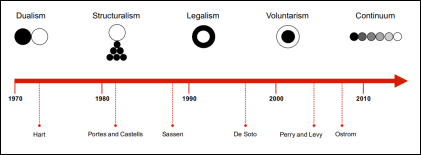
To increase understanding of how and why informality flourishes, a variety of conceptual and theoretical perspectives on informality and informal settlements are crucial. Perceptions of informality and informal settlements are traced from legal, social, economic, health, and environmental perspectives. The notions of dualism, legalism, structuralism, voluntarism, and continuum serve as summaries of these as reflected in
Figure 1.
Dualism concept
Reynolds et al introduced the theory of dualism, which is built upon two core concepts: the state sector and the trade service sector
| [27] | Reynolds, E. R. The Concept of Fate in Old English Poetry. University of South Carolina, 1969. |
[27]
. The state sector is characterized as an organized or formal sector, whereas the trade sector is identified as an unofficial domain that includes families operating in visible areas of metropolitan centers, such as sidewalks and alleyways; this comprises street vendors, artisans, and petty traders, particularly in underdeveloped nations
| [17] | Jones, P. The Shaping of Form and Structure in Informal Settlements: A Case Study of Order and Rules in Lebak Siliwangi, Bandung, Indonesia. Journal of Regional and City Planning. 2019, 30(1), 43–61. |
[17]
. Economic scholars subsequently proposed a dual concept of urban organizational activities, where one sector operates within the confines of state regulations while the other disregards legal statutes, resulting in an informal system that lacks a regulatory framework
| [18] | Kamalipour, H. Forms of Informality and Adaptations in Informal Settlements. ArchNet-IJAR: International Journal of Architectural Research. 2016, 10(3). |
[18]
.
However, the dualistic model of urban city organization has faced criticism, particularly from urban researchers in the 1980s.
| [7] | Carrizosa, M. Working Homes: Space-Use Intensity and Urban Informality in Bogotá. PhD Dissertation, The New School, New York, 2001. |
[7]
, argues for the necessity of transcending this binary framework, advocating for a deeper understanding of the social institutions and sociocultural practices that influence urban activity patterns. This critique highlights that the nomenclature surrounding urban organization, which often invokes concepts such as "third world poverty," is intrinsically tied to the dichotomy between the official and informal sectors. Thus, the dualist perspective poses a considerable challenge by perpetuating a binary perception of how urban environments function through the lens of informal and formal interactions.
Structuralism Concept
According to structuralists, informal activities not only support but are integrally linked to contemporary capitalist society
| [17] | Jones, P. The Shaping of Form and Structure in Informal Settlements: A Case Study of Order and Rules in Lebak Siliwangi, Bandung, Indonesia. Journal of Regional and City Planning. 2019, 30(1), 43–61. |
[17]
. The broad consensus is that complementarity is intended by the society's structure. In most cities, the formal and informal sectors cannot coexist structurally. A large number of the official organization's employees live in informal settlements.
Legalism concept
Legalism is characterized by a reliance on established norms and regulations aimed at ensuring efficiency in settlements. These regulations encompass land tenure and land use guidelines that adhere to zoning and development rules, particularly in areas requiring physical planning permits
| [20] | Kübler, D., Lefèvre, C. Megacity Governance and the State. Urban Research & Practice. 2017, 11(4), 378–395. |
| [22] | Mahmoudi, M. Assessing Informal Settlements with Focus on the Phenomenon of Migration in the Lower Fabrics. International Journal of Urban Management and Energy Sustainability. 2021, 2(3), 76–85. https://doi.org/10.22034/JUMES.2021.249504 |
[20, 22]
. While legalism typically promotes order in settlements, it simultaneously fosters a parallel informal economy. Critics argue that informality emerges as a proactive response to overbearing and irrelevant regulatory frameworks, with many individuals opting for informal operations due to the prohibitive costs and hostility of formal procedures
| [21] | Mahabir, R., Crooks, A., Croitoru, A., Agouris, P. The Study of Slums as Social and Physical Constructs: Challenges and Emerging Research Opportunities. Regional Studies, Regional Science. 2016, 3(1), 399–419.
https://www.tandfonline.com/doi/pdf/10.1080/21681376.2016.1229130 |
[21]
. The intricate and strict nature of legal systems under legalism arguably perpetuates the existence of informality. Advocates for reform suggest that the path to addressing the informal economy lies in comprehensive deregulation, easing the burdens of cumbersome processes required for obtaining title documents and planning permits
| [21] | Mahabir, R., Crooks, A., Croitoru, A., Agouris, P. The Study of Slums as Social and Physical Constructs: Challenges and Emerging Research Opportunities. Regional Studies, Regional Science. 2016, 3(1), 399–419.
https://www.tandfonline.com/doi/pdf/10.1080/21681376.2016.1229130 |
| [23] | Matamanda, A. R. Battling the Informal Settlement Challenge through Sustainable City Framework: Experiences and Lessons from Harare, Zimbabwe. Development Southern Africa. 2020, 37(2), 217–231. |
[21, 23]
. Policy recommendations include the legalization of informal activities through three interconnected approaches: property titling, the reduction of regulatory barriers (particularly for firm and building permits), and access to micro-finance solutions
| [7] | Carrizosa, M. Working Homes: Space-Use Intensity and Urban Informality in Bogotá. PhD Dissertation, The New School, New York, 2001. |
[7]
. Legalists perceive that micro-entrepreneurs and slum dwellers have little choice but to engage in informal practices as a means of survival.
Voluntarisms’ Theory
Voluntarists assert that individuals often prefer rational decision-making processes when considering their employment and economic situations. Instead of being merely excluded or marginalized from the formal economic sector, residents of informal settlements make a conscious choice to engage in informal work. This decision, they argue, stems from rational instincts that dictate that operating within the informal sector frequently aligns better with their personal preferences and priorities. Residents perceive this choice as optimal, largely due to the convenience and flexibility that informal employment offers in comparison to the structured and often restrictive nature of formal work environment.
Continuum Theory
Informality theory aligns with the continuum school of thought, which posits that informality is not inherently negative; rather, it is an essential counterpart to formal systems, suggesting that both should coexist. This perspective, views informality as practical and functional, highlighting the lessons that can be derived from informal practices. The theory argues that perceiving informality solely in a negative light threatens its validity and undermines the complementary nature of various settlement characteristics.
A key theoretical concept underpinning informality is dualism, which reflects the complex relationship between formal and informal systems. Informalization is conceptualized as a planning practice and a 'mode of spatial organization' that introduces social differences. This is manifested in the constructs of social stratification or segregation within planning contexts, evident through the classification of areas into low, medium, and high density, as well as distinguishing between planned and unplanned developments. Such classifications illustrate the significance of understanding informal practices in urban planning and their impact on social dynamics.
3.2. Conceptual Understanding of Informality and Perspectives of Urban Informal Settlements
Informality is a framework addressing the organization and regulation of activities, particularly manifesting in urban informal settlements, which face largely negative perceptions in urban planning literature. Typically labeled as "squatter settlements" or "unplanned towns," these areas are seen as outside state planning regulations, a view criticized by scholars such as
| [24] | More, N. S., Das, S., Bapat, U., Alcock, G., Manjrekar, S., Kamble, V., Osrin, D. Community Resource Centres to Improve the Health of Women and Children in Informal Settlements in Mumbai: A Cluster-Randomized Controlled Trial. The Lancet Global Health. 2017, 5(3), 335–349.
https://doi.org/10.1016/S2214-109X(16)30363-1 |
[24]
for oversimplifying the complexities of urban informality. Despite
| [29] | United Nations. The Sustainable Development Goals Report 2019. United Nations, New York, USA, 2019. |
[29]
, characterization of informal settlements including factors like inadequate access to water, sanitation, and overcrowding critics argue that this definition neglects the socio-cultural dimensions and assumes uniformity across diverse locales.
| [25] | Muanda, C., Goldin, J., Haldenwang, R. Factors and Impacts of Informal Settlements Residents’ Sanitation Practices on Access and Sustainability of Sanitation Services. Journal of Water, Sanitation and Hygiene for Development. 2020, 10(2), 238–248. https://doi.org/10.2166/washdev.2020.123 |
[25]
, stress the necessity to distinguish between informal settlements, slums, and squatter settlements, noting that while all slums are informal, not all informal settlements qualify as slums. The traditional notion of such settlements as illegal and undesirable is contested, particularly in African contexts, where land ownership complexities complicate the legality of informality
| [30] | Weimann, A. L., Oni, T. A Systematised Review of the Health Impact of Urban Informal Settlements and Implications for Upgrading Interventions in South Africa. International Journal of Environmental Research and Public Health. 2019, 16(19), 3600. https://doi.org/10.3390/ijerph16193608 |
[30]
.
This confusion underscores the urgency for a nuanced understanding of informal settlements. Emerging research suggests these settlements should be viewed as fluid entities, constantly in change, reflecting the dynamic pressures influencing urban landscapes
. Highlighting only their physical attributes may politicize the issue rather than address it scientifically
| [4] | Agyabeng, A. N., Peprah, A. A., Mensah, J. K., Mensah, E. A. Informal Settlement and Urban Development Discourse in the Global South: Evidence from Ghana. Norsk Geografisk Tidsskrift – Norwegian Journal of Geography. 2022, 76(4), 242–253. https://doi.org/10.1080/00291951.2022.2113428 |
| [28] | Takyi, S. A., Amponsah, O., Yeboah, A. S., Mantey, E. Locational Analysis of Slums and the Effects of Slum Dwellers’ Activities on the Social, Economic and Ecological Facets of the City: Insights from Kumasi, Ghana. Geography Journal. 2021, 86, 2467–2481. |
[4, 28]
. A broader perception acknowledges the evolution of urban informality, necessitating fresh conceptual frameworks that align with contemporary realities
| [32] | Zheng, H., Shen, G., Song, Y., Sun, B., Hong, J. Neighborhood Sustainability in Urban Renewal: An Assessment Framework. Environment and Planning B: Urban Analytics and City Science. 2016, 44, 903-924. https://doi.org/10.1177/0265813516655547 |
[32]
.
Furthermore, informal settlements often exacerbate environmental challenges and stress strategic ecosystems, as they frequently exist in unsuitable locations, presenting issues of pollution, exclusion, and violence
| [26] | Parra, C. A., Madero, Y. N., Mendez, M., Fasolino, I., Villegas Flores, V. N., Grimaldi, M., Acosta, C. N., Cicalese, F. Evaluation of the Impact of Informal Settlements on the Physical and Mental Health of Residents: Case Study Santa Marta, Bogotá, Colombia. Sustainability. 2024, 16(5), 1964.
https://doi.org/10.3390/su16051964 |
[26]
. Residents are typically trapped in deteriorating conditions that lack essential public services and face significant risks due to their geographic settings. This dire state correlates directly with poverty and public health crises, especially evident in contexts like Latin America and Africa, where environmental degradation and governance failures compound the issues of overcrowding and unemployment
| [24] | More, N. S., Das, S., Bapat, U., Alcock, G., Manjrekar, S., Kamble, V., Osrin, D. Community Resource Centres to Improve the Health of Women and Children in Informal Settlements in Mumbai: A Cluster-Randomized Controlled Trial. The Lancet Global Health. 2017, 5(3), 335–349.
https://doi.org/10.1016/S2214-109X(16)30363-1 |
[24]
. In light of these challenges, this discourse calls for a reassessment of urban informal settlements as essential socio-spatial phenomena that reflect broader social and environmental dynamics in urbanization.
3.3. Perspectives on Urban Informality
The document discusses various perspectives on urban informality, noting how different viewpoints economic, legal, social forces, behavioral, and sustainability impact its understanding and implications.
From an economic view, informality is linked to unregulated economic activities within the underground economy, involving income-generating practices not overseen by formal institutions. This perspective emphasizes the significance of unregistered economic activities,
suggesting that informality arises from production needs and economic organization in urban settings
| [3] | Amoah, I. D., Kumari, S., Reddy, P., Stenström, T. A., Bux, F. Impact of Informal Settlements and Wastewater Treatment Plants on Helminth Egg Contamination of Urban Rivers and Risks Associated with Exposure. Environmental Monitoring and Assessment. 2020, 192, 713.
https://link.springer.com/article/10.1007/s10661-020-08660-0 |
[3]
.
The legal perspective delineates informality as a spectrum of activities categorized as either legal or illegal
| [8] | Chumo, I., Kabaria, C., Shankland, A., Igonya, E., Mberu, B. Complementarity of Formal and Informal Actors and Their Networks in Support of Vulnerable Populations in Informal Settlements: Governance Diaries Approach. Frontiers in Public Health. 2023, 10, 1043602.
https://www.frontiersin.org/journals/public-health/articles/10.3389/fpubh.2022.1043602/full |
[8]
, reinforcing traditional dualism in urban theory. It posits that informal practices emerge in response to legal, bureaucratic, and market challenges
| [6] | Brown-Luthango, M., Reyes, E., Gubevu, M. Informal Settlement Upgrading and Safety: Experiences from Cape Town, South Africa. Journal of Housing and the Built Environment. 2017, 32(3), 471–493.
https://link.springer.com/article/10.1007/s10901-016-9523-4 |
| [9] | Cifuentes, A. V., Lufkin, S., Pérez, M. G., Rey, E. Sustainability Assessment of an Urban Neighbourhood Revitalization Project in Bogotá by Transposition of a European Indicator System to the Colombian Context. WIT Transactions on Ecology and the Environment. 2015, 194, 79–92. |
[6, 9]
. This perspective highlights unofficial strategies that operate outside predefined regulations, often resulting from barriers imposed by formal systems.
A critique of the economic viewpoint leads to the social force’s perspective, which recognizes the importance of social and cultural contexts in understanding informality. This approach focuses on the empowerment and collective survival mechanisms of the urban poor
| [10] | Cirolia, L. R., Görgens, T., van Donk, M., Smit, W., Drimie, S. Upgrading Informal Settlements in South Africa: An Introduction. UCT Press, Cape Town, South Africa, 2016. |
[10]
, arguing that informal practices stem from social actions and community-driven strategies necessary for navigating harsh urban environments
| [11] | Daruwalla, N., Machchhar, U., Pantvaidya, S., D'Souza, V., Gram, L., Copas, A., Osrin, D. Community Interventions to Prevent Violence Against Women and Girls in Informal Settlements in Mumbai: The SNEHA-TARA Pragmatic Cluster Randomised Controlled Trial. Trials. 2019. |
| [12] | Dinardi, C. Creativity, Informality and Cultural Work in Rio de Janeiro’s Favelas. International Journal of Cultural Studies. 2019, 22(2), 248–263. |
[11, 12]
.
The behavioral perspective presents informality as a dynamic interplay between formal and informal practices, rejecting the notion of a rigid dichotomy. It promotes the idea that informal behaviors evolve over time, influenced by changing conditions, thus maintaining a fluid relationship between legal and illegal activities
| [13] | Fekade, W. Deficits of Formal Urban Land Management and Informal Responses under Rapid Urban Growth: An International Perspective. Habitat International. 2000, 24, 127–150.
http://dx.doi.org/10.1016/S0197-3975(99)00034-X |
| [15] | Grazieschi, G., Asdrubali, F., Guattari, C. Neighbourhood Sustainability: State of the Art, Critical Review and Space-Temporal Analysis. Journal of Sustainable Cities. 2020, 6(3), 102–127. |
[13, 15]
.
Lastly, the sustainability perspective regards urban informality as intertwined with urban sustainability challenges, particularly concerning vulnerable populations affected by climate change
| [18] | Kamalipour, H. Forms of Informality and Adaptations in Informal Settlements. ArchNet-IJAR: International Journal of Architectural Research. 2016, 10(3). |
[18]
. Researchers in this domain argue that sustainable development must account for the complexities surrounding urban informality and its implications on land use, growth, and ecological vulnerability
| [1] | Adegun, O. B. Informal Settlement Intervention and Green Infrastructure: Exploring Just Sustainability in Kya Sands, Ruimsig and Cosmo City in Johannesburg. Doctoral Dissertation, University of the Witwatersrand, Johannesburg, 2016. |
| [16] | Huovila, A., Bosch, P., Airaksinen, M. Comparative Analysis of Standardized Indicators for Smart Sustainable Cities: What Indicators and Standards to Use and When? Cities. 2019, 89, 141–153. https://doi.org/10.1016/j.cities.2019.01.029 |
| [17] | Jones, P. The Shaping of Form and Structure in Informal Settlements: A Case Study of Order and Rules in Lebak Siliwangi, Bandung, Indonesia. Journal of Regional and City Planning. 2019, 30(1), 43–61. |
[1, 16, 17]
.
Together, these viewpoints provide a comprehensive framework for understanding urban informality, illustrating its multifaceted nature and the various factors that shape it.
3.4. Urban Informal Settlements and Its Poverty Perspective
Poverty and urban informality are rising, particularly in developing countries amid increasing urbanization. More than half of the global population now resides in urban areas, with over a third of this urban population living in informal settlements areas that do not comply with formal governance, planning, or regulations, often characterized by dynamic and complex living conditions. According to
| [29] | United Nations. The Sustainable Development Goals Report 2019. United Nations, New York, USA, 2019. |
[29]
, these informal settlements often reflect various dimensions of exclusion and deprivation, essentially manifesting urban poverty. Concurrently, the growth of these settlements is indicative of the urbanization of poverty currently observed in many developing cities
| [19] | Khalifa, M. A. Evolution of Informal Settlements Upgrading Strategies in Egypt: From Negligence to Participatory Development. Ain Shams Engineering Journal. 2015, 6(4), 1151–1159. https://doi.org/10.1016/j.asej.2015.04.008 |
[19]
.
Informal settlements can also be viewed positively, acting as conduits for lifting rural families out of poverty by providing access to urban employment opportunities. These settlements serve as affordable entry points into the city economy for migrants, offering valuable job information and skill development
| [21] | Mahabir, R., Crooks, A., Croitoru, A., Agouris, P. The Study of Slums as Social and Physical Constructs: Challenges and Emerging Research Opportunities. Regional Studies, Regional Science. 2016, 3(1), 399–419.
https://www.tandfonline.com/doi/pdf/10.1080/21681376.2016.1229130 |
[21]
. Many migrants gain necessary skills over time, allowing them to eventually transition to superior housing in better neighborhoods, marking informal settlements as potential ladders out of poverty. Urban slums are often depicted as springboards facilitating progression toward middle-class status
| [22] | Mahmoudi, M. Assessing Informal Settlements with Focus on the Phenomenon of Migration in the Lower Fabrics. International Journal of Urban Management and Energy Sustainability. 2021, 2(3), 76–85. https://doi.org/10.22034/JUMES.2021.249504 |
| [23] | Matamanda, A. R. Battling the Informal Settlement Challenge through Sustainable City Framework: Experiences and Lessons from Harare, Zimbabwe. Development Southern Africa. 2020, 37(2), 217–231. |
[22, 23]
, as they enable migrants to integrate into the urban economy despite being symptomatic of poverty.
Moreover, the substandard conditions of informal settlements help keep living costs low for low-wage workers. Frequently located close to job opportunities, such as in middle-class suburbs where individuals can find work as domestic staff or security personnel
| [24] | More, N. S., Das, S., Bapat, U., Alcock, G., Manjrekar, S., Kamble, V., Osrin, D. Community Resource Centres to Improve the Health of Women and Children in Informal Settlements in Mumbai: A Cluster-Randomized Controlled Trial. The Lancet Global Health. 2017, 5(3), 335–349.
https://doi.org/10.1016/S2214-109X(16)30363-1 |
| [25] | Muanda, C., Goldin, J., Haldenwang, R. Factors and Impacts of Informal Settlements Residents’ Sanitation Practices on Access and Sustainability of Sanitation Services. Journal of Water, Sanitation and Hygiene for Development. 2020, 10(2), 238–248. https://doi.org/10.2166/washdev.2020.123 |
[24, 25]
, these settlements, while cramped and makeshift, provide flexible living arrangements that correspond to the irregular earnings of residents. Additionally, informal settlements foster entrepreneurship by connecting individuals through local social networks and providing affordable workspace
| [26] | Parra, C. A., Madero, Y. N., Mendez, M., Fasolino, I., Villegas Flores, V. N., Grimaldi, M., Acosta, C. N., Cicalese, F. Evaluation of the Impact of Informal Settlements on the Physical and Mental Health of Residents: Case Study Santa Marta, Bogotá, Colombia. Sustainability. 2024, 16(5), 1964.
https://doi.org/10.3390/su16051964 |
[26]
.
However, informal settlements also function as poverty traps, particularly characterized by low social mobility and systemic barriers hindering progress. Many inhabitants migrate to these areas out of desperation, driven by rural hardships and insecurity. Often, they arrive without the skills demanded by employers, leading to high unemployment and poor working conditions that keep wages low and job prospects bleak. As a result, many remain stuck in precarious employment situations, such as scavenging, waste recycling, or small-scale livestock keeping to barely survive, thus remain in poverty.
3.5. Prospects of Urban Informal Settlement Management and Development
3.5.1. Strategic Urban Planning Perspective
The concept of quality of life from an urban planning perspective serves as a crucial determinant for designing inclusive and user-friendly urban environments. It is defined by the satisfaction levels of inhabitants in their cities, which directly influences spatial and territorial planning undertaken by regulatory bodies. Core to this notion is the interrelation of social, environmental, economic, cultural, and legislative elements, highlighting the necessity of understanding these systemic relationships to enhance overall human outcomes
| [31] | Zhang, Y. The Credibility of Slums: Informal Housing and Urban Governance in India. Land Use Policy. 2018, 79, 876–890. https://doi.org/10.1016/j.landusepol.2017.05.029 |
| [32] | Zheng, H., Shen, G., Song, Y., Sun, B., Hong, J. Neighborhood Sustainability in Urban Renewal: An Assessment Framework. Environment and Planning B: Urban Analytics and City Science. 2016, 44, 903-924. https://doi.org/10.1177/0265813516655547 |
[31, 32]
. Quality of life transcends mere leisure activities, higher incomes, and material possessions; it is fundamentally linked to the opportunities individuals have to pursue what they deem valuable, thus fostering feelings of well-being and security within their surroundings. Furthermore, strategic urban planning emerges as a key factor in the sustainable management of informal settlements, as it promotes organization, accessibility, convenience, and health safety for residents.
3.5.2. Health Infrastructure Perspective
To assess the quality of life in a population from a health standpoint, several dimensions must be meticulously examined, including basic infrastructure, housing, household services, environmental conditions, and employment opportunities. Addressing these dimensions can significantly decrease the biological vulnerability of residents, which is closely linked to crucial public health issues, notably prominent in informal urban areas. An increase in biological vulnerability can exacerbate poverty by elevating the prevalence of diseases and malnutrition. This situation forces residents to allocate a larger portion of their income towards remedial health care, thereby hindering their ability to enhance their overall quality of life
| [5] | Basile, P., Ehlenz, M. M. Examining Responses to Informality in the Global South: A Framework for Community Land Trusts and Informal Settlements. Habitat International. 2020, 96, 102108. https://doi.org/10.1016/j.habitatint.2019.102108 |
| [20] | Kübler, D., Lefèvre, C. Megacity Governance and the State. Urban Research & Practice. 2017, 11(4), 378–395. |
[5, 20]
.
Thus, above explanations are summarised in
Table 1 below, showing a synthesis of informality theories in relation to socio-economic and poverty aspects with the suggested planning and policy implications to salvage residents from poverty.
Table 1. The Urban Informality Theories, Perspectives, and Key Implications on Poverty.
Theory or Perspective | Core Argument | Key Drivers of Informality | Illustrative Examples | Key Planning & Policy Implications |
Chicago School / Early Informality perspective | Informality results from the migrant survival strategy (“culture of poverty”) | Rural–urban migration, marginalization being culturally driven | Early migrant enclaves (Chicago); inner-city Johannesburg | Shift from cultural blame to structural planning responses |
Wealth Distribution Perspective | Informality results from urban inequality and affordability constraints | Housing unaffordability, income disparity and exclusion from housing market. | Makoko & Ajegunle (Lagos); Kibera (Nairobi); Dharavi (Mumbai) | Introduce inclusive land and housing policy to promote affordability in the market |
State & Planning Perspective | Informality was produced by exclusionary planning through various tools and regulations | Rigid zoning, weak governance promotes informality | Mpape & Durumi (Abuja); peri-urban Lagos and Accra | Reforms of planning standards, zoning, and land administration |
Dualism Theory | Formal and informal sectors operate separately, yet within the same urban system | Legal–illegal divide exists in the urban area | Street trading vs. formal markets (Lagos Central Business District-CBD) | There is need to integrate planning systems rather than allowing sectoral operations |
Structuralism Theory | Informality is structurally rooted in the capitalist systems | Labor exploitations, housing deficits. | Informal housing for formal workers (e.g. Lagos, Nairobi) | Recognize formal–informal interdependence |
Legalism Theory | Informality caused by over-regulation | Residents choose informality to avoid hostile legal systems of costly permits and land tenure complexities | Cumbersome Land Titling in Lagos & Nairobi | Simplified regulations and tenure regularization |
Voluntarism Theory | Informality is seen as rational individual choice. | Flexibility, convenience | Informal traders in Accra in Ghana, and Aba, Nigeria | Support informal livelihoods without forced formalization |
Continuum Theory | Informality–formality exist on a spectrum. It can rarely be extinct | Hybrid practices always functional and complementary | Incremental upgrading (Thailand; Lagos) | Incremental and hybrid planning approaches |
Economic Perspective | Informality as underground urban economy | Need for income generation by an average person | Informal transport (Danfo, Okada in Lagos) | Integrate informal economy into city systems |
Legal Perspective | Informality shaped by legality/illegality | Bureaucratic exclusion | Evictions in Lagos waterfronts; Nairobi | Rights-based and adaptive legal frameworks |
Social Forces Perspective | Informality rooted in social networks | Collective survival strategies | Community savings (Kibera); self-help housing (Ibadan, Lagos, Akure) | Participatory and community-led planning |
Behavioral Perspective | This views informality as dynamic and evolving | The changing socio-economic conditions of the residents | Mixed-use informal housing (Accra, Lagos) | Flexible and adaptive planning instruments |
Sustainability Perspective | Informality linked to environmental risk | Climate vulnerability, poor location of the settlements | Flood-prone Makoko (Lagos); Dar es Salaam | Climate-sensitive upgrading and resilience planning is required |
Poverty Perspective (Positive) | Informality is seen as entry point to city life by most migrants | Migrant integration | Dharavi (Mumbai); Lagos informal areas | Support skills, mobility, and gradual upgrading |
Poverty Perspective (Negative) | Informality is seen as poverty trap. In this case, many settlers become helpless and only strive to survive | Unemployment, low mobility, low income. | Long-term deprivation in Kibera; Port Harcourt. | Integrated poverty reduction and spatial inclusion policies |
Strategic Urban Planning Perspective | Quality of life as planning objective. | Multi-sectoral urban deficits, | Medellín upgrading; Lagos urban regeneration (a case of Oworonsoki) | Inclusive, people-centered strategic planning |
Health Infrastructure Perspective | Informality worsens public health | Poor services, overcrowding, inadequate health infrastructure | Cholera outbreaks in Accra & Lagos. | Aggressive health-sensitive urban upgrading. |
4. Discussion
In order to provide a comprehensive knowledge of the causes, manifestations, and planning consequences of informal settlements, especially in rapidly urbanising situations in the Global South, this work synthesizes important theoretical and empirical perspectives on urban informality. The discussion depicts informality as a dynamic socio-spatial process impacted by economic inequalities, governance frameworks, legal regimes, and household decision-making, as opposed to seeing it as a uniform or extreme reality.
4.1. Informality as a Structural and Historical Urban Process
Early theories of urban informality, which had their roots in the Chicago School, described informal settlements as the result of cultural marginalisation and migrant survival tactics. Although the intro-duction of informality into urban theory was made possible by this viewpoint, it has been widely critiqued for attributing poverty to behavioral or cultural deficits rather than structural conditions. Contemporary evidence from cities such as Lagos, Nairobi, and Johannesburg demonstrates that informality is less a cultural anomaly and more a predictable outcome of uneven urban development and exclusionary planning systems. These findings align with wealth-distribution and state-centric perspectives, which emphasize housing affordability, land market failures, and restrictive planning regulations as primary drivers of informal urbanization.
4.2. Reassessing the Formal–informal Divide
The dualist conception of cities, which separates formal and informal sectors, remains influential in urban policy and legal frameworks. However, empirical realities challenge this binary framing. Structuralist and continuum theories demonstrate that formal and informal systems are deeply interconnected, with informal settlements housing workers essential to formal economies and informal enterprises supporting urban livelihoods. Case evidence from Lagos, Nairobi, and Accra illustrates how formal economic growth often depends on informally housed and employed labor, thereby undermining the notion that informality exists outside the formal urban system. This interdependence calls for integrated planning approaches that recognize informality as a functional component of urban systems rather than an aberration.
4.3. Legal and Regulatory Drivers of Informality
Legalist perspectives highlight the role of cumbersome regulatory frameworks, complex land tenure systems, and high processing costs which produces informality. In many African cities, land use laws and development control standards are misaligned with the socio-economic realities of low-income households, effectively excluding them from formal housing and land markets. For instance, in Lagos, Abuja and Nairobi informality tend to emerge as a rational response to unfavourable regulatory environments. However, deregulation alone is insufficient, but incremental legal reforms, such as simplified permitting processes, tenure regularization, and recognition of customary land systems appear positive in reducing informality without undermining planning objectives.
4.4. Agency, Choice, and Social Networks in Informal Settlements
Voluntarist and social forces perspectives introduce an important corrective to structural explanations by foregrounding human agency and collective action. Informal settlement residents are not merely passive victims of exclusion; they actively make rational choices based on flexibility, proximity to employment, and social support systems. Community-based practices observed in Kibera, Ibadan, and Accra underscore the significance of social networks, informal savings schemes, and self-help housing in sustaining urban livelihoods. However, emphasizing choice must be balanced against structural constraints, as many residents operate within severely limited alternatives. Recognizing both agency and constraint is therefore essential for equitable urban policy formulation.
4.5. Urban Mobility, Poverty, and Informality
The relationship between informality and poverty is complex and contradictory. On one hand, informal settlements function as entry points into urban economies, enabling migrants to access employment, acquire skills, and gradually improve their living conditions. In many cities like Dharavi and Lagos, informal settlements act as ladders out of poverty. On the other hand, persistent infrastructural deficits, insecure tenure, and limited access to education and formal employment can transform these same settlements into poverty traps. Long-term deprivation observed in settlements such as Kibera and Port Harcourt waterfronts highlights the need for targeted interventions that address both spatial and socio-economic dimensions of poverty.
4.6. Environmental, Health, and Sustainability Dimensions
Sustainability-oriented perspectives emphasize the disproportionate exposure of informal settlements to environmental risks, including flooding, pollution, and climate-related hazards. Settlements located in ecologically fragile areas such as coastal and flood-prone zones in Lagos and Dar es Salaam, illustrate how informality intersects with climate vulnerability and public health crises. Poor access to water, sanitation, and health infrastructure exacerbates biological vulnerability, reinforcing cycles of poverty and exclusion. These findings underscore the urgency of climate-sensitive upgrading strategies that integrate environmental risk reduction with basic service provision.
4.7. Implications for Strategic Urban Planning
The synthesis of perspectives presented in this discussion suggests that effective management of informal settlements requires a shift from reactive control to strategic and inclusive planning. Quality of life emerges as a unifying framework, encompassing health, security, accessibility, environmental safety, and economic opportunity. International experiences, such as citywide upgrading in Medellín, alongside emerging initiatives in Lagos, demonstrate that inclusive, people-centered planning can transform informal settlements without displacement. Strategic urban planning must therefore embrace informality as a legitimate mode of urbanization and integrate it into broader development frameworks through incremental upgrading, participatory governance, and institutional reform.
4.8. Toward an Integrated Understanding of Urban Informality
Overall, this discussion reinforces the argument that urban informality cannot be explained by a single theory or addressed through isolated policy interventions. Instead, informality should be understood as a multidimensional and evolving phenomenon shaped by economic structures, legal systems, social practices, and environmental constraints. An integrated theoretical approach combining structural, legal, behavioral, and sustainability perspectives offers the most robust foundation for addressing the challenges and opportunities associated with informal urbanization. Such an approach is particularly critical for cities in Africa and the Global South, where informality will continue to define urban growth trajectories in the foreseeable future.
5. Contribution to Knowledge
The following significant additions to our understanding of urban informality and informal settlements are made by this study, especially in light of the rapidly urbanising cities in the Global South.
1) Theoretical Integration of Disjointed Discourses on Informality
This work's methodical synthesis of historically disparate ideas of urban informality such as dualism, structuralism, legalism, voluntarism, continuum, and sustainability perspectives into a unified analytical framework is one of its main contributions. This study shows that informality is best un-derstood as a multifaceted and dynamic urban process, in contrast to previous research that frequently favours one theoretical perspective. The paper develops a more comprehensive theoretical understanding that goes beyond binary formal informal categories by synthesizing these view-points.
2) Reinterpreting Informality as an Urbanisation Process
From a conceptual standpoint, the work attempts to reinterpret urban informality as a legitimate and useful type of urbanisation rather than only as a socioeconomic oddity or planning failure. The research contradicts prevailing deficit-based narratives by emphasising informality as a form of spatial organisation and socio-economic adaptability. This corresponds with increasing literature that acknowledges informality as essential to modern urban growth, especially in African cities.
3) Connecting Global South Theory and Empirical Contexts
Grounding theoretical discussions in specific empirical contexts with a focus on African and Global South cities like Lagos, Abuja, Nairobi, Accra, and Dar es Salaam is another important addition. This fills a long-standing void in the liter-ature on urban studies, which has traditionally been dominated by viewpoints from the Global North. Thus, the study enhances the geographical balance and empirical relevance of research on informality.
4) Explaining the Nexus between Informality and Poverty
By providing a deeper understanding of the connection between urban poverty and informality, the paper enhances knowledge. The study illustrates informal settlements' dual role as both places of structural deprivation and facilitating spaces for economic integration, rather than portraying them only as poverty traps or idealised ladders of opportunity. More accurate theoretical and policy-focused conversations about urban poverty and social mobility are facilitated by this balanced framework.
5) Promoting Policy and Planning Conversation
The research advances urban planning scholarship by articulating strategic, inclusive, and incremental planning approaches through the integration of planning, legal, health, and sustainability perspectives. It draws attention to the shortcomings of strict regulatory frameworks and underscores the significance of climate-sensitive upgrading, participatory planning, and adaptive governance.
A solid knowledge framework for reconsidering informal settlement management in practice is provided by this interdisciplinary synthesis.
6) Contribution to Methodology via Analytical Synthesis
The study makes a methodological contribution by highlighting the usefulness of comparative analytical synthesis as a tool for literature-based research. For academics performing intricate literature evaluations in urban studies and allied fields, the conversion of various ideas and viewpoints into comparison matrices and an integrated debate offers a repeatable method.
7) Support for Upcoming Research Agendas
Lastly, the study concludes that informality is a dynamic and changing phenomena that calls for integrated, cross-sectoral research methods. The study creates new opportunities for future empirical and policy focused research by placing informality at the nexus of planning, governance, health, climate change, and socioeconomic systems, especially in the context of climate vulnerability and sustainable urban development.
6. Conclusion
This paper has advanced an integrated understanding of urban informality by synthesizing diverse theoretical traditions and empirical evidence from rapidly urbanizing cities, particularly in the Global South. The discussion demonstrates that informality is not a residual, temporary, or deviant condition of urbanization but a structurally produced and historically embedded socio-spatial process. It emerges from the interaction of economic inequality, exclusionary planning systems, regulatory constraints, governance failures, and the adaptive strategies of households and communities.
By reassessing early culturalist explanations and engaging structuralist, legalist, voluntarist, and sustainability-oriented perspectives, the study shows that informal settlements are deeply intertwined with formal urban systems. The persistence of a rigid formal–informal dichotomy obscures these interdependencies and limits the effectiveness of urban policy. Evidence from African and other Global South cities illustrates that informality often functions as both a mechanism of survival and a contributor to urban economic vitality, even as it simultaneously reproduces vulnerability, poverty, and environmental risk.
The analysis further highlights that residents of informal settlements exercise agency through rational location choices, social networks, and collective practices, yet this agency is constrained by structural barriers in land markets, housing affordability, and legal frameworks. Similarly, the relationship between informality and poverty is shown to be ambivalent: informal settlements can act as pathways to socio-economic mobility for some groups, while for others they become entrenched poverty traps, particularly where infrastructural deficits, insecure tenure, and environmental hazards persist.
From a planning perspective, the findings underscore the limitations of reactive, control-oriented approaches and support a transition toward strategic, inclusive, and quality-of-life centered urban planning. Incremental upgrading, participatory governance, legal and institutional reform, and climate-sensitive interventions emerge as critical pathways for addressing informality without displacement or social exclusion. Recognizing informality as a legitimate and enduring mode of urbanization is essential for aligning planning practice with the realities of contemporary cities.
In conclusion, this study argues that no single theory or policy instrument can adequately explain or manage urban informality. An integrated and context-sensitive framework one that combines structural, legal, behavioral, and environmental dimensions, offers a more robust foundation for research and practice. Such an approach is particularly vital for African cities and the wider Global South, where informality will continue to shape urban growth trajectories. Future research and policy must therefore move beyond binaries and embrace informality as central to the pursuit of inclusive, resilient, and sustainable urban development.





 Share This Article
 Twitter
 Linked In
 Facebook
 Copy
Copy Download