1. Introduction
Globally, crime and the fear of crime are recognized as major threats to public security of life and property and as factors that undermine all aspects of sustainable development
| [33] | Reitanono, T. and Hunter, M. B. (2018). Understanding the global illicit drug market: Trends, patterns and development. Geneva, Switzerland: Global Iniative Against Transnational Organised Crime. |
[33]
. Recent changes in global crime patterns have been heavily influenced by rising crime rates within African countries, especially in Southern Africa Development Community (SADC) nations, particularly regarding organized serious crimes and synthetic illicit trafficking
| [9] | Kanyamuna, A. (2019). Results-based management in the public sector: A conceptual analysis. Journal of Public Administration. |
[9]
Zimbabwe Statistical Agency reports that Zimbabwe’s national crime trends have increased dramatically over the past five years in both number and complexity, including theft, property crimes, illicit drug offences, and violent crimes and robberies, reflecting broader SADC regional trends
| [46] | Xavier, A. J., and Bianchi, C. (2019). An Outcome-Based Dynamic Performance management Approach to Collaborative Governance in Crime Control: Insights from Malaysia, Journal of Management and Governance, vol. 17, no. 3.
https://doi.org/10.1007/s10997-019-09469-6 |
| [52] | ZIMSTAT. (2025). 2025 First Quarter crime Report in Zimbabwe Report. Downloaded from https://www.zimstat.co.zw |
| [53] | ZIMSTAT. (2025). Poverty statistics report. Zimbabwe National Statistics Agency. |
| [54] | ZIMSTAT. (2017). Inter-Censal Demographic Survey: Volume 1, Harare. |
[46, 52-54]
.
These include murder, armed robbery, rape, vehicle theft, theft of gold and precious stones/metals, unlawful entry in aggravating circumstances, stock theft, illicit dangerous drugs, fraud, and corruption/criminal abuse of office. In response to the crime problem, the Government of Zimbabwe (GoZ), mirroring global administrative trends in developed economies, has adopted Integrated Results-Based Management (IRBM) as a strategic, whole-of-government performance management framework
| [7] | Gono, R. (2025, January 27). Zim Partners with INTERPOL for Enhanced National Security. Zimbabwenow. |
| [9] | Kanyamuna, A. (2019). Results-based management in the public sector: A conceptual analysis. Journal of Public Administration. |
[7, 9]
.
Consequently, the Zimbabwe Republic Police (ZRP) embraced IRBM in 2015 as a modern crime management model and cascaded it to provinces, districts, and stations in compliance with the current Constitution of Zimbabwe (Amendment No. 20) Act of 2013. Section 219 mandates the ZRP to investigate, detect, and prevent crime, thereby protecting and securing the lives and property of the people by enforcing criminal law without fear or favour.
The IRBM’s key assumptions centre on resource use, organizational alignment, and managerial accountability. It establishes a causal link between resources and results, known as the results chain assumption. Central to IRBM is the idea that there is a clear cause-and-effect relationship between the resources invested and the outcomes achieved in crime management. In policing, IRBM assumes that police effectiveness improves when the department’s vision and operational plans systematically align with national development goals.
This alignment ensures resources are directed toward high-impact areas, such as promoting safe communities in crime hotspots. Moreover, a results-focused culture cannot succeed if management functions operate in isolation; therefore, IRBM suggests that linking the Integrated Results-Based Policing Performance Planning (IRBPP), the Integrated Results-Based Policing Budgeting System (IRBPBS), and the Integrated Results-Based Police Performance Management (IRBPoPM) will create coherence and reinforce a results-driven culture across the organization. Consequently, the IRBPBS states that financial allocations will be effective only when supported by measurable outputs.
Additionally, the IRBM concept emphasizes managerial accountability and performance management. A key element of the IEBM is the shift in accountability toward results rather than just effort
| [9] | Kanyamuna, A. (2019). Results-based management in the public sector: A conceptual analysis. Journal of Public Administration. |
[9]
. The framework suggests that outputs and outcomes be clearly defined and measurable, using the Measurable, Achievable, Realistic, and Time-bound (SMART) criteria. SMART indicators enable fair and effective performance evaluations. This transition shifts accountability in policing from merely completing tasks, such as filing reports, to achieving tangible community benefits, such as reducing robbery rates
| [8] | Hughes, L., & Raper, J. (2011). The Rise of Results-Oriented Policing in Australia: Challenges and Benefits. |
| [31] | Rasappan, A. (2003). The Implementation of Integrated Results Based Management as Policy Implementation Tool in the Public Service of Malaysia, Doctoral Dissertation, University Kebangsaan Malaysia. |
[8, 31]
Furthermore, a robust monitoring and evaluation system is believed to consistently produce reliable performance data
| [9] | Kanyamuna, A. (2019). Results-based management in the public sector: A conceptual analysis. Journal of Public Administration. |
[9]
.
In light of the above, a key question arises: ‘How did the Integrated Results-Based Management framework evolve in the Zimbabwe Republic Police?’ This study aimed to explore the evolution, operational modalities, challenges, and opportunities to strengthen IRBM within the ZRP in Zimbabwe.
4. Analysis of Emerging Demographics and Its Implications to the Study
The ZRP was the primary research field, from which most participants were selected, comprising police managers and operational police officers. Police managers were drawn from the top (strategic), middle (tactical), and bottom (operational) levels. Four operational stations from the Duty Uniform Branch (DUB) and ten ancillary stations from the Criminal Investigation Department (CID) and DUB within the Bindura Policing District participated in the study.
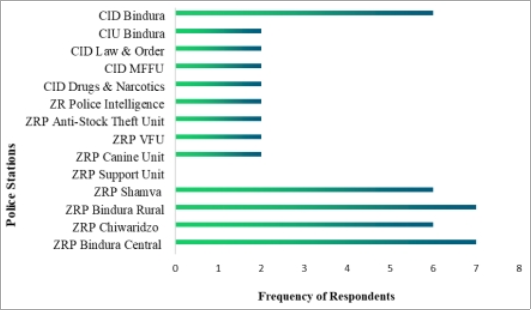
Figure 1. ZRP operative officers by stations or Units (n=48).
The Figure above illustrates the distribution of operational police officers by station within the ZRP Bindura District. It shows that more officers were deployed from DUB stations at ZRP Bindura Central, ZRP Bindura Rural, ZRP Chiwaridzo, and ZRP Shamva, while fewer came from auxiliary stations such as CIU Bindura, CID Law and Order, CID Minerals, Flora and Fauna Unit (MFFU), CID Drugs and Narcotics, ZR Police Intelligence, ZRP Anti-Stock Theft Unit, ZRP Victim Friendly Unit (VFU), and ZRP Canine Unit, except for CID Bindura. This pattern indicates that IRBM is a business or leadership innovation primarily driven by operational police officers, mainly from the main branch of the police organization-the DUB. These officers, who are sergeants and constables, participate in daily police work and crime prevention efforts, investigating, detecting, and arresting offenders. Their involvement is crucial for understanding how police operations at the ground level support the implementation of IRBM in crime management.
The officer cohort (n=48) was primarily male (67%), with 56% aged 31-50 years. This profile suggests a mid-career, experienced workforce, which is likely beneficial for implementing complex management systems like IRBM, as experience is linked to institutional knowledge and adaptability
| [21] | Muguti, A., Chiunye, T., Mutongi, C., and Kandufa, P. (2022). Unpacking Integrated Results Based Management (IRBM) Concept. International Journal of Multidisciplinary Research and Publications, vol. 4, no. 7, pp. 58-68, 2022. Available:
https://ijmrap.com |
[21]
. However, the near absence of officers over 55 (0%) and minimal representation in the 18-24 age group (0%) indicates a potential gap in intergenerational knowledge transfer and innovation. This gap exists because police recruits join the organization at age 18 and retire at 55, a retirement age that was recently extended to 65. Although this cohort of police officers lacks higher education (96% hold only Ordinary level or diplomas, with only 4% holding bachelor’s degrees), they still manage most critical crimes, including murder, rape, armed robbery, and theft, and are responsible for collecting and reporting data.
4.1. Findings and Discussion.
Evolution of IRBM in policing within Zimbabwe’s police
The study established that the IRBM ultimately evolved within the ZRP for crime management. With roots dating back to 2005, police managers contended that the evolution of IRBM for crime management was hinged on OPC’s letter number 6 of 2005, issued by GoZ, which directed all government departments to embrace it to strategically modernize their operations
| [48] | Zimbabwe Republic Police (n.d). Criminal Investigation Department: Zimbabwe Republic Police. Downloaded from
https://zrp.gov.zw |
| [55] | Zinyama, T. Nhema, A. G. and Mutandwa, H. “Performance Management in Zimbabwe: Review of Current Issues,” Journal of Human Resources Management and Labour Studies, vol. 3, no. 2, pp. 1-27, 2015. Available:
https://doi.org/10.15640/jhrmls.v3n2a1 |
[48, 55]
. Police managers’ perceptions aligned with those of most operational police officers, who strongly agreed that the ZRP introduced IRBM for crime management, with a mean score of 3.79 (SA). They also agreed that the IRBM commenced in 2005, with a mean score of 3.38 denoting their agreement. To validate this response, respondents rejected the variable that the ZRP never adopted the IRBM, with responses: 47.9% (SD), 45.8% (D), and 6.3% (A), yielding a mean score of 1.58, indicating their disagreement. Thus, the convergence of qualitative and quantitative results indicated that the evolution of the IRBM within the ZRP could be traced back to 2005.
During the IRBM’s evolution, the Ministry of Home Affairs and Cultural Heritage (MoHACH) guided the ZRP. MoHACH absorbed IRBM into its various departments, as other ministries did, including the ZRP
| [15] | McLaughin, E., and Muncie, J. (2019). The Sage Dictionary of Criminology, 5th edition, Sage Publication. |
[15]
. After receiving the AIPA template from the regulatory Minister for the MoHACH through the ZRPC, the IRBM was first introduced into the ZRP as a contemporary, proactive, strategic, results-oriented police performance management policy for crime management
| [7] | Gono, R. (2025, January 27). Zim Partners with INTERPOL for Enhanced National Security. Zimbabwenow. |
[7]
. Its evolution was under the directorship of the CGP, the kingpin at the apex of the organization with the highest decision-making and policy-making authority, appointed in terms of section 221 (1) of the Constitution. The ZRP adapted the principles of IRBM from their developmental framework to its policing practices.
The adoption of IRBM enabled the ZRP to align its crime management activities with its constitutional mandate under Section 219, ensuring that its efforts effectively support human security, peacekeeping, and community well-being
| [12] | Madhekeni, A. (2012). Implementing Results-Based Management System in Zimbabwe: Context and Implications for the Public Sector, International Journal of Humanities and Social Science, vol. 2, no. 8, pp. 122-129. |
| [31] | Rasappan, A. (2003). The Implementation of Integrated Results Based Management as Policy Implementation Tool in the Public Service of Malaysia, Doctoral Dissertation, University Kebangsaan Malaysia. |
| [39] | Thomas, K. (2005). Integrated Results Based Management - Country Experiences from Asia and Africa. A paper presented at a Workshop on Management for Development Results in Asia-Pacific Region at Kuan Yew School of Public Policy, University of Singapore, 30 August - 1 September 2005. |
[12, 31, 39]
. With the introduction of IRBM, police managers reported that the ZRP shifted from traditional command-and-control policing to results-oriented governance in crime management
. The organization began emphasizing measurable outcomes in public service delivery and continuous improvements in policing methods. Therefore, in its development, IRBM promotes a focus on police performance results rather than merely on police activities in crime management.
4.2. Vertical Evolution of IRBM Within the ZRP from the Top
The IRBM was implemented vertically through the ZRP’s organizational structure, from the top to the middle and lower levels. Acting on the ministerial template from the MoHACH and guided by IRBM performance agreement principles
| [27] | O'Connell, J. P., and Straub, P. (2007). CompStat: The Management Tool that Changed the Face of Policing in the United States, FBI Law Enforcement Bulletin, vol. 76, no. 7, pp. 1 - 6. |
[27]
, the CGP created the AIPA template for the ZRP. The template evolved to include integrated performance agreements and monitoring and evaluation, which guided the performance of police officers in crime management across all levels of the organization
| [39] | Thomas, K. (2005). Integrated Results Based Management - Country Experiences from Asia and Africa. A paper presented at a Workshop on Management for Development Results in Asia-Pacific Region at Kuan Yew School of Public Policy, University of Singapore, 30 August - 1 September 2005. |
[39]
. During this development, the CGP exercised command in line with written institutional IRBM policy directives set out in the ministerial template issued by the responsible Minister in the MoHACH, in accordance with section 221(4) of the Constitution. The CGP was responsible for the overall introduction of IRBM for crime management, not only in the ZRP Bindura District but across the whole organization.
The study found that the IRBM emerged gradually in 2005 and spanned a decade before gaining popularity within the ZRP in 2015. In support of these qualitative findings on the growing popularity of IRBM, respondents with a mean score of 3.77 indicated strong agreement that the ZRP began implementing the IRBM in 2015. Police managers noted that this was necessitated by the organization’s heavily centralized, overly bureaucratic organogram structure
, with 12 ranks in the organization. This resonates with SAPS’s bureaucratic culture, which affected the adoption of IRBM due to lengthy decision-making. ZRP’s decision-making mirrored SAPS’s, which was said to have been subjected to numerous consultations, thereby delaying the evolution of IRBM within the ZRP
| [1] | Auditor-General South Africa. (2018). MFMA 20167-17 Consolidated General Report on the Local Government Audit Outcomes. |
| [10] | Kapuria, M and Maguire, E. R. (2022). Performance Management and Police Response to Women in India. Social Sciences, vol. 11, no. 58, pp. 1-17. |
[1, 10]
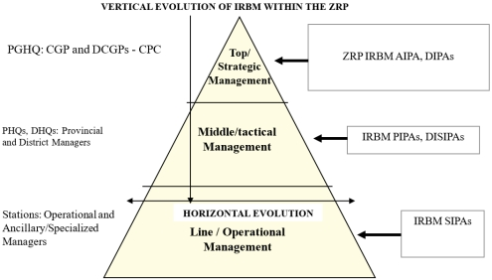
. This suggests that IRBM IPPA was developed and circulated extensively to all police officers, taking various forms from the top to the middle and lower levels of the organization, following a triangular structure as indicated in the Figure below. Thus, IRBM evolved through complete vertical integration.
Figure 2 shows the vertical trajectory of IRBM from top to bottom through the middle level of the existing organizational pyramid, which comprises 4 departments, 13 provinces, 137 districts, and 200 operational stations, each commanded by departmental, provincial, district, and operational managers, respectively
| [20] | Mugari, I., Maunga, M., and Chigariro, T. (2015). Embracing Intelligence-Led Policing in the Republic of Zimbabwe, International Journal of Innovative Research and Development, vol. 4, no. 2, pp. 87-94. |
| [43] | UNODC. (2011). Handbook on Police Accountability, Oversight and Integrity, Criminal Justice Handbook Series, English Publishing and Library Section, United Nations Office, Vienna. |
[20, 43]
. It also depicts the horizontal evolution of IRBM at the operational level, with 20 ancillary/specialized stations led by ancillary/specialized managers. This structure presents the chain of command that was instrumental in the adoption of IRBM in policing (ZRP IRBM Training Guide). Thus, the IRBM evolved vertically across all levels and horizontally between operational and ancillary stations within the ZRP.
Figure 2. ZRP Organogram.
The chain of command and rank system were redesigned in line with the dictates of IRBM, establishing clear lines of authority and responsibility
| [25] | O’Reilly, C. A., and Tushman, M. L. (2021). Lead and Disrupt: How to Solve the Innovator’s Dilemma, Stanford Business Books. |
| [30] | Rand, (2024). International Approaches to Police Performance Measurement. Available at
https://www.rand.org/pubs/research_reports.html |
[25, 30]
. The ranking system fit perfectly within the organogram
| [48] | Zimbabwe Republic Police (n.d). Criminal Investigation Department: Zimbabwe Republic Police. Downloaded from
https://zrp.gov.zw |
[48]
It helped maintain order within the organization by clarifying who reports to whom, decision-making responsibilities, resource allocation, and accountability for results, all of which were vital to the development of IRBM in crime management within the ZRP. Thus, the ranking system established differentiated roles from the top or strategic management level, consisting of the national police managers (the CGP, deputized by four DCGPs responsible for four functional departments (Crime, Administration, Human Capital/Resources and Police Operations)) to the line/operational level through the middle/tactical level.
The introduction of IRBM through the functional departments was guided by the overarching framework established by IRBM AIPA, which provided a structured approach to police performance management across departments
| [7] | Gono, R. (2025, January 27). Zim Partners with INTERPOL for Enhanced National Security. Zimbabwenow. |
[7]
. The DCGPs aligned departmental goals with organizational objectives. This alignment followed the IRBM components at the departmental level to enhance overall departmental performance in line with ZRP’s strategic objectives. ZRP’s alignment mirrored that of other police services in developed and developing countries, such as Britain, Malaysia, Kenya, and South Africa
| [28] | Pazvakavambwa A and Steyn G. M (2014). Implementing Results-Based Management in the Public Sector of Developing Countries: What Should be Considered? Mediterranean Journal of Social Sciences, vol. 5, no. 20, pp. 245-257. |
| [33] | Reitanono, T. and Hunter, M. B. (2018). Understanding the global illicit drug market: Trends, patterns and development. Geneva, Switzerland: Global Iniative Against Transnational Organised Crime. |
| [35] | SADC. (n.d). Police (SARPCCO), Southern African Development Community. Retrieved from https://www.sadc.int |
| [39] | Thomas, K. (2005). Integrated Results Based Management - Country Experiences from Asia and Africa. A paper presented at a Workshop on Management for Development Results in Asia-Pacific Region at Kuan Yew School of Public Policy, University of Singapore, 30 August - 1 September 2005. |
| [42] | United Nations Office on Drugs and Crime. (2018). Final Independent Project Evaluation of the Police Reform Programme in Kenya, KENZ04 (2013-2017), Vienna International Centre, Vienna. |
| [47] | Yuksel, Y (2013). Performance Management in Police Organizations. Retrieved from https://sosyalarastirmalar.com |
[28, 33, 35, 39, 42, 47]
. Strategic management established the CPC, housed at PGHQ. The CPC is the highest decision-making body and coordinated the development of IRBM within the ZRP, ensuring its evolution was centrally overseen at the PGHQ. It supervised 13 provinces, including Mashonaland Central, Mashonaland East, Mashonaland West, Manicaland, Midlands, Masvingo, Matabeleland North, Matabeleland South, Bulawayo, Harare, CID, and SU. Subsequently, the DCGPs initiated the communication of IRBM DIPAs to middle-level managers after they committed to the CGP.
4.3. The Development of IRBM at Middle Level
After its initial adoption at the national level, the introduction of IRBM was strategically expanded to provinces and districts, the middle level of the ZRP, to ensure its effectiveness across the organization. As in other government agencies, this delegation of management within the ZRP meant that senior police officers in middle or tactical management roles were entrusted with the important responsibility of overseeing its successful implementation at the grassroots level within their areas of command
| [8] | Hughes, L., & Raper, J. (2011). The Rise of Results-Oriented Policing in Australia: Challenges and Benefits. |
| [18] | Mookodi, K., and Kaboyakgosi, G. (2018). Experiences of the Integrated Results Based Management System (IRBM) in Botswana: Institutions, documentation and progress to date. African Journal of Public Administration and Management, vol. 25, no. 2, pp. 1-19. |
[8, 18]
. Therefore, provincial and district managers were accountable for their respective areas. These managers were responsible for translating broad strategic goals into localized, practical, and measurable performance plans, which were crucial for aligning daily police operations with national policing objectives and for improving service delivery and accountability at the local level.
4.4. The Growth of IRBM in Policing at the Provincial Level
The ZRP rolled out IRBM PIPAs across its 12 provinces, including MCPP, which commands the Bindura Policing District under study. MCPP, like every other province, is led by a provincial manager, the Officer Commanding Province, who holds the rank of Commissioner. The Commissioner crafted IRBM PIPAs, with three Assistant Commissioners acting on DIPAs received from DCGPs. Each Assistant Commissioner oversees a specific domain: Crime and Operations or Administration. Using rank-based roles to track and manage performance was not unique to ZRP, as it was prevalent elsewhere. The Australian Federal Police, for example, linked leadership roles to specific behaviors and expectations, such as how well someone ‘achieves results’ or ‘communicates with influence’ at every executive level, including Assistant Commissioner (Australian Federal Police, n.d.). In England and Wales, police performance is organized at the national or regional level, but local units still have room to adapt and act
| [26] | Ocholi, E. (2018). Examining the Challenges and Prospects of Security Sector Reforms in Kenya. African Journal of Public Administration and Management, 25(2), 120-137. |
[26]
.
The MCPP manager oversaw the rollout of IRBM in the Bindura Policing District, in coordination with the Mazowe, Mt Darwin, and Guruve districts. This top-down integration and transfer of responsibility are central to RBM. The provincial senior police leader was not merely a Figurehead but was responsible for performance planning and for working with teams to align everyone
| [32] | Rasappan, A. (2010). From Vision to Reality, Managing for Development Results using the IRBM system, Ankara. |
[32]
. In the US, policing is highly localized, yet there remains a strong focus on managing performance, with clear agency-level goals
| [3] | Bratton, W. J., & Knobler, P. (1998). Turnaround: How America’s Top Cop Reversed the Crime Epidemic. Random House. |
[3]
. South Africa’s police operate within an outcomes-focused system. They use tools such as the Annual Performance Plan (APP) to link local action to national goals, though there is always the challenge of ensuring these plans make a difference at the ground level (Civilian Secretariat for Police Service, n.d)
| [49] | Zimbabwe Republic Police (n.d). Horizon 2025, Strategic Plan. Downloaded from https://zrp.gov.zw |
| [50] | Zimbabwe Republic Police (n.d). Tactical Planning Guide, Police Printers, Harare. |
| [51] | Zimbabwe Republic Police. (n.d.). Annual report. Retrieved from http://www.zrp.gov.zw/annual-report |
[49-51]
.
After provincial managers compiled the PIPA, they handed it over to the district police. Cascading police performance plans are essential to ensure alignment across levels. Malaysia’s IRBM offered a similar approach by using an Integrated Performance Management Framework (IPMF) to monitor progress at regular intervals and connect long-term goals to short-term, budget-friendly actions
| [32] | Rasappan, A. (2010). From Vision to Reality, Managing for Development Results using the IRBM system, Ankara. |
[32]
. In Mozambique, police recognized the importance of a strategic plan to guide reforms and assess success based on citizen satisfaction as IRBM develops across provinces
| [34] | Rennison, C. M. and Hart, T. C. (2019). Crime and criminal justice: Concepts, methodologies, tools and applications. Hershey, PA.: IGI Global. |
| [41] | United Nations Office on Drugs and Crime. (2005). Strategic Plan of the Police of the Republic of Mozambique. Downloaded at https://www.unodc.org |
[34, 41]
. Collectively, these elements provide a solid framework for developing the IRBM at OPC, MoHACH, PGHQ, and MCPP before its implementation in the Bindura Policing District.
4.5. IRBM Evolution in Bindura Policing District
Later, the ZRP brought in IRBM DISIPAs across all 137 policing districts. That is where the story of IRBM in the Bindura Policing District picked up. The district’s manager, titled Officer Commanding District, like other district managers across the country holding the rank of Chief Superintendent, received the IRBM PIPA template from the provincial boss. Following the IRBM guidelines, the district manager led the evolution of IRBM within the Bindura Policing District, assisted by three Superintendents who deputized him in accordance with the district’s line of command. Each one took charge of a key area: crime, operations, and administration. Together, they generated the district’s DISIPA. The goal was to make district police work more accounTable, efficient, and effective
| [31] | Rasappan, A. (2003). The Implementation of Integrated Results Based Management as Policy Implementation Tool in the Public Service of Malaysia, Doctoral Dissertation, University Kebangsaan Malaysia. |
| [38] | Swiss, J. E and Straus, S. K. (2005). Implementing Results Based Management in Local Government, Spring/Summer. |
[31, 38]
. The DISIPA was then cascaded down to the operational managers.
Bringing IRBM into district policing was not unique to Zimbabwe. Rather, it was part of a global push, largely driven by public-sector performance management reforms to improve service delivery. In Southern and Central Africa, the experience was somewhat different. Countries such as Botswana and Kenya introduced IRBM as part of broader public-sector overhauls, using a ‘Whole of Government’ approach
| [14] | Manyaka, R. K., and Sebola, M. P. (2012). Impact of Performance Management on Service Delivery in the South African Public Service. Journal of Public Administration, vol. 47, no. 1, pp. 299-310. |
| [22] | Mutambatuwisi, F., Mapira, N., Muchadenyika., and Muzvidziwa, R. F. (2016). Effectiveness of Results Based Management as a Performance Management Tool, Evidence from Small and Medium Enterprises in Zimbabwe. International Journal of Trend in Research and Development, vol. 3, no. 1, pp. 88-96. |
[14, 22]
. However, while these countries adopted IRBM, there was little public documentation of police district downsizing or of mandatory district-level pilot programs for police, as practiced by the ZRP and provided below
| [27] | O'Connell, J. P., and Straub, P. (2007). CompStat: The Management Tool that Changed the Face of Policing in the United States, FBI Law Enforcement Bulletin, vol. 76, no. 7, pp. 1 - 6. |
[27]
. What is available, especially in places like South Africa and Mozambique, shows district managers constantly tracking and evaluating performance. They often end up shuffling administrative structures or setting up new units focused on hitting targets
| [38] | Swiss, J. E and Straus, S. K. (2005). Implementing Results Based Management in Local Government, Spring/Summer. |
[38]
. Malaysia took a similar route, rolling out IPAs and ensuring budgets aligned with actual staff performance
| [27] | O'Connell, J. P., and Straub, P. (2007). CompStat: The Management Tool that Changed the Face of Policing in the United States, FBI Law Enforcement Bulletin, vol. 76, no. 7, pp. 1 - 6. |
[27]
. This provided the Bindura Policing District with guidelines for the evolution of IRBM.
4.6. Downsizing the Bindura Policing District in the Adoption of IRBM in Policing
To make IRBM feasible, the Bindura Policing District was split in half during this period due to high crime rates. Originally, the district was responsible for eight police stations. After downsizing, it managed only four. The remaining four stations were incorporated into the new Mazowe Policing District. Following this change, Bindura District retained Bindura Central, Bindura Rural, Chiwaridzo, and Shamva, while Mazowe District took over Mazowe, Glendale, Concession, and Chombira. The district manager explained, “the goal was clear: make it easier for IRBM to take root and actually improve crime management.” This split was not merely about reducing the number of stations; it was intended to create smaller, more manageable units, echoing what US police did with CompStat in relation to IRBM in policing
| [2] | Barbrook-Johnson, P. and Penn, A. S. (2022). Systems mapping: How to build and use causal models of systems. Cham, Switzerland: Springer Nature.
https://doi.org/10.1007/978-3-31-01919-7 |
| [37] | Shopati, A., Mitonga, K., and Aipinge, L. (2018). Factors Affecting Plan Execution Process in Public Health Care, Int J Community Med Public Health, 474-481. |
[2, 37]
. With CompStat, police departments broke down large precincts into smaller, clearer units, making it easier to hold officers accounTable, as later happened in Zimbabwe’s police
| [37] | Shopati, A., Mitonga, K., and Aipinge, L. (2018). Factors Affecting Plan Execution Process in Public Health Care, Int J Community Med Public Health, 474-481. |
[37]
. Thus, downsizing in the ZRP helped advance IRBM development in policing within the district.
In line with the above, it was not about “downsizing” for its own sake. One of the district managers said, “they wanted to sharpen command and make sure everyone knew who was on the hook for what,” which resonates with comments on improving police officers’ accountability for their work
| [37] | Shopati, A., Mitonga, K., and Aipinge, L. (2018). Factors Affecting Plan Execution Process in Public Health Care, Int J Community Med Public Health, 474-481. |
[37]
. In Britain, especially in England and Wales, they went all-in on performance targets and league Tables. This led to shifting unit structures to hit those goals, though they talked more about “realignment” than actual downsizing
| [11] | Lainjo, B. (2019). Results-Based Management (RBM): An Antidote to Program Management. Journal of Administrative and Business Studies, vol. 5, no. 1, pp. 47-64. |
[11]
. Australia, meanwhile, focused on outcomes-based budgeting and tied performance reporting directly to the structure of police commands, ensuring results aligned with what the organization set out to do
| [5] | Creswell, J. W. and Creswell, J. D. (2023). Research Design: Qualitative, quantitative and mixed method approaches, 6th ed. Thousand Oaks, CA: SAGE Publications. |
[5]
. Be that as it may, Britain’s realignment and Australia’s outcome-based budgeting sound similar to the Zimbabwean scenario in the Bindura Policing District’s downsizing and made the evolution of IRBM in policing easier.
4.7. Pilot Trial of IRBM in Bindura Policing District
Before adopting IRBM in the Bindura Policing District, a small-scale pilot was conducted at ZRP Chiwaridzo to test its feasibility for crime management. The pilot helped the district identify IRBM's policing potential, and necessary adjustments were made to facilitate its scale-up at other police stations across the district. The district developed a pilot IRBM template focused solely on unlawful entry in aggravating circumstances cases, outlining the scope and SMART objectives for planning these cases. The template included IRBM components that articulated inputs to the pilot, such as staff requirements, policing budget, and technology needed for policing. Police activities and crime strategies, such as saturating patrols and intensifying crime awareness campaigns, were designed to manage crime as stipulated in the Results Chain
| [12] | Madhekeni, A. (2012). Implementing Results-Based Management System in Zimbabwe: Context and Implications for the Public Sector, International Journal of Humanities and Social Science, vol. 2, no. 8, pp. 122-129. |
| [31] | Rasappan, A. (2003). The Implementation of Integrated Results Based Management as Policy Implementation Tool in the Public Service of Malaysia, Doctoral Dissertation, University Kebangsaan Malaysia. |
[12, 31]
. This approach made the IRBM trial effective and successful.
Police performance results were achieved in terms of crime outputs: (1) increased police patrols and crime awareness campaigns, outcomes; (2) reduction in unlawful entry in aggravating circumstances cases and impacts; and (3) minimized fear of unlawful entries in the Chiwaridzo community
| [12] | Madhekeni, A. (2012). Implementing Results-Based Management System in Zimbabwe: Context and Implications for the Public Sector, International Journal of Humanities and Social Science, vol. 2, no. 8, pp. 122-129. |
| [31] | Rasappan, A. (2003). The Implementation of Integrated Results Based Management as Policy Implementation Tool in the Public Service of Malaysia, Doctoral Dissertation, University Kebangsaan Malaysia. |
[12, 31]
. Such success was attributed to an abundance of police resources made available to ZRP Chiwaridza, which the pilot recommended be provided at a similar level on a full scale. The complexity of IRBM was identified. Police managers said that the district tried to address this complexity by increasing training programs conducted by the Provincial Updating Center in Mashonaland Central, thereby increasing the likelihood of success for the larger IRBM project in the Bindura Policing District
| [27] | O'Connell, J. P., and Straub, P. (2007). CompStat: The Management Tool that Changed the Face of Policing in the United States, FBI Law Enforcement Bulletin, vol. 76, no. 7, pp. 1 - 6. |
| [38] | Swiss, J. E and Straus, S. K. (2005). Implementing Results Based Management in Local Government, Spring/Summer. |
[27, 38]
. The pilot was instrumental in the evolution of IRBM, paving the way for the district to roll it out across its police stations.
4.8. The Culmination of the Vertical Evolution of IRBM Within Operational Stations
The integration of IRBM within operational stations reached a major milestone with the adoption of IRBM SIPAs at the operational level in the ZRP. In the Bindura Policing District, four of the 200 operational stations—Bindura Central, Bindura Rural, Chiwaridzo, and Shamva-were managed by frontline managers known as Officers-in-Charge, who held the ranks of Chief Inspector and Inspector. These officers played a key role in implementing IRBM across ranks and sections, including crime management, operations, and administration. These sections were overseen by Assistant Inspectors and Sergeant Majors, who monitored the performance of police officers in the field, including Sergeants and Constables. As essential units for crime management, these police stations contributed significantly to the development of IRBM by providing critical crime data and the operational capacity needed to meet performance goals at the local level.
The successful vertical development of IRBM within the ZRP reflects a global trend toward results-based policing focused on performance management, with effectiveness evaluated at the operational command level. In countries like the United States, police departments often use systems such as CompStat, which emphasize decentralized accountability and data-driven results within precincts
| [23] | Mwaniki, D. M. (2017). Rethinking Ethical Leadership in Kenya: Adopting a New Paradigm, Journal of Values-Based Leadership, 10 (1), Article 5. |
| [40] | United Kingdom Government. (2018). Serious and Organized Crime Strategy, HM Government. |
[23, 40]
. Similarly, police performance measurement in the UK and Australia is organized at the national or state level, while allowing local units flexibility to align their objectives and targets with their specific operational contexts
| [26] | Ocholi, E. (2018). Examining the Challenges and Prospects of Security Sector Reforms in Kenya. African Journal of Public Administration and Management, 25(2), 120-137. |
[26]
. Therefore, the decentralization of accountability for IRBM development to the grassroots within the ZRP closely mirrors that of developed economies.
4.9. Horizontal Evolution of IRBM Across Ancillary/Specialized Stations
The development of IRBM in the Bindura Policing District expanded beyond operational stations to include auxiliary or specialized stations, as shown in
Figure 1, which supported crime management based on their areas of responsibility or expertise. This collaborative approach was also observed in other policing districts across Zimbabwe
| [20] | Mugari, I., Maunga, M., and Chigariro, T. (2015). Embracing Intelligence-Led Policing in the Republic of Zimbabwe, International Journal of Innovative Research and Development, vol. 4, no. 2, pp. 87-94. |
[20]
. The effectiveness of existing specialized units was evaluated to clarify their role in improving IRBM for crime management, enabling the targeted deployment of expertise and resources to address different serious crime types
| [20] | Mugari, I., Maunga, M., and Chigariro, T. (2015). Embracing Intelligence-Led Policing in the Republic of Zimbabwe, International Journal of Innovative Research and Development, vol. 4, no. 2, pp. 87-94. |
[20]
. Auxiliary stations were drawn from the DUB-the main branch of the ZRP - as well as support systems such as CID and SU, each operating within different districts and provinces.
The ancillary stations from DUB, including PI, VFU, AST, and canine units, along with those from the support system, supported the operational stations' efforts to develop IRBM in crime management. CID included Mainstream, Law and Order, MFFU, DNU, and CIU, which operated permanently within the Bindura Policing District, while Homicide, VTS, CCD, PACU, AFU, FSL, Ballistics, and Fingerprints Classifiers operated from Harare. This specialization significantly improved IRBM progress within the district. Throughout the development of IRBM, each ancillary station remained focused on addressing specific serious crime categories and on expertise relevant to their operational areas
| [20] | Mugari, I., Maunga, M., and Chigariro, T. (2015). Embracing Intelligence-Led Policing in the Republic of Zimbabwe, International Journal of Innovative Research and Development, vol. 4, no. 2, pp. 87-94. |
[20]
. In this context, ancillary stations within DUB, such as PI, provided intelligence support to operational stations while monitoring wanted persons, VFU focused on handling rape cases, and AST dealt with stock theft. These stations were overseen by ancillary managers known as Officers-in-Charge, typically Chief Inspectors and Inspectors, who ensured the effective implementation of IRBM within their specialized areas. Each station also comprised sections for crime, operations, and administration, managed by Assistant Inspectors and Sergeants Major, who supervised the performance of Sergeants and Constables.
The study indicated that the horizontal development of IRBM within the ZRP maintained the existing operational order of crime management, as shown in
Figure 2. This structure required CID to take over serious cases from operational stations for investigation, detection, prevention, and arrest of offenders, especially when the identities of accused persons were unknown, except in cases of stock theft and rape unless committed through robbery. The main CID unit in Bindura handled all serious cases, excluding politically motivated incidents, which were managed by the Law and Order division; theft of gold and precious minerals, managed by MFFU; and drug and narcotics cases, handled by DNU. In cases involving high levels of sophistication in serious crimes, Homicide Harare assisted in murder cases; VTS Harare in motor vehicle theft; CCD NR in fraud; PACU NR in corruption; AFU NR in forfeiture of proceeds of crime; FSL Harare in forensic analysis of evidence; Ballistics Harare in analyzing used firearms and spent cartridges; and Fingerprints Classifiers in examining latent fingerprints at crime scenes. CIU Bindura supported both operational and support stations through ILP
| [16] | Meier, K. J. (2003). The results-oriented public manager: Linking theory and evidence. Australian Journal of Public Administration, vol. 62, no. 4, pp. 10-23. |
| [20] | Mugari, I., Maunga, M., and Chigariro, T. (2015). Embracing Intelligence-Led Policing in the Republic of Zimbabwe, International Journal of Innovative Research and Development, vol. 4, no. 2, pp. 87-94. |
[16, 20]
. This specialization enhanced the horizontal development of IRBM in crime management within the Bindura Policing District and was implemented in other districts nationwide.





 Share This Article
 Twitter
 Linked In
 Facebook
 Copy
Copy Download