Abstract
This paper explores the benefits of adopting a community-based participatory research (CBPR) approach when designing leisure activities for newcomer Farsi-speaking immigrant women aged 30 to 55 in Ottawa, Canada. Immigrant women in this age range frequently navigate complex and overlapping demands related to paid employment, family responsibilities, caregiving, and unpaid labour, yet their leisure interests and access needs remain underrepresented in both the research literature and community programming. Through sustained collaboration with a local resettlement service organization, a bilingual (English/Farsi) leisure interest survey was administered to Farsi-speaking women who had arrived in Canada within the preceding five years and fell within the designated age range. The survey invited respondents to identify preferred leisure activities, accessibility requirements, language learning goals, and scheduling preferences. A total of 40 women submitted responses, and the findings were organized into three thematic leisure categories: (1) outdoor and movement-based activities, including yoga; (2) museum and gallery visits; and (3) social gatherings. This CBPR approach enabled these community members to articulate their leisure interests, assets, and specific needs, which in turn directly informed the development of culturally relevant and responsive leisure programming. Our discussion and conclusion emphasize that a pre-activity survey can serve as a meaningful methodological bridge between community-based participatory research and the design of culturally responsive leisure programs. Implications for researchers, community organizations, and practitioners working with newcomer populations are discussed.
|
Published in
|
Social Sciences (Volume 15, Issue 4)
|
|
DOI
|
10.11648/j.ss.20261504.11
|
|
Page(s)
|
153-162 |
|
Creative Commons
|

This is an Open Access article, distributed under the terms of the Creative Commons Attribution 4.0 International License (http://creativecommons.org/licenses/by/4.0/), which permits unrestricted use, distribution and reproduction in any medium or format, provided the original work is properly cited.
|
|
Copyright
|
Copyright © The Author(s), 2026. Published by Science Publishing Group
|
Keywords
Newcomers, Women, Leisure, Farsi-speaking Immigrants, Community-based Participatory Research,
Resettlement Service Organization, Leisure Interest Survey, Canada
1. Introduction
This paper explores the benefits of adopting a community-based participatory research (CBPR) approach when designing leisure activities for newcomer immigrant women aged 30 to 55 in Ottawa, Canada. Immigrant women in this age range frequently navigate complex and overlapping demands related to paid employment, family responsibilities, caregiving, and unpaid labor. Newcomer working women’s leisure interests and access needs remain underrepresented in both research literature and community programming, even though it may support self-care, social connection, inclusion, and well-being after migration. As such, our project aimed to develop a collaborative community-campus partnership between an interdisciplinary research team from the University of Ottawa and a local resettlement service organization in Ottawa to co-create inclusive, asset-based leisure opportunities for Farsi-speaking newcomer women. While the larger team project focused on older immigrant women over the age of 55, the project discussed in this article is part of a doctoral study that focused on newcomer immigrant women aged 30-55 whose leisure opportunities may be shaped by the intersecting demands of paid work, caregiving, domestic labor, settlement processes, and social adjustment. We advance the position that a pre-activity leisure interest survey serves not only the purpose of a needs assessment, but equally as a community-based participatory communication tool sharing participants’ interests, constraints, and priorities to inform the design of community-based leisure opportunities.
1.1. Leisure, Settlement and Everyday Participation
Settlement is often understood through formal markers such as employment, housing, language acquisition, education, and access to services. Important as these are, they do not fully explain how newcomers build everyday routines, social relationships, well-being, or a sense of belonging in a new social environment
| [3] | Ager, A.; Strang, A. Understanding integration: A conceptual framework. Journal of Refugee Studies 2008, 21(2), 166-191. https://doi.org/10.1093/jrs/fen016 |
| [6] | Barrick, S. ‘It’s just about having fun’? Interrogating the lived experiences of newcomers to Canada in introductory winter sport programs. International Review for the Sociology of Sport 2023, 58(4), 703-724.
https://doi.org/10.1177/10126902231156143 |
| [36] | Schinkel, W. Against ‘immigrant integration’: For an end to neocolonial knowledge production. Comparative Migration Studies 2018, 6(1), 31. https://doi.org/10.1186/s40878-018-0095-1 |
[3, 6, 36]
. Recent migration scholarship has therefore questioned one-directional integration narratives that position migrants as solely responsible for adapting to a presumed host society
| [12] | Fortes, E. Rethinking integration: Applying the capabilities approach to immigrant incorporation. Comparative Migration Studies 2025, 13(1), 77.
https://doi.org/10.1186/s40878-025-00495-3 |
| [29] | Murphy, F.; Vieten, U. M. Decolonizing refugee integration paradigms: Visions for a new politics of inclusion and participation in Europe and beyond. Ethnic and Racial Studies 2025, 48(11), 2103-2118.
https://doi.org/10.1080/01419870.2024.2438284 |
| [36] | Schinkel, W. Against ‘immigrant integration’: For an end to neocolonial knowledge production. Comparative Migration Studies 2018, 6(1), 31. https://doi.org/10.1186/s40878-018-0095-1 |
[12, 29, 36]
. Instead, settlement and belonging are increasingly understood as relational and socio-spatial, shaped through everyday encounters with people, institutions, and community spaces
| [1] | Al-Hamad, A.; Yasin, Y. M.; Metersky, K.; Kokorelias, K.; Zhuang, Z. C. Mapping arts and digital practices supporting diasporic identity and cultural memory among migrants and refugees: A scoping review protocol. Culture 2026, 2, 14.
https://doi.org/10.3390/culture2020014 |
| [13] | Frensch, K. M.; Akesson, B. A socio-spatial perspective on fostering a sense of belonging among refugee families resettled in Canadian small cities. Wellbeing, Space and Society 2025, 8, 100267. https://doi.org/10.1016/j.wss.2025.100267 |
| [45] | Yuval-Davis, N. Belonging and the politics of belonging. Patterns of Prejudice 2006, 40(3), 197-214.
https://doi.org/10.1080/00313220600769331 |
[1, 13, 45]
.
Within this broader understanding of settlement, leisure is a significant practice, yet often underexamined. Leisure can create opportunities for enjoyment, emotional restoration, social connection, identity continuity, physical activity, and participation in public life
| [7] | Caldwell, L. L. Leisure and health: Why is leisure therapeutic? British Journal of Guidance & Counselling 2005, 33(1), 7-26.
https://doi.org/10.1080/03069880412331335939 |
| [18] | Iwasaki, Y. Leisure and quality of life in an international and multicultural context: What are major pathways linking leisure to quality of life? Social Indicators Research 2007, 82(2), 233-264. https://doi.org/10.1007/s11205-006-9032-z |
| [22] | Lauckner, H.; Leclair, L.; Yamamoto, C.; Cockell, S.; Beanlands, H.; Egan, M.; Yoshida, K. Picturing recreation: Newcomers’ perspectives on experiences of recreation. Journal of International Migration and Integration 2022, 23(4), 2101-2123. https://doi.org/10.1007/s12134-021-00921-2 |
[7, 18, 22]
. For newcomers, recreation and leisure may also provide low-pressure opportunities to become familiar with local environments, meet others, and develop a sense of place. However, leisure is not automatically inclusive or inherently beneficial, its value depends on whether activities are accessible, culturally meaningful, socially welcoming, and practically feasible within participants’ everyday lives
| [22] | Lauckner, H.; Leclair, L.; Yamamoto, C.; Cockell, S.; Beanlands, H.; Egan, M.; Yoshida, K. Picturing recreation: Newcomers’ perspectives on experiences of recreation. Journal of International Migration and Integration 2022, 23(4), 2101-2123. https://doi.org/10.1007/s12134-021-00921-2 |
| [31] | Özgider, C.; Koch, J. Navigating new spaces: The role of sports and leisure in the lives of Montréal’s immigrant and refugee communities. Frontiers in Psychology 2026, 17.
https://doi.org/10.3389/fpsyg.2026.1732261 |
| [38] | Smith, R.; Spaaij, R.; McDonald, B. Migrant integration and cultural capital in the context of sport and physical activity: A systematic review. Journal of International Migration and Integration 2019, 20(3), 851-868.
https://doi.org/10.1007/s12134-018-0634-5 |
[22, 31, 38]
. This point is especially important in diverse communities, where access to leisure is shaped by more than individual preference. Research on immigrant and equity-denied groups in Canada shows that participation in physical activity, sport, and recreation is influenced by intersecting barriers such as cost, transportation, language, time scarcity, cultural accessibility, safety, and the design of programs and spaces
| [14] | Gagliardi, A. R.; Morrison, C.; Anderson, N. N. The design and impact of culturally safe community-based physical activity promotion for immigrant women: Descriptive review. BMC Public Health 2022, 22(1), 430.
https://doi.org/10.1186/s12889-022-12828-3 |
| [23] | Lee, E.-Y.; Lim, A.; Brar, B.; Sandhu, S.; Bhatt, M.; McFadyen, T.; Bhatt, H.; Azim, E. A scoping review of barriers and facilitators of physical activity among equity-denied groups in Canada: An intersectional equity lens. Journal of Immigrant and Minority Health 2025, 27(6), 1090-1106.
https://doi.org/10.1007/s10903-025-01727-5 |
| [41] | Tossutti, L. Municipal parks, recreation and cultural services in an age of migration and superdiversity. Urban Affairs Review 2023, 59(4), 1214-1249.
https://doi.org/10.1177/10780874221100698 |
[14, 23, 41]
. Municipal facilities or community programs do not necessarily produce equitable access simply because they exist. Participation depends on how programs are communicated, whether digitally, print advertising or word-of-mouth, where the leisure activities take place, whether they are affordable, safe, and respond to the lived realities of the communities they aim to serve.
1.2. Immigrant Working Women, Dual Workload Constraints, Leisure
Researchers in women’s leisure contributed to our understanding that leisure is not simply “free time.” For working women managing dual workloads of paid work and unpaid caregiving and domestic labor, leisure may be impacted by their paid work, unpaid domestic labor, caregiving responsibilities, household expectations, and broader gender norms
| [16] | Henderson, K. A.; Gibson, H. J. An integrative review of women, gender, and leisure: Increasing complexities. Journal of Leisure Research 2013, 45(2), 115-135.
https://doi.org/10.18666/jlr-2013-v45-i2-3008 |
| [32] | Petty, L.; Trussell, D. E. Leisure self-care, health and well-being in women’s lives. Annals of Leisure Research 2021, 24(3), 328-339.
https://doi.org/10.1080/11745398.2019.1652661 |
[16, 32]
. In the context of these challenges, leisure can also be understood as a form of self-care. As such, leisure is not merely entertainment but is also a practice through which women may seek restoration, well-being, and continuity of self. In the context of migration, familiar networks are disrupted when access to friends, extended family, and community contacts are reduced. Leisure spaces and community programs thus provide the opportunity for repeated, low-stakes interaction and support, but only if barriers are reduced rather than reproduced.
This study is focused on Farsi-speaking, Iranian immigrant women in Ottawa, Canada, aged 30-55, a group that often sits between two common frames in the literature on women, leisure, and immigration. The first frame centers on young adult women aged 18 to 29, a life stage typically characterized by post-secondary education, the pursuit of early career positioning, geographic mobility away from the family home, and a relatively greater degree of personal autonomy over time and social activity. Leisure research on this cohort tends to emphasize identity exploration, peer socialization, and the negotiation of independence. The second frame focuses on women aged 55 and older, a period associated with shifting caregiving roles, retirement transitions, declining physical mobility, and increased attention to healthy aging and social isolation. Women aged 30 to 55, by contrast, occupy a demanding middle ground that has received comparatively less sustained attention in leisure studies. Women in this stage of life may simultaneously manage paid employment, domestic labor, caregiving responsibilities, motherhood, spousal obligations, transnational family ties, and the practical demands of settlement in a new country.
Research on Iranian women's leisure suggests that participation may be shaped by gendered expectations around family responsibility, respectability, and women's perceived entitlement to time for themselves
. Migration may alter these expectations, but it does not necessarily remove them. Instead, pre-migration cultural norms, new social opportunities, economic pressures, care responsibilities, language barriers, and unfamiliar leisure systems may intersect in complex ways., Koosha's
recent analysis of aging policies in Iran similarly highlights policy fragmentation, weak community and intergenerational networks, and limited access to social support resources. Their research findings in a broader context strengthens the case for surveying Iranian newcomer women's leisure interests and access conditions in Canada, particularly when migration may involve fragmented support systems and uneven pathways into community life. Studies of Iranian migrant women emphasized how identity, autonomy, and empowerment are negotiated through gendered and cultural expectations in the receiving society
| [17] | Hosseini, M.; Safdar, S. Toward autonomy and empowerment: An examination of identity amongst Iranian migrant women in Canada. In Women’s Empowerment for a Sustainable Future: Transcultural and Positive Psychology Perspectives; Mayer, C.-H., et al., Eds.; Springer International Publishing: Cham, Switzerland, 2023; pp. 599-613.
https://doi.org/10.1007/978-3-031-25924-1_37 |
[17]
.
2. Materials and Methods
2.1. Conceptual Orientation
Settlement organizations can play an important role in sharing leisure information and making leisure opportunities more accessible. In Canada, settlement services are often associated with referrals, language training, employment support, and community connections. They may also act as bridges between newcomers and broader community life
| [2] | Ambrosio, L. Language learning in the community: A bridge for social cohesion. In Guarda, M.; Stopfner, M.; Meier, G. (Eds.) Changing Perspectives Towards Linguistic Diversity in Education; Educational Linguistics, Vol. 71; Springer: Cham, Switzerland, 2026.
https://doi.org/10.1007/978-3-032-16440-7_6 |
| [19] | Karlis, G.; Gravelle, F.; Stratas, A.; Makrodimitris, P. Inclusion and integration: A case study of the Hellenic Community of Ottawa’s cultural recreation activities. Athens Journal of Social Sciences 2019, 7(1). https://doi.org/10.30958/ajss.7-1-2 |
| [34] | Salami, B.; Salma, J.; Hegadoren, K.; Meherali, S.; Kolawole, T.; Richter, S. Sense of community belonging among immigrants: Perspective of immigrant service providers. Public Health 2019, 167, 28-33.
https://doi.org/10.1016/j.puhe.2018.10.017 |
[2, 19, 34]
. Settlement service organizations can reduce uncertainty, provide trusted communication channels, support culturally and linguistically appropriate engagement, and create safer entry points into unfamiliar recreational, social, and public spaces. This role is particularly relevant for community-based leisure programming. Inclusive leisure activities require more than selecting attractive activities. They require attention to the conditions under which participation becomes possible: language, scheduling, transportation, cost, location, group composition, communication, trust, and cultural familiarity.
This study is guided by four inter-connected conceptual orientations: 1) intersectionality, 2) community-based participatory research, 3) asset-based community development, and 4) structural access. Adopting intersectionality as a theoretical framework enables us to explore how leisure opportunities are shaped not by gender alone but by the interaction of migration, age, language, class, caregiving, racialization, religion, and institutional access
| [10] | Crenshaw, K. Mapping the margins: Intersectionality, identity politics, and violence against women of color. Stanford Law Review 1991, 43(6), 1241-1299. https://doi.org/10.2307/1229039 |
| [11] | Crenshaw, K. W. Demarginalizing the intersection of race and sex: A Black feminist critique of antidiscrimination doctrine, feminist theory and antiracist politics. In Feminist Legal Theories; Maschke, K. J., Ed.; Routledge: New York, NY, USA, 1997; pp. 23-51. https://doi.org/10.4324/9781315051536-2 |
| [37] | Scuzzarello, S.; Moroşanu, L. Integration and intersectionality: Boundaries and belonging ‘from above’ and ‘from below’. Introduction to the special issue. Ethnic and Racial Studies 2023, 46(14), 2991-3013.
https://doi.org/10.1080/01419870.2023.2182649 |
[10, 11, 37]
. Community-based participatory research (CBPR) is a collaborative research approach that positions community members as active partners in all phases of the research process, from design through to dissemination, recognizing and building on the knowledge, relationships, and strengths they bring
| [9] | Cargo, M.; Mercer, S. L. The value and challenges of participatory research: Strengthening its practice. Annual Review of Public Health 2008, 29, 325-350.
https://doi.org/10.1146/annurev.publhealth.29.091307.083824 |
| [28] | Minkler, M.; Wallerstein, N. (Eds.) Community-Based Participatory Research for Health: From Process to Outcomes, 2nd ed.; Jossey-Bass: San Francisco, CA, USA, 2008. |
| [35] | Salma, J.; Giri, D. Engaging immigrant and racialized communities in community-based participatory research during the COVID-19 pandemic: Challenges and opportunities. International Journal of Qualitative Methods 2021, 20, 1-11.
https://doi.org/10.1177/16094069211036293 |
| [42] | Vaughn, L. M.; Jacquez, F. Participatory research methods: Choice points in the research process. Journal of Participatory Research Methods 2020, 1(1).
https://doi.org/10.35844/001c.13244 |
[9, 28, 35, 42]
. In community-based leisure programming, a CBPR orientation means that the interests, constraints, and lived experiences of participants are not treated as background information but as the primary basis for program design.
Asset-based community development (ABCD), as conceptualized by Kretzmann and McKnight
| [21] | Kretzmann, J. P.; McKnight, J. L. Building Communities from the Inside Out: A Path Toward Finding and Mobilizing a Community’s Assets; ACTA Publications: Chicago, IL, USA, 1993. |
[21]
and further developed by Mathie and Cunningham
| [26] | Mathie, A.; Cunningham, G. From clients to citizens: Asset-based community development as a strategy for community-driven development. Development in Practice 2003, 13(5), 474-486.
https://doi.org/10.1080/0961452032000125857 |
[26]
, offers a complementary framework. Instead of focusing on a community's needs, deficits, or vulnerabilities, ABCD emphasizes what already exists within individuals and communities: their skills, knowledge, cultural capital, social networks, and collective capacities. Applied to leisure programming with immigrant women, an asset-based orientation means treating participants as holders of knowledge about their own lives whose preferences, experiences, and strengths should actively shape what is designed and offered. This conceptual contribution disrupts deficit-based approaches to leisure planning that risk constructing participants primarily through their disadvantages, thereby reproducing axes of exclusion that inclusive programming aims to address.
Structural access, the fourth conceptual orientation, draws attention to the social, economic, cultural, and institutional conditions that shape who participates, under what circumstances, and at what cost. For immigrant women, these conditions may include transportation, affordability, scheduling, caregiving demands, language, access to information, social comfort, safety, and trust in organizers
. A leisure activity that is desirable may nonetheless remain inaccessible if one or more of these structural conditions are not adequately addressed. Against this background, our study examined how a pre-activity leisure interest survey can inform the design of community-based leisure programs for Iranian immigrant women aged 30-55 in Ottawa. The supporting rationale is that this survey demonstrates preferred leisure activities and points out the practical and relational conditions under which those interests can become feasible forms of participation. In doing so, we explored whether a pre-activity leisure survey can serve as a methodological and conceptual bridge between participant knowledge and program design.
2.2. Survey Design and Delivery
This article focuses discussion on integrating a pre-activity leisure interest survey developed within a broader community-based research project on leisure, well-being, and social participation among Iranian immigrant women aged 30-55 in Ottawa. The survey was based on the team’s larger funded project on the role of language and leisure in settlement and the co-development of a pre-activity leisure interest survey tool shared with Iranian newcomer women over the age of 55
| [30] | O’Connor, E.; Abu-Zahra, N.; Wills, E.; Ambrosio, L.; El-Mohtadi, J.; PAND Settlement Services. Co-developing inclusive leisure for Farsi-speaking immigrant women in Ottawa, Canada: Adopting a community-campus approach with a local settlement service organization. Presented at the UK Leisure Studies Association Conference, University of the West of Scotland, Paisley, Scotland, July 2024. |
[30]
. For this study, the survey was modified to reflect a younger cohort, pilot tested with the supervisor and modifications implemented. As such, our survey functioned as an initial point of engagement through which working women aged 30-55 could anonymously articulate interests, preferences, access needs, and constraints before specific leisure opportunities were selected. This project collaborated with PAND Settlement Services, an Ottawa organization serving Farsi-speaking newcomers primarily of Iranian origin. PAND Settlement Services provided a trusted community network through which the survey could be circulated to women connected to the local Farsi-speaking community.
For this survey, we recruited Farsi-speaking immigrant women aged 30-55, an understudied group that may experience leisure differently from both older and university-aged immigrant women. Women in this age range are often simultaneously negotiating paid work, caregiving, household responsibilities, language learning, settlement demands, and social adjustment, making leisure both significant and difficult to access.
While the participant group was predominantly Iranian, the survey was open to all Farsi-speaking women between 30-55 years of age meeting the residency criteria; one participant of Afghan origin also took part in the first activity of the study. This mattered methodologically as well as practically. Access to leisure is shaped not only by formal availability but also by trust, language, cultural familiarity, and the perceived relevance of an invitation. By distributing the survey through a community organization already familiar to potential participants, the study enabled recruitment and delivery to be part of the relational infrastructure of participation.
The survey was provided in both English and Farsi. This bilingual format reflected the goals of our methodological and ethical design, helping to ensure that English proficiency did not determine whose preferences or constraints could be expressed clearly. The instrument was intentionally concise and accessible, organized into four sections: language proficiency and language-related goals; preferred scheduling and availability; leisure interests across five thematic categories (outdoor and physical activities, arts and creative expression, social and community activities, mind and relaxation, and cultural and educational activities); and open-ended questions addressing additional activity ideas and accessibility needs. The survey relied on checkboxes, ranking items, and short open-ended prompts rather than long written responses, and was designed to take approximately 15 minutes to complete.
In collaboration with the community partner, the survey was distributed digitally through PAND Settlement Services’ social media platforms which provide a communication platform for the local Farsi-speaking community in Ottawa. Respondents accessed the survey through a Google Forms link embedded in the Telegram post. Participation was voluntary, responses were anonymous, and no identifying information was collected. The survey was open from Saturday, 5 October until Friday, 10 October 2025, giving potential respondents approximately 5 days to complete it. Completing the survey did not obligate respondents to participate in any subsequent leisure activities; it was intended to function as a low-pressure planning tool rather than as a registration mechanism for predetermined programming.
Analytic approach and ethics
Survey responses were reviewed descriptively and interpretively to identify recurring preferences, access concerns, and feasible activity formats that could be developed through the community partnership. As respondents could identify up to three preferred activities, open-ended activity responses were reviewed as coded mentions rather than as mutually exclusive selections. The survey was used for planning data to identify patterns sufficiently clear to guide the development of participant-responsive leisure activities. This analytic approach was consistent with the project’s community-based orientation. The survey’s value lay in its ability to generate contextually meaningful information about activity type, timing, accessibility, language, cost, and facilitation.
Ethical and reflexive considerations were embedded throughout the larger study which received ethics approval from the University. Prior to taking the survey, respondents were provided with a consent form and needed to digitally confirm consent before reaching the landing page of the survey. In terms of positionality, the lead researcher of the doctoral study is a Farsi-speaking international graduate student who was under faculty supervision in their collaboration with the local resettlement organization.
3. Results
Over the course of the recruitment period, forty (40) respondents who identified as Farsi-speaking immigrant women aged 30-55 in Ottawa completed and submitted their survey responses. Their responses revealed that leisure was understood as a cluster of possible experiences connected to movement, enjoyment, social contact, cultural participation, learning, and temporary respite from everyday responsibilities.
3.1. Preferred Leisure Interests
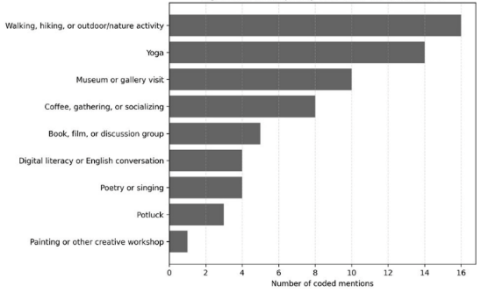
The survey instrument tool included an open-ended question asking respondents to identify their three preferred leisure activities from a list provided. Across the 40 responses, the most frequently mentioned form of leisure preference was outdoor and movement-based activity: walking along the Rideau Canal, hiking in Gatineau Park, or other nature-based outings were identified by 16 respondents, while yoga was identified by 14. Museum or gallery visits were the second most frequently mentioned preference, cited by 10 respondents, followed by social gatherings such as meetings for coffee or tea, cited by 8. Additional preferences included book, film, or discussion groups (n=5), digital literacy or English conversation practice (n=4), poetry or singing (n=4), potlucks and meal sharing (n=3), and painting or other creative workshops (n=1). One respondent noted that the demands of language learning, employment, and childcare left little room to think about leisure for herself, and that she would prefer not to leave her children at home unattended, a response that, while not a leisure preference as such, speaks directly to the structural barriers this study seeks to address.
Figure 1. Most frequently selected leisure interests.
Note: Bars represent activity mentions from open-ended responses, not unique participant counts. Because respondents could list multiple preferred activities, one response may be counted across more than one category.
3.2. Leisure Domains
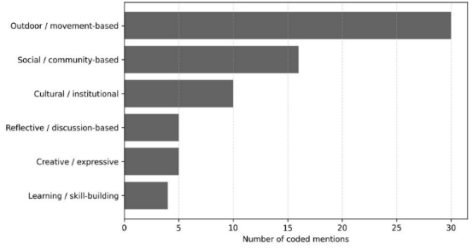
When the activity preferences are grouped into broader domains, the pattern of leisure preferences becomes even clearer. Outdoor and movement-based activities accounted for 30 mentions. Social and community-based activities accounted for 16, followed by cultural and institutional outings with 10 mentions. Reflective or discussion-based activities and creative or expressive activities each generated 5 mentions; while learning or skill-building activities generated 4 mentions. This distribution suggests that respondents imagined leisure through several overlapping pathways rather than through a single preferred format.
Figure 2. Broader leisure domains are reflected in survey responses.
Note:
Figure 2 reveals that outdoor and movement-based activities formed the largest broader domain, followed by social and community-based activities and cultural or institutional activities.
3.3. Access Conditions and Practical Feasibility
The survey allowed participants to express that interests could not be separated from practical feasibility. One respondent expressed interest in museum visits but noted that afternoon scheduling made participation difficult. This comment is important because it shows that interest alone does not guarantee participation. An activity may be desirable, but if its timing conflicts with work, caregiving, transportation, or household responsibilities, it may remain inaccessible. Another respondent described being so occupied with language learning, income generation, and caring for children that she rarely thought about her own leisure and would prefer not to leave her children at home to attend an activity.
Participant responses reveal several, intersecting constraints: settlement-related language needs, economic pressure, caregiving responsibility, and the difficulty of claiming time for oneself. Rather than indicating a lack of interest, it suggests that leisure may be difficult to imagine when everyday life is organized around urgent family, economic, and settlement demands. Responses related to accessibility reinforced the importance of designing activities with practical and embodied needs in mind.
While most respondents did not identify specific physical accessibility accommodations, some noted ankle pain that would make jumping or running difficult while others expressed a phobia of pets, particularly dogs in park settings. These responses reveal the pertinence of open-ended accessibility questions to gather data from the participants themselves. A general category such as physical activity may seem broadly accessible, yet the form of movement, level of intensity, setting, and environmental triggers can all affect whether a participant feels able to attend.
3.4. Survey Findings Inform Activity Planning
Analysis of the open-ended survey responses suggest three broad themes. First, participants expressed interest in leisure as embodied well-being and enjoyable movement. Yoga, walking, hiking, outdoor activity, and dance suggest a desire for movement that is beneficial yet socially comfortable and adaptable. Secondly, respondents described leisure as a social and community-based practice. Coffee gatherings, group socializing, potlucks, discussion groups, singing, poetry, and conversational activities indicate that leisure was valued as a way of being with others. Thirdly, the responses show that leisure was also imagined as a pathway into cultural and urban spaces. Museum visits, gallery visits, walks along a pedestrian path beside the Rideau Canal and cultural activities, poetry, singing, and dance all point to a desire to engage with both the city and culturally meaningful forms of expression.
Findings from the survey provided a practical basis for the subsequent activity phase of the project. The findings reveal preference for activities that were low-cost, group-based, socially or culturally meaningful, and feasible within participants’ constraints.
4. Discussion
The diversity of preferred leisure forms identified in this study aligns with a broader understanding of leisure as a multidimensional social phenomenon rather than a discrete recreational category. Participants' preference for walking, hiking, yoga, and other low-cost movement-oriented activities suggests interest in embodied forms of leisure that are social, accessible, and adaptable, rather than highly competitive, intensive, or institutionally formalized
| [6] | Barrick, S. ‘It’s just about having fun’? Interrogating the lived experiences of newcomers to Canada in introductory winter sport programs. International Review for the Sociology of Sport 2023, 58(4), 703-724.
https://doi.org/10.1177/10126902231156143 |
| [40] | Stodolska, M. Recreation for all: Providing leisure and recreation services in multi-ethnic communities. World Leisure Journal 2015, 57(2), 119-131.
https://doi.org/10.1080/16078055.2015.1040621 |
[6, 40]
. This distinction matters because leisure programming for immigrant women can sometimes be framed too narrowly around health promotion or physical activity outcomes, whereas these responses suggest that movement is meaningful precisely when it is linked to social ease, cultural comfort, and enjoyment
| [7] | Caldwell, L. L. Leisure and health: Why is leisure therapeutic? British Journal of Guidance & Counselling 2005, 33(1), 7-26.
https://doi.org/10.1080/03069880412331335939 |
| [18] | Iwasaki, Y. Leisure and quality of life in an international and multicultural context: What are major pathways linking leisure to quality of life? Social Indicators Research 2007, 82(2), 233-264. https://doi.org/10.1007/s11205-006-9032-z |
| [27] | McDonald, D.; Maxwell, H.; Gholizadeh, L.; Burridge, N. An exploration of physical activity, migrant women and leisure experiences. Leisure Studies 2023, 42(3), 447-461.
https://doi.org/10.1080/02614367.2022.2134442 |
[7, 18, 27]
. Museum and gallery visits reveal that leisure was not understood solely as physical activity or informal socializing; cultural and institutional spaces were also valued as opportunities for learning, exploration, and engagement with the city beyond the routines of work, family, and settlement responsibilities. Coffee gatherings, storytelling, potlucks, discussion groups, and conversational activities further point to the importance of leisure as a relational practice consistent with research showing that social participation is among the most significant functions of leisure for newcomer populations
| [4] | Antoun, A.; Karlis, G. Barriers to leisure for new immigrants in Canada: A conceptual look at ethnic cultural maintenance and mainstream adaptation. International Journal of the Sociology of Leisure 2025, 8, 377-389.
https://doi.org/10.1007/s41978-025-00185-5 |
| [8] | Cai, Y.; O’Connor, E. Exploring the practice and meanings of Tai Chi among Chinese-speaking practitioners in Ottawa, Canada. The International Journal of Sport and Society 2025, 16(1), 1-24. https://doi.org/10.18848/2152-7857/CGP/v16i01/1-24 |
| [15] | Hassanli, N.; Walters, T.; Williamson, J. Leisure provision and refugee settlement: A scoping review with stakeholder engagement to inform policy and practice. Journal of Leisure Research 2026, 1-24. https://doi.org/10.1080/00222216.2025.2601997 |
| [22] | Lauckner, H.; Leclair, L.; Yamamoto, C.; Cockell, S.; Beanlands, H.; Egan, M.; Yoshida, K. Picturing recreation: Newcomers’ perspectives on experiences of recreation. Journal of International Migration and Integration 2022, 23(4), 2101-2123. https://doi.org/10.1007/s12134-021-00921-2 |
[4, 8, 15, 22]
. Dance is particularly illustrative in this regard, as it sits across multiple categories simultaneously: it is movement-based, culturally expressive, social, and enjoyable, and was associated by several respondents with both physical activity and cultural expression. Research on leisure among ethnic and racialized communities demonstrates that leisure serves multiple simultaneous functions, including the facilitation of intercultural contact, sense of community, preservation of cultural identity, social bonding, and the promotion of physical and psychological well-being
| [24] | Liechty, T.; LeFevour, K.; Kerins, A.; Baker, B.; Lizzo, R. Leisure-time physical activity and sense of community among older adults in a group fitness program. Recreation, Parks, & Tourism in Public Health 2019, 3, 27-46.
https://doi.org/10.2979/rptph.3.1.04 |
| [40] | Stodolska, M. Recreation for all: Providing leisure and recreation services in multi-ethnic communities. World Leisure Journal 2015, 57(2), 119-131.
https://doi.org/10.1080/16078055.2015.1040621 |
| [44] | Woo, M.; Jang, I.; Lee, M.; Liechty, T. ‘Sauna is my nest!’: Sense of community among Korean middle-aged women enjoying sauna bathing. Leisure Sciences 2025, 1-20.
https://doi.org/10.1080/01490400.2025.2566169 |
[24, 40, 44]
, and these survey responses reflect all these dimensions. Inclusive leisure programming should therefore not rely on a single activity type or format; rather, it should offer varied options that respond to different forms of comfort, interest, and participation
. These findings are consistent with Arab-Moghaddam et al.’s
observation that Iranian women's leisure participation is shaped by complex intersections of cultural expectation, identity, and the negotiation of personal time.
Scholarship on leisure participation emphasizes that leisure is shaped by a convergence of social, cultural, economic, and structural factors that simultaneously condition both what people desire and what they are able to do
| [13] | Frensch, K. M.; Akesson, B. A socio-spatial perspective on fostering a sense of belonging among refugee families resettled in Canadian small cities. Wellbeing, Space and Society 2025, 8, 100267. https://doi.org/10.1016/j.wss.2025.100267 |
| [40] | Stodolska, M. Recreation for all: Providing leisure and recreation services in multi-ethnic communities. World Leisure Journal 2015, 57(2), 119-131.
https://doi.org/10.1080/16078055.2015.1040621 |
[13, 40]
. This resonates in our study with immigrant working women as they indicate their leisure behavior is influenced by personal preferences, settlement, gendered responsibility, and constrained access to time and resources
| [25] | Lim, M.; Bhardwaj, A.; Delacroix, E.; Dutil, C.; Fuentes, A.; Gauvreau, C.; Girard, M.; Laforce, S. Social isolation, loneliness and health: A descriptive study of the experiences of migrant mothers with young children (0-5 years old) at La Maison Blue. Frontiers in Global Women’s Health 2022, 3.
https://doi.org/10.3389/fgwh.2022.823632 |
| [39] | Stick, M.; Hou, F.; Schimmele, C.; Frank, K. The social networks of immigrant women. Statistics Canada: Economic and Social Reports 2024.
https://doi.org/10.25318/36280001202400400006-eng |
[25, 39]
.
An intersectional analytical lens, as conceptualized by Crenshaw
| [10] | Crenshaw, K. Mapping the margins: Intersectionality, identity politics, and violence against women of color. Stanford Law Review 1991, 43(6), 1241-1299. https://doi.org/10.2307/1229039 |
[10]
, is essential to understanding these findings. Intersectionality reveals that barriers to leisure participation are not the product of any single dimension of disadvantage but emerge from the simultaneous operation of gender, immigration status, language proficiency, income, caregiving responsibility, and cultural norms
| [10] | Crenshaw, K. Mapping the margins: Intersectionality, identity politics, and violence against women of color. Stanford Law Review 1991, 43(6), 1241-1299. https://doi.org/10.2307/1229039 |
[10]
. In this study, participants' scheduling constraints, accessibility concerns, and references to caregiving responsibilities illustrate precisely this kind of compounding disadvantage. Additional contextual factors specific to the Ottawa setting including the need for appropriate winter clothing, reliable and affordable transportation, and physically accessible venues further underscore how structural conditions intersect with individual circumstances to shape what leisure is practically possible
| [6] | Barrick, S. ‘It’s just about having fun’? Interrogating the lived experiences of newcomers to Canada in introductory winter sport programs. International Review for the Sociology of Sport 2023, 58(4), 703-724.
https://doi.org/10.1177/10126902231156143 |
| [25] | Lim, M.; Bhardwaj, A.; Delacroix, E.; Dutil, C.; Fuentes, A.; Gauvreau, C.; Girard, M.; Laforce, S. Social isolation, loneliness and health: A descriptive study of the experiences of migrant mothers with young children (0-5 years old) at La Maison Blue. Frontiers in Global Women’s Health 2022, 3.
https://doi.org/10.3389/fgwh.2022.823632 |
[6, 25]
. While a leisure activity may be listed as a preference, it remains inaccessible if it is scheduled during a work shift, financially prohibitive, linguistically inaccessible, or geographically difficult to reach
. A preference for a museum visit, for example, carries different practical weight depending on whether the activity is scheduled during working hours, whether admission costs are manageable, whether transportation is feasible, and whether women feel culturally comfortable participating in a group setting. Likewise, a dance class may be appealing, but it must be organized in a way that accounts for comfort, mobility, prior experience, and the need for a culturally safe environment. Leisure interest without attention to these structural conditions remains an incomplete and potentially misleading basis for program design
| [17] | Hosseini, M.; Safdar, S. Toward autonomy and empowerment: An examination of identity amongst Iranian migrant women in Canada. In Women’s Empowerment for a Sustainable Future: Transcultural and Positive Psychology Perspectives; Mayer, C.-H., et al., Eds.; Springer International Publishing: Cham, Switzerland, 2023; pp. 599-613.
https://doi.org/10.1007/978-3-031-25924-1_37 |
[17]
.
The CBPR framework adopted in this study provided the methodological approach to reveal these intersecting dimensions
| [28] | Minkler, M.; Wallerstein, N. (Eds.) Community-Based Participatory Research for Health: From Process to Outcomes, 2nd ed.; Jossey-Bass: San Francisco, CA, USA, 2008. |
| [43] | Wills, E. R.; El Richani, D.; Abu-Zahra, N. Building new practices of solidarity: The community mobilization in crisis project. Gender & Development 2020, 28(1), 51-68.
https://doi.org/10.1080/13552074.2020.1717174 |
[28, 43]
. Research conducted "with" rather than "on" communities a foundational CBPR principle enables participants to articulate not only what they want but what stands in the way, and to do so in a trusted environment facilitated through an established community partner
| [28] | Minkler, M.; Wallerstein, N. (Eds.) Community-Based Participatory Research for Health: From Process to Outcomes, 2nd ed.; Jossey-Bass: San Francisco, CA, USA, 2008. |
[28]
. The collaboration with PAND Settlement Services was central to this process. PAND Settlement Services was not simply a participant recruitment channel; as a resettlement organization, it had developed over time a relationship of trust and familiarity with members of the Farsi-speaking community in Ottawa. This trusted, relational infrastructure familiar with the community, its members, their assets, and their needs made it possible to reach participants. This survey empowered participants to communicate their preferences and concerns, which in turn supported our community-campus partnership to make programming decisions that were accessible, relevant, and socially grounded.
Our findings also support an asset-based understanding of community leisure programming, as theorized by Kretzmann and McKnight
| [21] | Kretzmann, J. P.; McKnight, J. L. Building Communities from the Inside Out: A Path Toward Finding and Mobilizing a Community’s Assets; ACTA Publications: Chicago, IL, USA, 1993. |
[21]
. Asset-based community development challenges deficit-oriented approaches that identify communities primarily through their needs, gaps, and vulnerabilities, and instead foregrounds the skills, knowledge, cultural capital, and social capacities that community members already possess
| [21] | Kretzmann, J. P.; McKnight, J. L. Building Communities from the Inside Out: A Path Toward Finding and Mobilizing a Community’s Assets; ACTA Publications: Chicago, IL, USA, 1993. |
| [26] | Mathie, A.; Cunningham, G. From clients to citizens: Asset-based community development as a strategy for community-driven development. Development in Practice 2003, 13(5), 474-486.
https://doi.org/10.1080/0961452032000125857 |
[21, 26]
. Although the survey identified constraints, it did not reduce participants to being defined or identified through those constraints. Women's responses revealed skills and assets they wanted to continue to build on in their leisure pursuits, and they expressed interests, cultural capital, social preferences, and forms of knowledge that could directly guide program design. This matters because deficit-based understandings of immigrant women's leisure risk overemphasizing gaps or vulnerabilities at the expense of recognizing what women already know and bring to community life
. By contrast, this pre-activity interest survey recognized women as holders of knowledge about their own lives and as contributors to the design of programming that could be meaningful to them an orientation that reflects both CBPR ethics and asset-based practice
| [9] | Cargo, M.; Mercer, S. L. The value and challenges of participatory research: Strengthening its practice. Annual Review of Public Health 2008, 29, 325-350.
https://doi.org/10.1146/annurev.publhealth.29.091307.083824 |
| [21] | Kretzmann, J. P.; McKnight, J. L. Building Communities from the Inside Out: A Path Toward Finding and Mobilizing a Community’s Assets; ACTA Publications: Chicago, IL, USA, 1993. |
[9, 21]
.
Practical Implications
Findings from this study provide practical implications for settlement agencies, community organizations, and municipal recreation systems. Leisure programming for immigrant women could include participant-informed inquiry on what women find meaningful, realistic, and comfortable. Culturally responsive programming requires minority-language communication, inclusion of cultural content and being attentive to scheduling, cost, transportation, childcare responsibilities, mobility concerns, communication channels, and the social atmosphere of participation. Future research could examine whether survey-informed activities lead to sustained participation, broader social networks, improved sense of belonging, or greater confidence in using community and public spaces over time.
5. Conclusions
This article makes two related contributions. Empirically, it documents how Farsi-speaking immigrant women aged 30-55 described meaningful and feasible leisure in a local Canadian context. Making this connection explicit matters because "Farsi-speaking" defined the linguistic criterion for participation, while "Iranian" reflects the cultural and national background shared by most respondents, two terms that overlap substantially but are not interchangeable. Methodologically, this article shows how a pre-activity survey can function as a bridge between community-based research principles and the practical design of leisure opportunities before activities are implemented. In doing so, it contributes to discussions of community diversity, immigrant inclusion, and participant-informed program development in leisure studies.
We explored how a pre-activity leisure interest survey can be beneficial in the design of community-based leisure activities for Farsi-speaking immigrant women aged 30-55 in Ottawa. Survey respondents (n = 40) revealed a strong preference for outdoor movement-based activities, yoga, dance, cultural outings, and social gatherings, while also showing that these interests were shaped by intersecting concerns around scheduling, caregiving, cost, transportation, language, accessibility, and community trust. Our research reveals that a pre-activity interest survey can help identify individual and community assets and needs, and act as a tool through which respondents could express their voice. As such, the survey can be understood as both a participant-informed communication tool and an early analytic lens onto the conditions under which leisure can become meaningful and accessible.
Integrating leisure as part of the social infrastructure of resettlement demonstrates how a participant-informed survey design can guide culturally responsive program development. Our findings contribute to discussions on the role of leisure in community development and newcomer social inclusion
| [33] | Rich, K. A.; Misener, L.; Dubeau, D. “Community Cup, we are a big family”: Examining social inclusion and acculturation of newcomers to Canada through a participatory sport event. Social Inclusion 2015, 3(3), 58-68.
https://doi.org/10.17645/si.v3i3.141 |
[33]
.
Abbreviations
CBPR | Community Based Participatory Research |
ABCD | Asset Based Community Development |
Acknowledgments
The authors acknowledge the collaboration of PAND Settlement Services organization and the participants who completed the survey.
Author Contributions
Mahsa Hadidi: Conceptualization, Data curation, Formal Analysis, Investigation, Methodology, Project administration, Writing – original draft, Writing – review & editing
Eileen O’Connor: Conceptualization, Formal Analysis, Funding acquisition, Methodology, Supervision, Writing – review & editing
Emily Wills: Conceptualization, Funding acquisition, Methodology, Writing – review & editing
Nadia Abu-Zahra: Conceptualization, Funding acquisition, Methodology, Writing – review & editing
Laura Ambrosio: Conceptualization, Funding acquisition, Methodology, Writing – review & editing
Funding
The lead author’s doctoral study stems from a larger SSHRC-funded community-engaged partnership project led by Dr. Eileen O’Connor on leisure, women and settlement services. Partial funding for the lead author was provided in the form of research assistantships (RA) from this grant.
Data Availability Statement
The data is available from the corresponding author and/or supervisor Dr. O’Connor upon reasonable request.
Conflicts of Interest
The authors declare no conflicts of interest.
References
| [1] |
Al-Hamad, A.; Yasin, Y. M.; Metersky, K.; Kokorelias, K.; Zhuang, Z. C. Mapping arts and digital practices supporting diasporic identity and cultural memory among migrants and refugees: A scoping review protocol. Culture 2026, 2, 14.
https://doi.org/10.3390/culture2020014
|
| [2] |
Ambrosio, L. Language learning in the community: A bridge for social cohesion. In Guarda, M.; Stopfner, M.; Meier, G. (Eds.) Changing Perspectives Towards Linguistic Diversity in Education; Educational Linguistics, Vol. 71; Springer: Cham, Switzerland, 2026.
https://doi.org/10.1007/978-3-032-16440-7_6
|
| [3] |
Ager, A.; Strang, A. Understanding integration: A conceptual framework. Journal of Refugee Studies 2008, 21(2), 166-191.
https://doi.org/10.1093/jrs/fen016
|
| [4] |
Antoun, A.; Karlis, G. Barriers to leisure for new immigrants in Canada: A conceptual look at ethnic cultural maintenance and mainstream adaptation. International Journal of the Sociology of Leisure 2025, 8, 377-389.
https://doi.org/10.1007/s41978-025-00185-5
|
| [5] |
Arab-Moghaddam, N.; Henderson, K. A.; Sheikholeslami, R. Women’s leisure and constraints to participation: Iranian perspectives. Journal of Leisure Research 2007, 39(1), 109-126.
https://doi.org/10.1080/00222216.2007.11950100
|
| [6] |
Barrick, S. ‘It’s just about having fun’? Interrogating the lived experiences of newcomers to Canada in introductory winter sport programs. International Review for the Sociology of Sport 2023, 58(4), 703-724.
https://doi.org/10.1177/10126902231156143
|
| [7] |
Caldwell, L. L. Leisure and health: Why is leisure therapeutic? British Journal of Guidance & Counselling 2005, 33(1), 7-26.
https://doi.org/10.1080/03069880412331335939
|
| [8] |
Cai, Y.; O’Connor, E. Exploring the practice and meanings of Tai Chi among Chinese-speaking practitioners in Ottawa, Canada. The International Journal of Sport and Society 2025, 16(1), 1-24.
https://doi.org/10.18848/2152-7857/CGP/v16i01/1-24
|
| [9] |
Cargo, M.; Mercer, S. L. The value and challenges of participatory research: Strengthening its practice. Annual Review of Public Health 2008, 29, 325-350.
https://doi.org/10.1146/annurev.publhealth.29.091307.083824
|
| [10] |
Crenshaw, K. Mapping the margins: Intersectionality, identity politics, and violence against women of color. Stanford Law Review 1991, 43(6), 1241-1299.
https://doi.org/10.2307/1229039
|
| [11] |
Crenshaw, K. W. Demarginalizing the intersection of race and sex: A Black feminist critique of antidiscrimination doctrine, feminist theory and antiracist politics. In Feminist Legal Theories; Maschke, K. J., Ed.; Routledge: New York, NY, USA, 1997; pp. 23-51.
https://doi.org/10.4324/9781315051536-2
|
| [12] |
Fortes, E. Rethinking integration: Applying the capabilities approach to immigrant incorporation. Comparative Migration Studies 2025, 13(1), 77.
https://doi.org/10.1186/s40878-025-00495-3
|
| [13] |
Frensch, K. M.; Akesson, B. A socio-spatial perspective on fostering a sense of belonging among refugee families resettled in Canadian small cities. Wellbeing, Space and Society 2025, 8, 100267.
https://doi.org/10.1016/j.wss.2025.100267
|
| [14] |
Gagliardi, A. R.; Morrison, C.; Anderson, N. N. The design and impact of culturally safe community-based physical activity promotion for immigrant women: Descriptive review. BMC Public Health 2022, 22(1), 430.
https://doi.org/10.1186/s12889-022-12828-3
|
| [15] |
Hassanli, N.; Walters, T.; Williamson, J. Leisure provision and refugee settlement: A scoping review with stakeholder engagement to inform policy and practice. Journal of Leisure Research 2026, 1-24.
https://doi.org/10.1080/00222216.2025.2601997
|
| [16] |
Henderson, K. A.; Gibson, H. J. An integrative review of women, gender, and leisure: Increasing complexities. Journal of Leisure Research 2013, 45(2), 115-135.
https://doi.org/10.18666/jlr-2013-v45-i2-3008
|
| [17] |
Hosseini, M.; Safdar, S. Toward autonomy and empowerment: An examination of identity amongst Iranian migrant women in Canada. In Women’s Empowerment for a Sustainable Future: Transcultural and Positive Psychology Perspectives; Mayer, C.-H., et al., Eds.; Springer International Publishing: Cham, Switzerland, 2023; pp. 599-613.
https://doi.org/10.1007/978-3-031-25924-1_37
|
| [18] |
Iwasaki, Y. Leisure and quality of life in an international and multicultural context: What are major pathways linking leisure to quality of life? Social Indicators Research 2007, 82(2), 233-264.
https://doi.org/10.1007/s11205-006-9032-z
|
| [19] |
Karlis, G.; Gravelle, F.; Stratas, A.; Makrodimitris, P. Inclusion and integration: A case study of the Hellenic Community of Ottawa’s cultural recreation activities. Athens Journal of Social Sciences 2019, 7(1).
https://doi.org/10.30958/ajss.7-1-2
|
| [20] |
Koosha, M. Aging in Iran: Challenges and future policy directions. Social Sciences 2025, 14(4), 382-389.
https://doi.org/10.11648/j.ss.20251404.19
|
| [21] |
Kretzmann, J. P.; McKnight, J. L. Building Communities from the Inside Out: A Path Toward Finding and Mobilizing a Community’s Assets; ACTA Publications: Chicago, IL, USA, 1993.
|
| [22] |
Lauckner, H.; Leclair, L.; Yamamoto, C.; Cockell, S.; Beanlands, H.; Egan, M.; Yoshida, K. Picturing recreation: Newcomers’ perspectives on experiences of recreation. Journal of International Migration and Integration 2022, 23(4), 2101-2123.
https://doi.org/10.1007/s12134-021-00921-2
|
| [23] |
Lee, E.-Y.; Lim, A.; Brar, B.; Sandhu, S.; Bhatt, M.; McFadyen, T.; Bhatt, H.; Azim, E. A scoping review of barriers and facilitators of physical activity among equity-denied groups in Canada: An intersectional equity lens. Journal of Immigrant and Minority Health 2025, 27(6), 1090-1106.
https://doi.org/10.1007/s10903-025-01727-5
|
| [24] |
Liechty, T.; LeFevour, K.; Kerins, A.; Baker, B.; Lizzo, R. Leisure-time physical activity and sense of community among older adults in a group fitness program. Recreation, Parks, & Tourism in Public Health 2019, 3, 27-46.
https://doi.org/10.2979/rptph.3.1.04
|
| [25] |
Lim, M.; Bhardwaj, A.; Delacroix, E.; Dutil, C.; Fuentes, A.; Gauvreau, C.; Girard, M.; Laforce, S. Social isolation, loneliness and health: A descriptive study of the experiences of migrant mothers with young children (0-5 years old) at La Maison Blue. Frontiers in Global Women’s Health 2022, 3.
https://doi.org/10.3389/fgwh.2022.823632
|
| [26] |
Mathie, A.; Cunningham, G. From clients to citizens: Asset-based community development as a strategy for community-driven development. Development in Practice 2003, 13(5), 474-486.
https://doi.org/10.1080/0961452032000125857
|
| [27] |
McDonald, D.; Maxwell, H.; Gholizadeh, L.; Burridge, N. An exploration of physical activity, migrant women and leisure experiences. Leisure Studies 2023, 42(3), 447-461.
https://doi.org/10.1080/02614367.2022.2134442
|
| [28] |
Minkler, M.; Wallerstein, N. (Eds.) Community-Based Participatory Research for Health: From Process to Outcomes, 2nd ed.; Jossey-Bass: San Francisco, CA, USA, 2008.
|
| [29] |
Murphy, F.; Vieten, U. M. Decolonizing refugee integration paradigms: Visions for a new politics of inclusion and participation in Europe and beyond. Ethnic and Racial Studies 2025, 48(11), 2103-2118.
https://doi.org/10.1080/01419870.2024.2438284
|
| [30] |
O’Connor, E.; Abu-Zahra, N.; Wills, E.; Ambrosio, L.; El-Mohtadi, J.; PAND Settlement Services. Co-developing inclusive leisure for Farsi-speaking immigrant women in Ottawa, Canada: Adopting a community-campus approach with a local settlement service organization. Presented at the UK Leisure Studies Association Conference, University of the West of Scotland, Paisley, Scotland, July 2024.
|
| [31] |
Özgider, C.; Koch, J. Navigating new spaces: The role of sports and leisure in the lives of Montréal’s immigrant and refugee communities. Frontiers in Psychology 2026, 17.
https://doi.org/10.3389/fpsyg.2026.1732261
|
| [32] |
Petty, L.; Trussell, D. E. Leisure self-care, health and well-being in women’s lives. Annals of Leisure Research 2021, 24(3), 328-339.
https://doi.org/10.1080/11745398.2019.1652661
|
| [33] |
Rich, K. A.; Misener, L.; Dubeau, D. “Community Cup, we are a big family”: Examining social inclusion and acculturation of newcomers to Canada through a participatory sport event. Social Inclusion 2015, 3(3), 58-68.
https://doi.org/10.17645/si.v3i3.141
|
| [34] |
Salami, B.; Salma, J.; Hegadoren, K.; Meherali, S.; Kolawole, T.; Richter, S. Sense of community belonging among immigrants: Perspective of immigrant service providers. Public Health 2019, 167, 28-33.
https://doi.org/10.1016/j.puhe.2018.10.017
|
| [35] |
Salma, J.; Giri, D. Engaging immigrant and racialized communities in community-based participatory research during the COVID-19 pandemic: Challenges and opportunities. International Journal of Qualitative Methods 2021, 20, 1-11.
https://doi.org/10.1177/16094069211036293
|
| [36] |
Schinkel, W. Against ‘immigrant integration’: For an end to neocolonial knowledge production. Comparative Migration Studies 2018, 6(1), 31.
https://doi.org/10.1186/s40878-018-0095-1
|
| [37] |
Scuzzarello, S.; Moroşanu, L. Integration and intersectionality: Boundaries and belonging ‘from above’ and ‘from below’. Introduction to the special issue. Ethnic and Racial Studies 2023, 46(14), 2991-3013.
https://doi.org/10.1080/01419870.2023.2182649
|
| [38] |
Smith, R.; Spaaij, R.; McDonald, B. Migrant integration and cultural capital in the context of sport and physical activity: A systematic review. Journal of International Migration and Integration 2019, 20(3), 851-868.
https://doi.org/10.1007/s12134-018-0634-5
|
| [39] |
Stick, M.; Hou, F.; Schimmele, C.; Frank, K. The social networks of immigrant women. Statistics Canada: Economic and Social Reports 2024.
https://doi.org/10.25318/36280001202400400006-eng
|
| [40] |
Stodolska, M. Recreation for all: Providing leisure and recreation services in multi-ethnic communities. World Leisure Journal 2015, 57(2), 119-131.
https://doi.org/10.1080/16078055.2015.1040621
|
| [41] |
Tossutti, L. Municipal parks, recreation and cultural services in an age of migration and superdiversity. Urban Affairs Review 2023, 59(4), 1214-1249.
https://doi.org/10.1177/10780874221100698
|
| [42] |
Vaughn, L. M.; Jacquez, F. Participatory research methods: Choice points in the research process. Journal of Participatory Research Methods 2020, 1(1).
https://doi.org/10.35844/001c.13244
|
| [43] |
Wills, E. R.; El Richani, D.; Abu-Zahra, N. Building new practices of solidarity: The community mobilization in crisis project. Gender & Development 2020, 28(1), 51-68.
https://doi.org/10.1080/13552074.2020.1717174
|
| [44] |
Woo, M.; Jang, I.; Lee, M.; Liechty, T. ‘Sauna is my nest!’: Sense of community among Korean middle-aged women enjoying sauna bathing. Leisure Sciences 2025, 1-20.
https://doi.org/10.1080/01490400.2025.2566169
|
| [45] |
Yuval-Davis, N. Belonging and the politics of belonging. Patterns of Prejudice 2006, 40(3), 197-214.
https://doi.org/10.1080/00313220600769331
|
| [46] |
Zagrebina, A. Leisure activities of new immigrants in the Montreal context: preferences, needs, and obstacles. Lsr & Soc / Society and Leisure 2026, 1-14.
https://doi.org/10.1080/07053436.2026.2635844
|
Cite This Article
-
APA Style
Hadidi, M., O’Connor, E., Wills, E., Abu-Zahra, N., Ambrosio, L. (2026). Integrating Community-based Participatory Research Methods to Identify Leisure Preferences Among Newcomer Immigrant Women Aged 30-55 in Ottawa, Canada. Social Sciences, 15(4), 153-162. https://doi.org/10.11648/j.ss.20261504.11
 Copy
|
Copy
|
 Download
ACS Style
Hadidi, M.; O’Connor, E.; Wills, E.; Abu-Zahra, N.; Ambrosio, L. Integrating Community-based Participatory Research Methods to Identify Leisure Preferences Among Newcomer Immigrant Women Aged 30-55 in Ottawa, Canada. Soc. Sci. 2026, 15(4), 153-162. doi: 10.11648/j.ss.20261504.11
Copy
|
Download
AMA Style
Hadidi M, O’Connor E, Wills E, Abu-Zahra N, Ambrosio L. Integrating Community-based Participatory Research Methods to Identify Leisure Preferences Among Newcomer Immigrant Women Aged 30-55 in Ottawa, Canada. Soc Sci. 2026;15(4):153-162. doi: 10.11648/j.ss.20261504.11
Copy
|
Download
-
@article{10.11648/j.ss.20261504.11,
  author = {Mahsa Hadidi and Eileen O’Connor and Emily Wills and Nadia Abu-Zahra and Laura Ambrosio},
  title = {Integrating Community-based Participatory Research Methods to Identify Leisure Preferences Among Newcomer Immigrant Women Aged 30-55 in Ottawa, Canada},
  journal = {Social Sciences},
  volume = {15},
  number = {4},
  pages = {153-162},
  doi = {10.11648/j.ss.20261504.11},
  url = {https://doi.org/10.11648/j.ss.20261504.11},
  eprint = {https://article.sciencepublishinggroup.com/pdf/10.11648.j.ss.20261504.11},
  abstract = {This paper explores the benefits of adopting a community-based participatory research (CBPR) approach when designing leisure activities for newcomer Farsi-speaking immigrant women aged 30 to 55 in Ottawa, Canada. Immigrant women in this age range frequently navigate complex and overlapping demands related to paid employment, family responsibilities, caregiving, and unpaid labour, yet their leisure interests and access needs remain underrepresented in both the research literature and community programming. Through sustained collaboration with a local resettlement service organization, a bilingual (English/Farsi) leisure interest survey was administered to Farsi-speaking women who had arrived in Canada within the preceding five years and fell within the designated age range. The survey invited respondents to identify preferred leisure activities, accessibility requirements, language learning goals, and scheduling preferences. A total of 40 women submitted responses, and the findings were organized into three thematic leisure categories: (1) outdoor and movement-based activities, including yoga; (2) museum and gallery visits; and (3) social gatherings. This CBPR approach enabled these community members to articulate their leisure interests, assets, and specific needs, which in turn directly informed the development of culturally relevant and responsive leisure programming. Our discussion and conclusion emphasize that a pre-activity survey can serve as a meaningful methodological bridge between community-based participatory research and the design of culturally responsive leisure programs. Implications for researchers, community organizations, and practitioners working with newcomer populations are discussed.},
 year = {2026}
}
Copy
|
Download
-
TY  - JOUR
T1  - Integrating Community-based Participatory Research Methods to Identify Leisure Preferences Among Newcomer Immigrant Women Aged 30-55 in Ottawa, Canada
AU  - Mahsa Hadidi
AU  - Eileen O’Connor
AU  - Emily Wills
AU  - Nadia Abu-Zahra
AU  - Laura Ambrosio
Y1  - 2026/07/08
PY  - 2026
N1  - https://doi.org/10.11648/j.ss.20261504.11
DO  - 10.11648/j.ss.20261504.11
T2  - Social Sciences
JF  - Social Sciences
JO  - Social Sciences
SP  - 153
EP  - 162
PB  - Science Publishing Group
SN  - 2326-988X
UR  - https://doi.org/10.11648/j.ss.20261504.11
AB  - This paper explores the benefits of adopting a community-based participatory research (CBPR) approach when designing leisure activities for newcomer Farsi-speaking immigrant women aged 30 to 55 in Ottawa, Canada. Immigrant women in this age range frequently navigate complex and overlapping demands related to paid employment, family responsibilities, caregiving, and unpaid labour, yet their leisure interests and access needs remain underrepresented in both the research literature and community programming. Through sustained collaboration with a local resettlement service organization, a bilingual (English/Farsi) leisure interest survey was administered to Farsi-speaking women who had arrived in Canada within the preceding five years and fell within the designated age range. The survey invited respondents to identify preferred leisure activities, accessibility requirements, language learning goals, and scheduling preferences. A total of 40 women submitted responses, and the findings were organized into three thematic leisure categories: (1) outdoor and movement-based activities, including yoga; (2) museum and gallery visits; and (3) social gatherings. This CBPR approach enabled these community members to articulate their leisure interests, assets, and specific needs, which in turn directly informed the development of culturally relevant and responsive leisure programming. Our discussion and conclusion emphasize that a pre-activity survey can serve as a meaningful methodological bridge between community-based participatory research and the design of culturally responsive leisure programs. Implications for researchers, community organizations, and practitioners working with newcomer populations are discussed.
VL  - 15
IS  - 4
ER  -
Copy
|
Download





 Share This Article
 Twitter
 Linked In
 Facebook