Abstract
Thin plated glued timbers (TPT) have emerged as a promising alternative to conventional construction materials due to their cost-effectiveness, sustainability, and structural versatility. Despite promising performance, there's a lack of understanding regarding TPT's suitability for structural applications. This study investigates the moisture content and density of various softwood and hardwood specimens obtained from Edo State, Nigeria, focusing on both solid and glued timber. The primary aim is to provide insights into the structural performance of these materials, guiding their applications in construction projects. Moisture content analysis revealed that solid timber generally absorbs less moisture compared to glued timber beams, with average moisture contents ranging from 11.3% to 12.0% for softwood and 8.2% to 10.2% for hardwood. These values are within the EN 338 standard for structural timber, pegged at 12%. Density measurements indicated that solid Ceiba Pentandra timber (softwood) had a higher average density (508.8 kg/m3) compared to its glued counterpart (378.5 kg/m3), while Terminalia ivorensis timber (hardwood) showed similar densities between solid (701.8 kg/m3) and glued specimens (697.5 kg/m3).
|
Published in
|
Science Research (Volume 14, Issue 4)
|
|
DOI
|
10.11648/j.sr.20261404.25
|
|
Page(s)
|
244-252 |
|
Creative Commons
|

This is an Open Access article, distributed under the terms of the Creative Commons Attribution 4.0 International License (http://creativecommons.org/licenses/by/4.0/), which permits unrestricted use, distribution and reproduction in any medium or format, provided the original work is properly cited.
|
|
Copyright
|
Copyright © The Author(s), 2026. Published by Science Publishing Group
|
Keywords
Timber Properties, Structural Performance, Moisture Content, Density, Softwood, Hardwood, Glued Timber, Solid Timber
1. Introduction
Timber is a natural, low-density, cellular, polymeric composite material whose unique anatomical structure distinguishes it from most conventional engineering materials. Due to its anisotropic and heterogeneous nature, timber exhibits mechanical properties that vary with grain orientation, moisture content, density, and species
| [7] | Cai, Z., & Ross, R. J. (2010). Mechanical Properties of Wood-Based Composite Materials. Forest Products Laboratory. |
| [8] | Green, P., & Black, A. (2017). Wood Mechanics. London: CRC Press. |
| [13] | Young, P. (2020). Structural applications of wood. University of Toronto Press. Zhang, Y. (2018). Wood engineering and design. Tsinghua University Press. |
[7, 8, 13]
. Structural timber is generally produced by sawing logs into prismatic members, typically with rectangular cross-sections, for use as load-bearing elements in buildings and other civil engineering structures
| [4] | Anderson, T., & Smith, K. (2020). Structural timber design. Macmillan. |
| [1] | Adams, R. D. (2018). Wood properties and uses. Timber Press. |
| [7] | Cai, Z., & Ross, R. J. (2010). Mechanical Properties of Wood-Based Composite Materials. Forest Products Laboratory. |
[4, 1, 7]
. The maximum dimensions of structural timber members are largely governed by the size and quality of the harvested trees, which has motivated the development of engineered wood products capable of overcoming these natural limitations.
Thin plated glued timber (TPT) has emerged as one of the promising engineered wood products due to its structural efficiency, cost-effectiveness, sustainability, and versatility in modern construction. Manufactured by bonding thin timber laminations or veneers using high-performance structural adhesives, TPT combines the desirable characteristics of timber with improved mechanical performance and dimensional stability
| [6] | Ezeagu, C. A., Eromosele, A., Okoro, H., Chukwujekwy, U., & Emetomo, T. (2015). Flexural Strength of solid and glue-laminated timber beams. American Journal of Engineering Science and Technology Research, 3(1), 1-14. |
| [10] | Oliveira, L. A., Silva, J. P., & Souza, C. R. (2020). Adhesive bonding techniques for enhanced structural stability in timber. Construction and Building Materials, 245, 118491. |
[6, 10]
. As the global construction industry increasingly embraces sustainable building materials, engineered timber products such as TPT have gained considerable attention as environmentally friendly alternatives to conventional materials including reinforced concrete and structural steel.
This study seeks to evaluate the performance of thin plated glued timber for construction projects in Edo State, Nigeria. The evaluation focuses on key performance indicators including structural integrity, durability, and environmental sustainability, with the aim of determining the suitability of TPT for structural applications within the region. Such an assessment is essential because local climatic conditions, biological agents, material availability, and construction practices significantly influence the long-term performance of timber structures.
The structural integrity of TPT is one of the primary factors determining its suitability for engineering applications. Previous investigations on thin plated glued timber produced from locally available timber species, including Obeche and Mahogany, have demonstrated satisfactory mechanical properties that satisfy structural design requirements
| [11] | Oyebanji, O., & Ogunde, A. (2019). Mechanical properties of thin plated glued timber: A study using local wood species. Nigerian Journal of Engineering, 26(1), 45-56. |
[11]
. Furthermore, studies have shown that appropriate adhesive bonding techniques, particularly the use of phenol-formaldehyde adhesives, significantly improve the structural stability, stiffness, and load-carrying capacity of glued timber members
| [10] | Oliveira, L. A., Silva, J. P., & Souza, C. R. (2020). Adhesive bonding techniques for enhanced structural stability in timber. Construction and Building Materials, 245, 118491. |
[10]
. Consequently, assessing the structural performance of TPT under local conditions provides valuable information regarding its reliability and safety for construction purposes.
Durability is another critical consideration in evaluating engineered timber products. Timber structures are susceptible to deterioration caused by fungal decay, termite attack, moisture fluctuations, and weathering. However, research has demonstrated that appropriate preservative treatments substantially improve the resistance of glued timber products to biological degradation, thereby extending their service life
| [2] | Adekoya, A. S., Ojo, A. E., & Babalola, D. A. (2018). Preservative treatment of timber for improved durability. Journal of Wood Science, 64(2), 123-130. |
| [5] | Antwi, K., Effah, B., Adu, G., & Adu, S. (2014). Strength and some Physical Properties of Allanblackia Parviflora for Furniture Production in Ghana. International Journal of Science and Technology. |
[2, 5]
. Effective moisture control and proper preservative impregnation remain essential requirements for ensuring the satisfactory long-term performance of timber structures, particularly in tropical climates where environmental conditions accelerate biological deterioration
| [3] | Ahmad, Z., & Anwar, H. (2019). Moisture content and timber durability. Journal of Wood Science, 55(4), 321-334. |
[3]
.
Apart from their structural advantages, thin plated glued timbers contribute significantly to environmental sustainability. Timber is a renewable construction material that stores atmospheric carbon throughout its service life and generally requires considerably less energy for production than steel and concrete. Consequently, replacing conventional structural materials with engineered timber products can substantially reduce greenhouse gas emissions associated with the construction industry
| [9] | Miguel, J., Oliveira, L., & Santos, J. (2021). Environmental sustainability of glued laminated timber. Environmental Research Letters, 16(3), 034024. |
[9]
. These environmental benefits align with global initiatives promoting sustainable infrastructure development and low-carbon construction practices.
Despite these advantages, the widespread adoption of TPT within Edo State and Nigeria generally faces several challenges. These include the absence of standardized manufacturing procedures, inadequate quality control during production, limited availability of locally manufactured structural adhesives, and insufficient technical guidelines governing the design and construction of glued timber structures. Addressing these challenges requires coordinated efforts among government agencies, research institutions, manufacturers, and professional bodies to establish appropriate standards, improve manufacturing practices, and encourage local production of quality structural adhesives.
A closely related engineered timber product is glued laminated timber (glulam), which consists of multiple layers of dimension lumber bonded together with high-strength structural adhesives to form a single structural member
| [12] | Wasiu, J. (2022). Glulam timber in the Canadian construction market. Canadian Journal of Civil Engineering, 49(1), 12-22. |
[12]
. Glulam technology has significantly expanded the application of timber in modern construction by enabling the production of large structural members with superior strength, stiffness, dimensional stability, and architectural flexibility. Unlike conventional sawn timber, glulam permits the utilization of smaller-diameter trees and lower-grade timber, thereby improving resource efficiency while producing structural elements capable of carrying substantial loads
| [12] | Wasiu, J. (2022). Glulam timber in the Canadian construction market. Canadian Journal of Civil Engineering, 49(1), 12-22. |
[12]
.
The increasing use of glulam has influenced revisions of building regulations in several countries, particularly Canada, where amendments to provincial building codes have permitted the construction of timber buildings up to six storeys in height
| [12] | Wasiu, J. (2022). Glulam timber in the Canadian construction market. Canadian Journal of Civil Engineering, 49(1), 12-22. |
[12]
. These regulatory developments demonstrate growing confidence in engineered timber systems and highlight the importance of developing reliable design guidelines for structural connections capable of resisting significant vertical and lateral loads.
Overall, the evaluation of thin plated glued timber represents an important step toward promoting sustainable construction in Edo State, Nigeria. By examining its structural performance, durability, and environmental benefits, this research aims to provide scientific evidence supporting the wider adoption of engineered timber products in the Nigerian construction industry while identifying areas requiring further improvement in manufacturing standards, quality assurance, and structural design practices.
2. Wood’s Structure
Wood is a naturally occurring cellular material composed of elongated cells arranged predominantly parallel to the longitudinal axis of the tree trunk, from which structural timber is obtained
| [7] | Cai, Z., & Ross, R. J. (2010). Mechanical Properties of Wood-Based Composite Materials. Forest Products Laboratory. |
| [22] | Forest Products Laboratory. (2010). Wood handbook: Wood as an engineering material (General Technical Report FPL-GTR-190). Madison, WI: U.S. Department of Agriculture, Forest Service, Forest Products Laboratory. |
[7, 22]
. These cells are generally spindle-shaped and contain internal cavities known as lumens. An understanding of the anatomical structure of wood is fundamental to appreciating its engineering behaviour, mechanical performance, and inherent limitations as a structural material
| [7] | Cai, Z., & Ross, R. J. (2010). Mechanical Properties of Wood-Based Composite Materials. Forest Products Laboratory. |
| [22] | Forest Products Laboratory. (2010). Wood handbook: Wood as an engineering material (General Technical Report FPL-GTR-190). Madison, WI: U.S. Department of Agriculture, Forest Service, Forest Products Laboratory. |
[7, 22]
.
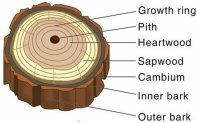
The tree trunk consists of several distinct regions, including the bark, cambium, sapwood, heartwood, and pith (
Figure 1). Among these, the sapwood is the outer, lighter-coloured portion immediately adjacent to the cambium. Sapwood performs three primary functions: providing structural support, conducting water and dissolved minerals from the roots to the leaves, and storing food reserves
| [22] | Forest Products Laboratory. (2010). Wood handbook: Wood as an engineering material (General Technical Report FPL-GTR-190). Madison, WI: U.S. Department of Agriculture, Forest Service, Forest Products Laboratory. |
[22]
. As trees mature, portions of the sapwood gradually transform into heartwood, which contributes mainly to the structural strength of the tree.
Figure 1. Parts of a Trunk.
Wood fibres develop with their longitudinal axes approximately parallel to the axis of the tree trunk. Consequently, wood exhibits anisotropic behaviour, meaning its mechanical and physical properties differ depending on the direction of loading. The three principal material directions are the longitudinal direction (parallel to the grain), the radial direction (perpendicular to the annual growth rings), and the tangential direction (tangent to the annual growth rings)
| [7] | Cai, Z., & Ross, R. J. (2010). Mechanical Properties of Wood-Based Composite Materials. Forest Products Laboratory. |
| [22] | Forest Products Laboratory. (2010). Wood handbook: Wood as an engineering material (General Technical Report FPL-GTR-190). Madison, WI: U.S. Department of Agriculture, Forest Service, Forest Products Laboratory. |
[7, 22]
. This directional dependence significantly influences the strength, stiffness, dimensional stability, and failure characteristics of timber used in engineering structures. The three principal axes of wood are presented in
Table 1.
Table 1. Principal Axes of Timber.
Principal Axis | Description |
Longitudinal | Parallel to grain |
Radial | Normal to annual rings |
Tangential | Tangent to annual rings and perpendicular to the grain |
Source:
| [22] | Forest Products Laboratory. (2010). Wood handbook: Wood as an engineering material (General Technical Report FPL-GTR-190). Madison, WI: U.S. Department of Agriculture, Forest Service, Forest Products Laboratory. |
[22]
2.1. Density of Timber
Density is one of the most important physical properties influencing the engineering performance of timber. It is defined as the mass of wood contained within a unit volume and is commonly expressed in kilograms per cubic metre (kg/m³). Timber density depends primarily on the proportion of solid cell-wall material relative to the volume of void spaces within the wood structure
| [7] | Cai, Z., & Ross, R. J. (2010). Mechanical Properties of Wood-Based Composite Materials. Forest Products Laboratory. |
| [22] | Forest Products Laboratory. (2010). Wood handbook: Wood as an engineering material (General Technical Report FPL-GTR-190). Madison, WI: U.S. Department of Agriculture, Forest Service, Forest Products Laboratory. |
[7, 22]
. Generally, timber species with higher densities possess greater strength, stiffness, hardness, and wear resistance than lower-density species
| [21] | Falemara, B. C., Aina, O. M., & Omole, A. O. (2012). Determination of physical properties of selected Nigerian timber species. Nigerian Journal of Technology, 31(2), 135–142. |
[21]
. These are shown in
Table 2. The mathematical expression of Density as givenin Equation (
1):
where: D = density (kg/m3), W = weight of the wood (kg), V = volume of the wood (m3).
Studies conducted in Nigeria have also shown that timber selection by users (
Table 2) is influenced by strength, durability, workability, and availability. Species such as Afzelia africana, Milicia excelsa (Iroko), and Khaya ivorensis (Mahogany) remain popular for structural applications because of their excellent mechanical properties and resistance to biological deterioration
| [14] | AbdulRahaman, A. A., Akinyemi, O., & Dauda, A. (2009). Indigenous timber species utilized in Irepodun Local Government Area of Kwara State, Nigeria. Ilorin: University of Ilorin Press. |
| [18] | Beak Consultants Limited. (1999). Forest resources study, Nigeria: Timber species and utilization report. Kaduna, Nigeria. |
[14, 18]
.
Table 2.
Density of Timber Species Used in Nigeria | [15] | Adebara, S. A., Adebara, O. I., & Ojo, A. O. (2014). Physical and mechanical properties of selected Nigerian timber species. Journal of Environmental Science, Toxicology and Food Technology, 8(4), 28–34. |
| [23] | National Council for Public Works. (1973). NCP 2: Nigerian standard code of practice for the use of timber in building construction. Lagos, Nigeria. |
Local Names | Botanical Names | Density at 18% M.C. (kg/m3) |
Abura | Mitragyna stipulosa | 576 |
Afara | Taminalia superba | 464 |
Agba | Gossweilerodendron balsamiferum | 544 |
Apa | Afzelia Africana | 864 |
Danta | Nesogordonia papaverifera | 784 |
Iroko | Melicea excels | 688 |
Obeche | Triplochiton scleroxylon | 384 |
Opepe | Nauclea diderricchii | 800 |
Sapele wood | Entandrophragma cylindricum | 704 |
Lagos Mahogany | Khaya ivorensis | 528 |
(Source:
| [22] | Forest Products Laboratory. (2010). Wood handbook: Wood as an engineering material (General Technical Report FPL-GTR-190). Madison, WI: U.S. Department of Agriculture, Forest Service, Forest Products Laboratory. |
[22]
)
Table 3. Uses and Qualities Considered by Users of Some Economic Trees.
Tree species | Uses | Quality considered |
Adansonia digitata L. | As building materials, container making (husk). | Soft wood, strong and durable |
Afzelia Africana Sm. | For furniture making, mortar making, carving, building materials and fuel wood | Hardwood, tough and very durable |
Specific gravity is closely related to timber density and is defined as the ratio of the density of wood to the density of water at a specified temperature. Because it reflects the amount of wood substance contained within a given volume, specific gravity is widely regarded as an excellent indicator of timber quality and mechanical performance
| [8] | Green, P., & Black, A. (2017). Wood Mechanics. London: CRC Press. |
[8]
. Timber with higher specific gravity generally possesses greater strength, stiffness, hardness, and abrasion resistance. Although specific gravity correlates strongly with mechanical properties, it may also be influenced by the presence of natural extractives such as gums, oils, and resins, which contribute to density but do not necessarily increase structural strength
| [8] | Green, P., & Black, A. (2017). Wood Mechanics. London: CRC Press. |
[8]
.
2.2. Size of the Test Piece
The dimensions of timber test specimens depend largely on the purpose of the investigation. Where the objective is to determine the intrinsic mechanical properties of a timber species or to compare different species under controlled laboratory conditions, small, defect-free specimens commonly referred to as small clear specimens are recommended
| [16] | ASTM International. (2025). ASTM D143-25: Standard test methods for small clear specimens of timber. ASTM International. |
| [19] | British Standards Institution. (1957). BS 373: Methods of testing small clear specimens of timber. London: BSI. |
[16, 19]
. However, when evaluating timber intended for structural applications, full-size structural members are preferred because they contain natural growth characteristics such as knots, grain deviations, checks, and slope of grain that significantly influence structural behaviour
| [17] | ASTM International. (2022). ASTM D198-22a: Standard test methods of static tests of lumber in structural sizes. ASTM International. |
| [20] | European Committee for Standardization (CEN). (2012). EN 408: Timber structures—Structural timber and glued laminated timber—Determination of some physical and mechanical properties. Brussels: CEN. |
[17, 20]
. Testing structural-size members therefore provides a more realistic representation of the performance of timber in service. International standards governing timber testing include ASTM D143 for small clear specimens
| [16] | ASTM International. (2025). ASTM D143-25: Standard test methods for small clear specimens of timber. ASTM International. |
[16]
, ASTM D198 for structural-size timber
| [17] | ASTM International. (2022). ASTM D198-22a: Standard test methods of static tests of lumber in structural sizes. ASTM International. |
[17]
, BS 373 for laboratory testing of small clear specimens
| [19] | British Standards Institution. (1957). BS 373: Methods of testing small clear specimens of timber. London: BSI. |
[19]
, and EN 408 for determining the physical and mechanical properties of structural timber and glued laminated timber
| [20] | European Committee for Standardization (CEN). (2012). EN 408: Timber structures—Structural timber and glued laminated timber—Determination of some physical and mechanical properties. Brussels: CEN. |
[20]
.
2.3. Modulus of Rupture (MOR)
The modulus of rupture (MOR), also known as flexural strength, represents the maximum stress developed in the outermost fibres of a timber member at the point of failure during bending
| [6] | Ezeagu, C. A., Eromosele, A., Okoro, H., Chukwujekwy, U., & Emetomo, T. (2015). Flexural Strength of solid and glue-laminated timber beams. American Journal of Engineering Science and Technology Research, 3(1), 1-14. |
[6]
. It provides an indication of the bending strength of timber and is an important parameter in the design of beams and other flexural members.
The modulus of rupture is calculated using Equation (
2):
Where, P is the load applied to a sample of test, length L (mm), width b (mm), and thickness d (mm)
Flexural strength, also known as modulus of rupture or bending strength is the material's ability to resist deformation under load. The flexural strength represents the highest stress experienced within the material at its moment of rupture.
2.4. Modulus of Elasticity (MOE)
The modulus of elasticity (MOE) is a measure of the stiffness of timber and represents its resistance to elastic deformation under applied loads. When timber is loaded within its elastic limit, it deforms proportionally to the applied stress and returns to its original shape upon removal of the load. Beyond the proportional limit, permanent deformation or failure occurs
| [7] | Cai, Z., & Ross, R. J. (2010). Mechanical Properties of Wood-Based Composite Materials. Forest Products Laboratory. |
[7]
.
The modulus of elasticity is one of the most important parameters used in structural timber design because it governs beam deflection, vibration characteristics, and overall serviceability. Laboratory determination of MOE is commonly carried out in accordance with BS 373 and ASTM D143, while structural-size members are evaluated using ASTM D198 and EN 408
| [16] | ASTM International. (2025). ASTM D143-25: Standard test methods for small clear specimens of timber. ASTM International. |
| [17] | ASTM International. (2022). ASTM D198-22a: Standard test methods of static tests of lumber in structural sizes. ASTM International. |
| [19] | British Standards Institution. (1957). BS 373: Methods of testing small clear specimens of timber. London: BSI. |
| [20] | European Committee for Standardization (CEN). (2012). EN 408: Timber structures—Structural timber and glued laminated timber—Determination of some physical and mechanical properties. Brussels: CEN. |
[16, 17, 19, 20]
. Higher MOE values indicate stiffer timber capable of resisting larger bending deformations under service loads.
Where, P is the load applied to a sample of test, length L (mm), width b (mm), and thickness d (mm)
3. Methods
3.1. Materials Used
The materials utilized in this study comprise; Ceiba Pentandra timber (Araba), along with Top Bond glue, and water.
3.1.1 Ceiba Pentandra (Araba)
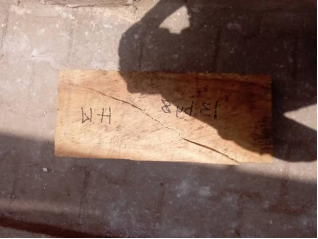
Ceiba pentandra, commonly known as Araba,(as shown in
Figure 2) is a tropical tree belonging to the order Malvales and the family Malvaceae (formerly classified under Bombacaceae). It is indigenous to regions including Mexico, Central America, the Caribbean, Northern and South America, and, as the variety C. pentandra var. guineesis, to tropical West Africa.
Figure 2. Ceiba Pentandra (Araba) softwood.
3.1.2. Top Bond Glue
In Nigeria, a frequently employed wood adhesive is known as "Top Bond." This adhesive (
Figure 3) is of high quality, appearing as a white, water-based substance.
3.1.3. Water
The water that was used in this experiment was obtained from the tap in the Department of civil engineering laboratory, in Edo State University, Uzairue. The water was assumed to be clean, free form contaminants and conforming to the BS 1377 code.
3.2. Experimental Design
Table 4 presents the dimensions of the test specimens following the standards ASTM D193 and EN 408. A set of 8 specimens were dimensioned according to ASTM D193 guidelines and prepared for bending tests. These, eight (8) specimens were designated for the glue-laminated beams.
Table 4. Experimental Design.
Dimension of Test Piece | Glue Laminated timber |
1000mm × 25mm × 25mm | 2 |
1000mm × 50mm × 50mm | 2 |
1000mm × 75mm × 75mm | 2 |
1000mm × 100mm × 100mm | 2 |
Total number of samples | 8 |
3.2.1. Sample Collection and Preparation
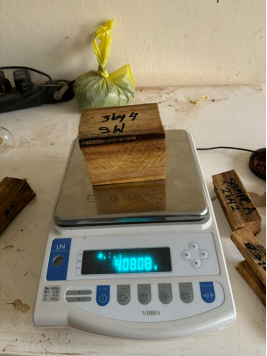
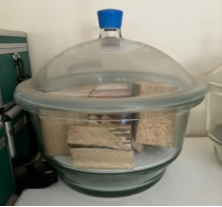
The test pieces (as shown in
Figures 4 and 5) were sourced from Etasako West, Esan South-East, Owan West, Igueben of Edo State, Southern central, Nigeria. The samples were conditioned in a standard environment (20°C and 65% relative humidity) and weighed to determine the density.
Figure 4. Test sample being weighed.
Figure 5. Test pieces in a Desiccator.
3.2.2. Laboratory Test
The various tests carried out on the timbers include:
3.2.3. Moisture Content Determination
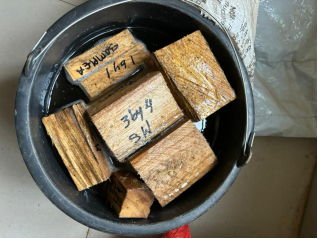
The Moisture Content was determined (BS EN 13183-1: 2002) using Equation (
4).
×=×(4)
Dry weight = W1
Weight in Water = W2
Figure 6. Soaked Timber Samples.
3.2.4. Density Determination
The density of the sample was determined (BS EN 13183-1: 2002) using Equation (
5).
(5)
where mx is the mass of timber at moisture content x,
m0 is the mass of timber at zero moisturecontent,
µ is the percentage moisture content,
vx is the volume of timber at moisture content x,
v0 is the volume of timber at zeromoisture content,
sv is the percentage volumetric shrinkage/expansion,
Figure 7. Weighing Timber Samples.
3.3. Static Bending Test (Flexure)
The specimen shape and the test method for this experiment were carried out in accordance with BS 373:1957 (Methods of Testing Small clear Specimens of Timber).
Test piece dimension: The test specimens for the static bending test were cut into (1000mm × 25mm × 25mm, 1000mm × 50mm × 50mm, 1000mm × 75mm × 75mm, 1000mm × 100mm × 100mm) in accordance to the secondary method of BS 373: 1957.
Sample size: 20 test samples were used for each timber species.
Apparatus: Universal Testing Machine (UTM), Hand operated G-Saw, Vernier caliper.
Test procedure: The specimens were loaded radially (tangential surface) at the centre to failure, on the span length of 280 mm (Central loading method). The test pieces were supported at the ends in such a way that they were quite free to follow the bending action, and were not restrained by friction which would resist the bending and tend to introduce longitudinal stresses. The modulus of elasticity (MOE) and modulus of rupture (MOR) were obtained from the Universal testing machine interfaced with a personal computer in which a BASIC program immediately after the test was performed. The straining rate for the static bending tests was at 0.26 in/min (6.6 mm/min). For the timber species, a total number of 80 samples were tested for static bending.
The static bending strength (flexural strength) or Modulus of Rupture (MOR) was calculated using Equation (
4). The Bending Modulus/Modulus of elasticity (MOE) was obtained from Equation (
5). According to BS 384 (2004), the characteristic values of strength properties based on the measured MC were calculated using Equation (
6).
Where f
k and f0.5 are the characteristic and 5th-percentile values of bending strength, respectively. fk is a factor to allow for the lower variability of f0.5 values between samples for machine grades in comparison with visual grades; for machine grades with fmk greater than 30 N/mm
2, and all visual grades, kv =1.0 for machine grades with fm equal to or less than 30 N/mm
2, kv =1.12. The 12% MC adjustment for bending strength as required by EN 338 (2009) was made using Equation (
7).
(7)
Where fm,12% is the bending strength at 12%, u is the measured MC (%) and fmeasure is the measured bending strength.
4. Results and Discussion
Tables 5 and 6 show the comparison in moisture content for the softwood and hardwood specimen. The comparison was made for glue thin plated and solid timber specimen. The solid timber tends to absorb less moisture compared to glued timber beams.
The average moisture content for 25-100 mm solid, and glued timber is in the range: 11.3-12.0% for softwood and 8.2-10.2% for hardwood. The solid timber has the lowest moisture content (8.2%) compared to other beam specimen. The EN 338 pegged the requirements for moisture content at 12% for structural timber classification. The estimated moisture content for all the tested specimen in this research are within this specification. The results of the density test are presented in
Tables 6, 7 and 8 respectively. The densities are compared for glued and solid timber specimen. For the hardwood specimen, the average density of the glue-laminated beams was approximate the same with that of the solid beam specimen. However, the glue-llaminate beam specimen (softwood) revealed the least density as shown in
Table 5. Ceiba pentandrea is a coniferous specie (softwood) because its characteristic density fell within the softwood density ranging from 540-590 kg/m
3 as specified by BS5268 code. Terminalia ivorensis and Tectona grandis are deciduous species (hardwood) because their characteristic densities fell within the hardwood density ranging from 590-1200 kg/m
3.
Table 5. Moisture Contents of Soft Wood Specimen.
SOFTWOOD |
Properties | Ceiba Pentandra timber (glued) | Ceiba Pentandra timber (solid) |
Thickness (mm) | 25 | 50 | 75 | 100 | 25 | 50 | 75 | 100 |
Initial Mass (kg) | 0.2 | 0.9 | 2.5 | 3.9 | 0.2 | 0.85 | 2.4 | 3.5 |
Oven Dry Mass (kg) | 0.18 | 0.80 | 2.2 | 3.5 | 0.18 | 0.78 | 2.1 | 3.15 |
Moisture Content (%) | 11 | 12.5 | 13.6 | 10.8 | 11 | 9 | 14.3 | 11 |
Average M.C. (%) | 12.0 | 11.3 |
Table 6. Moisture Contents of Hard Wood Specimens.
HARDWOOD |
Properties | Terminalia ivorensis (glued) | Terminalia ivorensis (solid) |
Thickness (mm) | 25 | 50 | 75 | 100 | 25 | 50 | 75 | 100 |
Initial Mass (kg) | 0.5 | 1.5 | 3.5 | 5.8 | 0.44 | 1.6 | 3.5 | 5.8 |
Oven Dry Mass (kg) | 0.46 | 1.3 | 3.2 | 5.4 | 0.37 | 1.5 | 3.35 | 5.5 |
Moisture Content (%) | 8.7 | 15.4 | 9.4 | 7.4 | 16.2 | 6.7 | 4.5 | 5.5 |
Average M.C. (%) | 10.2 | 8.2 |
Table 7. Densities and Classification of Ceiba Pentandra timber (Softwood).
SOFTWOOD |
Properties | Ceiba Pentandra timber (glued) | Ceiba Pentandra timber (solid) |
Thickness (mm) | 25 | 50 | 75 | 100 | 25 | 50 | 75 | 100 |
Mass (kg) | 0.2 | 0.9 | 2.5 | 3.9 | 0.35 | 1.2 | 2.9 | 4.8 |
Volume (m3) × 10-3 | 0.63 | 2.5 | 5.6 | 10 | 0.63 | 2.5 | 5.6 | 10 |
Density (Kg/m3) | 320 | 360 | 444 | 390 | 560 | 480 | 515 | 480 |
Average Density (Kg/m3) | 378.5 | 508.8 |
BS 5268 Classification | SC1-SC3 | SC1-SC3 |
Table 8. Densities and Classification of Terminalia ivorensis timber (Hardwood).
Hardwood |
Properties | Terminalia ivorensis timber (glued) | Terminalia ivorensis timber (solid) |
Thickness (mm) | 25 | 50 | 75 | 100 | 25 | 50 | 75 | 100 |
Mass (kg) | 0.5 | 1.9 | 3.6 | 5.9 | 0.5 | 1.5 | 3.3 | 8.2 |
Volume (m3) × 10-3 | 0.63 | 2.5 | 5.6 | 10 | 0.63 | 2.5 | 5.6 | 10 |
Densit y (Kg/m3) | 800 | 760 | 640 | 590 | 800 | 600 | 587 | 820 |
Average Density (Kg/m3) | 697.5 | 701.8 |
BS 5268 Classification | SC5 | SC5 |
5. Conclusion
The conducted study investigated the moisture content and density of various softwood and hardwood specimens for both solid and glued. The findings highlight key differences in the properties of these materials, providing valuable insights for their application in construction. The average moisture content for softwood specimens ranged from 11.3% to 12.0%, while hardwood specimens ranged from 8.2% to 10.2%. Notably, solid timber exhibited lower moisture content compared to glued timber beams. This indicates that solid timber is less prone to moisture absorption, making it potentially more stable in varying environmental conditions. All tested specimens met the EN 338 moisture content requirement of 12% for structural timber classification. The average density of softwood specimens (Ceiba Pentandra) was higher in solid timber (508.8 kg/m3) compared to glued timber (378.5 kg/m3). For hardwood (Terminalia ivorensis), densities were fairly similar between solid (701.8 kg/m3) and glued timber (697.5 kg/m3). The classifications based on BS 5268 standards confirmed the categorization of Ceiba Pentandra as softwood and Terminalia ivorensis as hardwood, aligning with their characteristic densities.
Abbreviations
BS | British Standard |
MOR | Modulus of Rupture |
MOE | Modulus of Elasticity |
Author Contributions
Ibrahim Abdulrazaq Olayinka: Supervision
Oseghale Osetohanmen Florence: Data curation, Methodology
Akinyemi Kehinde Murisel: Visualization
Wasiu John: Validation
Conflicts of Interest
The authors declare no conflict of interest.
References
| [1] |
Adams, R. D. (2018). Wood properties and uses. Timber Press.
|
| [2] |
Adekoya, A. S., Ojo, A. E., & Babalola, D. A. (2018). Preservative treatment of timber for improved durability. Journal of Wood Science, 64(2), 123-130.
|
| [3] |
Ahmad, Z., & Anwar, H. (2019). Moisture content and timber durability. Journal of Wood Science, 55(4), 321-334.
|
| [4] |
Anderson, T., & Smith, K. (2020). Structural timber design. Macmillan.
|
| [5] |
Antwi, K., Effah, B., Adu, G., & Adu, S. (2014). Strength and some Physical Properties of Allanblackia Parviflora for Furniture Production in Ghana. International Journal of Science and Technology.
|
| [6] |
Ezeagu, C. A., Eromosele, A., Okoro, H., Chukwujekwy, U., & Emetomo, T. (2015). Flexural Strength of solid and glue-laminated timber beams. American Journal of Engineering Science and Technology Research, 3(1), 1-14.
|
| [7] |
Cai, Z., & Ross, R. J. (2010). Mechanical Properties of Wood-Based Composite Materials. Forest Products Laboratory.
|
| [8] |
Green, P., & Black, A. (2017). Wood Mechanics. London: CRC Press.
|
| [9] |
Miguel, J., Oliveira, L., & Santos, J. (2021). Environmental sustainability of glued laminated timber. Environmental Research Letters, 16(3), 034024.
|
| [10] |
Oliveira, L. A., Silva, J. P., & Souza, C. R. (2020). Adhesive bonding techniques for enhanced structural stability in timber. Construction and Building Materials, 245, 118491.
|
| [11] |
Oyebanji, O., & Ogunde, A. (2019). Mechanical properties of thin plated glued timber: A study using local wood species. Nigerian Journal of Engineering, 26(1), 45-56.
|
| [12] |
Wasiu, J. (2022). Glulam timber in the Canadian construction market. Canadian Journal of Civil Engineering, 49(1), 12-22.
|
| [13] |
Young, P. (2020). Structural applications of wood. University of Toronto Press. Zhang, Y. (2018). Wood engineering and design. Tsinghua University Press.
|
| [14] |
AbdulRahaman, A. A., Akinyemi, O., & Dauda, A. (2009). Indigenous timber species utilized in Irepodun Local Government Area of Kwara State, Nigeria. Ilorin: University of Ilorin Press.
|
| [15] |
Adebara, S. A., Adebara, O. I., & Ojo, A. O. (2014). Physical and mechanical properties of selected Nigerian timber species. Journal of Environmental Science, Toxicology and Food Technology, 8(4), 28–34.
|
| [16] |
ASTM International. (2025). ASTM D143-25: Standard test methods for small clear specimens of timber. ASTM International.
|
| [17] |
ASTM International. (2022). ASTM D198-22a: Standard test methods of static tests of lumber in structural sizes. ASTM International.
|
| [18] |
Beak Consultants Limited. (1999). Forest resources study, Nigeria: Timber species and utilization report. Kaduna, Nigeria.
|
| [19] |
British Standards Institution. (1957). BS 373: Methods of testing small clear specimens of timber. London: BSI.
|
| [20] |
European Committee for Standardization (CEN). (2012). EN 408: Timber structures—Structural timber and glued laminated timber—Determination of some physical and mechanical properties. Brussels: CEN.
|
| [21] |
Falemara, B. C., Aina, O. M., & Omole, A. O. (2012). Determination of physical properties of selected Nigerian timber species. Nigerian Journal of Technology, 31(2), 135–142.
|
| [22] |
Forest Products Laboratory. (2010). Wood handbook: Wood as an engineering material (General Technical Report FPL-GTR-190). Madison, WI: U.S. Department of Agriculture, Forest Service, Forest Products Laboratory.
|
| [23] |
National Council for Public Works. (1973). NCP 2: Nigerian standard code of practice for the use of timber in building construction. Lagos, Nigeria.
|
Cite This Article
-
APA Style
Olayinka, I. A., Florence, O. O., Murisel, A. K., John, W. (2026). Assessment of Physical and Mechanical Properties of Solid and Thin-Plated Glued Timbers. Science Research, 14(4), 244-252. https://doi.org/10.11648/j.sr.20261404.25
 Copy
|
Copy
|
 Download
ACS Style
Olayinka, I. A.; Florence, O. O.; Murisel, A. K.; John, W. Assessment of Physical and Mechanical Properties of Solid and Thin-Plated Glued Timbers. Sci. Res. 2026, 14(4), 244-252. doi: 10.11648/j.sr.20261404.25
Copy
|
Download
AMA Style
Olayinka IA, Florence OO, Murisel AK, John W. Assessment of Physical and Mechanical Properties of Solid and Thin-Plated Glued Timbers. Sci Res. 2026;14(4):244-252. doi: 10.11648/j.sr.20261404.25
Copy
|
Download
-
@article{10.11648/j.sr.20261404.25,
  author = {Ibrahim Abdulrazaq Olayinka and Oseghale Osetohanmen Florence and Akinyemi Kehinde Murisel and Wasiu John},
  title = {Assessment of Physical and Mechanical Properties of Solid and Thin-Plated Glued Timbers},
  journal = {Science Research},
  volume = {14},
  number = {4},
  pages = {244-252},
  doi = {10.11648/j.sr.20261404.25},
  url = {https://doi.org/10.11648/j.sr.20261404.25},
  eprint = {https://article.sciencepublishinggroup.com/pdf/10.11648.j.sr.20261404.25},
  abstract = {Thin plated glued timbers (TPT) have emerged as a promising alternative to conventional construction materials due to their cost-effectiveness, sustainability, and structural versatility. Despite promising performance, there's a lack of understanding regarding TPT's suitability for structural applications. This study investigates the moisture content and density of various softwood and hardwood specimens obtained from Edo State, Nigeria, focusing on both solid and glued timber. The primary aim is to provide insights into the structural performance of these materials, guiding their applications in construction projects. Moisture content analysis revealed that solid timber generally absorbs less moisture compared to glued timber beams, with average moisture contents ranging from 11.3% to 12.0% for softwood and 8.2% to 10.2% for hardwood. These values are within the EN 338 standard for structural timber, pegged at 12%. Density measurements indicated that solid Ceiba Pentandra timber (softwood) had a higher average density (508.8 kg/m3) compared to its glued counterpart (378.5 kg/m3), while Terminalia ivorensis timber (hardwood) showed similar densities between solid (701.8 kg/m3) and glued specimens (697.5 kg/m3).},
 year = {2026}
}
Copy
|
Download
-
TY  - JOUR
T1  - Assessment of Physical and Mechanical Properties of Solid and Thin-Plated Glued Timbers
AU  - Ibrahim Abdulrazaq Olayinka
AU  - Oseghale Osetohanmen Florence
AU  - Akinyemi Kehinde Murisel
AU  - Wasiu John
Y1  - 2026/08/22
PY  - 2026
N1  - https://doi.org/10.11648/j.sr.20261404.25
DO  - 10.11648/j.sr.20261404.25
T2  - Science Research
JF  - Science Research
JO  - Science Research
SP  - 244
EP  - 252
PB  - Science Publishing Group
SN  - 2329-0927
UR  - https://doi.org/10.11648/j.sr.20261404.25
AB  - Thin plated glued timbers (TPT) have emerged as a promising alternative to conventional construction materials due to their cost-effectiveness, sustainability, and structural versatility. Despite promising performance, there's a lack of understanding regarding TPT's suitability for structural applications. This study investigates the moisture content and density of various softwood and hardwood specimens obtained from Edo State, Nigeria, focusing on both solid and glued timber. The primary aim is to provide insights into the structural performance of these materials, guiding their applications in construction projects. Moisture content analysis revealed that solid timber generally absorbs less moisture compared to glued timber beams, with average moisture contents ranging from 11.3% to 12.0% for softwood and 8.2% to 10.2% for hardwood. These values are within the EN 338 standard for structural timber, pegged at 12%. Density measurements indicated that solid Ceiba Pentandra timber (softwood) had a higher average density (508.8 kg/m3) compared to its glued counterpart (378.5 kg/m3), while Terminalia ivorensis timber (hardwood) showed similar densities between solid (701.8 kg/m3) and glued specimens (697.5 kg/m3).
VL  - 14
IS  - 4
ER  -
Copy
|
Download





 Share This Article
 Twitter
 Linked In
 Facebook