
Peak floor acceleration is a crucial engineering parameter for evaluating the seismic damage and post-earthquake functional state of non-structural components in buildings. To address the limitations of traditional dynamic time-history analysis, such as complex physical modeling and cumbersome computations, a data-driven rapid prediction model based on Extreme Gradient Boosting (XGBoost) is proposed, utilizing real steel structure array monitoring records. By taking ground motion intensity and spatial structural characteristics as inputs, a Bayesian optimization algorithm based on the Tree-structured Parzen Estimator (TPE) is introduced to achieve intelligent hyperparameter tuning. The results demonstrate that the optimized machine learning model exhibits excellent prediction accuracy and generalization performance. Furthermore, attribution analysis combining feature importance and the SHAP interpretability framework reveals that peak ground acceleration and normalized height are the core features dominating the amplification of floor responses. Validation through a finite element case study confirms that the model can effectively reproduce the variation of peak floor acceleration along the building height using only macroscopic geometric parameters of the structure. This provides a reliable analytical tool with physical interpretability for the rapid seismic performance assessment of non-structural components.
| Published in | Science Research (Volume 14, Issue 3) |
| DOI | 10.11648/j.sr.20261403.17 |
| Page(s) | 113-121 |
| Creative Commons |
This is an Open Access article, distributed under the terms of the Creative Commons Attribution 4.0 International License (http://creativecommons.org/licenses/by/4.0/), which permits unrestricted use, distribution and reproduction in any medium or format, provided the original work is properly cited. |
| Copyright |
Copyright © The Author(s), 2026. Published by Science Publishing Group |
Peak Floor Acceleration, Steel Structures, Non-structural Components, XGBoost, Bayesian Optimization, Interpretability Analysis
变量 | 均值 | 最小值 | 中位数 | 最大值 |
|---|---|---|---|---|
L1(m) | 73.07 | 12.19 | 67.06 | 208.18 |
L2(m) | 56.61 | 3.29 | 53.04 | 146.30 |
z(无量纲) | 0.52 | 0 | 0.50 | 1 |
VS30(m/s) | 358.25 | 162 | 339 | 2565 |
PGA(g) | 0.023 | 0.0015 | 0.012 | 0.427 |
PFA(g) | 0.031 | 0.0015 | 0.017 | 0.733 |
 (1)
(1) 超参数名称 | 最优结果 |
|---|---|
弱评估器个数 | 1487 |
最大深度 | 5 |
学习率 | 0.044 |
样本子采样率 | 0.936 |
特征列采样率 | 0.673 |
最小损失函数下降值 | 1.034 |
L1正则化惩罚项系数 | 0.033 |
L2正则化惩罚项系数 | 0 |
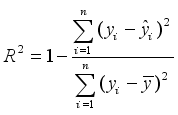 (2)
(2) 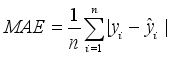 (3)
(3) 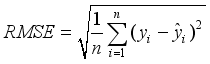 (4)
(4)  为样本真实值,
  为样本预测值,
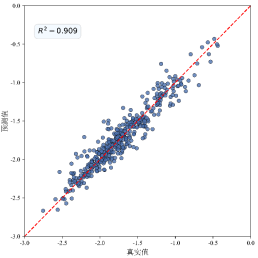
  为所有样本真实值的平均值。表3给出了优化前后的模型性能评价指标,经过超参数优化后,模型的R2提升了1.33%,MAE降低了4.32%,RMSE降低了5.93%,表明调优后的模型具有更高的预测精度。
 R2 | MAE | RSME | |
|---|---|---|---|
优化前 | 0.89 | 0.10 | 0.14 |
优化后 | 0.91 | 0.09 | 0.13 |
基底 | 1层 | 2层 | 3层 | |
|---|---|---|---|---|
(z=0) | (z=1/3) | (z=2/3) | (z=1) | |
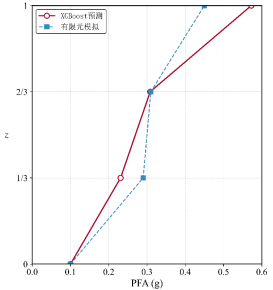
计算值(g) | 0.1 | 0.29 | 0.31 | 0.45 |
预测值(g) | 0.1 | 0.23 | 0.31 | 0.57 |
| [1] | 贺思维, 曲哲, 周惠蒙等.非结构构件抗震性能试验方法综述 [J]. 土木工程学报, 2017, 50(9): 16-27. |
| [2] | 刘汉泉, 曲哲. 建筑内部物品滑移破坏易脆性分析中的楼面运动强度指标 [J]. 世界地震工程, 2020, 36(2): 85-91. |
| [3] | 尚庆学, 郑迦译, 李吉超,等.各国规范对于楼面峰值加速度规定的对比研究 [J]. 工程力学, 2020, 37(S1): 71-77. |
| [4] | 刘荣恒, 柏文, 戴君武等. 基于强震记录的建筑结构楼层设计谱研究 [J]. 工程力学, 2024, 41(12): 176-188. |
| [5] | 唐小微, 白旭, 胡记磊. 基于贝叶斯网络的自由场地震液化沉降评估 [J]. 振动与冲击, 2018, 37(18): 177-183. |
| [6] | JIA J, GONG M, ZUO Z, et al. A novel deep learning-based method for generating floor response spectra of building structures [J]. Engineering Structures, 2025, 322: 119058. |
| [7] | JIA J, GONG M, ZUO Z, et al. Generating elastic floor response spectra using ensemble learning methods with whale optimization algorithm [J]. Structures, 2025, 82: 110587. |
| [8] | 贾佳, 公茂盛, 赵一男. 基于深度学习算法的地震动重要持时预测模型 [J]. 振动与冲击, 2023, 42(19): 249-259. |
| [9] | 崔铭钊, 公茂盛, 左占宣等.基于Light-GBM算法的地震动显著持时预测模型 [J]. 振动与冲击, 2025, 44(16). |
| [10] | 赵继幸. 基于机器学习的高层剪力墙结构地震易损性研究 [D]. 青岛: 青岛理工大学, 2024. |
| [11] | 李征, 陈飞. 自复位钢木混合框架-耗能支撑结构的地震峰值响应代理模型研究 [J]. 建筑结构学报, 2025. |
| [12] | LIU B, GONG M, WANG X, et al. Physics-guided neural network for structural seismic response reconstruction based on floor response spectra [J]. J Build Eng, 2026, 118: 114972. |
| [13] | JIA J, GONG M, ZUO Z, et al. Real-time structural seismic time history response prediction based on physics-informed deep learning [J]. J Build Eng, 2025, 108. |
| [14] | CHEN T, GUESTRIN C. XGBoost: A scalable tree boosting system [C] //Proceedings of the 22nd ACM SIGKDD International Conference on Knowledge Discovery and Data Mining. San Francisco: ACM, 2016: 785-794. |
| [15] | 赵煜东, 许卫晓, 李静等. 基于XGBoost模型集成学习的RC框架结构地震响应预测方法 [J]. 青岛理工大学学报, 2024, 45(2): 78-83. |
APA Style
Li, J., Gong, M. (2026). Prediction and Interpretability Study of Peak Floor Acceleration of Steel Structures Based on XGBoost. Science Research, 14(3), 113-121. https://doi.org/10.11648/j.sr.20261403.17
ACS Style
Li, J.; Gong, M. Prediction and Interpretability Study of Peak Floor Acceleration of Steel Structures Based on XGBoost. Sci. Res. 2026, 14(3), 113-121. doi: 10.11648/j.sr.20261403.17
@article{10.11648/j.sr.20261403.17,
  author = {Jinchi Li and Maosheng Gong},
  title = {Prediction and Interpretability Study of Peak Floor Acceleration of Steel Structures Based on XGBoost},
  journal = {Science Research},
  volume = {14},
  number = {3},
  pages = {113-121},
  doi = {10.11648/j.sr.20261403.17},
  url = {https://doi.org/10.11648/j.sr.20261403.17},
  eprint = {https://article.sciencepublishinggroup.com/pdf/10.11648.j.sr.20261403.17},
  abstract = {Peak floor acceleration is a crucial engineering parameter for evaluating the seismic damage and post-earthquake functional state of non-structural components in buildings. To address the limitations of traditional dynamic time-history analysis, such as complex physical modeling and cumbersome computations, a data-driven rapid prediction model based on Extreme Gradient Boosting (XGBoost) is proposed, utilizing real steel structure array monitoring records. By taking ground motion intensity and spatial structural characteristics as inputs, a Bayesian optimization algorithm based on the Tree-structured Parzen Estimator (TPE) is introduced to achieve intelligent hyperparameter tuning. The results demonstrate that the optimized machine learning model exhibits excellent prediction accuracy and generalization performance. Furthermore, attribution analysis combining feature importance and the SHAP interpretability framework reveals that peak ground acceleration and normalized height are the core features dominating the amplification of floor responses. Validation through a finite element case study confirms that the model can effectively reproduce the variation of peak floor acceleration along the building height using only macroscopic geometric parameters of the structure. This provides a reliable analytical tool with physical interpretability for the rapid seismic performance assessment of non-structural components.},
 year = {2026}
}
TY  - JOUR
T1  - Prediction and Interpretability Study of Peak Floor Acceleration of Steel Structures Based on XGBoost
AU  - Jinchi Li
AU  - Maosheng Gong
Y1  - 2026/06/09
PY  - 2026
N1  - https://doi.org/10.11648/j.sr.20261403.17
DO  - 10.11648/j.sr.20261403.17
T2  - Science Research
JF  - Science Research
JO  - Science Research
SP  - 113
EP  - 121
PB  - Science Publishing Group
SN  - 2329-0927
UR  - https://doi.org/10.11648/j.sr.20261403.17
AB  - Peak floor acceleration is a crucial engineering parameter for evaluating the seismic damage and post-earthquake functional state of non-structural components in buildings. To address the limitations of traditional dynamic time-history analysis, such as complex physical modeling and cumbersome computations, a data-driven rapid prediction model based on Extreme Gradient Boosting (XGBoost) is proposed, utilizing real steel structure array monitoring records. By taking ground motion intensity and spatial structural characteristics as inputs, a Bayesian optimization algorithm based on the Tree-structured Parzen Estimator (TPE) is introduced to achieve intelligent hyperparameter tuning. The results demonstrate that the optimized machine learning model exhibits excellent prediction accuracy and generalization performance. Furthermore, attribution analysis combining feature importance and the SHAP interpretability framework reveals that peak ground acceleration and normalized height are the core features dominating the amplification of floor responses. Validation through a finite element case study confirms that the model can effectively reproduce the variation of peak floor acceleration along the building height using only macroscopic geometric parameters of the structure. This provides a reliable analytical tool with physical interpretability for the rapid seismic performance assessment of non-structural components.
VL  - 14
IS  - 3
ER  -
Key Laboratory of Earthquake Engineering and Engineering Vibration, Institute of Engineering Mechanics, China Earthquake Administration, Harbin, China; Key Laboratory of Earthquake Disaster Mitigation, Ministry of Emergency Management, Harbin, China
Key Laboratory of Earthquake Engineering and Engineering Vibration, Institute of Engineering Mechanics, China Earthquake Administration, Harbin, China; Key Laboratory of Earthquake Disaster Mitigation, Ministry of Emergency Management, Harbin, China

Information



 Share This Article
 Twitter
 Linked In
 Facebook
 Copy
Copy Download