
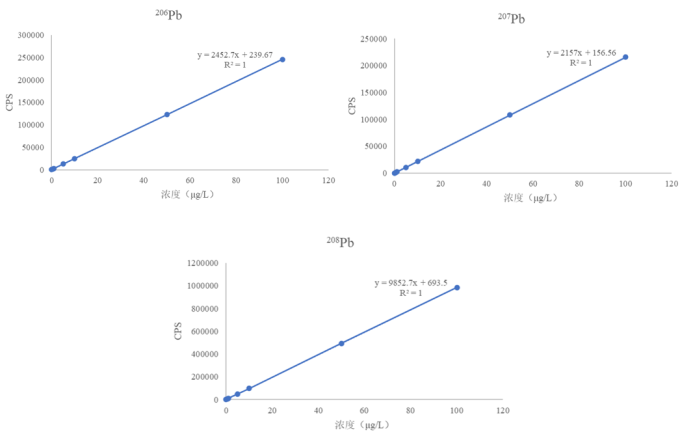
Background Lead is a common occupational toxicant. Long-term exposure to lead can damage the nervous and hematopoietic systems. Blood lead concentration is an important biomarker for assessing recent lead exposure. Establishing an accurate and sensitive method for blood lead determination is of great significance for occupational health monitoring. Objective To establish and validate an inductively coupled plasma mass spectrometry (ICP-MS) method for the determination of lead in blood. Methods Using an Agilent 7850 ICP-MS instrument, blood samples were directly diluted with a diluent containing 0.5% nitric acid and 0.01% Triton X-100. Holmium (Ho) was used as an online internal standard. Lead was measured at m/z 206, 207, and 208 in standard mode. The method was validated for linearity, detection limit, quantification limit, recovery, and precision according to the national standard GBZ/T 316.2-2018. Results Excellent linearity was observed in the range of 0–100 μg/L, with correlation coefficients (R²) of 1 for all three mass numbers. The detection limit was 0.013 μg/L, and the quantification limit was 0.044 μg/L. Recoveries at low (0.4 μg/L), medium (40.0 μg/L), and high (400.0 μg/L) concentration levels were 96.23%, 102.28%, and 100.64%, respectively, with relative standard deviations (RSD) of 1.10%, 0.45%, and 0.43%. Conclusion The method is simple, sensitive, and reproducible. All performance indicators are superior to the national standard requirements, making it suitable for rapid and accurate determination of lead in blood among occupationally exposed populations.
| Published in | Science Research (Volume 14, Issue 3) |
| DOI | 10.11648/j.sr.20261403.15 |
| Page(s) | 99-104 |
| Creative Commons |
This is an Open Access article, distributed under the terms of the Creative Commons Attribution 4.0 International License (http://creativecommons.org/licenses/by/4.0/), which permits unrestricted use, distribution and reproduction in any medium or format, provided the original work is properly cited. |
| Copyright |
Copyright © The Author(s), 2026. Published by Science Publishing Group |
Blood Lead, ICP-MS, Method Validation
参数 | 设计值 |
|---|---|
射频功率 | 1450 W |
冷却气流量(Ar) | 12.5 L/min |
辅助气流量(Ar) | 0.70 L/min |
雾化气流量(Ar) | 0.92 L/min |
蠕动泵转速 | 30 r/min |
雾化器温度 | 3 ℃ |
采样深度 | 8 mm |
测定模式 | 标准模式(无碰撞气体) |
测定质量数 | 206Pb, 207Pb,208Pb |
内标元素 | 165Ho |
内标引入方式 | 在线三通混合 |
内标浓度 | 10.0μg/L |
采集次数 | 3次 |
积分时间 | 0.1 s/质量数 |
每个样品总时间 | 约2 min |
检测项目 | 血铅值(μg/L) |
|---|---|
测定平均值 | 0.3849 |
理论浓度 | 0.4000 |
标准偏差 | 0.0044 |
检出限 | 0.013 |
定量限 | 0.044 |
理论浓度(μg/L) | 实测浓度(μg/L) | 回收率(%) | 精密度(%) |
|---|---|---|---|
0.4 | 0.3849 ± 0.0044 | 96.23 | 1.10 |
40.0 | 40.91 ± 0.18 | 102.28 | 0.45 |
400.0 | 402.57 ±1.70 | 100.64 | 0.43 |
| [1] | 中华人民共和国国家卫生健康委员会. 职业病危害因素分类目录 [S]. 北京: 中国标准出版社, 2015. |
| [2] | 孟金萍, 孙淑华, 王艳蓉,等.铅的生物学毒性效应 [J]. 中国比较医学杂志, 2007(01): 58-61. |
| [3] | 杜林, 黄鸿志, 王雅茜. 铅中毒及其防治研究进展 [J]. 广东微量元素科学, 2001, 8(5): 10. |
| [4] | 杨晓琳, 王苗苗, 张金龙等. 铅暴露水平与主要生物监测指标的剂量-反应关系[J]. 职业与健康, 2013(19): 2. |
| [5] | CDC. Adult Blood Lead Epidemiology and Surveillance (ABLES) Annual Report[R]. Atlanta: Centers for Disease Control and Prevention, 2024. |
| [6] | 陶雪, 潘亚娟, 闫慧芳. 石墨炉原子吸收光谱法测定血铅若干问题探讨[J]. 中华劳动卫生职业病杂志, 2013, 31(8): 2. |
| [7] | 游慧圆, 沈丽菲, 张琼等. 原子吸收光谱仪测定全血中铅, 镉的方法研究[J]. 大众科技, 2018(004): 020. |
| [8] | 李筱薇, 高俊全. 阳极溶出伏安法与石墨炉原子吸收光谱法在血铅检测中的应用比较 [J]. 卫生研究, 2007, 36(1): 3. |
| [9] | 张爱华, 董明, 李娟等. 电感耦合等离子体-质谱在职业卫生检测中应用 [J]. 中国职业医学, 2014, 041(001): 56-60. |
| [10] | GBZ/T 316.2-2018, 血中铅的测定 第2部分: 电感耦合等离子体质谱法 [S]. 北京: 中国标准出版社, 2018. |
| [11] | 王治国. 临床检验方法学评价 [M]. 第2版. 北京: 人民卫生出版社, 2020: 156-170. |
| [12] | 张淼, 郑磊, 孙琦等. 电感耦合等离子体质谱法测定血铅实验影响因素 [J]. 卫生研究, 2023, 6: 136-141. |
| [13] | Liu Y, Liu F, Dong KF, et al. Regional characteristics of children's blood lead levels in China: A systematic synthesis of national and subnational population data [J]. Science of The Total Environment, 2021, 769(9): 144649. |
| [14] | 彭荣飞, 甘平胜, 黄聪. ICP-MS直接测定儿童全血中Pb, Cd, Cu, Zn, Mn, Fe和Ca [J]. 中国卫生检验杂志, 2006, 16(011): 1303-1304. |
| [15] | Gajek R, Barley F, She J. Determination of essential and toxic metals in blood by ICP-MS with calibration in synthetic matrix [J]. Analytical Methods, 2013, 5, 2193-2202. |
APA Style
Zhou, X. (2026). Confirmation of the ICP-MS Method for the Determination of Blood Lead. Science Research, 14(3), 99-104. https://doi.org/10.11648/j.sr.20261403.15
ACS Style
Zhou, X. Confirmation of the ICP-MS Method for the Determination of Blood Lead. Sci. Res. 2026, 14(3), 99-104. doi: 10.11648/j.sr.20261403.15
@article{10.11648/j.sr.20261403.15,
  author = {Xiaomin Zhou},
  title = {Confirmation of the ICP-MS Method for the Determination of Blood Lead},
  journal = {Science Research},
  volume = {14},
  number = {3},
  pages = {99-104},
  doi = {10.11648/j.sr.20261403.15},
  url = {https://doi.org/10.11648/j.sr.20261403.15},
  eprint = {https://article.sciencepublishinggroup.com/pdf/10.11648.j.sr.20261403.15},
  abstract = {Background Lead is a common occupational toxicant. Long-term exposure to lead can damage the nervous and hematopoietic systems. Blood lead concentration is an important biomarker for assessing recent lead exposure. Establishing an accurate and sensitive method for blood lead determination is of great significance for occupational health monitoring. Objective To establish and validate an inductively coupled plasma mass spectrometry (ICP-MS) method for the determination of lead in blood. Methods Using an Agilent 7850 ICP-MS instrument, blood samples were directly diluted with a diluent containing 0.5% nitric acid and 0.01% Triton X-100. Holmium (Ho) was used as an online internal standard. Lead was measured at m/z 206, 207, and 208 in standard mode. The method was validated for linearity, detection limit, quantification limit, recovery, and precision according to the national standard GBZ/T 316.2-2018. Results Excellent linearity was observed in the range of 0–100 μg/L, with correlation coefficients (R²) of 1 for all three mass numbers. The detection limit was 0.013 μg/L, and the quantification limit was 0.044 μg/L. Recoveries at low (0.4 μg/L), medium (40.0 μg/L), and high (400.0 μg/L) concentration levels were 96.23%, 102.28%, and 100.64%, respectively, with relative standard deviations (RSD) of 1.10%, 0.45%, and 0.43%. Conclusion The method is simple, sensitive, and reproducible. All performance indicators are superior to the national standard requirements, making it suitable for rapid and accurate determination of lead in blood among occupationally exposed populations.},
 year = {2026}
}
TY  - JOUR
T1  - Confirmation of the ICP-MS Method for the Determination of Blood Lead
AU  - Xiaomin Zhou
Y1  - 2026/06/09
PY  - 2026
N1  - https://doi.org/10.11648/j.sr.20261403.15
DO  - 10.11648/j.sr.20261403.15
T2  - Science Research
JF  - Science Research
JO  - Science Research
SP  - 99
EP  - 104
PB  - Science Publishing Group
SN  - 2329-0927
UR  - https://doi.org/10.11648/j.sr.20261403.15
AB  - Background Lead is a common occupational toxicant. Long-term exposure to lead can damage the nervous and hematopoietic systems. Blood lead concentration is an important biomarker for assessing recent lead exposure. Establishing an accurate and sensitive method for blood lead determination is of great significance for occupational health monitoring. Objective To establish and validate an inductively coupled plasma mass spectrometry (ICP-MS) method for the determination of lead in blood. Methods Using an Agilent 7850 ICP-MS instrument, blood samples were directly diluted with a diluent containing 0.5% nitric acid and 0.01% Triton X-100. Holmium (Ho) was used as an online internal standard. Lead was measured at m/z 206, 207, and 208 in standard mode. The method was validated for linearity, detection limit, quantification limit, recovery, and precision according to the national standard GBZ/T 316.2-2018. Results Excellent linearity was observed in the range of 0–100 μg/L, with correlation coefficients (R²) of 1 for all three mass numbers. The detection limit was 0.013 μg/L, and the quantification limit was 0.044 μg/L. Recoveries at low (0.4 μg/L), medium (40.0 μg/L), and high (400.0 μg/L) concentration levels were 96.23%, 102.28%, and 100.64%, respectively, with relative standard deviations (RSD) of 1.10%, 0.45%, and 0.43%. Conclusion The method is simple, sensitive, and reproducible. All performance indicators are superior to the national standard requirements, making it suitable for rapid and accurate determination of lead in blood among occupationally exposed populations.
VL  - 14
IS  - 3
ER  -
Huizhou Occupational Health Hospital, Huizhou, China

Information



 Share This Article
 Twitter
 Linked In
 Facebook
 Copy
Copy Download