Abstract
The use of generative AI in education raises concerns primarily due to its impact on academic integrity. However, some researchers believe it could significantly help students with disabilities. So far, there has been no research on how these students use generative AI for academic writing. Based on a previous interview study and an AI-literacy model, we surveyed students about their use of generative AI, receiving 100 valid responses out of 5,000 from students with disabilities. We identified key conditions affecting writing, such as ADHD, dyslexia, dyspraxia, and autism. The primary generative AI tools employed were chatbots, particularly ChatGPT, along with rewriting applications. These tools were employed for various academic writing tasks. Main concerns expressed by students with disabilities included the inaccuracy of AI responses, potential threats to academic integrity, and the cost of subscriptions. Students also demonstrated a strong interest in being involved in AI policy development and expressed a desire for schools/universities to offer training on generative AI. Inspired by the daily experiences of my daughter, Saanvi, who has autism spectrum disorder (ASD), this research explores the potential of generative AI to enable more inclusive and equitable educational strategies. The paper concludes with recommendations for addressing educational gaps and promoting inclusivity.
|
Published in
|
Science Journal of Education (Volume 14, Issue 3)
|
|
DOI
|
10.11648/j.sjedu.20261403.16
|
|
Page(s)
|
87-97 |
|
Creative Commons
|

This is an Open Access article, distributed under the terms of the Creative Commons Attribution 4.0 International License (http://creativecommons.org/licenses/by/4.0/), which permits unrestricted use, distribution and reproduction in any medium or format, provided the original work is properly cited.
|
|
Copyright
|
Copyright © The Author(s), 2026. Published by Science Publishing Group
|
Keywords
ChatGPT, Artificial Intelligence (AI), Generative AI, Students with Disabilities, Academic Writing, AI Literacy
1. Introduction
The incredible capabilities of ChatGPT led to its rapid adoption after it was released to the public in November 2022. Its ability to provide coherent answers to questions, rewrite text in various styles, proofread and summarize content, and write code made it valuable across many contexts. The way it delivered well-formed answers to short prompts changed how people viewed AI's potential. However, many concerns arose during public discussions. These included worries about the accuracy and timeliness of the information it generates, its tendency to create false information, biases in its responses, and privacy issues. Allegations that copyright material was used to train models like ChatGPT without permission led to multiple lawsuits. Additionally, Perrigo (2023) highlighted how low-paid workers in some countries filtered content used for training ChatGPT. There were also concerns about the environmental impact and resource demands of AI models in general
. As a result, ChatGPT and similar services like Google Gemini sparked both excitement and controversy. One significant area of debate was the role of ChatGPT in education. Many anticipated benefits of generative AI for learning included making information more accessible, personalizing education, and promoting critical thinking
| [6] | Bozkurt, A., Junhong, X., Lambert, S., Pazurek, A., Crompton, H., Koseoglu, S.,... & Romero-Hall, E. (2023). Speculative futures on ChatGPT and generative artificial intelligence (AI): A collective reflection from the educational landscape. Asian Journal of Distance Education, 18(1), 53-130.
http://doi.org/10.5281/zenodo.7636568 |
[6]
. Many uses for teachers were also identified
. However, there were widespread fears about the potential negative effects of generative AI on education, especially regarding increased plagiarism
. The difficulty in automatically detecting AI-generated text made plagiarism detection software ineffective. Furthermore, banning students from using these tools was seen as impractical. Many Universities in the UK, introduced policies, but providing clear guidance was challenging, and enforcing that guidance was even harder. Academics worried that generative AI might make students less critical or produce less authentic writing
| [4] | Bender, E. M., Gebru, T., McMillan-Major A., & Shmitchell, S. (2021). On the Dangers of Stochastic Parrots: Can Language Models Be Too Big? Proceedings of the 2021 ACM conference on fairness, accountability, and transparency.
https://doi.org/10.1145/3442188.3445922 |
[4]
and possibly hinder their creativity
| [12] | Cotton, D. R., Cotton, P. A., & Shipway, J. R. (2024). Chatting and cheating: Ensuring academic integrity in the era of ChatGPT. Innovations in education and teaching international, 61(2), 228-239. https://doi.org/10.1080/14703297.2023.2190148 |
[12]
. Broader concerns about generative AI, like biases, privacy, and equitable access, were also significant issues for its use in higher education
| [15] | Grassini, S. (2023). Shaping the future of education: exploring the potential and consequences of AI and ChatGPT in educational settings. Education Sciences, 13(7), 692.
https://doi.org/10.3390/educsci13070692 |
[15]
. To use it safely, a certain level of generative AI literacy was necessary
. Despite these challenges, some researchers believed that generative AI could be especially beneficial for students with disabilities
| [1] | Addy, T., Kang, T., Laquintano, T., & Dietrich, V. (2023). Who Benefits and Who is Excluded?: Transformative Learning, Equity, and Generative Artificial Intelligence. Journal of Transformative Learning, 10(2), 92-103. |
[1]
, offering new types of support
. This aligns with suggestions that generative AI could benefit people with disabilities overall. For instance,
argued that generative AI creates new chances for organizations to provide tailored assistive technology solutions to employees with disabilities.
| [2] | Adnin, R., & Das, M. (2024). “I look at it as the king of knowledge”: How Blind People Use and Understand Generative AI Tools. Proceedings of the 26th International ACM SIGACCESS Conference on Computers and Accessibility (ASSETS ’24). ACM.
https://doi.org/10.1145/3663548.3675631 |
[2]
found that the 'visual question answering' feature of generative AI is beneficial for blind users. However, they also noted the need to rethink the design and policies surrounding generative AI from this user's perspective to ensure equal benefits. In the learning context, there appears to be potential for generative AI to assist students with tasks such as proofreading, text summarization, and interactive support, which could greatly benefit students with learning difficulties, including dyslexia
. UK schools/universities have begun offering generative AI chatbots as part of their learning management systems, including at the institution where data for this study was collected. At that institution, the Google Gemini chatbot was introduced as part of a Google-based learning platform. Given universities' legal responsibility to promote equality of opportunity and the continued under-representation of students with disabilities in UK higher education
| [9] | Chan, C. K. Y., & Hu, W. (2023). Students’ voices on generative AI: Perceptions, benefits, and challenges in higher education. International Journal of Educational Technology in Higher Education, 20(1), 43.
http://doi.org/10.1186/s41239-023-00411-8 |
[9]
generative AI seems to hold great promise. Especially when paired with improved lecture transcription, generative AI represents a significant leap forward in technologies that support learning. However, generative AI tools were not designed with these user groups in mind, so studying their impact requires further investigation. Initial discussions about generative AI in higher education occurred with limited systematic evidence on how students were utilizing AI in various learning environments. Although research is starting to emerge regarding students' use of generative AI, a significant gap remains in studies specifically focused on how students with disabilities engage with generative AI, particularly in academic writing, which is crucial in higher education. Based on insights from previous research that developed a model of generative AI literacy for academic writing
| [32] | Sullivan, M., Kelly, A., & McLaughlan, P. (2023). ChatGPT in higher education: Considerations for academic integrity and student learning. Journal of Applied Learning & Teaching, 6(1), 1-10. https://doi.org/10.37074/jalt.2023.6.1.17 |
| [38] | Zhao, X., Cox, A., & Cai, L. (2024). ChatGPT and the digitisation of writing. Humanities and Social Sciences Communications, 11(1), 1-9. https://doi.org/10.1057/s41599-024-02904-x |
[32, 38]
, this study aimed to explore how students with disabilities utilize generative AI.
The study aimed to explore the following research questions:
1) Which generative AI tools do students with disabilities utilize, and for what specific purposes?
2) What concerns or apprehensions do students with disabilities have regarding generative AI?
3) What types of support do students with disabilities require from their institutions to effectively use generative AI?
2. Survey of Existing Research
Generative AI in Education
The early discussion about generative AI lacked a clear understanding of its actual usage. However, 18 months after ChatGPT's launch, a clearer picture is emerging about how students are adopting generative AI. We now have international surveys
, national studies like those in the UK
, along with institutional studies. Additionally, detailed qualitative studies by
have provided valuable insights into how students from diverse backgrounds utilize generative AI in their learning. By capturing personal experiences, these studies give a more genuine and clear view of generative AI’s role in higher education.
Overall, students tend to view AI tools positively. A significant number of students, possibly even a majority, have used generative AI in their learning, as shown in
research. This research summarizes students’ attitudes and behaviors in the UK, which is the focus of this study.
data, from February 2024 revealed that two-thirds of UK students had used some form of AI, and a third had applied it for assessments. However, a digital divide is becoming apparent, with students from less privileged areas using AI less frequently. According to
, ChatGPT is the most commonly used service. Many students use it to gain an initial understanding of a concept, though a broad range of potential uses has been identified (JISC, 2024).
Interestingly,
found that most UK students believed there was a clear institutional policy on AI. Students expressed a need for better training from institutions
and for more tools to be provided
. Only 22% of respondents were satisfied with the support they had received
. Other qualitative studies have provided a deeper insight into students’ usage patterns. For instance,
, conducted interviews and observations with UK students, finding that they utilized generative AI in various ways to support different stages of writing. However, none of these surveys or interview-based studies systematically investigated students with disabilities and their use of generative AI. Malmström,
| [21] | Malmström, H, Stöhr, C, & Ou, CW. (2023). Chatbots and other AI for learning: A survey of use and views among university students in Sweden. Chalmers Studies in Communication and Learning in Higher Education 2023.
https://doi.org/10.17196/cls.csclhe/2023/01 |
[21]
mentioned that open-text comments offered anecdotal evidence of AI’s value for students with learning disabilities. This study differs from previous research in its primary focus on students with disabilities, aiming to address the gap in the literature regarding the inclusion of generative AI in higher education.
3. Generative AI for Students with Disabilities
Limited research has been done on the use of generative AI in education for students with disabilities. Some researchers see its potential benefits
. They have pointed out specific tasks where it might help, such as:
1) Reading: Generative AI can support students with disabilities—particularly those with dyslexia—by enhancing their ability to understand learning materials
. Students with cognitive challenges often experience difficulties in processing written text, leading to slower reading speeds and a higher likelihood of errors
| [30] | Schiavo, G., Mana, N., Mich, O., Zancanaro, M., & Job, R. (2021). Attention-driven read-aloud technology increases reading comprehension in children with reading disabilities. Journal of Computer Assisted Learning, 37(3), 875-886.
https://doi.org/10.1111/jcal.12530 |
[30]
. Generative AI tools can address these challenges by summarizing lengthy and complex texts into clear and concise formats, thereby improving comprehension
. This support helps students focus on core concepts and increases their engagement with reading tasks
.
2) Writing: Generative AI can assist students with disabilities—particularly those with dysgraphia—by supporting the planning and organization of writing tasks and by helping refine written output
| [23] | McCarthy, K. S., & Yan, E. F. (2023). Reading Comprehension and Constructive Learning: Policy Considerations in the Age of Artificial Intelligence. PolicyInsights from the Behavioral and Brain Sciences, 11(1), 19-26.
https://doi.org/10.1177/23727322231218891 |
[23]
. Research indicates that these students often face challenges in goal setting, organizing ideas, developing coherence, and revising for clarity and grammatical accuracy
| [28] | Roitsch, J., Gumpert, M., Springle, A., & Raymer, A. M. (2021). Writing instruction for students with learning disabilities: Quality appraisal of systematic reviews and meta-analyses. Reading & Writing Quarterly, 37(1), 32-44.
https://doi.org/10.1080/10573569.2019.1708221 |
[28]
. Generative AI can address these difficulties by clarifying writing instructions, supporting goal setting, and generating structured writing plans
. Additionally, it can help improve coherence and grammatical accuracy, resulting in more transparent and more precise written work
| [25] | Nacheva, R., & Czaplewski, M. (2024). Artificial Intelligence In Helping People With Disabilities: Opportunities And Challenges. HR and Technologies, (1), 102-124. |
[25]
.
3) Social Engagement: Generative AI may support the development of social skills among students with disabilities
). Students with learning disabilities often face challenges in expressing themselves and interpreting others’ verbal and nonverbal cues, which can contribute to social isolation
. Generative AI tools can simulate real-life communication scenarios, allowing students to practice conversational skills and improve their understanding of social interactions
. This practice can enhance peer collaboration and promote greater engagement within the learning environment.
4) Teaching: Generative AI can enhance the quality of education, thereby indirectly benefiting students with disabilities. For example, it can be used to evaluate the accessibility of instructional content and may be trained to identify early indicators of learning disabilities
| [19] | Johnson, C., Smart, K., & Mahar, P. (2023). Is There a Place for Generative Artificial Intelligence in Special Education?. National Social Science Technology Journal, 48. |
[19]
. Such capabilities can support educators in designing personalized instructional strategies that address the diverse needs of students with disabilities
| [34] | Tlili, A., Shehata, B., Adarkwah, M. A., Bozkurt, A., Hickey, D. T., Huang, R., & Agyemang, B. (2023). What if the devil is my guardian angel: ChatGPT as a case study of using chatbots in education. Smart Learning Environments, 10(1), 15.
https://doi.org/10.1186/s40561-023-00237-x |
| [37] | Y//u, H., & Guo, Y. (2023). Generative artificial intelligence empowers educational reform: current status, issues, and prospects. Frontiers in Education, 8, 1183162.
https://doi.org/10.3389/feduc.2023.1183162 |
[34,37]
. By offering both direct and indirect support, generative AI contributes to a more inclusive and supportive educational environment
| [11] | Chen, B., & Zhu, X. (2023). Integrating generative AI in knowledge building. |
[11]
, improving access to educational resources and potentially enhancing learning outcomes for students with disabilities
| [22] | Michel-Villarreal, R., Vilalta-Perdomo, E., Salinas-Navarro, D. E., Thierry-Aguilera, R., & Gerardou, F. S. (2023). Challenges and opportunities of generative AI for higher education as explained by ChatGPT. Education Sciences, 13(9), 856.
https://doi.org/10.3390/educsci13090856 |
[22]
.
However, views on the impact of generative AI on students with disabilities are not entirely positive. First, students with disabilities might find it hard to use it effectively. For example, visually impaired students often struggle with text-based chatbots
| [30] | Schiavo, G., Mana, N., Mich, O., Zancanaro, M., & Job, R. (2021). Attention-driven read-aloud technology increases reading comprehension in children with reading disabilities. Journal of Computer Assisted Learning, 37(3), 875-886.
https://doi.org/10.1111/jcal.12530 |
[30]
. Furthermore, generative AI is often trained on datasets that don’t fully consider the needs of marginalized users. This can lead to generic functions that do not meet the specific requirements of individuals with disabilities
| [4] | Bender, E. M., Gebru, T., McMillan-Major A., & Shmitchell, S. (2021). On the Dangers of Stochastic Parrots: Can Language Models Be Too Big? Proceedings of the 2021 ACM conference on fairness, accountability, and transparency.
https://doi.org/10.1145/3442188.3445922 |
| [18] | Jafry, A., & Vorstermans, J. (2024). Evolving intersections: AI, disability, and academic integrity in higher education. New Directions for Teaching and Learning. 2024; 1-14.
http://doi.org/10.1002/tl.20629 |
[4, 18]
. In some cases, the outputs from generative AI can overwhelm those with learning disabilities, increasing their stress levels
| [5] | Botchu, B., Iyengar, K. P., & Botchu, R. (2023). Can ChatGPT empower people with dyslexia?. Disability and Rehabilitation: Assistive Technology, 1-2.
https://doi.org/10.1080/17483107.2023.2256805 |
| [36] | Venkit, P. N., & Wilson, S. (2021). Identification of bias against people with disabilities in sentiment analysis and toxicity detection models. arXiv.org. https://arxiv.org/abs/2111.13259 |
[5, 36]
. Early versions of ChatGPT were limited to text-based interactions, which may have caused additional stress for students with dyslexia when trying to interpret the text outputs
. AI-based facial recognition systems often lack enough training data on students with autism, making them prone to misreading emotions and failing to offer tailored support
| [8] | Cardon, P., Fleischmann, C., Aritz, J., Logemann, M., & Heidewald, J. (2023). The challenges and opportunities of AI-assisted writing: Developing AI literacy for the AI age. Business and Professional Communication Quarterly, 86(3), |
| [16] | Habib, S., Vogel, T., Anli, X., & Thorne, E. (2024). How does generative artificial intelligence impact student creativity?. Journal of Creativity, 34(1), 100072.
https://doi.org/10.1016/j.yjoc.2023.100072 |
[8,16 ]
found that 13 language models associated disability-related terms with negative meanings, creating bias and possibly reducing engagement with these technologies among users with disabilities
.
To understand the impact of generative AI on students with disabilities, it is essential to center their lived experiences and perspectives. However, research on how these students use generative AI remains limited and produces mixed findings. For example,
| [11] | Chen, B., & Zhu, X. (2023). Integrating generative AI in knowledge building. |
[11]
reports potential adverse effects for students with ADHD, such as reduced attention due to oversimplified information processing. In contrast,
| [1] | Addy, T., Kang, T., Laquintano, T., & Dietrich, V. (2023). Who Benefits and Who is Excluded?: Transformative Learning, Equity, and Generative Artificial Intelligence. Journal of Transformative Learning, 10(2), 92-103. |
[1]
highlight benefits for neurodivergent students, including improved focus on core concepts and structured learning. These conflicting findings may stem from the limited inclusion of students with disabilities as primary participants. Unlike prior studies, which often examine general student populations, this study focuses directly on students with disabilities to better understand their interactions with generative AI.
4. Generative AI Literacy
The digital revolution has led researchers to identify various literacies essential for navigating the modern world. These include computer literacy, information literacy, media literacy, and digital literacy. The rising use of AI has sparked efforts to define AI literacy. For instance,
| [20] | Long, D., & Magerko, B. (2020). What is AI literacy? Competencies and design considerations. Proceedings of the 2020 CHI conference on human factors in computing systems (pp. 1-16). |
[20]
offered a key definition of AI literacy that includes 17 elements, along with guidelines for creating explainable AI. However, generative AI has altered how we perceive AI’s capabilities and its associated ethical dilemmas. In this regard,
, introduced a specific model of generative AI literacy comprising five elements.
1) Pra understanding: The individual can effectively use generative AI and critically assess the information it generates.
a) The individual can choose the right tool for the task among various options, including different generative AIs like ChatGPT.
b) The individual learns to use the selected tool effectively for specific tasks, such as “prompt engineering.”
c) The individual critically interprets generative AI outputs, understanding how they function and their limitations, like accuracy, timeliness, citation, and bias.
2) Safety understanding: The individual can use generative AI safely, being aware of privacy risks.
3) Introspective comprehension: The individual can evaluate and take steps to manage the effects of AI on their experiences, including its influence on their learning and dependence on technology.
4) Socio-ethical understanding: The individual understands the societal effects of AI, including issues related to intellectual property rights, its impact on information culture, misinformation, social problems stemming from exploitative creation processes, job impacts, access equity, environmental concerns, and the influence of major tech companies.
5) Contextual understanding: The individual knows how to use generative AI appropriately in specific contexts and can make their usage clear when necessary.
This definition combines the often-discussed aspect of “prompt engineering” with the need to select and learn from a growing array of AI services
. It emphasizes the importance of safety and ethics in the use of AI. Additionally, it emphasizes the importance of reflecting on how AI affects personal experiences, such as dependency or the loss of individual expression. While these dimensions capture essential components of generative AI literacy, we do not suggest simplistically measuring generative AI literacy. For example, we cannot claim that all societal effects of AI should be a primary concern, as opinions on the significance of these issues vary. Therefore, we present this definition as a broad framework to explore an emerging literacy.
Approaches
Due to limited research on the use of Generative AI by students with disabilities, we used an inductive approach to explore their experiences and views through an online survey. The survey included three main sections.
The first section collected demographic information about the respondents, including their gender, level of study, academic department, perceived English language skills, perceived digital skills, and standard generative AI tools they used.
The second section had questions related to disabilities. It examined how disabilities impact academic writing and the tools used to overcome these challenges. Participants received a list of disability conditions based on terminology from an authoritative higher education source, the Higher Education Statistics Agency (HESA) (2024). Experts from the Disability and Dyslexia Support Services at the university refined these categories. Participants could choose not to disclose any disability conditions. Some participants could report more than one condition. Consequently, the total number of self-reported disability conditions was higher than the number of participants who identified as having a disability.
The third section asked questions about the general use of generative AI. This covered its application at different stages of academic writing, costs, student perceptions of generative AI, current concerns, and recommendations for universities. Open-text questions explored how reported disabilities affect students' academic writing, which specific generative AI students used to overcome barriers related to their disabilities, and their suggestions for improving university support for students with disabilities. In addition to key questions about the use of generative AI, the survey aimed to provide information related to the model of generative AI literacy discussed earlier. The complete survey design, including all questions and their order, is presented in the appendix of this paper.
The survey was sent to all students at various therapy centers across the NCR in February and March 2025, targeting a different therapy center with 5,000 registered students with disabilities. The survey received 100 valid responses from students with disabilities. The numerical data were presented descriptively, while qualitative data were analyzed using content analysis, with codes created based on the data.
5. Results
Main Barriers to Writing
Respondents were asked to describe how their disabilities affected their writing. Of the 100 respondents, 18 did not respond, and 2 reported no impact, leaving 80 valid responses.
The main barriers identified are summarized in Table 1.Table 1. Barriers to writing experienced by respondents (n = 104).
Main barriers | n | % |
Proofreading (spelling and grammar) | 30 | 29% |
Reading | 22 | 21% |
Clarity of intended meaning | 21 | 20% |
Perceived slower writing speed | 18 | 17% |
Concentration | 17 | 16% |
Structuring ideas | 17 | 16% |
Getting started on a task | 13 | 13% |
Energy/motivation | 13 | 13% |
Staying on topic | 11 | 11% |
Time management | 10 | 10% |
Understanding the assessment brief | 9 | 9% |
Note. This was an open-ended question; respondents could report multiple barriers.
The findings highlight a wide range of challenges closely associated with participants’ reported disabilities. Responses frequently conveyed emotional strain, with terms such as “struggle” and “feeling overwhelmed” appearing repeatedly. Participants described significant difficulties with writing speed, clarity, tone, and organization, emphasizing fundamental differences in cognitive and communication processes compared to peers without disabilities.
6. Use of Generative AI
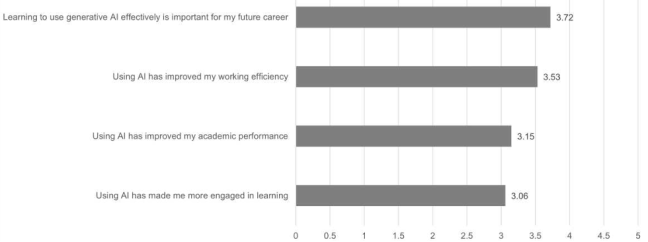
Students’ motivations for using generative AI were measured using a 5-point Likert scale (1 = strongly disagree to 5 = strongly agree). The primary driver was perceived relevance to future careers, followed by improved efficiency. Fewer students reported improvements in academic performance, and even fewer indicated increased engagement with learning.
Figure 1. Improvement in academic performance.
Of the 100 respondents, 77% (n = 96) reported using generative AI, while 22% (n = 28) used it infrequently or not at all. Most respondents (91%) did not pay for AI subscriptions.
Chatbots were the most commonly used tools (66%, n = 82), followed by rewriting tools (15%, n = 18) and translation software (8%, n = 10). The most frequently reported uses were summarising reading materials, overcoming mental blocks, brainstorming ideas, rewriting assignment text, and structuring ideas. Among chatbots, ChatGPT was the most popular (52%, n = 65), followed by Gemini (8%, n = 10), Copilot (4%, n = 5), and Claude (2%, n = 2).
6.1. ChatGPT
Respondents reported using ChatGPT across five key stages of the learning process: explaining topics, identifying resources, summarising materials, structuring writing, and refining written work.
ChatGPT was valued for explaining complex topics (15%, n = 18) by simplifying academic language and providing on-demand support. It was also used to identify learning resources (7%, n = 9), particularly by helping formulate effective search terms and reducing cognitive fatigue during information searches.
Participants frequently used ChatGPT to summarise learning materials (14%, n = 17), especially lengthy readings and lecture notes, supporting concentration and comprehension. Support for structuring writing (18%, n = 22) was highlighted as reducing anxiety and providing a clear starting point for essays. Finally, ChatGPT was commonly used for refining writing (19%, n = 24), including improving coherence, clarity, and academic tone.
Overall, respondents perceived ChatGPT as a flexible and accessible tool that supports both learning and writing processes, particularly for students with disabilities.
6.2. Gemini, Copilot, and Claude
In addition to ChatGPT, respondents reported using Gemini (8%, n = 10), Copilot (4%, n = 5), and Claude (2%, n = 2). Their use mirrored that of ChatGPT due to similar core functionalities, although overall usage was lower. Notably, Gemini was less frequently used despite being the institutionally approved tool.
Compared with ChatGPT, these chatbots were perceived as less comprehensive: Gemini was seen as limited in identifying learning resources, Copilot in refining written work, and Claude primarily in summarising materials and refining text. Nevertheless, respondents considered these tools reliable, particularly because of their non-intrusive support that preserved students’ thinking and writing processes, as well as their ease of access (e.g., Copilot’s integration into the Bing browser).
Their lower popularity was mainly attributed to limited familiarity, with students preferring ChatGPT as the tool they were first introduced to and had learned to use confidently.
7. Rewriting Applications and Translation Software
After chatbots, rewriting applications were the second most commonly used AI tools, including Grammarly (10%, n = 13), Quillbot (2%, n = 3), and Wordtune (1%, n = 1). Students used these tools primarily to correct grammatical errors (8%, n = 10), improve sentence coherence (2%, n = 3), and refine word choice and tone (2%, n = 3). These services helped students improve the overall quality of their writing.
ChatGPT was often used alongside rewriting tools, particularly Grammarly (n = 4), with students relying on Grammarly for proofreading and ChatGPT for rewording and clarifying meaning.
Translation software was the third most used category, including Google Translate (4%, n = 5), DeepL (3%, n = 4), and other tools (1%, n = 1). Students primarily used these tools for foreign language learning, understanding non-English texts, and refining written work.
8. Concerns About Adopting Generative AI
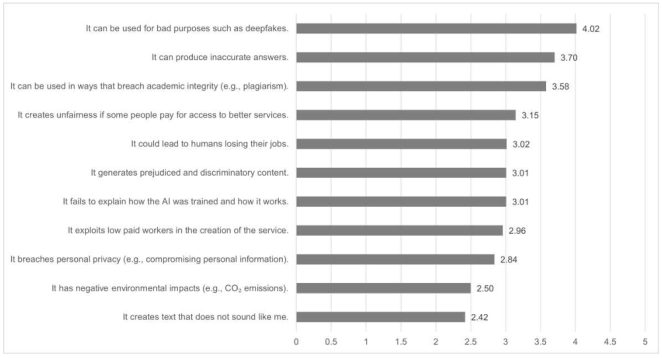
The survey explored students with disabilities’ views on key controversies surrounding generative AI. The most frequently reported concerns were the inaccuracy of AI-generated outputs and the risk of unfair academic practices. Respondents also expressed concern about inequality arising from paid AI services, while concerns about broader societal impacts, such as effects on employment, were moderate. In contrast, concerns related to exploitative development practices, environmental impact, and loss of personal writing voice were minimal.
Among the 28 students who reported not using generative AI, concerns largely mirrored those of AI users, focusing on accuracy and academic integrity. A small number also cited limited expertise as a barrier to adoption.
Figure 2. Concerns about Generative AI.
8.1. Support Students Seek from the School/Therapy Center
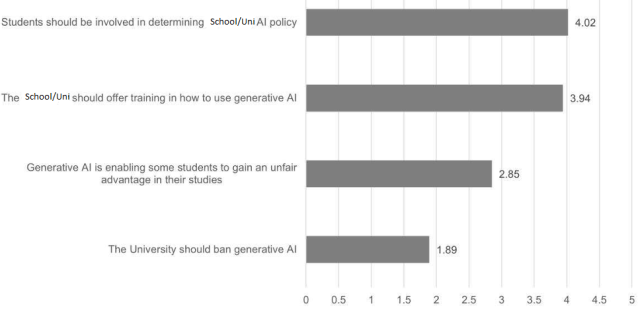
Survey results indicate that students believe they should be permitted to use generative AI ethically and express a strong desire to be involved in policy-making. There was broad agreement that universities/Schools/therapy centers should provide training on generative AI use.
Responses to an open-ended question aligned with closed-item results, with most students requesting training on effective use of generative AI (33%, n = 41). The primary focus was on ethical and responsible use, including avoiding unfair means (22%, n = 27) and unethical practices more broadly (7%, n = 9).
A smaller proportion of students requested practical skills training, such as writing prompts (11%, n = 14), search, fact-checking, and referencing (10%, n = 12), text summarization (5%, n = 6), and exposure to a wider range of tools (3%, n = 4). Few respondents mentioned support beyond writing, such as time planning (2%, n = 3), and only a small number requested disability-specific guidance (5%, n = 6), particularly on AI tools suitable for students with learning difficulties, ADHD, or autism.
Figure 3. Permission to use generative AI in Schools/Colleges/therapy centers.
8.2. Discussion
This study is among the first to collect real data on students with disabilities and their experiences using generative AI, like ChatGPT, rather than relying on general surveys or speculation about its benefits for these students. Our participants mainly included those with neurodiversity, such as ADHD, specific learning difficulties, and social or communication impairments like autism. These students remain underrepresented and need help to overcome barriers to participation and achievement
. Respondents reported facing various academic writing challenges, often accompanied by anxiety and difficulties related to their disabilities. If generative AI can help break down these barriers, it could significantly enhance inclusion. However, we must be cautious about the potential loss of learning opportunities that could come from relying too heavily on generative AI. The students with disabilities who participated mainly used generative AI, particularly ChatGPT. They also used some grammar-checking applications and translation software. There was little evidence of broader use of the many generative AI tools available
. Interestingly, few students were paying for a subscription. ChatGPT’s popularity seemed linked to students' familiarity with it and its ability to assist with many tasks, while other tools only supported a narrower range of activities. Generative AI chatbots were used throughout the study and academic writing process for:
1) Explaining complex topics
2) Improving search terms and conducting searches
3) Summarizing texts and other learning materials
4) Structuring ideas for writing
5) Refining text by combining ideas and improving word choice
Generative AI helps reduce anxiety around these complex tasks, which students with disabilities often find emotionally challenging. Some of this aligns with earlier speculation about generative AI’s potential to assist with reading, writing, and proofreading. However, this study offers a clearer understanding of how disabilities affect students and how they utilize generative AI to address challenges in written assignments. For instance, we gathered specific evidence on how students with disabilities use generative AI tools to find information and access learning resources.
Overall, survey responses indicated that students with disabilities view generative AI as effective assistive technology. Notably, the most helpful support often came from generative AI not recommended by their university. For example, Gemini, the approved chatbot at the institution where we collected data, was used relatively little. This gap between students' preferences and the university's recommendations raised concerns. Respondents worried that using their preferred generative AI, even if unapproved, could lead to issues around unfair means. As a result, some students hesitated or refused to use it, missing out on its benefits. This disengagement could impact fairness in higher education
, particularly for students with disabilities who are already marginalized
. To tackle this issue and ensure that all students, especially those with disabilities, can succeed in a more inclusive higher education setting, we need training in AI literacy
.
Returning to our definition of AI literacy, we can identify both strengths and weaknesses among students with disabilities overall. The variety of uses they made to tackle writing challenges shows creative engagement with the many possibilities provided by generative AI services. Responses indicated appropriate concerns about information accuracy and academic integrity. Respondents appeared to be aware of some socio-ethical and safety issues, emphasizing those that directly affected them rather than broader societal concerns. They also reflected on the potential effects of generative AI on their learning, such as dependency. They recognized the importance of contextual relevance. We can also spot significant gaps in students' generative AI literacy from the data. They primarily used ChatGPT, seemingly without exploring alternatives. Raising awareness among students about the societal and environmental impacts of generative AI seems essential. Further research is needed to explore other aspects of their literacy, such as how effectively they create prompts.
9. Conclusion
This study is one of the first to investigate how students with disabilities utilize generative AI. Higher education has viewed generative AI as a potential threat; however, given the persistent underrepresentation of students with disabilities in universities, if generative AI can support them, it offers significant benefits. The evidence collected reveals a diverse range of uses during the writing process. Student concerns centered on the accuracy of information and its impact on academic integrity. Some worried that access to generative AI could create digital inequality, while concerns about its societal effects were less prominent. Students expressed a desire for training in using generative AI and for involvement in policy-making.
The research provides crucial findings to guide disability support units and all individuals who assist students with disabilities in their studies. Given the groups who responded, it seems appropriate to enhance support for students with ADHD, specific learning difficulties like dyslexia and dyspraxia, and social or communication impairments like autism spectrum conditions. Regarding policy, there appears to be ongoing uncertainty about the acceptable and unacceptable uses of generative AI, which hinders its widespread adoption. A policy statement clarifying allowed uses for those with disabilities could be helpful. However, the diversity of disciplinary approaches to learning and assessment makes it challenging to create general guidelines. Many students with disabilities expressed a desire for their voices to be heard in policy-making. Respondents requested training that could highlight the uses they focused on. Given their usefulness and cost, providing subscriptions for students to generative AI services could also be considered.
While our study sheds light on how students with disabilities use AI and offers practical guidance for educators and policymakers, several limitations must be acknowledged. We should consider the potential impact of non-response bias on the results, as only those who are using generative AI or opposing its use may have responded. This may lead to results that do not capture all opinions. Without further investigation, we cannot establish this. The survey remains useful as it reveals beneficial uses identified by some students. The sample size was relatively small, with only 100 out of 5000 eligible students (about 1.4%) responding. Although we explored a range of disability conditions informed by existing HESA categories, the small sample size made it hard to differentiate between the experiences of students with different disabilities. Similarly, it was challenging to identify varying experiences of students from diverse backgrounds (e.g., international vs. local; undergraduate vs. postgraduate; across different disciplines). Nonetheless, as an exploratory study focusing on this under-researched group, our findings provide valuable insights for future research. Future studies could build on these findings by investigating specific disabilities or making comparisons to understand better their impact on students' writing, which would help provide more tailored support. Upcoming research could also explore how students' backgrounds may influence their use of generative AI. The study focused on just one institution in the UK, and existing institutional support might have influenced students' views. There was also a disproportionate number of female students among respondents, although this reflects the gender distribution within the university's overall student population. Future studies could aim for a larger sample size with a more balanced gender distribution and gather data from multiple institutions.
Abbreviations
ADHD | Attention Deficit/Hyperactivity Disorder |
HIV | Human Immunodeficiency Virus |
ChatGPT | Chat Generative Pre-trained Transformer |
Acknowledgments
I gratefully acknowledge my daughter, Saanvi, whose journey with autism has been a profound source of insight and inspiration. Her experiences have significantly influenced the perspective and motivation behind this research.
Author Contributions
Vinita Dutt: Conceptualization, Data curation, Formal Analysis, Funding acquisition, Investigation, Methodology, Project administration, Resources, Software, Supervision, Validation, Visualization, Writing – original draft, Writing – review & editing
Conflicts of Interest
The author declares no conflicts of interest.
Appendix: Survey Questions
Your gender
Current level of study, Academic department, English language competence, Digital competence
Which Generative AI do you use (1 - Never 2 - Rarely 3 - Sometimes 4 - Often 5 – Always)
1) ChatGPT
2) Google Gemini (formerly Bard)
3) Wordtune
4) Quillbot
5) GrammarlyGo
6) Jasper
7) Bing Chat
8) Google translate
9) Claude from Anthropic
10) DeepL
11) Otter AI
12) Elicit
13) Consensus
Do you have any specific feedback on how valuable you find any of the above tools?
Do you consider yourself to have a disability? What disabilities do you consider yourself to have?
1) Specific learning difficulty such as dyslexia, dyspraxia
2) Neurodiversity - e.g. ADHD
3) A social/communication impairment such as Asperger's syndrome/other autistic spectrum disorder
4) A long standing illness or health condition such as cancer, HIV, diabetes, chronic heart disease, or epilepsy
5) A mental health condition, such as depression, schizophrenia or anxiety disorder
6) A physical impairment or mobility issues, such as difficulty using arms or using a wheelchair or crutches
7) Deaf or a serious hearing impairment
8) Blind or a serious visual impairment uncorrected by glasses
9) A disability, impairment or medical condition that is not listed
10) Prefer not to answer
How, if at all, how does this affect your academic writing?
What Generative AI tools do you often use to support your learning, and why? What support and training on how to use generative AI would you like the School/College/Therapy Centre to offer
How do you use generative AI for academic writing (1 Never 2 Rarely 3
Sometimes 4 Often 5 Aways)
1) Interpreting an assignment brief
2) Finding information about a topic
3) Summarizing reading material
4) Translation of reading material
5) Brainstorming ideas
6) Validating a draft against assessment criteria
7) Overcoming a mental block
8) Structuring ideas for my assignment
9) Rewriting phrases in my assignment
10) Proof reading of my assignment
Monthly cost of subscription to all generative AI tools
Please respond to the following statements (1 Strongly disagree 2 Disagree 3 Neutral 4 Agree 5 Strongly agree)
1) Generative AI is enabling some students to gain an unfair advantage in their studies
2) Using AI has improved my working efficiency
3) Using AI has improved my academic performance
4) Using AI has made me more engaged in learning
5) Learning to use generative AI effectively is important for my future career
6) The University should offer training in how to use generative AI
7) The University should ban generative AI
8) Students should be involved in determining the School/College/Therapy center AI policy
What, if any, are your concerns about generative AI (1 Not at all concerned, 2. Slightly concerned 3 Moderately concerned 4 Very concerned 5 Extremely concerned)
1) It can be used in ways that breach academic integrity (e.g., plagiarism)
2) It can produce inaccurate answers
3) It generates prejudiced and discriminatory content
4) It creates text that does not sound like me
5) It breaches personal privacy (e.g., compromising personal information)
6) It fails to explain how the AI was trained and how it works
7) It could lead to humans losing their jobs
8) It can be used for bad purposes such as deepfakes
9) It creates unfairness if some people pay for access to better services
10) It exploits low paid workers in the creation of the service
11) It has negative environmental impacts (e.g., CO₂ emissions)
Do you have anything to add about the use of Generative AI tools in an educational setting?
References
| [1] |
Addy, T., Kang, T., Laquintano, T., & Dietrich, V. (2023). Who Benefits and Who is Excluded?: Transformative Learning, Equity, and Generative Artificial Intelligence. Journal of Transformative Learning, 10(2), 92-103.
|
| [2] |
Adnin, R., & Das, M. (2024). “I look at it as the king of knowledge”: How Blind People Use and Understand Generative AI Tools. Proceedings of the 26th International ACM SIGACCESS Conference on Computers and Accessibility (ASSETS ’24). ACM.
https://doi.org/10.1145/3663548.3675631
|
| [3] |
Baytas, C., & Ruediger, D. (2024). Generative AI in education: the product landscape. Ithaka S+R.
https://sr.ithaka.org/publications/generative-ai-in-higher-education/
|
| [4] |
Bender, E. M., Gebru, T., McMillan-Major A., & Shmitchell, S. (2021). On the Dangers of Stochastic Parrots: Can Language Models Be Too Big? Proceedings of the 2021 ACM conference on fairness, accountability, and transparency.
https://doi.org/10.1145/3442188.3445922
|
| [5] |
Botchu, B., Iyengar, K. P., & Botchu, R. (2023). Can ChatGPT empower people with dyslexia?. Disability and Rehabilitation: Assistive Technology, 1-2.
https://doi.org/10.1080/17483107.2023.2256805
|
| [6] |
Bozkurt, A., Junhong, X., Lambert, S., Pazurek, A., Crompton, H., Koseoglu, S.,... & Romero-Hall, E. (2023). Speculative futures on ChatGPT and generative artificial intelligence (AI): A collective reflection from the educational landscape. Asian Journal of Distance Education, 18(1), 53-130.
http://doi.org/10.5281/zenodo.7636568
|
| [7] |
Brewer, G., Urwin, E., & Witham, B. (2023). Disabled student experiences of Higher Education. Disability & Society, 1-20.
http://doi.org/10.1080/09687599.2023.2263633
|
| [8] |
Cardon, P., Fleischmann, C., Aritz, J., Logemann, M., & Heidewald, J. (2023). The challenges and opportunities of AI-assisted writing: Developing AI literacy for the AI age. Business and Professional Communication Quarterly, 86(3),
|
| [9] |
Chan, C. K. Y., & Hu, W. (2023). Students’ voices on generative AI: Perceptions, benefits, and challenges in higher education. International Journal of Educational Technology in Higher Education, 20(1), 43.
http://doi.org/10.1186/s41239-023-00411-8
|
| [10] |
Cheggs. (2024). Global student survey: 2023. Chegg.org.
https://www.chegg.org/global-student-survey-2023
|
| [11] |
Chen, B., & Zhu, X. (2023). Integrating generative AI in knowledge building.
|
| [12] |
Cotton, D. R., Cotton, P. A., & Shipway, J. R. (2024). Chatting and cheating: Ensuring academic integrity in the era of ChatGPT. Innovations in education and teaching international, 61(2), 228-239.
https://doi.org/10.1080/14703297.2023.2190148
|
| [13] |
Evmenova, A. S., Borup, J., & Shin, J. K. (2024). Harnessing the Power of Generative AI to Support ALL Learners. TechTrends, 68, 820-831.
https://doi.org/10.1007/s11528-024-00966
|
| [14] |
J. (2024). Provide or punish? Students’ views on generative AI in higher education. Higher Education Policy Institute, policy note 51.
https://www.hepi.ac.uk/2024/02/01/provide-or-punish-students-views-on-
generative-ai-in-higher-education/
|
| [15] |
Grassini, S. (2023). Shaping the future of education: exploring the potential and consequences of AI and ChatGPT in educational settings. Education Sciences, 13(7), 692.
https://doi.org/10.3390/educsci13070692
|
| [16] |
Habib, S., Vogel, T., Anli, X., & Thorne, E. (2024). How does generative artificial intelligence impact student creativity?. Journal of Creativity, 34(1), 100072.
https://doi.org/10.1016/j.yjoc.2023.100072
|
| [17] |
Hubble, S., & Bolton, P. (2021). Support for disabled students in higher education in England. House of Commons Library.
https://researchbriefings.files.parliament.uk/documents/CBP-8716/CBP-8716.pdf
|
| [18] |
Jafry, A., & Vorstermans, J. (2024). Evolving intersections: AI, disability, and academic integrity in higher education. New Directions for Teaching and Learning. 2024; 1-14.
http://doi.org/10.1002/tl.20629
|
| [19] |
Johnson, C., Smart, K., & Mahar, P. (2023). Is There a Place for Generative Artificial Intelligence in Special Education?. National Social Science Technology Journal, 48.
|
| [20] |
Long, D., & Magerko, B. (2020). What is AI literacy? Competencies and design considerations. Proceedings of the 2020 CHI conference on human factors in computing systems (pp. 1-16).
|
| [21] |
Malmström, H, Stöhr, C, & Ou, CW. (2023). Chatbots and other AI for learning: A survey of use and views among university students in Sweden. Chalmers Studies in Communication and Learning in Higher Education 2023.
https://doi.org/10.17196/cls.csclhe/2023/01
|
| [22] |
Michel-Villarreal, R., Vilalta-Perdomo, E., Salinas-Navarro, D. E., Thierry-Aguilera, R., & Gerardou, F. S. (2023). Challenges and opportunities of generative AI for higher education as explained by ChatGPT. Education Sciences, 13(9), 856.
https://doi.org/10.3390/educsci13090856
|
| [23] |
McCarthy, K. S., & Yan, E. F. (2023). Reading Comprehension and Constructive Learning: Policy Considerations in the Age of Artificial Intelligence. PolicyInsights from the Behavioral and Brain Sciences, 11(1), 19-26.
https://doi.org/10.1177/23727322231218891
|
| [24] |
McMurtrie. (2023). How ChatGPT could help or hurt students with disabilities. The Chronicle of Higher Education.
https://www.chronicle.com/article/how-chatgpt-could-help-or-hurt-students-with-disabilities
|
| [25] |
Nacheva, R., & Czaplewski, M. (2024). Artificial Intelligence In Helping People With Disabilities: Opportunities And Challenges. HR and Technologies, (1), 102-124.
|
| [26] |
Onufer, L. (2024). Using generative AI to create more accessible student learning experiences. University Times.
https://www.utimes.pitt.edu/news/teaching-pitt-using
|
| [27] |
Rocky Mountain ADA Center. (2023). ChatGPT and Disability: Benefits, Concerns, and Future Potential.
https://rockymountainada.org/resources/research/chatgpt-and-disability-benefits-concerns-and-future-potential
|
| [28] |
Roitsch, J., Gumpert, M., Springle, A., & Raymer, A. M. (2021). Writing instruction for students with learning disabilities: Quality appraisal of systematic reviews and meta-analyses. Reading & Writing Quarterly, 37(1), 32-44.
https://doi.org/10.1080/10573569.2019.1708221
|
| [29] |
Say, M. (2023). Swindon develops GenAI for Easy Read documents. UKAuthority.
https://www.ukauthority.com/articles/swindon-develops-genai-for-easy-read-documents/
|
| [30] |
Schiavo, G., Mana, N., Mich, O., Zancanaro, M., & Job, R. (2021). Attention-driven read-aloud technology increases reading comprehension in children with reading disabilities. Journal of Computer Assisted Learning, 37(3), 875-886.
https://doi.org/10.1111/jcal.12530
|
| [31] |
Starcevic, S. (2023). As ChatGPT faces Australia crackdown, disabled students defend AI. Context.
https://www.context.news/ai/as-chatgpt-faces-australia-crackdown-disabled-students-defend-ai
|
| [32] |
Sullivan, M., Kelly, A., & McLaughlan, P. (2023). ChatGPT in higher education: Considerations for academic integrity and student learning. Journal of Applied Learning & Teaching, 6(1), 1-10.
https://doi.org/10.37074/jalt.2023.6.1.17
|
| [33] |
Tamdjidi, R., & Billai, D, P. (2023). ChatGPT as an assistive technology to enhance reading comprehension for individuals with ADHD.
https://www.diva-portal.org/smash/get/diva2:1778288/FULLTEXT01.pdf
|
| [34] |
Tlili, A., Shehata, B., Adarkwah, M. A., Bozkurt, A., Hickey, D. T., Huang, R., & Agyemang, B. (2023). What if the devil is my guardian angel: ChatGPT as a case study of using chatbots in education. Smart Learning Environments, 10(1), 15.
https://doi.org/10.1186/s40561-023-00237-x
|
| [35] |
Upadhyay, A. K. (2024). Generative AI and training employees with special needs. Strategic HR Review. Advance online publication.
https://doi.org/10.1108/SHR-05-2024-0039
|
| [36] |
Venkit, P. N., & Wilson, S. (2021). Identification of bias against people with disabilities in sentiment analysis and toxicity detection models. arXiv.org.
https://arxiv.org/abs/2111.13259
|
| [37] |
Y//u, H., & Guo, Y. (2023). Generative artificial intelligence empowers educational reform: current status, issues, and prospects. Frontiers in Education, 8, 1183162.
https://doi.org/10.3389/feduc.2023.1183162
|
| [38] |
Zhao, X., Cox, A., & Cai, L. (2024). ChatGPT and the digitisation of writing. Humanities and Social Sciences Communications, 11(1), 1-9.
https://doi.org/10.1057/s41599-024-02904-x
|
Cite This Article
-
APA Style
Dutt, V. (2026). Adoption of Generative AI Tools by Students with Disabilities in Schools/Colleges. Science Journal of Education, 14(3), 87-97. https://doi.org/10.11648/j.sjedu.20261403.16
 Copy
|
Copy
|
 Download
ACS Style
Dutt, V. Adoption of Generative AI Tools by Students with Disabilities in Schools/Colleges. Sci. J. Educ. 2026, 14(3), 87-97. doi: 10.11648/j.sjedu.20261403.16
Copy
|
Download
AMA Style
Dutt V. Adoption of Generative AI Tools by Students with Disabilities in Schools/Colleges. Sci J Educ. 2026;14(3):87-97. doi: 10.11648/j.sjedu.20261403.16
Copy
|
Download
-
@article{10.11648/j.sjedu.20261403.16,
  author = {Vinita Dutt},
  title = {Adoption of Generative AI Tools by Students with Disabilities in Schools/Colleges},
  journal = {Science Journal of Education},
  volume = {14},
  number = {3},
  pages = {87-97},
  doi = {10.11648/j.sjedu.20261403.16},
  url = {https://doi.org/10.11648/j.sjedu.20261403.16},
  eprint = {https://article.sciencepublishinggroup.com/pdf/10.11648.j.sjedu.20261403.16},
  abstract = {The use of generative AI in education raises concerns primarily due to its impact on academic integrity. However, some researchers believe it could significantly help students with disabilities. So far, there has been no research on how these students use generative AI for academic writing. Based on a previous interview study and an AI-literacy model, we surveyed students about their use of generative AI, receiving 100 valid responses out of 5,000 from students with disabilities. We identified key conditions affecting writing, such as ADHD, dyslexia, dyspraxia, and autism. The primary generative AI tools employed were chatbots, particularly ChatGPT, along with rewriting applications. These tools were employed for various academic writing tasks. Main concerns expressed by students with disabilities included the inaccuracy of AI responses, potential threats to academic integrity, and the cost of subscriptions. Students also demonstrated a strong interest in being involved in AI policy development and expressed a desire for schools/universities to offer training on generative AI. Inspired by the daily experiences of my daughter, Saanvi, who has autism spectrum disorder (ASD), this research explores the potential of generative AI to enable more inclusive and equitable educational strategies. The paper concludes with recommendations for addressing educational gaps and promoting inclusivity.},
 year = {2026}
}
Copy
|
Download
-
TY  - JOUR
T1  - Adoption of Generative AI Tools by Students with Disabilities in Schools/Colleges
AU  - Vinita Dutt
Y1  - 2026/06/27
PY  - 2026
N1  - https://doi.org/10.11648/j.sjedu.20261403.16
DO  - 10.11648/j.sjedu.20261403.16
T2  - Science Journal of Education
JF  - Science Journal of Education
JO  - Science Journal of Education
SP  - 87
EP  - 97
PB  - Science Publishing Group
SN  - 2329-0897
UR  - https://doi.org/10.11648/j.sjedu.20261403.16
AB  - The use of generative AI in education raises concerns primarily due to its impact on academic integrity. However, some researchers believe it could significantly help students with disabilities. So far, there has been no research on how these students use generative AI for academic writing. Based on a previous interview study and an AI-literacy model, we surveyed students about their use of generative AI, receiving 100 valid responses out of 5,000 from students with disabilities. We identified key conditions affecting writing, such as ADHD, dyslexia, dyspraxia, and autism. The primary generative AI tools employed were chatbots, particularly ChatGPT, along with rewriting applications. These tools were employed for various academic writing tasks. Main concerns expressed by students with disabilities included the inaccuracy of AI responses, potential threats to academic integrity, and the cost of subscriptions. Students also demonstrated a strong interest in being involved in AI policy development and expressed a desire for schools/universities to offer training on generative AI. Inspired by the daily experiences of my daughter, Saanvi, who has autism spectrum disorder (ASD), this research explores the potential of generative AI to enable more inclusive and equitable educational strategies. The paper concludes with recommendations for addressing educational gaps and promoting inclusivity.
VL  - 14
IS  - 3
ER  -
Copy
|
Download





 Share This Article
 Twitter
 Linked In
 Facebook