
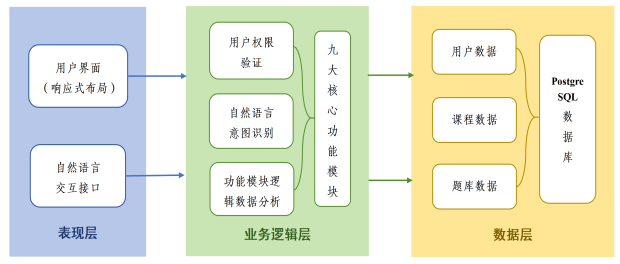
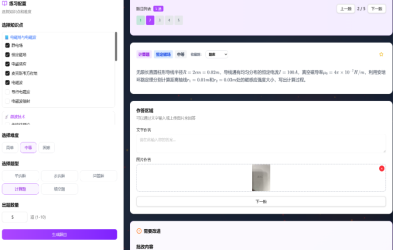
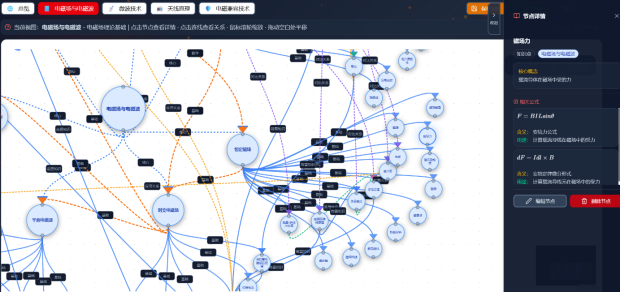
Electromagnetic information-related courses serve as a crucial foundational component for majors in electronic information. These courses are characterized by abstract theories, complex formulas, and significant practical relevance. However, traditional teaching methods exhibit notable shortcomings in terms of intelligence, personalization, and interactivity. To address these challenges, this paper presents an artificial intelligence-assisted teaching platform developed on the "Coze" platform, integrating technologies such as large language models, enhanced knowledge base retrieval, database storage, and visual drag-and-drop functionalities. The platform is designed with a three-layer architecture comprising a presentation layer, a business logic layer, and a data layer. It encompasses nine distinct functions, including AI companions, practice-assistant tools, question bank collection, one-click test generation, one-click grading, one-click PPT generation, knowledge graph creation, online classrooms, and translation conversion. Furthermore, it mitigates the issue of AI hallucination through a dual mechanism that combines enhanced knowledge base retrieval with prompt word constraints. Deployment and testing results demonstrate that the platform is functionally complete, operates stably, and is user-friendly. It effectively addresses challenges such as the abstract nature of electromagnetic information knowledge, inadequate support for personalized learning, and the excessive repetitive workload faced by educators. This system provides a low-cost and high-efficiency development paradigm that serves as a reference for teachers lacking a computer background to leverage AI tools in constructing an auxiliary teaching system.
| Published in | Science Innovation (Volume 14, Issue 6) |
| DOI | 10.11648/j.si.20261406.17 |
| Page(s) | 269-277 |
| Creative Commons |
This is an Open Access article, distributed under the terms of the Creative Commons Attribution 4.0 International License (http://creativecommons.org/licenses/by/4.0/), which permits unrestricted use, distribution and reproduction in any medium or format, provided the original work is properly cited. |
| Copyright |
Copyright © The Author(s), 2026. Published by Science Publishing Group |
Electromagnetic Information-related Courses, Coze Programming, AI-assisted Teaching, Natural Language Processing, Multi-user Terminal Design
数据表 | 主要字段 | 用途 |
|---|---|---|
用户数据表 | id、账号、密码、角色、权限 | 存储教师、学生、管理员的账户数据,实现账号管理与权限控制 |
收藏题库数据表 | id、userId、question、knowledgePoint、difficulty、courseType、answer | 存储练题助手生成的题目数据,为后续功能提供题目支撑 |
试卷数据表 | id、userId、title、course、knowledgePoints、difficulty、questionCount、questions | 存储出卷配置参数与生成试卷题目,为一键出卷提供数据支撑 |
类别 | 技术 | 用途 |
|---|---|---|
前端 | Next.js 16 + React 19 | 全栈框架与UI渲染核心,采用App Router模式 |
前端 | TypeScript 5 | 全栈类型安全,减少运行时错误 |
前端 | Tailwind CSS 4 + shadcn/ui | 响应式界面与标准化交互组件 |
前端 | KaTeX + react-markdown | 渲染数学公式与普通文字内容 |
前端 | ReactFlow | 知识图谱的可视化拖拽与关联展示 |
前端 | pptxgenjs | 浏览器端生成并下载PPT文件 |
后端 | Node.js 24 + Next.js API Routes | 服务端运行时与RESTful接口层 |
后端 | PostgreSQL + Drizzle ORM | 关系型数据库与类型安全操作 |
后端 | JWT + bcryptjs | 用户认证与密码加密 |
后端 | coze-coding-dev-sdk | AI能力集成(对话、图片生成、对象存储等) |
后端 | busboy | 流式处理大文件上传,避免内存溢出 |
模块 | 测试场景与预期结果 |
|---|---|
一键出卷 | 按要求生成试卷及参考答案与解析,题目数量内容准确,公式无乱码,可正确连接打印机 |
一键批改 | 正确识别题目并生成参考答案与解析,准确识别作答,给出合理批改结果与学习建议 |
AI学伴 | 专业易懂地解答电磁类问题,公式渲染正常,能够引导用户思考 |
线上课堂 | 视频可成功下载播放无卡顿,网站链接跳转顺畅 |
练题助手 | 题目正常生成无公式错误,批改结果正确合理,题目可成功收藏至题库 |
翻译转换 | 多语言翻译准确无误,无乱码 |
一键生成PPT | 下载导出的PPT美观准确,公式符号格式正确,无渲染错误 |
| [1] | Long Y, Zhu Y, Zhang Y. Learning and teaching in AI-empowered higher education [M]//Wen W, Zhang Y. The global development of AI-empowered higher education: Beyond the horizon. Singapore: Springer, 2025. |
| [2] | 胡佳健, 汪维富, 钟志贤. 国内外生成式人工智能教育现状分析与热点探究 [J]. 数字教育, 2024, 10(06): 84-92. |
| [3] | 叶维裕, 陈景. AI时代教育人工智能辅助教学现状及研究 [J]. 科技风, 2025, (04): 68-70. |
| [4] | 罗玮琪. 人工智能在教育领域中的应用 [J]. 汉字文化, 2025, (08): 184-186. |
| [5] | 梁迎丽, 刘陈. 人工智能教育应用的现状分析、典型特征与发展趋势 [J]. 中国电化教育, 2018, (03): 24-30. |
| [6] | 张治. ChatGPT/生成式人工智能重塑教育的底层逻辑和可能路径 [J]. 华东师范大学学报(教育科学版), 2023, 41(07): 131-142. |
| [7] | 朱永新, 杨帆. ChatGPT/生成式人工智能与教育创新:机遇、挑战以及未来 [J]. 华东师范大学学报(教育科学版), 2023, 41(07): 1-14. |
| [8] | 韦玉荣, 熊圣昊, 黄思颖. 基于 Coze 平台与 DeepSeek 大模型的智能辅助教学智能体 [J]. 软件工程与应用, 2025, 14 (06): 1246-1257. |
| [9] | 赵铁军, 许木璠, 陈安东. 自然语言处理研究综述 [J]. 新疆师范大学学报(哲学社会科学版), 2025, 46(02): 89-111. |
| [10] | 刘小冬. 自然语言理解综述 [J]. 统计与信息论坛, 2007, 22(02): 5-12. |
| [11] | Malik A, Khan L M, Hussain K, et al. AI in higher education: unveiling academicians’ perspectives on teaching, research, and ethics in the age of ChatGPT [J]. Interactive Learning Environments, 2025, 33(3): 2390-2406. |
| [12] | 裴壮, 田秀霞, 李冰雪. 知识图谱赋能的面向对象程序设计C++教学改革与实践 [J]. 华东师范大学学报(自然科学版), 2024, (05): 104-113. |
| [13] | 张缨斌, 吴若乔, 何雨轩, 等. 感知情境与人在回路的智能教育——《人工智能与教学的未来:见解与提议》要点与反思 [J]. 开放教育研究, 2023, 29(04): 11-20. |
| [14] | 郭全中, 张磊, 韦薇. AI幻觉的生成机理与敏捷治理 [J]. 新闻爱好者, 2026, (02): 36-41. |
| [15] | 管幸生, 邹明杰, 冯涛. 基于 QFD 的线上教学软件界面设计研究 [J]. 福建工程学院学报, 2021, 19(04): 385-390. |
APA Style
Hai, Z., Xu, C., Jiaojiao, X., Wei, T. (2026). Design and Implementation of an AI-Assisted Teaching Platform for Electromagnetic Information Courses. Science Innovation, 14(6), 269-277. https://doi.org/10.11648/j.si.20261406.17
ACS Style
Hai, Z.; Xu, C.; Jiaojiao, X.; Wei, T. Design and Implementation of an AI-Assisted Teaching Platform for Electromagnetic Information Courses. Sci. Innov. 2026, 14(6), 269-277. doi: 10.11648/j.si.20261406.17
@article{10.11648/j.si.20261406.17,
  author = {Zhang Hai and Chen Xu and Xie Jiaojiao and Tang Wei},
  title = {Design and Implementation of an AI-Assisted Teaching Platform for Electromagnetic Information Courses},
  journal = {Science Innovation},
  volume = {14},
  number = {6},
  pages = {269-277},
  doi = {10.11648/j.si.20261406.17},
  url = {https://doi.org/10.11648/j.si.20261406.17},
  eprint = {https://article.sciencepublishinggroup.com/pdf/10.11648.j.si.20261406.17},
  abstract = {Electromagnetic information-related courses serve as a crucial foundational component for majors in electronic information. These courses are characterized by abstract theories, complex formulas, and significant practical relevance. However, traditional teaching methods exhibit notable shortcomings in terms of intelligence, personalization, and interactivity. To address these challenges, this paper presents an artificial intelligence-assisted teaching platform developed on the "Coze" platform, integrating technologies such as large language models, enhanced knowledge base retrieval, database storage, and visual drag-and-drop functionalities. The platform is designed with a three-layer architecture comprising a presentation layer, a business logic layer, and a data layer. It encompasses nine distinct functions, including AI companions, practice-assistant tools, question bank collection, one-click test generation, one-click grading, one-click PPT generation, knowledge graph creation, online classrooms, and translation conversion. Furthermore, it mitigates the issue of AI hallucination through a dual mechanism that combines enhanced knowledge base retrieval with prompt word constraints. Deployment and testing results demonstrate that the platform is functionally complete, operates stably, and is user-friendly. It effectively addresses challenges such as the abstract nature of electromagnetic information knowledge, inadequate support for personalized learning, and the excessive repetitive workload faced by educators. This system provides a low-cost and high-efficiency development paradigm that serves as a reference for teachers lacking a computer background to leverage AI tools in constructing an auxiliary teaching system.},
 year = {2026}
}
TY  - JOUR
T1  - Design and Implementation of an AI-Assisted Teaching Platform for Electromagnetic Information Courses
AU  - Zhang Hai
AU  - Chen Xu
AU  - Xie Jiaojiao
AU  - Tang Wei
Y1  - 2026/11/10
PY  - 2026
N1  - https://doi.org/10.11648/j.si.20261406.17
DO  - 10.11648/j.si.20261406.17
T2  - Science Innovation
JF  - Science Innovation
JO  - Science Innovation
SP  - 269
EP  - 277
PB  - Science Publishing Group
SN  - 2328-787X
UR  - https://doi.org/10.11648/j.si.20261406.17
AB  - Electromagnetic information-related courses serve as a crucial foundational component for majors in electronic information. These courses are characterized by abstract theories, complex formulas, and significant practical relevance. However, traditional teaching methods exhibit notable shortcomings in terms of intelligence, personalization, and interactivity. To address these challenges, this paper presents an artificial intelligence-assisted teaching platform developed on the "Coze" platform, integrating technologies such as large language models, enhanced knowledge base retrieval, database storage, and visual drag-and-drop functionalities. The platform is designed with a three-layer architecture comprising a presentation layer, a business logic layer, and a data layer. It encompasses nine distinct functions, including AI companions, practice-assistant tools, question bank collection, one-click test generation, one-click grading, one-click PPT generation, knowledge graph creation, online classrooms, and translation conversion. Furthermore, it mitigates the issue of AI hallucination through a dual mechanism that combines enhanced knowledge base retrieval with prompt word constraints. Deployment and testing results demonstrate that the platform is functionally complete, operates stably, and is user-friendly. It effectively addresses challenges such as the abstract nature of electromagnetic information knowledge, inadequate support for personalized learning, and the excessive repetitive workload faced by educators. This system provides a low-cost and high-efficiency development paradigm that serves as a reference for teachers lacking a computer background to leverage AI tools in constructing an auxiliary teaching system.
VL  - 14
IS  - 6
ER  -
College of Information Science and Engineering, Huaqiao University, Xiamen, China

Information


 Share This Article
 Twitter
 Linked In
 Facebook



 Copy
 Download