International organizations (IOs) have become central actors in global governance in the 21st century, playing an increasingly visible role in managing conflict, public health crises, and international trade. At the same time, their expanding influence has generated sustained debates about the future of state sovereignty. This article examines the dual role of international organizations as both facilitators of international cooperation and as institutions that place constraints on state autonomy. Using a qualitative, literature-based comparative analysis, the study focuses on three key cases: the United Nations (UN) in conflict resolution, the World Health Organization (WHO) in global health governance, and the World Trade Organization (WTO) in international trade regulation. Drawing on realism, liberalism, constructivism, and postcolonial perspectives, the article argues that international organizations do not erode sovereignty in a linear or absolute manner. Instead, they reshape how sovereignty is exercised in practice. To capture this transformation, the study introduces the concept of adaptive sovereignty, understood as a flexible and negotiated form of state authority embedded within global governance frameworks. The findings suggest that contemporary global governance is best understood as an ongoing interaction between state power and international institutional influence, producing both opportunities for cooperation and persistent political tensions.
This is an Open Access article, distributed under the terms of the Creative Commons Attribution 4.0 International License (http://creativecommons.org/licenses/by/4.0/), which permits unrestricted use, distribution and reproduction in any medium or format, provided the original work is properly cited.
International Organizations, Global Governance, State Sovereignty, Adaptive Sovereignty, UN, WHO, WTO
1. Introduction
The 21st century has witnessed a profound transformation like international politics. States today face complex and transboundary challenges, including armed conflict, pandemics, climate change, economic crises, cyber threats, and global inequality. These issues cannot be effectively managed by individual states acting alone. As a result, international organizations (IOs) have assumed an increasingly central role in global governance, providing institutional frameworks for cooperation, norm setting, and collective decision making
[1]
Abbott, K. W., & Snidal, D. (2000). Hard and soft law in international governance. International Organization, 54(3), 421-456.
International organizations such as the United Nations (UN), the World Health Organization (WHO), and the World Trade Organization (WTO) are no longer just platforms for diplomatic dialogue. They actively shape global rules, influence domestic policy decisions, and set standards for appropriate state behavior. This expanded role has deepened scholarly and political debates about the future of state sovereignty. Traditional Westphalian sovereignty focused on territorial authority, non-intervention, and supreme decision-making within national borders
[8]
Ruggie, J. G. (1993). Territoriality and beyond: Problematizing modernity in international relations. International Organization, 47(1), 139-174.
. However, modern global governance seems to challenge these principles through binding agreements, monitoring systems, and institutional constraints. This development raises an important question in international relations theory: do international organizations weaken state sovereignty, or do they change how sovereignty is exercised? While some scholars believe that IOs undermine national independence by restricting autonomous decision-making, others argue that sovereignty is not disappearing but evolving in response to increasing global interdependence.
This article argues that international organizations neither abolish sovereignty nor fully subordinate states to supranational authority. Instead, they contribute to the emergence of adaptive sovereignty, a form of state authority that is flexible, negotiated, and embedded within global governance structures. Adaptive sovereignty reflects the reality that states voluntarily engage with international institutions to pursue national interests while simultaneously accepting certain constraints in exchange for cooperation, legitimacy, and collective problem-solving. Using a qualitative, literature-based comparative analysis, this study examines the role of three major international organizations: the United Nations in conflict governance, the World Health Organization in global health governance, and the World Trade Organization in international trade regulation. These cases are selected because they represent distinct issue areas: security, health, and trade, where international institutional influence is evident. By integrating insights from realism, liberalism, constructivism, and postcolonial perspectives, the article demonstrates that sovereignty in the 21st century is best understood not as a fixed legal status but as a dynamic and adaptive practice shaped by engagement with international organizations.
2. International Organizations, Sovereignty, and Theoretical Perspectives
The relationship between international organizations and state sovereignty has been a long-standing subject of debate in international relations theory. Different theoretical traditions offer competing interpretations of how IOs function and what their implications are for state authority.
2.1. Realist and Neorealist Perspectives
Realist and neorealist scholars argue that states remain the dominant actors in the international system and that international organizations have limited independent influence. According to this view, IOs are created by powerful states to serve their interests and reflect existing power distributions in the international system
[7]
Mearsheimer, J. J. (2001). The tragedy of great power politics. W. W. Norton & Company.
[10]
Waltz, K. N. (1979). Theory of international politics. McGraw-Hill.
[7, 10]
. Sovereignty, therefore, remains intact because states retain ultimate authority over compliance and enforcement.
From a realist perspective, international organizations do not constrain sovereignty in any meaningful sense; rather, they function as tools through which powerful states project influence and coordinate behavior. When IOs conflict with core national interests, states are expected to ignore, manipulate, or withdraw from them. This interpretation explains phenomena such as selective compliance with international law and the use of veto power in the UN Security Council.
2.2. Liberal and Neoliberal Institutional Approaches
Liberal and neoliberal institutionalist theories provide a more positive assessment of international organizations. Scholars such as
[6]
Keohane, R. O. (1984). After hegemony: Cooperation and discord in the world political economy. Princeton University Press.
[6]
argue that IOs facilitate cooperation by reducing uncertainty, lowering transaction costs, and providing information and mechanisms for dispute resolution. In an interdependent world, states recognize that long-term cooperation often yields greater benefits than unilateral action.
From this perspective, sovereignty is not weakened but pooled or exercised collectively through institutions. States voluntarily accept rules and constraints because doing so enhances predictability, stability, and mutual gains. International organizations thus enable states to pursue national interests more effectively rather than replacing state authority.
2.3. Constructivist Perspectives
Constructivist scholars shift the focus from material power to norms, identities, and social interaction. They argue that sovereignty itself is a socially constructed concept that evolves over time
[11]
Wendt, A. (1999). Social theory of international politics. Cambridge University Press.
[11]
. International organizations play a key role in shaping norms and defining what constitutes legitimate state behavior
[3]
Barnett, M., & Finnemore, M. (2004). Rules for the world: International organizations in global politics. Cornell University Press.
[5]
Finnemore, M., & Sikkink, K. (1998). International norm dynamics and political change. International Organization, 52(4), 887-917.
From a constructivist viewpoint, IOs influence sovereignty by redefining expectations rather than coercing states. For example, norms related to human rights, public health, or trade liberalization alter how states understand their responsibilities. Sovereignty persists, but its meaning and practice are continuously reconstructed through engagement with international institutions.
2.4. Postcolonial and Critical Approaches
Postcolonial and Marxist scholars offer a critical perspective, emphasizing power asymmetries within global governance. They argue that international organizations often reflect Western-centric norms and economic structures that constrain policy autonomy in developing states
[2]
Anghie, A. (2004). Imperialism, sovereignty and the making of international law. Cambridge University Press.
[4]
Chimni, B. S. (2006). International institutions today: An imperial global state in the making. European Journal of International Law, 15(1), 1-37.
. While sovereignty may exist formally, its practical exercise is uneven across the global system.
From this perspective, IOs may reproduce global inequalities by imposing policy prescriptions that limit developmental choices in the Global South. This critique highlights the tension between formal sovereignty and substantive autonomy, reinforcing the need for a concept such as adaptive sovereignty that captures these unequal power relations.
3. Methodology
This study employs a qualitative research design based on secondary sources to examine how international organizations influence the practice of state sovereignty in contemporary global governance. Rather than testing a single hypothesis, the research adopts an interpretive and comparative approach aimed at understanding patterns across different issue areas. Data for the study are drawn from peer reviewed journal articles, academic books, and official publications produced by international organizations
[1]
Abbott, K. W., & Snidal, D. (2000). Hard and soft law in international governance. International Organization, 54(3), 421-456.
. These sources were selected because they provide both theoretical insights and empirical observations on the functioning of international institutions. The analysis focuses on three major international organizations the United Nations (UN), the World Health Organization (WHO), and the World Trade Organization (WTO) which are widely recognized as central actors in security, health, and trade governance respectively.
A comparative case study method is used to explore similarities and differences in how these organizations interact with state sovereignty. The UN represents a security oriented institution with a strong political mandate, the WHO reflects a norm driven and technical organization, while the WTO embodies a highly legalized system of global economic governance. Examining these cases together allows for a more comprehensive understanding of how sovereignty is reshaped across different institutional contexts. The analysis relies on thematic interpretation, focusing on patterns related to rule-making, compliance, state consent, and institutional authority. By integrating insights from multiple theoretical traditions, the study avoids a single theory bias and instead offers a more nuanced interpretation of sovereignty as a dynamic and adaptive concept.
4. International Organizations in Practice
4.1. The United Nations and Conflict Governance
The United Nations plays a central role in international peace and security through peacekeeping operations, mediation initiatives, sanctions regimes, and humanitarian coordination
[9]
United Nations. (2020). United Nations peacekeeping operations: Principles and guidelines. United Nations Publications.
[9]
. Since the end of the Cold War, UN involvement in internal conflicts has expanded significantly, reflecting changing understandings of sovereignty and responsibility. UN peacekeeping missions in countries such as South Sudan and the Democratic Republic of Congo illustrate the complex relationship between international intervention and state authority. On one hand, these missions are deployed with the consent of host governments and aim to support national sovereignty by stabilizing fragile political environments. On the other hand, their presence often generates tensions, particularly when international actors are perceived as influencing domestic political processes or security decisions.
The Syrian conflict further demonstrates the limits of UN authority. Despite severe humanitarian consequences, divisions among permanent members of the Security Council have prevented decisive collective action. In this case, sovereignty has been strongly defended through veto power, revealing how geopolitical interests can override humanitarian norms. These examples show that the UN neither fully overrides sovereignty nor fully protects it; rather, sovereignty is constantly negotiated within institutional and political constraints
[10]
Waltz, K. N. (1979). Theory of international politics. McGraw-Hill.
[10]
.
4.2. The World Health Organization and Global Health Governance
The World Health Organization operates primarily through normative and technical authority rather than coercive power. Its role during global health crises, particularly the COVID-19 pandemic, highlights how sovereignty is exercised within frameworks of shared responsibility
[12]
World Health Organization. (2020). Managing epidemics: Key facts about major deadly diseases. WHO Press.
[13]
World Health Organization. (2021). COVID-19 strategic preparedness and response plan. WHO Press.
[12, 13]
. By issuing guidelines, coordinating data, and declaring public health emergencies, the WHO shapes global expectations regarding appropriate state responses. However, compliance with WHO recommendations remains voluntary, and states adapt global guidelines to domestic political, economic, and institutional contexts. This demonstrates that states retain decision-making authority while operating under international normative pressure.
The WHO case illustrates a form of sovereignty that is not diminished but contextualized. States remain accountable to their populations, yet their actions are increasingly evaluated against international standards of legitimacy and responsibility. This reinforces the idea that sovereignty in global health governance is adaptive rather than absolute.
4.3. The World Trade Organization and Trade Regulation
The World Trade Organization represents one of the most legalized forms of international governance. Through binding agreements and a formal dispute settlement mechanism, the WTO significantly influences national trade policies
[14]
World Trade Organization. (2019). World trade report 2019: The future of services trade. WTO Publications.
[15]
World Trade Organization. (2020). Understanding the WTO: Basics. WTO Publications.
[14, 15]
. Member states accept limitations on unilateral trade actions in exchange for predictability, market access, and rule-based cooperation.
While the WTO enhances stability in global trade, it also exposes power asymmetries. Developed countries often possess greater legal expertise and institutional capacity to navigate dispute mechanisms, while developing states may face structural disadvantages
[2]
Anghie, A. (2004). Imperialism, sovereignty and the making of international law. Cambridge University Press.
[2]
. Nevertheless, participation in the WTO reflects a deliberate choice by states to operate within a rules-based system. Trade governance therefore demonstrates how sovereignty is exercised through legal commitment rather than coercion. States constrain themselves institutionally, illustrating a clear example of adaptive sovereignty in practice.
5. Discussion
5.1. Adaptive Sovereignty in Global Governance
Across all three cases, a consistent pattern emerges. International organizations do not replace states as the primary actors in global politics, nor do they simply undermine sovereignty. Instead, they create institutional environments in which sovereignty is exercised through negotiation, selective compliance, and rule-based interaction
[16]
Zürn, M. (2018). A theory of global governance: Authority, legitimacy, and contestation. Oxford University Press.
[16]
. This study conceptualizes this process as adaptive sovereignty a form of sovereignty that is flexible, evolving, and shaped by engagement with international institutions
[8]
Ruggie, J. G. (1993). Territoriality and beyond: Problematizing modernity in international relations. International Organization, 47(1), 139-174.
. Adaptive sovereignty allows states to benefit from cooperation while managing constraints imposed by global governance frameworks. It reflects the reality of an interconnected world in which absolute autonomy is neither practical nor desirable.
5.2. Explanation of the Model
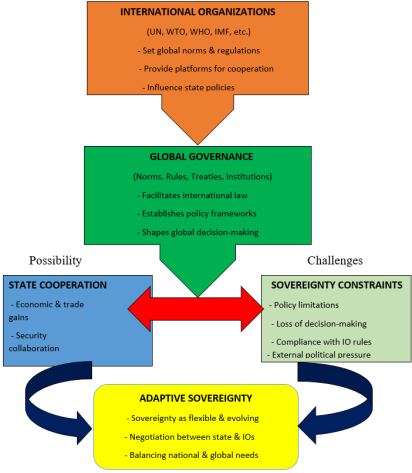
The model presented in this study illustrates the relationship between international organizations, global governance structures, and state sovereignty. International organizations contribute to global governance by setting norms, facilitating cooperation, and influencing policy frameworks. These processes generate both opportunities such as economic gains and security cooperation and challenges, including policy limitations and external pressure Adaptive sovereignty emerges at the intersection of these forces, representing a balance between national authority and global obligation. The model emphasizes that sovereignty is not lost but transformed through continuous interaction between states and international institutions.
5.3. Model of the Role of International Organizations in Global Governance and State Sovereignty
Figure 1. Model of the Role of International Organizations in G. lobal Governance and State Sovereignty.
6. Conclusion
International organizations have become indispensable actors in global governance in the 21st century. Through institutions such as the United Nations, the World Health Organization, and the World Trade Organization, states address shared challenges while redefining how sovereignty functions in practice. This study demonstrates that sovereignty has not disappeared; instead, it has evolved into a more flexible and negotiated form. By introducing the concept of adaptive sovereignty, the article contributes to ongoing debates in international relations regarding the role of institutions and the nature of state authority. Understanding sovereignty as adaptive provides a more accurate framework for analyzing contemporary global governance and the future trajectory of international cooperation.
Abbreviations
IOs
International Organizations
UN
United Nations
WHO
World Health Organization
WTO
World Trade Organization
Acknowledgments
First and foremost, I thank God for His guidance and blessings throughout my academic journey. I sincerely acknowledge Dr. Demissie Ferdissa (PhD) for his invaluable academic guidance, mentorship, and constructive support during my undergraduate research, which laid the foundation for this study. I also extend my gratitude to all the lecturers in the Department of Political Science and International Relations, Wollega University, for their academic support.
Author Contributions
Daniel Samuel Mamo is the sole author. The author read and approved the final manuscript.
Conflicts of Interest
The author declares no conflicts of interest.
References
[1]
Abbott, K. W., & Snidal, D. (2000). Hard and soft law in international governance. International Organization, 54(3), 421-456.
Mamo, D. S. (2026). International Organizations and Adaptive Sovereignty in 21st Century Global Governance: Possibilities and Challenges. Science Futures, 2(2), 169-173. https://doi.org/10.11648/j.scif.20260202.17
Mamo, D. S. International Organizations and Adaptive Sovereignty in 21st Century Global Governance: Possibilities and Challenges. Sci. Futures2026, 2(2), 169-173. doi: 10.11648/j.scif.20260202.17
Mamo DS. International Organizations and Adaptive Sovereignty in 21st Century Global Governance: Possibilities and Challenges. Sci Futures. 2026;2(2):169-173. doi: 10.11648/j.scif.20260202.17
@article{10.11648/j.scif.20260202.17,
  author = {Daniel Samuel Mamo},
  title = {International Organizations and Adaptive Sovereignty in 21st Century Global Governance: Possibilities and Challenges},
  journal = {Science Futures},
  volume = {2},
  number = {2},
  pages = {169-173},
  doi = {10.11648/j.scif.20260202.17},
  url = {https://doi.org/10.11648/j.scif.20260202.17},
  eprint = {https://article.sciencepublishinggroup.com/pdf/10.11648.j.scif.20260202.17},
  abstract = {International organizations (IOs) have become central actors in global governance in the 21st century, playing an increasingly visible role in managing conflict, public health crises, and international trade. At the same time, their expanding influence has generated sustained debates about the future of state sovereignty. This article examines the dual role of international organizations as both facilitators of international cooperation and as institutions that place constraints on state autonomy. Using a qualitative, literature-based comparative analysis, the study focuses on three key cases: the United Nations (UN) in conflict resolution, the World Health Organization (WHO) in global health governance, and the World Trade Organization (WTO) in international trade regulation. Drawing on realism, liberalism, constructivism, and postcolonial perspectives, the article argues that international organizations do not erode sovereignty in a linear or absolute manner. Instead, they reshape how sovereignty is exercised in practice. To capture this transformation, the study introduces the concept of adaptive sovereignty, understood as a flexible and negotiated form of state authority embedded within global governance frameworks. The findings suggest that contemporary global governance is best understood as an ongoing interaction between state power and international institutional influence, producing both opportunities for cooperation and persistent political tensions.},
 year = {2026}
}
TY  - JOUR
T1  - International Organizations and Adaptive Sovereignty in 21st Century Global Governance: Possibilities and Challenges
AU  - Daniel Samuel Mamo
Y1  - 2026/01/30
PY  - 2026
N1  - https://doi.org/10.11648/j.scif.20260202.17
DO  - 10.11648/j.scif.20260202.17
T2  - Science Futures
JF  - Science Futures
JO  - Science Futures
SP  - 169
EP  - 173
PB  - Science Publishing Group
SN  - 3070-6289
UR  - https://doi.org/10.11648/j.scif.20260202.17
AB  - International organizations (IOs) have become central actors in global governance in the 21st century, playing an increasingly visible role in managing conflict, public health crises, and international trade. At the same time, their expanding influence has generated sustained debates about the future of state sovereignty. This article examines the dual role of international organizations as both facilitators of international cooperation and as institutions that place constraints on state autonomy. Using a qualitative, literature-based comparative analysis, the study focuses on three key cases: the United Nations (UN) in conflict resolution, the World Health Organization (WHO) in global health governance, and the World Trade Organization (WTO) in international trade regulation. Drawing on realism, liberalism, constructivism, and postcolonial perspectives, the article argues that international organizations do not erode sovereignty in a linear or absolute manner. Instead, they reshape how sovereignty is exercised in practice. To capture this transformation, the study introduces the concept of adaptive sovereignty, understood as a flexible and negotiated form of state authority embedded within global governance frameworks. The findings suggest that contemporary global governance is best understood as an ongoing interaction between state power and international institutional influence, producing both opportunities for cooperation and persistent political tensions.
VL  - 2
IS  - 2
ER  -
Mamo, D. S. (2026). International Organizations and Adaptive Sovereignty in 21st Century Global Governance: Possibilities and Challenges. Science Futures, 2(2), 169-173. https://doi.org/10.11648/j.scif.20260202.17
Mamo, D. S. International Organizations and Adaptive Sovereignty in 21st Century Global Governance: Possibilities and Challenges. Sci. Futures2026, 2(2), 169-173. doi: 10.11648/j.scif.20260202.17
Mamo DS. International Organizations and Adaptive Sovereignty in 21st Century Global Governance: Possibilities and Challenges. Sci Futures. 2026;2(2):169-173. doi: 10.11648/j.scif.20260202.17
@article{10.11648/j.scif.20260202.17,
  author = {Daniel Samuel Mamo},
  title = {International Organizations and Adaptive Sovereignty in 21st Century Global Governance: Possibilities and Challenges},
  journal = {Science Futures},
  volume = {2},
  number = {2},
  pages = {169-173},
  doi = {10.11648/j.scif.20260202.17},
  url = {https://doi.org/10.11648/j.scif.20260202.17},
  eprint = {https://article.sciencepublishinggroup.com/pdf/10.11648.j.scif.20260202.17},
  abstract = {International organizations (IOs) have become central actors in global governance in the 21st century, playing an increasingly visible role in managing conflict, public health crises, and international trade. At the same time, their expanding influence has generated sustained debates about the future of state sovereignty. This article examines the dual role of international organizations as both facilitators of international cooperation and as institutions that place constraints on state autonomy. Using a qualitative, literature-based comparative analysis, the study focuses on three key cases: the United Nations (UN) in conflict resolution, the World Health Organization (WHO) in global health governance, and the World Trade Organization (WTO) in international trade regulation. Drawing on realism, liberalism, constructivism, and postcolonial perspectives, the article argues that international organizations do not erode sovereignty in a linear or absolute manner. Instead, they reshape how sovereignty is exercised in practice. To capture this transformation, the study introduces the concept of adaptive sovereignty, understood as a flexible and negotiated form of state authority embedded within global governance frameworks. The findings suggest that contemporary global governance is best understood as an ongoing interaction between state power and international institutional influence, producing both opportunities for cooperation and persistent political tensions.},
 year = {2026}
}
TY  - JOUR
T1  - International Organizations and Adaptive Sovereignty in 21st Century Global Governance: Possibilities and Challenges
AU  - Daniel Samuel Mamo
Y1  - 2026/01/30
PY  - 2026
N1  - https://doi.org/10.11648/j.scif.20260202.17
DO  - 10.11648/j.scif.20260202.17
T2  - Science Futures
JF  - Science Futures
JO  - Science Futures
SP  - 169
EP  - 173
PB  - Science Publishing Group
SN  - 3070-6289
UR  - https://doi.org/10.11648/j.scif.20260202.17
AB  - International organizations (IOs) have become central actors in global governance in the 21st century, playing an increasingly visible role in managing conflict, public health crises, and international trade. At the same time, their expanding influence has generated sustained debates about the future of state sovereignty. This article examines the dual role of international organizations as both facilitators of international cooperation and as institutions that place constraints on state autonomy. Using a qualitative, literature-based comparative analysis, the study focuses on three key cases: the United Nations (UN) in conflict resolution, the World Health Organization (WHO) in global health governance, and the World Trade Organization (WTO) in international trade regulation. Drawing on realism, liberalism, constructivism, and postcolonial perspectives, the article argues that international organizations do not erode sovereignty in a linear or absolute manner. Instead, they reshape how sovereignty is exercised in practice. To capture this transformation, the study introduces the concept of adaptive sovereignty, understood as a flexible and negotiated form of state authority embedded within global governance frameworks. The findings suggest that contemporary global governance is best understood as an ongoing interaction between state power and international institutional influence, producing both opportunities for cooperation and persistent political tensions.
VL  - 2
IS  - 2
ER  -





 Share This Article
 Twitter
 Linked In
 Facebook
 Copy
Copy Download