Abstract
Nigerian universities bring together students from many ethnic and linguistic backgrounds, yet there is little evidence that they deliberately provide organised spaces in which those students can learn from one another across cultural differences. University libraries are open to students of all disciplines and are less evaluative than lecture rooms. They are therefore well placed to offer such opportunities, but their role in language learning is usually limited to collections and information literacy instruction. This paper proposes that the academic library can be rethought as an intercultural learning space, in which library-based language programmes support the development of intercultural competence and of students’ confidence in using English, the two aspects most likely to change through such programmes, and contribute over time to intercultural communicative competence. Using a conceptual design based on a purposive integrative review, the paper brings together Byram’s model of intercultural communicative competence, Deardorff’s process model of intercultural competence, intergroup contact theory, scholarship on the library as place and contact zone, and work on translanguaging and cultural competence in librarianship, and relates these to the linguistic and cultural diversity of higher education in Nigeria. From this synthesis it develops the Library Intercultural Learning Space Model. The model proposes that institutional enabling conditions, namely multicultural collections, inclusive spaces, interculturally competent library staff, partnership with English departments and supportive policy, make possible six types of library-based language programme: conversation circles, multicultural reading circles, language exchange in tandem, Human Library dialogues, cultural exhibitions and screenings, and translanguaging-friendly information literacy sessions. These programmes are expected to work through four learning processes, namely structured contact, dialogue and mediation, guided reflection, and use of the full linguistic repertoire, to build the attitudes, knowledge, skills and critical cultural awareness required for intercultural interaction, and to enhance students’ confidence in using English. Confidence is treated as a psychological outcome that may support, but does not itself demonstrate, communicative competence in English. Resource constraints, language anxiety, intergroup tension and language hierarchy are identified as conditions that may weaken these effects at different stages, from implementation and participation to the quality of interaction. The relationships are theoretical expectations rather than demonstrated findings. To guide empirical research and practice, six groups of propositions, containing ten directional predictions and one exploratory research question, are presented, together with practical recommendations for university libraries, English departments and university management.
1. Introduction
Nigeria is one of the most linguistically diverse countries in the world. More than 500 languages are spoken within its borders
| [1] | Eberhard, D. M., Simons, G. F., Fennig, C. D., editors. Ethnologue: Languages of the World. 26th ed. Dallas, TX: SIL International; 2023. Available from: https://www.ethnologue.com |
[1]
, alongside English, which is the official language and the medium of instruction from the later years of primary school to university
| [2] | Bamgbose, A. Language and Exclusion: The Consequences of Language Policies in Africa. Münster: LIT Verlag; 2000. |
| [3] | Federal Republic of Nigeria. National Policy on Education. 6th ed. Lagos: Nigerian Educational Research and Development Council; 2013. |
[2, 3]
. This diversity is reflected in its universities. Federal universities in particular admit students from all over the federation, in line with the constitutional principle that public institutions should reflect the federal character of the nation
| [4] | Federal Republic of Nigeria. Constitution of the Federal Republic of Nigeria 1999 (as amended). Abuja: Federal Government Press; 1999, Section 14(3). |
[4]
. Speakers of Igbo, Yoruba, Hausa, Ibibio, Tiv, Edo and many other languages may therefore be found in the same lecture room, using English and, often, Nigerian Pidgin as common languages, but bringing different histories, religious traditions, customs and assumptions about communication
| [5] | Adegbija, E. Multilingualism: A Nigerian Case Study. Trenton, NJ: Africa World Press; 2004. |
| [6] | Simpson, A., Oyètádé, B. A. Nigeria: Ethno-linguistic competition in the giant of Africa. In: Simpson, A., editor. Language and National Identity in Africa. Oxford: Oxford University Press; 2008, pp. 172–198. |
[5, 6]
.
This diversity is an educational resource, but it is not automatically used as one. Evidence from secondary schools in Lagos shows that cross-group friendships and discussion in diverse settings are associated with more positive attitudes towards other ethnic and religious groups, whereas mere exposure to diversity has mixed effects
| [7] | Demarest, L., Langer, A. Ethnic diversity and intergroup relations among Nigerian adolescents: Testing intergroup contact and political deliberation theories. International Journal of Intercultural Relations. 2025, 105, 102149.
https://doi.org/10.1016/j.ijintrel.2025.102149 |
[7]
. It is reasonable to assume, although it has not been systematically documented, that many university students also form friendships and study groups mainly with those who share their language and home region, so that contact across groups remains superficial. This assumption is treated here as a contextual premise that requires empirical confirmation. Studies of intergroup contact have shown that diversity alone does not reduce prejudice or build understanding; contact must take place under supportive conditions, including equal status, shared goals, cooperation and institutional support
| [8] | Allport, G. W. The Nature of Prejudice. Cambridge, MA: Addison-Wesley; 1954. |
| [9] | Pettigrew, T. F., Tropp, L. R. A meta-analytic test of intergroup contact theory. Journal of Personality and Social Psychology. 2006, 90(5), 751–783.
https://doi.org/10.1037/0022-3514.90.5.751 |
[8, 9]
. There is little published evidence that Nigerian universities deliberately create environments in which these conditions are met. The curriculum is organised by discipline, and the general studies courses in the use of English and in Nigerian peoples and culture are usually taught in large classes that leave little room for planned interaction between students of different backgrounds.
At the same time, employers, professional bodies and international frameworks increasingly expect graduates to communicate effectively and appropriately with people from other cultures. This ability is referred to in the literature as intercultural communicative competence, which combines linguistic competence with the attitudes, knowledge and skills needed to interact across cultural boundaries
| [10] | Byram, M. Teaching and Assessing Intercultural Communicative Competence. Clevedon: Multilingual Matters; 1997. |
| [11] | Byram, M. Teaching and Assessing Intercultural Communicative Competence: Revisited. 2nd ed. Bristol: Multilingual Matters; 2021. https://doi.org/10.21832/9781800410251 |
| [12] | Deardorff, D. K. Identification and assessment of intercultural competence as a student outcome of internationalization. Journal of Studies in International Education. 2006, 10(3), 241–266. https://doi.org/10.1177/1028315306287002 |
[10-12]
. For Nigerian students, intercultural communicative competence matters both within the country, where national cohesion depends on understanding across ethnic and religious lines, and beyond it, in international study and work conducted largely in English.
The university library is an exceptionally suitable place in which to develop this competence. It is open to students of every discipline and year, it is a shared space that belongs to no single group, it holds materials that represent many cultures, and it is less evaluative than the lecture room
. International library guidance already commits libraries to serving culturally diverse communities and to fostering dialogue between cultures
. Academic libraries in other countries have begun to use conversation groups, language exchanges and Human Library events to bring students of different backgrounds into structured contact
| [16] | Zhao, S., Luo, R., Sabina, C., Pillon, K. The English Conversation Group: A library-led virtual program for international students. Practical Academic Librarianship. 2022, 12(1). Available from:
https://pal-ojs-tamu.tdl.org/pal/article/view/7137 |
| [17] | Steckel, E. Conversation hour in the academic library: A getting started guide. College & Research Libraries News. 2024, 85(5), 195. https://doi.org/10.5860/crln.85.5.195 |
| [18] | Lam, G. Y. H., Wong, H. T., Zhang, M. A systematic narrative review of implementation, processes, and outcomes of Human Library. International Journal of Environmental Research and Public Health. 2023, 20(3), 2485.
https://doi.org/10.3390/ijerph20032485 |
[16-18]
. In Nigeria, on the other hand, discussion of the library’s cultural role has focused mainly on preserving and promoting national culture through collections
| [19] | Akor, S. C. The role of libraries and librarians in the promoting Nigerian culture. Nigerbiblios: Journal of the National Library of Nigeria. 2023, 33(1), 143–154. |
[19]
, and discussion of its role in language learning has focused on collections and information literacy instruction
| [20] | Igbokwe, B., Nwanekezie, N. P. A conceptual model for integrating information literacy and task-based language teaching: Rethinking English language instruction in Nigerian secondary schools. International Journal of English Language, Literature and Translation Studies. 2026, 13(3), 121–134. http://ijelr.in |
| [21] | Igbokwe, B., Nwanekezie, N. P. Hedging, signposting and stance: A conceptual model of library–English department collaboration for developing metadiscourse competence in Nigerian undergraduate research proposals. Research Journal of English Language and Literature. 2026, 14(3), 508–522. http://rjelal.com |
[20, 21]
. Each existing framework explains part of the problem. Models of intercultural competence describe what students need to learn, but not where, outside the classroom or study abroad, a university can organise that learning
| [11] | Byram, M. Teaching and Assessing Intercultural Communicative Competence: Revisited. 2nd ed. Bristol: Multilingual Matters; 2021. https://doi.org/10.21832/9781800410251 |
| [12] | Deardorff, D. K. Identification and assessment of intercultural competence as a student outcome of internationalization. Journal of Studies in International Education. 2006, 10(3), 241–266. https://doi.org/10.1177/1028315306287002 |
[11, 12]
. Contact theory describes the conditions under which contact reduces prejudice, but not the campus settings in which those conditions can be created
. Scholarship on the library as place describes the library’s openness to students’ cultures, but not the programmes and processes through which that openness becomes learning
| [13] | Elmborg, J. K. Libraries as the spaces between us: Recognizing and valuing the third space. Reference & User Services Quarterly. 2011, 50(4), 338–350.
https://doi.org/10.5860/rusq.50n4.338 |
[13]
. The contribution of this paper is therefore integrative and contextual rather than entirely new: it brings these frameworks together, applies them to Nigerian university libraries, and proposes relationships that none of them states on its own, namely that particular library programmes activate particular learning processes, that the use of students’ full linguistic repertoires shapes participation and the quality of contact, and that different moderating conditions act at different stages. To the best of the authors’ knowledge, such an integrated framework has not previously been proposed for Nigerian university libraries.
This paper attempts to fill that gap. Its central argument is that the academic library can be reimagined as an intercultural learning space, in which deliberately designed language programmes bring students of different linguistic and cultural backgrounds into structured contact and, through that contact, foster intercultural competence and confidence in English, and so contribute over time to intercultural communicative competence. The paper has three aims: first, to synthesise research on intercultural communicative competence, intergroup contact, the library as place and contact zone, translanguaging and cultural competence in librarianship; second, to present the Library Intercultural Learning Space Model, setting out its enabling conditions, programme types, learning processes, outcomes and moderating conditions; and third, to derive testable propositions and practical recommendations for Nigerian university libraries, English departments and university management. The paper is conceptual. It reports no new data; it builds an argument from existing theory and evidence and presents a model that future empirical research can test, refine or reject.
2. Literature Review
2.1. Key Concepts
Four related constructs are distinguished in this paper.
Intercultural competence is the combination of attitudes, knowledge, skills and critical awareness that allows a person to interact effectively and appropriately with people from other cultures. Byram
| [10] | Byram, M. Teaching and Assessing Intercultural Communicative Competence. Clevedon: Multilingual Matters; 1997. |
| [11] | Byram, M. Teaching and Assessing Intercultural Communicative Competence: Revisited. 2nd ed. Bristol: Multilingual Matters; 2021. https://doi.org/10.21832/9781800410251 |
[10, 11]
describes it in terms of five elements: attitudes of curiosity and openness; knowledge of social groups and their practices; skills of interpreting and relating; skills of discovery and interaction; and critical cultural awareness. Deardorff’s
| [12] | Deardorff, D. K. Identification and assessment of intercultural competence as a student outcome of internationalization. Journal of Studies in International Education. 2006, 10(3), 241–266. https://doi.org/10.1177/1028315306287002 |
[12]
definition is similar but is not tied to a particular language.
Communicative competence in English is the linguistic, sociolinguistic and discourse competence required to use English accurately and appropriately.
Confidence in English refers to a learner’s willingness and perceived ability to use English in a given situation; it is a psychological state that may help to develop communicative competence but does not itself demonstrate accuracy or appropriateness.
Intercultural communicative competence, following Byram
| [10] | Byram, M. Teaching and Assessing Intercultural Communicative Competence. Clevedon: Multilingual Matters; 1997. |
| [11] | Byram, M. Teaching and Assessing Intercultural Communicative Competence: Revisited. 2nd ed. Bristol: Multilingual Matters; 2021. https://doi.org/10.21832/9781800410251 |
[10, 11]
, is the combination of intercultural competence with communicative competence in a shared language, so that a person can communicate effectively and appropriately across cultures in that language. In the Nigerian setting the shared language is usually English, occasionally Nigerian Pidgin, and the cultural boundaries that matter most are often those between Nigerian ethnic and linguistic groups rather than between nations.
Library-based language programmes are planned, recurring activities, organised or hosted by the library, in which language use and cultural exchange are the main purpose rather than a byproduct. They are not the same as ordinary information literacy instruction, which focuses on finding and evaluating information, or collection development, which provides materials without organising interaction around them. Information literacy sessions fall within the definition only when they are deliberately adapted for language and intercultural purposes, for example by forming groups of students from different language backgrounds and inviting them to use their full linguistic repertoires while working with English sources; such adapted sessions are included among the six programme types in Section 4.2, whereas ordinary information literacy instruction is not. Examples include conversation circles, reading circles, language exchanges, Human Library events and cultural exhibitions
| [16] | Zhao, S., Luo, R., Sabina, C., Pillon, K. The English Conversation Group: A library-led virtual program for international students. Practical Academic Librarianship. 2022, 12(1). Available from:
https://pal-ojs-tamu.tdl.org/pal/article/view/7137 |
| [17] | Steckel, E. Conversation hour in the academic library: A getting started guide. College & Research Libraries News. 2024, 85(5), 195. https://doi.org/10.5860/crln.85.5.195 |
| [18] | Lam, G. Y. H., Wong, H. T., Zhang, M. A systematic narrative review of implementation, processes, and outcomes of Human Library. International Journal of Environmental Research and Public Health. 2023, 20(3), 2485.
https://doi.org/10.3390/ijerph20032485 |
| [22] | Little, D., Brammerts, H., editors. A Guide to Language Learning in Tandem via the Internet. CLCS Occasional Paper No. 46. Dublin: Trinity College, Centre for Language and Communication Studies; 1996. |
[16-18, 22]
.
An
intercultural learning space is a physical or virtual setting that is deliberately arranged so that people of different backgrounds can meet on equal terms, engage with one another’s perspectives and reflect on what they learn. The term draws on Elmborg’s conception of the library as a “third space” between the cultures that users bring with them and the academic culture of the institution
| [13] | Elmborg, J. K. Libraries as the spaces between us: Recognizing and valuing the third space. Reference & User Services Quarterly. 2011, 50(4), 338–350.
https://doi.org/10.5860/rusq.50n4.338 |
[13]
, and on Pratt’s concept of contact zones as spaces in which cultures meet and grapple with one another
| [23] | Pratt, M. L. Arts of the contact zone. Profession. 1991, 33–40. |
[23]
.
2.2. Theoretical Foundations
2.2.1. Intercultural Communicative Competence
Byram’s model
| [10] | Byram, M. Teaching and Assessing Intercultural Communicative Competence. Clevedon: Multilingual Matters; 1997. |
[10]
remains the most influential account of intercultural communicative competence in language education. It holds that the ability to communicate effectively across cultures depends not only on linguistic accuracy but also on the willingness and ability to see another person’s point of view, to relate it to one’s own and to reflect critically on both. Byram distinguishes the intercultural speaker, who acts as a mediator between cultures, from the imitation of an idealised native speaker. The revised edition of the model
gives greater weight to critical cultural awareness and to education for democratic citizenship, which makes it relevant to national settings in which cultural difference carries political weight. Byram also stresses that intercultural competence can be developed outside the language classroom, including through fieldwork and encounters arranged outside formal teaching, provided that these encounters are followed by reflection. Kramsch
| [24] | Kramsch, C. Context and Culture in Language Teaching. Oxford: Oxford University Press; 1993. |
[24]
similarly argues that culture is learned through the negotiation of meaning in context, in a “third place” between the learner’s own culture and the culture being encountered.
2.2.2. The Process Model of Intercultural Competence
Deardorff
| [12] | Deardorff, D. K. Identification and assessment of intercultural competence as a student outcome of internationalization. Journal of Studies in International Education. 2006, 10(3), 241–266. https://doi.org/10.1177/1028315306287002 |
[12]
developed a process model of intercultural competence from a consensus among leading intercultural scholars. The model begins with requisite attitudes, namely respect, openness and curiosity, which make it possible to acquire knowledge and skills, such as cultural self awareness, listening, observing and interpreting. These lead to desired internal outcomes, such as adaptability, flexibility and empathy, and in turn to desired external outcomes, which Deardorff defines as behaving and communicating effectively and appropriately in intercultural situations. Deardorff stresses that intercultural competence develops continuously and that attitudes are the starting point of the process. The model matters for the present argument because it shows that intercultural learning moves from attitudes to behaviour over time, and that programmes which change attitudes, even before they change behaviour, are a legitimate first step.
2.2.3. Intergroup Contact Theory
Allport
| [8] | Allport, G. W. The Nature of Prejudice. Cambridge, MA: Addison-Wesley; 1954. |
[8]
proposed that contact between members of different groups reduces prejudice when four conditions are met: equal status within the situation, common goals, intergroup cooperation and the support of authorities, law or custom. Pettigrew and Tropp’s
meta analysis of more than 500 studies confirmed that intergroup contact typically reduces prejudice, and found that the effect was stronger when Allport’s conditions were present, although the conditions were not strictly necessary. Contact theory explains why diversity alone may not produce intercultural learning, and it specifies conditions that a library programme can be designed to meet. A conversation circle in which all participants are students, work towards a shared task and are welcomed by library staff meets these conditions more fully than casual proximity in a reading room.
2.2.4. The Library as Place, Third Space and Contact Zone
Bennett
describes a shift in the academic library from a place organised around collections to a place organised around learning, in which the design of space and services follows from the way students learn. Elmborg
| [13] | Elmborg, J. K. Libraries as the spaces between us: Recognizing and valuing the third space. Reference & User Services Quarterly. 2011, 50(4), 338–350.
https://doi.org/10.5860/rusq.50n4.338 |
[13]
goes further and describes the library as a “third space” in which students can bring their home cultures into contact with academic culture, and in which librarians can make room for that negotiation rather than requiring students to leave their identities at the door. Oldenburg’s
| [25] | Oldenburg, R. The Great Good Place. New York, NY: Paragon House; 1989. |
[25]
account of third places, informal public settings outside home and work where people meet as equals, also helps to explain why the library can feel less hierarchical than the lecture room. Pratt
| [23] | Pratt, M. L. Arts of the contact zone. Profession. 1991, 33–40. |
[23]
cautions, however, that contact zones are also sites of unequal power, where some languages and ways of speaking carry more prestige than others. A library that seeks to be an intercultural learning space must therefore consider which languages and voices are welcomed, not only whether different groups are present.
2.2.5. Translanguaging and Plurilingual Competence
García and Wei
describe translanguaging as the use by multilingual speakers of their full linguistic repertoire to make meaning, without strict separation between named languages. The Council of Europe’s companion volume to the Common European Framework of Reference
| [27] | Council of Europe. Common European Framework of Reference for Languages: Learning, Teaching, Assessment. Companion Volume. Strasbourg: Council of Europe Publishing; 2020. Available from: https://www.coe.int/lang-cefr |
[27]
likewise recognises plurilingual and pluricultural competence, and places mediation, the activity of making meaning accessible to others across languages and cultures, at the centre of the framework. Both perspectives treat multilingualism as a resource rather than a hindrance. Yu and Matteson
| [28] | Yu, C., Matteson, M. Decolonizing information literacy instruction for multilingual students: A translanguaging approach. In: Proceedings of the ALISE Annual Conference; 2025. https://doi.org/10.21900/j.alise.2025.2028 |
[28]
apply translanguaging to information literacy instruction for multilingual students and argue that acknowledging students’ full repertoires can make library instruction more inclusive and less intimidating. Norton’s
| [29] | Norton, B. Identity and Language Learning: Extending the Conversation. 2nd ed. Bristol: Multilingual Matters; 2013. |
[29]
work on identity and investment adds that learners participate more fully when they can claim a legitimate identity in the setting; programmes that value students’ home languages may therefore increase, rather than reduce, their investment in English.
2.3. Review of Related Literature
2.3.1. Linguistic and Cultural Diversity in Nigerian Higher Education
Nigeria’s linguistic diversity has been extensively documented
| [1] | Eberhard, D. M., Simons, G. F., Fennig, C. D., editors. Ethnologue: Languages of the World. 26th ed. Dallas, TX: SIL International; 2023. Available from: https://www.ethnologue.com |
| [5] | Adegbija, E. Multilingualism: A Nigerian Case Study. Trenton, NJ: Africa World Press; 2004. |
[1, 5]
. English is the language of government and education, three major languages, Hausa, Igbo and Yoruba, are used at regional and national levels, and hundreds of other languages are spoken by smaller communities
| [2] | Bamgbose, A. Language and Exclusion: The Consequences of Language Policies in Africa. Münster: LIT Verlag; 2000. |
| [6] | Simpson, A., Oyètádé, B. A. Nigeria: Ethno-linguistic competition in the giant of Africa. In: Simpson, A., editor. Language and National Identity in Africa. Oxford: Oxford University Press; 2008, pp. 172–198. |
[2, 6]
. Because language is closely tied to ethnic identity, competition between ethno-linguistic groups has been a recurring feature of national life
| [6] | Simpson, A., Oyètádé, B. A. Nigeria: Ethno-linguistic competition in the giant of Africa. In: Simpson, A., editor. Language and National Identity in Africa. Oxford: Oxford University Press; 2008, pp. 172–198. |
[6]
. Language policy has also been unsettled. In 2022 the Federal Government adopted a National Language Policy, developed by the Nigerian Educational Research and Development Council, which aimed to promote the use of Nigerian languages in education and public life and required the mother tongue to be used as the language of instruction in the early years of primary school
| [30] | Lawani, M. T. From policy to practice: Implementation strategies for the national language policy in Nigeria. Journal of the Linguistic Association of Nigeria. 2025, 5(1), 1–12.
https://doi.org/10.60787/jolan.vol5no1.406 |
[30]
. In November 2025 the Federal Government announced, in an official press release, that the 69th National Council on Education had agreed that English shall remain the medium of instruction from primary to tertiary education, and that the mother tongue policy had been cancelled and its implementation discontinued
| [31] | Federal Ministry of Information and National Orientation. FG reaffirms English as medium of instruction, launches inclusive language policy to promote national unity [Press release]. Abuja: Federal Ministry of Information and National Orientation; 13 November 2025. Available from:
https://fmino.gov.ng/?p=43776 |
[31]
. The same release announced an inclusive language policy that promotes the learning of at least one Nigerian language alongside English, and stated that its implementation would require further collaboration among curriculum developers, teacher education institutions and state ministries of education
| [31] | Federal Ministry of Information and National Orientation. FG reaffirms English as medium of instruction, launches inclusive language policy to promote national unity [Press release]. Abuja: Federal Ministry of Information and National Orientation; 13 November 2025. Available from:
https://fmino.gov.ng/?p=43776 |
[31]
. These are policy announcements; the detailed instruments for implementing them had not been published at the time of writing. These changes show that the relationship between English and Nigerian languages remains contested, and that students arrive at university with very different experiences of learning in English and in their home languages. They come to university as adults who share English but may know little about one another’s languages, histories and cultural norms. Attitudes to language varieties also matter. Aboh
found that Nigerian university students’ evaluations of Hausa, Igbo and Yoruba varieties of English differed according to their discipline and the type of secondary school they had attended, and Nwoda
| [33] | Nwoda, C. Attitudes regarding the use of Nigerian Pidgin English among Nigerian students at Coventry University. SOAS Working Papers in Linguistics. 2023, 21, 46–63. |
[33]
found generally unfavourable attitudes towards Nigerian Pidgin among Nigerian students studying in the United Kingdom. Such attitudes suggest that the languages students bring to the library do not carry equal prestige. Among secondary school students in Lagos, Demarest and Langer
| [7] | Demarest, L., Langer, A. Ethnic diversity and intergroup relations among Nigerian adolescents: Testing intergroup contact and political deliberation theories. International Journal of Intercultural Relations. 2025, 105, 102149.
https://doi.org/10.1016/j.ijintrel.2025.102149 |
[7]
found that cross-group friendships and discussion in diverse settings were associated with more positive intergroup attitudes, and concluded that actual positive contact matters more than mere exposure to diversity. Comparable studies of university students, and of intercultural programmes in Nigerian university libraries, appear to be lacking, so claims about university students in this paper are presented as contextual assumptions.
2.3.2. Libraries and Language Learning Programmes
Libraries in several countries have established programmes in which language practice and cultural exchange are the main purpose. Zhao et al.
describe an English conversation group for international students led by an academic library, which moved online during the pandemic and helped students stay connected to the university, the library and one another. Steckel
offers practical guidance for starting a conversation hour in an academic library, drawing on models from public libraries and connecting learners in different English programmes. Tandem language learning, in which two learners with different first languages help each other to learn, has a long history in higher education and rests on the principles of reciprocity and learner autonomy
| [22] | Little, D., Brammerts, H., editors. A Guide to Language Learning in Tandem via the Internet. CLCS Occasional Paper No. 46. Dublin: Trinity College, Centre for Language and Communication Studies; 1996. |
[22]
. These programmes are usually designed to support international students’ English, but the same formats can be adapted to bring together domestic students of different language backgrounds, as in Nigeria.
2.3.3. The Human Library
The Human Library is a format in which people from groups that are often stereotyped act as “books” that readers can “borrow” for a conversation. In a systematic narrative review, Lam et al.
| [18] | Lam, G. Y. H., Wong, H. T., Zhang, M. A systematic narrative review of implementation, processes, and outcomes of Human Library. International Journal of Environmental Research and Public Health. 2023, 20(3), 2485.
https://doi.org/10.3390/ijerph20032485 |
[18]
found that Human Library events were frequently reported to reduce prejudice and stereotypes and to lower social distance towards the groups represented, although evidence of effects on empathy, knowledge and behaviour was mixed and most studies used non-experimental designs. The review linked these effects to intergroup contact theory, suggesting that the benefits arose from direct contact with members of specific groups rather than from general exposure to diversity. The format is therefore a promising, if not yet well-evidenced, way of organising structured intercultural contact that libraries can host at little cost.
2.3.4. Cultural Competence in Librarianship
Overall
| [34] | Overall, P. M. Cultural competence: A conceptual framework for library and information science professionals. The Library Quarterly. 2009, 79(2), 175–204.
https://doi.org/10.1086/597080 |
[34]
proposed a framework of cultural competence for library and information professionals, in which cognitive, interpersonal and environmental domains work together, and argued that librarians need self awareness, knowledge of other cultures and the ability to create welcoming environments. Mestre
| [35] | Mestre, L. S. Librarians working with diverse populations: What impact does cultural competency training have on their efforts? The Journal of Academic Librarianship. 2010, 36(6), 479–488. https://doi.org/10.1016/j.acalib.2010.08.003 |
[35]
examined the diversity training received by academic librarians and how it shaped their efforts to promote cultural competency, and found that only a small proportion had been trained to lead such efforts. The IFLA/UNESCO Multicultural Library Manifesto
commits libraries to serving all members of culturally diverse communities, to promoting linguistic diversity and to fostering intercultural dialogue. Together, these sources suggest that the intercultural role of the library depends not only on its programmes but also on the competence and attitudes of its staff.
2.3.5. Nigerian Libraries, Culture and Language
Nigerian library scholarship has emphasised the role of libraries in preserving and promoting national culture through collections, archives and exhibitions
| [19] | Akor, S. C. The role of libraries and librarians in the promoting Nigerian culture. Nigerbiblios: Journal of the National Library of Nigeria. 2023, 33(1), 143–154. |
[19]
. Studies of students’ use of Nigerian university libraries show that use is uneven and that many students use the library mainly as a place for private study
| [36] | Nwanekezie, N. P., Igbokwe, B. Assessing the use of library resources by faculty of Art students in Kingsley Ozumba Mbadiwe University, Ideato, Imo State. International Journal of Library Science. 2022, 10(1), 8–13. https://doi.org/10.5923/j.library.20221001.02 |
[36]
. Recent conceptual work has called for closer collaboration between libraries and English departments in teaching academic language
| [21] | Igbokwe, B., Nwanekezie, N. P. Hedging, signposting and stance: A conceptual model of library–English department collaboration for developing metadiscourse competence in Nigerian undergraduate research proposals. Research Journal of English Language and Literature. 2026, 14(3), 508–522. http://rjelal.com |
[21]
and for integrating information literacy with task-based language teaching
| [20] | Igbokwe, B., Nwanekezie, N. P. A conceptual model for integrating information literacy and task-based language teaching: Rethinking English language instruction in Nigerian secondary schools. International Journal of English Language, Literature and Translation Studies. 2026, 13(3), 121–134. http://ijelr.in |
[20]
. Research on library anxiety has also shown that students who study in a second language may hesitate to approach librarians because they fear being judged on their spoken English
. This suggests that any library-based language programme in Nigeria should be designed to reduce, rather than heighten, such anxiety.
2.4. Gap in the Literature
Three gaps emerge from this review. First, research on intercultural communicative competence has concentrated on the foreign language classroom and on study abroad, and has given little attention to the intercultural learning that could take place among domestic students in multilingual countries. Second, library programmes that support language learning have mainly been designed for international students in English-speaking countries, and their potential to develop intercultural competence among domestic students of different language backgrounds has not been examined. Third, Nigerian library scholarship has treated culture mainly as heritage to be preserved rather than as a dimension of student learning to be developed through interaction. Existing models therefore leave three questions unanswered: which library programmes are most likely to produce intercultural learning, through which processes, and under what conditions in a multilingual setting where English is a second language. To the authors’ knowledge, no framework has yet brought these strands together to address these questions for undergraduates in Nigerian universities.
3. Materials and Methods
The paper adopted a conceptual research design based on an integrative review of literature. The aim of an integrative review is to generate new frameworks and perspectives by critically synthesising existing literature rather than simply summarising it
, and the approach corresponds to what Jaakkola
describes as a theory synthesis design, in which a conceptual article brings together theories from different fields to explain a phenomenon that none of them explains fully on its own. A systematic review was not undertaken, because the aim was to build a model rather than to estimate the size of effects.
Scope and sources. The review was purposive and nonsystematic. It covered literature from the foundational statement of intergroup contact theory in the 1950s to 2025, with most attention to work published since the 1990s, when the models of intercultural communicative competence and of the library as a learning place were developed. Searches were conducted in Google Scholar and on publisher and journal websites using combinations of the following terms: “intercultural communicative competence”, “intercultural competence”, “intergroup contact”, “library as place”, “third space”, “contact zone”, “translanguaging”, “plurilingual”, “cultural competence” with “librarian” or “library”, “conversation group” or “conversation hour” with “academic library”, “Human Library”, “language exchange” or “tandem”, and “Nigeria” combined with “language policy”, “Pidgin”, “language attitudes”, “interethnic” and “university library”. Policy documents were obtained from the websites of IFLA, the Council of Europe and the Nigerian Federal Government, and further sources were identified from the reference lists of key works. The number of records screened was not recorded, and no retrospective count is reported. The final synthesis draws on the sources listed in the references. Before submission, the bibliographic details of journal articles and conference papers were checked against publisher, journal, Crossref, OpenAlex or ERIC records, including whether each DOI resolves to the stated work, and the details of books and policy documents were checked against publisher, library catalogue or issuing-body records.
Choice of theoretical traditions. Five traditions were chosen because each explains one part of the phenomenon: intercultural communicative competence describes the intended outcome; the process model of intercultural competence explains how that outcome develops over time; intergroup contact theory specifies the conditions under which contact produces learning; scholarship on the library as place, third space and contact zone explains why the library is a suitable setting and what risks it carries; and translanguaging and plurilingual competence explain how multilingual students can use their full repertoires in the process. Literature on cultural competence in librarianship, library-based language programmes and Nigerian language and education was then added to relate these theories to the setting of the paper.
Selection and evaluation. Sources were included if they offered a foundational theoretical statement, a widely cited model, a review of evidence, or a description or evaluation of a library programme relevant to language or intercultural learning, or if they provided direct evidence on language, ethnicity or language policy in Nigeria. Opinion pieces without an evidential or theoretical basis, and studies of school libraries or public libraries that could not be related to higher education, were excluded. Three principles guided selection: relevance to the relationship between language, culture and library services; attention to higher education, with priority given to multilingual settings and to Nigeria; and recognition of the work in its field. Each source was read for its central claim, its evidence base and its fit with the other strands. Evidence was weighted by type: meta analyses and systematic reviews were given more weight than single studies, and empirical studies more weight than descriptive accounts of practice, which were used to illustrate feasibility rather than to establish effects. Because much of the evidence on library programmes comes from settings outside Nigeria, and much of it is descriptive, claims about Nigerian students are presented as theoretical expectations rather than established facts.
Treatment of contradictory perspectives. Where the literature offered competing views, these were retained and incorporated. The most important example concerns contact itself. Contact theory predicts that contact reduces prejudice, while the concept of the contact zone warns that contact can reproduce inequality when some languages and groups dominate. The model therefore treats the conditions of contact, and attention to language hierarchy, as essential components rather than optional features.
From synthesis to model. Model development proceeded in four steps. First, the central claims of each tradition about intercultural learning were summarised. Second, these claims were organised into a sequence of enabling conditions, programmes, learning processes and outcomes. Third, conditions that might weaken the expected effects were identified from the literature on intergroup contact, language anxiety and Nigerian higher education. Fourth, the expected relationships were stated as propositions. Because the paper is conceptual, its findings are arguments and hypothesised relationships rather than measured effects, and they should be judged by their clarity, coherence and usefulness for empirical research.
4. The Library Intercultural Learning Space Model
The model proposes that, under institutional enabling conditions, the library can offer a set of language programmes; that these programmes operate through four learning processes; and that these processes develop intercultural competence and confidence in English, which over time may contribute to intercultural communicative competence. Moderating conditions may dampen these effects at different stages, and the process is expected to be iterative rather than strictly linear: students’ initial attitudes influence whether they take part, and positive experiences encourage continued participation.
Figure 1 presents the model,
Table 1 links each programme to the learning processes it is most likely to activate, and
Table 2 sets out the propositions.
Figure 1. The Library Intercultural Learning Space Model.
4.1. Enabling Conditions
Multicultural and multilingual collections. Literature, oral histories, music and films from many Nigerian cultures, in English, in translation and where possible in Nigerian languages, provide the materials on which programmes can be based
| [15] | International Federation of Library Associations and Institutions. IFLA/UNESCO Multicultural Library Manifesto: The Multicultural Library, a Gateway to a Cultural Diverse Society in Dialogue. The Hague: IFLA; 2008. Available from: https://www.ifla.org/ifla-unesco-multicultural-library-manifesto/ |
| [19] | Akor, S. C. The role of libraries and librarians in the promoting Nigerian culture. Nigerbiblios: Journal of the National Library of Nigeria. 2023, 33(1), 143–154. |
[15, 19]
. Nigerian literature in English is particularly useful, because it represents many cultures in a language that all students share.
Inclusive and flexible space. Programmes need rooms or areas in which small groups can talk without disturbing others, furniture that can be arranged in circles rather than rows, and access to a screen for films and presentations. Such spaces signal that conversation is welcome in the library, and they form part of the shift towards the library as a learning place that Bennett
describes.
Interculturally competent staff. Librarians need to be aware of their own cultural assumptions, informed about the cultures of their users and skilled in creating a welcoming environment
| [34] | Overall, P. M. Cultural competence: A conceptual framework for library and information science professionals. The Library Quarterly. 2009, 79(2), 175–204.
https://doi.org/10.1086/597080 |
| [35] | Mestre, L. S. Librarians working with diverse populations: What impact does cultural competency training have on their efforts? The Journal of Academic Librarianship. 2010, 36(6), 479–488. https://doi.org/10.1016/j.acalib.2010.08.003 |
[34, 35]
. Staff attitudes towards Nigerian Pidgin and indigenous languages deserve particular attention, because a librarian who corrects a student’s English in public may undo the effect of a well-designed programme.
Partnership with English departments. English lecturers bring expertise in language teaching and in Nigerian and African literature, and can link library programmes to courses in the use of English and communication skills. Such partnership extends the model of library and English department collaboration already proposed for academic writing
| [21] | Igbokwe, B., Nwanekezie, N. P. Hedging, signposting and stance: A conceptual model of library–English department collaboration for developing metadiscourse competence in Nigerian undergraduate research proposals. Research Journal of English Language and Literature. 2026, 14(3), 508–522. http://rjelal.com |
[21]
and for information literacy
| [20] | Igbokwe, B., Nwanekezie, N. P. A conceptual model for integrating information literacy and task-based language teaching: Rethinking English language instruction in Nigerian secondary schools. International Journal of English Language, Literature and Translation Studies. 2026, 13(3), 121–134. http://ijelr.in |
[20]
.
Supportive policy. University management can recognise participation in programmes, for example through general studies credit or co-curricular transcripts, and can provide modest funding. The IFLA/UNESCO Manifesto
offers a policy framework for such support.
4.2. Library-based Language Programmes
The model identifies six types of programme that are expected to be achievable in Nigerian university libraries at modest cost.
Conversation circles. Small, mixed groups of students meet regularly to talk about agreed topics in English with a trained facilitator, who may be a librarian, an English lecturer or a senior student
| [16] | Zhao, S., Luo, R., Sabina, C., Pillon, K. The English Conversation Group: A library-led virtual program for international students. Practical Academic Librarianship. 2022, 12(1). Available from:
https://pal-ojs-tamu.tdl.org/pal/article/view/7137 |
| [17] | Steckel, E. Conversation hour in the academic library: A getting started guide. College & Research Libraries News. 2024, 85(5), 195. https://doi.org/10.5860/crln.85.5.195 |
[16, 17]
. Groups are purposefully composed of students from different language backgrounds.
Multicultural reading circles. Students read and discuss short works of Nigerian and African literature that represent cultures other than their own, such as stories, poems and plays in English or in translation. Discussion focuses on the customs, values and relationships the work portrays, and on how readers from different backgrounds interpret it.
Language exchange in tandem. Pairs of students with different first languages, for example an Igbo speaker and a Yoruba speaker, teach each other basic expressions in their languages and explain the cultural meanings behind them, using English as the shared language of explanation
| [22] | Little, D., Brammerts, H., editors. A Guide to Language Learning in Tandem via the Internet. CLCS Occasional Paper No. 46. Dublin: Trinity College, Centre for Language and Communication Studies; 1996. |
[22]
. The goal is not proficiency in a new language but an understanding of another culture and respect for its language.
Human Library dialogues. Students, staff or community members from different ethnic, religious or regional backgrounds serve as “books” and hold conversations with “readers” about their experiences, following agreed ground rules
| [18] | Lam, G. Y. H., Wong, H. T., Zhang, M. A systematic narrative review of implementation, processes, and outcomes of Human Library. International Journal of Environmental Research and Public Health. 2023, 20(3), 2485.
https://doi.org/10.3390/ijerph20032485 |
[18]
.
Cultural exhibitions and screenings. Displays and film screenings organised around cultural festivals, languages or regions, followed by a guided discussion in English, introduce students to cultures other than their own and give student groups an opportunity to present their own.
Translanguaging-friendly information literacy sessions. In
Table 1 these are called multilingual information literacy sessions. They are information literacy sessions in which students may use Nigerian Pidgin or their home languages to discuss tasks while working with English sources, so that skill development is combined with recognition of students’ full language repertoires
.
Not every programme is expected to activate all four learning processes to the same degree.
Table 1 lists the processes each programme is most likely to activate and the conditions under which intercultural learning, rather than mere exposure, is expected. In general, intercultural learning is expected when a programme involves sustained interaction between students of different backgrounds followed by reflection; programmes that provide exposure without interaction are expected mainly to raise curiosity.
Table 1. Library-based programmes, the learning processes they are most likely to activate, and conditions for intercultural learning.
Programme | Primary learning processes | Conditions under which intercultural learning is expected |
Conversation circles | Structured contact; dialogue and mediation | Groups are mixed by language background, meet regularly and discuss topics that invite comparison of experience |
Multicultural reading circles | Dialogue and mediation; guided reflection | Texts represent cultures other than readers’ own and discussion compares interpretations across backgrounds |
Language exchange in tandem | Structured contact; dialogue and mediation; use of the full repertoire | Partners are matched by language and availability, meet over several weeks and explain cultural meanings, not only words |
Human Library dialogues | Structured contact; guided reflection | Conversations are prepared, follow agreed ground rules and are followed by reflection |
Cultural exhibitions and screenings | Guided reflection, only when a facilitated discussion follows; otherwise the programme provides exposure, which is a programme feature rather than a learning process | A facilitated discussion follows; without it, effects are expected to be limited to curiosity |
Multilingual information literacy sessions | Use of the full repertoire; dialogue | Groups are mixed by language background and tasks require students to explain ideas to one another; otherwise the main benefit is lower anxiety rather than intercultural exchange |
Note: The mapping indicates expected emphases, not exclusive effects; it is a hypothesis for empirical testing.
4.3. Learning Processes
Structured contact. Programmes are designed to meet Allport’s conditions: participants have equal status as students, work towards a shared purpose such as finishing a reading or preparing a presentation, cooperate rather than compete, and are visibly supported by the library and the university
| [8] | Allport, G. W. The Nature of Prejudice. Cambridge, MA: Addison-Wesley; 1954. |
| [9] | Pettigrew, T. F., Tropp, L. R. A meta-analytic test of intergroup contact theory. Journal of Personality and Social Psychology. 2006, 90(5), 751–783.
https://doi.org/10.1037/0022-3514.90.5.751 |
[8, 9]
.
Dialogue and mediation. Participants explain their own cultural practices and interpret those of others, often switching between registers and languages. This is the mediation that the Council of Europe
| [27] | Council of Europe. Common European Framework of Reference for Languages: Learning, Teaching, Assessment. Companion Volume. Strasbourg: Council of Europe Publishing; 2020. Available from: https://www.coe.int/lang-cefr |
[27]
regards as central to plurilingual and pluricultural competence, and it corresponds to Byram’s skills of interpreting and relating
| [10] | Byram, M. Teaching and Assessing Intercultural Communicative Competence. Clevedon: Multilingual Matters; 1997. |
[10]
.
Guided reflection. Facilitators ask participants to consider what surprised them, how their own assumptions shaped their reactions and what they would do differently. Reflection is what turns contact into learning, and Byram
and Deardorff
| [12] | Deardorff, D. K. Identification and assessment of intercultural competence as a student outcome of internationalization. Journal of Studies in International Education. 2006, 10(3), 241–266. https://doi.org/10.1177/1028315306287002 |
[12]
both treat it as essential to the development of critical cultural awareness.
Use of the full linguistic repertoire. Participants may draw on all their languages, while English remains the shared language of the group. This helps to reduce the anxiety associated with performing in formal English
and signals that students’ home languages are legitimate, which may increase their commitment to the programme
| [26] | García, O., Wei, L. Translanguaging: Language, Bilingualism and Education. London: Palgrave Macmillan; 2014.
https://doi.org/10.1057/9781137385765 |
| [29] | Norton, B. Identity and Language Learning: Extending the Conversation. 2nd ed. Bristol: Multilingual Matters; 2013. |
[26, 29]
.
4.4. Outcomes
The model distinguishes proximal outcomes, which are expected to change during a period of participation, from a more distal outcome that is expected to develop over longer periods. The first proximal outcome is
4.5. Conditions Affecting Implementation, Participation and Effects
The conditions in this section are expected to act at different stages of the model, and they are not all moderators in the statistical sense. Resource constraints and initial attitudes are better understood as antecedents: resource constraints determine whether programmes are available at all, and initial attitudes influence which students choose to participate. Language anxiety acts mainly as a determinant of participation. Intergroup tension, language hierarchy and the cultural competence of facilitators are moderators in the narrower sense, because they are expected to change the strength of the relationship between participation and outcomes. For simplicity,
Figure 1 groups all of these as conditions, labelled by the stage at which each is expected to act.
Implementation: resource constraints. Limited space, unreliable electricity and internet access, heavy staff workloads and crowded timetables may determine whether programmes are offered at all, and how often.
Participation: language anxiety and initial attitudes. Students who are anxious about speaking English in public may avoid programmes or participate minimally
, and students with little initial curiosity about other cultures may not attend. Small groups, permission to use home languages and non-judgemental facilitation are expected to reduce the effect of anxiety. Because voluntary participants are likely to be more open to begin with, initial attitudes are also a source of self selection that research must take into account.
Interaction quality: intergroup tension and language hierarchy. Where relations between particular ethnic or religious groups are tense, contact may be uncomfortable and may confirm rather than challenge stereotypes
| [9] | Pettigrew, T. F., Tropp, L. R. A meta-analytic test of intergroup contact theory. Journal of Personality and Social Psychology. 2006, 90(5), 751–783.
https://doi.org/10.1037/0022-3514.90.5.751 |
| [23] | Pratt, M. L. Arts of the contact zone. Profession. 1991, 33–40. |
[9, 23]
. If English or one of the major Nigerian languages dominates every interaction, speakers of smaller languages may feel marginalised
| [2] | Bamgbose, A. Language and Exclusion: The Consequences of Language Policies in Africa. Münster: LIT Verlag; 2000. |
| [23] | Pratt, M. L. Arts of the contact zone. Profession. 1991, 33–40. |
| [32] | Aboh, S. C. Attitudes to Nigerian Englishes in higher education. World Englishes. 2026, 45(1), 144–162.
https://doi.org/10.1111/weng.12728 |
[2, 23, 32]
. These conditions are expected to weaken outcomes indirectly, by lowering the quality of contact rather than by preventing participation. Careful facilitation, ground rules, attention to equal status and deliberate inclusion of speakers of minority languages are expected to reduce these risks, but they may not remove them.
Outcomes: facilitator cultural competence. The cultural competence of facilitating staff
| [34] | Overall, P. M. Cultural competence: A conceptual framework for library and information science professionals. The Library Quarterly. 2009, 79(2), 175–204.
https://doi.org/10.1086/597080 |
| [35] | Mestre, L. S. Librarians working with diverse populations: What impact does cultural competency training have on their efforts? The Journal of Academic Librarianship. 2010, 36(6), 479–488. https://doi.org/10.1016/j.acalib.2010.08.003 |
[34, 35]
is expected to strengthen the relationship between participation and outcomes, by improving the quality of dialogue and reflection. Unlike the conditions above, it is a positive moderator.
4.6. Feedback
The model is iterative. Students’ initial attitudes influence whether they participate, and positive experiences are expected to increase their willingness to participate again, to recommend programmes to others and to use the library more generally. Over time, the library may come to be seen as a place where students of all backgrounds belong, which would strengthen the enabling conditions themselves. This feedback relationship is plausible but has not yet been demonstrated.
4.7. Propositions
The model yields six propositions for empirical testing, several of which are divided into separate predictions so that each can be tested individually. In all,
Table 2 contains ten directional predictions, stated as propositions, and one exploratory research question (P5c). The predictions are hypothetical, and associations observed among voluntary participants should not be interpreted as causal effects without a suitable design. They are selected, testable priorities rather than a complete account of every relationship in the model.
Table 2. Propositions and exploratory research question derived from the Library Intercultural Learning Space Model.
No. | Proposition | Model components | Main theoretical basis |
P1 | Students who participate regularly in library-based language programmes show greater gains in intercultural competence (attitudes, knowledge and skills) over a semester than comparable students who do not participate, after controlling for initial intercultural attitudes. | Programmes → intercultural competence | | [10] | Byram, M. Teaching and Assessing Intercultural Communicative Competence. Clevedon: Multilingual Matters; 1997. |
[10, 1 |
P2a | Regular participation is associated with an increase in confidence in English, measured as willingness to communicate in English. | Programmes → confidence in English | |
P2b | Regular participation is associated with a decrease in anxiety about speaking English in public. | Programmes → anxiety | |
P3 | Among participants, gains in intercultural attitudes appear earlier than gains in intercultural knowledge, skills and behaviour. | Processes → outcomes over time | | [12] | Deardorff, D. K. Identification and assessment of intercultural competence as a student outcome of internationalization. Journal of Studies in International Education. 2006, 10(3), 241–266. https://doi.org/10.1177/1028315306287002 |
[12] |
P4 | Programmes that meet more of the conditions of equal status, shared goals, cooperation and institutional support are associated with larger gains in intercultural competence than programmes that meet fewer of them. | Structured contact → intercultural competence | | [8] | Allport, G. W. The Nature of Prejudice. Cambridge, MA: Addison-Wesley; 1954. | | [9] | Pettigrew, T. F., Tropp, L. R. A meta-analytic test of intergroup contact theory. Journal of Personality and Social Psychology. 2006, 90(5), 751–783.
https://doi.org/10.1037/0022-3514.90.5.751 |
[8, 9] |
P5a | Programmes that permit the use of students’ full linguistic repertoires attract higher and more sustained participation than programmes conducted only in English. | Use of full repertoire → participation | | [26] | García, O., Wei, L. Translanguaging: Language, Bilingualism and Education. London: Palgrave Macmillan; 2014.
https://doi.org/10.1057/9781137385765 | | [27] | Council of Europe. Common European Framework of Reference for Languages: Learning, Teaching, Assessment. Companion Volume. Strasbourg: Council of Europe Publishing; 2020. Available from: https://www.coe.int/lang-cefr | | [28] | Yu, C., Matteson, M. Decolonizing information literacy instruction for multilingual students: A translanguaging approach. In: Proceedings of the ALISE Annual Conference; 2025. https://doi.org/10.21900/j.alise.2025.2028 |
[26-28] |
P5b | Such programmes are associated with lower anxiety among participants than programmes conducted only in English. | Use of full repertoire → anxiety | | [26] | García, O., Wei, L. Translanguaging: Language, Bilingualism and Education. London: Palgrave Macmillan; 2014.
https://doi.org/10.1057/9781137385765 | | [29] | Norton, B. Identity and Language Learning: Extending the Conversation. 2nd ed. Bristol: Multilingual Matters; 2013. |
[26, 29] |
P5c | Exploratory research question: changes in confidence in English are compared between such programmes and programmes conducted only in English, without a directional prediction. | Use of full repertoire → confidence in English | | [26] | García, O., Wei, L. Translanguaging: Language, Bilingualism and Education. London: Palgrave Macmillan; 2014.
https://doi.org/10.1057/9781137385765 | | [27] | Council of Europe. Common European Framework of Reference for Languages: Learning, Teaching, Assessment. Companion Volume. Strasbourg: Council of Europe Publishing; 2020. Available from: https://www.coe.int/lang-cefr |
[26, 27] |
P6a | Higher language anxiety at the outset predicts less frequent and less sustained participation. | Participation stage | |
P6b | Intergroup tension and language hierarchy within a group predict lower participant-rated quality of contact, and lower quality of contact is associated with smaller gains in intercultural competence. | Interaction-quality stage | | [9] | Pettigrew, T. F., Tropp, L. R. A meta-analytic test of intergroup contact theory. Journal of Personality and Social Psychology. 2006, 90(5), 751–783.
https://doi.org/10.1037/0022-3514.90.5.751 | | [23] | Pratt, M. L. Arts of the contact zone. Profession. 1991, 33–40. |
[9, 23] |
P6c | The cultural competence of facilitating staff strengthens the relationship between participation and gains in intercultural competence. | Positive moderator of outcomes | | [34] | Overall, P. M. Cultural competence: A conceptual framework for library and information science professionals. The Library Quarterly. 2009, 79(2), 175–204.
https://doi.org/10.1086/597080 | | [35] | Mestre, L. S. Librarians working with diverse populations: What impact does cultural competency training have on their efforts? The Journal of Academic Librarianship. 2010, 36(6), 479–488. https://doi.org/10.1016/j.acalib.2010.08.003 |
[34, 35] |
Note: The propositions are hypotheses to be tested empirically; arrows indicate expected directions of influence, not demonstrated causal effects.
Plausible indicators exist for each construct. Intercultural competence can be assessed with self-report scales based on Byram’s and Deardorff’s models, combined with reflective journals and observation of interaction during programmes
| [11] | Byram, M. Teaching and Assessing Intercultural Communicative Competence: Revisited. 2nd ed. Bristol: Multilingual Matters; 2021. https://doi.org/10.21832/9781800410251 |
| [12] | Deardorff, D. K. Identification and assessment of intercultural competence as a student outcome of internationalization. Journal of Studies in International Education. 2006, 10(3), 241–266. https://doi.org/10.1177/1028315306287002 |
[11, 12]
. Confidence in English can be assessed with measures of willingness to communicate, and anxiety with measures of speaking anxiety; these should be analysed separately. Participation can be recorded through attendance registers. The four contact conditions in P4 can be measured with short participant rating scales, for example on whether all members were treated as equals and whether the group worked towards a shared task, together with an observation checklist completed by a trained observer. Because participation is voluntary, P1 and P2 are open to self-selection bias: students who choose to attend may already be more open or more confident. Studies should therefore measure outcomes before and after participation, compare participants with similar nonparticipants or with students on a waiting list, and control for initial attitudes. P3 requires repeated measurement at three or more points, for example at the start, middle and end of a semester, so that the order in which changes appear can be established. P5a and P5b require comparison of programmes that differ in language policy. P5c is exploratory, because there is not yet enough evidence to justify a directional or noninferiority prediction; if a later study tests noninferiority, the acceptable margin of difference should be specified in advance. P6a requires measurement of anxiety before participation begins, P6b requires ratings of contact quality during sessions, and P6c requires comparison of groups led by facilitators who differ in cultural competence. To avoid circular measurement, facilitators’ cultural competence should be assessed independently of programme outcomes and before the programme begins, for example through a self assessment based on Overall’s
| [34] | Overall, P. M. Cultural competence: A conceptual framework for library and information science professionals. The Library Quarterly. 2009, 79(2), 175–204.
https://doi.org/10.1086/597080 |
[34]
framework combined with ratings by a trained observer of a recorded or observed session. Because intercultural communicative competence is a distal outcome, it should be assessed separately from self-reported confidence. A future study could, for example, observe students in a structured intercultural interaction task, such as explaining a cultural practice to a partner from another background and resolving a misunderstanding, and rate their performance with two rubrics, one for English language use and one for intercultural appropriateness. Such rubrics would need to be validated, and ratings should be made by at least two trained raters working independently, with inter-rater agreement reported.
4.8. Feasibility and Participant Safeguards
The six programmes differ in the resources they require. Conversation circles, multicultural reading circles, cultural exhibitions and translanguaging-friendly information literacy sessions can be run with existing staff, collections and space, and are good starting points. Language exchange in tandem requires the matching of partners by language, timetable and interest, and some monitoring of whether pairs continue to meet. Human Library dialogues are the most demanding: they require the recruitment and preparation of “books”, skilled facilitation and clear protocols, because conversations about ethnic or religious identity can be sensitive
| [18] | Lam, G. Y. H., Wong, H. T., Zhang, M. A systematic narrative review of implementation, processes, and outcomes of Human Library. International Journal of Environmental Research and Public Health. 2023, 20(3), 2485.
https://doi.org/10.3390/ijerph20032485 |
[18]
.
All programmes should observe basic safeguards. Participation should be voluntary, and students should be free to withdraw from a session or a programme at any time without penalty. Groups should agree ground rules at the start, including respect for all members, no ridicule of accents or language use, and confidentiality about personal stories shared in the group. Facilitators should be trained to handle difficult conversations, to intervene when remarks become hostile and to refer students to counselling or welfare services where necessary. Human Library “books” should give informed consent, decide in advance which questions they are willing to answer and be able to end a conversation at any time. Where programmes are evaluated for research, the usual requirements of ethical approval and informed consent will apply.
5. Discussion
5.1. Contribution of the Model to Existing Theory
The model’s contribution lies in the integration of existing theories and their application to a new setting, and in three relationships that the source theories do not state on their own, although elements of them may be found in other literatures: that particular library programmes activate particular learning processes (
Table 1); that the use of students’ full linguistic repertoires shapes both participation and the quality of contact (P5a to P5c); and that different moderating conditions act at different stages, from implementation to outcomes. Its contribution to each tradition is outlined below.
Intercultural communicative competence. Byram’s and Deardorff’s models were developed mainly with foreign language learning and international mobility in mind
| [10] | Byram, M. Teaching and Assessing Intercultural Communicative Competence. Clevedon: Multilingual Matters; 1997. |
| [12] | Deardorff, D. K. Identification and assessment of intercultural competence as a student outcome of internationalization. Journal of Studies in International Education. 2006, 10(3), 241–266. https://doi.org/10.1177/1028315306287002 |
[10, 12]
. The present model extends them to domestic intercultural learning in a multilingual country, where the shared language is a second language for most participants and the most salient cultural boundaries lie within the nation. It also identifies the library as a setting outside the language classroom in which such learning can be organised.
Intergroup contact theory. Contact theory specifies the conditions under which contact reduces prejudice
| [8] | Allport, G. W. The Nature of Prejudice. Cambridge, MA: Addison-Wesley; 1954. |
| [9] | Pettigrew, T. F., Tropp, L. R. A meta-analytic test of intergroup contact theory. Journal of Personality and Social Psychology. 2006, 90(5), 751–783.
https://doi.org/10.1037/0022-3514.90.5.751 |
[8, 9]
, but it does not identify the institutional settings in which those conditions can be created on a university campus. The model proposes that library programmes are one such setting, and it adds language, through the use of a shared second language and the welcoming of home languages, as a condition that shapes the quality of contact.
Library as place. Scholarship on the library as place and third space
has explored the library’s potential to welcome students’ cultures, but has rarely spelled out the programmes and processes through which that potential is realised. The model specifies six programme types and four learning processes, and links them to defined outcomes. It also draws on the concept of the contact zone
| [23] | Pratt, M. L. Arts of the contact zone. Profession. 1991, 33–40. |
[23]
to identify language hierarchy as a risk that library programmes need to manage.
Nigerian library scholarship. Nigerian work on libraries and culture has emphasised heritage and preservation
| [19] | Akor, S. C. The role of libraries and librarians in the promoting Nigerian culture. Nigerbiblios: Journal of the National Library of Nigeria. 2023, 33(1), 143–154. |
[19]
. The model reframes culture as a dimension of student learning, and positions the academic library as an active contributor to intercultural education and national cohesion, consistent with international library guidance
.
5.2. Illustrative Application
The following hypothetical example illustrates how the model might be applied. It is a constructed example, not a report of data. A university library, working with the Department of English, launches a fortnightly reading circle for first-year students. Each circle has eight members drawn from at least four language backgrounds. Over a semester the circle reads short stories by writers from different parts of Nigeria. At each meeting a librarian facilitates discussion of how the story presents family, authority and community, and invites members to compare these with practices in their own communities. Members may express an idea in Pidgin or in their home language before restating it in English. At the end of each meeting members write a short reflection. In the model’s terms, the reading circle depends on multicultural collections, a suitable room, a trained facilitator and departmental partnership; it works through structured contact, dialogue, reflection and use of the full repertoire; and it is expected to increase curiosity about other cultures, knowledge of them and confidence in speaking English. If one member is too anxious to speak, or if tension between two groups surfaces in discussion, the facilitator’s response becomes decisive, as the moderating conditions suggest.
5.3. Implications for Practice
For university libraries. Libraries can begin with programmes that require few resources, such as a conversation circle or a reading circle using existing collections, and extend to language exchange and Human Library events as staff gain experience and safeguards are put in place (Section 4.8). Staff development in cultural competence
| [34] | Overall, P. M. Cultural competence: A conceptual framework for library and information science professionals. The Library Quarterly. 2009, 79(2), 175–204.
https://doi.org/10.1086/597080 |
| [35] | Mestre, L. S. Librarians working with diverse populations: What impact does cultural competency training have on their efforts? The Journal of Academic Librarianship. 2010, 36(6), 479–488. https://doi.org/10.1016/j.acalib.2010.08.003 |
[34, 35]
should precede or accompany programme development. Libraries should also review their service practices, so that students who use Nigerian Pidgin or their home languages at service points are not corrected or turned away.
For English departments. English lecturers can help design programmes, recommend texts for reading circles, train student facilitators and link programme participation to courses in the use of English and communication skills. This extends existing proposals for collaboration between libraries and English departments
| [20] | Igbokwe, B., Nwanekezie, N. P. A conceptual model for integrating information literacy and task-based language teaching: Rethinking English language instruction in Nigerian secondary schools. International Journal of English Language, Literature and Translation Studies. 2026, 13(3), 121–134. http://ijelr.in |
| [21] | Igbokwe, B., Nwanekezie, N. P. Hedging, signposting and stance: A conceptual model of library–English department collaboration for developing metadiscourse competence in Nigerian undergraduate research proposals. Research Journal of English Language and Literature. 2026, 14(3), 508–522. http://rjelal.com |
[20, 21]
.
For university management. Management can recognise participation through general studies credit or co-curricular transcripts, provide modest funding and suitable space, and include intercultural competence among the intended outcomes of undergraduate education. The National Universities Commission could encourage such practice through its guidance on library services and general studies.
5.4. Limitations and Suggestions for Further Research
The model is developed from theory and a purposive, nonsystematic review of literature rather than from new data. Much of the evidence on library-based language programmes and on Human Library events comes from settings outside Nigeria, is descriptive and relies on non-experimental designs
| [18] | Lam, G. Y. H., Wong, H. T., Zhang, M. A systematic narrative review of implementation, processes, and outcomes of Human Library. International Journal of Environmental Research and Public Health. 2023, 20(3), 2485.
https://doi.org/10.3390/ijerph20032485 |
[18]
. Nigerian universities also differ considerably in student composition, facilities and institutional resources: a federal university with a national intake differs from a state or private university that draws mainly on one region, and the model may need to be adapted to each. Claims about students’ social groupings and about the scarcity of structured intercultural opportunities are contextual assumptions that require empirical confirmation. The model also assumes that students will choose to participate, whereas competing demands on their time may limit participation, and it does not examine the experiences of international students in Nigerian universities, who are relatively few. Future research should pilot the programmes described here and evaluate them with mixed methods, comparing participants with similar nonparticipants before and after a semester; should develop and validate measures of intercultural competence suited to domestic intercultural contact in Nigeria; and should examine how facilitators manage intergroup tension and language hierarchy in practice.





 Share This Article
 Twitter
 Linked In
 Facebook

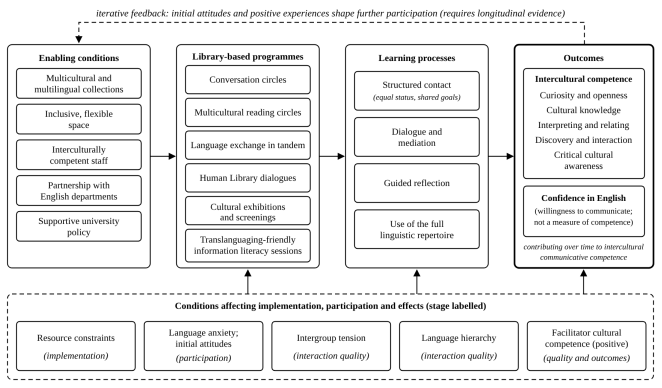
 Copy
 Download