
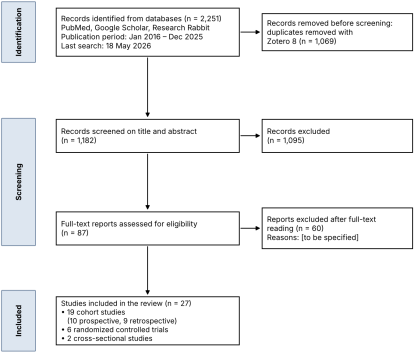
Mastectomy with axillary lymph node dissection (ALND) remains the standard operation for breast cancer in many low-resource settings, but it carries substantial early morbidity. This systematic review aimed to identify the frequency of immediate (30-day) complications after mastectomy with ALND and the factors associated with their occurrence. Following the PRISMA 2020 statement, PubMed, Google Scholar and Research Rabbit were searched for studies published between 1 January 2016 and 31 December 2025 (last search on 18 May 2026). Cohort, case-control, cross-sectional and randomized studies of women with breast cancer undergoing mastectomy with ALND, published in English or French and reporting immediate complications and associated factors, were eligible. After removal of duplicates, records were screened on title and abstract and then on full text; risk of bias was assessed with the Newcastle-Ottawa Scale, the Joanna Briggs Institute checklist and the Cochrane RoB 2 tool, and, because of marked heterogeneity, results were synthesized narratively. Of 2,251 records identified, 27 studies from 15 countries were included (19 cohort studies, 6 randomized controlled trials and 2 cross-sectional studies), only 4 of which were conducted in Africa. Seroma was the most frequent complication: in the 18 studies that reported an overall incidence, it ranged from 19.5% to 71.1% (median 29.4%). It was followed by surgical site infection (3.9–30%), haematoma (2.7–8.6%), wound dehiscence (2.9–5.5%) and skin flap necrosis (3.0–6.7%). Four factors were consistently associated with complications and confirmed in multivariable analyses: older age, high body mass index, extent of axillary dissection and prolonged operative time. Diabetes, smoking and hypertension were mainly associated with infection, whereas early drain removal and high early drainage volume were associated with seroma. Dead-space obliteration (quilting), advanced haemostatic devices, axillary exclusion and lymphatic-sparing techniques reduced seroma in individual studies. Seroma and surgical site infection therefore dominate the early morbidity of mastectomy with ALND. Distinguishing non-modifiable factors (age, tumour burden), which identify high-risk patients, from modifiable ones (obesity, glycaemic control, smoking, surgical technique and drain management) provides concrete targets for prevention in resource-limited settings, where prospective African studies with harmonized definitions are now needed.
| Published in | Journal of Surgery (Volume 14, Issue 6) |
| DOI | 10.11648/j.js.20261406.11 |
| Page(s) | 115-128 |
| Creative Commons |
This is an Open Access article, distributed under the terms of the Creative Commons Attribution 4.0 International License (http://creativecommons.org/licenses/by/4.0/), which permits unrestricted use, distribution and reproduction in any medium or format, provided the original work is properly cited. |
| Copyright |
Copyright © The Author(s), 2026. Published by Science Publishing Group |
Breast Cancer, Mastectomy, Axillary Lymph Node Dissection, Seroma, Surgical Site Infection, Postoperative Complications, Risk Factors, Systematic Review
Study (year), country | Design | n | Main immediate complications (%) | Associated factors / main finding |
|---|---|---|---|---|
Naz (2017), Pakistan [18] | Cross-sectional | 271 | Seroma 21.4 | No association with age, BMI or tumour size |
Nedooshan/Jafari (2022), Iran [19] | RCT, drain 1 vs 5 days | 88ᵃ | Seroma 31.8; SSI 12.5 | Early drain removal: seroma 52.3% vs 13.6% |
Njile (2024), Tanzania [20] | Prospective cohort | 106 | Seroma 49.1 | Age ≥ 50 years; drainage ≥ 150 mL in first 24 h |
Agarwal (2022), India [21] | Prospective cohort | 72 | Seroma 37.5; SSI 8.3; dehiscence 5.5; haematoma 2.7; paraesthesia 11.1 | Descriptive: higher seroma with age > 50, diabetes, NACT |
Abdulnabi (2019), Iraq [22] | Prospective cohort | 170 | Seroma 23.5; SSI 12.4 | Seroma 36.3% when ≥ 10 nodes involved |
Ali (2022), Pakistan [23] | Cross-sectional | 62 | Seroma 25.8; SSI 8.1 | Infection more frequent at stage II |
Ashok (2025), India [24] | Prospective cohort | 88 | Seroma 44; SSI 30; pain/paraesthesia 28; flap necrosis 3; haematoma 3 | Smoking, hypertension, NACT, stage III |
Köpke (2023), Germany [25] | Prospective cohort | 100 | Seroma 52 | Age (OR 1.095/year), specimen weight |
Faisal (2016), Egypt [26] | RCT, axillary exclusion vs conventional | 64 | SSI 5.9 vs 11.7; dehiscence 2.9 | Axillary exclusion reduced drainage and seroma |
Rana (2023), Bangladesh [8] | Prospective cohort | 46 | Seroma 21.7 | Age, BMI, electrocautery, early drain removal (OR 2.89) |
Gaber (2017), Egypt [27] | RCT, axillary reverse mapping vs control | 72 | Seroma 6.5 vs 25; SSI 6.5 vs 11.1; dehiscence 3.2 vs 5.6 | Reverse mapping reduced seroma |
Gambardella (2019), Italy [28] | Retrospective, 4 haemostatic devices | 100 | Seroma 16–64 by device; SSI 4 | Advanced devices (ThunderBeat 16% vs electrocautery 64%) |
Jonczyk (2019), USA [16] | Retrospective (NSQIP) | 226,899 | All 30-day complications 6.56 (mastectomy alone) | Operative time, ASA class, BMI, smoking, comorbidities |
Kuntaraksa (2018), Thailand [29] | RCT, lymphatic ligation vs conventional | 68 | Seroma 26.1 | Age (OR 1.09), BMI (OR 1.23); ligation ineffective |
Leppäpuska (2021), Finland [30] | Prospective cohort | 47 | SSI 17; prolonged seroma 87; haematoma 4.3 | Low TGF-β1 in day-1 exudate predicted SSI |
De Luca (2020), Italy [31] | Retrospective, 3 groups | 41 | Seroma 6–14 by group | Glues: no effect on seroma; shorter drainage |
Nadeem (2023), Pakistan [7] | Prospective cohort | 105 | Sensory loss 38.1; seroma 32.4; SSI 17.1; haematoma 8.6; flap necrosis 6.7; dehiscence 4.8; axillary vein thrombosis 1.9 | Diabetes (OR 2.5), BMI > 30 (OR 2.8), surgery > 120 min |
Obaid (2024), Iraq [32] | Prospective cohort | 100 | Seroma 24; SSI 24 | Seroma rose with nodal involvement (8%, 27%, 44%) |
Isozaki (2019), Japan [33] | Retrospective | 202 | Seroma 19.5 (ALND), 18.2 (SLNB) | BMI ≥ 25 (OR 2.54), level of dissection, specimen weight |
Suresh (2019), India [10] | Retrospective | 83 | Seroma 27 | Age > 40, tumour > 3 cm, nodes, BMI > 30, MRM (35.8% vs 13.8%) |
Wu (2020), China [34] | Retrospective, quilting vs conventional | 235 | Seroma 26.1–27.6; SSI 3.4–4.3; haematoma 4.2–4.3 | Age ≥ 60, BMI ≥ 25; quilting reduced grade 2–3 seroma |
Abouelsoued (2024), Egypt [35] | RCT, quilting vs conventional | 40 | Seroma 55 (35 vs 75) | Quilting reduced seroma and drained volume |
Li (2025), China [36] | Retrospective, minimally invasive vs conventional ALND | 147 | No difference in complications | Less blood loss, better shoulder mobility |
Baker (2020), USA [37] | Retrospective, immediate reconstruction | 986 | Breast complications 35.9 vs 25.6 | Nodal surgery (OR 1.62); access through mastectomy incision (seroma OR 3.60) |
Bogach (2022), USA [17] | Retrospective (NSQIP) | 18,232 | 30-day morbidity 4.9 (ALND) vs 4.3 (SLNB) | BMI (OR 1.06), operative time (OR 1.003/min) |
Brown (2025), USA [38] | Trial-based comparison, ILR vs none | 214 | Seroma 3.5 vs 12.1 | Immediate lymphatic reconstruction reduced seroma |
Fabro (2024), Brazil [39] | Prospective cohort | 249 | Seroma 71.1 | BMI ≥ 25 (OR 1.92), ALND (OR 2.06) |
Tool and judgement | Studies |
|---|---|
NOS – good (7–9 stars) | Abdulnabi, Ashok, Baker, Rana, Köpke, Leppäpuska, Li, Nadeem, Njile, Obaid, Wu (n = 11) |
NOS – fair (6 stars) | Agarwal, De Luca, Gambardella, Suresh (n = 4) |
NOS – moderate (5 stars) | Bogach, Fabro (n = 2) |
NOS – high risk of bias (≤ 4 stars) | Isozaki, Jonczyk (n = 2) |
JBI – moderate (5/8) | Naz, Ali (n = 2) |
RoB 2 – some concerns (moderate) | Nedooshan/Jafari, Faisal, Gaber, Kuntaraksa, Abouelsoued, Brown (n = 6) |
Complication | Studies (n) | Incidence range (%) | Studies at the lower and upper bounds |
|---|---|---|---|
Seroma (overall cohort incidence) | 18ᵃ | 19.5–71.1 (median 29.4) | Isozaki; Fabro |
Surgical site infection | 13 | 3.9–30 | Wu; Ashok |
Haematoma | 5 | 2.7–8.6 | Agarwal; Nadeem |
Wound dehiscence | 4 | 2.9–5.5 | Faisal; Agarwal |
Skin flap necrosis | 2 | 3.0–6.7 | Ashok; Nadeem |
Pain, paraesthesia or sensory loss | 3 | 11.1–38.1 | Agarwal; Nadeem |
Axillary vein thrombosis | 1 | 1.9 | Nadeem |
Factor | Studies evaluating it (n) | Studies with a significant association | Reported OR |
|---|---|---|---|
Older age | 9 | 7/9 | 1.09–29 |
High BMI or obesity | 12 | 9/12 | 1.06–3.31 |
Undernutrition or weight loss | 2 | ½ | 2.7–3.5 |
Specimen weight / breast volume | 2 | 2/2 | – |
Diabetes mellitus | 5 | 4/5 | 2.5 |
Smoking | 3 | 2/3 | 1.2 |
Hypertension | 3 | 2/3 | 1.2 |
High ASA score | 2 | 2/2 | 1.2–5.2 |
Factor | Studies evaluating it (n) | Studies with a significant association |
|---|---|---|
Tumour size | 3 | 2/3 |
Tumour stage (stage III) | 4 | 1/4 (2 descriptive only) |
Histological grade | 2 | 1/2 (univariable) |
Nodal involvement / number of nodes | 4 | 3/4 |
Factor | Studies evaluating it (n) | Studies with a significant association | Reported OR |
|---|---|---|---|
Type of surgery (MRM vs conservative) / route of nodal access | 4 | 3/4 | 1.62–3.60 |
Extent or level of axillary dissection | 4 | 4/4 | 2.06 |
Prolonged operative time | 3 | 3/3 | 1.003 per min to 7.16a |
Early drain removal | 5 | 2/5 | 2.89 |
High drainage volume | 3 | 3/3 | – |
Early shoulder mobilization | 1 | 0/1 | – |
Neoadjuvant chemotherapy | 3 | 1/3 | – |
Radiotherapy, surgeon experience | 0 | – | – |
Technique (vs comparator) | Study | Effect on seroma | Other effects |
|---|---|---|---|
Quilting / flap fixation | Abouelsoued; Wu | Significant reduction (35% vs 75%; grade 2–3 seroma 9.5% vs 19.3%) | Less drained volume; suturing about 7 min longer |
Axillary exclusion | Faisal | Significant reduction | Total drainage 1,476 vs 4,526 mL; drain removed earlier (11.3 vs 17.8 days) |
Axillary reverse mapping | Gaber | Reduction (6.5% vs 25%) | Fewer healing complications; drains removed earlier |
Electrocautery vs sharp dissection | Rana | Electrocautery associated with more seroma | – |
Advanced haemostatic devices (ThunderBeat) | Gambardella | Reduction (16% vs 64% with electrocautery) | Less drained volume |
Lymphatic ligation | Kuntaraksa | No effect (23.5% vs 28.6%) | Longer operative time |
Immediate lymphatic reconstruction | Brown | Reduction (3.5% vs 12.1%) | No reduction in drain days |
Surgical glues (Glubran® 2, fibrin sealant) | De Luca | No effect | Shorter drainage |
Minimally invasive axillary dissection | Li | No effect | Less blood loss; better shoulder mobility |
ALND | Axillary Lymph Node Dissection |
ASA | American Society of Anesthesiologists |
BMI | Body Mass Index |
CI | Confidence Interval |
DES | Diplôme d’Études Spécialisées (specialist diploma) |
GLOBOCAN | Global Cancer Observatory |
ILR | Immediate Lymphatic Reconstruction |
JBI | Joanna Briggs Institute |
MRM | Modified Radical Mastectomy |
NACT | Neoadjuvant Chemotherapy |
NOS | Newcastle-Ottawa Scale |
NSQIP | National Surgical Quality Improvement Program |
OR | Odds Ratio |
PICO | Population, Intervention, Comparator, Outcome |
PRISMA | Preferred Reporting Items for Systematic Reviews and Meta-Analyses |
PROSPERO | International Prospective Register of Systematic Reviews |
RCT | Randomized Controlled Trial |
RoB 2 | Cochrane Risk of Bias 2 tool |
RR | Risk Ratio |
SLNB | Sentinel Lymph Node Biopsy |
SSI | Surgical Site Infection |
TGF-β1 | Transforming Growth Factor beta 1 |
| [1] | Filho AM, Laversanne M, Ferlay J, Colombet M, Piñeros M, Znaor A, et al. The GLOBOCAN 2022 cancer estimates: data sources, methods, and a snapshot of the cancer burden worldwide. Int J Cancer. 2025; 156(7): 1336-46. |
| [2] | Fu M, Peng Z, Wu M, Lv D, Li Y, Lyu S. Current and future burden of breast cancer in Asia: a GLOBOCAN data analysis for 2022 and 2050. Breast. 2025; 79: 103835. |
| [3] | Some OR, Bague AH, Konkobo D, Hien D. Breast cancer in Bobo-Dioulasso, Burkina Faso: management outcomes. Oncologie. 2022; 24(2): 173-84. |
| [4] | Jedy-Agba E, McCormack V, Adebamowo C, dos-Santos-Silva I. Stage at diagnosis of breast cancer in sub-Saharan Africa: a systematic review and meta-analysis. Lancet Glob Health. 2016; 4(12): e923-35. |
| [5] | Toure M, Diouf D, Sando P, Sarr F, Diallo M, Ba NF, et al. Radiotherapy for breast cancers that do not respond to neoadjuvant chemotherapy: a series of illustrative cases and a review of the literature. Jaccr Onco-Palliative Care. 2025; 1(1): 17-24. |
| [6] | Nadeem M, Aslam MU, Akram R, Bhatti TA, Saeed ZA, Ayub S. Predictors of early postoperative complications after modified radical mastectomy: a prospective study of 105 patients. Pak J Med Health Sci. 2023. |
| [7] | Masud Rana A, Mahmuda A, Farouk O, Haque M, Haque S, Rahman Z, et al. Factor associated with post-operative seroma formation after modified radical mastectomy. Glob Acad J Med Sci. 2023. |
| [8] | Crestani A, Mahiou K, Bodet ML, Roosen A, Bonneau C, Rouzier R. Prevention of lymphocele or seroma after mastectomy and axillary lymphadenectomy for breast cancer: systematic review and meta-analysis. Sci Rep. 2022; 12(1): 10016. |
| [9] | Suresh BP, Sachin HG, Madhukar N, Varsha G. To study the factors influencing seroma formation after modified radical mastectomy/breast conservative surgery in MCH VIMS Ballari. Int Surg J. 2019; 6(1): 278-82. |
| [10] | Kilbreath SL, Refshauge KM, Beith JM, Ward LC, Ung OA, Dylke ES, et al. Risk factors for lymphoedema in women with breast cancer: a large prospective cohort. Breast. 2016; 28: 29-36. |
| [11] | Page MJ, McKenzie JE, Bossuyt PM, Boutron I, Hoffmann TC, Mulrow CD, et al. The PRISMA 2020 statement: an updated guideline for reporting systematic reviews. BMJ. 2021; 372: n71. |
| [12] | Wells GA, Shea B, O'Connell D, Peterson J, Welch V, Losos M, et al. The Newcastle-Ottawa Scale (NOS) for assessing the quality of nonrandomised studies in meta-analyses. Ottawa: Ottawa Hospital Research Institute; 2000. |
| [13] | Moola S, Munn Z, Tufanaru C, Aromataris E, Sears K, Sfetcu R, et al. Chapter 7: Systematic reviews of etiology and risk. In: Aromataris E, Munn Z, editors. JBI Manual for Evidence Synthesis. Adelaide: JBI; 2020. |
| [14] | Sterne JAC, Savović J, Page MJ, Elbers RG, Blencowe NS, Boutron I, et al. RoB 2: a revised tool for assessing risk of bias in randomised trials. BMJ. 2019; 366: l4898. |
| [15] | Jonczyk MM, Jean J, Graham RA, Chatterjee A. Trending towards safer breast cancer surgeries? Examining acute complication rates from a 13-year NSQIP analysis. Cancers (Basel). 2019; 11(2): 253. |
| [16] | Bogach J, Cordeiro E, Reel E, Cil T. Axillary surgery and complication rates after mastectomy and reconstruction for breast cancer: an analysis of the NSQIP database. Breast Cancer Res Treat. 2022. |
| [17] | Naz R, Gondal KM. Quilting technique to prevent seroma formation following mastectomy for breast cancer: a cross-sectional study. 2017; 11(4): 43-46. |
| [18] | Nedooshan JJ, Rahmatabadi MHD, Kargar S, Lotfi MH. Evaluation of complications of short-term and long-term drainage following mastectomy with removal of axillary lymph nodes: a randomized clinical trial. Asian Pac J Cancer Prev. 2022; 23(8). |
| [19] | Njile D, Kivuyo N, Brand N, et al. [Incidence] of seroma formation and the associated impact on adjuvant chemotherapy initiation for women undergoing mastectomy for breast cancer at a national referral hospital. East Cent Afr J Surg. 2024; 29(1):32-38. |
| [20] | Agarwal N, Agarwal S. Assessment of risks and complications associated with the breast cancer surgery with axillary dissection. Int J Health Sci. 2022; 6(S2). |
| [21] | Abdulnabi A, et al. Evaluating the effect of axillary lymph node involvement and dissection in the development of post-mastectomy lymphedema. 2019. |
| [22] | Ali H, Muhammad S, Balouch V, Shaikh M, Kumari P. Incidence of primary complications afterwards modified radical mastectomy in breast cancer. Pak J Med Health Sci. 2022. |
| [23] | Ashok A, Chaudhary AK, Arti A, Rana YS. Critical insights and challenges following modified radical mastectomy in breast cancer patients. Indian J Appl Res. 2025. |
| [24] | Köpke M, Wild CM, Schneider M, Pochert N, Schneider F, Sagasser J, et al. Elderly and patients with large breast volume have an increased risk of seroma formation after mastectomy — results of the SerMa pilot study. Cancers (Basel). 2023; 15(14): 3606. |
| [25] | Faisal M, et al. [Axillary exclusion technique versus conventional closure after modified radical mastectomy: a randomized controlled trial]. World J Surg Oncol. 2016; 14(1): 39. |
| [26] | Gaber A, Fawzy A, Sabry A, Sisi AE. Role of axillary reverse mapping in decreasing complications after axillary dissection in breast cancer. Int Surg J. 2017. |
| [27] | Gambardella C, Clarizia G, Patrone R, Offi C, Mauriello C, Romano RM, et al. Advanced hemostasis in axillary lymph node dissection for locally advanced breast cancer: new technology devices compared in the prevention of seroma formation. BMC Surg. 2019. |
| [28] | Kuntaraksa N. Lymphatic ligation versus conventional axillary lymph node dissection in breast cancer patients: a randomized controlled trial. Thai J Surg. 2018. |
| [29] | Leppäpuska IM, Rannikko EH, Laukka M, Peuhu E, Veemaa R, Viitanen TP, et al. Low TGF-β1 in wound exudate predicts surgical site infection after axillary lymph node dissection. J Surg Res. 2021. |
| [30] | De Luca A, Tripodi D, Frusone F, Leonardi B, Cerbelli B, Botticelli A, et al. Retrospective evaluation of the effectiveness of a synthetic glue and a fibrin-based sealant for the prevention of seroma following axillary dissection in breast cancer patients. Front Oncol. 2020; 10: 1061. |
| [31] | Obaid H, Mohammed MR, Hussein HNA. Role of axillary lymph nodes involvement in some complications of modified radical mastectomy. Med J Babylon. 2024. |
| [32] | Isozaki H, Yamamoto Y, Murakami S, Matsumoto S, Takama T. Impact of the surgical modality for axillary lymph node dissection on postoperative drainage and seroma formation after total mastectomy. Patient Saf Surg. 2019. |
| [33] | Wu Y, Wang S, Hai J, Mao J, Dong X, Xiao Z. Quilting suture is better than conventional suture with drain in preventing seroma formation at pectoral area after mastectomy. BMC Surg. 2020. |
| [34] | Abouelsoued A, El-Mabood EA, et al. [Comparative study between] conventional modified radical mastectomy and modified radical mastectomy with quilting technique to axillary skin flap in reduction of postoperative seroma. Benha J Appl Sci / Benha Med J. 2024; 9(2): 117-123. |
| [35] | Li et al. [Minimally invasive versus conventional axillary dissection]. Surg Endosc. 2025; 39(8): 4935-4945. |
| [36] | Baker N, Baecher KM, Hart AM, Styblo TM, Carlson GW, Losken A. The impact of axillary node surgery on outcomes following immediate breast reconstruction. Breast J. 2020. |
| [37] | Brown SJ, McLaughlin SA, Boughey J, Forte A, Hieken TJ, Piltin MA, et al. Axillary lymph node dissection with and without immediate lymphatic reconstruction: association with drain days and seromas. Am Surg. 2025. |
| [38] | Fabro EAN, Costa RM, Fernandes M, Ximenes MA, Nogueira DA, Soares NB, et al. Seroma incidence and risk factors in women undergoing mastectomies as surgical breast cancer treatment. Support Care Cancer. 2024. |
| [39] | Sousa J, Sood R, Liu D, Calhoun K, Louie O, Neligan P, et al. Comparison of outcomes in immediate implant-based breast reconstruction versus mastectomy alone. Plast Surg (Oakv). 2018; 26(1): 18-25. |
| [40] | Xue DQ, Qian C, Yang L, Wang XF. Risk factors for surgical site infections after breast surgery: a systematic review and meta-analysis. Eur J Surg Oncol. 2012; 38(5): 375-81. |
| [41] | Velotti N, Limite G, Vitiello A, Berardi G, Musella M. Flap fixation in preventing seroma formation after mastectomy: an updated meta-analysis. Updates Surg. 2021; 73(4): 1307-14. |
| [42] | Watanabe J, Kataoka Y, Koike A, et al. Efficacy and safety of surgical energy devices for axillary node dissection: a systematic review and network meta-analysis. Breast Cancer. 2023; 30: 531-40. |
| [43] | Guo X, Jiao D, Zhu J, Xiao H, Zhao X, Yang Y, et al. The effectiveness of axillary reverse mapping in preventing breast cancer-related lymphedema: a meta-analysis based on randomized controlled trials. Gland Surg. 2021; 10(4): 1447-59. |
APA Style
Adama, O., Raoul, Y. K. G., Issouf, O., Paul, K. D., Valérie, G. K. J., et al. (2026). Factors Associated with Immediate Complications After Mastectomy with Axillary Lymph Node Dissection for Breast Cancer: A Systematic Review from 2016 to 2025. Journal of Surgery, 14(6), 115-128. https://doi.org/10.11648/j.js.20261406.11
ACS Style
Adama, O.; Raoul, Y. K. G.; Issouf, O.; Paul, K. D.; Valérie, G. K. J., et al. Factors Associated with Immediate Complications After Mastectomy with Axillary Lymph Node Dissection for Breast Cancer: A Systematic Review from 2016 to 2025. J. Surg. 2026, 14(6), 115-128. doi: 10.11648/j.js.20261406.11
AMA Style
Adama O, Raoul YKG, Issouf O, Paul KD, Valérie GKJ, et al. Factors Associated with Immediate Complications After Mastectomy with Axillary Lymph Node Dissection for Breast Cancer: A Systematic Review from 2016 to 2025. J Surg. 2026;14(6):115-128. doi: 10.11648/j.js.20261406.11
@article{10.11648/j.js.20261406.11,
  author = {Ouattara Adama and Yaogo Kiswendsida Gaetan Raoul and Ouédraogo Issouf and Kain Dantola Paul and Garé Kopiho Jocelyne Valérie and Ouedraogo Charlemagne},
  title = {Factors Associated with Immediate Complications After Mastectomy with Axillary Lymph Node Dissection for Breast Cancer: A Systematic Review from 2016 to 2025},
  journal = {Journal of Surgery},
  volume = {14},
  number = {6},
  pages = {115-128},
  doi = {10.11648/j.js.20261406.11},
  url = {https://doi.org/10.11648/j.js.20261406.11},
  eprint = {https://article.sciencepublishinggroup.com/pdf/10.11648.j.js.20261406.11},
  abstract = {Mastectomy with axillary lymph node dissection (ALND) remains the standard operation for breast cancer in many low-resource settings, but it carries substantial early morbidity. This systematic review aimed to identify the frequency of immediate (30-day) complications after mastectomy with ALND and the factors associated with their occurrence. Following the PRISMA 2020 statement, PubMed, Google Scholar and Research Rabbit were searched for studies published between 1 January 2016 and 31 December 2025 (last search on 18 May 2026). Cohort, case-control, cross-sectional and randomized studies of women with breast cancer undergoing mastectomy with ALND, published in English or French and reporting immediate complications and associated factors, were eligible. After removal of duplicates, records were screened on title and abstract and then on full text; risk of bias was assessed with the Newcastle-Ottawa Scale, the Joanna Briggs Institute checklist and the Cochrane RoB 2 tool, and, because of marked heterogeneity, results were synthesized narratively. Of 2,251 records identified, 27 studies from 15 countries were included (19 cohort studies, 6 randomized controlled trials and 2 cross-sectional studies), only 4 of which were conducted in Africa. Seroma was the most frequent complication: in the 18 studies that reported an overall incidence, it ranged from 19.5% to 71.1% (median 29.4%). It was followed by surgical site infection (3.9–30%), haematoma (2.7–8.6%), wound dehiscence (2.9–5.5%) and skin flap necrosis (3.0–6.7%). Four factors were consistently associated with complications and confirmed in multivariable analyses: older age, high body mass index, extent of axillary dissection and prolonged operative time. Diabetes, smoking and hypertension were mainly associated with infection, whereas early drain removal and high early drainage volume were associated with seroma. Dead-space obliteration (quilting), advanced haemostatic devices, axillary exclusion and lymphatic-sparing techniques reduced seroma in individual studies. Seroma and surgical site infection therefore dominate the early morbidity of mastectomy with ALND. Distinguishing non-modifiable factors (age, tumour burden), which identify high-risk patients, from modifiable ones (obesity, glycaemic control, smoking, surgical technique and drain management) provides concrete targets for prevention in resource-limited settings, where prospective African studies with harmonized definitions are now needed.},
 year = {2026}
}
TY  - JOUR
T1  - Factors Associated with Immediate Complications After Mastectomy with Axillary Lymph Node Dissection for Breast Cancer: A Systematic Review from 2016 to 2025
AU  - Ouattara Adama
AU  - Yaogo Kiswendsida Gaetan Raoul
AU  - Ouédraogo Issouf
AU  - Kain Dantola Paul
AU  - Garé Kopiho Jocelyne Valérie
AU  - Ouedraogo Charlemagne
Y1  - 2026/11/23
PY  - 2026
N1  - https://doi.org/10.11648/j.js.20261406.11
DO  - 10.11648/j.js.20261406.11
T2  - Journal of Surgery
JF  - Journal of Surgery
JO  - Journal of Surgery
SP  - 115
EP  - 128
PB  - Science Publishing Group
SN  - 2330-0930
UR  - https://doi.org/10.11648/j.js.20261406.11
AB  - Mastectomy with axillary lymph node dissection (ALND) remains the standard operation for breast cancer in many low-resource settings, but it carries substantial early morbidity. This systematic review aimed to identify the frequency of immediate (30-day) complications after mastectomy with ALND and the factors associated with their occurrence. Following the PRISMA 2020 statement, PubMed, Google Scholar and Research Rabbit were searched for studies published between 1 January 2016 and 31 December 2025 (last search on 18 May 2026). Cohort, case-control, cross-sectional and randomized studies of women with breast cancer undergoing mastectomy with ALND, published in English or French and reporting immediate complications and associated factors, were eligible. After removal of duplicates, records were screened on title and abstract and then on full text; risk of bias was assessed with the Newcastle-Ottawa Scale, the Joanna Briggs Institute checklist and the Cochrane RoB 2 tool, and, because of marked heterogeneity, results were synthesized narratively. Of 2,251 records identified, 27 studies from 15 countries were included (19 cohort studies, 6 randomized controlled trials and 2 cross-sectional studies), only 4 of which were conducted in Africa. Seroma was the most frequent complication: in the 18 studies that reported an overall incidence, it ranged from 19.5% to 71.1% (median 29.4%). It was followed by surgical site infection (3.9–30%), haematoma (2.7–8.6%), wound dehiscence (2.9–5.5%) and skin flap necrosis (3.0–6.7%). Four factors were consistently associated with complications and confirmed in multivariable analyses: older age, high body mass index, extent of axillary dissection and prolonged operative time. Diabetes, smoking and hypertension were mainly associated with infection, whereas early drain removal and high early drainage volume were associated with seroma. Dead-space obliteration (quilting), advanced haemostatic devices, axillary exclusion and lymphatic-sparing techniques reduced seroma in individual studies. Seroma and surgical site infection therefore dominate the early morbidity of mastectomy with ALND. Distinguishing non-modifiable factors (age, tumour burden), which identify high-risk patients, from modifiable ones (obesity, glycaemic control, smoking, surgical technique and drain management) provides concrete targets for prevention in resource-limited settings, where prospective African studies with harmonized definitions are now needed.
VL  - 14
IS  - 6
ER  -
Training and Research Unit in Health Sciences, Bogodogo University Teaching Hospital, Ouagadougou, Burkina Faso;Training and Research Unit in Health Sciences, Joseph KI-ZERBO University, Ouagadougou, Burkina Faso

Information



 Share This Article
 Twitter
 Linked In
 Facebook

 Copy
 Download