
Introduction: The aim of this study was to describe abdominal wounds managed in the general surgery department of the Siguiri Prefecture Hospital. Methodology: This was a descriptive, mixed-method (retrospective and prospective) cross-sectional study spanning five years, from January 1, 2021, to December 31, 2025, covering all patients admitted to and treated in the department for abdominal wounds during the study period. Results: Abdominal wounds accounted for 7.50% of admissions to the department; penetrating wounds represented 82 cases (82.60%). The mean patient age was 31.5 years, ranging from 12 to 51 years. Men were the most represented group, with a male-to-female sex ratio of 3.18. Assaults were the leading cause of these injuries (48.91%), followed by fights (26.08%) and workplace accidents (10.86%); bladed weapons were the most commonly used by assailants (60.86%). Treatment was non-operative in 26 cases (28%) and operative in 66 cases (72%). The small intestine was the most frequently injured organ (40.90%). The most common surgical procedure was excision and suture (28.78%). Postoperative recovery was uncomplicated in 72.82% of cases, with a mortality rate of 8.69%. The average length of hospital stay was 8.5 days. Conclusion: Abdominal wounds are common and primarily affect young men. Challenges in patient management are linked to delayed presentation and a lack of medical and paramedical equipment.
| Published in | Journal of Surgery (Volume 14, Issue 4) |
| DOI | 10.11648/j.js.20261404.14 |
| Page(s) | 89-95 |
| Creative Commons |
This is an Open Access article, distributed under the terms of the Creative Commons Attribution 4.0 International License (http://creativecommons.org/licenses/by/4.0/), which permits unrestricted use, distribution and reproduction in any medium or format, provided the original work is properly cited. |
| Copyright |
Copyright © The Author(s), 2026. Published by Science Publishing Group |
Abdominal Wounds, Management, Prefecture Hospital, Siguiri
Circumstances of the event | Effective | Percentage |
|---|---|---|
Assaults | 45 | 48.91 |
Fights | 22 | 23.91 |
Workplace accident | 10 | 10.86 |
road accident | 5 | 5.43 |
Domestic accident | 3 | 3.26 |
hunting accident | 3 | 3.26 |
attempted suicide | 4 | 4.35 |
TOTAL | 92 | 100 |
Vulnerable agents | Effective | Percentage |
|---|---|---|
bladed weapons | 56 | 60.86 |
Firearm | 22 | 23.91 |
Horns (beef) | 6 | 6.52 |
motorcycle handlebars | 4 | 4.34 |
Drink | 3 | 3.26 |
Undetermined | 1 | 1.08 |
TOTAL | 92 | 100 |
Reasons for consultation | Frequency (92) | Percentage |
|---|---|---|
Abdominal pain | 92 | 100 |
Parietal hemorrhage | 63 | 68.47 |
Fever | 51 | 55.43 |
Nausea / Vomiting | 48 | 52.17 |
Dyspnea | 15 | 4:30 PM |
Psychomotor agitation | 9 | 9.78 |
Intense thirst | 2 | 2.17 |
Metrorrhagia | 1 | 1.08 |
Total hematuria | 1 | 1.08 |
physical signs | Effective | Percentage |
|---|---|---|
Abdominal defense | 59 | 64.13 |
The bomb in Douglas's dead end and the pain | 50 | 54.34 |
Abdominal muscle spasm | 48 | 52.17 |
Matite tilts its sides | 37 | 40.21 |
Umbilical cry | 30 | 32.60 |
Disappearance of pre-hepatic dullness | 13 | 14.13 |
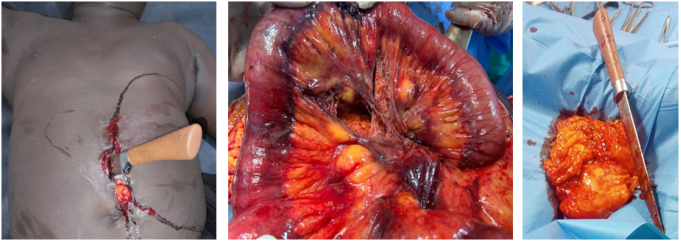
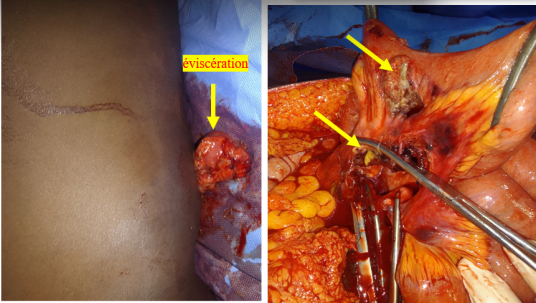
Post-traumatic evisceration | 10 | 10.86 |
Surgical indication | Effective | Percentage |
|---|---|---|
Abdominal wound and peritoneal irritation syndrome | 37 | 56.06 |
Abdominal injury + hemoperitoneum syndrome + hemodynamic instability | 19 | 28.79 |
Abdominal wound + Evisceration | 10 | 15.15 |
Total | 66 | 100 |
Type of injury | Number of employees = 66 | Percentage |
|---|---|---|
ileal/jejunal lesion | 27 | 40.91 |
colic ulcer | 17 | 25.76 |
Gastric lesion | 13 | 19.69 |
Mesenteric wound | 13 | 19.69 |
Retroperitoneal hematoma | 4 | 6.06 |
Liver wound | 4 | 6.06 |
Spleen injury | 3 | 4.54 |
Bladder injury | 1 | 1.51 |
Uterine lesion | 1 | 1.51 |
Actions taken | Number of employees (66) | Percentage |
|---|---|---|
Excision + suture | 32 | 48.48 |
Resection + anastomosis | 13 | 19.69 |
Resection + stoma | 12 | 18.18 |
hemostatic suture | 4 | 6.06 |
Respect for the retroperitoneal hematoma | 4 | 6.06 |
mesentery repair | 4 | 6.06 |
total splenectomy | 3 | 4.54 |
Cystorrhaphy | 1 | 1.51 |
Hysterorrhaphy | 1 | 1.51 |
Evolutionary suites | Personnel (92) | Percentage | |
|---|---|---|---|
Simple | 67 | 72.82 | |
Complications | Type of complication | 17 | 18.48 |
Type of complication | parietal suppurations | 8 | 8.69 |
fecal fistulas | 4 | 4.34 | |
Postoperative peritonitis | 3 | 3.26 | |
Post-operative eviscerations | 2 | 2.17 | |
Death | 8 | 8.69 | |
ATLS | Advanced Trauma Care Student |
SAMU | Lack of emergency medical assistance services |
SPSS | Statistical software for the social sciences |
| [1] | Moore EE, Feliciano DV, Mattox KL, Cocanour CS, West MA, Davis JW, et al. Trauma. 9th ed. New York: McGraw-Hill, 2020. |
| [2] | World Health Organization. Global Road Safety Report. Geneva: WHO; 2018. |
| [3] | Kassegne I, Gnassingbe K, Tekou H, Kolou M, Amana B, Tchangai B, et al. Abdominal trauma in sub-Saharan Africa. Med Trop. 2010; 70(6): 587-90. |
| [4] | Navsaria PH, Edu S, Nicol AJ, Krige JE, Kahn D, Omoshoro -Jones J et al. Penetrating abdominal trauma: indications for laparotomy. Curr Critical Care Opinion. 2011; 17(6): 620-6. |
| [5] | Benkhedda M, Hachem A, Boudiaf M, Ziani R, Bensalem A, Charefeddine L, et al. Abdominal trauma in Algeria: epidemiological and therapeutic aspects. Ann Afr Chir. 2018; 12(2): 55-60. |
| [6] | Dembele B, Cisse L, Doumbia Y, Traore I, Boubacar M, Diallo M, et al. Abdominal wounds in war wounded in Douentza, Mali: experience of a reference center. Rev Mal Chir. 2020; 6(1): 25-31. |
| [7] | Diallo MS, Soumah A, Kourouma F, Camara D, Kaba M, Fofana A, et al. Abdominal trauma in a regional hospital in Guinea: epidemiological and therapeutic aspects. Guinée Médicale. 2021; 4(1): 25-32. |
| [8] | American College of Surgeons. ATLS: Course Manual for Advanced Trauma Care Students. 11th ed. Chicago: ACS; 2019. |
| [9] | Stassen NA, Bhullar I, Cheng JD, Crandall M, Kerwin AJ, Ibrahim J, et al. Non-operative management of abdominal trauma. J Trauma Acute Care Surg. 2012; 73(5 Suppl 4): 288-93. |
| [10] | Wabada S, Abubakar AM, Chinda JY, Adamu S, Bwala KJ. Penetrating abdominal wounds in children: a study of 33 cases. Ann Pediatr Surg. 2018; 14(1): 8-12. |
| [11] | Raherinantenaina F, Rakotomena SD, Rajaonarivony T, Rabetsiahiny LF, Rajaonanahary TMA, Rakototiana FA, et al. Closed and penetrating abdominal trauma: retrospective analysis of 175 cases. Pan Afr Med J. 2015; 20: 129. |
| [12] | Chiche B, Moule P. Surgical emergencies, Masson abridged (Paris), 2007; 2: 86-90. |
| [13] | Ivatury RR, Simon RJ, Stahl WM. Critical evaluation of laparoscopy in penetrating abdominal trauma. J Trauma. 1993; 34(6): 822-7. |
| [14] | Hoffmann C, Goudard Y, Falzone E, et al. Management of penetrating abdominal trauma: specific considerations. Ann Fr Anesth Réanim, 2013; 32(2): 104-11. |
APA Style
Seydou, K., Sandaly, D., Amara, C., Bakary, D., Sokona, C. I., et al. (2026). Anatomo-clinical Aspects and Management in the General Surgery Department of the Siguiri Prefectural Hospital. Journal of Surgery, 14(4), 89-95. https://doi.org/10.11648/j.js.20261404.14
ACS Style
Seydou, K.; Sandaly, D.; Amara, C.; Bakary, D.; Sokona, C. I., et al. Anatomo-clinical Aspects and Management in the General Surgery Department of the Siguiri Prefectural Hospital. J. Surg. 2026, 14(4), 89-95. doi: 10.11648/j.js.20261404.14
@article{10.11648/j.js.20261404.14,
  author = {Keita Seydou and Diakite Sandaly and Condé Amara and Doumbouya Bakary and Camara Ibrahima Sokona and Soumaoro Labile Togba and Fofana Houssein and Touré Aboubacar},
  title = {Anatomo-clinical Aspects and Management in the General Surgery Department of the Siguiri Prefectural Hospital},
  journal = {Journal of Surgery},
  volume = {14},
  number = {4},
  pages = {89-95},
  doi = {10.11648/j.js.20261404.14},
  url = {https://doi.org/10.11648/j.js.20261404.14},
  eprint = {https://article.sciencepublishinggroup.com/pdf/10.11648.j.js.20261404.14},
  abstract = {Introduction: The aim of this study was to describe abdominal wounds managed in the general surgery department of the Siguiri Prefecture Hospital. Methodology: This was a descriptive, mixed-method (retrospective and prospective) cross-sectional study spanning five years, from January 1, 2021, to December 31, 2025, covering all patients admitted to and treated in the department for abdominal wounds during the study period. Results: Abdominal wounds accounted for 7.50% of admissions to the department; penetrating wounds represented 82 cases (82.60%). The mean patient age was 31.5 years, ranging from 12 to 51 years. Men were the most represented group, with a male-to-female sex ratio of 3.18. Assaults were the leading cause of these injuries (48.91%), followed by fights (26.08%) and workplace accidents (10.86%); bladed weapons were the most commonly used by assailants (60.86%). Treatment was non-operative in 26 cases (28%) and operative in 66 cases (72%). The small intestine was the most frequently injured organ (40.90%). The most common surgical procedure was excision and suture (28.78%). Postoperative recovery was uncomplicated in 72.82% of cases, with a mortality rate of 8.69%. The average length of hospital stay was 8.5 days. Conclusion: Abdominal wounds are common and primarily affect young men. Challenges in patient management are linked to delayed presentation and a lack of medical and paramedical equipment.},
 year = {2026}
}
TY  - JOUR
T1  - Anatomo-clinical Aspects and Management in the General Surgery Department of the Siguiri Prefectural Hospital
AU  - Keita Seydou
AU  - Diakite Sandaly
AU  - Condé Amara
AU  - Doumbouya Bakary
AU  - Camara Ibrahima Sokona
AU  - Soumaoro Labile Togba
AU  - Fofana Houssein
AU  - Touré Aboubacar
Y1  - 2026/08/24
PY  - 2026
N1  - https://doi.org/10.11648/j.js.20261404.14
DO  - 10.11648/j.js.20261404.14
T2  - Journal of Surgery
JF  - Journal of Surgery
JO  - Journal of Surgery
SP  - 89
EP  - 95
PB  - Science Publishing Group
SN  - 2330-0930
UR  - https://doi.org/10.11648/j.js.20261404.14
AB  - Introduction: The aim of this study was to describe abdominal wounds managed in the general surgery department of the Siguiri Prefecture Hospital. Methodology: This was a descriptive, mixed-method (retrospective and prospective) cross-sectional study spanning five years, from January 1, 2021, to December 31, 2025, covering all patients admitted to and treated in the department for abdominal wounds during the study period. Results: Abdominal wounds accounted for 7.50% of admissions to the department; penetrating wounds represented 82 cases (82.60%). The mean patient age was 31.5 years, ranging from 12 to 51 years. Men were the most represented group, with a male-to-female sex ratio of 3.18. Assaults were the leading cause of these injuries (48.91%), followed by fights (26.08%) and workplace accidents (10.86%); bladed weapons were the most commonly used by assailants (60.86%). Treatment was non-operative in 26 cases (28%) and operative in 66 cases (72%). The small intestine was the most frequently injured organ (40.90%). The most common surgical procedure was excision and suture (28.78%). Postoperative recovery was uncomplicated in 72.82% of cases, with a mortality rate of 8.69%. The average length of hospital stay was 8.5 days. Conclusion: Abdominal wounds are common and primarily affect young men. Challenges in patient management are linked to delayed presentation and a lack of medical and paramedical equipment.
VL  - 14
IS  - 4
ER  -
Department of General Surgery, Gamal Abdel Nasser University, Conakry City, Republic of Guinea
Department of General Surgery, Gamal Abdel Nasser University, Conakry City, Republic of Guinea

Information



 Share This Article
 Twitter
 Linked In
 Facebook
 Copy
Copy Download