Abstract
Persistent conflict in Central Africa—and across post-colonial states more broadly—is not the product of episodic crises, contemporary leadership failures, or random instability. It is the structural legacy of colonial state design. This article identifies a central mechanism—annexation without incorporation—through which colonial border-making produced populations formally subjected to state authority but denied enforceable rights, political membership, and protection. Such populations experience durable structural insecurity and, over generations, mobilize in predictable ways, generating recurrent, frequently cross-border conflict. A comparative analysis of multi-border and compact states illustrates the mechanism. Fragmented colonial borders in the Democratic Republic of the Congo (DRC) institutionalized political exclusion and territorial fragmentation, producing persistent armed groups and externalized insecurity. Rwanda, by contrast, internalized authority within a compact territory, resolved internal instability while remaining exposed to unresolved vulnerabilities among politically excluded populations beyond its borders. Historical evidence shows that colonial annexation and administrative incorporation without political integration were systematic, not accidental, features of state formation. In eastern Congo, communities historically connected to Rwanda and local polities were annexed without full membership, creating enduring zones of exclusion that continue to structure violence. The mechanism generalizes beyond the Great Lakes, as seen in cases from Sudan/South Sudan to Cameroon/Nigeria and Somalia/Ethiopia, where annexed populations remain politically marginal and structurally insecure. The article advances a historically grounded, mechanism-driven, and predictive framework for post-colonial conflict, demonstrating that persistent instability is not an aberration of weak states but the expected outcome of institutional design. Durable peace, therefore, requires structural remedies—legal recognition, political inclusion, secure land tenure, and regional coordination—rather than purely episodic interventions.
Keywords
Colonial State Formation, Arbitrary Borders, Annexation Without Incorporation, Structural Insecurity, Post-colonial Conflict,
Cross-border Insurgency, Democratic Republic of Congo, Multi-border Governance
1. Introduction
Persistent conflict in post-colonial states remains one of the most enduring and unevenly distributed challenges in comparative politics and political economy. Across Africa and beyond, violence persists decades after independence, disproportionately concentrated in specific territories rather than uniformly distributed across national boundaries. These patterns endure despite regime changes, development endeavours, peacekeeping interventions, and changes in international participation. The persistence and spatial clustering of conflict raises an important question: why do some regions remain structurally prone to insecurity while others, under comparable political and economic conditions, do not?
The dominant theories emphasize ineffective government, ethnic divisions, or rivalry over limited resources. While each captures significant aspects of violence, none thoroughly explains its temporal persistence or territorial concentration. Ethnic diversity is widespread but does not always lead to conflict; institutional instability is typical but does not always lead to insurgency; and resource endowments fluctuate without consistently forecasting where violence will occur. Most notably, these models fail to explain why conflict usually clusters in borderlands and peripheral regions, or why the same groups are mobilized throughout generations. As a result, most research discusses why conflict occurs but does not explain why it persists.
The inability of dominant theories to explain the territorial persistence of conflict suggests that its causes are not merely contemporaneous but structurally embedded. If violence repeatedly concentrates in the same regions across generations, its origins must lie in the historical organization of political authority, territory, and belonging. Accordingly, a large amount of literature has identified the historical foundations of these dynamics. Mamdani
| [1] | M. Mamdani, Citizen and subject: contemporary Africa and the legacy of late colonialism. in Princeton studies in culture/power/history. Princeton: Princeton University Press, 2018. https://doi.org/10.23943/9781400889716 |
[1]
shows how indirect rule and political dualism institutionalized exclusion by distinguishing between subjects and citizens. Bates
| [2] | Bates, R. H., "Markets and states in tropical Africa The political basis of agricultural policies. Univ of California Press." 2014. |
[2]
and Hope
| [3] | Hope, K. N. Colonial Rule and Natural Resources Exploitation in Post-colonial Africa. In Colonial Heritage and the Socio-Economic Development of Africa (pp. 209-228). Cham Springer Nature Switzerland, 2025.
https://doi.org/10.1007/978-3-031-73695-7_11 |
[3]
demonstrate how colonial extractive and administrative logics created incentives for coercion rather than responsibility. Martin
| [4] | “Martin, G., "Jeffrey Herbst. States and Power in Africa: Comparative Lessons in Authority and Control. Princeton, NJ: Princeton University Press, 2000. 272 pp. Figures. Maps. Tables. Index. $17.95." Paper. African Studies Review, 44(3), 179-182., 2001. |
[4]
stresses the difficulties of administering regions inherited from colonial authority, emphasizing weak sovereignty and uneven geographical penetration. Historical reports, such as Pakenham
| [5] | “Pakenham, T., "The Scramble for Africa White Man’s Conquest of the Dark Continent from 1876 to 1912." HarperCollins., 1992. |
[5]
, illustrate the arbitrary drawing of colonial frontiers with little regard for pre-existing polities.
Despite significant insights, extant research continues to treat borders primarily as fixed constraints or inert background conditions, rather than as active political structures that organize inclusion, exclusion, and access to protection. This conceptual limitation has prevented scholars from systematically reconciling territorial design, population annexation, and political membership within a single causal framework. As a result, the literature lacks a coherent explanation for how populations can be formally subordinated to state authority while remaining continuously insecure and why such conditions generate recurring armed groups and cross-border violence as structural rather than situational outcomes. Consistent with this critique, Mertens
| [6] | C. Mertens, S. Perazzone, and D. Mwambari, “Fatal misconceptions: colonial durabilities, violence and epistemicide inAfrica’s Great Lakes Region,” Critical African Studies, vol. 14, no. 1, pp. 2–18, Jan. 2022,
https://doi.org/10.1080/21681392.2022.2059901 |
[6]
argues that violence in the Great Lakes region is frequently misunderstood through depoliticized lenses—ethnicity, government failure, or criminality, because colonial epistemologies continue to shape how conflict is defined and managed.
This research bridges that gap by proposing a mechanism-centred explanation grounded in annexation without incorporation. During colonial and early post-colonial state creation, communities were routinely annexed into newly defined territory without being formally integrated into systems of enforceable rights, representation, and protection. These populations were administratively managed but politically excluded, resulting in a structural insecurity that has persisted for generations. Under such conditions, mobilization and conflict are predictable responses to long-term institutional exclusion built into the state’s design, rather than atypical consequences of episodic shocks.
The Democratic Republic of the Congo (DRC) and Rwanda present contrasting examples of annexation without incorporation in practice. The Congolese state was territorially expanded by colonial annexation, resulting in fractured sovereignty and long-standing political exclusion. Multiple border crossings led to colonial annexation, creating zones in which populations historically associated with neighbouring polities, including Rwanda, were officially admitted into the Congolese state but not granted political membership. Empirical data reveal that these populations remain legally and politically insecure, particularly regarding land tenure and citizenship, which reinforces the conditions that lead to recurring conflict rather than its dissipation
| [7] | M. C. Mkhize, C. Nyere, and T. D. Tumba, “The implications of bifurcated citizenship and access to land in Africa: the case of DRC conflict,” Front. Hum. Dyn., vol. 7, p. 1637169, Aug. 2025, https://doi.org/10.3389/fhumd.2025.1637169 |
[7]
.
The divergence between the DRC and Rwanda reflects contrasting colonial territorial trajectories rather than a simplistic conflict-versus-stability dichotomy. Rwanda was territorially restricted but administratively and politically consolidated, enabling the internalization of authority and comparatively secure political participation within its limited borders. This consolidation, however, did not eliminate structural insecurity; instead, it displaced it beyond Rwanda’s borders, where political membership or rights were territorially compressed and unresolved.
Rwanda’s concern in eastern DRC must therefore be understood not merely through cross-border ethnic ties, but as the institutional consequence of this externalized insecurity following post-genocide against Tutsi stabilization. Armed actors responsible for the genocide against the Tutsi, notably the Democratic Force for the Liberation of Rwanda (FDLR) and Interahamwe elements, were relocated into Eastern DRC, where fragmented and unreliable sovereignty, as well as weak incorporation, allowed their protection and continued mobilization for waging war in Rwanda. As a result, Eastern DRC became a twin source of structural insecurity for populations annexed but not incorporated. It left Rwanda politically vulnerable and facing ongoing external threats to its internal consolidation. Under these conditions, cross-border action emerges not as discretionary aggression, but as a structurally compelled response to misaligned regimes of political inclusion across territorial boundaries.
This paper contains four contributions. First, it conceptualizes annexation without incorporation as a causal mechanism linking colonial territorial design to ongoing conflict, going beyond explanations based on ethnicity, resources, or state weakness. Second, it demonstrates temporal continuity by examining how colonial administrative decisions shaped contemporary conflict systems throughout decades of post-colonial rule. Third, it generalizes the mechanism across different geographical configurations, demonstrating that structural insecurity is a predicted consequence of institutional design rather than an outlier. Finally, it discusses the policy implications of political inclusion, legal recognition, and cross-border coordination, emphasizing that long-term stability necessitates tackling structural rather than episodic causes of violence.
The remainder of the paper will continue as follows. Section 2 situates the argument within existing scholarship and identifies the analytical gap. Section 3 outlines the conceptual structure. Section 4 provides a historical background. Section 5 contains comparative case analysis. Section 6 summarizes the mechanisms of conflict reproduction. Section 7 addresses theoretical and policy consequences. Section 8 concludes.
2. Literature Review
This section places the research within three major analytical traditions that have influenced scholarly debates on African political order and instability: (1) colonial state formation and institutional legacies, (2) political exclusion and conflict mobilisation, and (3) borders, territoriality, and regional insecurity. While each tradition provides valuable explanatory insights, they are imperfectly integrated. This fragmentation obscures the structural link between geographical annexation, imperfect political absorption, and the perpetuation of instability.
2.1. Colonial State Formation and Institutional Legacies
The first corpus of scholarship focuses on the colonial state's institutional design and long-term implications. Comparative historical assessments show that colonial governments prioritised extraction and control over social integration. Administrative rationality was focused on preserving order at the lowest possible cost, often through indirect rules and decentralised authority structures.
Mahmood Mamdani
| [1] | M. Mamdani, Citizen and subject: contemporary Africa and the legacy of late colonialism. in Princeton studies in culture/power/history. Princeton: Princeton University Press, 2018. https://doi.org/10.23943/9781400889716 |
[1]
presents one of the most influential definitions of this heritage, arguing that colonial rule established a two-tiered state structure: urban inhabitants under civil law and rural subjects under customary authority. This dual system established divided citizenship, defined ethnic identities, and instilled legal pluralism in government institutions. Rather than creating united political communities, colonial nations produced layered, divided authority.
Similarly, Jeffrey Herbst
| [8] | G. Martin and J. Herbst, “States and Power in Africa: Comparative Lessons in Authority and Control,” African Studies Review, vol. 44, no. 3, p. 179, Dec. 2001,
https://doi.org/10.2307/525650 |
[8]
contends that African nations have historically failed to assert control over sparsely populated territories, resulting in low infrastructure penetration and weak territorial consolidation. Colonial borders frequently included inhabitants without matching official incorporation. These inherited territorial divisions became sovereign states after independence, but their internal integration was inadequate.
While this study persuasively demonstrates the persistence of colonial institutional legacies, it primarily focuses on structural weaknesses and dispersed authority. It does not adequately explain how territorial annexation without genuine political integration leads to recurring instability across generations.
2.2. Political Exclusion and Conflict Mobilization
A second analytical tradition shifts focus from institutional design to patterns of political exclusion and mobilisation. Quantitative conflict studies show that exclusion from central state power significantly increases the likelihood of violent rebellion. Lars-Erik
demonstrates that politically excluded ethnic groups are substantially more likely to initiate insurgency. Their findings suggest that conflict is closely tied to structured patterns of access to power rather than mere cultural difference. Earlier work by David A. Lake and Donald Rothchild
| [6] | C. Mertens, S. Perazzone, and D. Mwambari, “Fatal misconceptions: colonial durabilities, violence and epistemicide inAfrica’s Great Lakes Region,” Critical African Studies, vol. 14, no. 1, pp. 2–18, Jan. 2022,
https://doi.org/10.1080/21681392.2022.2059901 |
[6]
conceptualises ethnic conflict as a security dilemma that emerges under conditions of weak institutional guarantees. Where credible commitments are absent, groups mobilise preemptively to secure survival.
According to Douglass
| [10] | D. C. North, J. J. Wallis, and B. R. Weingast, “Violence and the Rise of Open-Access Orders,” jod, vol. 20, no. 1, pp. 55–68, Jan. 2009, https://doi.org/10.1353/jod.0.0060 |
[10]
, credible elite bargains and enforceable institutional limitations are necessary for stable political systems. When such arrangements fail to include essential participants, violence becomes a tool for renegotiation. Although this study views exclusion as a predictor of instability, it typically sees it as a modern governance failure. It rarely examines the broader spatial and historical grounds that underpin exclusion.
2.3. Borders, Territoriality, and Regional Insecurity
A third line of research looks at the territorial structure of African governments and the regional spread of instability. The existence of colonial borders has long been regarded as a stabilising feature in African politics. However, researchers contend that these divisions frequently trap diverse communities without fostering a cohesive political identity
. According to Christopher Clapham
| [12] | Clapham, C. S. "Africa and the international system: The politics of state survival (Vol. 50). Cambridge University Press.”, 1996. |
[12]
, African regimes commonly manage insecurity through regional entanglements, proxy alignments, and cross-border interventions. Rather than remaining confined to local theatres, instability frequently crosses boundaries via familial networks, refugee flows, and insurgent movements.
Furthermore, the author shows how quasi-political institutions and cross-border solidarity call into question traditional concepts of consolidated sovereignty. In multi-border configurations, fragmented territorial integration undermines the state's monopoly on violence and political goods. This territorial literature sheds light on how borders influence patterns of conflict dissemination. However, it falls short of integrating territorial fragmentation and institutional exclusion into a single explanatory process.
2.4. Literature Gap and Analytical Positioning
Taken together, these three traditions give critical insights: colonial institutional legacies define state capacity, political exclusion predicts mobilisation, and territorial fragmentation fosters regional dissemination. However, they are still analytically compartmentalised. What is absent is a mechanism-based framework that connects territorial annexation, imperfect political absorption, and the spread of insecurity across borders. This analysis fills that gap by viewing annexation without inclusion as a structural situation that results in chronic political instability and recurring mobilisation.
2.5. Conceptual Framework: Arbitrary Borders and Annexation Without Incorporation
This paper presents a mechanism-driven theoretical framework for explaining the persistence of conflict in postcolonial governments by examining the institutional repercussions of colonial territorial planning. Rather than treating theory as abstract or disconnected from empirical reality, the framework combines conceptual reasoning, historical reconstruction, and empirical patterns to show how colonial annexation without political incorporation results in structurally insecure populations and recurring mobilisation. At its core is the method of annexation without incorporation, in which populations are placed under formal sovereign authority but are not offered enforced citizenship, significant political representation, secure property tenure, or credible institutional protection.
The argument relies on previous research on colonial state development while expanding it into the geographical domain. Mamdani
| [1] | M. Mamdani, Citizen and subject: contemporary Africa and the legacy of late colonialism. in Princeton studies in culture/power/history. Princeton: Princeton University Press, 2018. https://doi.org/10.23943/9781400889716 |
[1]
highlighted how colonial regimes institutionalised split systems of authority, resulting in differentiated citizenship through indirect governance. Boldorini
| [13] | “Boldorini, A. B. C., "Segurança humana e a crise migratória no leste da República Democrática do Congo (2019-2023)". 2025. |
[13]
demonstrated that colonial administrative rationality prioritised extraction and control over political integration. Herbst
| [4] | “Martin, G., "Jeffrey Herbst. States and Power in Africa: Comparative Lessons in Authority and Control. Princeton, NJ: Princeton University Press, 2000. 272 pp. Figures. Maps. Tables. Index. $17.95." Paper. African Studies Review, 44(3), 179-182., 2001. |
[4]
also suggested that many African states inherited geographical jurisdictions without achieving significant infrastructural penetration or consolidation. These publications show that the construction of the colonial state created institutional disparities within the postcolonial political order. This study contextualises that understanding by claiming that arbitrary borders enshrine political exclusion across territory, institutionalising structural instability.
Annexation is the formal extension of sovereign jurisdiction over territory via boundary construction or redefinition. Historically, annexation has not been intrinsically destabilising; nations have expanded without creating chronic insecurity. The key variable is whether annexation is followed by political incorporation. Political incorporation is the acceptance of annexed populations as full members of the political community, with enforceable legal standing, meaningful representation, institutional guarantees, and secure access to property and livelihood. Territorial consolidation can help to maintain political order when annexation is combined with incorporation. Where it is missing, populations are managed but not integrated.
Annexation without incorporation occurs when administrative inclusion replaces political membership. Populations are taxed, regulated, and ruled, but they lack secure citizenship and reliable institutional protection. This circumstance creates structural insecurity, defined as long-term ambiguity about property rights, political affiliation, and physical safety inherent to institutional systems. Unlike episodic insecurity generated by short-term disasters, structural insecurity is cumulative and self-reinforcing. It extends throughout generations because the state's institutional framework perpetuates it.
The causal logic emerges successively. Populations are annexed into newly established political units by arbitrarily designed territorial boundaries. Administrative control replaces political incorporation, leaving unresolved issues of citizenship and land tenure. Structural insecurity emerges as an ongoing condition. In such cases, mobilisation becomes a reasonable response to institutional fragility, rather than a statement of ideology or identity. As a result, violence becomes more common and regularly crosses boundaries, especially where borders separate historically related communities. Conflict, according to this perspective, is not a breakdown of order, but rather the foreseeable effect of regulating populations without fully integrating them.
This hypothesis differs from the mainstream conflict theories. Ethnicity-centred views frequently regard identification as causative without identifying the institutional conditions under which identity is politically mobilised
. Security dilemma approaches emphasise fear and commitment issues, but do not adequately explain why certain populations remain structurally susceptible over time
| [6] | C. Mertens, S. Perazzone, and D. Mwambari, “Fatal misconceptions: colonial durabilities, violence and epistemicide inAfrica’s Great Lakes Region,” Critical African Studies, vol. 14, no. 1, pp. 2–18, Jan. 2022,
https://doi.org/10.1080/21681392.2022.2059901 |
[6]
. State weakness explanations emphasise limited capacity but do not explain why insecurity is spatially concentrated within specific annexed territories
| [4] | “Martin, G., "Jeffrey Herbst. States and Power in Africa: Comparative Lessons in Authority and Control. Princeton, NJ: Princeton University Press, 2000. 272 pp. Figures. Maps. Tables. Index. $17.95." Paper. African Studies Review, 44(3), 179-182., 2001. |
[4]
. Resource-based theories also fail to account for chronic violence in areas with little extractive riches. In contrast, annexation without incorporation identifies the institutional condition that causes insecurity to be long-lasting, spatially ingrained, and resistant to conventional treatments.
The mechanism is notably prominent in Central Africa. Colonial boundary-making during and after the Berlin Conference fractured pre-existing political groups and absorbed them into newly formed territorial entities that lacked political integration. The Democratic Republic of the Congo provides a particularly clear example of this phenomenon. Its borders intersect with those of numerous neighbouring states, including Rwanda, Uganda, and Zambia, resulting in a multi-border arrangement in which communities historically linked across space were officially integrated without coherent absorption.
In the early twentieth century, colonial demarcations in eastern DRC transferred communities with historical ties to Rwanda into the Congo Free State and later the Belgian Congo. Administrative authority was expanded, but political inclusion remained unclear. Citizenship regimes, land tenure systems, and representational frameworks were never completely integrated. Subsequent colonial labour movements strengthened cross-border social ties while increasing institutional ambiguity. Postcolonial states inherited these geographical configurations, and the unresolved status of annexed populations fuelled a cycle of mobilisation and armed conflict. Groups like the M23, which have risen, demonstrate that mobilisation arises in the context of prolonged institutional insecurity rather than just ethnic animosity or resource competition.
Although the DRC serves as a paradigmatic example, the mechanism is not geographically limited. Whereas colonial borders separated pre-existing political communities without institutional integration, annexation without incorporation resulted in structurally insecure populations. In more territorially tight nations, such as Rwanda, greater internal consolidation may prevent internal fragmentation, but exclusion might be pushed outwards, spreading insecurity to surrounding regions. The framework's generality stems from institutional logic rather than regional specificity.
Under conditions of annexation without incorporation, stability is dependent, whereas insecurity is structurally embedded. Conflict should not be seen as an anomaly of postcolonial governance, but rather as a long-term institutional consequence of colonial territory formation. By identifying the mechanism that links arbitrary borders to repeated violence, this framework combines colonial state formation theory, conflict studies, and territorial institutionalism into a coherent explanatory paradigm.
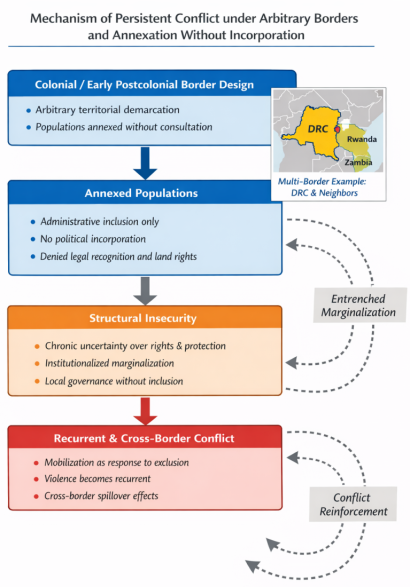
Figure 1. This figure illustrates conflict not as an episodic disorder, but as the predictable outcome of colonial state construction that incorporated territory without politically integrating populations, thereby generating enduring structural instability.
The figure above depicts the causal line from colonial and post-colonial border design (top) to annexed people, leading to structural insecurity and recurring cross-border conflict (bottom). Solid arrows imply causal flow, while dotted arrows represent feedback loops that reinforce insecurity and marginalisation. The inset mini-map depicts the DRC and its borders with Rwanda and Zambia, demonstrating how cross-border situations intensify the mechanisms to deter broader invasions. Although the rationale is based on the DRC-Rwanda situation, it applies to other post-colonial contexts.
2.6. Methodology
This study employs a historical-comparative, mechanism-driven approach to trace how colonial territorial design produced structurally insecure populations and recurring conflict in East Africa (EA), particularly along the borders of the DRC and Rwanda. The DRC and Rwanda were selected for their contrasting territorial configurations: the DRC exemplifies multi-border fragmentation and political exclusion, while Rwanda illustrates compact-state consolidation and internalized authority
| [14] | J. Stearns, North Kivu: the background to conflict in North Kivu Province of Eastern Congo. Rift Valley Institute: London, 2012. |
| [15] | M. Mamdani, “Indirect Rule and the Struggle for Democracy: A Response to Bridget O’Laughlin,” African Affairs, vol. 99, no. 394, pp. 43–46, 2000, [Online]. Available:
http://www.jstor.org/stable/723546 |
[14, 15]
, but not immune to conflict on its border with eastern DRC. This comparison allows analysis of how annexation without incorporation operates differently across state designs. More importantly, the choice of these countries is not only guided by their current intense conflict but also by the sites where brutal forms of imperialism unfolded from the 19th to the 21st century.
The evidentiary base combines archival and colonial documents, administrative reports, treaties, ethnographic and historical studies, and contemporary conflict data
| [5] | “Pakenham, T., "The Scramble for Africa White Man’s Conquest of the Dark Continent from 1876 to 1912." HarperCollins., 1992. |
| [13] | “Boldorini, A. B. C., "Segurança humana e a crise migratória no leste da República Democrática do Congo (2019-2023)". 2025. |
[5, 13]
. Sources were systematically selected to capture information directly relevant to territorial annexation, political incorporation, and structural insecurity. Historical materials were restricted to the colonial period (late nineteenth to mid-twentieth century) to reconstruct border demarcation, administrative policies, and precolonial social-political structures. At the same time, contemporary sources cover post-independence developments, recurring insurgencies, and cross-border mobilization.
Triangulation of these sources establishes causal links between colonial territorial design, political exclusion, and persistent conflict. Priority was given to primary archival evidence and peer-reviewed historical or ethnographic research, with secondary sources included only if verifiable. Data were analysed to distinguish between structural mechanisms and situational factors such as leadership choices, shocks, or policy variation.
The analytical strategy follows the causal chain: colonial border-making → annexation without incorporation → structural insecurity → recurrent and cross-border conflict. Comparative analysis of the DRC and Rwanda, alongside illustrative cases from other African multi-border contexts, tests the generality of the mechanism
| [8] | G. Martin and J. Herbst, “States and Power in Africa: Comparative Lessons in Authority and Control,” African Studies Review, vol. 44, no. 3, p. 179, Dec. 2001,
https://doi.org/10.2307/525650 |
[8]
. This approach allows the study to demonstrate that recurring conflict is mechanically produced, historically grounded, and institutionally embedded, rather than episodic or contingent.
By combining historical reconstruction, cross-case comparison, and careful source selection, the methodology links colonial territorial planning to contemporary conflict outcomes. It ensures that conclusions are empirically grounded, causally plausible, and theoretically generalizable, supporting annexation without incorporation as a durable explanation for structural instability in post-colonial multi-border regions
| [15] | M. Mamdani, “Indirect Rule and the Struggle for Democracy: A Response to Bridget O’Laughlin,” African Affairs, vol. 99, no. 394, pp. 43–46, 2000, [Online]. Available:
http://www.jstor.org/stable/723546 |
[15]
.
3. Case Analysis: Annexation Without Incorporation in Multi-border CA
3.1. The DRC: Multi-border Fragmentation and Structural Insecurity
The eastern DRC provides clear empirical evidence that annexation without incorporation can result in long-term systemic insecurity and conflict. The origins of this mechanism are traced to the colonial demarcation of borders at the turn of the twentieth century, when Belgian authorities incorporated territories and populations into the CFS through diplomatic agreements and administrative fiat rather than through political negotiation with existing powers. In North Kivu, colonial borders intersected precolonial political formations, historically linked to Rwanda and local governments, thereby territorially integrating these populations into the Congolese state while severing established systems of political belonging and authority
.
Colonial annexation was followed by administrative inclusion but not political incorporation. Belgian sovereignty brought taxation, forced labour, and the administration of territory to eastern Congo, but political membership remained ambiguous and was selectively withheld. Customary authorities were subservient to colonial administrators, citizenship remained vague, and access to land and political representation was determined by shifting administrative categories rather than enforceable rights
| [14] | J. Stearns, North Kivu: the background to conflict in North Kivu Province of Eastern Congo. Rift Valley Institute: London, 2012. |
| [17] | G. Mathys, “BRINGING HISTORY BACK IN: PAST, PRESENT, AND CONFLICT IN RWANDA AND THE EASTERN DEMOCRATIC REPUBLIC OF CONGO,” J. Afr. Hist., vol. 58, no. 3, pp. 465–487, Nov. 2017,
https://doi.org/10.1017/S0021853717000391 |
[14, 17]
. As a result, populations were subjected to official power while remaining outside of the political community itself. This arrangement resulted in a form of governance without membership: populations were ruled, regulated, and compelled, but not politically recognized.
This institutional structure resulted in structural insecurity rather than episodic instability. In North Kivu, insecurity was built into ordinary governing systems, not provoked by a crisis. Land tenure remained politically precarious, citizenship status was frequently questioned, and political participation was based on fluid definitions of belonging. Populations previously associated with Rwanda were repeatedly reinterpreted as “foreign” or “non-indigenous,” making rights to property, protection, and representation reversible and insecure. These conditions lasted after independence, as the Congolese state inherited colonial administrative systems while maintaining their exclusionary logic.
In such circumstances, mobilization became a logical response to institutionalized vulnerability. Armed movements in eastern DRC did not develop from abrupt breaks in order, but instead followed the same institutional fault lines generated by annexation without inclusion. Groups like the M23 armed group mobilized in areas where political exclusion and land instability had long existed, rather than being created recently. The multi-border structure exacerbated this dynamic: groups barred from one state may use cross-border affiliations, claims, or assistance to turn localized insecurity into transnational conflict. Violence in this context did not herald the collapse of the state; instead, it reflected a long-term governance system in which authority was wielded without incorporation and accountability remained fragmented.
The continuation of such conflicts despite repeated interventions is due to what Mertens, Perazzone, and Mwambari
| [6] | C. Mertens, S. Perazzone, and D. Mwambari, “Fatal misconceptions: colonial durabilities, violence and epistemicide inAfrica’s Great Lakes Region,” Critical African Studies, vol. 14, no. 1, pp. 2–18, Jan. 2022,
https://doi.org/10.1080/21681392.2022.2059901 |
[6]
refer to as “fatal misconceptions”: analytical and policy frameworks that depoliticise violence by classifying it as ethnic, criminal, or episodic rather than structurally produced. By failing to address the institutional condition of annexation without inclusion, remedies have continually targeted symptoms while leaving the underlying process unaffected, perpetuating insecurity across generations.
Similar dynamics may be seen along the DRC’s borders with Uganda and Zambia, where communities historically associated with neighbouring polities were absorbed without political inclusion. In each case, colonial administrative practices—coercive governance, uneven territorial integration, and indirect rule—created zones of chronic vulnerability rather than fully integrated political communities. The recurrence of violence across various regions demonstrates that the process is not limited to a single ethnic group or border, but rather applies to multi-border scenarios where administrative authority replaces political affiliation.
3.2. Rwanda: Compact Borders and the Structural Consequences of Annexed Populations
Rwanda offers a contrasting example of how border layout influences the emergence of structural insecurity. Rwanda, unlike the DRC, is a compact state with strong internal cohesion. Populations within its borders are incorporated mainly into political, legal, and institutional frameworks, enjoying citizenship, enforceable rights, and access to state protection. Governance is centralized, and institutions remain relatively consistent across the region, preventing internal structural insecurity. Historical evidence indicates that precolonial Rwandan polities were largely coherent, with established authority structures and dispute-resolution processes
| [18] | “Vansina (Jan) _ Paths in the rainforest. Toward a history of Political Tradition in Equatorian Africa - Persée.html.”, 1990. |
[18]
. Colonial rule formalized these boundaries, although, unlike in eastern DRC, most Rwandans were politically integrated, ensuring institutional continuity.
The structural vulnerability studied here stems from communities historically associated with Rwanda that were absorbed into the Congo as a result of colonial border delineation
. In North Kivu, for example, these populations were administratively incorporated into the Congo Free State without political integration, placing them under state jurisdiction while denying them secure political membership. This combination resulted in a long-lasting state of structural instability, characterized by challenged land tenure, unclear citizenship, and systematic exclusion from political representation. Although these groups frequently preserve social and historical ties with Rwanda, they are legally and politically marginalized inside the Congolese state, demonstrating the long-term institutional implications of colonial annexation without absorption.
Rwanda’s apprehension in eastern DRC must therefore be viewed as a response to externally induced structural insecurity, rather than an extension of internal strife or ethnic affinity. Post-genocide against Tutsi, state consolidation in Rwanda resulted in a territorially contained and politically integrated polity. Still, it also increased vulnerability to challenges emanating from outside its borders, where authority remains fragmented. In eastern Congo, annexed but unincorporated territory allowed armed groups to persist and mobilize, including factions antagonistic to the Rwandan state, like the FDLR, which left Rwanda after carrying out the Genocide against Tutsi, and were safeguarded by DRC leadership, as well as vulnerable communities without effective political authority. Rwanda’s diplomatic pressure, security interventions, and cross-border concerns reflect efforts to manage insecurity that cannot be territorially contained beyond its borders due to misaligned political incorporation and the persistence of ungoverned armed actors, rather than attempts to externalise instability
| [7] | M. C. Mkhize, C. Nyere, and T. D. Tumba, “The implications of bifurcated citizenship and access to land in Africa: the case of DRC conflict,” Front. Hum. Dyn., vol. 7, p. 1637169, Aug. 2025, https://doi.org/10.3389/fhumd.2025.1637169 |
[7]
.
This exclusion is large in scope and long-lasting. According to archival and ethnographic data, numerous people historically associated with Rwanda were absorbed into North Kivu during Belgian control without receiving comparable governmental recognition. Current research reveals that these groups continue to experience disputed land rights, restricted political voice, and recurring violence, suggesting that institutional ambiguity persists decades after the initial colonial choices
| [19] | Research Center for Analysis and Security Studies (RECASS), Ghana and F. A. Afriyie, “Congo: Protracted Social Conflict and the M23 Rebellion. Analyzing the Ongoing Struggle Between the DRC Military and Rebels,” CSQ, no. 52, pp. 3–31, Jul. 2025, https://doi.org/10.24193/csq.52.1 |
[19]
. Land, citizenship, and political membership are all contingent rather than guaranteed, which perpetuates vulnerability regardless of ethnicity, local government competence, or short-term political change.
Comparatively, Rwanda’s compact territorial configuration illustrates how the exact mechanism—annexation without incorporation—produces divergent outcomes depending on state design. In the multi-border DRC, non-incorporated populations generate chronic insecurity, fragmented authority, and recurrent mobilization. In Rwanda, internal political integration helps prevent domestic insecurity, but cannot eliminate threats originating in adjacent territories where incorporation was never completed. Cross-border insecurity thus emerges as a structural consequence of territorial misalignment rather than as evidence of aggressive intent or governance failure.
Taken together, the Rwanda scenario demonstrates the generality and predictability of the paradigm proposed in this research. Colonial annexation without integration resulted in structurally unstable populations in the eastern DRC, whereas territorial consolidation provided institutional stability in Rwanda. These findings show that persistent insecurity is not transient, episodic, or policy-driven, but rather historical and institutionally established. Compact nations may internalize authority and prevent internal conflict. Still, they remain vulnerable to the external effects of unresolved political exclusion beyond their borders, highlighting the regional ramifications of colonial territorial design.
3.3. Historical and Institutional Continuity
The persistence of conflict in eastern DRC is profoundly anchored in institutional continuity from colonial governance, suggesting that modern insecurity is structurally integrated rather than contingent. Colonial administrations, such as the Congo Free State and later Belgian control, built a coercive governance architecture that extended authority over conquered populations while systematically denying them political inclusion. Populations historically associated with Rwanda and local governments were nominally annexed in peripheral, multi-border regions, such as North Kivu, but they were barred from meaningful involvement in governance, legal recognition, or secure land tenure
| [14] | J. Stearns, North Kivu: the background to conflict in North Kivu Province of Eastern Congo. Rift Valley Institute: London, 2012. |
| [16] | M. Doevenspeck, “Constructing the border from below: Narratives from the Congolese–Rwandan state boundary,” Political Geography, vol. 30, no. 3, pp. 129–142, Mar. 2011,
https://doi.org/10.1016/j.polgeo.2011.03.003 |
[14, 16]
. This administrative strategy produced structurally insecure populations subject to state power but without enforceable rights, creating long-term vulnerabilities that endure into the post-colonial era
| [17] | G. Mathys, “BRINGING HISTORY BACK IN: PAST, PRESENT, AND CONFLICT IN RWANDA AND THE EASTERN DEMOCRATIC REPUBLIC OF CONGO,” J. Afr. Hist., vol. 58, no. 3, pp. 465–487, Nov. 2017,
https://doi.org/10.1017/S0021853717000391 |
[17]
.
The colonial government model was mainly based on militarised administration and indirect rule. Local governments were subservient to colonial agents, coercion replaced integration, and extraction (by taxation, forced labour, and resource expropriation) took precedence over political inclusion. These techniques resulted in fragmented authority, with multi-border regions receiving inconsistent oversight compared to core extraction zones, leaving inhabitants in North Kivu politically marginalized but territorially annexed. As a result, these people’s daily lives were defined by chronic uncertainty about property, legal protection, and political representation, thereby embedding structural instability into institutional routines.
This structural design produced a long-term mechanism for repeating conflict. Excluded populations mobilized in response to insecurity, as expected. The M23 armed group, for example, drew on communities with grievances stemming from previous denial of political integration, unresolved land claims, and administrative marginalization. The recurrence of cross-border mobilisation, territorial contestation, and episodic violence reveals the mechanical logic of annexation without incorporation: structural insecurity drives repeated conflict in the absence of short-term shocks, ideology, or leadership failure.
3.4. Multi-border Comparison: Annexation Without Incorporation Across the DRC’s Frontier Zones
A comparative examination of the DRC’s international borders demonstrates that recurring conflict is neither random nor uniformly distributed. Instead, violence is concentrated in multi-border regions where colonial boundary formation divided precolonial polities and annexed populations without political incorporation
| [20] | P. Englebert, S. Tarango, and M. Carter, “Dismemberment and Suffocation: A Contribution to the Debate on African Boundaries,” Comparative Political Studies, vol. 35, no. 10, pp. 1093–1118, Dec. 2002, https://doi.org/10.1177/001041402237944 |
[20]
. Of the DRC’s nine international borders, those with Rwanda, Uganda, Burundi, and Angola exhibit durable conflict dynamics directly traceable to colonial territorial reconfiguration and the institutional insecurity it produced.
Along the eastern frontiers with Rwanda, Uganda, and Burundi, colonial demarcation shifted borders over cohesive populations without redefining their political membership. These communities were administratively included but denied stable citizenship, legal protection, and secure land rights. The result was the production of structurally insecure populations whose access to authority and protection remained conditional and contestable. The concentration of armed groups, militia mobilisation, and cross-border concerns in North and South Kivu and Ituri—persisting across regimes and political eras—indicate that violence in these regions is driven less by contemporary governance failures or ideology than by inherited institutional exclusion.
The southern border with Angola reflects a distinct but structurally similar configuration. Colonial incorporation without political integration produced long-term marginalization, forced displacement, and militarised governance in regions such as Kasai and Katanga. Although conflict here has often taken territorial or state-centric forms rather than ethnic mobilization, the underlying mechanism remains constant: populations subjected to authority without incorporation experience chronic insecurity that periodically erupts into violence. Annexation without incorporation thus generates variable conflict expressions while preserving a consistent causal logic.
By contrast, the DRC’s borders with Tanzania, Zambia, and the Republic of the Congo are comparatively stable. These boundaries did not significantly fragment precolonial polities or produce large populations with unresolved citizenship and political status. While these regions are not immune to spillovers or economic pressures, they lack the institutionalized insecurity characteristic of the eastern and southern frontiers. Their relative stability confirms that conflict is not an inherent feature of borderlands, but a consequence of specific historical and institutional configurations.
This comparison yields three core insights. First, annexation without incorporation produces spatially uneven conflict within the same state, concentrating violence where political membership is unresolved. Second, the mechanism operates across diverse conflict forms, indicating that variation in violence does not undermine the underlying causal structure. Third, the absence of comparable conflict along other borders demonstrates that structural insecurity—rather than poverty, ethnicity, or governance capacity—is the decisive factor.
Taken together, the DRC’s frontier zones illustrate that colonial borders function as active political institutions. Where borders annexed populations without redefining political participation, they generated durable zones of insecurity that continue to reproduce conflict decades after independence. Where such annexation did not occur, persistent violence is notably absent. This comparative evidence reinforces the paper’s central claim: recurrent conflict in multi-border African states is structurally rooted in colonial territorial design and the enduring exclusion of annexed populations.
4. Analytical Synthesis
The DRC and Rwanda indicate that annexation without absorption leads to distinct and predictable political instability. Colonial border-drawing fractured precolonial polities, transferring populations across newly formed state borders without determining their political affiliations. These groups were administratively regulated but not permanently integrated into political communities, resulting in structural insecurity that became rooted in everyday institutions rather than emerging episodically from crises or misrule.
In multi-border configurations like the DRC, this circumstance resulted in fractured authority and persistent exclusion. Populations traditionally linked to neighbouring polities were subjected to state coercion while lacking enforceable rights to land, representation, and security. As a result, governance in these zones was based on militarised authority, not as a policy failure, but as an institutional response to controlling populations without political integration. Coercion supplanted legitimacy, and extraction replaced integration. Under such circumstances, mobilization and recurring conflict became viable techniques for gaining attention and survival.
Rwanda demonstrates how the same mechanism develops differently in compact geographical conditions. While Rwanda’s borders shrank rather than expanded, those who were relocated or left outside the post-colonial state faced marginalization and instability in equal measure. Internal inclusion prevents home fragmentation, but insecurity was spatially relocated rather than eliminated. The presence of politically disenfranchised populations across the border, combined with unresolved security threats from armed entities linked to genocide against Tutsi, resulted in long-standing cross-border tensions.
When taken together, these situations form a generalizable institutional logic. Where colonial frontiers fragmented pre-existing political communities and annexed populations were denied political integration, nations inherited insecure populations and coercive governance structures. Conflict in such situations is not an anomaly or a breakdown in order; it is the predictable result of a territorial system that governs without fully incorporating. The DRC-Rwanda combination thus illustrates that post-colonial Africa’s chronic violence is better understood as the long-term reproduction of insecurity rooted in colonial state design, rather than as contingent failure.
4.1. Synthesis of Mechanisms of Conflict Reproduction
Persistent conflict in Central Africa is not random, situational, or adequately explained by poor governance, ethnicity, or episodic leadership failure; rather, it reflects long-lasting mechanisms embedded in the geographical and institutional architecture of post-colonial states, which were directly inherited from colonial annexation. Where communities were integrated into newly defined states by administrative expansion rather than political incorporation—subject to authority without enforceable rights, representation, or protection—structural insecurity resulted. This insecurity is institutionalized across colonial, post-colonial, and current governance regimes.
Arbitrary colonial frontiers exacerbated these dynamics by fragmenting precolonial polities and spreading populations across several states, with no procedures for political reintegration. The ensuing multi-border configurations created zones of fragmented authority, diminished political membership, and peripheral rule based on coercion rather than incorporation. While leadership choices, ideology, and exogenous shocks influence how violence emerges, they do not change the fundamental conditions that contribute to mobilization and recurring conflict. Conflict thus occurs as a predictable result of inherited institutional architecture, rather than a failure of short-term governance.
The DRC clearly displays this mechanism. During colonial border demarcations, inhabitants historically associated with precolonial Rwanda were annexed in North Kivu and surrounding areas without being integrated into the political communities of the Congo Free State or Belgian Congo. Colonial authority relied on taxation, forced labour, and indirect rule, with administrative control taking precedence over political membership. Post-colonial governments maintained these arrangements, preserving multi-border frameworks characterized by inadequate integration, repressive governance, and ongoing political marginalization in peripheral regions.
These conditions created fundamentally insecure populations, for whom mobilization and armed groups are rational responses to long-term marginalization. Armed movements like the M23 emerge not from fleeting breakdowns but from inherited conditions of divided authority, unclear citizenship, and unresolved political involvement. Recurrent violence in eastern DRC thus indicates the long-term implications of annexation without inclusion, rather than a temporary governance failure.
Multi-border architecture accentuates these dynamics. Politically excluded communities continue to be integrated into cross-border social and historical networks, allowing them to mobilise across official territorial boundaries. Fragmented authority blurs the divisions between state troops, militias, and outsider players, while institutionalized labels like “autochthon” and “stranger” reinforce exclusion and encourage violence. In this context, insurrection is motivated less by ideology or leadership than by unresolved political absorption.
Rwanda presents a counterexample that clarifies the same technique under different territorial settings. Rwanda’s small boundaries facilitated internal political absorption and authority consolidation, resulting in a significant reduction in structural instability. However, populations historically related to Rwanda but annexed into eastern DRC remain excluded under a multi-border state setup, exacerbating vulnerability outside Rwanda’s borders. This viewpoint explains Rwanda’s security concern analytically rather than normatively: compact nations can internalize authority effectively while remaining vulnerable to instability generated in nearby territories where integration was never completed.
The persistence of these patterns demonstrates their structural nature. Precolonial polities were based on recognized authority and mutual political commitments. Colonial annexation upended these institutions by imposing administrative authority without political representation and separating cohesive communities across artificial lines. Post-colonial regimes inherited and perpetuated these fractured institutions, ruling peripheral regions through exclusion and militarisation rather than integration. Contemporary conflict thus indicates continuity rather than variance from inherited political logic.
Comparative evidence supports the generality of this process. In Sudan and South Sudan, Cameroon and Nigeria, and the Horn of Africa, annexation without political inclusion has resulted in structurally insecure populations and recurring periphery violence, regardless of recent policy developments. Historical, institutional, and contemporary evidence suggest a continuous causal sequence: arbitrary borders, annexation without incorporation, structural insecurity, recurring mobilization, and cross-border violence. This paradigm connects territorial design, institutional exclusion, and contemporary violence to provide a generalizable, historically based, and predictive explanation of post-colonial conflict, moving conflict theory away from descriptive descriptions and towards mechanism-driven analysis.
4.2. Implications for Theory and Policy
This study advances annexation without incorporation as a unifying framework for understanding ongoing post-colonial conflict. Rather than blaming recurring violence on race, resources, or episodic governance failure, it identifies political membership—shaped by colonial territorial design—as the primary institutional determinant. Populations subject to state authority without enforceable rights, secure citizenship, or meaningful representation are fundamentally insecure, making mobilization a sensible and predictable response rather than an ideological or cultural outlier.
In theory, the framework redefines borders as active political structures. Arbitrary colonial boundaries did more than divide space; they created long-lasting patterns in which authority was stretched without incorporation. This explains why multi-border states generate chronic insecurity and recurrent insurgency. In contrast, compact states internalize authority more efficiently but remain vulnerable to externalized instability stemming from unresolved political exclusion in surrounding zones. By explicitly tying territorial design to conflict reproduction, the framework provides a portable, historically grounded mechanism for explaining diversity in violence that avoids ethnic essentialism or contingency explanations.
The Central African cases clearly highlight this mechanism. In the DRC, colonial annexation incorporated populations historically associated with neighbouring polities into the administrative state without becoming politically involved, producing zones of long-term vulnerability marked by ambiguous citizenship, contested land tenure, and fragmented authority. Territorial consolidation in Rwanda enabled internal political inclusion and prevented domestic insecurity, while structural vulnerability persists beyond Rwanda among groups historically tied to Rwanda but now living elsewhere. Cross-border tensions and interventions develop as a result of external impacts stemming from unresolved incorporation in multi-border arrangements, rather than an expansionist aim.
This analysis views conflict persistence as institutionally inherited and mechanically repeated. Structural insecurity is not a one-time occurrence; it persists beyond colonial, post-colonial, and contemporary governance regimes. While leadership decisions, ideology, and shocks modify the time and shape of violence, they do not change the fundamental architecture that makes recurrence likely. Comparative situations, ranging from Sudan/South Sudan to Cameroon-Nigeria and Somalia-Ethiopia, indicate the generality of this mechanism wherever colonial frontiers separated pre-existing polities without resolving political membership.
Policy implications follow directly. Interventions based on ethnicity, resource management, or military repression will not produce long-term stability if incorporation is not completed. Effective peace requires institutional reforms that address structural exclusion, including enforceable citizenship, secure land tenure, meaningful political representation, and, in multi-border contexts, coordinated regional mechanisms such as dual citizenship, cross-border land rights, or negotiated recognition of historical affiliations. By mapping zones of annexation without incorporation, governments can anticipate future conflicts and pursue proactive, incorporation-oriented solutions rather than reactive containment.
To summarise, continuing post-colonial conflict is neither accidental nor contingent. It is historically rooted, institutionally anchored, and consistently replicated by colonial territorial design that combined annexation and political exclusion. Recognizing this mechanism shifts the study of African conflict from descriptive accounts to causal, predictive, and policy-relevant frameworks. Durable stability depends not on short-term remedies but on tackling the unfinished business of colonial incorporation—and on rethinking political membership where it was never completed.
5. Conclusion
Persistent conflict in CA—and other post-colonial settings—is not an accident, an episode, or the product of contemporary governance failure. It is a structural manifestation of colonial state planning. This study highlights annexation without incorporation as the primary mechanism: communities were submitted to state control through colonial border-making while being denied enforceable rights, political membership, and long-term protection. These conditions created long-term structural instability, turning mobilization and recurring conflict into sensible, predictable responses rather than anomalies.
The contrast between multi-border nations like the DRC and compact states like Rwanda reveals how consistently this mechanism operates. Insurgency, challenged authority, and cross-border conflict were used to perpetuate insecurity where colonial borders divided pre-existing polities and annexed populations without political integration. Internal insecurity was reduced where territorial consolidation enabled integration or absorption, but external vulnerability persisted among groups left outside national borders. Cross-border tensions arise from unresolved institutional exclusions rooted in colonial territorial design, rather than modern policy failures.
Historical and comparative evidence support the generality of this process. From eastern Congo to Sudan/South Sudan, Cameroon-Nigeria, and Somalia-Ethiopia, multi-border arrangements perpetuate political exclusion and structural vulnerability, regardless of present leadership, resources, or administrative capabilities. Even strong or compact states are vulnerable to the external consequences of annexation without inclusion in neighbouring territories. Conflict persistence reflects institutional continuity rather than contingent disintegration.
There are direct policy implications. Political exclusion must be addressed to establish long-term stability. Legal recognition, enforceable citizenship, meaningful representation, and secure access to land and livelihoods are all prerequisites for effective peacekeeping. In multi-border settings, this demands regional collaboration to recognize historically divided communities through procedures such as dual citizenship, cross-border land rights, or negotiated repatriation. Without such reforms, cycles of mobilization and violence remain predictable. Mapping zones of annexation without inclusion enables anticipatory governance by focusing on structural factors rather than responding to episodic violence.
Contextual variation improves but does not degrade this mechanism. Customary governance, economic integration, and regional mediation may postpone conflict, but they do not remove the underlying structural logic. Where political membership is unsettled, vulnerability persists.
This study proposes a historically grounded, mechanism-driven, and predictive framework for understanding post-colonial conflict by connecting colonial territorial planning, institutional exclusion, and contemporary mobilization. Persistent instability is not a break from normal state development, but rather the expected result of inherited institutional structure. Recognising this shifts research and policy from descriptive explanations to causal diagnoses, revealing that peace is not dependent on crisis management but on completing the political integration left incomplete by colonial powers. Finally, in this case, African good governance should take the lead, led by leaders who love their continent and its citizens, and who put humanity at the centre, guided by a common understanding, to alleviate inherited conflicts left by colonial masters who employed these forms of rule to maintain their indirect rule.
Abbreviations
DRC | Democratic Republic of Congo. |
FDLR | Democratic Force for the Liberation of Rwanda |
CA | Central Africa |
CFS | Congo Free State |
M23 | March 23 |
EA | East Africa |
Author Contributions
Antoine K. Nyagatoma: conceptualization, data curation, formal analysis, investigation, methodology, project administration, resources, validation, visualization, writing – original draft, writing – review & editing
Conflicts of Interest
The author declares no conflicts of interest.
Appendix
Chronology of DRC–Rwanda Border Changes
Precolonial Era (before 1885)
The territories that are now North and South Kivu were historically linked to the Rwandan kingdom through vassal chiefdoms, trade, and cultural ties. Local populations often recognized the authority of the Rwandan polity or maintained close social and political relationships with it.
Berlin Conference and Early Colonial Demarcation (1884–1908)
1) 1884–1885: The Berlin Conference divided Africa among the European powers. The Congo Free State (under King Leopold II) was established, claiming vast territories including the present-day eastern DRC.
2) Colonial powers began drawing borders arbitrarily, without consultation of local populations, dividing pre-existing polities between Congo, Rwanda (then part of German East Africa), and Uganda.
Belgian Colonial Period (1908–1960)
1) 1909–1910: The Kivu region (including parts of North Kivu) is formally annexed to the Belgian Congo, severing historical connections to Rwanda.
2) Belgian administration imposes indirect rule and labour policies, resettling Rwandan-origin populations into Kivu for labour while leaving them politically marginalized within the Congo.
3) 1916–1924: After Germany’s defeat in WWI, Rwanda and Burundi became Belgian mandates (Ruanda-Urundi). Border adjustments solidify separation from Congo, with administrative oversight replacing historical political ties.
4) Throughout this period, borders are actively enforced, creating populations that are administered but not politically incorporated.
Post-Independence Adjustments (1960–1990s)
1) 1960: Congo gains independence. The borders established during colonial rule remain largely intact, but peripheral regions (Kivu) remain politically insecure.
2) 1960s–1980s: Waves of migration and displacement of Rwandan-origin populations continue, with little legal recognition or political inclusion.
3) Cross-border interactions, often informal, maintain social and economic ties with Rwanda.
Post-1990s Conflicts and Modern Era
1) 1994: Rwandan Genocide against Tutsi triggers massive refugee flows into eastern DRC, particularly North and South Kivu. Many Rwandan-origin populations are now in territories they historically claimed but remain politically excluded in the DRC.
2) 2000s–2010s: Emergence of armed groups (e.g., M23) composed mainly of populations historically associated with Rwanda, born of structural insecurity stemming from annexation without incorporation.
3) Present day: The border remains officially unchanged, but territorial claims, political exclusion, and cross-border tensions persist, demonstrating the long-term structural consequences of colonial border-making.
References
| [1] |
M. Mamdani, Citizen and subject: contemporary Africa and the legacy of late colonialism. in Princeton studies in culture/power/history. Princeton: Princeton University Press, 2018.
https://doi.org/10.23943/9781400889716
|
| [2] |
Bates, R. H., "Markets and states in tropical Africa The political basis of agricultural policies. Univ of California Press." 2014.
|
| [3] |
Hope, K. N. Colonial Rule and Natural Resources Exploitation in Post-colonial Africa. In Colonial Heritage and the Socio-Economic Development of Africa (pp. 209-228). Cham Springer Nature Switzerland, 2025.
https://doi.org/10.1007/978-3-031-73695-7_11
|
| [4] |
“Martin, G., "Jeffrey Herbst. States and Power in Africa: Comparative Lessons in Authority and Control. Princeton, NJ: Princeton University Press, 2000. 272 pp. Figures. Maps. Tables. Index. $17.95." Paper. African Studies Review, 44(3), 179-182., 2001.
|
| [5] |
“Pakenham, T., "The Scramble for Africa White Man’s Conquest of the Dark Continent from 1876 to 1912." HarperCollins., 1992.
|
| [6] |
C. Mertens, S. Perazzone, and D. Mwambari, “Fatal misconceptions: colonial durabilities, violence and epistemicide inAfrica’s Great Lakes Region,” Critical African Studies, vol. 14, no. 1, pp. 2–18, Jan. 2022,
https://doi.org/10.1080/21681392.2022.2059901
|
| [7] |
M. C. Mkhize, C. Nyere, and T. D. Tumba, “The implications of bifurcated citizenship and access to land in Africa: the case of DRC conflict,” Front. Hum. Dyn., vol. 7, p. 1637169, Aug. 2025,
https://doi.org/10.3389/fhumd.2025.1637169
|
| [8] |
G. Martin and J. Herbst, “States and Power in Africa: Comparative Lessons in Authority and Control,” African Studies Review, vol. 44, no. 3, p. 179, Dec. 2001,
https://doi.org/10.2307/525650
|
| [9] |
L.-E. Cederman, A. Wimmer, and B. Min, “Why Do Ethnic Groups Rebel? New Data and Analysis,” World Pol., vol. 62, no. 1, pp. 87–119, Jan. 2010,
https://doi.org/10.1017/S0043887109990219
|
| [10] |
D. C. North, J. J. Wallis, and B. R. Weingast, “Violence and the Rise of Open-Access Orders,” jod, vol. 20, no. 1, pp. 55–68, Jan. 2009,
https://doi.org/10.1353/jod.0.0060
|
| [11] |
Englebert, P. "Africa Unity. Sovereignty & Sorrow (Boulder, Co. Lynne Rienner)", 2009.
https://doi.org/10.1080/02589001.2011.562007
|
| [12] |
Clapham, C. S. "Africa and the international system: The politics of state survival (Vol. 50). Cambridge University Press.”, 1996.
|
| [13] |
“Boldorini, A. B. C., "Segurança humana e a crise migratória no leste da República Democrática do Congo (2019-2023)". 2025.
|
| [14] |
J. Stearns, North Kivu: the background to conflict in North Kivu Province of Eastern Congo. Rift Valley Institute: London, 2012.
|
| [15] |
M. Mamdani, “Indirect Rule and the Struggle for Democracy: A Response to Bridget O’Laughlin,” African Affairs, vol. 99, no. 394, pp. 43–46, 2000, [Online]. Available:
http://www.jstor.org/stable/723546
|
| [16] |
M. Doevenspeck, “Constructing the border from below: Narratives from the Congolese–Rwandan state boundary,” Political Geography, vol. 30, no. 3, pp. 129–142, Mar. 2011,
https://doi.org/10.1016/j.polgeo.2011.03.003
|
| [17] |
G. Mathys, “BRINGING HISTORY BACK IN: PAST, PRESENT, AND CONFLICT IN RWANDA AND THE EASTERN DEMOCRATIC REPUBLIC OF CONGO,” J. Afr. Hist., vol. 58, no. 3, pp. 465–487, Nov. 2017,
https://doi.org/10.1017/S0021853717000391
|
| [18] |
“Vansina (Jan) _ Paths in the rainforest. Toward a history of Political Tradition in Equatorian Africa - Persée.html.”, 1990.
|
| [19] |
Research Center for Analysis and Security Studies (RECASS), Ghana and F. A. Afriyie, “Congo: Protracted Social Conflict and the M23 Rebellion. Analyzing the Ongoing Struggle Between the DRC Military and Rebels,” CSQ, no. 52, pp. 3–31, Jul. 2025,
https://doi.org/10.24193/csq.52.1
|
| [20] |
P. Englebert, S. Tarango, and M. Carter, “Dismemberment and Suffocation: A Contribution to the Debate on African Boundaries,” Comparative Political Studies, vol. 35, no. 10, pp. 1093–1118, Dec. 2002,
https://doi.org/10.1177/001041402237944
|
Cite This Article
-
APA Style
Nyagatoma, A. K. (2026). States Designed for Conflict: Colonial State Formation and the Structural Reproduction of Violence: Evidence from Rwanda and the Eastern Democratic Republic of Congo. Journal of Political Science and International Relations, 9(1), 100-112. https://doi.org/10.11648/j.jpsir.20260901.17
 Copy
|
Copy
|
 Download
ACS Style
Nyagatoma, A. K. States Designed for Conflict: Colonial State Formation and the Structural Reproduction of Violence: Evidence from Rwanda and the Eastern Democratic Republic of Congo. J. Polit. Sci. Int. Relat. 2026, 9(1), 100-112. doi: 10.11648/j.jpsir.20260901.17
Copy
|
Download
AMA Style
Nyagatoma AK. States Designed for Conflict: Colonial State Formation and the Structural Reproduction of Violence: Evidence from Rwanda and the Eastern Democratic Republic of Congo. J Polit Sci Int Relat. 2026;9(1):100-112. doi: 10.11648/j.jpsir.20260901.17
Copy
|
Download
-
@article{10.11648/j.jpsir.20260901.17,
  author = {Antoine K. Nyagatoma},
  title = {States Designed for Conflict: Colonial State Formation and the Structural Reproduction of Violence: Evidence from Rwanda and the Eastern Democratic Republic of Congo},
  journal = {Journal of Political Science and International Relations},
  volume = {9},
  number = {1},
  pages = {100-112},
  doi = {10.11648/j.jpsir.20260901.17},
  url = {https://doi.org/10.11648/j.jpsir.20260901.17},
  eprint = {https://article.sciencepublishinggroup.com/pdf/10.11648.j.jpsir.20260901.17},
  abstract = {Persistent conflict in Central Africa—and across post-colonial states more broadly—is not the product of episodic crises, contemporary leadership failures, or random instability. It is the structural legacy of colonial state design. This article identifies a central mechanism—annexation without incorporation—through which colonial border-making produced populations formally subjected to state authority but denied enforceable rights, political membership, and protection. Such populations experience durable structural insecurity and, over generations, mobilize in predictable ways, generating recurrent, frequently cross-border conflict. A comparative analysis of multi-border and compact states illustrates the mechanism. Fragmented colonial borders in the Democratic Republic of the Congo (DRC) institutionalized political exclusion and territorial fragmentation, producing persistent armed groups and externalized insecurity. Rwanda, by contrast, internalized authority within a compact territory, resolved internal instability while remaining exposed to unresolved vulnerabilities among politically excluded populations beyond its borders. Historical evidence shows that colonial annexation and administrative incorporation without political integration were systematic, not accidental, features of state formation. In eastern Congo, communities historically connected to Rwanda and local polities were annexed without full membership, creating enduring zones of exclusion that continue to structure violence. The mechanism generalizes beyond the Great Lakes, as seen in cases from Sudan/South Sudan to Cameroon/Nigeria and Somalia/Ethiopia, where annexed populations remain politically marginal and structurally insecure. The article advances a historically grounded, mechanism-driven, and predictive framework for post-colonial conflict, demonstrating that persistent instability is not an aberration of weak states but the expected outcome of institutional design. Durable peace, therefore, requires structural remedies—legal recognition, political inclusion, secure land tenure, and regional coordination—rather than purely episodic interventions.},
 year = {2026}
}
Copy
|
Download
-
TY  - JOUR
T1  - States Designed for Conflict: Colonial State Formation and the Structural Reproduction of Violence: Evidence from Rwanda and the Eastern Democratic Republic of Congo
AU  - Antoine K. Nyagatoma
Y1  - 2026/03/16
PY  - 2026
N1  - https://doi.org/10.11648/j.jpsir.20260901.17
DO  - 10.11648/j.jpsir.20260901.17
T2  - Journal of Political Science and International Relations
JF  - Journal of Political Science and International Relations
JO  - Journal of Political Science and International Relations
SP  - 100
EP  - 112
PB  - Science Publishing Group
SN  - 2640-2785
UR  - https://doi.org/10.11648/j.jpsir.20260901.17
AB  - Persistent conflict in Central Africa—and across post-colonial states more broadly—is not the product of episodic crises, contemporary leadership failures, or random instability. It is the structural legacy of colonial state design. This article identifies a central mechanism—annexation without incorporation—through which colonial border-making produced populations formally subjected to state authority but denied enforceable rights, political membership, and protection. Such populations experience durable structural insecurity and, over generations, mobilize in predictable ways, generating recurrent, frequently cross-border conflict. A comparative analysis of multi-border and compact states illustrates the mechanism. Fragmented colonial borders in the Democratic Republic of the Congo (DRC) institutionalized political exclusion and territorial fragmentation, producing persistent armed groups and externalized insecurity. Rwanda, by contrast, internalized authority within a compact territory, resolved internal instability while remaining exposed to unresolved vulnerabilities among politically excluded populations beyond its borders. Historical evidence shows that colonial annexation and administrative incorporation without political integration were systematic, not accidental, features of state formation. In eastern Congo, communities historically connected to Rwanda and local polities were annexed without full membership, creating enduring zones of exclusion that continue to structure violence. The mechanism generalizes beyond the Great Lakes, as seen in cases from Sudan/South Sudan to Cameroon/Nigeria and Somalia/Ethiopia, where annexed populations remain politically marginal and structurally insecure. The article advances a historically grounded, mechanism-driven, and predictive framework for post-colonial conflict, demonstrating that persistent instability is not an aberration of weak states but the expected outcome of institutional design. Durable peace, therefore, requires structural remedies—legal recognition, political inclusion, secure land tenure, and regional coordination—rather than purely episodic interventions.
VL  - 9
IS  - 1
ER  -
Copy
|
Download





 Share This Article
 Twitter
 Linked In
 Facebook