1. Introduction
Sustainability has become a trend in today’s workplace. More organizations are embracing the need for inclusion of sustainable strategies in the organization’s culture. Sustainability,
| [1] | Kramar, R. (2014). Beyond strategic human resource management: Sustainable HRM. |
[1]
is a concept where broad organizational goals aim to support economic, social, human, and environmental goals in the short- and long-term. As worldwide problems like warming temperatures and social inequality intensify, organizations are becoming more aware of the significance of promoting sustainability. Sustainability practices enable the achievement of economic, social and environmental goals, with impact inside and outside the organization and in the long term, while controlling unintended side effects and negative feedback
| [2] | Ehnert, I., Parsa, S., Roper, I., Wagner, M., & Müller?Camen, M. (2016). Reporting on sustainability and HRM: A comparative study of sustainability reporting practices by the world’s largest companies. The International Journal of Human Resource Management, 27(1), 88-108.
https://doi.org/10.1080/09585192.2015.1024157 |
[2]
.
Employee engagement is defined as a type of attitude towards work
| [3] | Juchnowicz, M. (2012). Zaangażowanie pracowników: Sposoby oceny i motywowania [Employee engagement: Methods of assessment and motivation]. |
[3]
. It consists of three components: cognitive, emotional and behavioral. The attitude of commitment requires the employee to have knowledge about the organization, positive feelings towards it, and acceptance of its values, goals, leaders' behavior and action. An engaged employee focuses on tasks, performs them with passion and enthusiasm, has a positive attitude towards the organization - or work - and takes actions that are in the interest of the company
| [3] | Juchnowicz, M. (2012). Zaangażowanie pracowników: Sposoby oceny i motywowania [Employee engagement: Methods of assessment and motivation]. |
[3]
.
Kahn
| [4] | Kahn, W. A. (1990). Psychological conditions of personal engagement and disengagement at work. "Academy of Management Journal," 33(4), 692-724. |
[4]
defines employee engagement as the attachment of employees to the organization or their professional roles. It is manifested by a physical, cognitive and emotional connection to the company or profession. An uncommitted employee distances himself or herself from his or her organization or professional role, cutting himself or herself off physically, cognitively and emotionally. In this approach, commitment focuses on the psychological relationship between the employee and the organization or role. It is divided into an organizational attachment and professional attachment. The former is the employee's attitude resulting from positive social exchange in the workplace. It can be considered in different relationships, e.g., towards the organization, the team or the supervisor. Professional attachment refers to commitment to a profession, i.e. a specific activity that requires a specific set of competencies and conduct in accordance with the requirements of the profession
.
Engagement is also defined as a state of mind, positively related to work. It is characterized by a high energy level, dedication, passion and full concentration on work
| [6] | Schaufeli, W. B., Salanova, M., González?Romá, V., & Bakker, A. B. (2002). The measurement of engagement and burnout: A two?sample confirmatory factor analytic approach. Journal of Happiness Studies, 3, 71-92.
https://doi.org/10.1023/A:1015630930326 |
[6]
. It consists of three components: vigour, dedication to work and preoccupation with work. The first refers to high levels of energy, enthusiasm, perseverance and willingness to work even in the face of difficulties
| [7] | Bakker, A. B., Schaufeli, W. B., Leiter, M. P., & Taris, T. W. (2008). Work engagement: An emerging concept in occupational health psychology. Work & Stress, 22, 187-200.
https://doi.org/10.1080/02678370802393649 |
[7]
. The second refers to a strong identification with one's work, with a sense of meaning, significance and pride. The third manifests itself in concentration on one's work and difficulty in detaching from it. The positive - work-related - state of mind characterized by vigour, dedication and absorption by one's role, to be considered as engagement, cannot be a temporary state. Work engagement is constant, unfocused on any particular object, event or behavior.
Committed employees have high energy levels and good health. They are more willing to work outside of set hours. They feel greater job satisfaction
| [7] | Bakker, A. B., Schaufeli, W. B., Leiter, M. P., & Taris, T. W. (2008). Work engagement: An emerging concept in occupational health psychology. Work & Stress, 22, 187-200.
https://doi.org/10.1080/02678370802393649 |
[7]
. The benefits of engagement relate to both the organization and the employees
. Research suggests that work engagement is one of the key outcomes of sustainable human resource management practices
| [9] | Parakandi, M., & Behery, M. (2016). Sustainable human resources: Examining the status of organizational work-life balance practices in the United Arab Emirates. Renewable and Sustainable Energy Reviews, 55, 1370-1379.
https://doi.org/10.1016/j.rser.2015.07.095 |
[9]
.
Employee engagement is crucial for growth and to remain competitive. Most organizations are constantly recruiting to get fresh ideas and remain competitive in the market. Employees are seeking an environment that suits and complements who they are and their values. Employee engagement is a prerequisite for meeting contemporary organizational challenges
| [10] | Lewicka, D. (2018). Satisfaction, employee engagement and commitment in the context of employee diversity potential. Anna Rakowska, 18, 35-45. |
[10]
.
1.1. Problem Statement
Sustainability dimensions focus on integrating environmental, social, and economic aspects to create the well-being of the organization and the employee in the long run. When the employee is well taken care of, health wise and development, this reduces turnover, ecological footprints and enhances business and societal value.
Firms are leaning more in Sustainability, emphasizing on the three dimensions; social, economic and environmental for good performance. For firms to be successful, they must integrate people, planet and profit
| [11] | Elkington, J. (1997). Cannibals with Forks: The Triple Bottom Line of 21st Century Business. |
[11]
.
However, a gap still exists due to the inadequate data in Sustainability and employee engagement. Engaged and healthy employees are critical contributors to sustainable business practices, yet organizations continue to underemphasize it
| [12] | Kashyap, V. (2025). Employee engagement and well-being as drivers of organizational sustainability: A strategic perspective. TMIMT International Journal. |
[12]
. Firms are still not clear on how to effectively use the sustainability initiatives to maximize employee engagement. Some utilize the strategy separately thereby not getting full benefits. Those who utilize both are greatly advantaged.
The problem is that most firms have not embraced sustainability in the workplace. If this was intensively done, employee engagement would be high, leading to better margins and competitive firms, well-being of the environment as well as happier generations. Due to this knowledge gap, firms haven’t reached their full potential and achievements.
1.2. Objectives of the Study
1.2.1. General Objective
The main objective of this paper is to review existing literature on sustainability and its influence on employee engagement in an organization.
1.2.2. Specific Objectives
To examine the influence of sustainability on employee engagement
To assess the influence of social sustainability on employee engagement
To assess the influence of economic sustainability on employee engagement
To assess the influence of environmental sustainability on employee engagement
1.3. Conceptual Framework
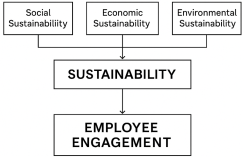
Figure 1. Conceptual Framework.
The conceptual framework above shows that sustainability has three dimensions – Social, economic and environmental sustainability. These in a great way affect how employees think, act and perceive their work as well as the organization. In the Social aspect, employees’ state of being is enhanced. There are inclusion, equity and involvement in community work. Some practices in social sustainability are feeding programs to the less fortunate, paying school fees to bright poor children in schools as well as distribution of sanitary pads to teenage girls in poor backgrounds. Such fair treatment in turn causes the employee to be fair to the organization through, going the ‘extra mile’ in their duties and other activities of the organization. It molds individual employees to be sensitive to others’ needs and creates a sense of community even long after they have left the organization. This affects their levels of engagement within the firm. Organizations become socially responsible when they provide flexible work schedules, attend to employee personal and family needs, and go above and beyond what is mandated by law
| [13] | Bhattacharya, C. B., Sen, S., & Korschun, D. (2008). Using corporate social responsibility to win the war for talent. MIT Sloan Management Review, 49, 37-44. |
[13]
. This is an indication that for an organization to be socially responsible, they should implement practices and policies that support employee development and reward them among other general corporate social responsibility initiatives, involving businesses and their employees, lower environmental contamination and address the issue of climate change. There is need to have policies and practices that lead to sustainable workforce and embrace the concept of work–life balance and appreciate its importance as a tool to improve employee productivity, satisfaction and retention
| [14] | Eberlein & Matten, 2009 Parakandi, M., & Behery, M. (2016). Sustainable human resources: Examining the status of organizational work-life balance practices in the United Arab Emirates. Renewable and Sustainable Energy Reviews, 55, 1370-1379. https://doi.org/10.1016/j.rser.2015.07.095 |
[14]
.
In the economic aspect of sustainability, the organization leans on ensuring that resources are well utilized, looking at the growth and financial stability of the firm. Employees feel proud to associate with an organization that is stable and forward looking. They see themselves as long-term employees of the company thus affecting the way they engage at work and with work. Economic sustainability is the integration of long-term financial viability with employee well-being moving beyond short-term profit maximization to ensure organizational resilience and resource efficiency. It balances economic growth with social and environmental responsibility, focusing on sustaining human capital through training, fair compensation, and motivation to support enduring organizational success
| [14] | Eberlein & Matten, 2009 Parakandi, M., & Behery, M. (2016). Sustainable human resources: Examining the status of organizational work-life balance practices in the United Arab Emirates. Renewable and Sustainable Energy Reviews, 55, 1370-1379. https://doi.org/10.1016/j.rser.2015.07.095 |
[14]
.
In the aspect of environmental sustainability, certain practices come into play. This includes energy conservation where electricity and fuel take center stage. Use of green energy e.g. solar, working from home, and use of electric cars to reduce carbon emissions are but a few examples of saving fuel. Waste reduction e.g. paperless billing, digital subscriptions, bulk buying are also examples of enhancing environmental sustainability. Employees also engage in community work where they clean up the environment and teach people the benefits of living in a clean environment. All these ecofriendly initiatives by an organization endears itself to the employees and feel part and parcel of the process and the activity, thus being more emotionally connected to their work and the organization.
These three pillars of sustainability therefore serve as moderating variables in sustainability and employee engagement. Each of them shows how sustainability enhances employee engagement.
2. Literature Review
2.1. Theoretical Literature Review
Engagement is the degree to which employees bring their full self - physically, emotionally, and cognitively to their work roles
| [4] | Kahn, W. A. (1990). Psychological conditions of personal engagement and disengagement at work. "Academy of Management Journal," 33(4), 692-724. |
[4]
. He emphasized that engagement is not merely about job satisfaction but involves a deeper connection to one's work.
He identified three core psychological needs that, when met, contribute to employee engagement: Meaningfulness: Employees seek a sense of purpose and significance in their work
| [4] | Kahn, W. A. (1990). Psychological conditions of personal engagement and disengagement at work. "Academy of Management Journal," 33(4), 692-724. |
[4]
. Leaders should align organizational goals with individual values, providing employees with a clear understanding of how their contributions contribute to broader objectives. Safety: Employees need to feel psychologically safe to express their true selves at work without fear of reprisal. Leaders can cultivate a culture of trust and openness, encourage communication and collaboration while valuing diverse perspectives. Availability involves the extent to which employees can personally invest themselves in their work. Leaders should encourage autonomy, giving employees the freedom to use their skills and creativity, fostering a sense of ownership and pride in their contributions. Further he denotes four dimensions of psychological presence: attentiveness, connectivity, integration and focus. The three psychological conditions drive psychological presence, which leads to personal engagement, and personal engagement results in various outcomes
| [15] | Kahn, W. A. (1992). To be fully there: Psychological presence at work. Human Relations, 45(4), 321-349. |
[15]
. The experience of the three psychological conditions influences the extent to which individuals are psychologically present and engaged in a work situation
| [15] | Kahn, W. A. (1992). To be fully there: Psychological presence at work. Human Relations, 45(4), 321-349. |
[15]
.
The employee engagement theory is relevant and supports this study, since it enhances greater engagement in the workplace, as seen in the previous works above, showing the thoroughness and the integration of self to work and goals of the firm. It further shows the psychological conditions that are needed for employee engagement, which keeps the employees engaged, leading to greater performance and more sustainable organization, with a team that is motivated, committed and dedicated to their work.
Social exchange is the exchange of activities, materials or intangibles, and rewards between at least two parties
| [16] | Homans, G. C. (1958). Social behavior as exchange. American Journal of Sociology, 63(6), 597-606. |
[16]
. Social exchange is the voluntary behavior motivated by expected returns
| [17] | Blau, P. M. (1964). Exchange and power in social life. Wiley. |
[17]
. Relationships may dissolve due to insufficient reinforcement or an imbalance between incentives and costs. Behaviors that yield positive outcomes are more likely to be repeated and rewarded
| [18] | Cropanzano, R. & Mitchell, M. S. (2005). Social exchange theory: An interdisciplinary review. Journal of Management, 31, 1-27. |
[18]
. The Social Exchange Theory (SET) is valued for analyzing workplace behavior
. In the context of SET, social exchange refers to the reciprocal exchange of value between an organization and its employees. Relationships abide by certain exchange rules such as the norm of reciprocity
| [18] | Cropanzano, R. & Mitchell, M. S. (2005). Social exchange theory: An interdisciplinary review. Journal of Management, 31, 1-27. |
[18]
. Employees choose to engage themselves in their jobs based on the resources they receive from their organization
. When employees receive valued resources from their organizations (e.g., rewards and recognition), it creates a sense of obligation, and employees will reciprocate or repay their organization with higher levels of engagement, or they will withdraw their engagement if they do not receive sufficient resources. From a social exchange framework, employees expect to be treated in a particular way (but to their benefit) by the organization and when treated in an unexpected manner it is reflected in their levels of engagement
| [20] | Colquitt, J. A., Scott, B. A., Rodell, J. B., Long, D. M., Zapata, C. P., Conlon, D. E., & Wesson, M. J. (2013). Justice at the millennium, a decade later: A meta-analytic test of social exchange and affect-based perspectives. Journal of Applied Psychology, 98(2), 199-236. https://doi.org/10.1037/a0031757 |
[20]
. Employees who benefit from the organization economically, socially, and emotionally feel obliged to reciprocate
| [21] | Alfes, K., Shantz, A., Truss, C., & Soane, E. (2013). The role of employee engagement in the relationship between job design and task performance, citizenship and deviant behaviours. International Journal of Human Resource Management. Advance online publication.
https://doi.org/10.1080/09585192.2012.744334 |
[21]
. This means that the employees also give back by involving themselves physically, socially emotionally and even economically where possible. This behavior explains why and how engaged they are in their job.
The Social exchange theory therefore supports sustainability and employee engagement in that while employees can work without certain incentives, there are some practices that can be embedded in the culture of the organization that greatly influence the sustainability of the organization. Further, the theory gives a clearer understanding of how sustainability impact employee engagement in the workplace. This is through being fair to all individuals, reciprocal values and support from the organization. As illustrated by the different authors, in sustainability, the theory emphasizes that commitment between all stakeholders is realized when the benefits of engagement surpass costs. This increases trust and mutual dependence between parties. The theory also shows that it’s not only about profits but also the emotional and social aspect where employees perceive that the organization cares for them, leading to a deeper engagement.
Triple Bottom Line (TBL), a sustainability framework, posits that organizational performance should be measured across three pillars: People, Planet, and Profit
| [11] | Elkington, J. (1997). Cannibals with Forks: The Triple Bottom Line of 21st Century Business. |
[11]
. TBL shifts organizations from focusing solely on financial outcomes to adopting a holistic sustainability mindset
.
The
People pillar looks at fairness, ethical labor practices, safety, and employee development
| [11] | Elkington, J. (1997). Cannibals with Forks: The Triple Bottom Line of 21st Century Business. |
[11]
. This includes initiatives that cater for the well-being of the employee as well as diversity, equity and inclusion, and employee well-being initiatives. The
Planet pillar involves reducing environmental impact. The
Profit pillar is the long-term financial stability.
This theory is relevant in this study because it clearly addresses the issues that the paper is aimed at – People (Social), Planet (Environment) and Profit (Economic) aspect of sustainability. It further highlights that the economic, environmental and social dimensions influence both the behavior of the organization and that of the employee. Though its incorporation into the organizational strategies, it shows heightened social and environmental wellness. The organization therefore projects itself as ethical and responsible to the employees. This enhances the bond, thus creating more engagement in their work. The framework accelerates deeper engagement of the employees to the organization.
2.2. Empirical Literature Review
Very few studies have been done on Sustainability and employee engagement. A study done by Ispiryan, Pakeltiene, Ispiryan, & Giedraitis, aimed to develop a multifaceted conceptual basis for employee collaboration about promoting organizational sustainability, which encompasses environmental, social, and economic dimensions
| [23] | Ispiryan, A., Pakeltiene, R., Ispiryan, O., & Giedraitis, A. (2024). Fostering Organizational Sustainability Through Employee Collaboration: An Integrative Approach to Environmental, Social, and Economic Dimensions. Encyclopedia, 4(4), 1806-1826. https://doi.org/10.3390/encyclopedia4040119 |
[23]
. The results indicated that organizations characterized by a robust collaborative culture demonstrated greater success in fostering sustainable innovations, minimizing environmental impact and enhancing employee engagement. They further noted that a strong employee collaboration culture directly enhanced operational sustainability through innovation, improved resource efficiency, increased resilience as well as aligning sustainability goals throughout the organization. Collaboration ensures that sustainability is not treated as a separate initiative but as a core aspect of organizational operations, leading to more efficient and long-term sustainable outcomes. The relationship between employee collaboration culture and operational sustainability is synergistic; a strong collaboration culture significantly boosts the effectiveness of sustainability initiatives within the organization. The study showed that collaboration encouraged a holistic approach to sustainability, where employees recognized the interconnectedness of various operational activities. The study elucidated that collaboration among employees was essential for organizational sustainability, as this facilitated the integration of environmental, social, and economic factors of sustainability into corporate strategies. The results showed that effective collaboration not only augmented knowledge dissemination and problem resolution but also amplified employee engagement and commitment towards sustainability objectives. However, the study noted certain limitations. The extrapolation of findings across various sectors was restricted by diverse organizational contexts and resource availability. The study encouraged subsequent research to explore how sector-specific determinants, such as regulatory mandates or market dynamics, affect the implementation of the proposed framework. While a multitude of organizations acknowledge the significance of collaboration, only a select few have successfully ingrained it into their operational frameworks. There’s also need for more context-specific investigations into cultural, structural, and technological factors that may shape collaborative sustainability outcomes.
In a study done by Kashyap on employee engagement and well-being as drivers of organizational sustainability, they found that a key factor in attaining organizational sustainability is employee engagement and well-being
| [12] | Kashyap, V. (2025). Employee engagement and well-being as drivers of organizational sustainability: A strategic perspective. TMIMT International Journal. |
[12]
. Long-term success depends on keeping a motivated and healthy workforce as companies adapt to economic, social, and environmental challenges. The study examined the connection between sustainability, well-being, and employee engagement by examining previous research and evaluating important findings. It addresses tactics that companies can use to improve engagement and well-being for long-term sustainability and emphasizes the role that engaged workers play in sustainable business practices. The paper explored the intricate relationship between employee engagement, well-being, and organizational sustainability, while examining how a positive work environment and prioritizing employee health can lead to enhanced performance, reduced turnover, and a stronger corporate reputation. Through secondary data, the study found the need for businesses to invest in employee-centric strategies for long-term, and that the organizations with high levels of employee engagement and well-being outperform competitors in terms of financial performance, innovation, and sustainability. Engaged employees are more likely to align with organizational goals, demonstrate resilience in times of crisis, and contribute to social responsibility initiatives. Successful organizations adopt strategies that foster engagement and well-being, for instance Work-Life Balance Initiatives, Inclusive Leadership, Sustainable HR Practices and Corporate Social Responsibility. However, since the paper relies primarily on secondary data Kashyap acknowledges significant research gaps, including the need for empirical validation of the engagement–sustainability link, sector specific studies, and deeper analysis of the mechanisms through which engagement and well being exert their influence. These gaps suggest that while current literature positions engaged and healthy employees as vital to sustainable organizational development, further empirical, contextual, and longitudinal work is necessary to fully understand and operationalize these relationships in diverse organizational settings.
De Silva, De Silva Lokuwaduge, and Charumathi did a theoretical study on social sustainability for employee engagement and belonging
| [24] | De Silva, De Silva Lokuwaduge & Charumathi (2025). Social Sustainability for Employee Engagement and Belongingness. |
[24]
. The study proposed that integrating social sustainability practices could be a powerful tool for promoting employee engagement and belonging. Prioritizing the initiatives that address ethical business practices, promoting an inclusive and diverse workplace environment, and positive community contribution, could create more meaningful and purpose-driven work experience for their employees, which in turn could lead to a more engaged and motivated workforce. The study reviewed theories that pertain to the relationship between social sustainability, employee engagement, and sense of belonging and identified that despite the significant impact of social sustainability on employee engagement and sense of belonging, it is under-researched. A key limitation of the conceptual analysis is its reliance on existing literature, prior studies, and reports to support the proposed concepts. The study utilized existing theories and literature to provide a foundation for subsequent empirical and theoretical studies. It is important to understand the functional significance of different managerial tools such as goal setting, work compensation, monitoring, and work design, as they too could impact the psychological factors related to workplace behavior.
Maryem & Mouna did a study to carry out a systematic review of the literature on strategies to encourage employee involvement in sustainable initiatives
| [25] | Machiche, M. I., & Boudribila, M. (2025). Employee engagement and sustainable development: A PRISMA systematic review of strategies for responsible corporate performance. International Journal For Multidisciplinary Research (IJFMR). |
[25]
. Employee involvement in sustainable initiatives play a central role in the success of these projects, especially with increasing societal expectations and ecological pressures. To meet these challenges, companies need to deploy effective strategies aimed at fully integrating their employees into these initiatives. However, for these initiatives to be truly successful, it is essential that employees are actively involved. This requires a thorough understanding of engagement mechanisms and adoption of appropriate managerial practices. There’s need to identify and implement strategies that motivate and involve their employees in the ecological transition. By analyzing the factors that have contributed to the collective awareness of the importance of sustainability, there’s awareness of its breadth, which encompasses both the preservation of the environment, the promotion of social equity and the pursuit of balanced economic prosperity. The paper found out that engaging employees in sustainable initiatives is an essential strategic lever for companies seeking to align their economic performance with sustainable development goals. This review has shown that engaging entrepreneurs in sustainability, through sustainable entrepreneurship practices, is essential to laying the foundations for a responsible organizational culture. The studies highlight that innovation, digitalization and Corporate Social Responsibility play key roles in the integration of sustainable practices, offering solutions that are both economical and responsible. The most effective strategies for engaging employees include raising awareness, ongoing training, promoting social responsibility and actively involving teams in defining sustainable practices. Companies must also invest in the well-being of their employees, thereby fostering their long-term commitment. The paper noted some limitations, including the costs associated with implementing the initiatives, resistance to change within organizations, and the difficulty of accurately measuring the impact of these actions. Also, the analysis is based mainly on sector specific studies, which could limit the generalizability of the results to other sectors or types of company, as well as the long-term impact of sustainable commitment strategies that are yet to be fully explored. The study noted that the question of the real effectiveness of these practices in sustaining companies remains a crucial area for future research and also the impact of new technologies on employee engagement in sustainable initiatives, particularly in sectors where digitalization is on the rise.
2.3. Summary of Research Gaps
The study done by Ispiryan, Pakeltiene, Ispiryan, & Giedraitis, (2024) elucidates that the collaboration among employees constitutes an essential impetus for organizational sustainability, as it facilitates the integration of environmental, social, and economic factors into corporate strategies. Organizations that cultivate a robust collaborative culture exhibit greater success in embedding sustainability within their operational frameworks, resulting in innovative solutions and enhanced resilience. The results underscore that effective collaboration not only augments knowledge dissemination and problem resolution but also amplifies employee engagement and commitment towards sustainability objectives. However, the study noted certain limitations. The extrapolation of findings across various sectors may be restricted by diverse organizational contexts and resource availability.
This study touched on sustainability and employee collaboration, though it didn’t dwell on the commitment and emotional attachment of the employee as employee engagement would have addressed, necessitating further research.
In a study done by Kashyap (2025) The paper aimed to explore the intricate relationship between employee engagement, well-being, and organizational sustainability. It examined how fostering a positive work environment and prioritizing employee health can lead to enhanced performance, reduced turnover, and a stronger corporate reputation. The study shows lack of adequate material for empirical data on Sustainability and Employee engagement.
The study done by De Silva, De Silva Lokuwaduge, and Charumathi (2025) on social sustainability for employee engagement and belonging, reviewed theories pertaining to the relationship between social sustainability, employee engagement, and sense of belonging. The was a gap, that despite the significant impact of social sustainability on employee engagement and sense of belonging, it was under-researched. The conceptual analysis relied on existing literature, prior studies, and reports to support the proposed concepts. The authors didn’t fully have the discussions as expected due to limited research in the subject.
The study found out that engaging employees in sustainable initiatives is an essential strategic lever for companies seeking to align their economic performance with sustainable development goals
| [25] | Machiche, M. I., & Boudribila, M. (2025). Employee engagement and sustainable development: A PRISMA systematic review of strategies for responsible corporate performance. International Journal For Multidisciplinary Research (IJFMR). |
[25]
. The gap in this study were the costs associated with implementing the initiatives, resistance to change within organizations, and the difficulty of accurately measuring the impact of noted actions. The study focused more on sustainable development and entrepreneurs which was sector specific. Sustainability in organizations that are not profit making are left out, necessitating further research.





 Share This Article
 Twitter
 Linked In
 Facebook
 Copy
Copy Download