
 ,
Traore Korotimi,
Drabo Soungalo Moustapha,
Compaore Wendenda Cyntia Vanessa,
Kindo Ragnimsom Sekou Ibrahim,
Biego Elie Wilfried Wendnongma,
Traore Desire,
Savadogo Aly,
Sawadogo-Lingani Hagretou
This study aimed to evaluate processed foods consumption habits of preschool children and their associated chemical additive risks in Ouagadougou and Bobo-Dioulasso, two main urban cities of Burkina Faso. Therefore, the survey involved sixty volunters preschools on processed foods used in their canteen menu, and 1120 parents concerning the use of processed foods for their children at home, and their knowledge on food additives and their dangers. Usual processed foods consumed by preschools children were then collected in school’ markets, and their contents of food chemical additives were firstly listed. and their danger evaluated based on standards and previous works. A total of 1120 parents’ including 71.2% women and 28.8% men were involved in the study. Preschool students were 53.39% girls and 46.61% boys, from two- to six-year-old. Main processed foods were crips, sweets, chocolates, dairy products, cereals, biscuits, and juices. Parents (91.70%) were not aware about food additive danger for children’s health. Processed foods are more consumed at home than in schools. On overage, processed foods are consumed on regular based, at least few times a week. Sixty-four different food additives were listed among which eighteen are listed red additives, including Brilliant Blue FCF (E133, Ponceau 4R (E124), Azorubine, carmoisine (E122), Allura Red AC (E129), Orange yellow S (E110), Tartrazine yellow (E102) which are prohibited in several countries because of health risk evidences. Some listed food additives have a high danger level on children’s health taking into account the consumption frequency. It is therefore necessary to reinforce national regulatory measures.
| Published in | Journal of Food and Nutrition Sciences (Volume 14, Issue 6) |
| DOI | 10.11648/j.jfns.20261406.11 |
| Page(s) | 408-418 |
| Creative Commons |
This is an Open Access article, distributed under the terms of the Creative Commons Attribution 4.0 International License (http://creativecommons.org/licenses/by/4.0/), which permits unrestricted use, distribution and reproduction in any medium or format, provided the original work is properly cited. |
| Copyright |
Copyright © The Author(s), 2026. Published by Science Publishing Group |
Food Additives, Processed Foods, Preschool, Health Danger, Burkina Faso
Ouagadougou | Bobo Dioulasso | Both cities | ||||
|---|---|---|---|---|---|---|
Frequency | Percentage | Frequency | Percentage | Frequency | Percentage | |
Schools’ location | ||||||
Poor neighbourhood | 11 | 36.66 | 13 | 43.33 | 24 | 40.98 |
Middle-class neighbourhood | 10 | 33.34 | 13 | 43.33 | 23 | 37.70 |
Wealthy neighbourhood | 9 | 30.00 | 4 | 13.34 | 13 | 21.32 |
Total | 30 | 100 | 30 | 100 | 60 | 100 |
Person preparing the canteen menu | ||||||
Principal | 19 | 63.33 | 17 | 58.62 | 36 | 60 |
Founder | 6 | 20.00 | 5 | 17.24 | 12 | 20 |
Parents' Association | 3 | 10.00 | 5 | 17.24 | 8 | 13.34 |
Nutritionist/Health staff | 2 | 6.67 | 3 | 6.90 | 4 | 6.66 |
Total | 30 | 100 | 30 | 100 | 60 | 100 |
Frequency of canteen menu preparation | ||||||
Invariable all year round | 6 | 19.36 | 18 | 62.07 | 24 | 40 |
Quarterly | 6 | 19.36 | 1 | 3.46 | 7 | 11.66 |
Monthly | 11 | 35.48 | 4 | 13.79 | 15 | 25 |
Weekly | 4 | 12.90 | 3 | 10.34 | 7 | 11.67 |
Flexible, depending on availability | 4 | 12.90 | 3 | 10.34 | 7 | 11.67 |
Total | 31 | 100 | 29 | 100 | 60 | 100 |
Use of processed foods in the canteen | ||||||
Yes | 23 | 76.66 | 18 | 60.00 | 41 | 68.33 |
No | 07 | 23.34 | 12 | 40.00 | 19 | 31.67 |
Total | 30 | 100 | 30 | 100 | 60 | 100 |
Food allergies reported by parents | ||||||
Yes | 0 | 0.00 | 5 | 83.33 | 5 | 8.33 |
No | 30 | 100 | 25 | 16.67 | 55 | 91.67 |
Total | 30 | 100 | 30 | 100 | 60 | 100 |
Ouagadougou | Bobo Dioulasso | Both cities | ||||
|---|---|---|---|---|---|---|
Frequency | Percentage | Frequency | Percentage | Frequency | Percentage | |
Parents’ sex | ||||||
Female | 393 | 76.60 | 403 | 66.60 | 797 | 71.2 |
Male | 120 | 23.40 | 204 | 33.40 | 323 | 28.8 |
Total | 513 | 100 | 607 | 100 | 1120 | 100 |
Instruction level | ||||||
High school | 214 | 41.70 | 237 | 39.04 | 451 | 40.26 |
Secondary school | 200 | 39.00 | 245 | 40.37 | 445 | 39.73 |
Primary school | 33 | 6.40 | 65 | 10.71 | 98 | 8.8 |
Not attending school | 66 | 12.70 | 60 | 9.88 | 126 | 11.25 |
Total | 513 | 100 | 607 | 1120 | 1120 | 100 |
Food restriction and prohibition practices | ||||||
Yes | 363 | 70.76 | 405 | 66.72 | 768 | 68.57 |
No | 150 | 29.24 | 202 | 33.28 | 352 | 31.43 |
Total | 513 | 100 | 607 | 100 | 1120 | 100 |
Knowledge of food additives | ||||||
Yes | 480 | 93.60 | 402 | 66.20 | 93 | 8.30 |
No | 33 | 6.40 | 205 | 33.80 | 1027 | 91.70 |
Total | 513 | 100 | 607 | 100 | 1120 | 100 |
Knowledge about food additives danger | ||||||
Yes | 482 | 93.90 | 547 | 90.10 | 1029 | 91.88 |
No | 31 | 6.10 | 60 | 9.90 | 91 | 8.22 |
Total | 513 | 100 | 607 | 100 | 1120 | 100 |
Ouagadougou | Bobo Dioulasso | Both cities | ||||
|---|---|---|---|---|---|---|
Frequency | Percentage | Frequency | Percentage | Frequency | Percentage | |
Children sex | ||||||
Female | 280 | 52.20 | 404 | 66.60 | 598 | 53.39 |
Male | 230 | 44.80 | 203 | 33.40 | 522 | 46.61 |
Total | 513 | 100 | 607 | 100 | 1120 | 100 |
Children age | ||||||
Two-year-old | 28 | 5.5 | 9 | 1.50 | 37 | 3.30 |
Three-year-old | 187 | 36.5 | 204 | 33.60 | 391 | 34.91 |
Four-year-old | 187 | 36.5 | 288 | 47.40 | 475 | 42.41 |
Five-year-old | 99 | 19.3 | 102 | 16.80 | 202 | 18.04 |
Six-year-old | 12 | 2.3 | 4 | 0.50 | 15 | 1.34 |
Total | 513 | 100 | 607 | 100 | 1120 | 100 |
Preschool level | ||||||
First year | 216 | 42.1 | 215 | 35.40 | 327 | 29.20 |
Second year | 185 | 36.1 | 260 | 42.80 | 445 | 39.73 |
Third year | 112 | 21.8 | 132 | 21.7 | 348 | 31.07 |
Total | 513 | 100 | 607 | 607 | 1120 | 100 |
Processed food consumption | ||||||
Yes | 494 | 96.30 | 592 | 97.50 | 1086 | 97.00 |
No | 19 | 3.70 | 15 | 2.50 | 34 | 03.00 |
Total | 513 | 100 | 607 | 100 | 1120 | 100 |
Additives (Code) | Category | ADI | Main health issues |
|---|---|---|---|
Tartrazine yellow (E102) | Colorant | 7.5 | Carcinogenic and mutagenic, allergies, hyperactivity (in children) |
Orange yellow S (E110) | 2.5 | Allergies, asthma, agitation, stomach aches, vomiting | |
Allura Red AC (E129) | 7 | Probable carcinogens, allergy and hyperactivity (in children) | |
Azorubine, carmoisine (E122) | 4 | Allergies, asthma, edema, insomnia, could be carcinogenic | |
Ponceau 4R (E124) | 4 | Risk of insomnia, excitement, would be carcinogenic | |
Erythosine (E127) | 0.1 | Allergies, asthma, risk of insomnia, excitation, risk of cancer | |
Brilliant Blue FCF (E133) | 10 | Risks of allergies, insomnia and cancer | |
Ammonia caramel (E150c) | 200 | - | |
Sulphite ammonium caramel (E150d) | 200 | - | |
Sodium benzoate (E211) | Anti-oxygen | 5 | High risk of allergies, excitation, eye irritation, insomnia, growth disturbance. May have links with leukemia |
Propyl gallate (E310) | 0.5 | Allergies, hyperactivity, insomnia, liver and kidney problems, lymphomas | |
Tertiary butylhydroquinone (E319) | 0,7 | Allergies, weakened immune defense | |
Sodium diphosphate (E450) | Texturizing agent | 70 | Allergies, cardiovascular disorders, digestive disorders and hyperactivity in children (Excessive consumption). |
Sodium pyrophosphate (E450i) | 70 | Allergies, cardiovascular risks, digestive disorders, hyperactivity (children) | |
Mono and diglycerides of fatty acids (E471) | ns | Growth blockage, enlargement of the liver and kidneys, poor absorption of essential fatty acids, uterine disorders, reduction in the size of the testicles | |
Mono- and diacetyl tartaric acid esters of mono- and diglycerides of fatty acids (E472e) | 25 | Growth blockage, enlargement of the liver and kidneys, poor absorption of essential fatty acids, uterine disorders, reduction in the size of the testicles | |
Sucrose esters of fatty acids (E473) | 25 | Suspected of being carcinogenic | |
Aspartame (E951) | Sweetener | 40 | Possibly carcinogenic to humans (IARC), articularly dangerous for people suffering from phenylketonemia |
ADI | Acceptable Daily Intake |
EFSA | European Food Safety Authority |
IARC | International Agency for Research on Cancer |
US | Unated State |
| [1] | Martyn, D. M., et al., Food additives and preschool children. 2013. 72(1): p. 109-116. |
| [2] | Martins, F. C., M. A. Sentanin, and D. De Souza, Categories of food additives and analytical techniques for their determination, in Innovative Food Analysis. 2021, Elsevier. p. 123-156. |
| [3] | Sun, B., J. J. F. S. i. C. S. Wang, Technology, Management, and Regulation, Food additives. 2017: p. 186-200. |
| [4] | Amchova, P., F. Siska, and J. J. T. Ruda-Kucerova, Food safety and health concerns of synthetic food colors: an update. 2024. 12(7): p. 466. |
| [5] | Lalani, A. R., et al., Food Additives, Benefits, and Side Effects: A Review Article. 2024. 14(1). |
| [6] | Sultana, S., et al., Food color additives in hazardous consequences of human health: An overview. 2023. 23(14): p. 1380-1393. |
| [7] | Kraemer, M. V. d. S., et al., Food additives in childhood: a review on consumption and health consequences. 2022. 56: p. 32. |
| [8] | Rigal, N., Diversification alimentaire et construction du goût. 2010. 17: p. S208-S212. |
| [9] | Schaal, B. and R. J. E. Soussignan, The child and food: from early tastes to preferences and programming. 2008. 60(3): p. 213-218. |
| [10] | Gelin, É., et al., Development of an analysis grid: menus in early childhood care services. 2011. 72(1): p. 24-30. |
| [11] | Kovalchuk, Y. J. S. A. J. o. P. S., Engineering and Technology, Reassessing Food Additive Safety: The Impact of Combined Exposure and the Case for Policy Change. 2024. 16(04): p. 193-205. |
| [12] | Ouattara, A. A., Assessment of the use of food additives in artisanal and semi-artisanal agri-food processing units in the Hauts-Bassins region, 2025, Master dissertation, Catholic University of West Africa: Burkina Faso. p. 81. |
| [13] | Soura, A., C. J. I. d. S. à. O. R. d. u. O. d. P. U. a. B. F. Rossier, edited by Clémentine Rossier, Abdramane Soura,, and G. Duthé, The Ouagadougou Population Observatory: Generalities, dynamics and socio-demographic profile. 2019: p. 37-70. |
| [14] | FAO-WHO, General Standard for Food Additives, revision 2024, in Codex Stan 192. 2024, Codex Alimentarius. p. 620. |
| [15] | Auvinet Eugénie, H. C. e. M. A.-L., Food, nutrition, and therapeutic diets. 5th édition ed. Studyrama, Avril 2024. |
| [16] | EFSA, Establishing the specifications for food additives listed in Annexes II and III to the Regulation (CE) n o 1333/2008 Establishing the specifications for food additives listed in Annexes II and III to the Regulation, in regulations (UE) N o 231/2012 from the commission of March 9 2012 ed. 2012, EU. p. 297. |
| [17] | Martins, A. P. B., et al., Increased contribution of ultra-processed food products in the Brazilian diet (1987-2009). 2013. 47: p. 656-665. |
| [18] | Mendonca, V. J. I. J. I. R. E. M., Modern food habits and its impact on human health. 2023. 10: p. 182-185. |
| [19] | Pagliai, G., et al., Consumption of ultra-processed foods and health status: a systematic review and meta-analysis. 2021. 125(3): p. 308-318. |
| [20] | Whelan, K., et al., Ultra-processed foods and food additives in gut health and disease. 2024. 21(6): p. 406-427. |
| [21] | Hélène, B. d. V., Food additives: what labels are hiding. Edition Tredaniel Poche, 2008 75005, p66. |
| [22] | Urrutia-Pereira, M., et al., Food additives and their impact on human health. 2025. 53(2): p. 26-31. |
| [23] | Amira, G., Impact toxicologique d’un additif alimentaire sur la levure «Saccharomyces cerevisiae». 2022. |
| [24] | Zhou, X., et al., The impact of food additives on the abundance and composition of gut microbiota. 2023. 28(2): p. 631. |
| [25] | Raoul, P., et al., Food additives, a key environmental factor in the development of IBD through gut dysbiosis. 2022. 10(1): p. 167. |
| [26] | Liu, C., et al., Food additives associated with gut microbiota alterations in inflammatory bowel disease: friends or enemies? 2022. 14(15): p. 3049. |
| [27] | Albuquerque, T. G., et al., Processed food: nutrition, safety, and public health. 2022, MDPI. p. 16410. |
| [28] | Ponzo, V., et al., Strategies for reducing salt and sugar intakes in individuals at increased cardiometabolic risk. 2021. 13(1): p. 279. |
| [29] | Fiolet, T., et al., Consumption of ultra-processed foods and cancer risk: results from NutriNet-Santé prospective cohort. 2018. 360. |
APA Style
Flibert, G., Korotimi, T., Moustapha, D. S., Vanessa, C. W. C., Ibrahim, K. R. S., et al. (2026). Assessment of Processed Foods Consumption Habits of Preschool Children and Their Exposure to Food Additives in Burkina Faso’s Main Urban Cities. Journal of Food and Nutrition Sciences, 14(6), 408-418. https://doi.org/10.11648/j.jfns.20261406.11
ACS Style
Flibert, G.; Korotimi, T.; Moustapha, D. S.; Vanessa, C. W. C.; Ibrahim, K. R. S., et al. Assessment of Processed Foods Consumption Habits of Preschool Children and Their Exposure to Food Additives in Burkina Faso’s Main Urban Cities. J. Food Nutr. Sci. 2026, 14(6), 408-418. doi: 10.11648/j.jfns.20261406.11
AMA Style
Flibert G, Korotimi T, Moustapha DS, Vanessa CWC, Ibrahim KRS, et al. Assessment of Processed Foods Consumption Habits of Preschool Children and Their Exposure to Food Additives in Burkina Faso’s Main Urban Cities. J Food Nutr Sci. 2026;14(6):408-418. doi: 10.11648/j.jfns.20261406.11
@article{10.11648/j.jfns.20261406.11,
  author = {Guira Flibert and Traore Korotimi and Drabo Soungalo Moustapha and Compaore Wendenda Cyntia Vanessa and Kindo Ragnimsom Sekou Ibrahim and Biego Elie Wilfried Wendnongma and Traore Desire and Savadogo Aly and Sawadogo-Lingani Hagretou},
  title = {Assessment of Processed Foods Consumption Habits of Preschool Children and Their Exposure to Food Additives in Burkina Faso’s Main Urban Cities},
  journal = {Journal of Food and Nutrition Sciences},
  volume = {14},
  number = {6},
  pages = {408-418},
  doi = {10.11648/j.jfns.20261406.11},
  url = {https://doi.org/10.11648/j.jfns.20261406.11},
  eprint = {https://article.sciencepublishinggroup.com/pdf/10.11648.j.jfns.20261406.11},
  abstract = {This study aimed to evaluate processed foods consumption habits of preschool children and their associated chemical additive risks in Ouagadougou and Bobo-Dioulasso, two main urban cities of Burkina Faso. Therefore, the survey involved sixty volunters preschools on processed foods used in their canteen menu, and 1120 parents concerning the use of processed foods for their children at home, and their knowledge on food additives and their dangers. Usual processed foods consumed by preschools children were then collected in school’ markets, and their contents of food chemical additives were firstly listed. and their danger evaluated based on standards and previous works. A total of 1120 parents’ including 71.2% women and 28.8% men were involved in the study. Preschool students were 53.39% girls and 46.61% boys, from two- to six-year-old. Main processed foods were crips, sweets, chocolates, dairy products, cereals, biscuits, and juices. Parents (91.70%) were not aware about food additive danger for children’s health. Processed foods are more consumed at home than in schools. On overage, processed foods are consumed on regular based, at least few times a week. Sixty-four different food additives were listed among which eighteen are listed red additives, including Brilliant Blue FCF (E133, Ponceau 4R (E124), Azorubine, carmoisine (E122), Allura Red AC (E129), Orange yellow S (E110), Tartrazine yellow (E102) which are prohibited in several countries because of health risk evidences. Some listed food additives have a high danger level on children’s health taking into account the consumption frequency. It is therefore necessary to reinforce national regulatory measures.},
 year = {2026}
}
TY  - JOUR
T1  - Assessment of Processed Foods Consumption Habits of Preschool Children and Their Exposure to Food Additives in Burkina Faso’s Main Urban Cities
AU  - Guira Flibert
AU  - Traore Korotimi
AU  - Drabo Soungalo Moustapha
AU  - Compaore Wendenda Cyntia Vanessa
AU  - Kindo Ragnimsom Sekou Ibrahim
AU  - Biego Elie Wilfried Wendnongma
AU  - Traore Desire
AU  - Savadogo Aly
AU  - Sawadogo-Lingani Hagretou
Y1  - 2026/11/16
PY  - 2026
N1  - https://doi.org/10.11648/j.jfns.20261406.11
DO  - 10.11648/j.jfns.20261406.11
T2  - Journal of Food and Nutrition Sciences
JF  - Journal of Food and Nutrition Sciences
JO  - Journal of Food and Nutrition Sciences
SP  - 408
EP  - 418
PB  - Science Publishing Group
SN  - 2330-7293
UR  - https://doi.org/10.11648/j.jfns.20261406.11
AB  - This study aimed to evaluate processed foods consumption habits of preschool children and their associated chemical additive risks in Ouagadougou and Bobo-Dioulasso, two main urban cities of Burkina Faso. Therefore, the survey involved sixty volunters preschools on processed foods used in their canteen menu, and 1120 parents concerning the use of processed foods for their children at home, and their knowledge on food additives and their dangers. Usual processed foods consumed by preschools children were then collected in school’ markets, and their contents of food chemical additives were firstly listed. and their danger evaluated based on standards and previous works. A total of 1120 parents’ including 71.2% women and 28.8% men were involved in the study. Preschool students were 53.39% girls and 46.61% boys, from two- to six-year-old. Main processed foods were crips, sweets, chocolates, dairy products, cereals, biscuits, and juices. Parents (91.70%) were not aware about food additive danger for children’s health. Processed foods are more consumed at home than in schools. On overage, processed foods are consumed on regular based, at least few times a week. Sixty-four different food additives were listed among which eighteen are listed red additives, including Brilliant Blue FCF (E133, Ponceau 4R (E124), Azorubine, carmoisine (E122), Allura Red AC (E129), Orange yellow S (E110), Tartrazine yellow (E102) which are prohibited in several countries because of health risk evidences. Some listed food additives have a high danger level on children’s health taking into account the consumption frequency. It is therefore necessary to reinforce national regulatory measures.
VL  - 14
IS  - 6
ER  -
Food Science and Nutrition Department, University Faustin Sie Sib, Gaoua, Burkina Faso
Food Technology Department, National Center for Scientific and Technologic Research/Institut of Applied Sciences and Technology Research, Ouagadougou, Burkina Faso
Food Science and Nutrition Department, University Faustin Sie Sib, Gaoua, Burkina Faso
Human Nutrition and Food Security, Institut of Management and Training, Ouagadouougou, Burkina Faso
Science and Technology, New Dawn University, Bobo-Dioulasso, Burkina Faso
Science and Technology, New Dawn University, Bobo-Dioulasso, Burkina Faso
Science and Technology, New Dawn University, Bobo-Dioulasso, Burkina Faso
Biochemestry and Microbiology Department, University Joseph KI-ZERBO, Ouagadougou, Burkina Faso
Food Technology Department, National Center for Scientific and Technologic Research/Institut of Applied Sciences and Technology Research, Ouagadougou, Burkina Faso
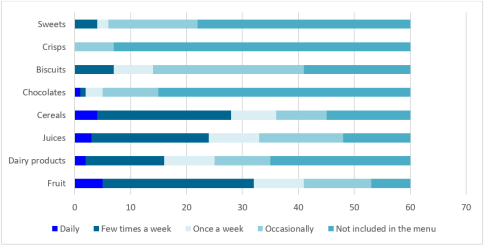
Figure 1. Processed foods frequency in preschool canteens.
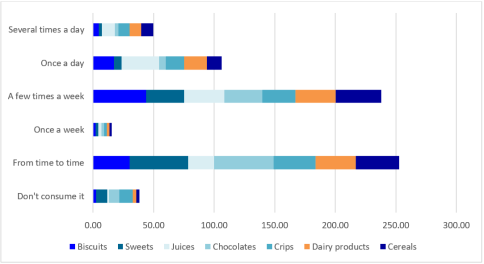
Figure 2. Processed foods consumption’s frequency at children's homes.
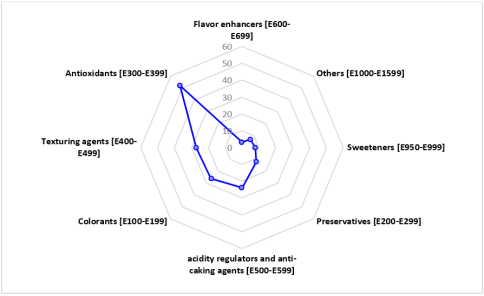
Figure 3. Categories of the 64 food additives in children processed foods.
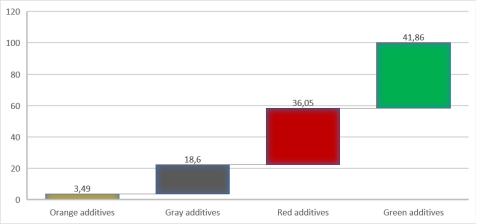
Figure 4. Distribution of listed food additives according to their level of danger.
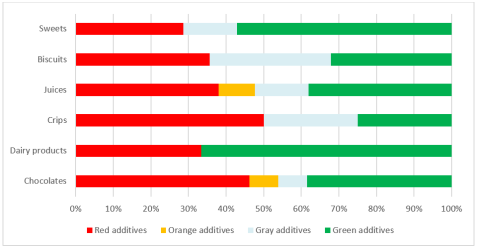
Figure 5. Distribution of food additives by risk level in main processed foods.

Information


 Share This Article
 Twitter
 Linked In
 Facebook

 Copy
 Download