Research Article | | Peer-Reviewed

Storage Stability of Rhynchophorus phoenicis Larvae Powder: Changes in Nutritional, Physicochemical, Water and Oil Absorption Properties Under Packaging Materials

Received: 3 January 2026     Accepted: 19 January 2026     Published: 2 February 2026
Views:       Downloads:
Abstract

Packaging control is a key aspect of the food sector for ensuring the stability and quality of food products. In this study, the storage stability of defatted Rhynchophorus phoenicis larvae powder was evaluated by analyzing the influence of three packaging materials on its nutritional, physicochemical, and techno-functional properties during storage. Defatted Rhynchophorus phoenicis larvae powder was packaged in polyethylene (PE), brown kraft paper (BP), and polypropylene (PP) and stored at room temperature for 60 days. Nutritional composition (protein, lipids, carbohydrates), physicochemical parameters (moisture content, pH, lipid oxidation indices: acid value, peroxide value, TBARS), and techno-functional properties (water and oil absorption capacities) were monitored periodically to assess storage stability. The initial powder contained 31.54% protein, 27.66% lipids, and 30.02% carbohydrates, with low lipid oxidation and hydrolysis. During storage, moisture content increased in BP and PP due to high water vapor permeability, while PE maintained a stable moisture content (~5.5%). pH decreased in all samples, but PE maintained pH at 6.57 on day 30 compared to 5.57 in PP. Lipid deterioration (acid value, peroxide value, TBARS) was pronounced in BP and PP, whereas PE limited these changes. Techno-functional properties evolved differently: water absorption capacity increased in BP and PP, but PE showed a transient increase followed by stabilization; oil absorption capacity increased in PE but decreased in BP and PP. Polyethylene packaging effectively preserved the nutritional, physicochemical, and functional quality of defatted R. phoenicis larvae powder during storage, whereas brown kraft paper and polypropylene were inadequate for long-term stability. PE is recommended for sustainable storage of insect-derived powders.

Published in Journal of Food and Nutrition Sciences (Volume 14, Issue 1)
DOI 10.11648/j.jfns.20261401.16
Page(s) 68-81
Creative Commons

This is an Open Access article, distributed under the terms of the Creative Commons Attribution 4.0 International License (http://creativecommons.org/licenses/by/4.0/), which permits unrestricted use, distribution and reproduction in any medium or format, provided the original work is properly cited.

Copyright

Copyright © The Author(s), 2026. Published by Science Publishing Group

Keywords

Defatted Larvae Powder, Edible Insects, Lipid Oxidation, Packaging Materials, Rhynchophorus phoenicis, Storage Stability

1. Introduction
The global population continues to grow and is projected to reach 10 billion by 2050 . This demographic surge has led to an escalating demand for food, particularly animal-derived proteins . However, conventional protein resources are insufficient to meet these needs. In Cameroon, for instance, diets are increasingly reliant on animal protein, yet such resources remain scarce and costly, exacerbating food insecurity and malnutrition. Given the challenges of food safety, nutritional sovereignty, and ecological sustainability associated with traditional animal protein sources, edible insects have emerged as a promising alternative . Several hundreds of millions people, primarily in Africa, Asia, and Latin America, already consume insects as part of their regular diet . Insects such as beetles, caterpillars, ants, and grasshoppers are commonly eaten, with specific species preferred in different regions based on availability and cultural preferences . Insects are a rich source of essential nutrients, including proteins, essential amino acids, fats, essential fatty acids, vitamins, and minerals, often comparable to or exceeding those found in conventional livestock . The nutritional profile of insects makes them a viable alternative to traditional animal proteins, particularly in regions facing protein-energy malnutrition . Among edible insects, Rhynchophorus phoenicis (African palm weevil) is widely consumed across several African countries, including 7 to 10 regions in Cameroon . Previous studies have demonstrated that R. phoenicis larvae are an excellent source of macronutrients—carbohydrates, lipids, and proteins and are even used in traditional medicine to treat childhood illnesses . Additionally, they exhibit notable techno-functional properties, such as water absorption capacity (3 mL/mg) and oil absorption capacity (3.5 mL/mg), making them suitable for food applications like bakery products . However, the high lipid content of R. phoenicis larvae, rich in unsaturated fatty acids, makes them susceptible to oxidation, a chemical process where oxygen reacts with the double bonds, leading to the rancidity of the products . This phenomenon of lipid oxidation produces undesirable volatile compounds (aldehydes and ketones) which rapidly deteriorate the organoleptic qualities (taste, smell) and nutritional value of the food, thereby reducing its shelf life and potentially its consumer acceptability . This highlights the imperative of using appropriate processing or preservation methods, such as delipidation or low-temperature storage, use of appropriate packaging materials, in order to preserve the nutritional integrity of the products . Defatting of the larvae and processing into powder can enhance food security, promote wider acceptance, and overcome consumer neophobia by facilitating their incorporation into diverse diets . Packaging materials such as polyethylene, polypropylene, and Brown paper, which are mostly used in many regions in Cameroon specifically in markets, industries and even at home play a critical role in preserving product quality. For instance, polyethylene, a hydrophobic polar polymer, effectively blocks extrinsic factors like oxygen, humidity, and light, thereby extending shelf life . While prior research on R. phoenicis larvae powder has mainly focused on its techno-functional properties and nutritional value , no study has examined how packaging materials and storage duration affect its properties. Given this gap, we hypothesized that packaging material significantly influences the nutritional, physicochemical, and techno-functional properties of R. phoenicis larvae powder during storage. This study aimed to: produce and characterize R. phoenicis larvae powder by analyzing its nutritional composition, physicochemical properties, and techno-functional attributes; and monitor changes in these parameters over time when stored in three distinct packaging materials.
2. Materials and Methods
2.1. Animal Material
One batch of Rhynchophorus phoenicis larvae (Coleoptera) were obtained in a viable state from a single agro-entrepreneur located in Bafoussam, in the West Region of Cameroon. The larvae, aged 36 days, had been reared on a growth substrate composed of crushed cassava, coconut powder, and pig feed.
2.2. Packaging Materials
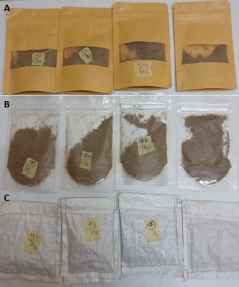
Three types of packaging materials were evaluated in this study: brown kraft paper (BP), polyethylene (PE), and polypropylene (PP). All packaging materials were purchased from a local supermarket in Douala, Cameroon and are representative of packaging commonly used for dry food products in local markets (Figure 1). Brown kraft paper (BP) consisted of a cellulose-based material with a thickness of approximately 63 µm. This material is known for its relatively high moisture and oxygen permeability, making it a semi-permeable packaging system. Kraft paper is often used for dry foods due to its biodegradability and low cost, although its barrier properties against water vapor and oxygen are limited . Polyethylene (PE) bags were transparent, flexible plastic films with a thickness of approximately 30 µm. PE is characterized by low moisture permeability and moderate oxygen barrier properties, which makes it suitable for protecting food powders against moisture uptake during storage. Its widespread availability and good sealing capacity make it a common packaging material for food products . Polypropylene (PP) bags had a thickness of approximately 35 µm. PP films generally exhibit low moisture permeability but higher oxygen permeability compared to PE. Polypropylene bags, commonly used in local markets, are considered non-hermetic (open) packaging systems, and therefore allow greater gas and moisture exchange with the surrounding environment . The key physical and barrier properties of the packaging materials assessed are presented in Table 1.
Table 1. Characteristics of packaging material: Brown kraft paper, Polyethylene paper, Polypropylene (Forsido et al., 2021).

Package material

Thickness (µm)

WVP

OP

Brown kraft paper (BP)

63

319

345,043

Polyethylene paper (PE)

30

86

50,000–200,000

Polypropylene (PP)

35

7–20

50,000–100,000

WVP: moisture permeability in g⋅μm/m2⋅day⋅kPa; OP: oxygen permeability in cm3⋅μm/m2⋅day⋅atm
Figure 1. Packaging materials: A (brown Kraft paper), B (polyethylene), C (polypropylene bags).
2.3. Preparation of Rhynchophorus phoenicis Larvae Powder
After collection, the larvae were transported to the Laboratory of Biochemistry at the University of Douala. They were washed thoroughly with tap water, and 3 kg were blanched at 100°C for 10 minutes in 1 liter of distilled water. They were then immediately cooled in cold water, eviscerated using sterile knives, and pre-dried at 40°C in a water bath for 5 to 8 minutes. Mechanical pressing was applied to remove lipids. The larvae were then dried in an oven at 40°C for three days. The dried samples were ground using a laboratory mill for 2 to 3 minutes and sieved through a 4 mm mesh. The final powder (approximately 1 kg) was stored at -20°C pending further analysis.
2.4. Experimental Design
Powdered samples (30 g each) were packaged in three types of materials: polyethylene plastic (PE), brown kraft paper (BP), and polypropylene sacks (PP). The samples were stored at room temperature (24–25°C) for 60 days. Samplings were performed three times per package on days 10, 20, 30, and 60 for nutritional composition, physicochemical, techno-functional, and microbiological analyses. The analysis of variance (ANOVA) with one factor and Ducan’s post hoc test were used to compare the three packages for a given follow-up time, with a significance threshold of 5%.
2.5. Proximate Analyses
Moisture content was determined by oven-drying samples at 105°C to constant weight (AFNOR, 1982) and calculated as the percentage weight loss. Protein content was measured via the Kjeldahl method (AOAC, 1988), involving mineralization, distillation, titration of total nitrogen with sulfuric acid, and application of a 6.19 conversion factor. Lipid content was extracted using a Soxhlet apparatus with hexane for 12 hours (AOAC, 1988) and expressed as percentage weight loss. Ash content was quantified by incineration in a muffle furnace at 550°C for 24 hours (AFNOR, 1981). Total carbohydrates were calculated by difference: 100% minus the sum of protein, lipid, moisture, and ash percentages.
2.6. Physicochemical Analysis
2.6.1. pH Measurement
One gram (1 g) of each powder sample was macerated in 2 mL of distilled water. The pH of the resulting suspension was subsequently measured using a calibrated pH meter (Cordosa et al., 2019).
2.6.2. Acid Value (AV)
The Acid Value (AV) of the different oils was determined according to the International standard . A mass M of 1 g of oil was introduced into a 250 mL beaker, followed by the addition of 100 mL of 95°C ethanol. Two drops of 1% phenolphthalein solution were added to the beaker's contents, and the mixture was titrated with a 0.1 N potassium hydroxide (KOH) solution. The volume V1 of KOH solution used to reach the indicator endpoint (pink coloration persisting for 10 seconds) was recorded. A blank assay was performed under the same conditions, and the volume V0 of KOH used was noted. The Acid Value is calculated using the following formula:
AV mg KOH /g oil= V1-V0 ×56.1 ×Nm
Where: mg KOH/ g oil: milligrams of potassium hydroxide per gram of oil; V1: volume of KOH used for the sample (mL); V0: volume of KOH used for the blank (mL); N: normality of the KOH solution (mol/L); 56.1: relative molecular mass of KOH (g/mol); m: mass of the test portion (g).
2.6.3. Peroxide Value (PV)
The peroxide value was determined according to the standard spectrophotometric method of IDF 74 A:1991 . Into a 10 mL glass test tube containing 50 mg of the sample, 9.8 mL of a chloroform/methanol mixture (7:3 v/v) was added, and the mixture was shaken for 2-4 s. Next, 50 μL of 30% aqueous ammonium thiocyanate solution was added and shaken for 2-4 s, followed by the addition of 50 μL of an aqueous ferrous chloride (FeCl2) solution. The mixture was shaken again for 2-4 s. After 5 minutes of incubation at room temperature, the absorbance of the reaction mixture was read at 500 nm using a spectrophotometer against a blank containing all reagents except the sample. The peroxide value is expressed in milliequivalents of active oxygen per kilogram of oil (meq. O2/kg powder). The Peroxide Value is calculated according to the formula:
PV meq. (O2/kg powder= As-Ab ×k55.84 ×m
Where: meq. 02: milliequivalent of oxygen; PV: Peroxide Value (meq. O2/kg); As: Sample absorbance ; Ab: blank absorbance ; k: slope obtained from the calibration curve (value provided: 38.40); m: mass of the sample (g); 55.84: molar mass of iron (g/mol) (often part of a constant factor in this calculation).
2.6.4. Thiobarbituric Acid Reactive Substances (TBARS) Index
The method employed is that of . One gram (1 g) of the sample was weighed and introduced into a 10 mL test tube, and then an aqueous solution of 0.1% trichloroacetic acid (TCA) was added. The mixture was vigorously shaken. Subsequently, 1 mL of 0.375% thiobarbituric acid (TBA) solution, 1 mL of 15% TCA solution, and 1 mL of 0.25 N hydrochloric acid (HCl) solution were successively added to the tube. The tube's content was shaken before being incubated in a water bath at 95°C for 30 minutes. After removing the tubes from the bath and cooling to room temperature, the aqueous phase was sampled, and its absorbance was measured at 532 nm using a spectrophotometer against a blank. The TBARS value is expressed as mg of Malondialdehyde (MDA) per kg of powder. The TBARS index is calculated using the following formula:
TBARS mg MDA / kg= As-Ab×10-2×VTCA ×2 ×M1.56 ×m
Where: mg MDA/ kg: milligrams of malondialdehyde per kilogram; As: sample absorbance ; Ab: blank absorbance ; VTCA: volume of trichloroacetic acid (mL); m: mass of the sample (g); 2: dilution factor; 1.56: molar extinction coefficient of the MDA-TBA complex (typical value).
2.7. Techno-functional Properties Analysis
2.7.1. Determination of Water Absorption Capacity
Water Absorption Capacity (WAC) is an essential functional property defined as the maximum amount of water that a powder sample can absorb and retain, typically expressed in mL/g. It reflects the sample's hydrophilicity and its potential for use in aqueous food systems. For its determination, a modified method based on was used: 0.1 g of Rhynchophorus phoenicis larva powder was mixed with 1.0 mL of distilled water, agitated for 30 seconds, and then subjected to rigorous centrifugation (40 mn at 4000 rpm). The supernatant was subsequently decanted. The WAC was calculated by dividing the volume of absorbed water by the initial mass of the R. phoenicis larva powder. The formula for calculating the Water Absorption Capacity (WAC) is:
WAC mLg= Initial volume of Water mL-Volume of supernatant mLMass of Rhynchophorus phoenicis larva powder
2.7.2. Oil Absorption Capacity (OAC) and Procedure
Similarly, Oil Absorption Capacity (OAC) represents the sample's ability to bind and retain oil, expressed in mL/g. This property is crucial for the powder's application in fatty matrices, indicating its hydrophobic interactions and its potential role in emulsion stabilization. The OAC is measured using a procedure similar to the WAC : 0.1 g of Rhynchophorus phoenicis larva powder was mixed with 1.0 mL of refined palm oil. Following agitation for 30 seconds and identical centrifugation (40 minutes at 4000 rpm), the oily supernatant was decanted. The OAC is then determined by quantifying the volume of oil bound by the sample. The volume of absorbed oil is divided by the initial mass of the R. phoenicis larva powder to obtain the sample's oil absorption capacity. The formula for calculating the Oil Absorption Capacity (OAC) is:
OAC mL/g= Initial volume of oil mL-Volume of supernatant (mL)Mass of Rhynchophorus phoenicis larva powder
3. Results and Discussion
3.1. Initial Composition of the Defatted Rhynchophorus phoenicis Larvae Powder
3.1.1. Proximate Composition
The proximate composition of the defatted Rhynchophorus phoenicis larvae powders presented in Table 2 reveals that these powders have a high nutritional density. Proteins are the major constituents, followed by carbohydrates and lipids, while ash is the minor constituent. The results show that the initial water content of R. phoenicis larvae powders is 7.10±0.10 g/100 g of powder. The moisture content of R. phoenicis larvae varies across studies, with values as low as 4.79% in adult stages and up to 11.94% in early larva stages . This content is comparable to that reported by Ngono et al. (7.07±0.02 g/100 g of powder) . The reported 7.10% is within a range that supports food stability. The initial water content in food is a critical determinant of its stability, influencing both microbial and chemical degradation processes. Low water content in food products is essential for limiting microbial growth and chemical reactions that can lead to spoilage . The R. phoenicis larvae powder has a high protein content of 31.54±0.31 g/100 g of powder. This high protein content makes them a valuable dietary supplement. This high protein content can be explained by the mechanical defatting applied in our study, which concentrated the proteins by reducing the lipid fraction. Recent work has shown that the proteins in R. phoenicis larvae are very rich in essential amino acids . The initial carbohydrate content of the R. phoenicis larvae powder was 30.02±0.62 g/100 g of powder. This value was higher than the value of 17.56 ± 0.02 g/100 g powder previously reported . The significant presence of carbohydrates is interesting, suggesting that the powder can contribute to fiber (chitin) or complex sugar intake, which distinguishes it from pure protein concentrates. The lipid content was 27.66 ± 0.57 g/100 g powder. This value is higher than 8.00 ± 0.11 g/100 g powder reported by , and 0 g/100 g powder reported by who performed total defatting on R. phoenicis larvae. This difference reflects the more moderate efficiency of the mechanical pressing used in our study. Previous works showed that the lipids in R. phoenicis larvae have good proportions of essential fatty acids . The ash content was 4.33±0.57 g/100 g of powder. This ash content is an indicator of the mineral richness of these larvae. This value, although moderate, suggests an interesting contribution of micronutrients such as Potassium and Magnesium, which have previously been observed in these insects . Generally, these results indicate that R. phoenicis larvae powder is rich in protein, lipids and carbohydrates and could contribute significantly to the daily caloric and protein intake (23–56 g of protein/day), thus constituting a potential nutritional supplement, a food additive, and an alternative to traditional animal protein sources (fish, meat).
Table 2. Characterization of Rhynchophorus phoenicis larval powder: macronutrient content, stability indices, techno-functional properties, and microbiological quality.

Parameter

Value

Proximate Composition

Moisture (g/100 g powder)

7.1 ± 0.1

Protein (g/100 g powder)

31.54 ± 0.31

Fat (g/100 g powder)

27.66 ± 0.57

Carbohydrate (g/100 g powder)

30.02 ± 0.62

Ash (g/100 g powder)

4.33 ± 0.57

Energy Value* (kCal/100 g powder)

495.1

Physicochemical Properties

Ph

6.99 ± 0.01

Acid Value (mg KOH/g powder)

0.57 ± 0.01

Peroxide Value (meq O₂/kg powder)

2.5 ± 0.08

TBARS (mg MDA/kg powder)

0.79 ± 0.06

Techno-functional Properties

Water Absorption Capacity (mL/g powder)

0.22 ± 0.01

Oil Absorption Capacity (mL/g powder)

0.64 ± 0.01

*The energy value was calculated using the Atwater coefficient, using 4 kCal/g for proteins and total carbohydrates and 9 kCal/g for lipids
3.1.2. Physicochemical Properties
The initial physicochemical properties are also presented in Table 2. The initial pH is 6.99 ± 0.01, almost neutral. This pH value indicates that the Rhynchophorus phoenicis larvae powder has a neutral taste, thus allowing it to be incorporated at high doses into various food matrices such as tomato paste and frankfurters, without the need for pH correctors or strong flavourings to mask an undesirable taste . This pH may also contribute to the chemical stability of the R. phoenicis larvae powder by minimizing the rate of lipid hydrolysis . The stability indices, crucial for food preservation, especially for those rich in lipids, are very stable. The initial acid value is 0.57 ± 0.01 mg KOH/g, which is lower than 3 mg KOH/g, the maximum recommended value for food products . This index measures the amount of free fatty acids. The low value obtained indicates a low level of triglyceride hydrolysis, meaning that the cooking-pressing process used was gentle and well-controlled, minimizing the hydrolytic rancidity of our larvae powders. The peroxide value is 2.50 ± 0.08 meq O₂/kg. This index measures hydroperoxides, the primary products of lipid oxidation (oxidative rancidity). The value obtained is below the critical threshold set at 10 meq O₂/kg for food products. Products with peroxide value exceeding 10 meq/kg are typically rejected or deemed unsuitable for consumption . The low value obtained is an indicator of the low deterioration of the lipids in the Rhynchophorus phoenicis larvae powders, despite their high lipid content. The TBARS index, an indicator of secondary lipid oxidation, measures aldehydes and ketones. Its value was 0.79 ± 0.06 mg MDA/kg. This value is below the limit of 2.5 mg MDA/kg, reflecting good oxidative stability . This suggests that the R. phoenicis larvae powder underwent only minimal oxidation during its preparation. These results highlight the initial stability at room temperature of the R. phoenicis larvae powder.
3.1.3. Techno-functional Properties
The techno-functional properties of Rhynchophorus phoenicis larval powder are presented in Table 2. The measured water absorption capacity (WAC) was 0.22 ± 0.01 mL/g, which is markedly lower than the value reported by Womeni et al. for larval powders processed under different conditions (3.50 mL/g) . This difference may be attributed to the effects of processing methods, which can induce protein denaturation and aggregation, thereby reducing the availability of hydrophilic groups capable of binding water. The oil absorption capacity (OAC) of the studied powder was 0.64 ± 0.01 mL/g, also lower than the 3.00 mL/g reported by . Nevertheless, these properties confer technological interest to the powder for its incorporation into various food formulations (cakes, sausages, cheeses, or soups), where it may contribute to the texture and stability of food matrices.
Previous studies have shown that thermal and dehydration treatments strongly influence the absorption capacities of R. phoenicis powders. Womeni et al. observed a reduction in WAC in grilled or roasted larvae (2.25 mL/g) compared with control samples (2.50 mL/g), suggesting increased protein aggregation and greater exposure of hydrophobic groups . Similarly, Ngono et al. reported a more pronounced decrease in WAC following a cooking–pressing treatment (1.90 ± 0.02 mL/g) . In addition, dehydration treatments, including electric drying as well as boiling followed by sun drying, resulted in a significant reduction in WAC . Regarding OAC, Ngono et al. (2023) showed that the cooking–pressing treatment reduced this property to 2.58 ± 0.01 mL/g compared with smoked samples. These findings confirm that processing methods modify protein structure and their affinity for lipids, thereby influencing the techno-functional potential of Rhynchophorus phoenicis larval powders.
3.2. Effects of Packaging Type on the Properties and Characteristics of Rhynchophorus phoenicis Larvae Powder During Storage
3.2.1. Effects on the Evolution of Proximate Composition
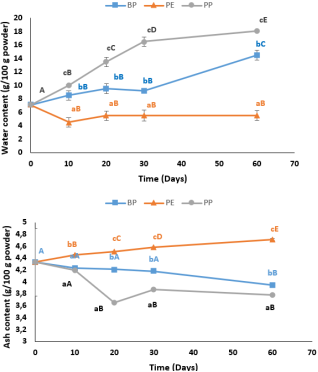
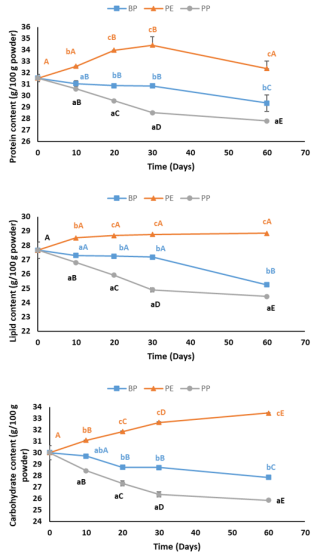
The evolution of macronutrient content of the powder of larvae of Rhynchophorus phoenicis under the three types of packaging is presented in Figure 2.
Figure 2. Evolution of Water content and ash content of the powder of Rhynchophorus phoenicis larvae as function of time.
For a given storage time, points labelled with lowercase letters (a, b, c) are statistically significant at the 5% level. For a given packaging type, points labelled with different uppercase letters (A, B, C) are statistically significant at the 5% level. BP (Brown kraft paper); PE (polyethylene); PP (polypropylene). a>b>c; A>B>C>D>E
Moisture content is a critical parameter influencing the quality, microbiological stability, and shelf life of foods and agricultural products . For hygroscopic products (which absorb moisture from the environment), the choice of packaging material is essential, as it serves as a protective barrier against oxygen and water vapor transfer . Excessive permeability of the packaging may lead to rapid product deterioration, thereby limiting consumption, distribution and commercialization. Figure 2 shows the evolution of moisture content as a function of three different packaging types: Brown kraft paper (BP), Polyethylene (PE), and Polypropylene (PP), over a 60-day period. The general trend indicates an increase in moisture content in the powders of R. phoenicis larvae stored in BP and PP, whereas moisture content stabilized rapidly in the PE packaging. This trend is directly related to the water vapor permeability of each material. After 60 days of storage at ambient temperature (27°C ± 4), moisture content increased in BP and PP packages, reaching 14.5 ± 0.74 g/100 g and 18.1 ± 0.14 g/100 g powder, respectively. An increase in moisture content generally correlates with an increase in water activity, which can promote the growth of microorganisms, including bacteria, yeasts, and moulds . Conversely, the powder stored in PE packaging shows a non-significant decrease in moisture content and a stabilization at a lower level (5.5 ± 0.71 g/100 g), which can be explained by the low water permeability of polyethylene due to it’s tight polymer structure and level of crystallinity which makes it hard for water molecule to squeeze inside . Water acts as a catalyst for many chemical and biochemical reactions; therefore, this change in water content will influence macronutrient composition, microbial load, and free fatty acid levels. The other nutritional parameters, namely ash, carbohydrate, protein, and lipid contents, showed variations closely correlated with changes in moisture content (Figures 2, 3). Indeed, any modification in moisture content directly affects the apparent concentration of these constituents, either through a dilution effect or through a concentration of dry matter. Thus, an increase in moisture content is generally associated with a relative decrease in nutrient contents expressed on a wet basis, whereas a reduction in moisture leads to an apparent increase in these parameters. These findings highlight the importance of controlling moisture content when evaluating and comparing the nutritional quality of food products.
Figure 3. Evolution of protein, lipid and carbohydrate content of the powder of Rhynchophorus phoenicis larvae as function of time.
For a given storage time, points labelled with lowercase letters (a, b, c) are statistically significant at the 5% level. For a given packaging type, points labelled with different uppercase letters (A, B, C) are statistically significant at the 5% level. BP (Brown kraft paper); PE (polyethylene); PP (polypropylene). a>b>c; A>B>C>D>E
Polyethylene (PE) appears to be the optimal packaging choice for storing R. phoenicis larva powder, as it maintained moisture content at a low and stable level, which is essential for preserving quality and extending shelf life. Polypropylene (PP) is the least suitable option, as it leads to rapid quality deterioration due to substantial moisture uptake. Brown kraft paper (BP) provides temporary protection, but its performance declines after approximately 30 days, making it unsuitable for long-term storage.
3.2.2. Effects on the Evolution of Physicochemical Properties
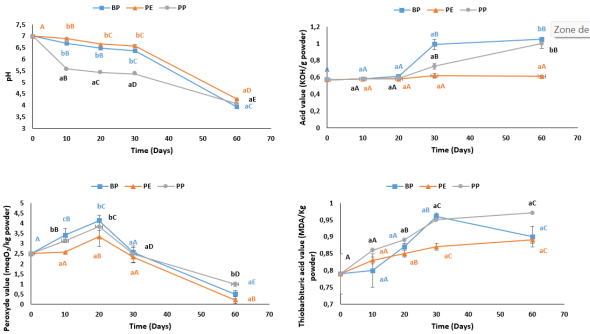
The evolution of physicochemical properties of Rhynchophorus phoenicis larva powder under the three types of packaging are presented in Figure 4. The pH of R. phoenicis larval powders decreased progressively during storage regardless of the type of packaging used, indicating a gradual acidification likely due to biochemical reactions, lipid oxidation, and the formation of acidic metabolites . Although all samples started with an identical initial pH (6.99 ± 0.01), significant differences appeared over time depending on the packaging material. The most pronounced decrease occurred in polypropylene (PP) packaging, where the pH dropped sharply by day 10 (5.57 ± 0.01) and continued to decline until day 60 (4.07 ± 0.01), suggesting greater exposure to environmental factors promoting acid formation. In the study of kimchi, PP packaging showed a significant decrease in pH from 6.25 to 4.12-4.16 over 20 days, indicating a rapid increase in acidity attributed to the material's permeability . The powder stored in Brown kraft paper (BP) also exhibited a marked reduction in pH, particularly after day 20 (6.48 ± 0.01) until day 60 (3.92 ± 0.01), likely due to the porous structure and higher permeability of the material to oxygen and moisture, which enhances oxidative and hydrolytic reactions . In contrast, the powder packaged in polyethylene (PE) showed the most stable pH profile, with slower and less pronounced changes up to day 30 (6.57 ± 0.04), demonstrating its superior barrier properties and greater ability to preserve the physicochemical quality of the powder. Overall, the findings clearly demonstrate that packaging type significantly influences pH stability during storage, with polyethylene providing the most effective protection against acidification, while polypropylene and brown kraft paper were less effective in limiting chemical reactions leading to pH decline.
The evolution of the acid value during storage also demonstrates an influence of the type of packaging on the lipid stability of Rhynchophorus phoenicis larval powder. Acid value was similar in all packaging material at Day 0 (0.57 mg KOH/g). Throughout storage, the acid value remained relatively stable in polyethylene (PE) packaging, with no significant difference observed up to Day 60 (0.61±0.01 mg KOH/g), highlighting its effective protection against lipid hydrolysis . In contrast, a progressive and significant increase was observed in powder stored in Brown kraft paper (BP) and polypropylene (PP) packaging, reaching 1.05 mg KOH/g and 1.00 mg KOH/g at Day 60, respectively. This increase suggests that polypropylene and brown kraft paper were less effective in limiting exposure to moisture and oxygen. Moisture and oxygen are known to influence lipolysis and the release of free fatty acids . These findings are consistent with previous reports showing that low-permeability packaging materials, such as polyethylene, delay lipid oxidation and hydrolysis compared with permeable packaging . Studies on lipid-rich products, further confirm that oxygen-water vapor permeability of packaging strongly influences acid value increase during storage . Therefore, polyethylene appears to be the most suitable packaging material for preserving lipid quality in R. phoenicis larval powders, whereas brown kraft paper and polypropylene are less effective in limiting oxidative and hydrolytic reactions.
The peroxide value (PV) evolution demonstrates a clear influence of packaging material on the primary lipid oxidation kinetics in Rhynchophorus phoenicis larval powders during storage. The peroxide value at Day 0 was 2.50 ± 0.08 meq O₂/kg. A significant increase in PV was observed in all treatments up to Day 20, with the highest values recorded in brown kraft paper (BP) (4.12 ± 0.28 meq O₂/kg), followed by polypropylene (PP) (3.83 ± 0.19 meq O₂/kg), and polyethylene (PE) (3.33 ± 0.48 meq O₂/kg). This early rise indicates the formation of primary oxidation products, with BP and PP showing the greatest susceptibility, likely due to their higher permeability to oxygen and moisture . Thereafter, PV sharply declined across all packaging systems by Day 60, reaching 0.50 ± 0.19, 0.21 ± 0.17, and 0.99 ± 0.08 meq O₂/kg for BP, PE, and PP, respectively. This decrease suggests the decomposition of unstable peroxides into secondary oxidation products, a phenomenon often observed during advanced lipid oxidation stages . Polyethylene consistently showed the most stable behaviour, reflecting its superior barrier performance in limiting oxidative reactions, whereas brown kraft paper and polypropylene exhibited significantly higher fluctuations, confirming their lower protective efficiency . These observations align with previous reports indicating that lipid-rich insect powders are highly sensitive to oxygen exposure and that packaging with low oxygen permeability is critical to maintaining oxidative stability . Overall, the peroxide value profile underscores the pivotal role of packaging in mitigating primary lipid oxidation, highlighting polyethylene as the most suitable option for preserving the oxidative quality of R. phoenicis larval powders.
The evolution of thiobarbituric acid reactive substances (TBARS) further highlights the influence of packaging material on secondary lipid oxidation in Rhynchophorus phoenicis larval powders during storage. At Day 0, the malondialdehyde (MDA) concentrations was similar for all samples (0.79 ± 0.06 mg MDA/kg). Throughout storage, a gradual and significant increase in TBARS was observed across all packaging systems, consistent with the progressive degradation of peroxides into secondary oxidation products . Polyethylene (PE) exhibited the slowest rate of increase, with TBARS values reaching 0.89 ± 0.01 mg MDA/kg at Day 60, indicating best oxidative protection. In contrast, polypropylene (PP) recorded the highest TBARS concentration at Day 60 (0.97 ± 0.03 mg MDA/kg), followed by brown kraft paper (BP) (0.90 ± 0.09 mg MDA/kg), reflecting greater oxidative stress likely attributed to their higher permeability to oxygen and moisture . The more moderate TBARS increase in PE corroborates its superior barrier properties and aligns with the decrease in peroxide value, reinforcing polyethylene as the most effective packaging for maintaining lipid stability . These findings are consistent with previous studies reporting that oxygen-impermeable packaging effectively limits secondary lipid oxidation in insect-based and other food products . The TBARS profile shows that the packaging material also plays an important role in limiting lipid oxidation in insect flours during storage, with polyethylene offering better protection than polypropylene or Brown kraft paper for preserving lipid quality during storage.
Figure 4. Evolution of physicochemical properties (pH, acid value, peroxide value, thiobarbituric acid value) of the powder of Rhynchophorus phoenicis larvae as function of time.
For a given storage time, points labelled with lowercase letters (a, b, c) are statistically significant at the 5% level. For a given packaging type, points labelled with different uppercase letters (A, B, C) are statistically significant at the 5% level. BP (Brown kraft paper); PE (polyethylene); PP (polypropylene). a>b>c; A>B>C>D>E
3.2.3. Effects on the Evolution of Water Absorption Capacity (WAC) and Oil Absorption Capacity (OAC)
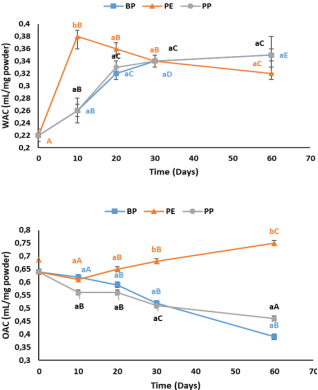
The evolution of water and oil absorption capacities of Rhynchophorus phoenicis larva powder under the three types of packaging are presented in Figure 5. The evolution of water absorption capacity (WAC) during storage revealed significant effects of packaging material on the hydration properties of Rhynchophorus phoenicis larval powders. This effect has previously been observed in several food products such as yam powders, infant flours, and sesame powders . At the initial stage, all powders showed similar WAC values (0.22 ± 0.01 mL/mg). During storage, WAC increased in the powders stored in all packaging materials. This increase in WAC was positively correlated with the rise in moisture content in the powders. In brown kraft paper (BP) and polypropylene (PP) packaging, the increases in WAC were the most pronounced, reaching 0.35 ± 0.03 and 0.35 ± 0.01 mL/mg respectively by Day 60, reflecting a higher water-holding capacity likely linked to greater exposure to moisture due to the higher permeability of these materials . This water uptake may have caused protein denaturation, exposing more hydrophilic polar groups that were previously buried within the protein structure, thereby increasing the available binding sites for water and resulting in the higher measured WAC. In the presence of moisture, partial hydrolysis (bond cleavage) of large molecules (proteins or starches) may also have occurred, generating smaller polar fragments (amino acids, sugars) capable of binding water through hydrogen bonding . In contrast, in polyethylene (PE) packaging, a different kinetic pattern was observed, with an early peak at Day 10 (0.38 ± 0.01 mL/mg) followed by a gradual decrease to 0.32 ± 0.01 mL/mg by Day 60. This transient increase followed by a decline suggests that in polyethylene packaging, the powders undergo an initial denaturation and structural rearrangement that temporarily exposes hydrophilic sites, but over time, structural aggregation and potential cross-linking between denatured proteins or protein–carbohydrate complexes reduced water accessibility . These trends align with previous studies showing that high-barrier packaging slows functional deterioration in food powders, although prolonged storage still induces structural changes affecting hydration capacity . Overall, these results demonstrate that packaging strongly influences the functional stability of insect powders during storage, with polyethylene providing better short-term protection, while more permeable materials such as BP and PP allow progressive physicochemical changes that alter protein–water interactions.
Figure 5. Evolution of water absorption capacity (WAC) and oil absorption capacity (OAC) of the powder of Rhynchophorus phoenicis larvae as function of time.
For a given storage time, points labelled with lowercase letters (a, b, c) are statistically significant at the 5% level. For a given packaging type, points labelled with different uppercase letters (A, B, C) are statistically significant at the 5% level. BP (Brown kraft paper); PE (polyethylene); PP (polypropylene). a>b>c; A>B>C>D>E
The oil absorption capacity (OAC) of Rhynchophorus phoenicis larva powder exhibited different variations during storage, strongly influenced by the type of packaging. This effect has previously been observed in yam powders . At the initial time, OAC values were identical across all packaging types (0.64 ± 0.01 mL/mg). However, during storage, distinct kinetic patterns were observed. In polyethylene (PE) packaging, a progressive and significant increase in OAC was recorded, reaching 0.75 ± 0.01 mL/mg at Day 60. This increase may be attributed to partial protein denaturation, exposing hydrophobic amino acid residues and lipid-binding sites. Such behaviour has been reported in food protein matrices where moderate oxidation increases surface hydrophobicity and oil affinity . Conversely, powders stored in brown kraft paper (BP) and polypropylene (PP) showed a progressive decline in OAC, decreasing to 0.39 ± 0.01 mL/mg and 0.46 ± 0.01 mL/mg, respectively, at Day 60. These decreases may be due to increased oxidative and hydrolytic deterioration under conditions of higher oxygen and moisture permeability, promoting protein aggregation and cross-link formation that limit lipid interactions . Additionally, lipid oxidation products generated in permeable packaging can react with protein side chains, reducing binding capacity and impairing techno-functional performance . These results indicate that packaging material can profoundly influence lipid–protein interaction dynamics and the functional stability of insect powders.
The overall results obtained demonstrate that packaging conditions are crucial for preserving the stability of edible insect-based products, particularly regarding lipid oxidation and moisture-induced modifications. Beyond polyethylene, packaging materials with even better barrier properties can be considered to further improve the stability of insect powders during storage. With this in mind, smart packaging or films based on nanocellulose represent a promising sustainable prospect, due to their excellent oxygen barrier performance and their potential to limit oxidative degradation .
4. Conclusions
This study clearly demonstrates that the choice of packaging material is a decisive factor in preserving the nutritional, physicochemical, and techno-functional quality of Rhynchophorus phoenicis larvae powder during storage. Although the initial powder exhibited satisfactory oxidative stability, the evolution of its quality strongly depended on the packaging system in which it was stored. Among the materials evaluated, polyethylene (PE) consistently provided the highest level of protection. PE effectively limited moisture uptake, thereby reducing microbial risk and slowing the biochemical reactions associated with lipid hydrolysis and oxidation. In addition, PE ensured better preservation of techno-functional properties by stabilizing water absorption capacity and enhancing oil absorption capacity. In contrast, brown kraft paper (BP) and polypropylene (PP), due to their higher permeability to water vapor and oxygen, promoted accelerated chemical and functional deterioration, leading to significant quality losses within 60 days of storage. Overall, these results indicate that polyethylene is the most suitable packaging material for extending shelf life and maintaining the functional quality of insect-based flours.
Abbreviations

AFNOR

Association Française de Normalisation

AOAC

Association of Official Analytical Chemists

AV

Acid Value

BP

Brown Kraft Paper

MDA

Malondialdehyde

OAC

Oil Absorption Capacity

PE

Polyethylene

PP

Polypropylene

PV

Peroxide Value

TBARS

Thiobarbituric Acid Reactive Substances

WAC

Water Absorption Capacity

Author Contributions
Whitney Sandy Kamgaing Motou: Investigation, Writing – original draft, Formal Analysis, Investigation, Writing – Review & Editing.
Aymar Rodrigue Fogang Mba: Conceptualization, Data Curation, Methodology, Project administration, Validation, Writing – original draft, Writing – review & editing.
Adelaide Demasse Mawamba: Validation, Writing – review & editing.
Mohamed Ismael Ntieche: Investigation, Writing – review & editing.
Awawou Rissikatou Ntientie Mfombam: Investigation, Writing – review & editing.
Jules Christophe Manz Koule: Writing – review & editing.
Loick Pradel Kojom Foko: Validation, Writing – review & editing.
Fabrice Fabien Dongho Dongmo: Validation, Writing – review & editing.
Germain Kansci: Resources, Supervision, Writing – review & editing.
Inocent Gouado: Resources, Supervision, Writing – Review & Editing.
Conflicts of Interest
The authors declare no conflicts of interest.
References
[1] F. R. Siegel, Countering 21st Century Social- Environmental Threats to Growing Global Populations. Washington, DC: Springer Briefs IN Environmental Science, 2015.
[2] E. Zielińska, B. Baraniak, M. Karaś, K. Rybczyńska, and A. Jakubczyk, “Selected species of edible insects as a source of nutrient composition,” Food Res. Int., vol. 77, pp. 460–466, 2015,
[3] P. Polepole, L. Laroumagne, F. J. Muafor, P. Legall, and L. Brice, “Introduire les insectes comestibles dans l’alime ntation animale au Cameroun - une nouvelle opportunité ? : Revue de la littérature,” Living For. Trust, no. 237, pp. 1–21, 2019.
[4] A. van Huis, A. Halloran, J. Van Itterbeeck, H. Klunder, and P. Vantomme, “How many people on our planet eat insects: 2 billion?,” J. Insects as Food Feed, vol. 8, no. 1, pp. 1–4, 2022,
[5] P. Pal and S. Roy, “Edible Insects: Future of Human Food - A Review,” Int. Lett. Nat. Sci., vol. 26, pp. 1–11, 2014,
[6] A. K. Chakravarthy, G. T. Jayasimha, R. Rachana, and G. Rohini, “Insects as human food,” in Economic and Ecological Significance of Arthropods in Diversified Ecosystems: Sustaining Regulatory Mechanisms, A. K. Chakravarthy and S. Sridhara, Eds., 2016, pp. 133–146.
[7] J. N. Kinyuru, J. B. Mogendi, C. A. Riwa, and N. W. Ndung’u, “Edible insects-A novel source of essential nutrients for human diet: Learning from traditional knowledge,” Anim. Front., vol. 5, no. 2, pp. 14–19, 2015,
[8] B. A. Rumpold and O. K. Schlüter, “Nutritional composition and safety aspects of edible insects,” Mol. Nutr. Food Res., vol. 57, no. 5, pp. 802–823, 2013,
[9] A. R. Fogang Mba et al., “Growing conditions and morphotypes of African palm weevil (Rhynchophorus phoenicis) larvae influence their lipophilic nutrient but not their amino acid compositions,” J. Food Compos. Anal., vol. 69, no. September 2017, pp. 87–97, 2018,
[10] E. Dounias, “The unknown exploitation of a known resource: the collection of edible weevil larvae in the south of Cameroon,” in Les insectes dans la tradition orale - Insects in oral litterature and traditions, Paris-Louv., E. MOTTE-FLORAC and J. M. C. Thomas, Eds., LEUVEN-PARIS-DUDLEY, MA, 2003, pp. 257–278.
[11] L. N. Adobeze and V. H. A. Enemor, “Amino Acid and Carbohydrate Profiles of Rhynchophorus phoenicis (the Larva of Raffia Palm Weevil),” Am. J. Heal. Res., vol. 12, no. 2, pp. 392–400, 2020.
[12] J. M. Nzikou et al., “Characterisation and Nutritional Potentials of Rhynchophorus phoenicis Larva Consumed in Congo-Brazzaville,” Curr. Res. J. Biol. Sci., vol. 2, no. 3, pp. 189–194, 2010.
[13] H. M. Womeni et al., “Nutritional value and effect of cooking, drying and storage process on some functional properties of Rhynchophorus phoenicis,” Int. J. Life Sci. Pharma Res., vol. 2, no. 3, pp. 203–219, 2012.
[14] B. Tiencheu et al., “Changes of lipids in insect (Rhynchophorus phoenicis) during cooking and storage,” Eur. J. Lipid Sci. Technol., vol. 115, no. 2, pp. 186–195, 2013,
[15] F. Shahidi and A. Hossain, “Role of Lipids in Food Flavor Generation,” Molecules, vol. 27, no. 5014, pp. 1–16, 2022,
[16] M. Ahmed, J. Pickova, T. Ahmad, M. Liaquat, A. Farid, and M. Jahangir, “Oxidation of Lipids in Foods,” Sarhad J. Agric., vol. 32, no. 3, pp. 230–238, 2016,
[17] E. Kamau et al., “Effect of Packaging Material, Storage Temperature and Duration on the Quality of Semi-Processed Adult House Cricket Meal,” J. Food Res., vol. 7, no. 1, pp. 21–26, 2018,
[18] N. S. Marasca et al., “Effect of Defatting Method on the Nutritional, Functional, and Bioactive Properties of Black Soldier Fly (Hermetia illucens) Larvae,” Insects, vol. 16, no. 8, pp. 1–16, 2025,
[19] N. M. de Carvalho, A. R. Madureira, and M. E. Pintado, “The potential of insects as food sources–a review,” Crit. Rev. Food Sci. Nutr., vol. 60, no. 21, pp. 3642–3652, 2020,
[20] X. Yan, S. Laurent, M. Federighi, G. Boué, and V. Jury, “Processing edible insects into powders: a review of available processes and potential microbial inactivation methods,” J. Insects as Food Feed, vol. 9, no. 3, pp. 325–338, 2022.
[21] S. Fikreyesus Forsido, E. Welelaw, T. Belachew, and O. Hensel, “Effects of storage temperature and packaging material on physico-chemical, microbial and sensory properties and shelf life of extruded composite baby food flour,” Heliyon, vol. 7, no. 4, p. e06821, 2021,
[22] D. M. Koffi, M. Cisse, G. A. Koua, and S. L. Niamke, “Nutritional and functional properties of flour from the palm (Elaeis Guineensis) weevil Rhynchophorus phoenicis larvae consumed as protein source in South Côte D’Ivoire,” Ann. Univ. Dunarea Jos Galati, Fascicle VI Food Technol., vol. 41, no. 1, pp. 9–19, 2017.
[23] A. R. Fogang Mba et al., “Lipid and amino acid profiles support the potential of Rhynchophorus phoenicis larvae for human nutrition,” J. Food Compos. Anal., vol. 60, pp. 64–73, Jul. 2017,
[24] S. ISO 660, “Animal and vegetable fats and oils — Determination of acid value and acidity,” Switzerland, 2020.
[25] IDF, “International Dairy Federation Standard Methods, Sec. 74A, Square Vergote 41,” Brussels, Belgium, 1991.
[26] H. H. Draper and M. Hadley, “Malondialdehyde determination as index of lipid Peroxidation,” Methods Enzymol., vol. 186, no. 43, pp. 421–431, 1990,
[27] M. J. Lin, E. S. Humbert, and F. W. Sosulski, “Certain functional properties of sunflower meal products,” J. Food Sci., vol. 39, pp. 5–7, 1974.
[28] O. T. Omotoso and C. O. Adedire, “Nutrient composition, mineral content and the solubility of the proteins of palm weevil, Rhynchophorus phoenicis f. (Coleoptera: Curculionidae).,” J. Zhejiang Univ. Sci. B., vol. 8, no. 5, pp. 318–322, 2007,
[29] S. N. N. Ngono Eyenga, A. R. Fogang Mba, P. Mounjouenpou, and G. Kansci, “Nutritional, functional properties and estimated shelf-life of defatted Rhynchophorus phoenicis (Fabricius, 1801 ) larvae flours,” Int. J. Biol. Chem. Sci., vol. 17, no. 6, pp. 2439–2455, 2023.
[30] V. Lavelli and W. Kerr, “Moisture properties and stability of novel bioactive ingredients,” in Food Quality and Shelf Life, Elsevier Inc., 2019, pp. 33–54.
[31] A. M. B. Loh, K. Yisa Njowe, and M. Kana Sop, “Preliminary Proximate Composition and Mineral contents of Five Edible Insects from Cameroon,” Int. J. Curr. Microbiol. Appl. Sci., vol. 6, no. 3, pp. 1984–1995, 2017,
[32] L. Chamoun, S. Karboune, H. E. Lutterodt, and H. Melgar-Quinonez, “Nutritional composition and consumer acceptance of tomato paste fortified with palm weevil larvae (Rhynchophorus phoenicis Fabricius) in the Ashanti region, Ghana,” Food Sci. Nutr., vol. 11, no. 8, pp. 4583–4595, 2023,
[33] M. Abo, O. Awodoyin, O. Adediran, and A. Omojola, “The Nutritive, textural and sensory attributes of frankfurter fortified with graded levels of edible Palm weevil larvae (Rhynchophorus phoenicis F),” Niger. J. Anim. Prod., vol. 49, no. 6, pp. 78–88, 2023,
[34] A. R. Fogang Mba, E. David-briand, M. Viau, A. Riaublanc, G. Kansci, and C. Genot, “Protein extraction yield, lipid composition, and emulsifying properties of aqueous extracts of Rhynchophorus phoenicis larvae extracted at pH 3.0 to 10.0,” Futur. Foods, vol. 4, no. March, p. 100037, 2021,
[35] T. E. Purbaningtias and Sandy, “Evaluation of Ethanol Grade on the Robustness of Acid Number Determination in Fish Oil,” Indones. J. Chem. Anal., vol. 07, no. 02, pp. 237–244, 2024,
[36] M. Ali, M. Imran, M. Nadeem, M. K. Khan, and M. Sohaib, “Oxidative stability and Sensoric acceptability of functional fish meat product supplemented with plant − based polyphenolic optimal extracts,” Lipids Health Dis., vol. 18, no. 35, pp. 1–16, 2019.
[37] P. R. Thiel, K. B. Massaut, M. Arocha Gularte, C. E. dos Santos Cruxen, and A. M. Fiorentini, “Fish and derivatives: oxidative stability,” Ed. Científica Digit., vol. 3, pp. 62–80, 2024.
[38] R. Dominiguez, M. Pateiro, M. Gagaoua, F. J. Barba, W. Zhang, and J. M. Lorenzo, “A Comprehensive Review on Lipid Oxidation in Meat and Meat Products,” Antioxidants, vol. 8, no. 429, pp. 1–31, 2019.
[39] A. Lopez-Malo and S. Alzamora, “Water Activity and Microorganism Control : Past and Future,” in Water Stress in Biological, Chemical, Pharmaceutical and Food Systems, G. V. B.-C. Gustavo F. Gutiérrez-López, Liliana Alamilla-Beltrán, María del Pilar Buera, Jorge Welti-Chanes, Efrén Parada-Arias, Ed., Springer New York, NY, 2015, pp. 245–262.
[40] C. Caballero-Cerón, J. A. Guerrero-Beltrán, H. Mújica-Paz, J. A. Torres, and J. Welti-Chanes, “Moisture sorption isotherms of foods: experimental methodology, mathematical analysis, and practical applications,” in Water Stress in Biological, Chemical, Pharmaceutical and Food Systems., Food Engin., G. Gutiérrez-López, L. Alamilla-Beltrán, M. del Pilar Buera, J. Welti-Chanes, E. Parada-Arias, and G. Barbosa-Cánovas, Eds., New York: Springer, 2015, pp. 187–214.
[41] C. Mannheim and N. Passy, “Choice of Packages for Foods with Specific Considerations of Water Activity BT - Properties of Water in Foods: in Relation to Quality and Stability,” in Properties of Water in Foods, D. Simatos and J. L. Multon, Eds., Dordrecht: Springer Netherlands, 1985, pp. 375–391.
[42] E. J. Rifna, M. Dwivedi, and O. P. Chauhan, “Role of Water Activity in Food Preservation,” in Advances in Food Chemistry, O. P. Chauhan, Ed., Singapore: Springer Nature Singapore, 2022, pp. 39–64.
[43] B. Jasse, A. M. Seuvre, and M. Mathlouthi, “Permeability and structure in polymeric packaging materials,” in Food Packaging and Preservation, M. Mathlouthi, Ed., Springer New York, NY, 1994, pp. 1–22.
[44] H.-Y. Park, J.-A. Ahn, H.-J. Seo, and C. Hye-Sun, “Quality Characteristics of Small Package Kimchi according to Packing Material and Storage Temperature,” Korean J. food Cook. Sci., vol. 27, no. 1, pp. 63–73, 2011.
[45] O. F. Etefa, H. Zinabu, S. F. Forsido, Y. B. Tola, and T. Astatkie, “Effect of packaging materials, storage temperatures, and storage durations on physico- chemical qualities of red-hot pepper (Capsicum annum L) powder,” J. Microbiol. Biotechnol. Food Sci., vol. 15, no. 2, pp. 1–10, 2025.
[46] H. R. Kim, D. S. Shin, K. M. Kim, S. M. Yu, and J. S. Kim, “Effect of Packaging on Quality of Stored Gangjung,” Korean J. Food Sci. Technol., vol. 44, no. 1, pp. 48–54, 2012.
[47] S. Emebu, O. Osaikhuiwuomwan, A. Mankonen, C. Udoye, C. Okieimen, and D. Janáčová, “Influence of moisture content, temperature, and time on free fatty acid in stored crude palm oil,” Sci. Rep., vol. 12, no. 9846, pp. 1–11, 2022,
[48] W. Tsuzuki, Y. Suzuki, S. Yamada, S. Kano, and H. Ohnishi, “LWT - Food Science and Technology Effect of oxygen absorber on accumulation of free fatty acids in brown rice and whole grain wheat during storage,” LWT - Food Sci. Technol., vol. 58, no. 1, pp. 222–229, 2014,
[49] S. A. Moon, S. Wongsakul, and H. Kitazawa, “Lipid Oxidation Changes of Arabica Green Coffee Beans during Accelerated Storage with Different Packaging Types,” Foods, vol. 11, no. 3040, pp. 1–21, 2022.
[50] R. Sahu and D. Khokhar, “Evaluation of Water Vapour Permeability of Some Food Grain Packaging Materials,” J. Sci. Res. Reports, vol. 30, no. 6, pp. 558–563, 2024.
[51] M. Lorenzo, R. Domininguez, M. Pateiro, and P. E. S. Munekata, Methods to Assess the Quality of Meat Products, Lorenzo, J. New, 2022.
[52] Y. S. V Leães et al., “Lipid oxidation (Primary and Secondary Products) BT - Methods to Assess the Quality of Meat Products,” in Methods to Assess the Quality of Meat Products. Methods and Protocols in Food Science, J. M. Lorenzo, R. Domínguez, M. Pateiro, and P. E. S. Munekata, Eds., New York, NY: Springer US, 2022, pp. 115–132.
[53] E. N. Frankel and N. Regional, “Lipid Oxidation: Mechanisms, Products and Biological Significance,” J. Am. Oil Chem. Soc., vol. 61, no. 12, pp. 1908–1917, 1984.
[54] A. Raleng, M. R. Manikantan, and A. A. Mishra, “Effect of packaging materials on storage stability of protein rich flour from deoiled sesame cake Effect of Packaging Materials on Storage Stability of Protein rich flour from deoiled Sesame cake,” Int. J. Adv. Res., vol. 2, no. 14, pp. 248–254, 2014.
[55] A. Adebowale et al., “Influence of storage conditions and packaging materials on some quality attributes of water yam flour Influence of storage conditions and packaging materials on some quality attributes of water yam flour,” Cogent Food Agric., vol. 3, no. 1385130, pp. 1–26, 2017,
[56] N. Yousefi and S. Abbasi, “Food proteins : Solubility & thermal stability improvement techniques,” Food Chem. Adv., vol. 1, no. August, p. 100090, 2022,
[57] X. Zhao, Y. Fu, and C. Song, “Proteins,” in Essentials of Food Chemistry, J. Kan and K. Chen, Eds., Singapore: Springer Singapore, 2021, pp. 49–121.
[58] Zhang, Y. Liu, P. Wang, and Y. Zhao, “The Effect of Protein – Starch Interaction on the Structure and Properties of Starch, and Its Application in Flour Products,” Foods, vol. 14, no. 778, pp. 1–23, 2025.
[59] Z. Wang, X. Liu, T. Ojangba, L. Zhang, Q. Yu, and L. Han, “Storage and Packaging Effects on the Protein Oxidative Stability, Functional and Digestion Characteristics of Yak Rumen Smooth Muscle,” Foods, vol. 11, no. 2099, pp. 1–15, 2022.
[60] L. Geng, K. Liu, and H. Zhang, “Lipid oxidation in foods and its implications on proteins,” Front. Nutr., no. June, pp. 1–12, 2023,
[61] T. Riaz et al., “The Biophysics of Nanocellulose Packaging: Linking Nanoscale Structure to Food Preservation and Safety,” Food Biophys., vol. 20, no. 4, p. 196, 2025,
[62] M. A. Ashraf et al., “Innovative technologies in postharvest management of fruits and vegetables: a review,” Eur. Food Res. Technol., vol. 251, no. 11, pp. 3445–3463, 2025,
Cite This Article
  • APA Style

    Motou, W. S. K., Mba, A. R. F., Mawamba, A. D., Ntieche, M. I., Mfombam, A. R. N., et al. (2026). Storage Stability of Rhynchophorus phoenicis Larvae Powder: Changes in Nutritional, Physicochemical, Water and Oil Absorption Properties Under Packaging Materials. Journal of Food and Nutrition Sciences, 14(1), 68-81. https://doi.org/10.11648/j.jfns.20261401.16

    Copy | Download

    ACS Style

    Motou, W. S. K.; Mba, A. R. F.; Mawamba, A. D.; Ntieche, M. I.; Mfombam, A. R. N., et al. Storage Stability of Rhynchophorus phoenicis Larvae Powder: Changes in Nutritional, Physicochemical, Water and Oil Absorption Properties Under Packaging Materials. J. Food Nutr. Sci. 2026, 14(1), 68-81. doi: 10.11648/j.jfns.20261401.16

    Copy | Download

    AMA Style

    Motou WSK, Mba ARF, Mawamba AD, Ntieche MI, Mfombam ARN, et al. Storage Stability of Rhynchophorus phoenicis Larvae Powder: Changes in Nutritional, Physicochemical, Water and Oil Absorption Properties Under Packaging Materials. J Food Nutr Sci. 2026;14(1):68-81. doi: 10.11648/j.jfns.20261401.16

    Copy | Download

  • @article{10.11648/j.jfns.20261401.16,
      author = {Whitney Sandy Kamgaing Motou and Aymar Rodrigue Fogang Mba and Adelaide Demasse Mawamba and Mohamed Ismael Ntieche and Awawou Rissikatou Ntientie Mfombam and Jules Christophe Manz Koule and Loick Pradel Kojom Foko and Fabrice Fabien Dongho Dongmo and Germain Kansci and Inocent Gouado},
      title = {Storage Stability of Rhynchophorus phoenicis Larvae Powder: Changes in Nutritional, Physicochemical, Water and Oil Absorption Properties Under Packaging Materials},
      journal = {Journal of Food and Nutrition Sciences},
      volume = {14},
      number = {1},
      pages = {68-81},
      doi = {10.11648/j.jfns.20261401.16},
      url = {https://doi.org/10.11648/j.jfns.20261401.16},
      eprint = {https://article.sciencepublishinggroup.com/pdf/10.11648.j.jfns.20261401.16},
      abstract = {Packaging control is a key aspect of the food sector for ensuring the stability and quality of food products. In this study, the storage stability of defatted Rhynchophorus phoenicis larvae powder was evaluated by analyzing the influence of three packaging materials on its nutritional, physicochemical, and techno-functional properties during storage. Defatted Rhynchophorus phoenicis larvae powder was packaged in polyethylene (PE), brown kraft paper (BP), and polypropylene (PP) and stored at room temperature for 60 days. Nutritional composition (protein, lipids, carbohydrates), physicochemical parameters (moisture content, pH, lipid oxidation indices: acid value, peroxide value, TBARS), and techno-functional properties (water and oil absorption capacities) were monitored periodically to assess storage stability. The initial powder contained 31.54% protein, 27.66% lipids, and 30.02% carbohydrates, with low lipid oxidation and hydrolysis. During storage, moisture content increased in BP and PP due to high water vapor permeability, while PE maintained a stable moisture content (~5.5%). pH decreased in all samples, but PE maintained pH at 6.57 on day 30 compared to 5.57 in PP. Lipid deterioration (acid value, peroxide value, TBARS) was pronounced in BP and PP, whereas PE limited these changes. Techno-functional properties evolved differently: water absorption capacity increased in BP and PP, but PE showed a transient increase followed by stabilization; oil absorption capacity increased in PE but decreased in BP and PP. Polyethylene packaging effectively preserved the nutritional, physicochemical, and functional quality of defatted R. phoenicis larvae powder during storage, whereas brown kraft paper and polypropylene were inadequate for long-term stability. PE is recommended for sustainable storage of insect-derived powders.},
     year = {2026}
    }
    

    Copy | Download

  • TY  - JOUR
    T1  - Storage Stability of Rhynchophorus phoenicis Larvae Powder: Changes in Nutritional, Physicochemical, Water and Oil Absorption Properties Under Packaging Materials
    AU  - Whitney Sandy Kamgaing Motou
    AU  - Aymar Rodrigue Fogang Mba
    AU  - Adelaide Demasse Mawamba
    AU  - Mohamed Ismael Ntieche
    AU  - Awawou Rissikatou Ntientie Mfombam
    AU  - Jules Christophe Manz Koule
    AU  - Loick Pradel Kojom Foko
    AU  - Fabrice Fabien Dongho Dongmo
    AU  - Germain Kansci
    AU  - Inocent Gouado
    Y1  - 2026/02/02
    PY  - 2026
    N1  - https://doi.org/10.11648/j.jfns.20261401.16
    DO  - 10.11648/j.jfns.20261401.16
    T2  - Journal of Food and Nutrition Sciences
    JF  - Journal of Food and Nutrition Sciences
    JO  - Journal of Food and Nutrition Sciences
    SP  - 68
    EP  - 81
    PB  - Science Publishing Group
    SN  - 2330-7293
    UR  - https://doi.org/10.11648/j.jfns.20261401.16
    AB  - Packaging control is a key aspect of the food sector for ensuring the stability and quality of food products. In this study, the storage stability of defatted Rhynchophorus phoenicis larvae powder was evaluated by analyzing the influence of three packaging materials on its nutritional, physicochemical, and techno-functional properties during storage. Defatted Rhynchophorus phoenicis larvae powder was packaged in polyethylene (PE), brown kraft paper (BP), and polypropylene (PP) and stored at room temperature for 60 days. Nutritional composition (protein, lipids, carbohydrates), physicochemical parameters (moisture content, pH, lipid oxidation indices: acid value, peroxide value, TBARS), and techno-functional properties (water and oil absorption capacities) were monitored periodically to assess storage stability. The initial powder contained 31.54% protein, 27.66% lipids, and 30.02% carbohydrates, with low lipid oxidation and hydrolysis. During storage, moisture content increased in BP and PP due to high water vapor permeability, while PE maintained a stable moisture content (~5.5%). pH decreased in all samples, but PE maintained pH at 6.57 on day 30 compared to 5.57 in PP. Lipid deterioration (acid value, peroxide value, TBARS) was pronounced in BP and PP, whereas PE limited these changes. Techno-functional properties evolved differently: water absorption capacity increased in BP and PP, but PE showed a transient increase followed by stabilization; oil absorption capacity increased in PE but decreased in BP and PP. Polyethylene packaging effectively preserved the nutritional, physicochemical, and functional quality of defatted R. phoenicis larvae powder during storage, whereas brown kraft paper and polypropylene were inadequate for long-term stability. PE is recommended for sustainable storage of insect-derived powders.
    VL  - 14
    IS  - 1
    ER  - 

    Copy | Download

Author Information
  • Department of Biochemistry, The University of Douala, Douala, Cameroon
  • Department of Biochemistry, The University of Douala, Douala, Cameroon;Department of Biochemistry, University of Yaoundé I, Yaoundé, Cameroon

  • Department of Biochemistry, The University of Douala, Douala, Cameroon

  • Department of Biochemistry, The University of Douala, Douala, Cameroon

  • Department of Biochemistry, The University of Douala, Douala, Cameroon

  • Department of Biochemistry, The University of Douala, Douala, Cameroon

  • Center for Expertise and Research in Applied Biology (CEREBA), Douala, Cameroon

  • Department of Biochemistry, The University of Douala, Douala, Cameroon

  • Department of Biochemistry, University of Yaoundé I, Yaoundé, Cameroon

  • Department of Biochemistry, The University of Douala, Douala, Cameroon

  • Abstract
  • Keywords
  • Document Sections

    1. 1. Introduction
    2. 2. Materials and Methods
    3. 3. Results and Discussion
    4. 4. Conclusions
    Show Full Outline
  • Abbreviations
  • Author Contributions
  • Conflicts of Interest
  • References
  • Cite This Article
  • Author Information