Research Article | | Peer-Reviewed

Effect of Storage Conditions and Soybean Variety on Mineral Composition of Soybean Grains

Received: 8 December 2025     Accepted: 12 January 2026     Published: 30 January 2026
Views:       Downloads:
Abstract

Post-harvest losses are largely driven by insufficient storage methods, which compromise grain quality and nutritional value, exacerbating food insecurity and economic waste. In Tanzania, most storage-related losses are attributed to the use of inadequate storage materials and practices in general. The study aims to determine the influence of soybean variety (SC Semeki and Uyole soya 2), storage temperature (15°C and 25°C) and material (polypropylene and Purdue Improved Crop Storage (PICS) bags and polypropylene bags) on mineral profile (Calcium, potassium, magnesium, manganese, phosphorus, iron, copper and zinc) for period of 3 months. The results revealed that the highest level of decrease in varieties was observed with SC Semeki (maximum decrease 49%) compared to Uyole soya 2 (38%). With storage material, polypropylene bags (49%) had higher decrease compared to PICS bags (maximum decrease 29%). While, with temperature 25°C (maximum decrease 42%) had higher decrease in comparison to 15°C (maximum decrease 38%). In addition, the relationship between factors and mineral profile (R square) revealed highest variation in iron (99%), copper (98.7%) and calcium (82.8%), while the least with potassium (46.8%). However, general findings in mineral composition during storage showed that the least decrease was with iron (maximum decrease 5%) and the highest was with calcium (maximum decrease 49%). These findings underscore the efficiency of PICS bags and low temperature storage while acknowledging the variation in sensitivity of mineral profile with soybean variety.

Published in Journal of Food and Nutrition Sciences (Volume 14, Issue 1)
DOI 10.11648/j.jfns.20261401.13
Page(s) 34-43
Creative Commons

This is an Open Access article, distributed under the terms of the Creative Commons Attribution 4.0 International License (http://creativecommons.org/licenses/by/4.0/), which permits unrestricted use, distribution and reproduction in any medium or format, provided the original work is properly cited.

Copyright

Copyright © The Author(s), 2026. Published by Science Publishing Group

Keywords

Storage Temperature, Material, Soybean Variety, Mineral Composition

1. Introduction
Soybean grains are highly nutritious food source rich in protein (40%– 42%), edible oil (18%–22%), essential vitamins and minerals . According to Etiosa , soybean contains essential minerals such as calcium (300.36mg/100g), magnesium (258.24mg/100g), iron (16.4mg/100g), zinc (2.7mg/100g), sodium (3.0mg/100g), and phosphorus (695.20 mg /100g). Minerals like calcium, iron and zinc have been declared of paramount important to children diet particularly toddlers . This is due to their significance in maintaining health and bodily functions from regulating nerve impulses and blood pressure to building strong bones and teeth .
However, just like other quality attribute of grains, mineral composition can be compromised when stored under inadequate conditions. The use of inadequate storage materials such as non-hermetic material and storage at high temperature and relative humidity have been shown to be detrimental to the mineral profile of grains . For instance, a study by Meena, , reported that storage using hermetic/ airtight material at low temperature compared to non-hermetic bags and high temperature was successful in maintaining the mineral profile of soybean grains after 18 months of storage. Aside from storage conditions, difference in varieties can lead in variation in mineral profile. For example, a study by Codină , reported difference in concentration of zinc, sodium, iron and copper with different varieties of triticale. Furthermore, interaction of varieties and storage conditions has been reported to influence the nutritional component in soybeans , leading to decrease in nutrients with varieties under different conditions.
Despite the threat of losses during storage, majority of farmers and other stakeholders in developing countries like Tanzania refrain from adopting proper storage practices. A study by Twilumba in Kilolo district, Iringa reported that 65.4% of farmers used polypropylene bags, 24.7% used traditional granaries, and 15.8 used bamboo baskets while 32.2% used storage chemicals, 18.2% used PICS bags, 4.1% used improved granaries, and 2.2% used metal silos. Farmers usually reason that the use of such materials is due to factors like limited awareness, income constraints, and the perceived unaffordability of this technology .
Though research on the effect of storage conditions on mineral composition of soybeans has been done . There still lacking and research explicit on the effect of storage conditions on mineral profile from soybean varieties in Tanzania is yet to be explored. This study aims to determine the influence of storage temperature, material and variety on the concentration of different minerals after 3 months of storage.
2. Materials and Methods
2.1. Study Location
The samples for this study were collected from Ipunda village in Ipunda ward at Songwe region, which lies between latitude of 7° and 9° 36’ south of the equator, east of Greenwich meridian within 32° and 33° 41’ Longitudes. The samples were packed in polypropylene bags and immediately transported to the food quality laboratory in International Institute of Tropical Agriculture (IITA) Mikocheni Tanzania, where the study took place.
2.2. Sample Size and Sampling
A total of 40kg {20kg of each variety} of soybean grains {Uyole soya 2 and SC Semeki} were purposively collected from two different farmers. The collected samples have been harvested and sun dried at Songwe in May, 2024. Samples were placed in polypropylene bags and immediately transported to the International Institute of Tropical Agriculture (IITA) for further analysis.
Mineral components (Calcium, potassium, magnesium, manganese, phosphorus, iron, copper and zinc) from samples of each variety were analyzed. The soybean grains were stored in two different storage materials (polypropylene bags and PICS bags) and placed under two sets of environmental conditions in plant growth chamber (Percival Plant Growth Chamber E-36L, Perry, Iowa, USA). These were set at low and high storage temperature of 15°C and 25°C respectively with a relative humidity ranging from 65% to 75%. Experimental samples were kept in the growth chamber for three months and sample analysis was carried out after every 30 days (i.e. 0, 30, 60 and 90 days).
2.3. Experimental Design
2x2x2 factorial design was used for the study, where soybean varieties, storage temperature and materials were the main factors. The two soybean varieties were SC Semeki and Uyole soya 2, whereas the storage materials were polypropylene and PICS bags and the storage temperatures were 15°C and 25°C. This resulted into 8 treatments which were stored for 90 days and analyzed at 30 days interval (i.e. 0, 30, 60 and 90 days). The treatment replicated four times which resulted to a total of 128 samples including control (i.e., sample before storage).
2.4. Methods
Minerals were analyzed using Atomic Absorption Spectrophotometry according to AOAC Official Method 999.11 (or appropriate method). Phosphorus was analyzed using UV-visible spectrophotometry following AOAC Official Method 995.11 (or appropriate method). Ashed samples were prepared according to AOAC Official Method 923.03.
2.5. Statistical Analysis
Data was analyzed by R studio software version 2024: 12.0+462.
2.5.1. Analysis of Variance
Three-way analysis of variance (ANOVA) was performed to assess the effect of storage conditions (soybean varieties, storage temperature, and storage materials) on the mineral composition of soybean. The factors effect model is as shown in Equation (1). The differences between group means were statically determined at p< 0.05 by using Turkey test.
Yijkt=μ+αi+βj+γk+(αβ)ij+(αγ)ik+(βγ)jk+(αβγ)ijk+εijkt(1)
2.5.2. Regression Analysis
Regression analysis examines individual factors (soybean variety, storage material, temperature and duration) contributions on the mineral profile of grains. The regression model was as shown in equation (2) below.
y=β+β1x1+β2x2+β3x2+β4x4+e(2)
3. Results
The study investigated the effect of soybean variety, storage temperature, material and their interaction on the mineral composition of soybeans. Analysis of variance (ANOVA) revealed significant effects and interactions, as detailed below. Descriptive statistics (Figures 1, 2 and 3) provided baseline value for each mineral under different conditions, allowing for comparison of the magnitude of change. Multiple linear regression (Table 1) was developed to quantify the relationship between the independent variables and each mineral.
3.1. Effect of Soybean Variety on the Mineral Composition
Regression results showed that soybean variety (X1) did not significantly contribute to the change in calcium (0.05, p=0.418) and phosphorus (0.001, p=0.836). On the other hand, soybean variety (X1) has a significant positive contribution to potassium (0.073, p=0.001), magnesium (0.027, p=0.001), zinc (2.699, p=0.001), iron (31.771, p<0.001), and copper (7.134, p<0.001) except for manganese (-3.306, p<0.001). This suggests that certain soybean variety have higher potassium, magnesium, zinc, iron and copper while lower manganese compared to the other.
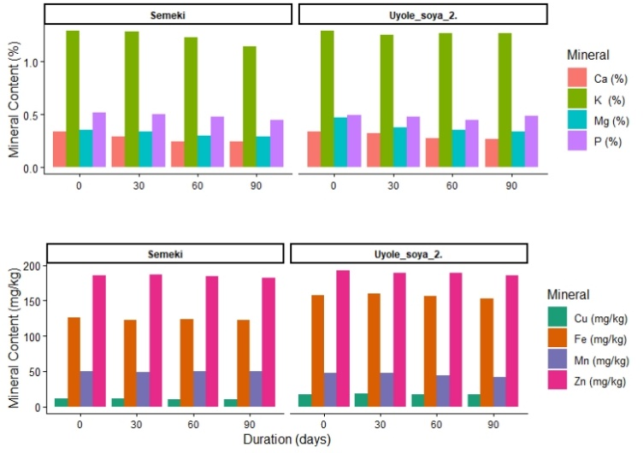
Furthermore, Anova results indicates that except for calcium and manganese, the remaining 6 minerals were significantly different (p<0.05) with the soybean variety. Post hoc result suggest that the concentration of the remaining minerals was significantly higher (p<0.01) in Uyole soya 2 compared to SC Semeki. The results from descriptive statistics (Figure 1) showed that Uyole soya 2 had a lower drop in mineral composition compared to SC Semeki. In SC Semeki, the highest decrease after storage was observed in calcium by 41% (0.196 ± 0.034% vs initial 0.335 ± 0.020%) while the lowest drop was with iron by 5% (119.42 ± 2.42 mg/kg vs initial 125.43 ± 0.142 mg/kg) and zinc by 4% (178.26 ± 0.034 mg/kg vs initial 184.92 ± 3.12 mg/kg) (Figure 1). While the highest decrease in uyole soya 2 was observed in calcium by 35% (0.206 ± 0.046% vs initial 0.318 ± 0.03%) and magnesium by 38% (0.289 ± 0.036% vs initial 0.463 ± 0.01%) and the lowest decrease was with copper by 4% (16.77 ± 0.71 mg/kg vs initial 17.54 ± 0 mg/kg) and iron by 3% (151.06± 2.52 mg/kg vs initial 156.36± 2.39 mg/kg.
3.2. Effect of Storage Temperature on the Mineral Composition
The results from regression analysis showed that storage temperature (X3) did not significantly (p>0.05) contribute to majority of the minerals except for zinc (1.816, p=0.016) (Table 1). In zinc, temperature had a significant negative effect, which indicates increase in temperature decreases zinc content by 1.816 mg/kg. This was further emphasized with Anova results, where all minerals had not been significantly affected with storage temperature except for zinc (p=0.0482) and iron (p=0.005). When comparing means, zinc and iron has significantly different (p<0.05) means which decreased from its initial level to 15°C and 25°C.
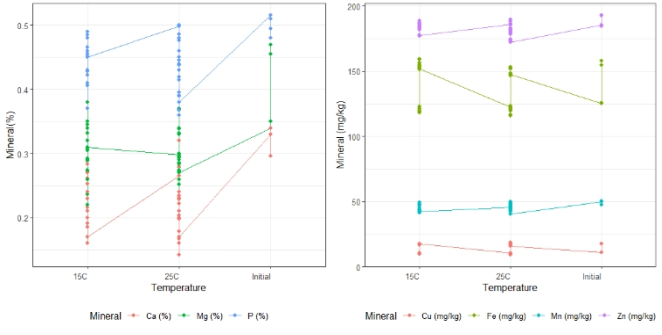
However, at the end of storage time, the level of decrease from all mineral compositions was highest when stored at 25°C (range 5% to 42% decrease) compared to 15°C (range 3% to 38% decrease). After 90 days of storage, the highest level of decrease was observed at 25°C with magnesium by 33% (0.27 ± 0.029% vs initial 0.404 ± 0.04%) and calcium 42% (0.195± 0.043% vs initial 0.335± 0.019%) (Figure 2). While the lowest decrease level was observed at 25°C with iron by 5% (134.51± 17.87 mg/kg vs initial 140.896± 17.91 mg/kg) and zinc by 7% (176.314± 2.25 mg/kg vs initial 188.83± 4.54 mg/kg). Similarly, the highest and lowest drop when stored at 15°C was observed in calcium by 38% (0.207± 0.028% vs initial 0.335± 0.019%) and iron by 3% (135.97± 18.5 mg/kg vs initial 140.896± 17.91 mg/kg) respectively (Figure 2).
3.3. Effect of Storage Material on the Mineral Composition
Storage material (X2) had significantly negative contribution (p<0.05) to the decrease in mineral composition excluding zinc (-0.804, p=0.273) and manganese (-0.622, p=0.111) (Table 1). This indicates that change in storage material resulted to decrease in mineral compositions. Where such change resulted to decrease in potassium (-0.054, p=0.005), magnesium (-0.022, p=0.003), calcium (-0.40, p<0.0001), iron (-1.842, p<0.001), copper (-0.234, p=0.035) and phosphorus (-0.030, p<0.0001) (Table 1). However, results from Anova suggests that all mineral composition were significantly affected (p<0.05) by storage materials. This was further highlighted by results from mean comparison where all mineral composition had significantly different (p<0.05) mean value at initial, when stored at PICS and polypropylene bags.
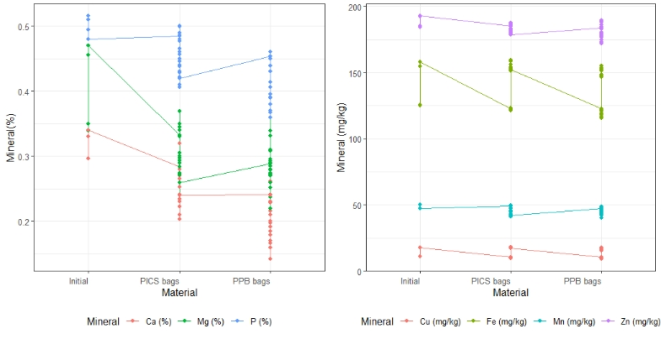
Results from descriptive statistics show that with minerals stored using PICS bags had higher mineral compositions compared to when stored using polypropylene bags (Figure 3). Whereas after 90 days of storage, the highest and lowest level of decrease in mineral compositions with the use of PICS bags was observed with Magnesium by 29% (0.286± 0.012% vs initial 0.404± 0.069%) and iron by 3% (137.1± 16.6 mg/kg vs initial 140.896± 17.9 mg/kg). When storing using polypropylene bags the highest and lowest level of decrease in mineral compositions was observed with calcium by 49% (0.165± 0.012% vs initial 0.33± 0.021%) and zinc by 7% (175.39± 2.44mg/kg vs initial 188.83± 4.54mg/kg). Thus, the use of polypropylene bags was more detrimental to the mineral composition compared to PICS bags.
3.4. Interaction Impact on the Mineral Composition
Significantly high level of variation (p<0.001) in mineral composition was explained by soybean variety (X1), storage material (X2), temperature (X3) and duration (X4) (Table 1). The most affected amongst the minerals was iron (99%), copper (98.7%) and calcium (82.8%). While the least variation was observed with potassium (46.8%) {Table 1}, lower R2 for potassium suggests other unmeasured factors influencing its variability. However, results from ANOVA shows that no significant difference on the effect of the interactions of three factors (variety, temperature and material) to the mineral compositions, except for material and temperature in copper (p=0.036) & phosphorus (p=0.00429), variety and temperature in iron (p=0.00988), and variety and material in potassium (p=0.000599) & magnesium (p=0.0209).
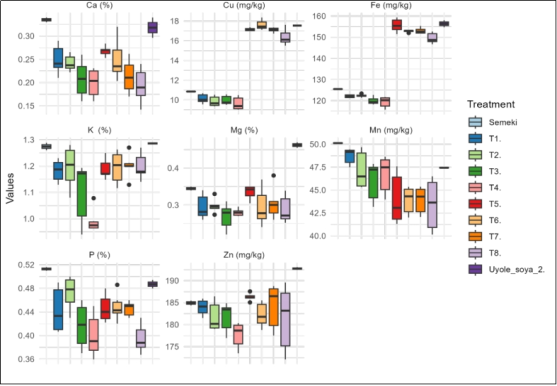
Results on the mean values at Figure 4 reveals that calcium (drop by 16% to 41%) and magnesium (15% to 38% decrease) had the highest drop in its composition compared to other minerals (Figure 4). However, in minerals like manganese, zinc, potassium, and iron the level of decrease remain constant and low (Figure 4). Furthermore, majority of the minerals in both varieties had their lowest level when stored using polypropylene bags at 25°C {T4 and T8} (Figure4). On the contrary, when using PICS bags most minerals retained their composition, though not all minerals maintained their composition when stored using PICS bags at 15°C {T1 and T5}.
These findings align with the study by Meena et al., , which reported that storage of seeds using hermetic material like vacuum bags in either cold or room temperature had the highest level of minerals (iron, copper, zinc, and manganese) compared to non-hermetic materials like gunny bags. Similarly, studies indicates that storage at 25°C accelerate decrease in minerals in comparison to storage at 10°C and 4°C within 360 days of storage .
4. Discussion
This profound varietal disparity in mineral retention, particularly the robust performance of Uyole Soya 2, suggests underlying genetic determinants that govern post-harvest physiological stability . The seed coat, being the primary interface with the storage environment, plays a crucial role. It was possible that Uyole soya 2 possessed a denser or more lignified seed coat structure, acting as a superior barrier against gas diffusion and moisture uptake . This would effectively decelerate the seed’s respiratory metabolism, a process that consumes stored reserves and release heat and moisture, thereby preserving internal mineral integrity . Furthermore, genetic differences in the chelation and compartmentalization of minerals within the seed could explain this trend . Minerals like iron stored within the stable protein complex of phytoferritin maybe less susceptible to leakage or chemical transformation than free ions . The significant negative coefficient for manganese in SC Semeki was particularly intriguing. Manganese is a vital cofactor for several enzymes, including Mn-superoxide dismutase (Mn-SOD), which is crucial for mitigating oxidative stress in seeds . A higher initial activity a turnover of such enzymes in SC Semeki during storage could lead to a more rapid apparent depletion of manganese, a hypothesis that warrants targeted biochemical investigation in future studies.
The observed sensitivity of zinc and iron to elevated temperature, as evident by their significant negative coefficients and Anova results, underscores their metabolic liability. These trace elements are fundamental cofactors for a plethora of enzymes involved in respiration (e.g., cytochromes for iron) and cellular repair mechanisms . Under the stress of higher temperatures (25°C), the accelerated metabolic rate likely increases the demand and turnover of these Metallo-enzymes, pools that are less extractable or detectable . This phenomenon moves beyond mere leaching and points to a biochemical transformation within the seed . Some regression and descriptive statistics results contradict Anova results as minerals like calcium show no statistical significance change with temperature, it still has a relatively high level of decrease with higher temperature. The general, though often statistically insignificant, trend of greater mineral loss at 25°C aligns with the fundamental Q10 principle of chemical kinetics, where reaction rates typically double for every 10°C increase in temperature . This principle governs not only the seed’s own respiration but also the kinetics of non-enzymatic oxidation reactions and the potential for microbial proliferation . While this 90-day study captured significant initial trends, it was conceivable that over a longer storage period, the cumulative effect of temperature would become statistically significant for a wider array of minerals, as the slow but persistent biochemical degradation compounds over time .
The stark contrast between PICS and polypropylene bags can be attributed to the controlled condition that restrict permeable Polypropylene bags, being gas-permeable allowing for continuous oxygen entrance, sustaining seed respiration and oxidative processes . This leads to a depletion of valuable compounds including organic acids that may help solubilize and retain certain minerals, and generates heat and water vapor that can create localized microclimates of high humidity, further accelerating degradation . In contrast, PICS bags leverage the grain’s own respiration to create an internal atmosphere rich in CO2 and depleting O2 . This suppressed aerobic environment drastically lowers the metabolic rate of the seeds, effectively putting them in a state of dormancy . Moreover, the low oxygen tension inhibits the growth of aerobic spoilage microorganisms and minimizes oxidative reactions that could alter the chemical speciation of minerals like iron from the ferrous to less bioavailable ferric form . The finding that even within PICS bags, minerals like magnesium with 29% decrease, highlights that while hermetic storage was superior, it does not completely halt physiological and biochemical changes; it merely drastically slows them down. This residual loss could be attributed to the initial metabolic adjustment phase and the activity of enzymes that remain functional even at low oxygen levels .
The high R2 values from iron and copper indicate that the factors explain almost all of the variability observed in these minerals. Conversely, the lower R2 for potassium implies that other unmeasured factors played a major role in its change. Usually, Potassium is highly soluble and can act as a mobile osmoticum within seed tissues, making its movement particularly sensitive to minor moisture gradients that may not have been fully captured by the experimental controls . The significant two-way interaction detected from mineral reveals nuanced relationships. For instance, the interaction between variety and materials for potassium and magnesium suggests that the genetic makeup of seed determines co-effectively it can utilize the protective benefits of a hermetic environment . The variety with higher leakage like SC Semeki might benefit disproportionately more from the oxygen barrier provided by PICS bags compared to a inherently more stable variety like uyole soya 2.
While this study provides valuable insights into the effects of storage conditions on soybean mineral composition, several limitations should be acknowledged. First, the storage duration was limited at 90 days, which, while sufficient to capture initial trends, was shorter than typical on-farm periods in Tanzania and other regions where longer storage of 6 to 18 months. Longer-term studies would help determine whether the observed trends continue or stabilize over time. Second, the experiment was conducted under controlled relative humidity (65% to 75%), whereas real-world storage often involves fluctuations in humidity, moisture content, and pest pressure which can accelerate mineral losses. Third, the samples were purposively collected from two farmers in a single region, which may not fully capture the genetic diversity or pre-storage environmental conditions experienced by these varieties across different agro-ecological zones. Fourth, while PICS bags showed clear advantages in mineral preservation, the study did not include an economic feasibility analysis, which is critical for farmers adoption. Finally, the analytical methods measured total mineral content but did not assess bioavailability, which is a determinant for nutritional impact. Future research should address these gaps through longer storage trails, multi-location sampling, cost-benefit assessment, and bioavailability studies to provide a more comprehensive basis for storage recommendations.
5. Conclusions and Recommendation
5.1. Conclusion
Mineral profile of soybean grains during storage was significantly affected by soybean variety, storage material, and temperature. Whereas the highest level of variation in mineral composition was observed in iron (99%), copper (98.7%) and calcium (82.8%), while the least variation was observed with potassium (46.8%). While, general results indicate that the highest decrease in mineral composition with all factors and their interaction was observed in calcium (maximum decrease 49%) and the lowest in iron (maximum decrease 5%).
On soybean variety, the level of mineral composition during storage was significantly higher with uyole soya 2 (3% to 38% decrease) compared to SC Semeki (4% to 41% decrease). The changes varied with varieties due to difference in the level of sensitivity to storage conditions. However, storage temperature significantly affected only zinc and iron. Storage was more detrimental at 25°C than at 15°C. With storage at 25°C (5% to 42% decrease) was higher compared to 15°C (3% to 38% decrease). In contrast, all mineral composition were significantly affected with storage materials and their mean values varied significantly from initial with the use of PICS (3% to 29% decrease) and polypropylene bags (7% to 49% decrease). The variation in mineral profile was attributed to physiological and biochemical processes in the grains. These processes were accelerated with high temperature and the use of non-hermetic material (polypropylene bags).
5.2 Recommendation
The findings from this study provides actionable guidance for preserving soybean nutrition during storage. Key recommendations include; using hermetic storage materials particularly PICS bags instead of polypropylene bags to significantly reduce mineral loss. Storage of soybean in cooler area to slow mineral losses. Finally, increasing farmers education on the significance of proper storage practices in maintaining nutritional quality and ultimate increase in crop value.
Abbreviations

PICS

Polypropylene and Purdue Improved Crop Storage

PPB

Polypropylene Bags

IITA

International Institute of Tropical Agriculture

SUA

Sokoine University of Agriculture

Acknowledgments
The authors would like to express their sincere gratitude to laboratory technical team at IITA namely Audifasi Shirima, Mwantum Omary, Godlisten Marandu, Linda Clara Leonard and Stadius Stephen for their invaluable contribution to the completion of this study.
Author Contributions
Rabia Msuya: Conceptualization, Data curation, Formal Analysis, Methodology.
Frederick Baijukya: Conceptualization, Funding acquisition, Supervision, Project administration, Writing- review and editing.
Jamal Kussaga: Conceptualization, Supervision, Writing – review & editing
Lucy Chove: Conceptualization, Supervision, Writing – review & editing.
Funding
This work is supported by International Institute of Tropical Agriculture of Tanzania (IITA).
Data Availability Statement
The data supporting the outcome of this research work has been reported in this manuscript.
Conflicts of Interest
The authors declare no conflicts of interest.
Appendix
Figure 1. The changes in mineral composition/ content in two varieties (SC Semeki and uyole soya 2) over different durations. The panel shows percentage content of minerals (Ca, K, Mg, P) and lower panel shows minerals in mg/kg (Cu, Fe, Mn, Zn) across the same durations.
Figure 2. The effect of different temperatures (15°C and 25°C) on mineral composition. The panel shows the percentage content of minerals (Ca, K, Mg, P), and the lower panel shows minerals in mg/kg (Cu, Fe, Mn, Zn) across different temperatures and control/initial conditions.
Figure 3. The effect of different storage materials on mineral composition. The panel shows percentage content of minerals (Ca, K, Mg, P) and lower panel shows minerals in mg/kg (Cu, Fe, Mn, Zn) across different temperature and control/ initial. Whereas, PPB bags mean polypropylene bags and PICS bags mean Purdue Improved Crop Storage bags.
Figure 4. Effect of the interaction of soybean variety, storage temperature and material on its mineral composition. Whereas Semeki and uyole soya 2 represent sample varieties before storage, T1 means SC Semeki+ PICS bags +15°C, T2 means SC Semeki+ PICS bags +25°C, T3 means SC Semeki+ Polypropylene bags +15°C, T4 means SC Semeki+ Polypropylene bags +25°C, T5 means Uyole soya 2+ PICS bags +15°C, T5 means Uyole soya 2+ PICS bags +15°C, T6 means Uyole soya 2+ PICS bags +25°C, T7 means Uyole soya 2+ Polypropylene bags +15°C, and T8 means Uyole soya 2+ Polypropylene bags +25°C.
Table 1. Relationship between soybean variety and storage condition on its mineral composition.

Mineral

Equation

R square (R2)

p-Value

K (%)

Y=1.2 + 0.073X1 – 0.054X2 - 0.011X3 -0.001X4

0.468

<0.001

Ca (%)

Y=0.338 +0.05 X1 – 0.04X2 – 0.005X3 -0.001X4

0.828

<0.001

Mg (%)

Y= 0.359+0.027X1 –0.022 X2 –0.013X3 -0.001X4

0.682

<0.001

P (%)

Y= 0.52- 0.001X1 – 0.030X2 -0.001X4

0.619

<0.001

Zn (mg/kg)

Y= 187.68+2.699 X1 –0.804 X2-1.816X3 -.094X4

0.651

<0.001

Mn (mg/kg)

Y=54.341 -3.306 X1 –0.622 X2 -0.059X3 -0.049X4

0.713

<0.001

Fe (mg/kg)

Y= 95.136+31.771X1 -1.842X2 -0.698X3-0.039X4

0.990

<0.001

Cu (mg/kg)

Y= 3.871+ 7.134X1 – 0.234X2– 0.033X3 -0.012X4

0.987

<0.001

* Soybean variety (X1), storage material (X2), temperature (X3) and duration (X4).
References
[1] Naresh, S., Ong, M. K., Thiagarajah, K., Muttiah, N. B. S. J., Kunasundari, B., & Lye, H. S. (2019). Engineered Soybean-Based Beverages and Their Impact on Human Health. Non-Alcoholic Beverages: Volume 6. The Science of Beverages, 329–361.
[2] Etiosa, O., Chika, N., & Benedicta, A. (2018). Mineral and Proximate Composition of Soya Bean. Asian Journal of Physical and Chemical Sciences, 4(3), 1–6.
[3] Food and Agriculture Organization of the, & Organization (FAO), W. H. (WHO). (2001). Human vitamin and mineral requirements. Human Vitamin and Mineral Requirements, 249–269.
[4] Godswill, A. G., Somtochukwu, I. V., Ikechukwu, A. O., & Kate, E. C. (2020). Health Benefits of Micronutrients (Vitamins and Minerals) and their Associated Deficiency Diseases: A Systematic Review. International Journal of Food Sciences, 3(1), 1–32.
[5] Kibar, H., Sönmez, F., & Temel, S. (2021). Effect of storage conditions on nutritional quality and color characteristics of quinoa varieties. Journal of Stored Products Research, 91.
[6] Meena M, K., Chetti B, M., & Nawalagatti, C.. (2017). Seed Physiological and Biochemical Parameters of Soybean (Glycine max) As Influenced by Different Packaging Materials and Storage Conditions. Int. J. Pure App. Biosci, 5(1), 864–875.
[7] Kayişoğlu, S., & Demirci, M. (2006). Effects of storage time and condition on mineral contents of grape pekmez produced by vacuum and classical methods. Journal of Tekirdag Agricultural Faculty, 3(1), 7.
[8] Codină, G. G., Ursachi, F., Dabija, A., Paiu, S., Rumeus, I., Leatamborg, S., Lupascu, G., Stroe, S. G., & Ghendov-Mosanu, A. (2025). Physicochemical Properties, Polyphenol and Mineral Composition of Different Triticale Varieties Cultivated in the Republic of Moldova. Molecules, 30(6).
[9] Liu, J., Qin, W., Wu, H., Yang, C., Deng, J., Iqbal, N., Liu, W., Du, J., Shu, K., Yang, F., Wang, X., Yong, T., & Yang, W. (2017). Metabolism variation and better storability of dark- versus light-coloured soybean (Glycine max L. Merr) seeds. Food Chemistry, 223, 104–113.
[10] Kim, J. J., & Kim, S. H. (2005). Changing soybean isoflavone composition and concentrations under two different storage conditions over three years. 38, 435–444.
[11] Šimić, B., Vratarić, M., Sudarić, A., Krizmanić, M., & Andrić, L. (2004). Effect Of Storage Longevity Under Different Storage Conditions On Seed Vigor And Oil Content In Maize, Soybean And Sunflower. 1–6.
[12] Twilumba, J. K., A. K. Ahmad, & Shausi, G. L. (2020). Factors Influencing Use of Improved Postharvest Storage Technologies among Small Scale Maize Farmers: a Case of Kilolo district, Tanzania. Tanzania Journal of Agricultural Sciences, 19(1), 11–21.
[13] Kaseka, F. (2018). Effectiveness Of Selected Food Storage Technologies In Reduction of Post-Harvest Losses of Beans In Selected Households of Kilosa District, Tanzania.
[14] Sharma, P., Aggarwal, P., & Kaur, A. (2017). Biofortification: A new approach to eradicate hidden hunger. Food Reviews International, 33(1), 1-21.
[15] Kuchlan, M. K., Dadlani, M., & Samuel, D. V. K. (2010). Seed coat properties and longevity of soybean seeds. Journal of New seeds, 11(3), 239-249.
[16] Brinch-Pedersen, H., Borg, S., Tauris, B., & Holm, P. B. (2007). Molecular genetic approaches to increasing mineral availability and vitamin content of cereals. Journal of Cereal Science, 46(3), 308-326.
[17] Zielińska-Dawidziak, M. (2015). Plant ferritin—a source of iron to prevent its deficiency. Nutrients, 7(2), 1184-1201.
[18] Alscher, R. G., Erturk, N., & Heath, L. S. (2002). Role of superoxide dismutases (SODs) in controlling oxidative stress in plants. Journal of experimental botany, 53(372), 1331-1341.
[19] Zhang, Y., & Gladyshev, V. N. (2009). Comparative genomics of trace elements: emerging dynamic view of trace element utilization and function. Chemical reviews, 109(10), 4828-4861.
[20] Simčič, T., Jesenšek, D., & Brancelj, A. (2015). Effects of increased temperature on metabolic activity and oxidative stress in the first life stages of marble trout (Salmo marmoratus). Fish Physiology and Biochemistry, 41(4), 1005-1014.
[21] Rousseau, S., Celus, M., Duijsens, D., Gwala, S., Hendrickx, M., & Grauwet, T. (2020). The impact of postharvest storage and cooking time on mineral bioaccessibility in common beans. Food & Function, 11(9), 7584-7595.
[22] Schipper, L. A., Hobbs, J. K., Rutledge, S., & Arcus, V. L. (2014). Thermodynamic theory explains the temperature optima of soil microbial processes and high Q10 values at low temperatures. Global change biology, 20(11), 3578-3586.
[23] Ali, A. S., & Elozeiri, A. A. (2017). Metabolic processes during seed germination. Advances in seed biology, 2017, 141-166.
[24] Krumbein, W. E. (1988). Microbial interactions with mineral materials. In Biodeterioration 7 (pp. 78-100). Dordrecht: Springer Netherlands.
[25] Aboagye, D., Darko, J. O., & Banadda, N. (2017). Comparative study of hermetic and non-hermetic storage on quality of cowpea in Ghana. Chemical and Biological Technologies in Agriculture, 4(1), 1–6.
[26] Ziegler, V., Paraginski, R. T., & Ferreira, C. D. (2021). Grain storage systems and effects of moisture, temperature and time on grain quality - A review. In Journal of Stored Products Research (Vol. 91). Elsevier Ltd.
[27] Li, S., Li, C., Gao, X., Zhu, M., Li, H., & Wang, X. (2025). Biomineralization Mediated by Iron-Oxidizing Microorganisms: Implication for the Immobilization and Transformation of Heavy Metals in AMD. Minerals (2075-163X), 15(8).
[28] Gajdanowicz, P., Michard, E., Sandmann, M., Rocha, M., Corrêa, L. G. G., Ramírez-Aguilar, S. J.,... & Dreyer, I. (2011). Potassium (K+) gradients serve as a mobile energy source in plant vascular tissues. Proceedings of the National Academy of Sciences, 108(2), 864-869.
Cite This Article
  • APA Style

    Msuya, R., Baijukya, F., Kussaga, J., Chove, L. (2026). Effect of Storage Conditions and Soybean Variety on Mineral Composition of Soybean Grains. Journal of Food and Nutrition Sciences, 14(1), 34-43. https://doi.org/10.11648/j.jfns.20261401.13

    Copy | Download

    ACS Style

    Msuya, R.; Baijukya, F.; Kussaga, J.; Chove, L. Effect of Storage Conditions and Soybean Variety on Mineral Composition of Soybean Grains. J. Food Nutr. Sci. 2026, 14(1), 34-43. doi: 10.11648/j.jfns.20261401.13

    Copy | Download

    AMA Style

    Msuya R, Baijukya F, Kussaga J, Chove L. Effect of Storage Conditions and Soybean Variety on Mineral Composition of Soybean Grains. J Food Nutr Sci. 2026;14(1):34-43. doi: 10.11648/j.jfns.20261401.13

    Copy | Download

  • @article{10.11648/j.jfns.20261401.13,
      author = {Rabia Msuya and Frederick Baijukya and Jamal Kussaga and Lucy Chove},
      title = {Effect of Storage Conditions and Soybean Variety on Mineral Composition of Soybean Grains},
      journal = {Journal of Food and Nutrition Sciences},
      volume = {14},
      number = {1},
      pages = {34-43},
      doi = {10.11648/j.jfns.20261401.13},
      url = {https://doi.org/10.11648/j.jfns.20261401.13},
      eprint = {https://article.sciencepublishinggroup.com/pdf/10.11648.j.jfns.20261401.13},
      abstract = {Post-harvest losses are largely driven by insufficient storage methods, which compromise grain quality and nutritional value, exacerbating food insecurity and economic waste. In Tanzania, most storage-related losses are attributed to the use of inadequate storage materials and practices in general. The study aims to determine the influence of soybean variety (SC Semeki and Uyole soya 2), storage temperature (15°C and 25°C) and material (polypropylene and Purdue Improved Crop Storage (PICS) bags and polypropylene bags) on mineral profile (Calcium, potassium, magnesium, manganese, phosphorus, iron, copper and zinc) for period of 3 months. The results revealed that the highest level of decrease in varieties was observed with SC Semeki (maximum decrease 49%) compared to Uyole soya 2 (38%). With storage material, polypropylene bags (49%) had higher decrease compared to PICS bags (maximum decrease 29%). While, with temperature 25°C (maximum decrease 42%) had higher decrease in comparison to 15°C (maximum decrease 38%). In addition, the relationship between factors and mineral profile (R square) revealed highest variation in iron (99%), copper (98.7%) and calcium (82.8%), while the least with potassium (46.8%). However, general findings in mineral composition during storage showed that the least decrease was with iron (maximum decrease 5%) and the highest was with calcium (maximum decrease 49%). These findings underscore the efficiency of PICS bags and low temperature storage while acknowledging the variation in sensitivity of mineral profile with soybean variety.},
     year = {2026}
    }
    

    Copy | Download

  • TY  - JOUR
    T1  - Effect of Storage Conditions and Soybean Variety on Mineral Composition of Soybean Grains
    AU  - Rabia Msuya
    AU  - Frederick Baijukya
    AU  - Jamal Kussaga
    AU  - Lucy Chove
    Y1  - 2026/01/30
    PY  - 2026
    N1  - https://doi.org/10.11648/j.jfns.20261401.13
    DO  - 10.11648/j.jfns.20261401.13
    T2  - Journal of Food and Nutrition Sciences
    JF  - Journal of Food and Nutrition Sciences
    JO  - Journal of Food and Nutrition Sciences
    SP  - 34
    EP  - 43
    PB  - Science Publishing Group
    SN  - 2330-7293
    UR  - https://doi.org/10.11648/j.jfns.20261401.13
    AB  - Post-harvest losses are largely driven by insufficient storage methods, which compromise grain quality and nutritional value, exacerbating food insecurity and economic waste. In Tanzania, most storage-related losses are attributed to the use of inadequate storage materials and practices in general. The study aims to determine the influence of soybean variety (SC Semeki and Uyole soya 2), storage temperature (15°C and 25°C) and material (polypropylene and Purdue Improved Crop Storage (PICS) bags and polypropylene bags) on mineral profile (Calcium, potassium, magnesium, manganese, phosphorus, iron, copper and zinc) for period of 3 months. The results revealed that the highest level of decrease in varieties was observed with SC Semeki (maximum decrease 49%) compared to Uyole soya 2 (38%). With storage material, polypropylene bags (49%) had higher decrease compared to PICS bags (maximum decrease 29%). While, with temperature 25°C (maximum decrease 42%) had higher decrease in comparison to 15°C (maximum decrease 38%). In addition, the relationship between factors and mineral profile (R square) revealed highest variation in iron (99%), copper (98.7%) and calcium (82.8%), while the least with potassium (46.8%). However, general findings in mineral composition during storage showed that the least decrease was with iron (maximum decrease 5%) and the highest was with calcium (maximum decrease 49%). These findings underscore the efficiency of PICS bags and low temperature storage while acknowledging the variation in sensitivity of mineral profile with soybean variety.
    VL  - 14
    IS  - 1
    ER  - 

    Copy | Download

Author Information
  • Department of Food Science and Agro-processing, Sokoine University of Agriculture, Morogoro, Tanzania
    Biography: Rabia Msuya is a Masters Student at Sokoine University of Agriculture, Food Science and Agro-processing Department. She completed her Bachelor degree in Animal Science from Sokoine University of Agriculture in 2021. She has participated in a research fellowship program at International Institute of Tropical Agriculture in recent years.

  • Department of Natural Resources, International Institute of Tropical Agriculture, Dar es Salaam, Tanzania

  • Department of Food Science and Agro-processing, Sokoine University of Agriculture, Morogoro, Tanzania

  • Department of Food Science and Agro-processing, Sokoine University of Agriculture, Morogoro, Tanzania

  • Abstract
  • Keywords
  • Document Sections

    1. 1. Introduction
    2. 2. Materials and Methods
    3. 3. Results
    4. 4. Discussion
    5. 5. Conclusions and Recommendation
    Show Full Outline
  • Abbreviations
  • Acknowledgments
  • Author Contributions
  • Funding
  • Data Availability Statement
  • Conflicts of Interest
  • Appendix
  • References
  • Cite This Article
  • Author Information