Research Article | | Peer-Reviewed

Firms Characteristics, Institutional Factors and Corporate Sustainability Disclosure in Healthcare Companies in Nigeria

Received: 11 December 2025     Accepted: 24 December 2025     Published: 2 February 2026
Views:       Downloads:
Abstract

Considering the importance of sustainable activities of corporations in the 21st century and environmental friendly accounting practice vis-à-vis economic growth, some factors impact on the Phenomena-Corporate Sustainability Disclosure. This study sought to empirically assess the moderating effect of these institutional factors on the relationship between firm characteristics and corporate sustainability disclosure for 10 years (2011-2020). This study relied extensively on secondary source and the data was specifically gathered from the annual reports of the listed health companies in Nigeria under study. The regression output on the relationship between firm characteristics and CSD (MODEL1) revealed that firm size and performance alone are relatively not enough to determine CSD, evidenced from R2 of 57%. The regression output of the effect of firm characteristics and institutional factor put together on CSD (MODEL 2) revealed an R2 of 92%, which implies that firm size, performance, board size and institutional factors together are very good determinants of CSD, evidenced from significant p-value of 0.000 which is less than significance value of 0.05. The effect of interaction between firm characteristics and institutional factor on CSD (MODEL 3) showed an R2 of 93%. This means that the interaction variable could explain up to 93% variation in CSD. This is further substantiated by a significant p-value of 0.000 which is less that significance value of 0.05. In conclusion, institutional factor moderates the relationship between firm characteristics and CSD. Therefore, policy makers in Nigeria related to sustainability development issues like NESREA should consider the importance of institutional factors in the study and introduce laws that mandate CSD like other part of the countries.

Published in Journal of Finance and Accounting (Volume 14, Issue 1)
DOI 10.11648/j.jfa.20261401.14
Page(s) 53-61
Creative Commons

This is an Open Access article, distributed under the terms of the Creative Commons Attribution 4.0 International License (http://creativecommons.org/licenses/by/4.0/), which permits unrestricted use, distribution and reproduction in any medium or format, provided the original work is properly cited.

Copyright

Copyright © The Author(s), 2026. Published by Science Publishing Group

Keywords

Firm Characteristics, Institutional Factors, Corporate Sustainability Disclosure, Board Size, Healthcare Sector

1. Introduction
The relevance of sustainability reporting for the clarity it provides on the value creation, future oriented perspective and its emphasis on measurable performance cannot be undermined, especially with the recent move for mandatory reporting in the financial annual report . Its reporting has always been guided by global reporting initiative GRI, an institutionalized framework because of its worldwide use. Researchers have always relied on this framework when carrying out their studies. In the same vein, Nigerian in its effort has developed its sustainability reporting guideline for companies to comply deduced from GRI in 2018. However, the application of the Nigerian sustainability guideline is still uncommon. Furthermore, sustainability disclosure practice is an important dimension of accounting information and has cut across various industries of the economy including Oil and Gas, Energy, Telecommunication, ICT, Insurance, hospitality, Manufacturing, and Banking Service Sectors among others. Despite some attempts sustainability reporting is still not very prevalent in the health sector across the globe and particularly in Nigeria . This is further substantiated by the statement “banking and oil and gas sector take sustainability reporting more seriously than any other sector in Nigeria .
In addition, studies have focused on linear relationships in areas such as firms’ performance and corporate disclosures, determinants of corporate sustainability, corporate sustainability practices, factors influencing corporate disclosure, investigation of the association between firms characteristics and CSD in the financial sector, environmental and social disclosure, and firms characteristics as well as organizational factors influencing corporate disclosure . But these investigations have not yielded steady outcomes i.e. mixed, suspected to be due to disparity in the laws and policies of the nationals of each country as well as that of companies’ understudy. Some studies showed a significant positive impact while immaterial results were found in other studies and. Therefore, in order to help explain the link as well as strengthen the relationship between firm characteristics and CSD, a moderating variable (institutional factor) was introduced. Literature has shown that these institutional factors identified have been used to moderate the relationships in the past .
Furthermore, Institutional theory has also affirmed that the practice of a company is predicted by other factors outside management choice including the disclosure culture of companies. In addition, studies sighted so far have given little attention to the role of moderators in the relationship between variables of the study .
On this background this study intends to assess the effect of institutional factors on the relationship between firm characteristics and corporate sustainability disclosure in the health sector of Nigeria. The study seeks to answer the question “does institutional factors moderate the relationship between firms characteristic and corporate sustainability disclosure of healthcare sector of Nigeria”. And hypothesized that institutional factors have no significant effect on the relationship between firms characteristic and corporate sustainability disclosure of healthcare sector of Nigeria.
2. Literature Review
Firm Characteristics
A Firm is a business organization such as a corporation, partnership, or sole trader that sell goods or service to make a profit or gain. Typical attributes or features noticeably about a business are what distinguish it from other kinds of businesses. The term firm is used interchangeably with the words Company, organisation, business, and or enterprise among others. The common attributes of business organizations that differentiate them from one another include but are not limited to the size of the firm, number of employees, performance capital structure, membership or type of industry, ownership, firm age, etc.
Corporate size
Corporate size also called firm size is generally defined as measure of how large a company is often based on quantitative indicators such as total asset, total sales, number of employees etc.
In empirical research, corporate size is commonly measure as the natural log of total asset to reduce the skewness and normalize the data distribution .
Profitability
Profitability is the company’s ability to earn or generate profit in relation to its sales. Total assets or own capital. Mathematically it is measured as a ratio of Profit=sales/sales/totalasset/equity .
CSD
Sustainability reporting includes environmental aspects (such as raw materials, energy, water, biodiversity, air, suppliers, products and services, and transportation) as well as social aspects (such as labor practices, human rights, customer health and safety, respect for privacy, bribery, and corruption, public policy competition, pricing, and corporate citizenship) .
The OECD Guidelines for Multinational Enterprises comprise 10 elements: concepts and principles, general policies, disclosures, employment and labor relations, environment, combating bribery, consumer interests, science and technology, competition, and taxation. This portrays the need for disclosures including corporate sustainability.
Institutional factors
The moderating variable can be defined as a third variable that affects the strength of the relationship between the independent and dependent variables of this study. This is aimed at bringing out the strengths or weaknesses of the variable. In the context of this study institutional factor is the moderator introduced to observe if any changes that may occur after its introduction. the study hypothesized the moderating effect of institutional factors (Nigerian Sustainability Guideline, Sustainability Committee Presence, and corporate membership in advocacy groups) on the association between Firm characteristics and corporate sustainability disclosure of healthcare sector companies in Nigeria.
Conceptual Framework
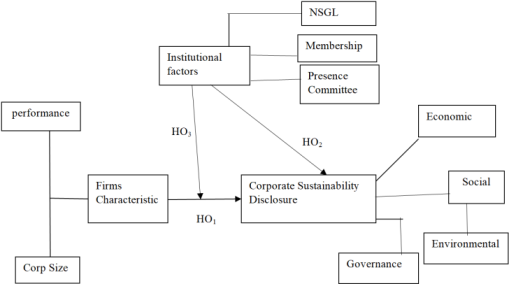
The diagram below demonstrates the conceptual framework for the connection between firm characteristics and corporate sustainability disclosure to be moderated by institutional factors. It is used to predict the relationship empirically between firm characteristics, institutional factors and CSD underpinned by institutional theory.
Source: Adapted from work of .

Download: Download full-size image

Figure 1. Moderating effect of IF on the relationship between FC and CSD.
The independent variable represents the factor that is observed in the study. In this context, it is firm characteristics. While the dependent variables represent the outcome or response that is measured. In this case, it is CSD. Moderator variable which institutional factor was introduced to see if the independent variable i.e. firm characteristics influences the dependent variables i.e. rate of disclosure under a different condition.
Theoretical Framework
According to institutional theory was first founded by Selznick in 1957. It is based on the assumption that organisation do not act only based on efficiency or profit motive but they also behave in way that conform to social rule, norms expectation and pressure in their work environment in order to gain legitimacy. It strengthens the dependent association between an organisation and environment. On the other hand, companies and their practices are molded by business related i.e. institutional factors in the corporate environment and one of these practices is sustainability. Sustainability practice has recently gained relevance especially in stakeholders’ decision making as it covers social, environmental and governance concern in addition to economic. Institutional theory lingers on answering question on institutional factors because it mainly concentrated on customs and obligations, such as bylaws, rules, cultural demands, social comparison processes, or belief systems. To safeguard both present and future, legitimate compliance with institutional factors, for proper accountability, sustainability, and disclosure, the institutional theory will be accepted to pilot this research.
Empirical Studies
Khan et al (2018) carried out a comparative analysis of institutional impacts on corporate social responsibility in New Zealand and Pakistan using quantitative content analyses as a method for the study. The results highlighted that Pakistani companies disclose more about CSR than those analysed from New Zealand. This result is attributed to the recently developed corporate governance guidelines by the Securities and Exchange Commission of Pakistan. The informal national institutions in both countries also play a vital role in the disparity of disclosures. This is not to suggest that New Zealand-listed companies lag behind those in Pakistan concerning their contribution to CSR initiatives, simply that the disclosure levels between the two favour those companies in Pakistan. In this study, the institutional factor was utilized as a moderating variable to see whether it affects CSD or not. It was found that CSR is shaped differently by institutional factors such as legal, financial, political, culture, values, norms, and beliefs in the two countries. The study did not justify why there were 8 companies listed on both stock exchanges.
Nwobu (2017) in her doctoral dissertation studied Determinants of Corporate Sustainability Reporting in selected companies in Nigeria from 2010 to 2014. Company attributes, external institutional factors, and internal organizational process factors were found to be significant determinants of corporate sustainability reporting in the selected companies. The study also revealed that there was a statistically significant variation in sustainability reporting from the year 2010 to 2014 in the sample companies. The study further revealed that the companies were influenced by the disclosure guidelines of the Nigerian Stock Exchange regulator (SEC), the banking sector regulator introduced in 2011 and 2012 respectively. Results of the Fixed Effects model showed that the Securities and Exchange Commission (SEC) code of corporate governance, Central Bank of Nigeria Sustainability Banking Principles, accounting firm affiliation, and sustainability reporting. Also, stakeholder engagement had a significant positive relationship with sustainability reporting. From these findings, it can be concluded that stakeholder engagement is crucial for sustainability reporting.
Mahmood et al (2018) examined the impact of corporate governance (CG) on economic, social, and environmental sustainability disclosures of the top 100 companies listed on the Pakistan Stock Exchange (PSE) for the period ranging from 2012 to 2015. Data were collected from both primary and secondary sources. Overall results indicate that corporate governance elements enhance sustainability disclosures. Precisely, a large board size consisting of a female director and a CSR committee (CSRC) is better able to check and control management decisions regarding sustainability issues and result in better sustainability disclosure.
In a related development, a doctoral dissertation carried out at the University of Huddersfield by studied Institutional Environment, Corporate Governance, and Corporate Social Responsibility Disclosure (comparatively) in Thailand, Singapore, Malaysia, Indonesia, Philippines, and Vietnam. The Analysis of Variance and Regression technique was utilized in the study. Firstly, empirical findings of CSRD levels across the countries showed that Thailand has the highest level of disclosure, followed by Indonesia, Malaysia, Singapore, Philippines, and finally Vietnam. There were significant differences between the extent of CSRD of the two countries with the highest disclosure (Thailand and Indonesia) and the lowest disclosure group (Philippines and Vietnam). The findings are interesting in the sense that the levels of CSRD do not reflect the stages of economic development, and therefore, the differences in CSRD levels could be attributable to the impact of other institutional factors. Secondly, in relation to internal determinants and based on the existing literature and the context of Southeast Asia, six corporate governance practices were identified to examine the impact of corporate governance on CSRD. The results of OLS regression supported the negative impact of block ownership and the positive impact of board size as well as the presence of the CSR committee on CSRD. Contrary to the theoretical and empirical expectations, board gender diversity was found to have a significantly negative relationship with CSRD, and board independence had no impact on CSRD. These differences could be explained by the context of the study where the presentation of women onboard is very low and independent directors might not be wholly independent. The effect of six institutional factors representing the three pillars, regulative (legal origin and mandatory disclosure), cultural-cognitive (uncertainty avoidance and masculinity cultural dimensions), and normative (the adoption of GRI standard and membership of CSR-related associations), were evaluated in this study. The empirical results indicate that mandatory disclosure, uncertainty avoidance dimension, and the adoption of GRI standards have a positive impact on CSRD, while the masculinity dimension has a negative relationship with CSRD. The findings imply that the institutional environment influences CSRD through all three pillars with some institutional factors having a greater impact than others.
In the same vein, studied the key determinants of effective corporate sustainability reporting practices by Malaysian government-linked companies using an E-Survey in 2011. Both Ontological and Epistemological philosophical paradigms were used as a guide for the study. It was found that, effective sustainability reporting efforts of the Government promote reporting and the ability of companies to do so. The study further reveals that the critical success factors for effective sustainability reporting practice by multinational listed Malaysian Government-Linked Companies (GLCs) require Government encouragement and incentives. The literature justifies the use of the institutional factor variables in this study.
Jibril et al (2022) examined the impact of corporate board gender on energy disclosure with the moderating effect of institutional strength by the listed firms in Nigeria. Data was collected from annual reports of non- financial listed companies on NS limited and data analyzed using random and fixed effect regression. The finding reveals that gender board is significantly related to energy disclosure. Institutional strength was found to have an insignificant effect on the relationship between board gender and energy.
Zangina and Baba (2025) examined the moderating effect of profitability on the relationship between firm attribute and sustainability disclosure of consumer goods companies in Nigeria. The study employed hierarchical multiple regression to assess the effect on the secondary data obtained. Outcome of the study revealed insignificant and negative effect of firm attribute on sustainability disclosure. Findings also revealed that introduction of profitability greatly enhances the relationship between firm attribute and sustainability disclosure. It was recommended that profitability should be integrated for sustainability reporting among consumer company in Nigeria.
3. Methodology
Research design adopted is the combination of both qualitative and quantitative designs. Qualitative design i.e. descriptive statistic was used because numerical data are to described in order to answer the research question, including mean, standard, minimum and maximum while quantitative i.e. inferential statistic was used because it allows for test of hypothesis. Hierarchical moderated multiple regression analysis was used to test the hypothesis to establish the connection among the moderator, explained and explanatory variables as used in similar study of . The study sampled 7 healthcare companies listed on the Nigerian exchange group for period of 10 years from 2011-2020, selected based on criteria adapted in work of . Panel data was extracted from the annual report of the selected companies.
Table 1. Variables and Measurement.

Variables

Apriori sign

Measurement

Source

Independent variables

+/-

Natural log of total assets

Muigai and Muriithi 2017.

Corporate size

+/-

Measured as the ratio of profit after tax total to asset

Profitability

Dependent variable

OCSD

Nwobu 2017

CSD

+/-

ECSD

Moderating variables

SGL

+/-

It was scored as “1” if companies comply with guideline and “0” otherwise, then averaged between observed and expected to obtain the outcome ratio utilized in the study

Nwobu, 2017; Tran, 2017.

MEM

+/-

It was scored as “1” if companies belong to any of the mentioned groups and “0” if otherwise, then averaged between observed and expected to obtain the outcome ratio utilized in the study.

Nwobu, 2017; Tran, 2017.

PSC

+/-

It was scored “1” where a company has a committee on sustainability and “0” where it does not have a sustainability committee. The observed are then averaged against the expected to obtain the outcome ratio utilized in the study

Mahmood et-al., 2018; Tran, 2017.

Control variables Bsize

+/-

it is measured as the number of members on the board

Muchemwa 2016, Isik and Ince 2016)

Source: Author’s design 2025.
The model can be specified below
TCSDit=β01SIZit2PERit+BSIZ+ε(1)
TCSDit=β01SIZit1PERit2IFitt+BSIE+ε(2)
TCSDit=β01β1SIZit1PERit+BSIZE+β2IFit3FCit*IFit+ε.(3)
Where;
β0, β2 is the regression model coefficients of the independent variables
x 0, x 3 is the parameters of the explanatory variables
ε is the random error term
it particular independent variable at a given period or point in time
SIZ= firm characteristic abbreviation for firm Size
PER= firm characteristic abbreviation for Performance
FC= Average of firm size and ROA
TCSD = Average of Total Corporate Sustainability Disclosure
NSGL= Nigerian sustainability guideline
MEM= Membership with INDC/ advocacy group
PSC= presence of sustainability committee
IF= Institutional Factors (average of NSGL, PSC, and MEM)
BSIZ= Board Size
4. Results and Discussion
The data collected were subjected to preliminary and advanced analysis. The preliminary analysis involves the use of tables and narrations to explain the data collected. While advanced analysis involves the use of both descriptive (mean, standard deviation, minimum and maximum) and inferential statistics (correlation analysis, regression analysis) respectively. In addition, some diagnostic tests such as multicollinearity, normality, heteroscedasticity were equally conducted to ensure the model is valid, reliable and statistically sound and as to meet up with assumption of using regression analysis in a study .
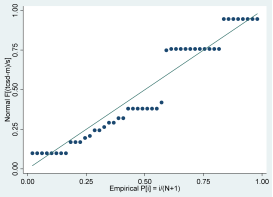
The diagnostic result showed the absence of multicollinearity evidenced by VIF of 1.36 which is less than 10 indicating no harm. Normality test result also showed no significant deviation from the line of best fit as depicted in Figure 2. This indicates good fit and absence of outliers. skewness and kurtosis test of variable indicate that none of the variables are highly skewed. And the result for heteroscedasticity test revealed that data is homoscedastic, evidenced by the insignificant p-values of 0.8997 and 0.3011 for models I and 2, significant at 5% level.
Figure 2. Probability P-Plot for Normality test of the dependent Variable.
Test of hypothesis.
Table 2. Hierarchical Regression Results of the Models.

VARIABLES

(1)

(2)

(3)

Basic model

Basic model

Interaction model

BS

0.1094***

0.0562**

0.0564***

(9.65)

(10.35)

(9.85)

FC

-0.0221

-0.0335

-0.0303

(-0.58)

(-2.15)

(-1.24)

INSTFCT

-

0.5274***

0.2980

(18.42)

(0.44)

FC*INSTFCT

-

-

0.0203

N

70

70

70

R-SQ

0.5725

0.9291

0.9295

P-VALUE

0.0000

0.0000

0.0000

t statistics in parentheses, * p<0.1, ** p<0.05, *** p<0.01
This table permits the researcher to make some conclusions about the directions of the main effects. It shows that board size as a control variable (BS) yielded a significant positive beta (0.1093579) in the first step. This step is considered to be the basic relationship of moderation, and it tells us that higher board sizes were associated with higher corporate sustainability disclosure. We see that firm characteristic (FC) yielded an insignificant negative beta (-0.0220995) in the first step. This step is considered to be the basic relationship of moderation, and it tells us that higher firm characteristics were associated with lower corporate sustainability disclosure. The second step shows that institutional factors (INSTFCT) were significantly associated with corporate sustainability disclosure after firm characteristics are entered first—remember, this is a hierarchical regression, so this beta is not the same as a zero-order correlation between institutional factors and corporate sustainability disclosure. And finally, in the third step, the interaction term yielded an insignificant beta in predicting corporate sustainability disclosure. The beta for the interaction term is 0.020341. This means that the moderation effect tested positive i.e. larger number of institutional factors has a positive impact on the relationship between firm characteristics and CSD and vice versa. This is in line with the works of .
This relationship can be further substantiated with the use of a graph but involving computing a series of algebraic equations and this is also a quest on the technique as stated earlier. And it should be noted that this procedure would not be performed by hand .
Further analyses concerning the moderator effect are carried out in three steps in other to clearly explain the occurrence of moderation using a marginal graph.
The first step consists of an interpretation of the regression coefficient that belongs to the interaction term (new variable as the product of independent together with moderated variables). In the second step, the relationship between the predictor and the criterion variable is checked in detail for different characteristics of the moderator variable.
Based on this, a subsequent third step is a statistical significance test of the regression increase of each particular regression line .
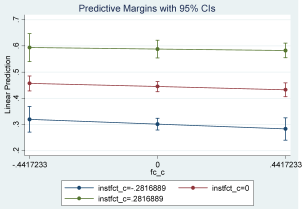
Figure 3. Graphical depiction of institutional factors moderating the firm characteristics to corporate sustainability disclosure relationship.
Graphically, one way to interpret an interaction is to notice the steepness of the slope of the lines. In Figure 3 you will notice that the institutional factors moderating line are flatter at all three levels (below, above, and within the mean) of standard deviation. This pattern means that the moderating effect of institutional factors in the relationship between firm characteristics and corporate sustainability disclosure is the same for all levels of institutional factors. The margin plot function automatically plotted the simple slopes (+1 SD above, 0 within the mean, and -1 SD below the mean) of the moderating effect. Figure 3 shows that those companies with less institutional factor i.e. the blue line disclose less CSD with FC but those on the red line disclose overall on an average. Those healthcare companies with more institutional factors i.e. the green line which is the highest tend to disclose more CSD with more FC as well and disclose more CSD than average. The difference in the slopes for those with more or less IF shows that IF moderates the relationship between FC and CSD.
Furthermore, determination of moderator effects size is relevant to demonstrate the extent of such effect. Whether or not we find a moderating effect, can be judged by the significance of the regression coefficient on model 3 belonging to the interaction term model (). Alternative to the t-test for the regression parameter for the interaction model, it can be examined with the F test whether the change of the coefficient of determination R2 from the basic model to the interaction model is significantly different from zero. The change of the coefficient of determination (R2) is also a measure of the effect size of the moderator effect (). The R2 increase indicates how much criterion variance is additionally explained by the product term and, therefore, can be ascribed to the moderator effect . Given the result, this is identical to the use of the t-test. The strength of the moderator effect is habitually displayed in form of the Effect Size Index (f2):
f2=R12-RB21-R12
R12 characterizes the coefficient of determination of the interaction model and the RB2 coefficient of determination of the basic model. These were extracted from Table 2 on Hierarchical Moderated Regression Results for Interaction Basic Model 2 and Model 3.
f2inthisstudyequals=0.9295 - 0.92911 - 0.9295
Therefore, f2 = 0.0057.
For the evaluation of the effect size, Cohen (1988) has proposed the following values of f2 that are conventionally established: 0.02 = low; 0.15 medium; 0.35 = high (also ). A literature review by over 30 years revealed that the average effect size f2 is about 0.005, and the median is about 0.002. From the outcome of the study, it has been observed that there exists moderating effect on the relationship between a firm characteristic and CSD in the health sector of Nigeria. Specifically, the effect size of the moderating variable was found to be 0.0057 which is the same as the average effect of 30 years’ analysis made by . Furthermore, the value obtained did coincided with how Cohen defined values of a low, medium, and high effect. Therefore, according to Cohen's definition, the moderating effect can be considered to be low.
5. Implication
Companies should have a management system that will not only keep track of sustainability reporting level but also a sanctioning system for those companies that are not in compliance with the requirement of the regulators. And that policy makers in Nigeria related to sustainability development issues like NESREA considering the importance of institutional factors should introduce laws that mandate CSD like other part of the countries. In addition, future study should consider expanding and refining the model by integrating additional variables such as a mediator to strengthen the explanatory and predictive power.
6. Conclusion
It can be concluded that large and financially sound healthcare companies are likely to disclose on sustainability more and institutional factors such as sustainability guideline, presence of sustainability committee as well as membership in advocacy groups greatly influence the level of sustainability disclosure even in the healthcare sector of Nigeria. While this study relied solely on secondary data from credible source however future research could complement these findings with primary data to provide deeper insight.
Abbreviations

SIZ

Firm Size

PER

Performance

FC

Average of Firm Size and ROA

CSD

Corporate Sustainability Disclosure

TCSD

Average of Total Corporate Sustainability Disclosure

NSGL

Nigerian Sustainability Guideline

MEM

Membership with INDC/ Advocacy Group

PSC

Presence of Sustainability Committee

INSTFCT

Institutional Factors (Average of NSGL, PSC, and MEM)

BS

Board Size

CSRD

Corporate Social Responsibility Disclosure

OECD

Organisation of Economic Cooperation and Development

SD

Standard Deviation

PSE

Pakistan Stock Exchange

CG

Corporate Governance

GRI

Global Reporting Initiative

NESREA

National Environmental Standards and Regulations Enforcement Agency

Author Contributions
Yagana Alhaji Baba is the sole author. The author read and approved the final manuscript.
Conflicts of Interest
The author declares no conflicts of interest.
References
[1] Aguinis, H. 2004. Regression analysis for categorical moderators. New York: Guilford Press.
[2] Aiken, L S, and S G West. 1991. Multiple regression: testing and interpreting interactions. Newbury Park, CA: Sage.
[3] Aliona, B. (2016). Financial performances measurement tools. Annals of the Constantin University, Jiu, Economy Series, 171-181.
[4] Akbas H. E. (2016) the relationship between firm characteristics and environmental disclosure, evidence of from turkey. International journal of accounting and financial reporting 6(2).
[5] Baba Y. A., Joel M, Tahir F.A & Gulani M. G. (2023). Effect of firm characteristics on corporate sustainability disclosure in the health care sector of Nigeria. international journal of intellectual discourse, Bauchi State University, Gadau, Nigeria.
[6] Baltes-Go¨tz, B. 2006. Moderator Analyse per multiplier Regression mit SPSS. July 15.
[7] Baron, R. and D Kenny. 1986. W+hn strategic, and statistical considerations." Journal of Personality and Social Psychology 51: 1173-1182.
[8] Cohen, J, P Cohen, S G West, and L S Aiken. 2003. Applied multiple regression/correlation analyses for the behavioral sciences. 3. Mahwah, New Jersey: Lawrence Erlbaum.
[9] Deegan, C. I., & Gordon, B. (1996). A study of the environmental disclosure practices of Australian corporations. Accounting and Business Research, 26(3), 187-199.
[10] Esa, E., & Ghazali, A. M. N. (2012). Corporate social responsibility and corporate governance in Malaysian government-linked companies. Corporate Governance: The international journal of business in society, 12(3), 292-305.
[11] Garko, J. S. (2014). Corporate Governance and Voluntary Disclosure In The Nigerian Listed Industrial Goods Companies. Kano: An Unpublished PhD Theses in Accounting and Finance submitted to Bayero University Kano.
[12] Gujarati, D. N. (2003). Basic Econometrics. London: McGraw-Hill.
[13] Hashim S. D, Guzar, Ghafur Z. & Nazl 2020 snesitivity of firm size measure to practice of corporate finance: evidence from BRICS, future business journal 6(1), springers.
[14] Ikpor I. M., Bracci E., Kanu U., Levol R., Okezie B. mlanga S. & Ogbekiqwe (2022) Drivers of Sustainability Accounting and Reporting in emerging Economies. Evidnece from Nigeria.
[15] Jaccard, J, and R Turrisi. 2003. Interaction effects in multiple regression. 2nd. Newbury Park, CA: Sage.
[16] Jibril, R. S., Isa, M. A, & Maigoshi, Z. S. (2022) Corporate board, institutional strength and energy disclosure in Nigeria. Journal of Chinese economic and foreign trade studies.
[17] Jones, S., Frost, G., Loftus, J., & Laan, S. (2007). An empirical examination of the market returns and financial performance of entities engaged in sustainability reporting. Australian Accounting Review, 17(43), 78-87.
[18] Jose, Paul E. 2013. Doing Statistical Mediation and Moderation. New York: The Guilford Press.
[19] Khan, M., James, L. C., & Bathurst, J. R. (2018). Institutional impacts on corporate social responsibility: a comparative analysis of New Zealand and Pakistan. International Journal of Corporate Social Responsibility, 3(4).
[20] KPMG ((2024). The move to mandatory reporting 2024.
[21] Lu, Y. (2012). Corporate social and environmental disclosure practices: Evidence from China. Wollongong, China: PhD thesis published by the School of Accounting and Finance, University of Wollongong.
[22] Mahmood Z. Kouser R., Ali W., Ahmad Z& Salma T. (2018) does corporate governance affect sustainability disclosure? A mixed method study. Sustainability 10(1).
[23] Naseer, K., & Hassan, Y. (2013). Determinants of corporate social responsibility reporting: Evidence from an emerging economy. Journal of Contemporary Issues in Business Research, 2(3), 56-74.
[24] Ngatno, Endang, P Apriatni, and Arief Youlianto. 2021. "Moderating effects of corporate governance mechanism on the relation between capital structure and firm performance." Cogent Business & Management 8(1): 1-22.
[25] Nwobu, O. A. (2017). Determinants of Corporate Sustainability Reporting in selected companies in Nigeria. Ota, Nigeria: An Unpublished PhD Thesis in Accounting, Covenant University.
[26] Ong, S. H. (2016). Measuring the quality and identifying influencing factors of sustainability reporting: Evidence from the resources industry in Australia. Australia: Published PhD Theses, Edith Cowan University.
[27] Russo S. (2024) sustainability accounting and reporting seaching for a viable framework in public heaith care organisation SSRN, department of management, universita ca foscari venzia working working page 10.
[28] Sarton R. A. 2010, Managemen Keuangan: Teori dan aphkasi 4th edition- yogyakata. BPFE.
[29] Selvanathan, P. J. (2012). Identifying the key determinants of effective corporate sustainability reporting by Malaysian government-linked companies. Lismore NSW, Australia: Published PhD theses in Business Administration, Southern Cross University.
[30] Selznick, P. (1957). Leadership in administration: a sociological interpretation. New York: harper and row.
[31] Tagesson, T., Blank, V., Broberg, P., & Collin, S. (2009). What explains the extent and content of social and environmental disclosures on corporate websites: A study of social and environmental reporting in Swedish listed corporations. Corporate Social Responsibility and Environmental Management, 16(6), 352-364.
[32] Tran, T. T.-M. (2017). Institutional Environment, Corporate Governance and Corporate Social Responsibility Disclosure: A Comparative Study of Southeast Asian Countries. Huddersfield, United Kingdom: An Unpublished PhD theses submitted to the University of Huddersfield.
[33] Wang, M. C. (2017). The Relationship between Firm Characteristics and the Disclosure of Sustainability. Journal of sustainability, 9, 1-14.
[34] Zangina J. & Baba Y. A. (2025). Firm attribute and sustainability disclosure of consumable good company in Nigeria. Social science research network publications.
[35] Zikri 2024 does size matter? Examining the probability of firm emergence from bankruptcy, international review of finance 20(4), Wiley online library.
Cite This Article
  • APA Style

    Baba, Y. A. (2026). Firms Characteristics, Institutional Factors and Corporate Sustainability Disclosure in Healthcare Companies in Nigeria. Journal of Finance and Accounting, 14(1), 53-61. https://doi.org/10.11648/j.jfa.20261401.14

    Copy | Download

    ACS Style

    Baba, Y. A. Firms Characteristics, Institutional Factors and Corporate Sustainability Disclosure in Healthcare Companies in Nigeria. J. Finance Account. 2026, 14(1), 53-61. doi: 10.11648/j.jfa.20261401.14

    Copy | Download

    AMA Style

    Baba YA. Firms Characteristics, Institutional Factors and Corporate Sustainability Disclosure in Healthcare Companies in Nigeria. J Finance Account. 2026;14(1):53-61. doi: 10.11648/j.jfa.20261401.14

    Copy | Download

  • @article{10.11648/j.jfa.20261401.14,
      author = {Yagana Alhaji Baba},
      title = {Firms Characteristics, Institutional Factors and Corporate Sustainability Disclosure in Healthcare Companies in Nigeria},
      journal = {Journal of Finance and Accounting},
      volume = {14},
      number = {1},
      pages = {53-61},
      doi = {10.11648/j.jfa.20261401.14},
      url = {https://doi.org/10.11648/j.jfa.20261401.14},
      eprint = {https://article.sciencepublishinggroup.com/pdf/10.11648.j.jfa.20261401.14},
      abstract = {Considering the importance of sustainable activities of corporations in the 21st century and environmental friendly accounting practice vis-à-vis economic growth, some factors impact on the Phenomena-Corporate Sustainability Disclosure. This study sought to empirically assess the moderating effect of these institutional factors on the relationship between firm characteristics and corporate sustainability disclosure for 10 years (2011-2020). This study relied extensively on secondary source and the data was specifically gathered from the annual reports of the listed health companies in Nigeria under study. The regression output on the relationship between firm characteristics and CSD (MODEL1) revealed that firm size and performance alone are relatively not enough to determine CSD, evidenced from R2 of 57%. The regression output of the effect of firm characteristics and institutional factor put together on CSD (MODEL 2) revealed an R2 of 92%, which implies that firm size, performance, board size and institutional factors together are very good determinants of CSD, evidenced from significant p-value of 0.000 which is less than significance value of 0.05. The effect of interaction between firm characteristics and institutional factor on CSD (MODEL 3) showed an R2 of 93%. This means that the interaction variable could explain up to 93% variation in CSD. This is further substantiated by a significant p-value of 0.000 which is less that significance value of 0.05. In conclusion, institutional factor moderates the relationship between firm characteristics and CSD. Therefore, policy makers in Nigeria related to sustainability development issues like NESREA should consider the importance of institutional factors in the study and introduce laws that mandate CSD like other part of the countries.},
     year = {2026}
    }
    

    Copy | Download

  • TY  - JOUR
    T1  - Firms Characteristics, Institutional Factors and Corporate Sustainability Disclosure in Healthcare Companies in Nigeria
    AU  - Yagana Alhaji Baba
    Y1  - 2026/02/02
    PY  - 2026
    N1  - https://doi.org/10.11648/j.jfa.20261401.14
    DO  - 10.11648/j.jfa.20261401.14
    T2  - Journal of Finance and Accounting
    JF  - Journal of Finance and Accounting
    JO  - Journal of Finance and Accounting
    SP  - 53
    EP  - 61
    PB  - Science Publishing Group
    SN  - 2330-7323
    UR  - https://doi.org/10.11648/j.jfa.20261401.14
    AB  - Considering the importance of sustainable activities of corporations in the 21st century and environmental friendly accounting practice vis-à-vis economic growth, some factors impact on the Phenomena-Corporate Sustainability Disclosure. This study sought to empirically assess the moderating effect of these institutional factors on the relationship between firm characteristics and corporate sustainability disclosure for 10 years (2011-2020). This study relied extensively on secondary source and the data was specifically gathered from the annual reports of the listed health companies in Nigeria under study. The regression output on the relationship between firm characteristics and CSD (MODEL1) revealed that firm size and performance alone are relatively not enough to determine CSD, evidenced from R2 of 57%. The regression output of the effect of firm characteristics and institutional factor put together on CSD (MODEL 2) revealed an R2 of 92%, which implies that firm size, performance, board size and institutional factors together are very good determinants of CSD, evidenced from significant p-value of 0.000 which is less than significance value of 0.05. The effect of interaction between firm characteristics and institutional factor on CSD (MODEL 3) showed an R2 of 93%. This means that the interaction variable could explain up to 93% variation in CSD. This is further substantiated by a significant p-value of 0.000 which is less that significance value of 0.05. In conclusion, institutional factor moderates the relationship between firm characteristics and CSD. Therefore, policy makers in Nigeria related to sustainability development issues like NESREA should consider the importance of institutional factors in the study and introduce laws that mandate CSD like other part of the countries.
    VL  - 14
    IS  - 1
    ER  - 

    Copy | Download

Author Information